Heroic Roleplaying in a World of Swords, Sorcery, and Steam

I’d like to introduce Aetrimonde, a TTRPG I’ve been designing with heavy inspiration from the houserules my group used back in our Dungeons and Dragons 4e days. I’m not ready to publish Aetrimonde yet, but I’m opening up this blog to discuss its design principles, mechanics, and systems.

  • Before I get back to building the latest Inquisitor sample character (and if you haven’t already voted on their ancestry and faith, go do that now!), I’m putting up this one last post related to faith and religion in Aetrimonde. Today, I’m talking about the heavenly realm!

    …Which means it’s going to be a short post, because despite the best efforts of Aetrimonde’s planar explorers, there simply isn’t that much known about it.


    Where Faerie and the Underworld are fairly easy planes to visit, the Heavenly Realm is quite difficult to reach. This is partly because crossings to the Heavenly Realm are rare: they occur only in places that have seen singular acts of genuine faith, and as such, they tend to wind up with shrines and temples built on top of them, with priests who tend to want to vet anyone using their temple to go and explore heaven. Complicating this is the fact that crossings to the Heavenly Realms are harder to actually use, as though universally closed off by the Seal Planar Crossing ritual.

    That said, a scarce few expeditions to the Heavenly Realm have succeeded and returned, and while some of the early ones were clearly pushing a doctrinal agenda in their recountings, there have emerged a few commonalities…many of which raise more questions than they answer.

    • The Heavenly Realm is an apparently infinite expanse: it has a perfectly flat ground made of an utterly invulnerable substance variously described as alabaster, white opal, and mother-of-pearl, and is suffused by a constant white light emanating from no particular source and leaving no shadows. There are no bodies of water and no plant or animal life; between that, the unsettling lighting, and the lack of a horizon, the plane is actually one of the more hostile to mortals, for both logistical and psychological reasons.
    • The plane’s only native inhabitants are angels, most of whom are so intent on various ineffable tasks that they pay no attention to mortals. The rare few that so much as acknowledge mortals can often be persuaded to provide food, water, and other supplies from unknown sources, but they seldom answer questions about matters of theology and when they do, the answers are uniquely unhelpful.
    • The only landmarks in the Heavenly Realm are scattered monolithic structures, ranging from the size of towers to the size of cities or mountains, which later accounts describe as having the quality of machinery but without any visible means of function or operation.1 There is an apparent center to the plane, a region densely packed with these structures2 and in which all recorded planar crossings from the material world are located
    • Some of the structures appear to be in a state of disrepair; others are tended by angels who may or may not be operating them. It’s unclear what the angels’ interactions with the machinery serves to accomplish, since for the most part their actions consist of flying to an unremarkable part of the structure, staring intently at it for a moment, and then briefly laying a hand on a spot indistinguishable from any other before flying off again.
    • Some of the structures appear to be off-limits to mortals, as attempting to enter draws first a polite rebuff from nearby angels, and then (as one unwisely persistent expedition discovered) an forceful response from angels that descend in rapidly increasing numbers on intruders. However, there are other structures where mortals are tolerated, which is to say mostly ignored.
    • Geography in the Heavenly Realm works familiarly to mortals: directions and distances are consistent, meaning that it can actually be mapped! What isn’t consistent is time: the subjective time experienced by mortals is increasingly compressed as they move further from the plane’s center, such that what seems a day to them passes as months or years in the mortal world. (One early expedition, initially thought lost, was devastated to learn that in the subjective month that they spent exploring the outer reaches of the plane, more than two centuries had passed.)

    Up Next

    There is of course one exception to the prevailing conditions of the Heavenly Realm, which is the Pit of Hell. But, I’m saving that for a later post series…perhaps for Aetrimonde’s second Halloween!


    1. Earlier accounts, from before Aetrimonde’s industrial revolution, focus solely on the monolithic size and scale of the structures. More recent accounts compare various features of the structures to pistons, boilers, ducting, and other familiar mechanical components, although they note that the parts have not actually been observed to function as such. ↩︎
    2. “Densely” here meaning that the structures are separated by mere miles. ↩︎
  • Following on from its mentions in my previous post, today I’m going into detail about the “antechamber to the afterlife,” the Underworld. This is another of the alternate planes of existence that overlaps Aetrimonde; for more details on Aetrimonde’s cosmology, see this other previous post.


    Aetrimondean cosmologists often treat Faerie and the Underworld as related planes. Like Faerie, the Underworld is relatively easy to reach, it has fractal topology in place of geometry, and it is hypothesized to be a genius loci that enforces a form of narrative causality. Adventurers who take this as an indication that the Underworld can be approached in the same way as Faerie rapidly learn their mistake, or die, for the Underworld is a far less forgiving plane to visit: it is a dreadful plane of existence, in the sense that everything about it seems purpose-built to inspire dread.

    Planar crossings to the Underworld arise in places associated with terror, madness, and death, such as graveyards, insane asylums, and the sites of massacres. They are relatively stable, only vanishing if the nature of their surroundings is altered to remove the source of dread, but generally unmarked. It is possible to stray into one accidentally, but given that they occur in unsettling places, it is difficult to do so ignorantly.

    Terrain and Conditions

    This contrast between Faerie and the Underworld is immediately apparent just from surface appearances: where Faerie is rife with dramatic landmarks, scenic vistas, and quaint villages, the Underworld can only be described as bleak and dreary. The plane has a day and night cycle, but its days are consistently overcast and gloomy, with a side of fog and drizzling rain, punctuated with ominous thunderstorms. There is no sun during the days, merely an omnipresent grey illumination. What plant life exists is pale and stunted, and the waters are stagnant, brackish, and tainted.

    It is possible, if only barely, for mortals to eke out an existence in the Underworld. The immediate problem faced by those optimistic mortals intending to settle the Underworld is growing food and finding clean water for sustenance, but beyond that obstacle lurks a subtler one: mortals simply were not made to live in a place like the Underworld, and it inevitably wears on them psychologically. While it might be fine to visit, the lack of sunlight, the perpetual gloom, and the absence of green growing things all combine to drive mortals to ennui, followed by madness, in the long-term.

    Inhabitants

    The Underworld has three kinds of inhabitants, who appear completely unrelated to each other, and largely ignore each other.

    Shades and the River of Souls

    First, there are the shades of the dead: when a mortal dies, the important parts of their soul1 transmigrate into the Underworld, becoming a shade. Shades appear as a silvery, translucent reflection of how the living person saw themselves in life: typically younger than they were when they died, and in possession of personal effects that they were attached to, like favorite articles of clothing, weapons, and so on.

    While they remember who they were in life, shades are almost completely passive and apathetic, perhaps not even self-aware: left to their own devices, shades wander listlessly but persistently through the Underworld towards a fixed point that draws them all. The crowds of shades grow denser as they approach this destination, and their silvery, shimmery appearance can cause a procession of shades to be mistaken for a stream or river from a distance. The processions of shades are thus collectively called the River of Souls, and they serve as a kind of landmark.

    It isn’t known what lies at the end of the River of Souls, although the Pantheonic faith, for one, would say that it leads to the true afterlife. There is a point where all the River’s known tributaries have joined together, but the River continues far beyond that point. Many explorers have tried to follow the River in search of answers to their theological and cosmological questions, but there is a danger in this: as shades proceed along the river, they feel the call of whatever lies at its end. Follow it too far, and even living mortals will hear this call…and join the procession. Successive expeditions, using ever more sophisticated protective wards, have managed to follow the procession further and further over the years, but pushing the envelope of what is possible is risky, and many of these expeditions never return.

    Resurrecting the dead–not raising them as undead, but truly returning a dead person to life–invariably requires retrieving their shade. The Pantheonic sects known to perform resurrections (on rare occasions and for only the gravest of reasons) have ways of doing this without actually paying a visit to the Underworld. Vitalists–the scientists, alchemists and magicians aiming to replicate the temples’ closely held secrets–are generally forced to enter the Underworld, dowse out the desired shade (or just pick one at random, sometimes), and magically bind and contain it for transport back to the material world and installation in a new body. Indeed, vitalism is in enough demand that there is a small industry in undertaking such tasks, for a sizeable fee…

    The Gravelords and their Courts

    The second group of the Underworld’s inhabitants are the Gravelords and their courts. Each Gravelord is a being of great magical power, with some capacity to pull shades from the River of Souls and grant them a degree of awareness and self-direction. This allows the Gravelords to create their own personalized afterlives, filled with whatever shades they find worthy of expending their magic on.

    The various Gravelords prefer different traits in shades and induct them into their courts for different purposes. Some are warlords, with ambitions to conquer the Underworld and even the material world, and they pick out shades of great warriors and soldiers. Others are collectors or scavengers, who seek out the shades of famous and powerful people in order to learn the secrets they took to their graves, or just to have interesting company. And some (largely of mortal origins) have simply decided that they weren’t done living, and continue to live it up in the Underworld in the company of any shades who feel the same.

    It isn’t known who the first Gravelords were; when the first mortals entered the Underworld to explore, the Gravelords of their time described predecessors from whom they had inherited, won, or usurped their positions. Among the minority current Gravelords whose origins are actually known are some shades who inherited the position and a source of power from older Gravelords, several formerly mortal necromancers, an ancient vampire, an extraordinarily powerful ghoul, and a dragon who hoards the shades of the wealthy and powerful. But most Gravelords hide their origins, and some of them are difficult even to describe: among the stranger Gravelords are a female giantess who calls herself a “dead muse,” a living shadow, and a collectively intelligent swarm of locusts.

    Monsters

    Finally, the Underworld also contains what can only be called monsters. Many of them are undead, or at least resemble undead (ghouls may have originated from the Underworld, although it’s not clear). Others, which explorers of the Underworld have taken to calling “slashers,” resemble mortals, of the most sadistically violent and violently insane persuasions. And some are simply animalistic: great savage wolves, bloodsucking giant bats, and maneating spiders are in abundance throughout the Underworld. These different varieties have one trait in common: they are seemingly designed to inspire dread and terror in mortal visitors.

    The Underworld’s monsters utterly ignore the shades of the dead in the River of Souls, and while they are known to attack the courts of the Gravelords, they appear only to do so when no actual mortals are nearby. And when mortals are nearby, they know it: these monsters have an uncanny ability to pick up on a mortal presence and home in on it. The only saving grace to be had is that they apparently don’t aim to kill interloping mortals as much as horrify and psychologically torment them: Underworld monsters have been observed to toy with their prey, picking off the members of an expedition one by one over days rather than wiping them out in one confrontation, even when it appears that would be trivial for them. They are even known to purposefully leave survivors, though never without a few psychological scars in addition to the physical ones.

    The Genius Mori Hypothesis

    Like Faerie, the Underworld is hypothesized to have, or be, a genius loci. This would likely be a popular hypothesis just based on the behavior of its monsters, but what really clinches it is the nature of its fractal topography. Faerie’s fractal topography is relatively firm and settled: new ways through Faerie are discovered all the time, but always in ways that make it at least plausible that they were just previously overlooked–and once discovered, they seldom close.

    Not so in the Underworld. New connections open up all the time around mortals visiting the Underworld, and often in places that they could not possibly have been beforehand. A cave system will turn out to have one cavern full of hundreds of zombies, which somehow went undetected for weeks before they abruptly burst out in the middle of the night; an abandoned manor will turn out to have a secret passage, allowing a slasher to make it inside, even after an expedition spent hours searching and fortifying it. Even worse, connections that mortals are counting on will close, generally at the worst possible moment. A small creek will flood and turn into a morass just in time to trap a bunch of mortals fleeing from some horrible monster, or a mountain pass will suffer an avalanche and trap them with dwindling food supplies.

    Both behaviors are extensions of a truism coined by the earliest explorers of the Underworld: no matter how bad it seems, it’ll always get worse. The Underworld’s narrative causality (and genius loci, if it has one) isn’t concerned with telling a tale of heroism and nobility: it will settle for a tragedy, if that’s all it can get, but ultimately, it wants to tell a horror story. Events unfold in the Underworld in a manner calculated to traumatize mortals: they will be made to witness steadily escalating scenes of horror and make ever more terrible decisions, until either they snap under the pressure, or give up and flee. Either outcome serves the interests of the Underworld, which seems to desire that mortals view it with reverent dread.

    Plot Hooks

    You can always use denizens of the Underworld as enemies in an encounter, but the slow-burn, dread-based nature of the Underworld lends itself better to longer-term usage, such as adventures or entire campaigns that revolve around it.

    Adventure Hooks

    • A bedraggled, half-crazed adventurer bursts into the inn where the PCs are staying, raving incoherently about the “creature” following them. Upon questioning, the few lucid answers they can give suggest that the adventurer narrowly survived a doomed expedition to the Underworld…and that something else came back with them…
    • The PCs have recently lost an ally (a fellow PC or a close NPC ally), and have decided to have them resurrected by a vitalist, despite the risks. This, of course, necessitates a trip to the Underworld to dowse out their shade before it gets too far down the River of Souls.
    • A representative of a Gravelord makes one of the PCs an offer: in exchange for riches or a favor now, the Gravelord demands their service after their death. Of course, the Gravelords are often impatient, and this offer carries no guarantee of a natural death…

    Campaign Hooks

    • One of the Gravelords has become ascendant, and is assembling an army of shades, undead, slashers, and other denizens of the Underworld to invade the mortal plane. It is up to the PCs to organize a defense and ultimately overthrow this Gravelord.
    • For an unusual campaign, the PCs begin the game as shades in the service of a Gravelord (or are killed in a hopeless battle early in the campaign and fished from the River of Souls), and must earn their freedom and resolve their unfinished mortal business. For added fun, the nature of shades can allow the PCs to “respawn” when killed.

    1. The Intellectus, housing memory, knowledge, and skills, and the Spiritus, housing beliefs, morals, and ethics. The Animus, or life-force, which houses instinct and motivation, is left behind and is often what animates undead. ↩︎
  • Continuing on from the overview of Aetrimonde’s many approaches to faith and religion, today I’m going to focus on the Pantheon, those gods that are responsible for the powers of Divine classes.

    Also, if you haven’t already, go vote in the poll that will determine the faith and ancestry of the sample Inquisitor I’m working up!

    The Major Gods

    The CRB covers the fourteen major gods and their creeds, and encourages GMs and players to make up their own minor gods if they so desire (although they won’t have the benefit of the creed-specific feats in the CRB…).

    DeityCreed
    Deum HarmoniousRevere nature. Preserve life. Prevent destructive change.
    Deum KnowingUnderstand the world. Spread knowledge. Act on evidence.
    Deum MakingBuild usefully. Create beautifully. Hone your craft.
    Deum MilitantFight for glory. Fight to survive. Fight to win.
    Deum MockingAct in the moment. Speak truth to power. Count on nothing.
    Deum RadiantSpread hope. Uncover truth. Act righteously.
    Deum RevelingSpread joy. Build community. Comfort the desperate.
    Deum RulingGuard civilization. Bring justice. Act lawfully.
    Deum TerminalAccept endings. Embrace change. Break what can be broken.
    Deum ValiantProtect the innocent. Act honorably. Fear nothing.
    Deum VeiledGather knowledge. Guard your secrets. Act subtly.
    Deum UntamedStand firm. Act freely. Defy limits.
    The Bright LadyNurture children. Heal the sick.
    The Dark MaidHonor the dead. Ease their passing.

    The Pantheonic Canon

    The Pantheonic faith’s loose approach to doctrine and canon means that even Orthodox sects have their own distinct myths, practices, and beliefs. All of them, however, agree on several core points of doctrine, the most important of which are:

    The names of the gods hold power

    Pantheonic sects agree that the gods should not be named, and refer to them only by titles and poetic epithets. Sects have a variety of approaches to this: some believe that the gods’ names simply cannot be known to mortals, and that giving them a name of mortal invention is disrespectful. Others believe that speaking or writing a god’s name weakens them in some way, or that the gods for their own ineffable reasons dislike hearing their names in the mouths of mortals, and are likely to curse them with ill fortune. Regardless of the reasons, the gods of the Pantheon are identified by titles reflecting their divine portfolio, which generally begin with the honorific “Deum:” Deum Valiant is the god of courage, while Deum Terminal is the god of endings, for example.

    The gods help those who help themselves

    Aside from the divine powers channeled by anointed priests, there is little hard evidence of divine intervention in Aetrimonde. According to the Pantheonic faiths, this is because the gods are distant and subtle. They seldom send direct divine intervention, but they empower mortals who they trust to act on their behalf, and engage with the world in other, subtler ways. 

    The true afterlife lies on the far side of the Underworld

    The extraplanar realm of the Underworld indisputably exists—mortals even visit on a regular basis—but it’s not a pleasant place to spend eternity. Upon transmigrating to the Underworld, mortal souls are inexorably drawn to the River of Souls—not actually a water feature, but an immense procession of souls which can be mistaken for a river at a distance. The procession moves slowly, but inexorably, into the deepest reaches of the Underworld, and although mortal explorers have attempted to find the end of the River, none have ever returned from it. According to the Pantheonic faiths, this is merely an antechamber to the true afterlife: a soul’s time in the River of Souls serves to purify it and allow it to lose its earthly attachments, at which point it reaches the end of the River and enters into its chosen god’s true afterlife.

    Hell exists, but is hard to get into

    Hell, or the Abyss, or the Pit, is a prominent part of most Pantheonic sects’ teachings. It is home to demons who oppose the angelic hosts serving the Pantheon; it is also popularly believed that those demons were once angels, and were condemned to the Abyss as punishment for some transgression against their patron god. Demons covet the souls of mortals, for unspecified reasons: possibly because those souls are a source of power, or to satisfy their sadistic impulses, or maybe just because it offends the gods. A demon can only obtain a mortal soul if the mortal signs it away intentionally and willingly—demons cannot trick a mortal’s soul away from them, or take it by force, and even the most foul and wicked mortals will not end up in Hell unless they have signed away their souls.

    The mortal soul is sacred

    The soul cannot be destroyed—this is not just a belief of the Pantheonic religions, but has been confirmed by various researchers. (This line of research is a decidedly unsanctioned one, but some of the researchers’ experimental notes survived to be studied after their authors met their just ends.) However, souls can be tormented and warped, even used as a source of power—and the Pantheon abhors this. No matter how badly a soul is damaged, it will eventually recover in the River of Souls, but the process of recovery delays a soul’s entry into the true afterlife. For a soul to be signed away to a demon is even worse, for it is rarer than rare for a soul to escape Hell and pass even into the Underworld. Pantheonic sects hold any tampering with the mortal soul to be an abominable act, punishable by excommunication.

    Aetrimondean Atheism

    It’s difficult for atheism to persist in the face of actual, commonplace divine magic as practiced by anointed priests. Aetrimondean atheism therefore does not deny the existence of the Pantheonic gods–just that they have some special divine nature. There are a few seeming inconsistencies in how the Pantheon’s gods work that allows staunch atheists to argue that the gods are nothing special:

    The Pantheon are poor judges of character

    Becoming an anointed priest requires believing in and living an appropriate creed–but particularly deluded mortals can convince themselves that seemingly any action, including some that plainly run contrary to the creed, are in fact consistent with it. That the gods empower mortals who then act against their purposes suggests that they lack the omniscience attributed to the Pantheon.

    Angels themselves seemingly don’t consider the Pantheon gods

    Granted, angels don’t talk much about anything: they are purpose-driven, and single-mindedly focus on whatever purpose they were created for. But, on those rare occasions when angels have deigned to speak with mortals, they have had nothing to say on questions of doctrine or theology. It can be difficult to read angelic faces and body language, but many observers have described angels as seeming “baffled” or “uncomprehending” when asked even simple theological questions.

    Aetrimonde has plenty of powerful beings who aren’t called gods

    There are some people who revere dragons, elementals, demons, powerful spirits, or their own ancestors. Some of those entities can even grant powers, much like the gods empower their followers, and some of them don’t even demand worship. The gods empowering a cleric aren’t any different from a faerie empowering one of their servants—so why treat the gods differently?


    I wrote the lore surrounding Aetrimonde’s Pantheon to be ambiguous: the true nature of the gods, or even if they actually exist, is a mystery, and one that GMs and players can interpret as they like for their games–or, a GM can decide on some answers and let the players discover them as part of a campaign. (Author’s Note: I absolutely have my own answer to what the gods are actually like. But I’m not going to spoil the fun for everyone else by making it a canonical answer to this question.) As with much of Aetrimonde’s deep lore, I prefer my writing to raise interesting questions for players to explore.

    Up Next

    I’ll be picking back up with the creation of a sample Inquisitor soon. And seriously: go vote in the poll that will determine this character’s faith and ancestry!

  • Since I’ve just started a post series focused on the creation of an Inquisitor as a sample character, now seems like a great time to dive into how Aetrimondeans worship. I’m going to split this into two posts, first covering all the common forms of religion in Aetrimonde, and in a second post I’ll dive deeper into the Pantheon, whose religion is the most widespread and who are believed to be the deities to empower Divine classes.

    Also, as a reminder, there’s currently a poll up to determine the faith and ancestry of the fourth sample character I’m building, an Inquisitor. Go vote to let me know what you’d like to see focused on as I build this character out!


    The Pantheon

    Aetrimonde’s most widespread faith is actually a loose collection of faiths, practiced by a wide and diverse assortment of religious sects that are more or less compatible with each other. Pantheonists practice henotheism, acknowledging the existence of multiple gods and occasionally participating in rites for most or all of them, but principally worshipping a single one.

    The Pantheonic faith coalesced around a very loose religious canon, recognizing fourteen major gods and an uncertain number of minor ones. The boundaries of Pantheonic faith are fuzzy: most sects are relatively small compared to the Pantheonic faith at large, there is no central authority who can decide whether a sect worships the Pantheon “properly,” and the faith’s religious canon is governed by an informal process of building consensus among disparate sects (and the occasional summit meeting). In theory any sect, even one devoted to a minor god whose existence is not universally accepted, can claim to be Pantheonic if it accepts the existence of the fourteen major gods and the most important and agreed-upon points of canon. In practice, new sects are admitted to the Pantheonic faith by a consensus among established Pantheonic sects; there can be a certain amount of disagreement and conflict over whether certain fringe sects really belong in the Pantheon.

    Organization

    Strictly speaking, the term sect refers to an organization of anointed priests (members of a Divine class, and anyone else who can employ similar powers), lay priests (who lack these powers but are vested with the authority to perform appropriate rites), and associated temples, monasteries, meeting houses, etc. where these priests conduct rites and lead services. Only the priests of a sect are said to “belong” to the order; ordinary people who worship under the auspices of the sect are instead said to “adhere” to it.

    The various Pantheonic sects organize themselves as they see fit, and there is a great deal of variation in their internal structures. Most commonly, a sect maintains a high temple where, in addition to leading services for its adherents, new priests are trained, holy texts are copied out by hand (or more recently, printed), and the sect’s high priest tends to matters of theological and administrative import. Depending on the size of the sect, it may also maintain other, smaller temples, monasteries, and other facilities, appointing priests as necessary. Departures from this common structure tend to go hand-in-hand with the god a sect worships: sects devoted to Deum Ruling tend to be larger, with multiple layers of administration and authority, while those devoted to Deum Knowing tend to be highly centralized, eschewing additional temples in favor of expanding on their archives and scriptoria, for example.

    It is difficult for a sect to grow large without losing its identity. Anointed priests gain their powers by embodying a creed associated with their deity, but there is a considerable range of creeds that each deity seems to find acceptable. Thus, the larger a sect grows, the more likely it is that an adherent will become an anointed priest with a creed outside the sect’s norm. When this happens, it acts as incontrovertible proof that this creed has divine approval, and often leads to the priest splitting off from the sect to found a new one, taking a few adherents with them. The largest sects devoted to each god thus tend to be the ones that are most accepting of variant creeds, which tends to dilute its identity and leads to a certain genericity; smaller sects, by comparison, have more focused beliefs, and their adherents tend to be more committed in those beliefs.

    Heterodox Sects

    Religious sects with doctrines reasonably consistent with the Pantheonic faith, but that are not (yet) accepted into it by consensus are called heterodox sects. Heterodox sects can be excluded for a variety of reasons: the most common is that their deity’s purported sphere of influence encroaches on that of a major Pantheonic deity. Other reasons for exclusion range from the trivial, like a disagreement over the appropriate form for liturgies and rituals, to more significant factors such as an inability to produce an anointed priest capable of channeling divine powers.

    Orthodox Pantheonism views these sects as fundamentally misguided (sometimes dismissing them as having misidentified a major deity as a new one), but not dangerous, just kooky. Adhering to a heterodox sect might make the neighbors look askance at you, but generally won’t put you at risk of witch hunts.

    Heretical Cults

    Sometimes, though, a nominally Pantheonic sect strays too far from the consensus canon, and begins preaching a doctrine that is flatly incompatible with Orthodox Pantheonism. Such sects are denounced, again by consensus among Pantheonic orders, as heretical cults. This is not a step to be taken lightly: Aetrimonde had its share of religious strife in past centuries, and mainstream Pantheonism, with its extremely loose canon and tolerant attitude towards heterodoxy, arose partly from the bloodshed that started when people threw around accusations of heresy for trivial reasons. Declaring a sect heretical is a last resort, used when it engages in practices dangerous not just to its members and adherents, but to the general public: common features of such a doctrine include summoning demons or other extraplanar creatures, animating undead, performing resurrections outside of rare circumstances, and tampering with the immortal tripartite soul.

    Openly adhering to a heretical cult is likely to get someone shunned, and that is the most lenient outcome: most governments outlaw heretical cults for reasons of public safety, and remaining with a cult after it is declared heretical can be punished with fines, imprisonment, exile, or execution…and that’s for adherents who are caught by the law, and not a frenzied mob of Orthodox zealots.

    Ancestor Worship

    Some cultures—notably the dwarves—worship their own ancestors. In the case of the dwarves, this practice takes place alongside more traditional Pantheon worship: the dwarven form of ancestor worship focuses on emulating respected and accomplished ancestors so as to bring honor to the deceased. However, the dwarves also have a practice in which the most honored of ancestors are “immortalized in stone” by dedicating lavish and detailed statues to them, supposedly allowing their souls to linger in the world and watch over their descendants. Certain religious orders—none of them predominantly dwarven—are suspicious that this conceals some form of necromancy or soul-manipulation (especially since the statues are known to walk off of their pedestals and fight when the dwarves go to war…).

    Other forms of ancestor worship are practiced by tribal goblins and orcs, the wood elves of Tir Coetir, and the primitive inhabitants of the Horselands. In many of these forms of ancestor worship, shamans call upon the ancestors for strength or wisdom, occasionally manifesting their ancestors as a ghostly spirit. This, too, is sometimes condemned as necromancy.

    Ancestor worship is sometimes considered a form of animism, discussed next.

    Animism

    Aetrimonde is home to a bewildering variety of spirits—concepts personified by the thoughts and minds of mortals. Animism is a catch-all term for religions formed around the worship of spirits.

    Animistic religions usually revolve around powerful nature spirits—the spirits of places, beasts, or the elements—which offer powerful boons if properly appeased, or which threaten to cause destruction if not placated. Such spirits often demand sacrifices: if the worshippers are capable of opposing the spirit, these sacrifices can simply be ceremonial, such as a token offering of blood or the choice cuts of meat from a successful hunt, but if the spirit outclasses its worshippers, the sacrifices may turn deadly.

    Animism is widely practiced in Tir Coetir, Urku, and the former territories of Gobol Karn, to such an extent that Pantheonism has little presence there. In most other places, it is considered a pagan belief, the domain of uncultured rustics and superstitious sailors. However, in recent years, animism has experienced a revival in an unlikely place. The engineers of steamships, railway locomotives, and other powerful engines have always been prone to anthropomorphize their machines, and in so doing it appears that they have created a kind of spirit, one that responds to prayer and supplication by causing machinery to run smoothly. 

    Demon Cults

    Demons are often willing to grant power, wealth, or other rewards in exchange for the promise of a mortal soul, and cunning demons sometimes encourage the growth of cults as a way of attracting supplicants. Aside from providing the demon with a steady supply of souls, demonic cults also allow demons an opportunity to indulge their sadistic or lascivious desires when summoned to the mortal world.

    Demonic cults frequently engage in sacrificial rituals, as well as other debased and decadent practices: they can often be spotted by a sudden spree of grisly murders or unexplained disappearances. Cults with more cunning leaders often disguise themselves as a legitimate religious order, or coopt small temples as a disguise.

    The Auran Empire suffered from an infestation of demonic cults in the years leading up to the Collapse, as the nobility and commonfolk alike succumbed to desperation and the allure of demonic power. The Novan Imperium inherited many of these cults, and never quite managed to stamp them all out: new cults, and resurgences of older ones, continue to pop up several times per year, and the imperial bureaucracy has an entire department of lawmen dedicated to rooting them out.

    Dragon Cults

    As some of the most powerful and majestic creatures native to Aetrimonde, it was inevitable that dragons would become the object of worship—or something like worship. Dragon worship often resembles a protection racket more than a religion, with the dragon demanding regular tributes of livestock and valuables to ensure that it doesn’t simply devour and plunder as it pleases.

    Less commonly, dragons form actual cults around themselves to gather a supply of mortal agents. The dragons who choose to do this are often older, and require guards for their periods of torpor, or catspaws for the schemes they direct against rival dragons. Such dragons are often able to convey “blessings” upon their worshippers: many dragons are accomplished magicians themselves, able to provide their cultists with magical weapons and secret arcane knowledge—or simply fortunes in gold. 

    Dragons, and therefore dragon worship, are most common in mountainous regions such as the Ironspine, and other remote places where a dragon can conceal a lair to house itself and its hoard.

    Faerie Cults

    Many of the inhabitants of Faerie are quite happy to be worshipped by mortals, although the ones who actually pretend to be gods tend to be the least dangerous. Satyrs may create cults to ensure a steady supply of wine, music, and pleasant company, and enterprising redcaps might view a cult as a way to keep their caps freshly dyed in blood, but the Sidhe rulers of Faerie are mostly above such pretenses.

    Sidhe who cultivate mortal followings typically treat it as a form of feudal bond, or even a simple transaction. Their followers perform tasks required of them—an assassination here, a fertility ritual there—and are rewarded in kind. Those who have sworn the faerie troth are protected in many small ways: their crops grow bountifully, their children grow healthy and tall, and none who cheat them ever prosper by it. For the few who attract the personal attention of their fey liege, more is expected—but the rewards can be valuable indeed, from magic beans, to seven-league boots, to elixirs of true love.

    Faerie cults are widespread, and tend to spring up around elven ruins from the era of Caras Seidharen, which are spread throughout the known world. The elven successor-states of Caras Elvaren and Tir Coetir are relentless in stamping out the influence of faerie cults, but the Sidhe are no less relentless in their attempts to infiltrate and gain a foothold in the nations they believe they should rightfully rule.

    Grave Cults

    With the nature of the afterlife being such a mystery, many mortals seek to avoid it altogether. For those who cannot attain immortality by extending their lifespan with magic, and do not wish to risk signing their souls over to a demon, an alternative is to join one of the grave cults and seek the patronage of the Gravelords, the undying rulers of the underworld. 

    The Gravelords themselves are powerful entities caught between life and death: some are simply the shades of mortals who somehow avoided being drawn into the River of Souls, and rose to power over the denizens of the Underworld. Others are powerful natives of the plane—shadowy beings reminiscent of vampires, mummies and other undead. Regardless of origin, the Gravelords themselves cannot leave the Underworld, and so they recruit courtiers to do their bidding in the mortal world: these agents procure luxuries that cannot be found among the dead and engage in intricate plots and counter-plots against rival cults. The Gravelords’ mortal agents do all of this in the hope that, when their time ultimately comes, their patron will see fit to winnow them from the River of Souls to spend eternity in their Court.

    Grave cults tend to resemble their patron Gravelord’s Court in miniature. Some are filled with grim, fatalistic warriors seeking to win a place in an army of deathly soldiers. Others are bleak, with supplicants subjected to the uncaring, iron rule of an immortal despot, and yet others are joyous and colorful, inhabited by those who had so much joie de vivre that they chose to continue existing after death much as they did in life—even if it meant refusing the true afterlife.

    (Author’s Note: I’m putting together an entire post expanding on the nature of the Underworld, to be delivered later this month.)

    Paths to Enlightenment

    Not every religion is centered on an object of worship, or even calls for worship in the traditional sense. Some revolve around meditation, philosophy, and a quest for enlightenment.

    Naturally, some of these religions are scams created by charismatic con artists to exploit gullible, troubled, or desperate people. Some of them even attract enough true believers that they survive past the point when their founder dies, retires, or has the law catch up with them.

    And then there are the genuine article—belief systems and philosophies intended to help people better themselves and unlock their hidden potential. While they may not grant magical powers like the faiths of the Pantheon, or even some cults, followers who achieve enlightenment sometimes attain extraordinary mental or physical prowess—perfect memory, for example, or in the case of some philosophies that strive for a more physical sort of perfection, the ability to literally punch good sense into someone.

    Star Cults

    Many ancient societies looked up at the stars and saw something divine in them. Early forms of Pantheon worship associated each of the gods with a constellation in the night sky and interpreted the movements of planets and moons against the stars as omens. This is no longer a widespread practice among the faiths of the Pantheon, but other, stranger beliefs involving the stars survive.

    Most so-called star cults are benign, as their beliefs typically revolve around predicting the future from the movements of heavenly bodies. Star worshippers often lead their lives by strange rules that seem to have little reason behind them, but it is rare that their religion inspires them to act out: most of them are eccentric but harmless kooks.

    However, star worship can, in rare cases, become something vastly more dangerous. Like more conventional astronomers, star worshippers who spend too much time gazing through a telescope are prone to strange forms of madness. This typically begins with speaking in tongues and strange obsessions, and progresses to violent paranoia and a desire to “enlighten” the sufferer’s friends and family. To make matters worse, star madness is sometimes accompanied by bizarre and disturbing magical powers. As astronomical telescopes become cheaper and therefore more available to casual star-worshippers, these events have become more common, and it is whispered that kidnappings, murder sprees, and mass suicides are only the least horrifying acts committed by star cultists—the worse incidents having been covered up by shadowy government agencies.

    Sun and Moon Worship

    Although no longer widely practiced in any modern society, the first religions created by mortals involved worship of the sun. A variety of beliefs were invented to explain the sun’s daily passage through the sky, involving everything from chariots, to reflections from the eyes of celestial lions, to industrious dung beetles. Similarly, the phases and erratic orbits of the three moons have been explained as the dance of three feuding sisters, the eyes of a pack of wolves, or as the cheeses formed from the spilled milk of a primordial cow.

    The primitive societies that worshipped the sun and moon also created surprisingly complex astronomical calculators in the form of stone circles and obelisks. When these beliefs fell out of favor, the purpose of these constructions was forgotten, causing much mystification and speculation until it was rediscovered by modern astronomers. Although the original beliefs have mostly been lost to the mists of time, there have been periods when it was fashionable to hold celebrations (mostly invented out of whole cloth, it must be said) at the local standing stones during solstices and equinoxes. A handful of modern revivalists have come up with their own beliefs involving the sun and moon, inspired by the beliefs of the ancients (or rather, what they happen to think the ancients believed).


    As you can see, Aetrimonde gives characters a wide range of options when it comes to faith and religion. Divine characters are slightly more constrained, but only a little: a Divine character gets their powers from their belief in and embodiment of a creed, not a god. It’s possible for someone who isn’t a devout worshipper, but nonetheless lives according to an appropriate creed, to gain the same powers as someone who lives the creed for religious reasons.

    Up Next

    Stay tuned for the second part of this post, focusing on the common beliefs and consensus doctrine of Orthodox Pantheonism. And, if you haven’t already, do go and vote in the poll I’ve put up to determine the faith, and ancestry, of the Inquisitor sample character I’m building!

  • Today kicks off my post series creating the fourth sample character for Aetrimonde’s starter kit, who is going to be an inquisitor to fill in a gap in the party left by the previous sample characters. I’m trying a new thing with this series and starting with the class first–which will let me put in a couple of polls letting you pick this inquisitor’s ancestry, class, and other aspects of the character.

    Class: Inquisitor

    The inquisitor class is designed as the “sneaky” Divine class, more at home with secrecy and subterfuge than paladins, clerics, and crusaders. Here’s what the CRB has to say about inquisitors:

    Any organization must eventually reckon with corruption within its ranks, and religious orders are no exception. The priesthood offers authority over the devout, and charlatans, egotists, and heretics sometimes see joining it as a way to amass money, followers, or power. Then there are the dangers posed by Anathema, which are not always mindless undead or ravening demons: many an Anathemaic plot has begun with the infiltration of a temple or community from within.

    Inquisitors are anointed priests whose calling is to watch their superiors and fellow-worshippers, and ideally themselves, ensuring that they remain true to the creed of their faith. Of all the anointed priests, inquisitors are most willing and able to grapple with difficult questions of theology, dogma, and morals, and when schisms and heresies arise within a religious order, it is the inquisitors who attempt to resolve it. It is also inquisitors who watch for signs of cults and dark magic, and protect congregants from the depredations of demons, undead, and other unholy monsters. Their divine magic allows them to denounce the wicked (or those who they decide are wicked), metaphysically casting them out as the equivalent of said unholy monsters.

    Inquisitors are unusual for anointed priests, in that they are all too familiar with the failings of their orders, and even their own creeds. They tend to be cynical, although most of them would insist that they are merely realists; many inquisitors start down their path when they witness or fall victim to an abuse of power by authority figures in the church, and somehow emerge without their faith being entirely shattered. Most are not attached to a temple or congregation, although major orders in large cities might have an inquisitor or two who rotate between their temples as needed. Like crusaders, inquisitors tend to be itinerant, following whispers of corruption, heresy, or Anathema wherever they lead. Unlike crusaders, they seldom allow themselves to be beholden to the leadership of their church, viewing it as their first duty to keep that leadership honest. At their best, they are grim but benevolent protectors, able to grapple with the failings of their fellow-worshippers while maintaining their own faith. At worst, they can become paranoid extremists, who see heresy in every corner and risk causing more harm than the foes they imagine.

    Inquisitors are especially common in the faith of Deum Mocking, whose creed of speaking truth to power encourages the typical inquisitorial mindset. They are also common among worshippers of Deum Veiled, who find acting in secret comes naturally to them, and Deum Knowing, whose search for knowledge can overlap with the hunt for lies and deception.

    To summarize: a stereotypical inquisitor is someone who grapples with the flaws and failings of their faith and their religious order, and still holds on to that faith. They concern themselves with threats to their order and congregation that come from within, rather than without, and they are willing to break the letter of their creed to uphold its spirit.

    Let’s take a look at the Inquisitor’s class features:

    With a mere 16 hit points, 1d6 healing die, and 2 resurgences, Inquisitors have the frailest base stats of any Aetrimonde class, shared with Druids, Shamans, and Wizards. Inquisitor powers and features don’t favor Dexterity or Grace, so most Inquisitors will be wearing maille armor or a maille hauberk, making them slow and giving only mediocre AC with minimal armor resistance.

    Inquisitors make up for this relative frailty with a trio of class features that all build on each other, making them incredibly potent:

    At the center of the Inquisitor’s toolkit is Conviction, making it substantially harder for Anathema (unholy creatures like demons and undead) to shake off the effects of Divine powers. Anathema blinded by holy light, burning with holy fire, or fixed in place by holy terror will remain so much longer than most foes. (Mathematically, a recoverable effect will last for around 1.81 recovery attempts normally, and 3.45 with disfavor: this about doubles the expected duration of recoverable effects.)

    But building on Conviction, there is also Denunciation, allowing the Inquisitor to declare any enemy Anathema, with the only condition being that the Inquisitor has to then engage this enemy by attacking it, or getting in close enough to threaten it with a melee weapon. Aside from subjecting the Denounced enemy to Conviction, this also allows the Inquisitor to target them with certain Divine powers that are usable only against Anathema, and have unusually potent (or just unusual) effects.

    And finally, the Inquisitor has Wrath of Heaven, a Miracle power. Each of the Divine classes has a Miracle they can perform: this is a greater power with an especially powerful (if short-lived) effect, which they can use only a single time per long rest. The Inquisitor’s Wrath of Heaven allows them to completely prevent an Anathema (including a creature made Anathema by Denunciation) from succeeding at recovery rolls against their Divine powers: this is an excellent power to use once an Inquisitor has gotten one or two recoverable effects onto an enemy, ensuring that these effects stay in force for at least another full round. And, as a bonus, this Anathema takes repeated damage until it shakes off all of the Inquisitor’s recoverable effects.

    These class features combine to make the Inquisitor incredibly dangerous to Anathema—and anyone they decide to treat as one.

    Up Next

    Next week I’ll be covering this Inquisitor’s heritage and abilities (and giving it a name and background). And I’ll be leaving some of these choices up to you readers! I haven’t done a poll in a while, so now seems like an opportune moment: I’ve yet to cover five of the CRB’s eight ancestry options, and I’ve got an inquisitorial concept that uses each one of the remaining choices, with related faiths. (I’ll be talking more about religion and faith in Aetrimonde in my next post, but I think the names of these faiths are evocative enough to go on.)

  • For today’s topic, I’m taking a breather from non-combat encounters to discuss their polar opposite: extraordinarily powerful enemies inspired by videogame “bonus bosses!”

    General Concept

    The core rules in Aetrimonde are designed to support characters from level 0 to roughly 20. That’s a soft cap: you can absolutely run a campaign past that point, and characters can keep gaining levels and powers and feats, but past that point the system’s solid level scaling (one of my initial design goals…) starts getting less solid.

    So level 20 is the maximum supported level, and as such serves as an “aspirational” level for a campaign: this is the level at which the GM, if they aren’t going to start using a lot of homebrewed content to keep going, needs to start bringing the campaign to a satisfying conclusion. And one thing that a satisfying conclusion needs…is a climactic fight with the campaign’s villain.

    You can absolutely make a satisfying climactic fight without the ultimate villain being some gigantic demon or eldritch monstrosity. (For my part, I once ran a well-received final battle as a gauntlet, where the PCs had to fight their way through a huge force of the villain’s guards and lieutenants, and the villain himself was a noncombatant.) But, that’s an option that the rules need to support. So, Aetrimonde’s Bestiary contains several endgame super-bosses (which is not a rules term, just a description): Tier 6 Champion enemies designed to be a challenging fight for a level 20 party, all by themselves. All of these creatures are unique individuals with their own lore and, in some cases, unique loot…

    Viridithrase the Avaricious

    As initially mentioned in the dragon lore I revealed a few weeks back, Viridithrase the Avaricious is a dragon largely responsible for the invention of paper money in Aetrimonde. (Because after she stole the reserves of several banks, they had to start issuing claim slips in place of coin…) And she’s still around!

    Viridithrase Lore

    Difficulty 15 History: Viridithrase the Avaricious became notorious four centuries ago with a string of bank robberies—in which she simply tore the roofs off of the buildings, ripped out the vaults and flew off with them. She later graduated to corporate raiding, leveraging her wealth to perform marginally less hostile takeovers of other banks and add their reserves to her hoard.

    Difficulty 15 Society: Today, Viridithrase’s public face is the “Bank of Viridithrase,” a commercial bank with branches across the continent. The bank is notable for accepting deposits in both coin and paper money, but allowing withdrawals only in banknotes backed by Viridithrase’s hoard (and her willingness to do violence when provoked). Viridithrase’s banknotes are considered a high-quality asset and widely accepted as a form of payment.

    Difficulty 20 Society: Viridithrase has her claws in many industries: through an array of holding companies, she owns major stakes in numerous merchant houses, manufacturing concerns, and trade guilds. Her investment strategies are unorthodox, often making returns only after decades or centuries.

    Secret Knowledge: Though no less avaricious than any other dragon, Viridithrase’s financial holdings serve a long-term agenda rather than to enlarge her hoard. The actual goal of this agenda is unclear, but over the centuries she has periodically suffered avoidable financial losses, some of which coincidentally contributed to changes of government and outbreaks of war.

    Viridithrase as an Enemy

    Viridithrase is based on a different “family” of dragons than the Fierce Dragonet/Rampaging Drake/Cataclysm Dragon I previewed earlier. She’s a Skirmisher, a role for enemies whose challenge lies in their mobility…and despite her Colossal size, Viridithrase is a swift and evasive flier. The initial challenge, for any party of adventurers who don’t all have effective ranged attacks, will be to bring her down to their level by damaging her wings until she loses her flight speed. This is more easily said than done, given that one of her initial moves may be to make a Flyby attack, grabbing a handful of PCs in passing, and then just…fly off with them. Played cunningly (and Viridithrase is nothing if not cunning…), she can open an encounter by grabbing the PCs whose ranged attacks pose the greatest threat to her, at which point they face the dilemma of trying to use those ranged attacks from inside Viridithrase’s melee range, using their presumably weaker melee attacks…or trying to get out of her grip and falling to their dooms.

    Viridithrase is also unique among the dragons in the Bestiary in breathing poison, rather than flames. Her Dragonstrafe power allows her to lay down a lingering trail of poisonous fumes, which will force any PCs not thoroughly resistant or immune to poison to relocate or take a deadly amount of repeated damage. (4d4 + 14 averages out to 24 poison damage per turn, which is enough to reliably incapacitate unprotected PCs in 2-3 turns even at level 20.) And, this poison damage comes with a side of the Dragontox affliction, causing the affected PCs to hallucinate horribly.

    Viridithrase has some other movement-based abilities, including Wingover (allowing her to dodge out of range of an attack or behind cover), Backwing (letting her scatter the PCs as she moves in for the kill), and Heavy Landing (knocking her enemies prone across a potentially huge area as she touches down). And this is capped off with Terrible Roar, forcing enemies to flee her in terror.

    Viridithrase as a Villain

    The GMH naturally provides some advice for using such a unique enemy in a campaign:

    Viridithrase is the wealthiest individual in Aetrimonde, and she uses that wealth to guide and manipulate mortal society for her own agenda—which is unclear, but some interesting possibilities all revolve around her desire to own everything in existence:

    • She is working on a ritual that will physically draw all of the refined precious metals in the world to her, causing untold physical destruction.
    • She is working on a device to crack open the planet and draw the gold from its molten core.
    • She is working on a scheme to enslave all of mortalkind by poisoning every source of food or water outside of her control.

    There is virtually no way for Viridithrase to be taken by surprise in her torpor: the entire purpose of her guards and other security is to detect and delay intruders long enough for her to rouse to full wakefulness. A party of adventurers who intend to slay Viridithrase could, with extensive planning and preparation, obtain various maps, talismans, keys or disguises allowing them to penetrate partway into her lair before being detected: they will still inevitably set off an alarm at some point, but if everything goes according to plan they might be able to reach Viridithrase before she is fully ready to fight back.

    Other ways to prepare for a confrontation with Viridithrase involve removing her two main advantages: her flight, and her poison.

    • A good first step would be for all the PCs to acquire good ranged attacks, so that they can all help to damage Viridithrase’s wings and bring her down to ground level.
    • It could also be effective to set up an ambush with siege weapons or artillery to damage her wings.
    • Poison resistance will help the PCs cope with Viridithrase’s poison attacks, but most commonly-available sources will not stand up to the amount of damage they deal. The PCs could seek out specially-made antitoxins or poison-proofing spells to compensate.

    Viridithrase’s Hoard

    Viridithrase’s hoard can hypothetically contain literally anything that the PCs are looking for: powerful magical items, tomes of forgotten knowledge, lost cultural artifacts, etc. It also naturally contains vast wealth in the form of coinage, bullion and precious gems; however, because the hoard consists of the reserves of numerous banks that Viridithrase pillaged or acquired over her centuries, PCs that lay claim to the hoard may find themselves fighting off rival claimants to the treasure, with paperwork and legal rights giving their claims legitimacy. (This can be the basis for a further adventure, in fact.) How much of the hoard the PCs can legitimately keep is up to you, but it should be at least a few million gp—far more than PCs could ever hope to spend on magical items and other adventuring equipment, and enough for them to retire in style and comfort even after paying out any competing claims.

  • To wrap up this series on non-combat encounters, I’m going to share an excerpt from the GMH providing advice on how to actually use non-combat encounters in an adventure. My previous excerpts have covered how to construct non-combat encounters of various types, but this advice is more about when and how to work a non-combat encounter into an adventure.


    Advice on Using Non-Combat Encounters

    To be clear, there are many ways to design a non-combat encounter beyond the three general kinds discussed above and their variations, and you as a GM can and should experiment with them and try out new twists and ideas. But with these basics in mind, the next question is: how can non-combat encounters add to a campaign?

    For starters, non-combat encounters are for modeling complex situations: simple tasks like opening a lock, jumping across a gap, or recalling information about a monster don’t warrant a non-combat encounter. Instead, reserve non-combat encounters for situations with multiple moving parts, requiring multiple skill checks to resolve and offering players the chance to show off their out-of-the-box thinking.

    But this still leaves several ways to work non-combat encounters into the structure of your campaign:

    Discrete Encounters

    The simplest way to add non-combat encounters to your campaign is in the same way as combat encounters. This as a discrete encounter that the players start, run through, and finish before moving on to the next stage of their adventure, and the examples of non-combat encounters on the previous pages are designed with this structure in mind.

    Resource and contest encounters are fairly straightforward, and you can employ them regularly in this capacity. Nodal encounters are more complicated, requiring more prep time, and are more like set-piece combat encounters—and should be used with around the same regularity, at once or twice per adventure.

    Interleaved with Combat Encounters

    Large and complicated non-combat encounters—particularly nodal encounters—can be broken up into phases separated by combat encounters, keeping the PCs on their toes.

    Resource and contest encounters can be broken up by a combat encounter at the start or end of each non-combat round. This can model a desperate forced march, coming under periodic attack from enemy forces, or a series of formalized duels or battles with each side having opportunities to tilt the odds in their favor ahead of time. You can have the results of the non-combat encounter influence the details of the combat encounters, or vice-versa, or both.

    As mentioned above, combat can be a consequence of failing a nodal encounter, or of failing to resolve specific nodes. Nodal encounters can also just have some nodes in the flowchart be combat encounters, allowing the PCs to resolve them by winning the fight. These combat nodes can be blockers, complications, or bonuses—and they can be influenced by various other complication or bonus nodes, giving the PCs additional enemies to fight, or allies or weapons that they can use to gain an advantage.

    Combined with Combat Encounters

    It’s also possible to combine combat and non-combat encounters, creating something with aspects of both. This is easiest to do with resource and contest encounters, but with enough planning and thought, a nodal encounter could be worked into a combat encounter (but it would probably need to be a big set-piece encounter).

    A mid-combat resource encounter might give players a limited number of rounds in which to do something that affects the wider combat encounter, like seal off a source of enemy reinforcements, or prevent cultists from summoning their eldritch master. To accomplish this, the PCs would need to come up with a plan, and then make the appropriate skill checks. Depending on the setup, this might require them to reach certain places on the battlefield by fighting through enemies.

    A contest encounter combined with combat would likewise require the players to succeed on certain skill checks faster than an opposing team (likely the enemies in the encounter) can do the same, with the added twist that the outcome of the contest affects the combat. The non-combat part of the encounter might allow one side or the other to seize control of a powerful weapon by fighting over its control stations, or to summon a powerful monster to aid their side in combat. As with resource encounters, making the necessary skill checks can require the combatants to be in specific locations, which for contest encounters turns into a kind of king-of-the-hill scenario.

    Woven Through an Adventure

    Finally, it’s also possible to weave a non-combat encounter through an entire adventure, or even a whole campaign. In this structure, the PCs (and their opposition, as applicable) would get to make their skill checks at narratively appropriate points in the adventure (say, after achieving certain plot-relevant goals) instead of in a regular turn order.

    Making a resource or contest encounter work as part of an adventure will likely require careful attention to the passage of time, with checks being made every day, week, or month (depending on the time scale of the adventure). This could be used to model a looming threat, like the arrival of a hostile army that the PCs must prepare to fight, or a research effort where the PCs and their opposition are vying to decipher a code or piece together a historical mystery. The outcome of this encounter can then influence details of the adventure’s climax, like how many enemies the PCs have to fight or whether the PCs or their enemies arrive at the site of the final battle first and have the advantage of being on the defensive.

    Nodal encounters are even better suited for weaving through an adventure, though, especially if the adventure is non-linear. The nodes of the nodal encounter can be hidden at first and revealed as the PCs progress through various parts of the adventure; completing the nodal encounter can then require backtracking and revisiting earlier parts of the adventure once the PCs discover and resolve nodes later in the adventure that make earlier nodes feasible to resolve.


    Up Next

    Well, that wraps up the GMH’s material on non-combat encounters (or at least what I’m sharing here: the GMH contains additional examples of each type of encounter that I’ve omitted here for brevity). I hope this illustrates the sort of advice that the GMH provides for GMs who want to write their own content for adventures in Aetrimonde; I’ll be returning to GM mechanics later on, to discuss similar advice for designing combat encounters, adventures, campaigns, settings, and so on.

    But for now, I’m going to be moving on to a new series, covering a fourth sample character! Since the first three were a martial, spiritual, and arcane character, that leaves one origin I haven’t covered yet: the divine characters, who gain power from a deity or creed. And, based on the first three characters (the tough Fighter, deadly Skinchanger, and protective Artificer), I know which of the divine classes I’ll be covering: the Inquisitor, whose denunciation renders their foes helpless before the displeasure of the gods.

    Stay tuned!

  • Having recently dropped a lot of lore relating to alchemy, I’m going to top it off by discussing some lore related to Gobol Karn, ancient birthplace of the alchemical arts…and a lot of horrific atrocities committed using them.

    The ruins of Gobol Karn are presented as one setting for classic dungeon-crawl adventures in Aetrimonde: they are your classic ancient ruins, filled with treasure, traps, and monsters. Unlike the Dwarven Federation and Caras Elvaren, Gobol Karn is not a functioning polity in the setting’s present day, and so its entry in the campaign setting doesn’t focus so much on culture and politics–because it doesn’t have any. This entry is designed to inspire GMs to write adventures set in the ruins of Gobol Karn, by conveying a concept and tone: these are the fallen ruins of a great and terrible civilization, still haunted by remnants of the atrocities it committed and the mistakes that laid it low.


    The Ruins of Gobol Karn

    Gobol Karn, at its height, laid claim to the entire south of the continent, but even at the peak of its power it remained a singular, megalopolis-sized city state. The goblin imperial family was large and riven with infighting, and from the earliest days of the empire its Emperors and Empresses understood that they could not allow a potential rival to establish a separate seat of power. They kept their rivals close, and took pains to prevent their outlying fortresses, slave camps, and other outposts from becoming self-sufficient settlements that might grow into a rival’s base of power. And so Gobol Karn grew into something like an anthill, with a vast population held close at hand, where their rulers could keep an eye on them. The city itself sprawled, forming a warren of cyclopean structures built from black basalt and held upright, in many cases, because they were packed so tightly together that they simply had no room to collapse.

    Feeding a population of such density required the efforts of vast cohorts of laborers, slaves, and beasts of burden, and as the goblins perfected their grasp of alchemy, the difference between these castes vanished. Alchemy made laborers and slaves stronger and more docile, at the same time it made working animals smarter and more biddable. But this use of alchemy eventually proved to be a key factor in Gobol Karn’s downfall. It first caused problems when alchemically-altered animals escaped from captivity and began to breed true in the wild: among them were gryphics, the ancestors of modern gryphons and hippogryphs, which became a hazard to life and limb in outlying parts of the city where they would nest atop towers and prey on slaves and citizens alike. But worse than the predators were the vermin: altered rats and mice and rabbits, created by ill-conceived experiments and freak lab accidents, that became an ecological catastrophe when they were introduced into the wild. And worst of all were the plants: artificial crops intended to feed the city’s endless mouths but which choked out all other vegetation and drained the soil of life.

    Gobol Karn did not fall in a day, or even a year: it took a decade, during which the empire was wracked by repeated famines, leading to uprisings, leading to palace coups, leading to riots, leading finally to fires which swept through the city. The chaos broke the imperial family’s hold on the populace, not to mention their slaves, and there was ultimately a diaspora as the inhabitants of the great city abandoned it in search of somewhere that food still grew. The ecological damage remained localized to Gobol Karn due to climatic factors: the invasive crops that had been designed for the warm south failed to thrive in the cooler north (to the great relief of the other polities of the time), and the animals rapidly became the targets of organized hunts (those that weren’t found to be useful and domesticated). But the south of the continent remains in large part barren, as a legacy of Gobol Karn’s ecological tampering.

    The desolation is most severe immediately around the city of Gobol Karn, and there are stranger things to be found here too: alchemical experiments that ran out of control as their creators escaped the city, bizarre cross-bred creatures that evolved in the selection pressures of the abandoned warrens, and the inbred goblinoid descendants of the imperial family’s political prisoners who were left to rot in the dungeons beneath the palace. The city is incredibly dangerous, and all the moreso for its tight quarters and the ravages of centuries. Gobol Karn was never extensively mapped, and it is now half-buried in silt blown in from the wastelands. The parts of the city still exposed to daylight have long been exhaustively looted, but many buried buildings in the lower levels of the city have been preserved, and the catacombs and tunnels have barely been touched. Delving into them means digging into long-buried chambers, where one can never be sure what unnatural creatures lurk through the next doorway or around the next corner…

    The dangers of delving into the goblin ruins are not only in the ruins themselves. Further from the city, the wastes are inhabited by rivalrous tribes of goblins, who remember little of their ancient empire and are more concerned with eking out an existence from the inhospitable land. Some of them consider their ancestral ruins cursed, avoiding them like the plague; others dare to venture within, hunting alchemical beasts for food and hides, or scavenging artifacts to sell to adventurers and merchants not brave enough to enter the ruins for themselves. Many of the northern tribes continue their ancestors’ slave-taking traditions, raiding outlying villages in the Unclaimed Reaches for captives and loot; virtually all of the tribes attack travelers opportunistically, if they have the advantage of numbers or are able to make an effective ambush. And most of them have learned, in recent years, that adventurers heading to the ruins carry valuable supplies…while ones coming back might have found something valuable.


    Up Next

    That’s it for Gobol Karn, at least for now. I have my own take on what Gobol Karn was like before it collapsed, but unless there’s great demand to hear about it, I’m going to keep these thoughts to myself and let other GMs develop their own versions as their campaigns demand. In the meantime, keep an eye out for the concluding post on non-combat encounters, and some more dragons…

  • In this penultimate post on non-combat encounters, I’m presenting one example of a nodal encounter designed to capture the complexities of a bank heist: sneaking past guards, cracking vaults, and of course, planning the heist. This is a bare-bones version of a heist, which a GM could adapt to many more specific situations…


    Example: The Bank Heist

    The PCs are planning to rob a bank: maybe they’re thieves aiming to get rich, or maybe they just need to get their hands on something a villain stashed in their safe deposit box. Regardless of why, this is exactly the sort of situation where a nodal encounter works best, and as part of this example we’re going to demonstrate how to take a complex situation like this and turn it into a nodal encounter.

    This is intended to be a big, notable encounter, the sort of thing that could take an entire session, so it’s going to have a lot of nodes and quirks, covering:

    • What is the layout of the bank?
    • What sort of guards are on-site, and what kind of schedules do they keep?
    • What sort of locks, vault doors, etc. will the PCs have to get through?
    • What kind of magical protections does the bank have?
    • And, how can the PCs learn about all of these defenses?

    Let’s start by defining the objective and failure modes: the objective node could be the vault…except what happens if the PCs get into the vault, get their target, and then get caught by the guards on the way out? The objective node should be a clean getaway, where the PCs get out of the bank with their loot. If the PCs are detected by the bank guards at any point, that causes a failure of some kind, but it depends on how and when they are detected:

    • If the guards detect them at all (they find where the PCs tunneled in through a wall, or find the vault door open after the PCs have started moving back out), they call for the city watch, who arrive shortly and set up a perimeter around the bank, forcing the PCs to fight their way out.
    • If the guards actually catch any of the PCs red-handed, they will have to fight the guards inside the bank as they converge on the PCs who got caught.
    • If the PCs are caught on the way in, they can easily call off the heist and retreat, although it means not getting their loot. But if they are caught having already gotten to the vault, or they carry on with the heist after being caught and fighting their way through the guards, then they risk being trapped by the watch when it arrives.

    With that in mind, let’s define the layout of the bank and the nature of the guards:

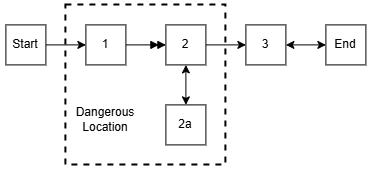
    • The bank is a two-story building with a basement, and each floor is divided into three sections, dividing the building into nine locations, plus a tenth “outside” location. There are stairs connecting the middle sections of each floor. On their turns, a character can move to an adjacent location instead of attempting to resolve a node.
    • The bank’s main entrance is in the front section of the ground floor, and there is another entrance to the back section of the ground floor as well. There is also a hatch to the roof, and the basement adjoins the basement of a neighboring building.
    • The vault is in the back of the basement.
    • There are two guard patrols, one that moves about the building, and another that initially stays in the guardroom at the front of the basement. Unless they are responding to a noise, the guards randomly choose a section of the building (other than the vault) and move towards it turn by turn.
    • The guards can detect PCs in their section of the building or an adjacent one, unless the PC succeeds on a Stealth check. This check is easier if the PCs are merely adjacent to the guards.
    • The guards respond to noises and other events, and can be lured to specific parts of the building in this way. The second time this happens, the mobile guards call for the other patrol to start searching the building; the third time, they call for backup from the city watch or other authorities.
    • There is a vantage point in a nearby, unsecured building where an observer can watch the guards’ movements on the ground and second floors, though not the basement.

    This gives us some idea of how the encounter might go once the PCs decide to put a plan into action: they will make entry to the bank somewhere, and then try to creep down to the vault while evading the guards. They might even split up, and one team lure the roving guards to a remote part of the building so that they can easily reach the vault. We’ll attach some numbers to these options later…

    Next, let’s consider physical and magical security:

    • The front and back doors to the bank are of course locked, but the front door is more decorative than sturdy, and can be easily broken down. The roof hatch is unlocked.
    • The door to the vault itself is also locked, requiring a difficult Subterfuge check to pick the lock. It could also be blasted open with the right kind of explosives, but that inherently attracts the guards.
    • The actual treasure the PCs are after is inside a locked chest, safe deposit box, cage, or other layer of security, which likewise can be picked quietly or broken open loudly.
    • There is a spell on the vault, which sounds an alarm if an object that has been in the vault longer than 24 hours is removed from it if a special talisman is not present at the door to the vault. The spell is powered by a focus located in the manager’s office on the top floor.
    • The guardroom contains a magical signaling system that can be used to call in the city watch. The patrolling guards can shout from as far away as the ground floor for the guards in the guardroom to use this system, or the guards in the guardroom can use it if they detect the PCs nearby.

    Finally: how much of this information can the PCs learn ahead of time, and how much will be a surprise to them when they spring into action? Before launching the heist, the PCs can, on their turns, make appropriate checks to investigate and plan their heist, such as:

    • Stealing the bank floorplans from town hall and deciphering them (Subterfuge, followed by Engineering, revealing the bank’s floorplan).
    • Getting a bank employee to talk about the bank’s security (Persuasion, learning one piece of information per success; on a failure, no further checks can be made).
    • Building an explosive device to blow a hole in the wall from the basement of the adjoining building (Engineering; does not work to blast directly into the vault, which has reinforced walls).
    • Stealing a security talisman for the vault from a bank employee (Subterfuge; optionally Deception to prepare a forgery as a replacement to avoid suspicion).

    Now, when presenting this encounter to the PCs, it might be helpful to have some kind of diagram to help them understand the layout of the bank and various nodes that can be interacted with. It might also be helpful to construct this diagram using index cards or sticky notes that can be added to the diagram as the PCs discover various nodes.

    Finally, before running this encounter, it may pay to think about some unusual ways that the PCs might try to resolve certain nodes. In particular, how might they try to neutralize the guards? This is an aspect of the encounter that will differ greatly from group to group: different players, and different characters, will approach the encounter differently, and you as the GM should consider their likely tactics.

    • As suggested above, they might try to lure the guards away from the vault (to the upper floor, say) by making noises. The first time they do this should attract the roving patrol; the second should attract both; the third should result in one patrol heading for the guardroom to signal for help.
    • Could the PCs sabotage the signaling system once the second patrol leaves the guardroom? This might be doable with Arcana or just by smashing things up. If the signal is broken, might one patrol leave the bank to fetch reinforcements?
    • Could the PCs knock the guards out, say by slipping a sleeping potion into their tea or pumping knockout gas into the guardroom? Where could they get the potion or the gas from?
    • Is there prep work that the PCs could do by visiting the bank during opening hours before the heist? This might allow them to, say, steal a key or a talisman for the vault alarm, or plant sleeping potion in the guards’ tea stash.
    • Most importantly: are the PCs likely to turn the heist into a smash-and-grab where they knock out (or kill) the guards, blast open the vault, and run off with the loot? Some groups might find the smash-and-grab more fun, in which case you might want to scrap the nodal encounter entirely in favor of giving them an interesting fight.

    Up Next

    I’ll be wrapping up this series on non-combat encounters next week, with some general discussion of how and when to use the various forms I’ve presented here. I’ve also got a Gazetteer post on the Ruins of Gobol Karn (an excellent site for adveture) in the works…and a post on an entirely different type of GM mechanic, which coincidentally builds on the dragon lore I posted a couple of weeks back…

  • Following on from my previous post about alchemical volatiles, today I’m going to cover potions and elixirs, the sort of alchemy that adventurers drink for healing, invigoration, or protection.

    Using Potions and Elixirs

    Potions and elixirs, with a few exceptions, are magical liquids that interact with mortal biology: they accelerate healing, toughen flesh, sharpen senses, or have other transformative effects on the adventurer who drinks them (or in some cases, dabs them on as ointment or inhales the vapors: the application method for many alchemical volatiles is not non-specific).

    A character can drink a potion or elixir as a minor action; if it was stored where they can easily get to it, like in a bandolier or belt pouch, they can draw and drink it in a single minor action. Otherwise, they need to draw it as a separate action first.

    Potions generally have short-lived or instantaneous effects, while elixirs have longer-lasting, and often more powerful, effects. Potions can be mixed, but a character can have the benefit of only one elixir at once. Drinking a second elixir before the first wears off neutralizes the effects of both.

    Characters with the Alchemy feat are able to brew their own potions and elixirs (and can also make the volatiles discussed in my earlier post).

    Examples of Potions and Elixirs

    The first potion I’m going to reveal is the humble Healing Potion, without which no fantasy RPG really feels complete. Yes, it’s red because healing potions in most videogames are red. There is only a single potency of healing potion in Aetrimonde, because it simply allows the drinker to use a resurgence, and so it scales with hit points instead of requiring advanced versions for higher-level characters that have significantly more hit points.

    The Potion of Numbness is an in-the-moment defensive potion: it can completely protect a character from repeated psychic damage (which Aetrimonde often uses to represent the madness caused by having looked upon eldritch abominations and other Things Mortals Were Not Meant to See) and reduces the damage they take from other psychic damage.

    The Potion of Magical Might is a more offensively-minded potion (although it could conceivably be used to make Ward powers retaliate harder against creatures striking their recipients…). It has the straightforward effect of giving a character just under two turns of favor on the attack and damage rolls of magical powers (those with the three keywords listed): great for moments where the PCs finally have a powerful foe on the ropes and need to hit it as hard and as fast as they possibly can.

    Finally, there is the Absorbent Fixative, an example of several things: it’s an Elixir, having a longer-lasting effect than Potions; it comes in multiple varieties that protect against different types of damage; and at least as far as flavor is concerned, it’s not actually something you drink, but something that you pour over yourself and your equipment to form a protective outer layer. (But of course, this is merely for flavor, and has no real mechanical effect.) At two large heals, Absorbent Fixative actually provides one of the larger healing-ish effects available, which compensates for the fact that it only provides temporary hit points and only protects against a single damage type.

    Bio-Alchemy Lore

    Now, mechanics are one thing, but alchemy also deserves lore, and I’m someone who knows just enough about chemistry and biology to want some kind of explanation for what a healing potion actually is. Is it a spell bound to a liquid? Is it a miraculous panacea distilled from a rare plant? Is it a chemical compound synthesized with the aid of magic? Well, since I’m lumping potions and elixirs in with alchemy, I’m going to say that it’s a magically transformed substance…and I’ve got more lore where that came from. If this topic interests you, read on: I’m not actually sure whether to put this excerpt in the Core Rulebook or the Aetrimonde Setting chapter of the GMH, but it’ll go in somewhere:


    Producing magical substances that interact safely with mortal biology is complicated. Potions and elixirs are not magical spells anchored to a liquid medium, which would be far, far safer: they are literally magical substances activated by contact with living tissue. Small mistakes in concocting potions and elixirs can leave the imbibers dead, or worse…which is why most commonly-available potions and elixirs are derivatives of a very few alchemical processes that are well-understood and difficult to get seriously wrong.

    Most of these common alchemical processes originated with the goblins of Gobol Karn, the original alchemists, who are still unsurpassed in the discipline of bio-alchemy. Unlike the techniques of producing alchemical metals, Gobol Karn did not trade away knowledge of bio-alchemy, because they based the structure of their entire society around these secrets, much to the horror and dismay of their contemporaries.

    Like most of its contemporary societies, Gobol Karn practiced slavery. Unlike its contemporaries, Gobol Karn used bio-alchemy to render its slaves docile and compliant…and to twist and warp them into new forms suitable for the work to which they were forced. Karnish alchemists were able to produce permanent transformations, making subjects grow into muscle-bound hulks or forcing them into parodies of their original shapes for the amusement of the goblin public.

    The eventual collapse of Gobol Karn, caused ironically by the backfiring of the imperial family’s attempts to alchemically enhance themselves, allowed some of the lesser techniques of bio-alchemy to spread from Gobol Karn. The more advanced techniques and formulas, including the ones capable of inducing permanent and hereditary transformations, remain lost.

    Many expeditions to the ruins of Gobol Karn are formed in the hopes of finding some fragment of alchemical knowledge in a preserved laboratory or archive, and in fact some such fragments have been recovered. However, the horrors perpetrated by Gobol Karn still loom large in the minds of many authorities: over the centuries, many papyri and tablets brought back from the ruins have been seized and destroyed or hidden for fear of how their contents might be used if they made it into wide circulation.

    Modern alchemical research falls into two camps: the respectable camp works by making small, incremental adjustments to proven formulae or by testing new formulae recovered from Gobol Karn and very carefully vetted by reliable alchemists and government censors. The products of such experimentation, when they don’t explode at the first hurdle, are tested first on lab animals and eventually on daring volunteers. Progress in this manner is, naturally, slow.

    Disreputable alchemists, meanwhile, haphazardly mix and recombine formulas according to principles based half on superstition and half on fragments of ancient texts that escaped the censors, with a dash of pure madness often thrown in for flavor. The results, when they last long enough to administer without exploding, are generally lethal, and when they aren’t lethal, generally cause horrific mutations or mind-shattering insanity…but occasionally, they produce substances with applications useful enough to make the side effects worthwhile.

    Bio-alchemists are therefore viewed with more than a trace of suspicion by the general public. Potions and elixirs not clearly labeled and sealed with the mark of a reputable company or guild are worse than worthless, because they can draw accusations of illicit experimentation (and the companies and guilds are very quick indeed to crack down on unlicensed use of their marks). Nonetheless, a few unaffiliated, unsupervised alchemists brew products outside the usual range of substances…and desperate or foolhardy adventurers might find them worth the risks.


    And this isn’t actually just lore! The GMH contains a random-roll table that a GM can use to determine the side effects of imperfect, experimental, or tainted potions and elixirs. (It could also be used, as an optional rule, to determine the effects of mixing multiple elixirs at once…) The GM is intended to roll once per batch of unorthodox alchemy, but could roll whenever the product is consumed if appropriate. Importantly, the only reliable way to determine what side effects a batch of alchemical product has is to try it out on a test subject. A few entries from this table are provided here:

    4d10 ResultEffects
    4The drinker dissolves rapidly, and painfully, into a puddle of bloody flesh, but does not die.
    15The product is psychoactive: 1d10 days after consumption, the user develops a random affliction from among the psychological traumas starting on page [NA].
    20The product causes an unusual, noticeable, but ultimately innocuous physical transformation, such as changing skin color, causing eyes to glow, or making hair grow rapidly. Effects last for 5 minutes or until the product wears off, whichever is longer.
    33The product has both its normal effect and the effect of another, randomly chosen potion or elixir.
    40The product is unusually potent, and its effects are permanent. Effects that would normally occur once instead occur at the start of the drinker’s every turn.

    For players who want to try their hands at experimental alchemy, the GMH also provides the following suggested framework:

    The player should start by specifying a desired product that is a variation on an existing alchemical product: a Healing Potion that grants favor on its healing roll, for example. For each distinct variation like this, the character needs to make a Difficulty 20 Arcana check, with success meaning that the batch has the desired variation but gains a side effect such as one randomly generated from the table; a failure means that the entire batch goes up in smoke instead. If the player wants to create an entirely original alchemical product, then it is up to the GM how many Arcana checks they need to make (and thus how many side effects it could possibly have).

    Up Next

    I’ve got a couple more posts relating to non-combat encounters planned. I think I might also have a Gazetteer post on Gobol Karn and its ruins…and another that might expand on the dragons I presented last week. Stay tuned!

Is this your new site? Log in to activate admin features and dismiss this message
Log In