
For today’s post, I’ll be talking about Aetrimonde’s resolution mechanic, called the core roll, that is used to determine the success or failure of just about every action in the game.
An RPG needs a resolution mechanic to avoid the cops-and-robbers problem. (“I shot you!” “Nuh-uh!” “Yes so!” and so on.) This is some kind of random process that, in the end, produces a Yes result some of the time and a No result the rest of the time.
D&D has traditionally used “d20 + Modifier” as its resolution mechanic: roll a d20, add a modifier from your character, and if you beat a target number, you succeed.
Resolution in Other Systems
Other RPG systems use different resolution mechanics, which have different properties:
- Roll + Modifier: Like d20 + Modifier, but with different dice. 3d6 + Modifier has the same mean as d20 + modifier, but a more bell-shaped distribution, and has been mentioned as an optional variant in some D&D sourcebooks. In general, Roll + Modifier is a simple way to determine success or failure: you want to have a bigger modifier, and you hope that the target number is low. This mechanic’s big drawback is that it’s all-or-nothing: it can only handle partial success or partial failure by having multiple target numbers for varying degrees of success.
- Roll-Under: Commonly based on percentile dice, you roll some dice, add or subtract a number, and try to roll under a target value. This is mathematically equivalent to Roll + Modifier, and is less commonly used because it is counterintuitive: implementations vary, but generally, somewhere in a Roll-Under system, you find that smaller numb.
- Dice Pool: Roll several dice at once; you get more dice for things you are better at. There are several variants of this:
- Sum vs. Difficulty: Add up all the dice and try to beat a target number. This works much like Roll + Modifier, except that modifiers come in the form of dice added to the pool.
- Individual Successes: Each die you roll can be a success or failure (or, possibly, neutral) depending on its result. Try to get a target number of successes. This handles degrees of success very well, by allowing for complications based on the number of failures in a roll. However, the probabilities here are more complicated, and it’s harder to work out the probability of an action’s success on the fly even if the target number is known.
d20 + Modifier is simple, but it doesn’t actually correspond to the kind of randomness we see in nature or human activity. A d20, like every die, has a uniform probability density, which is to say, every one of its outcomes is equally likely. In the case of the d20, this means that each of the numbers 1-20 has an equal (5%) chance to occur each time you roll the die.
Unfortunately, most complex real-world randomness we see–like the accuracy of someone shooting a bow, or the speed of someone climbing a cliff–displays some kind of central tendency, meaning that moderate outcomes are more likely than extreme ones. So, I want a resolution mechanic that reflects this.
There are several ways to get central tendency in a dice roll (See: 3d6 + Modifier, Dice Pools, in the box above) but the absolute simplest way to get a dice roll with central tendency is to use two dice added together. That won’t create a classic bell curve (although using three or more dice would come closer), but it will give us a “peaked” distribution where the most common result (11) has a 10% chance of occurring on each roll, while the most extreme results (2 or 20) each have only a 1% chance. This is good enough to be getting on with, and it has the advantage of not requiring too many dice.
2d10 + Modifier is simple to learn and not too difficult to predict probabilities for; it uses a pair of dice that come in most dice sets aimed at D&D, which makes it accessible; and as I’ll get to in the next post, it has certain distributional properties that play well with circumstance mechanics. The probability distribution of 2d10 is also sufficiently close to 1d20 and 3d6 that either of these could be patched in as a substitute (because I’m not the only GM who likes to tinker with rules…).
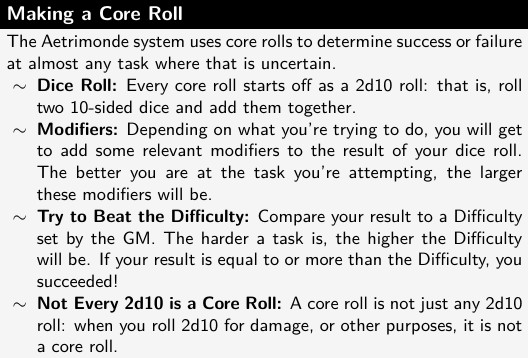
So yeah, we’ll use 2d10 + Modifier as Aetrimonde’s resolution mechanic. You can see what the rules have to see about it to the left.
In accordance with the goal of Unified Mechanics, every question of success or failure will be resolved with a core roll. Degrees of success or failure, like the damage from an attack, may be handled with different rolls.
Up Next
Yes, it was a short post today. The next post in this series will be longer, and will discuss circumstance mechanics that can alter dice rolls including Core Rolls.
 Aetrimonde
Leave a comment