
In my last post, I discussed resolution mechanics used to determine success or failure of actions, and I introduced Aetrimonde’s version: the Core Roll. Today, I’ll cover circumstance mechanics that can alter these and other rolls.
Warning: this post contains math.
On top of the resolution mechanic, I also want a circumstance mechanic: something that provides a quick, consistent way to improve or hinder a roll to represent better or worse circumstances.
Circumstance in Other Systems
Many systems have circumstance mechanics implemented in various ways:
- D&D 3.5e heavily used “circumstance modifiers,” situational bonuses and penalties that the GM could hand out to represent helpful or unhelpful circumstances. The size of the modifier could vary and was ultimately up to the GM, although the rules provided examples and guidelines.
- D&D 4e also used circumstance modifiers, and heavily pressured the GM to just use +2 or -2. It also codified “combat advantage,” a circumstance modifier specifically for attack rolls that you could get from flanking, ambushing, and many other sources, and defaulted to +2.
- D&D 5e introduced advantage and disadvantage: roll twice, and take the better or worse result. This replaced most circumstance modifiers, removing a little bit of math from the game and generally speeding up play.
- The Fate system allows players to invoke relevant aspects of characters or situations, generally in exchange for a resource, gaining bonuses to their roll or rerolling the dice.
Because of Design Goal #2 (Minimize Fiddly Numbers), I want the circumstance mechanic to be non-numeric: nobody should have to do more math, and the GM shouldn’t have to decide how large a modifier should be for the circumstances.
The advantage/disadvantage mechanic from D&D 5e is mechanically simple: with advantage, you roll twice and keep the better result. With disadvantage, you roll twice and keep the worse result. With both, they cancel out, and you roll normally. There’s no math involved, the GM doesn’t have to decide how large a modifier to give, and a lot of 5e’s actual rules use this mechanic (in addition to recommending that the GM use it to represent different circumstances).
Let’s take a closer look at the math of this mechanic to figure out just what it does. The mean d20 roll with advantage is 13.82, which is a huge boost from the mean of a plain d20 roll (10.5). The median is further distorted: 15 with advantage, 10.5 without. However, neither of those is the best measure of what advantage would actually do in play: the effectiveness of advantage is going to depend heavily on what you need to roll.
I’m going to peg the “normal” rate of success in Aetrimonde at 2/3: if you are competent at something but there is still risk involved, you succeed about twice as often as you fail. Assuming that a d20 roll would succeed 65% of the time (needing to roll an 8, as close as you can get to 2/3 on a d20), rolling with advantage succeeds 88% of the time, or 1.35x as often. Disadvantage does the opposite, causing the roll to succeed only 0.65x as often.
This seems like a good place for advantage, numerically: it shifts the rate of success up or down by about a third for something you’re competent at.
When does advantage have the largest impact?
This depends a lot on how you define “largest impact.”
If the probability you succeed on a d20 roll is X, then the probability you succeed with advantage is 1 – (1 – X)^2, or 2X – X^2.
In terms of percentage points, this means that the increase in probability of success you get from advantage is (2X – X^2) – (X) or X – X^2. This increase is 0 if you already have 0% probability of success (because advantage won’t let you succeed at an impossible task) or 100% (because there’s no room for improvement). It’s greatest for X = 0.5 or 50%.
However, in relative terms, the increase in your rate of success is ((2X – X^2) / (X)) – 1, or 1 – X. (For X not equal to 0, which makes it undefined.) The lower your initial rate of success, the more advantage will increase that rate, relative to the initial rate. If you succeed 5% of the time normally, advantage will make you succeed 9.75% of the time, a whopping 95% relative improvement! (Never mind that you probably still won’t succeed…)
Generally speaking, though, advantage feels useful when you already have a moderate chance of success. If you’re already very likely to succeed, there’s not much point in getting advantage, other than to further reduce the odds of getting that pesky natural 1. And if you’re already very unlikely to succeed, getting advantage won’t hugely increase your odds.
For my own part, I feel like advantage is worth going for if I’m going to succeed between 30% and 70% of the time: advantage will turn that into 51% to 91%.
Adapting Advantage and Disadvantage
Here’s the problem: advantage and disadvantage isn’t going to translate perfectly to Aetrimonde’s 2d10 core roll. Not only will the numbers be different, it’s going to be cumbersome in play to roll 2d10 twice, because you would need to roll 4d10 but keep each pair separate. Sure, most RPG players have at least two sets of dice in different colors, but I don’t want to assume that. It also involves an extra step of mental math, in that you have to total two sets of dice.
Fortunately, there’s a neat solution, a nice little mechanic inspired by advantage/disadvantage, but adapted for the 2d10 core roll.
Adding a third d10 to the roll, and keeping only the best two, means that if a core roll succeeds 64% of the time (needing to roll a 10, as close as possible to 2/3 on 2d10), then it will succeed 85% of the time with the third die. This is nice! The math is pretty similar (around this 2/3 success setpoint) to what you would get with a d20 resolution mechanic and the advantage mechanic. The corresponding adaptation of disadvantage (roll 3d10, keep only the two best) is similarly similar. It will be familiar to players of 5e.
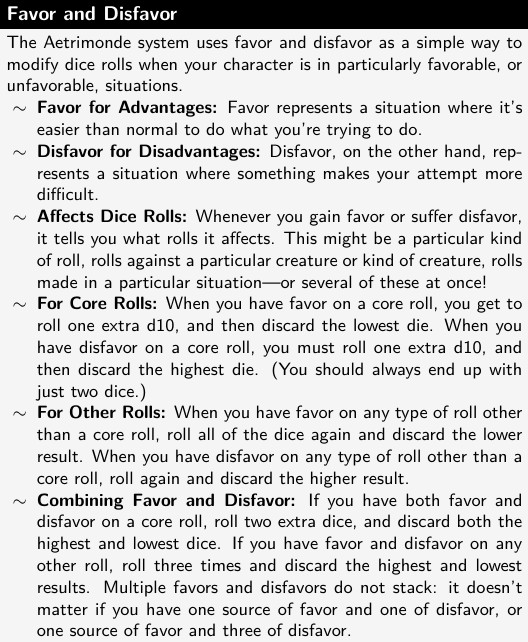
So this is what Aetrimonde will use as a circumstance mechanic, inspired by advantage/disadvantage. We’ll call it favor/disfavor: if you have favor on a core roll, then you roll an extra d10 and keep the top two. With disfavor, you roll an extra d10 and keep the bottom two. For anything other than core rolls, roll the dice an extra time and keep the higher/lower result.
That’s the basic idea worked out. Now for some twists…
Combining Favor and Disfavor
Having played some 5e, I don’t actually like that advantage and disadvantage on the same roll cancels out. To my mind, if you have both helpful and harmful circumstances when doing something, the way that they affect you should vary based on how good you are at it. If you’re skilled at a task, then you should be able to take better advantage of help and minimize the harm of hindrances, for a net improvement; if you’re unskilled, the opposite should be true.
This is not actually difficult to make work in our favor/disfavor mechanic! What we will want to do is strengthen the central tendency of a roll without skewing its mean, and one way to do this is by discarding all the extreme results. This would make it so that if you would already be likely to succeed, you become more likely, and if you are unlikely to succeed, you become less likely.
We can do this just by rephrasing how favor and disfavor work: instead of “roll 3d10 and keep the higher/lower two dice” we will instead say “roll an additional d10 and discard the lowest/highest die.” These instructions are not contradictory: if you have both favor and disfavor, you should roll two additional dice, and discard both the lowest and the highest. Likewise, for favor and disfavor on a non-core roll, you should make the roll three times, and discard the higher and lower results (keeping the middle).
Stacking Favor or Disfavor
Since we’ve discussed how favor and disfavor should interact, here’s another question: should multiple sources of favor or disfavor do anything?
It wouldn’t be that hard to say that for every source of favor you have, you roll an extra d10 for your core roll and discard one of the lowest. But I’m not going to do that, and I think it’s for the same reason that the designers of 5e didn’t make advantage and disadvantage work that way: counting up every instance of favor and disfavor you have would slow down gameplay. Rolling a ton of dice and then figuring out which ones to discard would be slower, too. It’s sufficient for the favor/disfavor mechanic to care about whether you have favor or disfavor, and not how much you have.
With that in mind, you can see the completed rules for favor and disfavor to the left.
Up Next
That’s it on dice mechanics for now. Up next, I’ll discuss resource mechanics that will be common to all characters.
 Aetrimonde
Leave a comment