
Today kicks off a post series in which I’ll be walking through the creation of an Aetrimonde character to illustrate the components and choices that go into a character. However, this series will alternate with other posts covering topics like the reasoning behind certain mechanical choices, peripheral systems like magical items, alchemy, and ritual magic, and information about Aetrimonde’s default setting.
But before I get into Etterjarl Ragnvald, he isn’t the last character I’ll be building in this blog, and I’m going to leave the next one up to you readers. Respond to the poll below to pick the ancestry you want to see in the next character build I demonstrate!
Introducing Etterjarl Ragnvald
Etterjarl Ragnvald is a character I played myself in one of the few 4e games where I got to be a player rather than a GM, and I’ve since played iterations of him in Pathfinder and 5e. I’ve done a bit of digging in some very old files and managed to dig up how I introduced him to the first group he was a part of:
Etterjarl Ragnvald is the last scion of an ancient dwarf lineage, now in much-reduced circumstances. He was raised with the expectation that he would become a lawyer and finally settle the question of an inheritance that his family has believed is rightfully theirs for the last five centuries; unfortunately, the interest on the legal fees they incurred in the last round of unsuccessful litigation have [sic] forced him into a change of plans. Ragnvald has turned to adventuring in the hopes that he can forestall his family’s creditors long enough to finish his last decade of dwarfish law school.
Although he prefers to be addressed formally, in the manner prescribed for a dwarf of his nominal title of Etterjarl (Under-Earl, loosely translated), Ragnvald grudgingly tolerates being called Reggie by those who consider themselves his friends.
It’s going to be a long post today. We’ll go over the basics for Ragnvald as an Aetrimonde character: his heritage, class, and ability scores.
Heritage
D&D has typically conflated ancestry and culture: if you are a dwarf, you speak Dwarfish, you know how to use hammers and picks as weapons, and you know how to use some craftsman’s tools. Per the rules as written, this is the case even for a dwarf who was raised by humans or elves.
I want to avert this in Aetrimonde: the Victorian Fantasy setting means that there will be more widely available travel than in a typical pseudo-medieval D&D setting, which means there it should accommodate expatriates and immigrants a little more readily.
So, what D&D has typically split into “race” (boy, is that a term I want to not use…) and “background,” I’m going to split into ancestry, culture, and stratum.
- Ancestry covers who your parents were, and gives you some biological traits.
- Culture covers who you grew up around, and determines things like languages you speak.
- Stratum determines your place in your culture: what you did for a living, what skills you might have, etc.
Together, these make up your heritage.
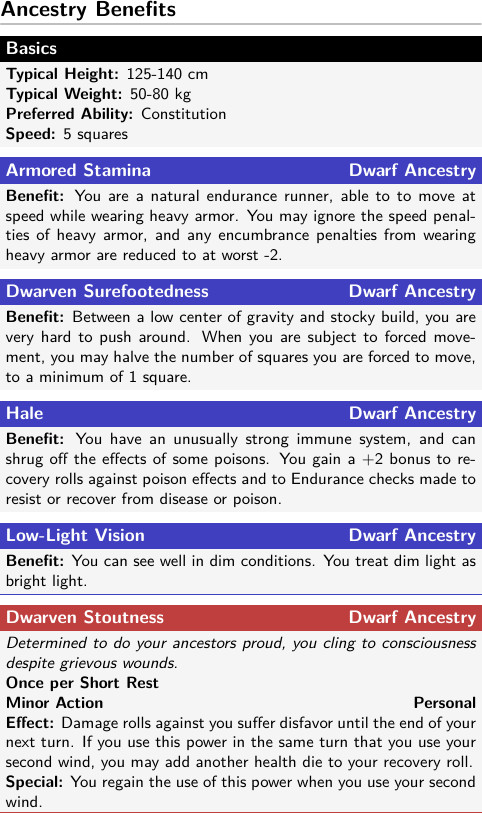
Ancestry: Dwarf
Ragnvald is, obviously, a dwarf. Aetrimonde dwarves are, for the most part, typical dwarves: short, stout, hairy. Their racial features reflect that:
Basics
Typical height and weight are, I think, self-explanatory.
Preferred abilities allow a character to increase a pair of abilities further than they would normally be able to: all three parts of heritage grant one preferred ability, and a character can choose two of them to increase by +1. As a dwarf, one of Ragnvald’s preferred abilities will be Constitution.
Speed, of course, determines how far and fast a character can move. In Ragnvald’s case, he can move up to 5 squares during his turn (if he doesn’t dash, sprint, or try to move carefully; I will discuss these details in a later series of posts on combat). 5 squares is slightly below average, on par with a human in heavy armor.
Armored Stamina
This makes dwarves better able to handle heavy armor, making up for their low base speed.
Dwarven Surefootedness
This makes dwarves much harder to push any great distance, allowing them to hold their ground better.
Hale
We haven’t discussed recovery rolls or skills (such as Endurance) yet. Suffice to say, a +2 bonus is significant, and it means that dwarves will shake off poison and disease faster than most other characters, and might not be affected in the first place.
Low-Light Vision
This makes dwarves (and other ancestries with low-light vision, because this is not unique to dwarves) able to function better in bad lighting.
Aetrimonde’s implementation of low-light vision doesn’t make dwarves able to see any farther than humans, but allows them to see more detail in bad lighting. This helps to avoid situations where one character can see something another cannot: in a video game where each player is looking at a separate screen, this is fine, but when all the players are looking at the same map spread out on a table, it can be difficult to pretend that some of their characters can’t see something that the players can.
Dwarven Stoutness
This is an active power that dwarves have: since it is the first time I’m showing off a power, I’ll go into what the different parts of it mean:
- The red header indicates that this is a power Ragnvald can use as an action. Many things in Aetrimonde are color-coded like this: passive features are shades of blue, equipment is yellow, and rules shared by all or most characters are black. “Dwarven Stoutness” is of course the name of the power, and “Dwarf Ancestry” indicates why a character would have this power.
- The italic text is flavor: it has no mechanical impact, but gives context as to what this power represents.
- “Once per Short Rest” is the frequency with which the power can be used. Other powers might say here “At-Will,” “Lesser,” or “Greater.”
- The next line indicates that the power can be used as a minor action (so Ragnvald could use this power and then make an attack or use his second wind), and has a Personal range (affects only him).
- The Effect is the meat of this power: this is what actually happens when Ragnvald uses it. This power reduces how much damage Ragnvald takes for a round (by imposing disfavor on damage rolls against him) and if coupled with his second wind, lets him get more health back.
- The Special section explains how this power breaks the normal rules: while it is nominally usable once per short rest, Ragnvald gets it back when using his second wind.
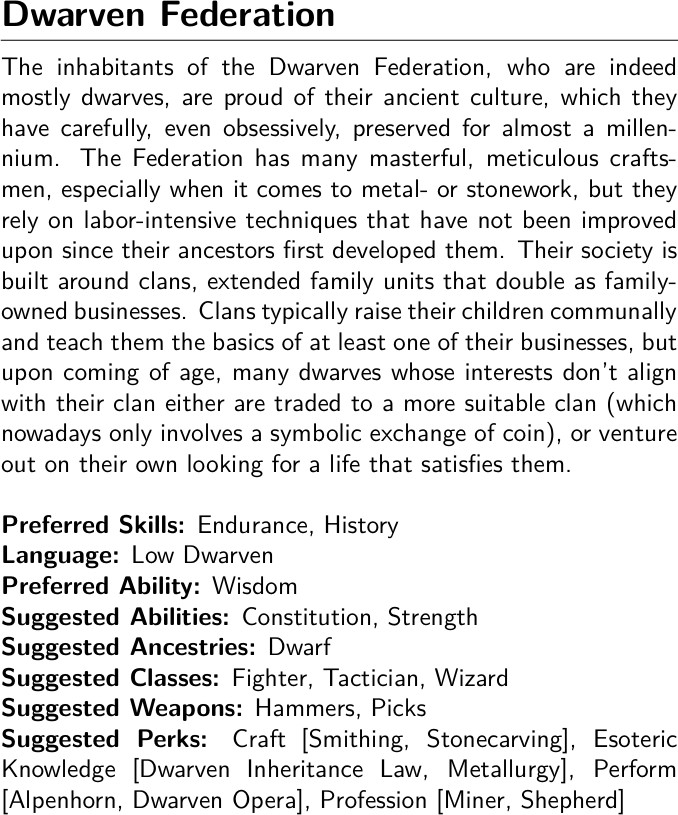
Culture: Dwarven Federation
Ragnvald is a traditional dwarf: stubbornly devoted to honoring his ancestors, insistent in getting what he is due, and distrustful of anything new-fangled. In Aetrimonde, the culture with these attitudes is that of the Dwarven Federation (left).
Like all cultures, this gives Ragnvald another preferred ability, a preferred skill (which I’ll talk about in detail in the next post), and a language he speaks (likewise). It also makes a bunch of suggestions for abilities, ancestries, classes, weapons, and perks that would suit a character from this culture, in case you can’t figure out where to go next with your character. (And a flexible GM might even let a character swap out their culture’s preferred ability for a suggested one, if they can give a good reason why that’s more appropriate for their character.)
The information about the culture of the Dwarven Federation presented here raises a question: what is the business of Ragnvald’s clan? I’m going to say that they’re atypical, and don’t create anything tangible: they’re financiers who loan money to other dwarf clans. And unfortunately, their long-running legal battle over Ragnvald’s inheritance (coupled with the economic downturn in the Federation) has drained the family coffers to the point that they’ve been doing more borrowing than lending lately.
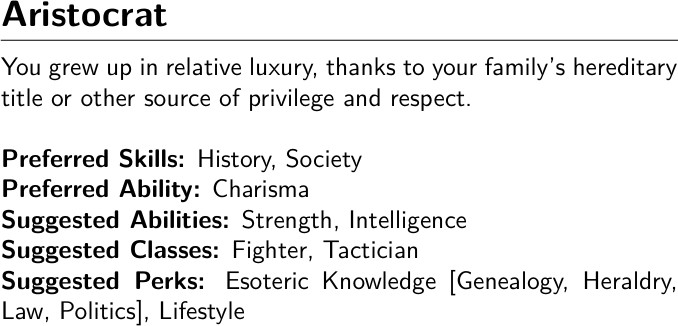
Stratum: Aristocrat
Ragnvald comes from a clan that considers themselves noble. In reality, they’re a bunch of vexatious litigants with a questionable claim to a long-defunct title, but they stubbornly act like nobles and raise their children to believe and act as such. Ragnvald has the Aristocrat stratum (right).
Like cultures, strata provide preferred abilities and skills, and make suggestions about abilities, classes, and perks that reflect a character’s stratum.
Up Next
In the next post, we’ll go over the Fighter class and pick Ragnvald’s abilities. And if you want to see a specific ancestry in the next sample character, remember to let me know in the poll above!
 Aetrimonde
Leave a comment