
Today’s post will cover the last (mechanical) choices made when creating a character: powers, feats, and starting equipment.
Powers
Powers are special things a character can do (mostly for combat), that most other characters cannot. They include among other things special sword strikes and tactics, spells of fire and lightning, divinely granted healing, and the ability to grow fangs and bite your foes.
Because Ragnvald is a fighter, one of the four Martial classes, he gets to pick Martial powers (the aforementioned special sword strikes and tactics among them). At level 0, he gets to pick four, of which one must be lesser and one must be greater.
I envision Ragnvald as a quintessential dwarf fighter, which means heavy armor, melee weapon, and shield. There are plenty of suitable Martial powers (200 in total, of which around 40% are melee powers), so let’s narrow it down: as a frontline fighter, some useful things Ragnvald should be able to do include:
- Push enemies around.
- Keep enemies from moving around him.
- Do something to make enemies fight at a disadvantage.
- Do something to keep himself alive in a bad situation.
Let’s try and cover these bases with the four powers available.
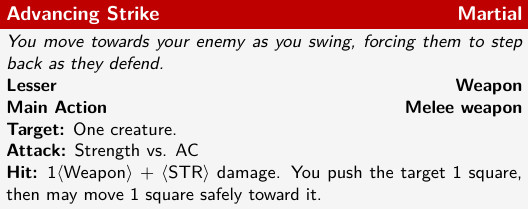
Firstly, moving enemies around: this is something Ragnvald might need to do repeatedly in order to push forward or keep enemies back. Let’s make sure it’s a lesser power, so that it costs no resources. Advancing Strike fits the bill: this lets Ragnvald push an enemy 1 square and then move safely towards it to close the gap. (I’ll talk about safe movement in detail in a later post; for the time being it is enough to understand that this lets Ragnvald move back towards the enemy he just pushed without being attacked himself.)
This is the first attack power I’ve revealed, so I’ll take a moment to dissect it:
- The power’s range is “Melee weapon,” meaning it is based off of the weapon Ragnvald uses to make the attack. For most weapons, this is 1 square; for polearms, it is 2 squares.
- The power targets one creature.
- The power’s attack being Strength vs. AC means that Ragnvald will make a core roll adding his Strength and (because this power has the Weapon keyword) the precision of his weapon. If the total is at least equal to the target’s AC, the attack will hit.
- The “1<Weapon> + <STR>” notation indicates that, if the attack hits, it will deal damage based on Ragnvald’s weapon, plus his STR. The rest of this line describes how Ragnvald pushed his foe back and can follow it…again, if he hits. None of these things happen if the attack misses.
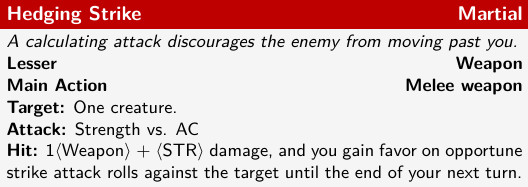
Next, keeping enemies from moving around him. While the Battlefield Superiority class feature goes some ways towards this, let’s lean into it and try to make Ragnvald even “stickier.” Hedging Strike (right) will synergize nicely. This will make Ragnvald’s opportune strikes even more accurate, beyond even the bonus he gets from the Battlefield Superiority class feature. If he hits an enemy with Hedging Strike, that enemy will face a very accurate opportune strike if it then moves.
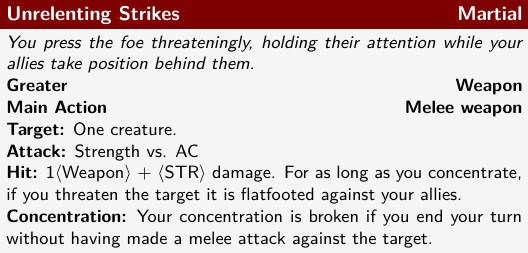
Ragnvald is going to have plenty of armor resistance with heavy armor. If he needs to place an enemy at a disadvantage, it’s probably because he’s dealing with one big enemy who can punch through it, not a bunch of small ones. Unrelenting Strikes (left) is a greater power that Ragnvald can use to make an enemy flatfooted against his adventuring allies.
This flatfootedness applies only if Ragnvald threatens his foe (is in melee range and not staggered/dazed/etc.), and only as long as he keeps making melee attacks against it. However, he can first use Unrelenting Strikes against an enemy, and then (if he hits) use Hedging Strike on subsequent turns: this keeps his enemy flatfooted, and makes it much harder for the enemy to get away, because Ragnvald will have favor on opportune strikes against it.
This is the first power I’ve shown that uses concentration: a character can concentrate on one effect at once, which might be a series of weapon attacks like this, or a magical spell. Concentration can be broken by taking a significant amount of damage, by conditions such as being stunned, or by power-specific requirements like in this case.
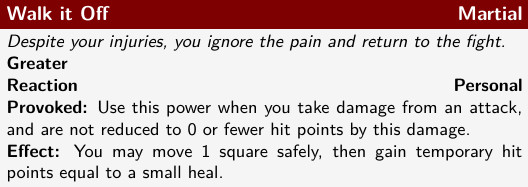
Finally, keeping himself alive. Ragnvald can get a lot of healing from his second wind, thanks to his Dwarven Stubbornness ancestry feature. What he really needs, in a tight spot, is something that will keep him alive until he gets a chance to use it on his turn. Walk it Off (right) will give him some temporary hit points if he takes damage from an attack and is worried about surviving until his turn.
This is a reaction power, and as all reactions, is Provoked by a specific event. In this case, Ragnvald can use this power when he is damaged but not downed by an attack, and can then safely move a short distance and gain temporary hit points equal to a small heal (which is generally equal to one healing die, in Ragnvald’s case a d12). This can get Ragnvald out of a sticky position and also give him a few temporary hit points to make up for the damage he took.
Feat
Feats are passive traits that alter other aspects of a character: they may increase defenses, grant bonuses to certain damage, cause extra effects to occur when attacking or using powers, or improve class or ancestry features, among many other possible benefits.
Like virtually all characters, Ragnvald gets one feat at level 0. Here are several options that would improve various aspects of Ragnvald:
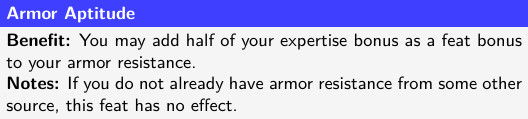
Armor Aptitude will give Ragnvald a +1 bonus to armor resistance (scaling at higher levels!), which would be especially good against low-damage attacks like those made by groups of weak enemies. It would be less useful against single, powerful attacks.

Dwarven Second Wind will give Ragnvald a second use of his second wind, and by extension a third use of Dwarven Stubbornness. Of course, using his second wind takes a main action that he would normally use to attack, so he will only get full use of it if he needs healing badly.

Improved Battlefield Challenge will let Ragnvald make multiple Battlefield Challenge attacks per round, where he could normally only make one. But, it will require that he forgo using his reaction, which he could normally use for Walk it Off.
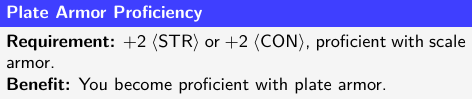
Plate Armor Proficiency will let Ragnvald wear plate armors without the (sizeable) penalties of doing so without proficiency. If he can afford the cost of plate armor, this could net him an additional +1 AC and +1 armor resistance over the armors he is currently proficient with. However, it would not scale at higher levels like Armor Aptitude.
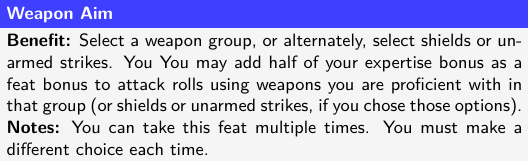
Weapon Aim would give Ragnvald a +1 feat bonus to his attacks with one weapon group (axes, heavy blades like longswords, hammers, etc.). Ragnvald would apply this feat to whatever kind of melee weapon he decides to equip himself with. This could compensate for using an imprecise weapon like a warhammer, and would also scale at higher levels.
Since I need to pick just one, I’m going with Dwarven Second Wind for its added durability (and thematicness!), but the other options here will remain useful options as Ragnvald levels up and picks out more feats.
Starting Equipment
Ragnvald now has 100gp to buy equipment, which is standard for a level-0 Aetrimonde character. There are a few must-buy items that Ragnvald should pick out first: armor, a shield, and a one-handed melee weapon.
Armor and Shield
Armor adds to a character’s AC and armor resistance. It comes in several varieties and can be grouped into light, medium, and heavy armor. When wearing light armor, a character can add the greater of their DEX or GRA to their AC as well as the bonus from the armor. When wearing medium armor, they can instead add the lesser of those abilities, and when wearing heavy armor they can add neither.
Strengths and Weaknesses of Armor Groups
The three armor groups are good for different things: light armor can give a character higher AC (easily 17 before feat and item bonuses, less easily 18) at a relatively low cost in ability points, but offers little to no AR. Medium armor can give similarly high AC and better AR, but it either requires more investment of ability points, or reduces the character’s ability to move. Heavy armor doesn’t allow for quite as high AC unless a character is proficient with plate, the heaviest type of armor, and definitely reduces a character’s ability to move, but offers some of the best AR and requires no ability points at all.
Ragnvald has poor DEX and GRA. He will want heavy armor, and he is proficient with scale armors, of which there are two medium and one heavy type:
| Armor | AC | AR | Encumbrance | Save Move | Speed | Value | Bulk |
|---|---|---|---|---|---|---|---|
| Brigandine (Medium) | 3 | 2 | -2 | 20gp | 10 | ||
| Lamellar Armor (Medium) | 4 | 2 | -2 | -1 | 25gp | 15 | |
| Scaled Hauberk (Heavy) | 5 | 2 | -2 | -1 | -1 | 30gp | 20 |
The heaviest scale armor is a scaled hauberk, which offers +5 AC and 2 AR, but will slow and encumber Ragnvald…or would, if he wasn’t a dwarf. Since Ragnvald can ignore the speed and encumbrance penalties (though not the safe movement penalty) of scale armor, that’s what he will wear.
Shields are easy: a shield is a shield. Ragnvald will buy one for the added +1 AC. Together, the armor and shield cost 35gp.
Weapons
Ragnvald wants a weapon he can wield with his shield, meaning a one-handed weapon. There are two properly dwarfish weapons like this: the warhammer and the light pick. Here they are, presented alongside a longsword for comparison:
| Weapon | Precision | Damage | Value | Bulk | Properties |
|---|---|---|---|---|---|
| Light Pick | +2 | 1d6r2 | 10gp | 2 | Critical Potential |
| Longsword | +2 | 1d8 | 10gp | 2 | Solid |
| Warhammer | +1 | 2d4r2 | 10gp | 2 | Solid |
The warhammer has only +1 precision, but will reliably deliver an average of 6 damage: the 2d4r1 notation means to roll 2d4, rerolling any 1s. Not only does this have central tendency, making low rolls unlikely, it will never roll less than 4. Most hammers have similar traits. It can also be wielded in both hands due to the Solid property, changing its damage to 2d4r2 (rerolling 2s as well as 1s) and increasing its average damage to 7.
The light pick instead has +2 precision, but deals 1d6r2 damage, averaging only 4.5 damage. However, it has the Critical Potential quality, meaning that on a critical hit it will deal an extra 1d6r2 damage (beyond what critical hits normally do, which is a matter for another post). Again, this is typical of picks.
By comparison, the longsword has the same precision and average damage as the light pick, but its damage is less consistent, ranging from 1-8 instead of 3-6. Also, instead of Critical Potential, it has Solid like the warhammer, and could be wielded in both hands to make its damage 1d8r2.
Ragnvald will take the warhammer, and will loudly extol its superiority over the “plebeian” pick. That costs him another 10gp.
Ragnvald will also want some kind of ranged weapon for emergencies. While he could take a crossbow or an untraditional firearm, he lacks the DEX to really be any good with them. Instead, he will pick up a hurled weapon.
Unlike thrown weapons, which base their attack and damage rolls on DEX, hurled weapons use STR, which Ragnvald has in spades. His options are the javelin or the throwing axe.
| Weapon | Precision | Damage | Range | Value | Bulk | Properties |
|---|---|---|---|---|---|---|
| Javelin | +1 | 1d6 | 5/10 | 2gp | 1 | Hurled |
| Throwing Axe | +1 | 1d6 | 5/10 | 5gp | 1 | Hurled |
The axe is not precisely a dwarfish weapon, being more associated with orcs, but it’s better than a wimpy little twig of a spear (an elven weapon if ever Ragnvald saw one) even if it costs more. Ragnvald will take two, for another 10gp.
Other Useful Equipment
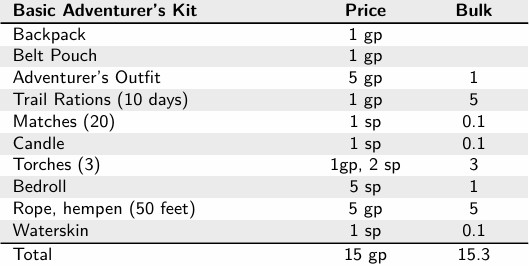
With 45gp unspent, Ragnvald can afford some extras. For starters, he’ll pick up a Basic Adventurer’s Kit (left) costing 15gp. This contains all the basics for an adventurer: a backpack and belt pouch for carrying things; durable clothing; food and a waterskin; light sources; a bedroll for camping; and the ever-useful coil of rope.
And, with almost the last of his gold, Ragnvald will buy a tinker’s kit and a stopwatch, playing into his secret fascination with clockwork. Each would normally cost 10gp, but because of his Craft perk, Ragnvald will actually have built the watch from parts at a cost of just 5gp.
Ragnvald is now well outfitted, and even has 15gp left over for incidentals on his first adventure!
Up Next
This was the last of the posts making choices for Ragnvald. The next post will be math-heavy, as we compute things like hit points, defenses, and attack and damage bonuses for Ragnvald’s weapons and powers.
 Aetrimonde
Leave a comment