
Today, following in the pattern I set with Ragnvald, I’ll be introducing our second sample character’s class (skinchanger) and picking his abilities. This character, you’ll recall, is Valdo the Bat-Eater: a horrifying hero with a background in hunting, and messily devouring, the horrible monsters of Der Eisenwald. Let’s see how he actually accomplishes this:
Class: Skinchanger
Skinchanger is not a particularly recognizable name in the milieu of fantasy classes, the way fighter, wizard, and cleric are. So I think I should start off by introducing the lore associated with the class:
Skinchangers are often misunderstood, and equally often feared, for the powers they gain by bonding spirits can be unsettling. A skinchanger’s bond allows them to draw spirits into themselves, expressing them as changes to their own body. While this is most often done with animal spirits, allowing them to sprout the antlers of a great stag or the claws of a ferocious bear, they can do this with most any spirit, allowing them to turn their skin to stone or gain the strength of an ancient warrior.
Welcoming spirits into their bodies comes with risks for a skinchanger: while the bodily transformations they provide can be helpful, some spirits will also try to impose mental changes as well. The keen senses of a wolf spirit may allow a skinchanger to track their enemies by scent, but if the skinchanger cannot maintain control of the spirit, it can also give them pack-hunting instincts, or drive them to attack anything that presents itself as prey. The side effects of a transformation grow greater when the spirit is more powerful; the mark of a practiced skinchanger is that they can resist the mental changes forced on them by the most powerful of spirits.
Of course, not all skinchangers choose to resist when their spirits try to affect their minds. Some of them feel that embracing the strange thoughts and ideas that come to them when in a transformed state allows them to better understand their spirits, deepening their bond. Others simply enjoy the thrill of the hunt when in the form of a wolf, or appreciate the beauty they see in flames when influenced by a spirit of fire.
While normally a skinwalker’s mental changes are as transitory as the physical ones, there is a danger that they may become permanent, especially if a skinwalker embraces them, or repeatedly comes under the influence of an especially powerful spirit. Once this happens, they often experience a rapid decline into an inhuman mindset, becoming something other than simply mortal.
The skinchanger class takes part of the lore associated with the druid class of D&D, that being their ability to transform into animals (and other forms, but it is most strongly associated with, and has the most mechanical support for, turning animals). The druid has traditionally been a very broad class with a ton of features letting them fight as well as a fighter when transformed into an animal, plus cast spells almost as well as a cleric or wizard when not. In the interest of having more well-defined classes, I’ve split the druid’s traditional niche apart into the four Spiritual classes, each with a different focus.
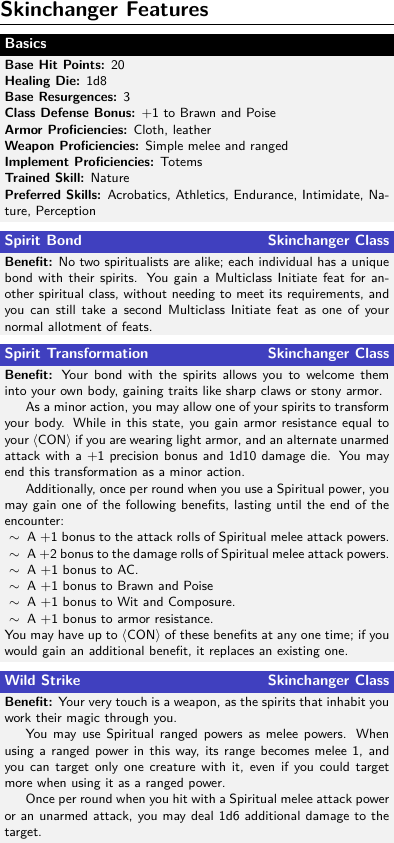
Let’s take a look at their class features: I’m going to go into more detail here than I did for the fighter class, because I think the skinchanger class is going to be less self-explanatory.
Basics
The skinchanger is a lot more fragile than the Fighter. With only 20 base hit points, 3 base resurgences, and 1d8 healing die, it is, on paper, about as tough as a Rogue. However, its features give it a surprising amount of durability in practice…
Skinchangers gain +1 to Brawn and Poise, based on the resilience and agility of animals. They gain proficiency only with leather armors and simple weapons, but (as with all Spiritual classes) they are also proficient with Totem implements used with Spiritual powers.
Finally, skinchangers are trained in Nature, and gain a variety of preferred skills suited to surviving in the wilderness (plus Intimidate, which is a natural extension of being able to sprout fangs…).
Spirit Bond
All four Spiritual classes gain the same Spirit Bond feature (much as all Martial classes gain the Martial Endurance feature). Spirit Bond gives a skinchanger an extra feat, which must be a Multiclass Initiate feat for another Spiritual class. But what does that mean?
D&D typically allows multiclassing by taking individual levels of a class. Which is to say, a 4th level character could have 4 levels of fighter, or 2 of fighter and 2 of wizard, or whatever combination you can think of. D&D 4e was an exception to this, and is in fact what I based Aetrimonde’s multiclassing on, with some departures.
In Aetrimonde, you will always be a member of your original class first and foremost, but you can, by taking multiclass feats, gain some of the features of a second class. Spirit Bond gives Spiritual characters a head start on this process, and does not prevent them from also multiclassing to a third class (which would normally not be allowed). Part of the theme of the Spiritual classes is that they are versatile, and Spirit Bond gives Spiritual characters a broader set of tools from level 0.
Multiclassing Details
Multiclassing as far as possible takes a total of up to four feats:
- [Martial/Arcane/Divine/Spiritual] Dabbler: Makes you count as a member of a class from the appropriate power source, just not any class in particular. (You can take powers of the associated power source and feats requiring to to be, e.g., “Any Arcane class,” but not feats specifically for wizards.) Also grants appropriate weapon and implement proficiencies.
- [Class] Initiate: Makes you count as a specific class from a power source you already have, and grants a version of one of their class features, with added restrictions on how often you can use it. The Dabbler feat is a necessary prerequisite if multiclassing to a class from a different power source than your original one.
- Multiclass Adept: Grants an additional class feature from your secondary class (or, in some cases, removes a restriction from the Initiate feature).
- Multiclass Mastery: Removes the restrictions from the class features gained from the Initiate and Adept feats.
Importantly, multiclassing will never give you another class’s “signature” feature: you can never gain Martial Endurance if you didn’t start out as a Martial character or Spirit Bond if you didn’t start out as a Spiritual character (and you can’t get them a second time if you did). These are powerful features, and it helps preserve class identities to make them unique to characters that started as that class (rather than being available at the cost of a few feats).
Spirit Transformation
The first of the skinchanger’s two unique features contains two parts: firstly, a skinchanger can enter a transformed state where they gain some pretty significant armor resistance and an alternate unarmed attack (which isn’t actually as good as Valdo’s Carnivorous Bite, but still…). The armor resistance is not a bonus, and does not stack with other sources of armor resistance (like hide armor, for example), but with even modest investment in CON this can give Valdo AR on par with plate armor.
But the meat of Spirit Transformation is the ability to gain a shifting array of bonuses as Valdo uses Spiritual powers. There are 6 bonuses to gain, of which Valdo can keep up to CON at once. (It is becoming apparent that Valdo will want to have good CON for a variety of reasons.) This allows Valdo to tailor himself over a few turns to whatever enemies he winds up facing.
The second part of Spirit Transformation ties into another part of the theme of Spiritual characters, which is growth. All four Spiritual classes have a class feature of this nature, that gets more powerful as they use Spiritual powers, and many Spiritual powers themselves have effects that get bigger or more powerful over time.
Wild Strike
The skinchanger’s second unique feature also has two parts to it. Firstly, it allows a skinchanger to use some Spiritual powers that would normally be long-ranged as melee attacks. Why would this be a good thing? Because using a ranged power while tied up in close combat normally leaves a character open for opportune strikes. Being able to use these powers as melee attacks gives the skinchanger a wider range of powers they can realistically use.
And, this ties into the second half of the feature, which grants the skinchanger additional damage with Spiritual melee attack powers and unarmed attacks. In the interest of clarity, I’ll confirm here that this additional damage applies to attacks using Valdo’s Carnivorous Bite and Spirit Transformation unarmed attacks, and to Spiritual ranged powers that Valdo uses as melee powers via the first half of this feature.
Several other classes have additional damage features like this, including the rogue’s Sneak Attack, the warlock’s Law of Contagion, and the crusader’s Vengeful Oath. The amount and circumstances of additional damage varies by class; Wild Strike is the easiest source of additional damage to gain, but provides the smallest amount of damage.
Abilities
Next up, let’s pick Valdo’s abilities.
I haven’t shown any Spiritual powers yet, but they will use Wisdom in their attack and damage rolls, and either Constitution or Intelligence, depending on the type of power, for secondary effects. Valdo will want Constitution over Intelligence: this is partly because of his class features, partly because the powers that work best with Wild Strike will mostly use Constitution, and partly because as a melee-focused character with rogue-level toughness, he needs the extra hit points.
To get +4 WIS, without WIS being a preferred ability, will cost 10 ability points. However, CON and INT are both preferred abilities, so Valdo will pay another 3 points for +2 CON, boosted to +3, and 1 more point for +1 INT boosted to +2.
We have positive abilities contributing to Brawn, Wit, and Composure so far, so to round it out, let’s also pay 1 ability point for +1 GRA so that he also has decent Poise. This will bring our ability point cost to 15 points, so we’ll now need to drop two abilities.
I’ve settled on Valdo being well-intentioned but off-putting, so giving him negative CHA is fitting. I think that he should have at least +0 CUN, since the backstory I’ve written has him survive hunting vampires, and while he doesn’t strictly need STR to use Spiritual melee powers, negative STR would make it especially difficult for him to actually use his unarmed attacks. So, let’s also drop DEX to -1.
All told, Valdo will have the following abilities, using up his 13 ability points:
| +0 STR | -1 DEX | +0 CUN | +4 WIS |
| +3 CON | +1 GRA | +2 INT | -1 CHA |
Up Next
The next post on Valdo will be a short one covering his skills, perk, and languages. Stay tuned!
 Aetrimonde
Leave a comment