
In the second part of this week’s introduction to Faerie, I’m going to cover some Sidhe-themed feats powers that I at one point considered for inclusion in the core rulebook, for Arcane characters, before ultimately shelving them. They might eventually see daylight as part of a Faerie- or Arcane-themed supplement, but for now, they remain apocrypha.
At one point, much earlier in development, Aetrimonde’s warlock class was centered around pacts with otherworldly entities such as the fae. (Much like D&D’s warlock, in fact.) While I’ve since backed off of that characterization, at the time I had written the predecessors these powers to be spells that warlocks and other arcanists could take to become vaguely fae-themed. The powers I’m presenting here have received a brief rewrite to catch them up with how the Aetrimonde system has evolved since then, but are true to the spirit of those early powers.
Sidhe Powers
In general, the magic of the Sidhe is based around three pillars: trickery (deceiving the mind), glamour (deceiving the senses), and compulsion (controlling the mind). Individual Sidhe may have other magics, but any Sidhe can be counted on to have some magic related to one of these three pillars.
Trickery
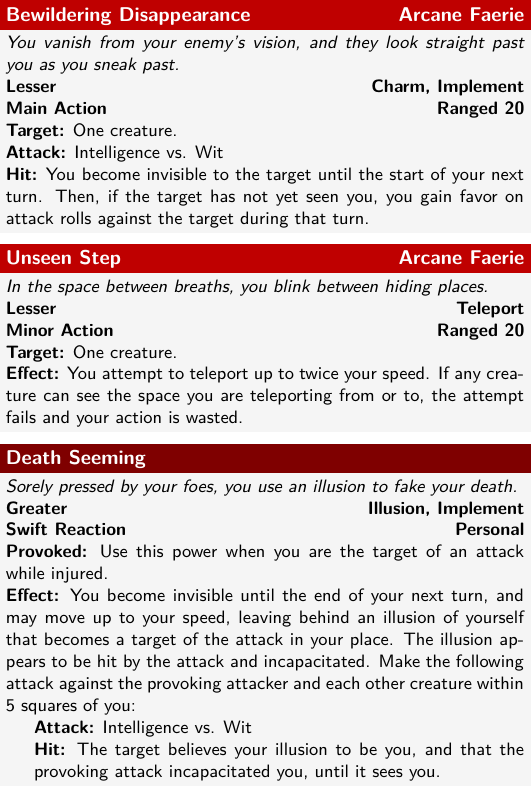
The Sidhe are fond of invisibility: not merely so that they can attack from hiding (although yes, they will do that too), but so that they can observe mortals unseen, pick apart their flaws and vulnerabilities with taunts and cutting remarks, and drive them to rash action or self-pitying inaction. And, worst come to worst, they will happily fake their deaths and run away to fight another day.
Bewildering Disappearance is a power designed to enable an ambush on a single creature. Aside from granting invisibility (against that creature only) so that the user can get close without causing alarm, it also grants favor on attack rolls if the user can avoid being spotted until their next turn.
Unseen Step is a versatile utility spell, letting the user teleport a long distance with just a minor action. It has one drawback, in that it doesn’t work if the user is being observed, or trying to teleport somewhere that is being watched. So, it is more useful outside of combat than it is during it. Also, as one of my playtesters worked out, that very drawback can provide useful information: if it doesn’t work, then you know that either something is watching you (useful when you suspect an ambush), or something is watching where you intend to go (similarly useful to avoid teleporting into an ambush).
Death Seeming is the ultimate escape spell: usable as a Swift Reaction, taking place before you are hit by an attack that might drop you to 0 hit points, it gives you some brief invisibility, lets you escape the attack, and to cap it all off, leaves behind an illusion that can convince your attacker and other nearby creatures that they actually did kill you. From a GM’s perspective, this is a great power for recurring villains, because it gives them an out to avoid being killed prematurely. For players, it’s a great emergency backup plan if they get overwhelmed.
Glamour
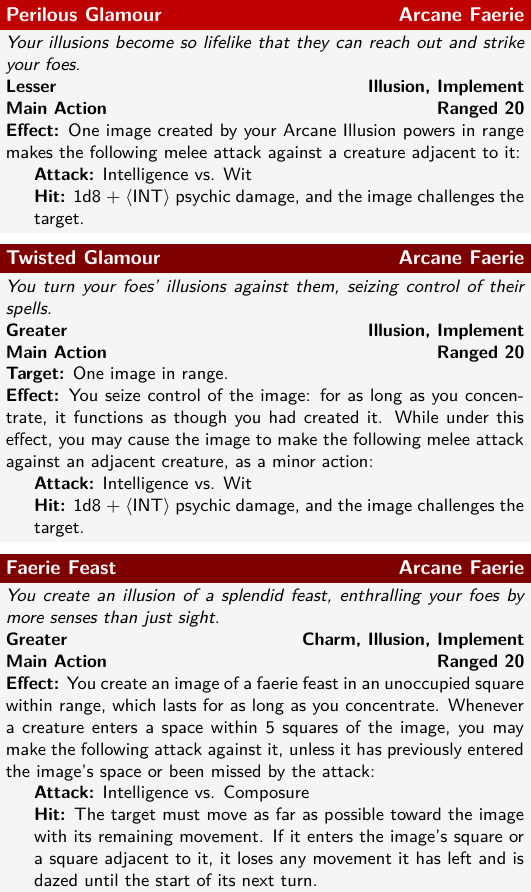
The Sidhe are also fond of glamour: loosely defined, a kind of illusion that changes what objects seem to be. Not necessarily what they actually look like (although again, the Sidhe will do that too…) but how people perceive them. Glamour can make an armored warrior seem harmless, or a worthless crust of bread seem like a feast. It can also make illusions so real as to actually cause harm…
Illusions in Aetrimonde
Without going into unnecessary detail, many Illusion powers create images, which are not creatures but work like them in many ways:
- Images occupy a space, typically one square.
- Images can be attacked like a creature, and are automatically hit when attacked, but are unaffected by attacks.
- Images do not take their own turns.
- The powers that create images often allow the power’s user to make attacks using the image as a point of reference. (The attack originates from the image, not the user.)
- Creatures believe an image to be real if they are under the effect of the power that created them. Realizing that an image isn’t real may not have an effect in some cases (such as that of the Illusory Wall, which still blocks line of sight).
- Creatures with truesight can see images for what they are.
Perilous Glamour is meant to be used in conjunction with other Illusion powers: it allows an image created by other Illusion powers to reach out with a sword or a claw and attack someone with such verisimilitude that they actually bleed. (As a GM, I have to choke back an evil chuckle at the idea of a dungeon full of non-damaging illusions…followed by an encounter with a Sidhe who can make those harmless illusions fight back.)
Twisted Glamour is, yes, a twist on Perilous Glamour, representing the Sidhe’s command of illusion: they can seize control of other magicians’ illusions, turning them to their own ends and coincidentally, letting them lash out in the same manner as Perilous Glamour.
Faerie Feast is a more straightforward Illusion power, creating an image that draws enemies towards it. This can be used to sidetrack enemies, by placing it to the side where it will pull enemies away from their charge, or just to get them to bunch up around the image so that they’re perfect targets for a Fireball. Notably, the power doesn’t work indefinitely: once missed by the power’s attack, targets are immune, as are targets that actually make it into the image’s space (since they then discover that the Faerie Feast is an old crust of bread, if there was actually anything there at all).
Compulsion
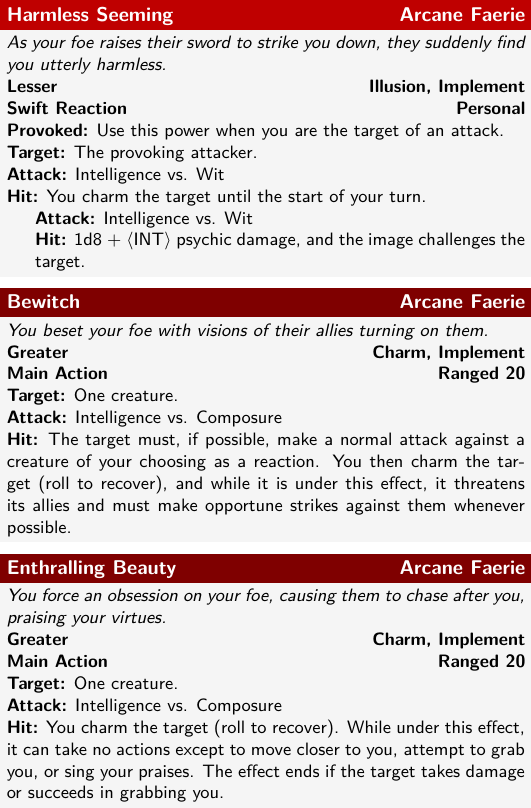
The final kind of Sidhe magic is one that they fall back on when deceiving the mind or the senses doesn’t work: it simply compels obedience, or forces creatures to act in a way that suits the Sidhe’s purposes.
There are already a number of Arcane spells that charm or dominate creatures: I won’t get into those here. Sidhe magic has some unique variations on those spells, which can be summed up as “charm with added effects.”
Charm in Aetrimonde
Charmed is a common condition in Aetrimonde. When charmed:
- You are flatfooted against the creature that charmed you.
- You have disfavor on attack rolls against the creature that charmed you.
- The creature that charmed you gains favor on Charisma, Deception, Intimidate, and Persuasion checks against you.
- A charmed creature is unaware that it has been charmed until the effect wears off, and may react unfavorably afterwards.
Harmless Seeming is a reactive Charm spell, letting the user perhaps avoid being hit by an attack, because if it is successful, the attacker then has disfavor on the provoking attack. Unlike a lesser Charm power that did make it into the core rulebook, Harmless Seeming doesn’t keep the target charmed long enough for the user to gain favor on any attack rolls against them.
Bewitch is a Charm spell with the added benefit of making the charmed creature a danger to their own allies. Best used on a group of enemies who have huddled up defensively, it encourages other enemies to distance themselves from the target. (And to be careful when doing it, lest they provoke opportune strikes.) This is great for disrupting enemies that gain benefits from being adjacent to each other.
Enthralling Beauty is another Charm spell with a rider, in this case, drastically limiting what actions the target can take. It does generally come at the cost of making the target zero in on the user…but the Sidhe are generally competent enough not to mind this terribly. A mobile character can use this to lead their target on a merry chase, keeping them completely occupied.
So Why Are These Apocrypha?
At this point you may be wondering why these powers have been relegated to apocrypha and maybe a later supplement. They’re not extraordinarily weak or powerful compared to other powers I’ve shown off (although I realize that I haven’t yet shown off the Arcane powers that are the most direct comparison, so it’s fair to reserve judgement on that). So what gives?
Ultimately, it comes down to two things: flavor and mechanics.
Flavor-wise, I eventually decided that powers in the core rulebook should be relatively generic, so as to make them suitable for as many character concepts and campaigns as possible. These fae-themed powers (and their demon-, undead-, and eldritch-themed counterparts didn’t make the cut, because they were too specific in flavor.
And mechanically, I found that some of these powers (in particular Bewildering Disappearance, Unseen Step, and Death Seeming) would complicate things for a GM: Bewildering Disappearance would require the GM to keep track of which creatures can and cannot see the power’s user, Unseen Step would require the GM to know whether specific squares are being observed at any time (and could also reveal ambushes anticlimactically, which reduces GMs’ freedom to write plots…), and Death Seeming would again require the GM to keep track of which creatures do and don’t think that the power’s user was dead. So I erred on the side of less mechanically-complicated powers, in general.
To be clear, I think there’s absolutely room for powers like this in Aetrimonde…I just don’t know that the first book, which I think should generally be relatively simple and balanced, is the place for them. Hence, why I would plan to put them in a supplement later on.
 Aetrimonde
Leave a comment