
Today, I’m going to talk about the first of Aetrimonde’s subsystems, ritual magic.
I’m defining subsystems to mean parts of the rules that not all characters will necessarily interact with, or interact with in a deep way. Everything I’ve revealed so far (heritage, class, skills, perks, feats, powers, equipment, even how enemies work…) is common to all characters. Ritual magic is not: it’s something that a character must opt into by taking a specific feat or purchasing ritual scrolls. So let’s take a look:
The Purpose of Ritual Magic
One of the design goals I’ve discussed for Aetrimonde is Tactical Combat. But, that doesn’t mean that an Aetrimonde campaign should revolve entirely around combat: it’s merely something that the system is designed to be good at handling. Various game designers and ludologists have discussed the “pillars” of RPG gameplay, which can be summarized as combat (fighting things), interaction (talking with NPCs, trying to suss out their motives or persuade them to do things), and exploration (experiencing interesting places and ideas, uncovering secrets, solving puzzles).
On the player side of the table, Aetrimonde handles interaction and exploration largely through its skill and perk systems. (And it also provides the GM with advice and tools to set up interesting people, places, and challenges.) Ritual magic is an extension to the skill system, allowing characters additional uses for skills. Because interaction and exploration usually take place outside of combat (although I personally enjoy creating the occasional encounter where they overlap), I’ve designed the ritual magic subsystem with the following goals:
- It should be entirely optional, and not built into any character.
- It should not significantly eat into character-building resources used to make a character better at combat (feats, powers, etc.).
- It should offer characters new ways to interact with NPCs or the setting.
- It should not make ordinary skills and perks obsolete, and should in fact rely on skill and ability checks (which can benefit from perks).
- It should generally be difficult to use during combat, but if the PCs put together a plan for it (or the GM sets up an opportunity) it should be possible to do so.
With that in mind, let’s take a look at the implementation:
Ritual Mechanics
The rules for using ritual magic take up an entire page in the rulebook, but that covers virtually all aspects of learning and using rituals.
Ritual Magic Rules
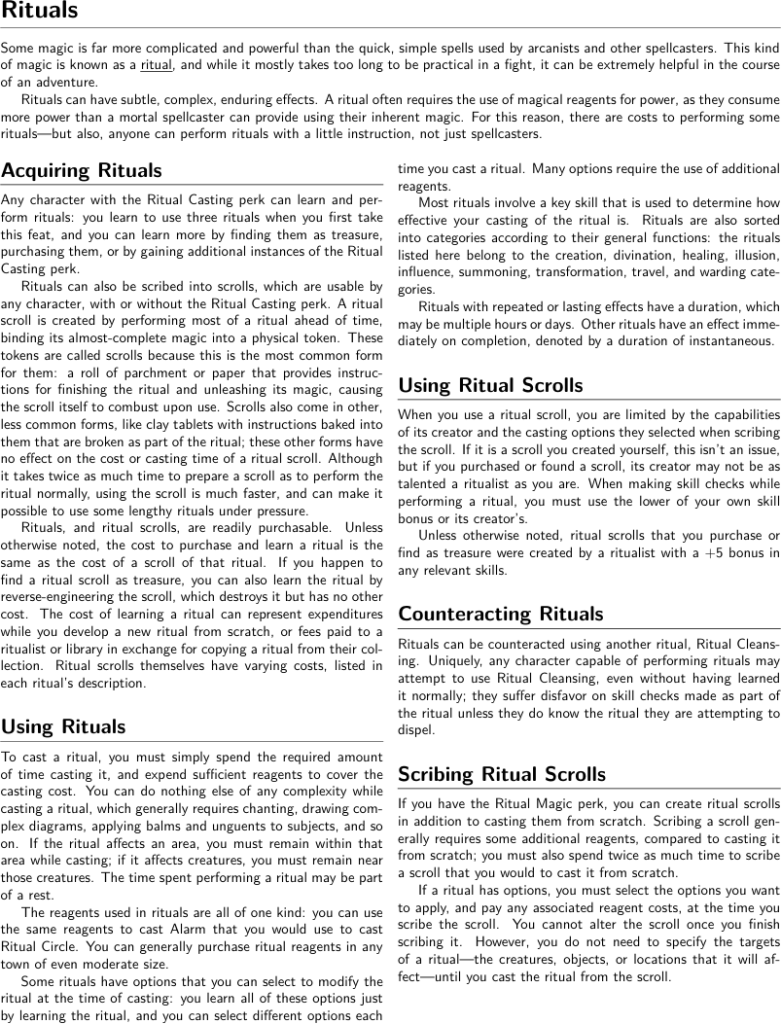
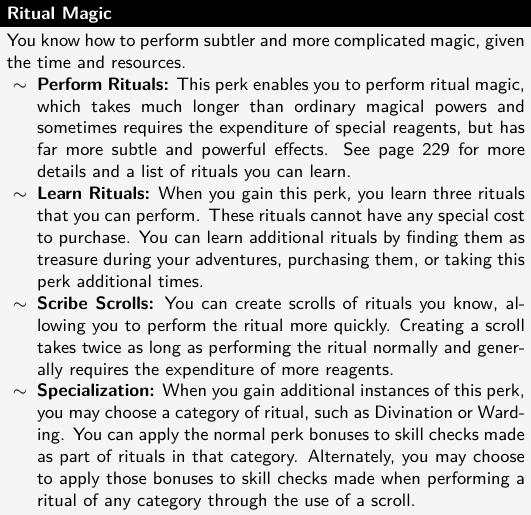
I’ll also put the actual perk that a character would take to learn ritual magic here: a character who wants to specialize in ritual magic can take this perk multiple times to not just learn several rituals, but also to specialize in certain kinds, applying the benefits of the perk to such rituals.
The meat of the ritual magic subsystem is the rituals themselves, so I’ll reveal a few of them here.
Cure Injury
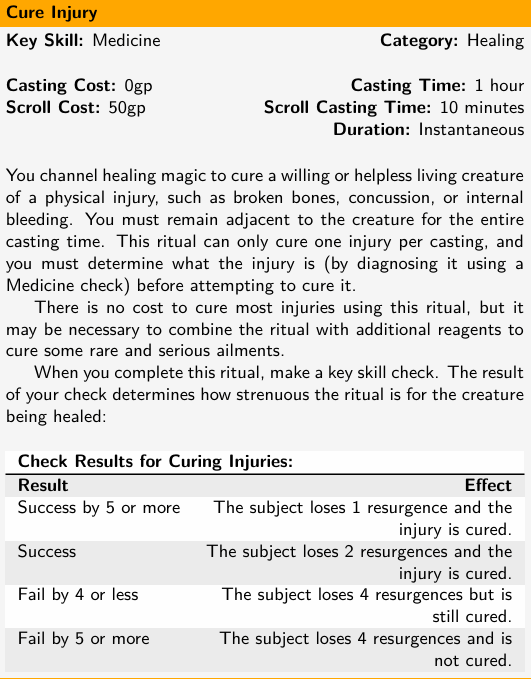
I previously alluded to a Cure Injury ritual when I was discussing afflictions: some of the examples I provided there mentioned that, if the affliction worsened too far, the only way to remove the affliction was with this ritual. So, I’ll start there:
Cure Injury allows the caster to (hopefully) heal their or an ally’s injury in a mere hour, rather than waiting for it to heal naturally. This has a cost: not a monetary one, unless using a scroll to cure the injury in 10 minutes, but in resurgences: healing an injury so rapidly is stressful for the body, and depending on how well the caster performs the ritual, it can drain the beneficiary of resurgences in the process. If the caster performs especially badly (or it was a really nasty injury, the ritual may even fail to work while still draining the patient. As such, Cure Injury is not necessarily the go-to answer to an injury: it is best reserved for injuries that it is urgent to get rid of, or that have progressed so far that there is no other way to heal them.
I’ll also mention, while I’m at it, that there are two other, very similar rituals: Cure Ailment cures poison and disease, while Dispel Curse breaks curses.
Open Planar Crossing
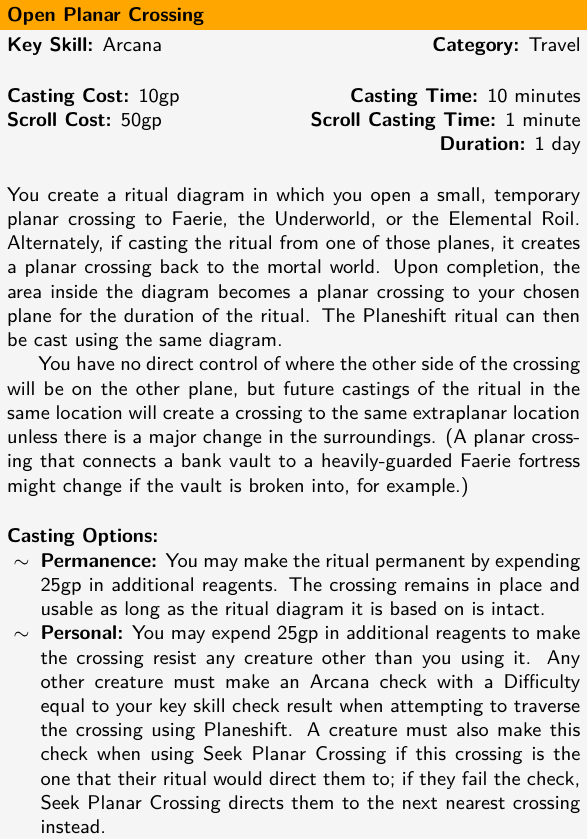
I’ve also recently mentioned the Planeshift ritual and planar crossings. I won’t actually go into the mechanics of Planeshift here, because it’s actually really straightforward and I want to cover some more interesting rituals. Open Planar Crossing allows the caster to tear open their own planar crossing wherever they please. And while they won’t have control over where the other side of the crossing is, it will get them to their plane of choice.
Open Planar Crossing is partly a tool for GMs, allowing them to easily explain why, for example, a bunch of elementals have appeared out of nowhere to trash a small town: some villain in the Elemental Roil opened a crossing to invade the mortal world, and that’s where it popped up.
It is also another ritual giving PCs rules for building something: with a little bit of work (and the cooperation of the GM), a group of PCs can search out an appropriate place to open a planar crossing that will put them near to where they want to go on another plane. Or, with a bit more work…they can open an entire network of crossings, located in convenient places to let them travel long distances by passing through other planes as a shortcut.
Dowsing
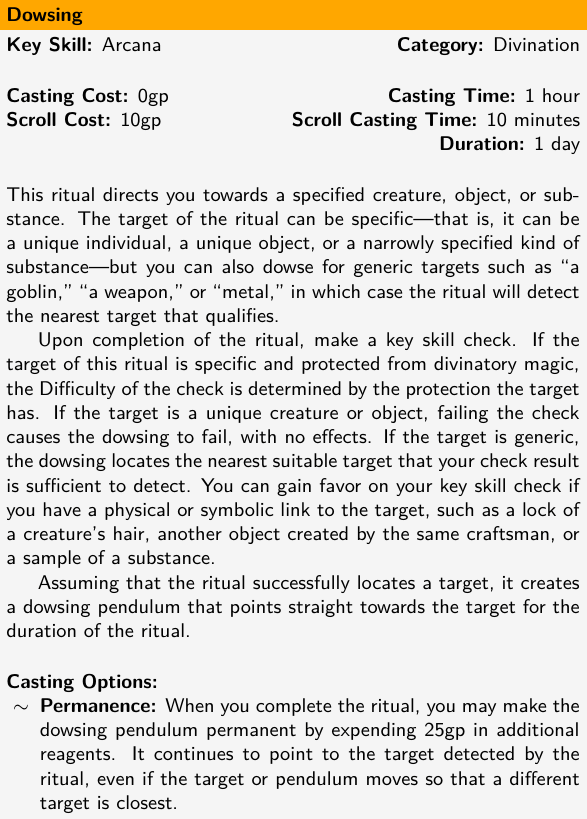
Dowsing is a neat utility ritual for PCs, allowing them to easily track down something they’re looking for. This is common enough in many TTRPGs, but I’ve attempted to do two things with it.
First, I’ve tried to make the ritual generally applicable. D&D, in its many editions, has had oddly specialized spells like Locate Creature, Locate Object, Locate Animals or Plants, Locate City, Locate Water, and Find Traps. Dowsing is, instead, generally applicable, able to find anything from “iron ore” to “my buddy Fred.”
And secondly, I’ve stylized the ritual. Rather than magically giving the caster knowledge of the location, or even just direction, of what they’re looking for, it create a dowsing pendulum that points them in the right direction. This is perhaps less instantly useful (they have to follow the pendulum until they get to what they’re looking for), but it’s also more helpful when trying to track down a moving target like a fugitive.
Alarm
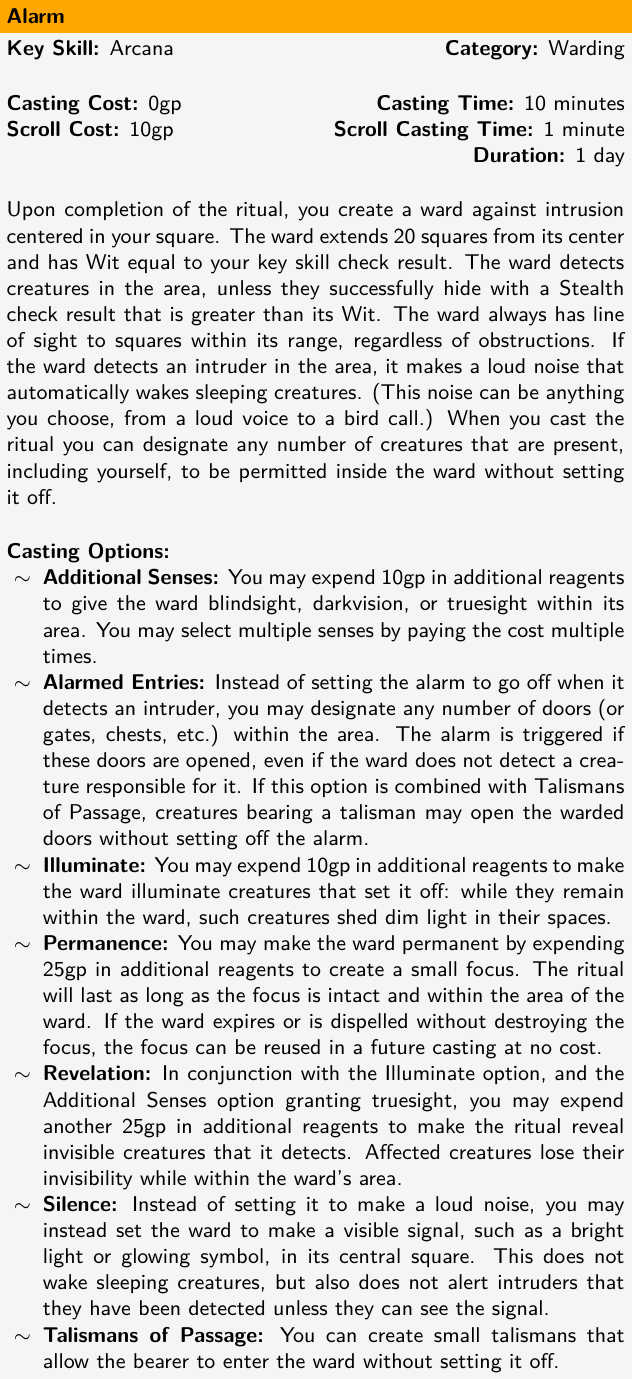
The last ritual I’ll present today is Alarm, which is an excellent example of just how flexible Aetrimonde’s rituals can be (and that’s convenient, because it’s also the alphabetically first in the book).
The basic version of Alarm is simple: it creates a sensor that watches over a large area and makes a loud noise if anyone enters the area: great for watching over a campsite if the party is too tired to keep a constant watch, or the terrain would make it easy to sneak up. But, the true value of Alarm is in its casting options: for an additional expenditure of reagents, the ritual can be made to:
- Spot creatures that are invisible, shrouded in complete darkness, or hidden by fog.
- Watch for doors being opened instead of watching for unknown creatures.
- Cause intruders to glow so that they are easier to spot, or even break their invisibility.
- Last indefinitely.
- Alert guards with a visible signal instead of an audible one.
And the last option, I will spend some additional time discussing, because it’s an example of what you might call a sub-subsystem. Many rituals can create talismans (of Passage, of Compulsion, of Interaction, etc…) that alter how the ritual works. The purpose of talismans is to provide some lightweight rules for plot tokens like the magical key that opens the warded door to the villain’s secret passage, or the cursed necklace that allows an evil wizard to possess the wearer. And those rules work for PCs, not just the GM: if they want, players can use Alarm and various other rituals to ward and enhance a home base for themselves, and talismans give them a way to have a “key” to their wards.
Up Next
Part of why I’ve covered ritual magic now is so that I can now present my next post, which will be another Apocrypha post, this time on the subject of Faerie rituals. Stay tuned!
 Aetrimonde
Leave a comment