
Now that I’ve covered Aetrimonde’s ritual magic subsystem, in my previous post, I’m going to jump into some borderline-apocryphal rituals, themed around the plane of Faerie, that are in limbo and may or may not make it into the core rulebook. Why this indecision? Well, mainly, I’m not yet satisfied with the quality of the rituals I’ve written up for the other planes, and I’d prefer not to favor Faerie. So unless I can make some improvements to the other planar rituals by the time I’m ready to publish the core rules, I’ll be saving them all for later supplements, much like the Faerie powers in my previous Apocrypha post.
Beggar at the Feast
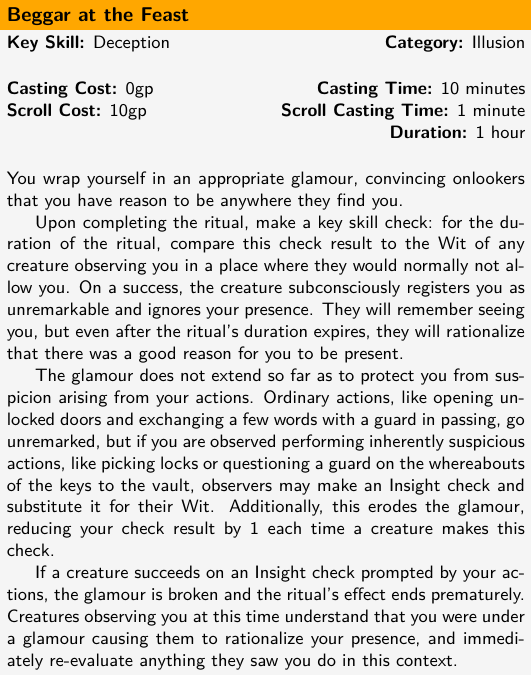
This ritual is inspired by fairy tales about kings going incognito among their people and witches showing up uninvited to a feast. It makes the caster so bland and unremarkable that anyone who sees them, no matter how out of place they are, rationalizes and ignores their presence.
Now, I mentioned in my first post on ritual magic that I didn’t want rituals to obviate ordinary skill checks and perks. So does Beggar at the Feast make skills like Deception, Disguise, and Stealth obsolete for sneaking around? I’m going to say no, but let me walk through my reasoning:
Firstly, while Beggar at the Feast makes a character less remarkable, it doesn’t actually help them get into places that they shouldn’t be: it doesn’t open locked doors, much less castle gates, and so in order to make use of it, there needs to be an existing path to where a character needs to be. This is a plus in my view: it creates opportunities for the PCs to work together to, for example, draw out a bunch of guards so that one of the PCs can go back inside with them under the effect of Beggar at the Feast.
And secondly, Beggar at the Feast actually makes it harder, or at least riskier, to do things like pick locks or pump guards for information. A character relying on regular old Stealth and Deception checks could feasibly talk their way out of trouble if they get caught; if Beggar at the Feast breaks, everyone looking at them (not just the guards, everyone) immediately realizes that they had been placed under a glamour, and that’s the sort of thing that makes a lot of enemies.
In all, Beggar at the Feast is a specialized tool: great for sneaking into exclusive parties and eavesdropping on private conversations, not so great for robbing vaults or springing allies out of jail.
Dolmen Door
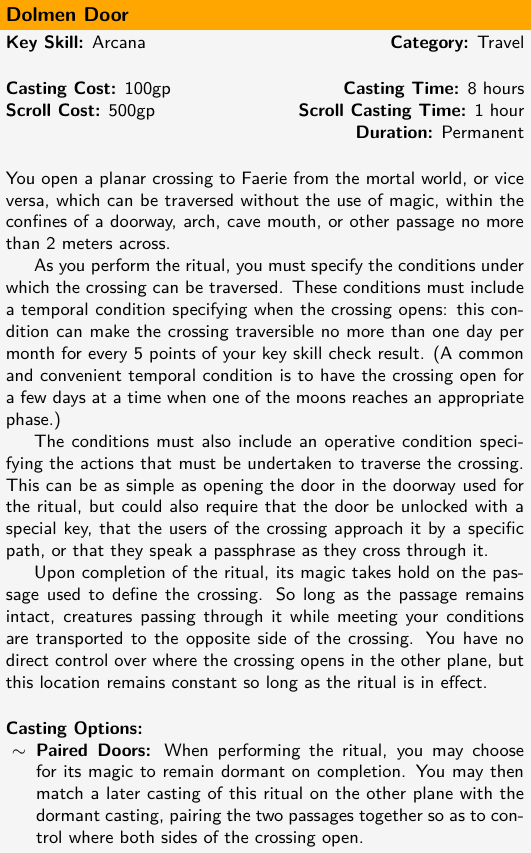
I previously showed off the Open Planar Crossing ritual, which is one way to create crossings into Faerie and other planes. Dolmen Door is another: more expensive, in terms of reagents, with more restrictions, but if used with planning and forethought, potentially more powerful.
This ritual was designed specifically to replicate a Narnia-style portal to another world: a door that can be opened (or a cave that can be walked through, or any number of variations) under the right circumstances to cross into another plane. It can be used by anyone, with no need for magic (and for any GMs reading, that makes it a great tool for any Sidhe wanting to move an army into the mortal world…), but it also offers tools to control who can use it through passwords, keys, and other conditions that can be placed on the crossing.
Dolmen Door also offers a way for the caster to control where both sides of a crossing are, which isn’t easy to achieve with other methods of planar travel. This does require performing the ritual on both sides, though…which makes a great premise for an adventure, in multiple ways:
- The villain is trying to infiltrate a stronghold to place the other end of a Dolmen Door; they have a scroll, so it will only take them an hour, but that’s an hour that they need to remain uninterrupted. The PCs need to search the stronghold and find where the villain is performing the ritual.
- The PCs themselves want to open a passage into Faerie (perhaps to evacuate refugees from the Sidhe, or move troops in to support a rebellion). They need it to go to a specific place in Faerie, and that means that they will need to cross into Faerie themselves and make the journey to where they will perform the ritual.
The one big downside to Dolmen Door is that it only makes a functioning crossing for a few days per (35-day) month. Which is, actually, another great thing from a GM’s perspective, because it allows creating time pressure. (“There is a passage that will take you near to where you must go in Faerie…but once you cross, you must return within three days, or else you may be trapped for years…”)
Fool’s Bounty
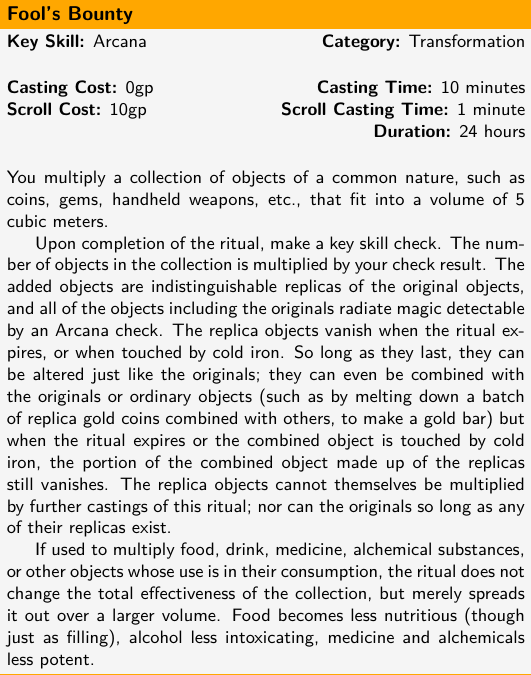
Where do leprechauns get all that gold, anyways? With Fool’s Bounty, we may have an answer. The ritual multiplies ordinary objects (and coins are one of the suggested options…), creating a vast number of temporary replicas. With a good Arcana bonus, and some luck, a caster could easily multiply their available cash by 20 or more, making it a scoundrel character’s dream.
Of course…there are some subtle pitfalls here, which I’ve gone to pains to insert. (It’s not called Fool’s Bounty for nothing.) Firstly, the ritual makes all the duplicated objects radiate detectable magic. Is every merchant that the PCs want to spend money with going to be able to detect that? Well, no, the provisioner at the general store and the barkeep in the grimy tavern probably won’t have the means to check coinage for magic…but in the far more likely scenario (based on my experience of TTRPG player psychology) where a PC is trying to cheat a merchant of magical items out of a valuable weapon, that merchant is probably able to detect magic, or has a piece of cold iron available. So if the PCs want to pull a scam with this ritual, they’d better come up with a clever one.
Secondly, the ritual makes identical replicas. So, if the PCs are planning on replicating their weapons to arm a bunch of villagers against raiders…they’d better keep track of which weapon is the real one, lest they find themselves abruptly unarmed 24 hours later.
The last restriction on Fool’s Bounty is one that I added mainly for flavor (though, also, to prevent the PCs replicating healing potions or alchemist’s fire). You can’t live on food replicated by Fool’s Bounty, unless you want to eat vastly more of it. Which is the basis for another plot: mortals ensnared by the Sidhe, and kept trapped in a neverending night of feasting and dancing, slowly withering away no matter how much they eat… Someone should probably write an adventure about that.
Up Next
These aren’t the only Faerie-themed rituals I’ve written, but I think they provide a good taste of what I’m going for in ritual in general: fun, useful, powerful…but not something that trivially solves an adventure without the need to think about the problem.
This is the last of my Apocrypha posts for the time being: next Wednesday will be the first post in the creation of elf artificer, Gwynne of House Midwinter.
 Aetrimonde
Leave a comment