
Today, I’m starting in on the creation of a third sample character: Gwynne of House Midwinter! Gwynne is an elf artificer, a combination I picked out in response to reader polls. So, as is my wont, I’m going to spend this first post in the series discussing Gwynne’s heritage:
Ancestry: Elf
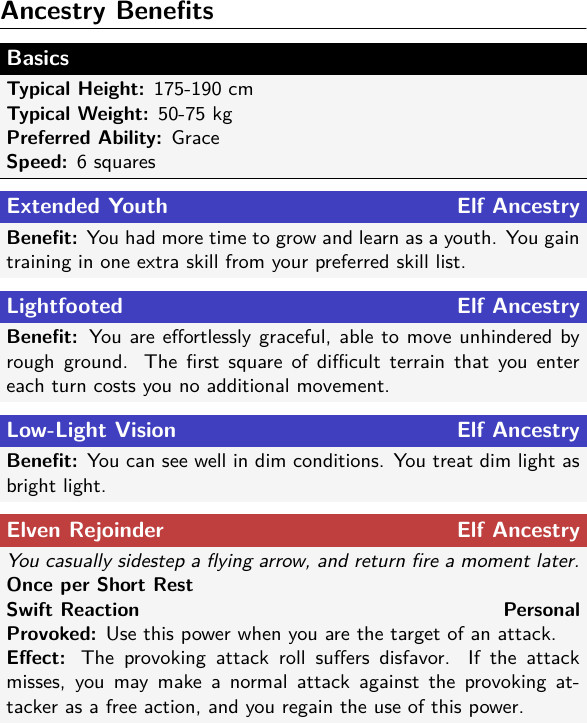
Aetrimonde’s elves are a toned-down version of the Tolkienesque model common to a lot of RPGs: long-lived, but not immortal; lithe and graceful, but not superhumanly so; inclined to magic, but still with a normal mortal’s potential for it.
Basics
With Grace as a preferred ability, elves will have slightly better Poise defense, as well as Armor Coverage if wearing light or medium armor. Grace also influences safe movement, which synergizes with the Lightfooted trait that we’ll get to in a moment. And with a perfectly normal speed of 6 squares, elves can easily be quite mobile.
Extended Youth
Representing elves’ long lifespans, which see them reach maturity at around 25, Extended Youth allows elves to be trained in an additional skill from their preferred skill list.
Lightfooted
While it doesn’t directly increase elves’ speed, Lightfooted allows elves to move a little further through difficult terrain like brush, mud, and shifting sand, which normally costs twice as much movement.
Low-Light Vision
This works just like the versions associated with dwarves and ghouls. I should stress that not every ancestry has low-light vision! It’s a mere coincidence that all three ancestries so far have had it…
Elven Rejoinder
The elf ancestry power is Elven Rejoinder, allowing an elf to attempt to resist an attack and respond with a counter. While the flavor text describes gracefully dodging a physical attack, it does also work on attacks vs. Wit or Composure.
While the rules do not touch on this, the way I would try to run this and similar powers at the table is that the player of an elf character must declare their intent to use this power before the attack is rolled: it does not allow a player to force disfavor on an attack roll after seeing the roll, much less after the GM has determined the effect. However, this requires the GM to be consistent about declaring who is being attacked and giving the player a moment to decide to use the power before they actually roll dice. Depending on how a group prefers to play, they might be more lenient about when the power must be used.
Like Dwarven Stubbornness and Ghoulish Tenacity, there is a way for elves to regain this power, which is to be missed by the provoking attack. That’s a little more up to chance, but it can be made more reliable using a feat, which we’ll see in a couple of weeks.
Culture: Caras Elvaren
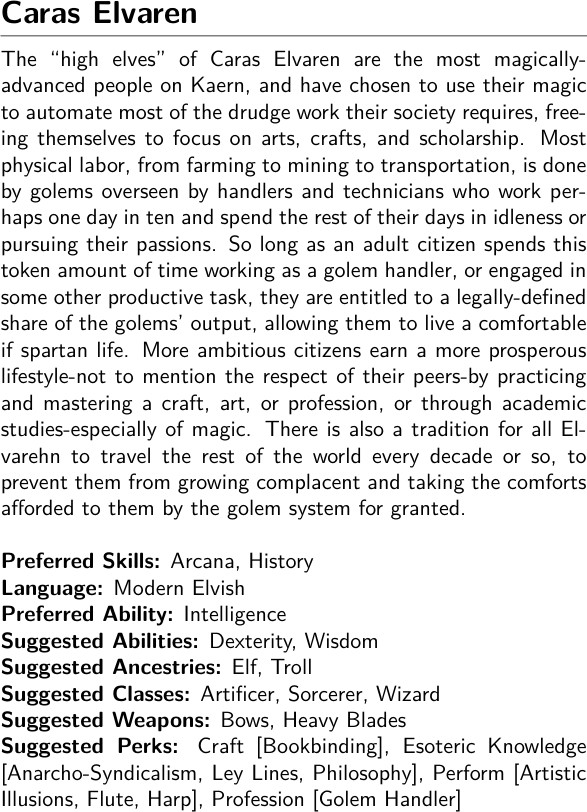
Since Gwynne is an artificer, using Arcane magic, I’m going to design her to fit the “high elf” archetype. In Aetrimonde, “high elf” is a cultural distinction, not a racial one: the high elves are those elves who live in the nation of Caras Elvaren, which is the world’s most magically advanced society. While it isn’t quite post-scarcity, Caras Elvaren is certainly post-hardship: past generations of Elvaren wizards and arcanists poured their magical efforts into building an automated golem labor force, which by the setting’s present day has grown to the point that the nation has eradicated hunger, homelessness, and virtually all drudgery.
I’ll be revealing more about the nation of Caras Elvaren in some upcoming posts, the same way I did with the Dwarven Federation.
The Caras Elvaren culture gives Gwynne Intelligence as a preferred ability, which is great: Arcane magic keys off of Intelligence foremost, so this will give her an advantage here.
Stratum: Technician
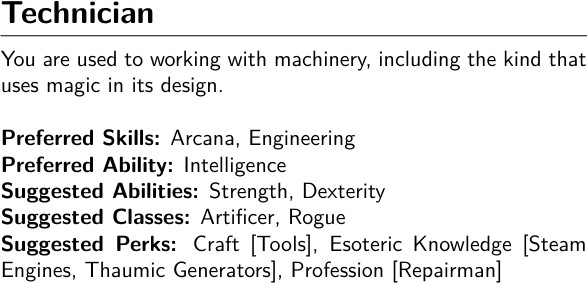
And finally, Gwynne will come from the Technician stratum, representing the class of skilled laborers who work with magic and machinery (which are often intertwined in Aetrimonde).
This gives Gwynne a second instance of Intelligence as a preferred ability, which sort of locks her choices in: since she will want to boost Intelligence, and her only other preferred ability is Grace, she’ll also be boosting it as well.
Tying It Together
So how do we fit all this together into Gwynne’s backstory?
Because Caras Elvaren is so much more magical, and more prosperous, than the rest of Aetrimonde, I’m going to write Gwynne as someone who wasn’t always an adventurer: she’ll be an older elf, closer to middle age (so around 150…), and formerly a small-time artificer who built “ordinary” magical things that the high elves would take for granted but would be extraordinary elsewhere.
Like toys…
As for why Gwynne is “of House Midwinter,” and why a former toymaker would take up adventuring…I’ve got ideas on that front, but I think that I will space these out a bit. Some of them deserve more explanation than I think will fit neatly into this post, so I’ll return to them once I’ve revealed a bit more about the nation of Caras Elvaren.
Up Next
We now have a basic concept for Gwynne: she’s an older elf, formerly a toymaker, who has taken up adventuring as what you might call a career change. And I’m excited to build on that as we get into the artificer class in next week’s post!
 Aetrimonde
Leave a comment