
Today, I’ll be continuing with the creation of Gwynne of House Midwinter, elf artificer, and introducing the artificer class!
The artificer fills a different niche than the two classes I’ve previewed thus far: the fighter is a tough “tanky” character able to protect allies; the skinchanger is a deadly shapeshifter able to quickly bring down foes; the artificer belongs to a third group of classes, designed to empower allies and heal injuries. Let’s take a look at how it accomplishes that:
Class: Artificer
Aetrimonde’s artificer represents a specific kind of magician who uses physical tools to aid their practice of magic. Here’s how the core rulebook explains the nature of artifice:
Arcanists have long used tools to enhance their magic: enchanted implements are prized by all kinds of magic-worker, and the concept of placing spells on objects rather than casting them directly is not a new one. Artificers are unique in that they make magical tools into a core part of their practice. Working with only the pittance of magical power available to most mortals, they create physical objects that substitute for some of the complex memorization and mental gymnastics that other arcanists rely on.
At their core, an artificer’s tools are mnemonic aids: artificers condition themselves to associate the mental state required by certain spells with specific tools, or specific uses of those tools. Thus, they can quickly reach a specific mindset by waving an implement through a complicated gesture, or tapping out the right series of runes engraved on their armor. An artificer can also imbue their tools with actual magic power: with even a little time to prepare, an artificer can ready a tool to hold and channel part of their magic, and even hand these prepared tools off to allies to use as they see fit. One of the simplest uses of such tools is as a protective talisman or warding device: a physical object that protects against harm and can heal a wounded ally.
Many artificers find that their talents apply naturally to the creation of magical items, and even those who don’t tend to be passingly familiar with how they work. This expertise allows artificers to rapidly alter the workings of magical items, achieving effects that their original creators might never have expected.
If wizards are scientists and philosophers who study the nature of magic and how it fits into the cosmos, artificers are the engineers who apply magical principles to practical effect. Artificers are often less concerned with why a novel piece of magic works the way that it does than with how they can interact with, modify, or adapt it for their own purposes.
Some artificers start out intending to study magic in the tradition of wizardry, which is often more prestigious, but then find that they can get better results using physical tools—or they just enjoy solving practical problems more than they do the abstract theoretical problems involvedin wizardry. Others are mundane craftsmen who began dabbling in magic and gravitated towards a tool-based approach that they found familiar. Some wizards look down on artificers for taking what they view as an easy way out, but almost everyone gives artificers more credence than sorcerers who gain their magic through accidents of birth, or warlocks who dabble in dark magics as a quick and dirty shortcut.
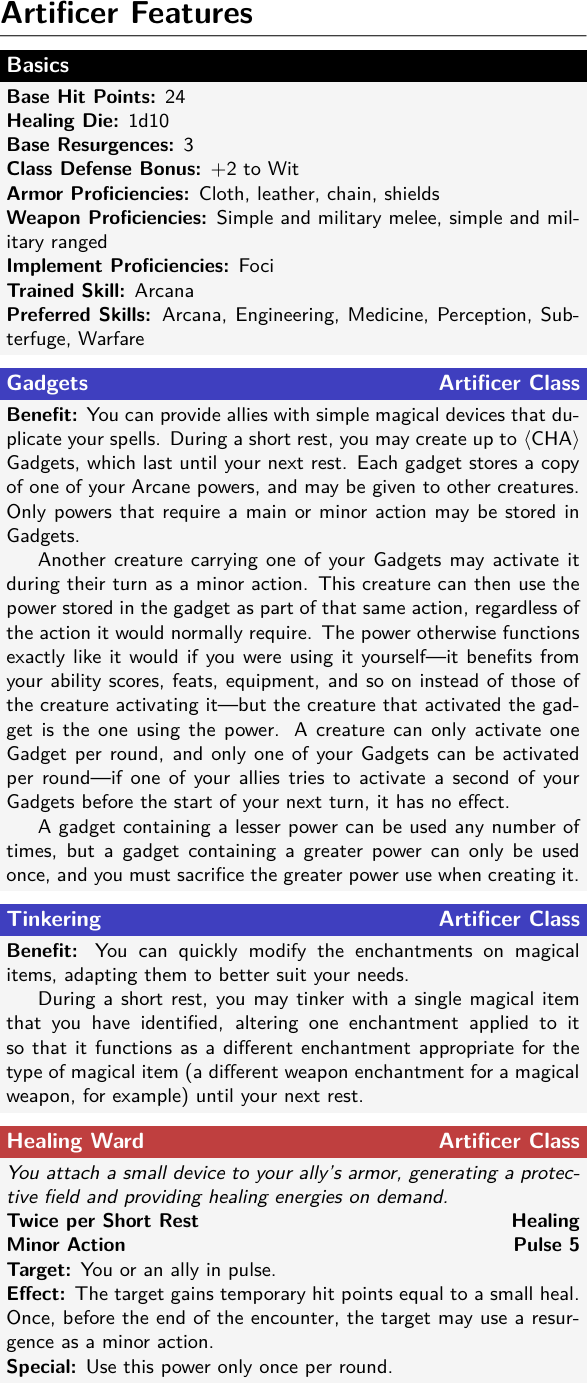
So let’s take a look at the artificer’s class features:
Basics
With 24 base hit points, a 1d10 healing die, and 3 base resurgences, the artificer is only slightly less tough than the fighter. And with armor proficiency up through chainmail and shields, and proficiency with military weapons, they can actually be quite tough in a scrap! But, at their core, artificers are an Arcane class, meaning that they are spellcasters–just unusually tough ones.
Artificers are of course trained in Arcana, and add a variety of knowledge and practical skills to their preferred skill list. Of note are Engineering, making artificers familiar with ordinary machinery (although the line between magic and machine is often blurred in Aetrimonde) and Subterfuge, allowing an artificer to disarm traps.
Gadgets
The first of the artificer’s main class features is Gadgets, which is a long block of rules for a fairly straightforward idea: an artificer can imbue their own spells (Arcane powers) into physical objects, and hand them off to their allies. At its core, this lets allies get off an extra attack per round as a minor action, but it also opens up a bunch of tactical possibilities, by giving allies access to spells that they normally wouldn’t be able to use. (Imagine giving a rogue a Gadget containing a spell of invisibility before they go off to scout, or loading up a fighter with several Gadgets containing powerful close-range spells and sending them into the midst of an enemy horde.)
Tinkering
This class feature is analogous to the fighter’s Martial Endurance and the skinchanger’s Spirit Bond features, in that it fits into a niche shared by all of the classes from a particular origin. The Arcane classes are themed around adaptability, and each one has a feature allowing them to quickly change the powers available to them. These features all work differently, however, and the artificer’s Tinkering feature works by modifying magical items. Given time to take a rest and tinker with a magical item, the artificer can change one of its enchantments into whatever enchantment would be most helpful for upcoming challenges.
As for what this means in practice…well, I’ll be revealing Aetrimonde’s magic item subsystem in December, before we get too much further in building Gwynne.
Healing Ward
The Healing Ward class feature power allows the artificer to protect allies from harm. This is built into the artificer class, giving artificers the ability to heal allies without needing to devote their other power choices or their greater power uses to it–although an artificer wanting to focus on healing could do so.
Healing Ward combines proactive and reactive protection: it both grants temporary hit points (protecting allies from future harm) and allows the recipient to later trigger it to use a resurgence and actually regain hit points.
Abilities
Now, as for abilities: Gwynne will want to have Intelligence, Wisdom, and Charisma as her three highest abilities, but each will affect her Arcane powers in different ways:
- Intelligence will be used in the attack and damage rolls of most Arcane powers, and is the most important of the three unless building an artificer that makes no direct attacks.
- Wisdom will not inherently improve Arcane powers, but can be used by many Arcane School feats that would allow Gwynne to specialize in certain kinds of Arcane power (like fire or illusions). An artificer (or any Arcane character) with high Wisdom and moderate Charisma will be really good at what they specialize in, and mediocre at everything else.
- Charisma will improve the secondary effects of many Arcane powers, and will also improve Armament and Ward powers that enhance an ally’s attacks or defenses. (We’ll see some of these when we pick out Gwynne’s powers!) An artificer with high Charisma will be decent with most Arcane powers, but won’t reach the heights possible with specialization.
Since I want Gwynne to be a well-rounded example of a character, that a new player can easily pick up and play, I’m going to prioritize Intelligence, then Charisma, then Wisdom. This will let a player try out different kinds of Arcane magic without being locked into a specialization.
Gwynne has Intelligence and Grace as preferred abilities, so I’ll buy +3 <INT>, +2 <CHA>, and +2 <WIS>, for 12 points. And to take advantage of proficiency with chain armor, I’ll also buy +1 <DEX> and +0 <GRA> with the remaining point. After boosting <INT> and <GRA>, this will let her have 15-16 AC, depending on whether she opts for a maille shirt or the heavier maille armor.
This leaves <STR>, <CON>, and <CUN>. And I think it makes sense to increase <CON> and drop <STR>, which will give her better Brawn defense, hit points, and resurgences.
Gwynne’s finalized abilities will be:
| -1 STR | +1 DEX | +0 CUN | +2 WIS |
| +1 CON | +1 GRA | +4 INT | +2 CHA |
Up Next
I think perhaps it might be becoming apparent why I gave Gwynne a background as a toymaker: artificer class features revolve around handing out “toys” in the form of Gadgets, Tinkered magic items, and Healing Wards. And there’s a lot of room here to give artificers unique kinds of gadgets: I’ve got some ideas already in mind for Gwynne, but that will have to wait until we get around to selecting her spells in a couple of weeks. Stay tuned!
 Aetrimonde
Leave a comment