
In a recent post on the creation of Gwynne, elf artificer, I revealed the artificer class’s Tinkering feature, which allows them to temporarily modify an enchantment on a magical item. But at the time, I didn’t go into details about what an enchantment was.
Well, today I’m going to be revealing the basics of Aetrimonde’s magical item system, which includes defining these enchantments!
Subsystem Design Goals
I’m treating magical items, or rather, the creation of magical items, as a subsystem: players do not have to interact with magical items beyond finding them as treasure when the GM places them as such, and then using them. Even an artificer, who has a class feature involving magical items, does not need to interact with magical items all that much more deeply than the average player. But if a player wants to create magical items (as would be very, very thematic for an artificer), I want Aetrimonde to have rules support for that!
When setting out to design this subsystem, I had some thoughts on how magic items should fit into the Aetrimonde setting:
- Relatively simple magical items should be relatively common and easy to create. Aetrimonde is undergoing its version of the Industrial Revolution, and industry, in Aetrimonde, covers magic. Narratively, there should be a thriving magical-engineering industry pumping out these simple magical items using regular, widely-known processes. This means that these should be relatively easy to acquire, even if they are expensive.
- Conversely, more powerful magical items should be rarer: these are the works of master craftsmen and singular geniuses at the pinnacle of their craft, and not producible by replicable processes that can be industrialized. These artifacts are the sort of magical item that would be the object of a quest, or a plot device.
It’s much easier to devise rules for the former type of magical item, created according to standardized procedures, and so this is the kind that Aetrimonde’s magical item subsystem will cover. One-of-a-kind artifacts will remain the province of the GM to create (although if a player wants the creation of such an item to be a part of their character’s arc, I strongly encourage the GM to work with them on it).
I have some further thoughts about the kind of magic that should be present in these standardized magical items:
- One kind of enchantment these kind of items can carry should simply enhance their innate nature, making weapons sharper, armor more resilient, and implements better channels for magic. These enchantments can be reflected by providing an item bonus to something that the item is already used for (damage rolls for weapons, AC for armor, attack rolls for specific kinds of magic for implements, etc.).
- A second kind of enchantment should make an item do something that it wouldn’t normally, but that is thematically appropriate for the kind of item. These enchantments can create things like thrown weapons that return to the wielder, cloaks that let the wielder glide, or boots that cling to walls.
- A third kind of enchantment should allow ordinary Arcane, Divine, and Spiritual magic (the kind represented in powers and feats for the respective classes) to be set into a physical object. These enchantments can provide their owners with powers and even feats that they wouldn’t otherwise have.
And finally, I have some mechanical goals for this subsystem:
- It should be possible to find not just complete magical items as treasure, but also components for them that a character who has opted to interact with item creation (or a friendly NPC) can use to make items to order. This lets a GM put part of a magical item into a treasure at low levels instead of an entire (valuable and expensive) item. It also lets a GM nudge their PCs in a particular direction by, say, providing components that are specifically for a fire-based magical item.
- Any bonuses provided by items should be noticeable, but not game-changing. As a rule of thumb, item bonuses should be equivalent to the effect of having +2 expertise. In other words, item bonuses should grant +1 to attacks/defenses/armor resistance, +2 to damage, +4 to hit points, etc. It shouldn’t be possible to stack these, and they definitely shouldn’t scale with level.
- The most powerful magical items should be an inefficient use of resources, encouraging players to have more, but less powerful, items. (And, also, making powerful magical items a noteworthy piece of loot…) Coupled with item bonuses being only an incremental bonus, this will nudge players away from being overly reliant on single powerful items that cannot be taken from them without making their character impossible to play.
So let’s take a look at the implementation:
Defining Magical Items
Before setting rules for how magical items can be made, let’s define what magical items do and how PCs can interact with them. The full rules for magical items take up a couple of pages, so I’ll be summarizing here:
Basic Benefits of Magical Items
Magical weapons, shields, and implements can bypass the invulnerable resistance (a resistance applying to all types of damage from all sources, which is more comprehensive than armor resistance) of some powerful, supernatural creatures like demons and faeries. This is noted in the creatures’ stat blocks; it is not a universal property of invulnerable resistance.
Likewise, magical armor and shields provide additional protections against the attacks of some creatures, like ghosts and wraiths, that can just reach through non-magical armor and shields.
Identifying Magical Items
The basic benefits of magical items work even if a character isn’t aware that it’s magical, but their more advanced and intention-driven benefits don’t. The Arcana skill is necessary to detect that a magical item is magical and work out what it can do in order to use it. It takes two Arcana checks to fully understand a magical item: more powerful ones are easier to detect as magical, but harder to figure out the functions of.
Properties and Powers
Magical items can provide properties and powers.
Item properties are near-passive benefits, like feats and the features of classes and ancestries: they do have to be purposefully turned on, but can be left running indefinitely…or as long as the item is properly worn or wielded.
Item powers work essentially like a character’s own lesser and greater (and feature) powers, with the exception that they do not, generally, benefit from the user’s feats and bonuses. In fact, many item powers that replicate Martial, Arcane, Divine, or Spiritual powers override the user’s own abilities with their own, generally mediocre, values. This is for two purposes; the first is to ensure that a character’s own powers are generally better than those granted by an item; the second is to ensure that a character can use such powers that would normally require abilities that they don’t have (as in the case of a Divine character with an item granting an Arcane power, for example).
Creating Magical Items
With those general concepts out in the open, let’s look at how a standard magical item is created:
A magical item is created by combining:
- A base item, which must be a well-made but mundane example of an appropriate physical item like a weapon or a pair of boots.
- A power source, which provides the inexhaustible supply of power needed to create a permanent magical item.
- One or more enchantments, which channel the power source’s magic into particular effects.
Power Sources
A power source serves two functions in a magical item: it determines how many enchantments the item can support, and it also determines, in many cases, the potency of the item’s powers. More powerful sources can support more enchantments and provides bonuses to the attack and damage rolls of the item’s properties and powers. (Which is not the same thing as bonuses to ordinary attack and damage rolls using the item, as in the case of a normal attack using a magical weapon.)
Power sources can be Arcane, Divine, or Spiritual, depending on which character class the creator has. (If the creator is none of those types of class, they choose one.)
Enchantments
This is the real meat of a magical item, determining what it can do that a nonmagical item could not. Enchantments can be Arcane, Divine, or Spiritual, and can only be applied to a magical item with the same type of power source.
Enchantments are what determine the properties and powers of a standard magical item, and there is a wide variety in the core rulebook, of which I’ll reveal several today. Let’s start with some simple ones, that might be applied to a magical weapon:
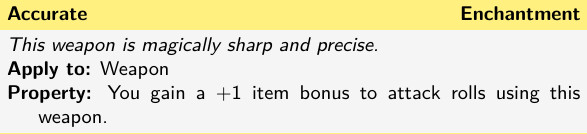
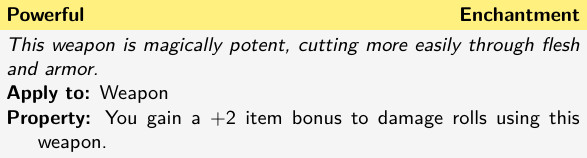
The Accurate and Powerful enchantments are straightforward and universal (can be applied to an item with any kind of power source), and both contribute to the most basic concept of a “magical weapon.” Accurate would make a sword more likely to strike true; Powerful would make it bite deeper when it does.
And with these two enchantments, I can give a first example of how an artificer’s Tinkering feature can be used: if the artificer or their ally has an Accurate magical sword, but doesn’t feel the need for an item bonus to attack rolls, the Artificer can temporarily alter the Accurate enchantment into a Powerful enchantment, giving the weapon greater damage instead of greater accuracy.
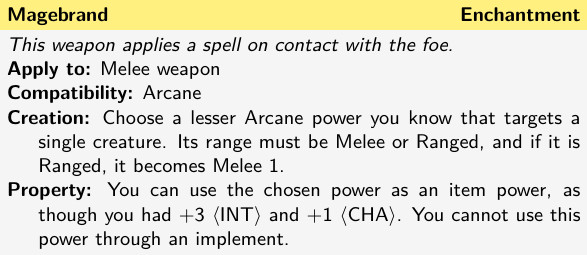
…or, the artificer could perhaps get creative, and instead transform the Accurate enchantment into a Magebrand enchantment.
Magebrand can only be applied to melee weapons with Arcane power sources, but can be incredibly versatile. It requires that the creator make a decision when applying the enchantment (including through Tinkering), choosing an Arcane power that they themselves know and storing it in the enchantment. The weapon’s wielder can then use this power, albeit at what is likely lesser potency than the item’s creator could have. The choice would be permanent when applied as a normal enchantment, but an artificer using Tinkering can choose a different power each time they use the feature to change an enchantment to Magebrand.
In many cases, Magebrand may be a better choice for Tinkering than Powerful: while it doesn’t inherently grant a bonus to damage, the wide range of damage types available with Arcane powers means that this can give an ally a power that exploits an enemy’s vulnerability, such as a Fire power when facing flammable mummies. It can also be used to “double-up” on a useful power that the Artificer has and wants to share with the rest of the party, much like the artificer’s Gadgets feature. Magebrand also makes ranged powers into melee powers, making them more useful for allies likely to be in the thick of battle.
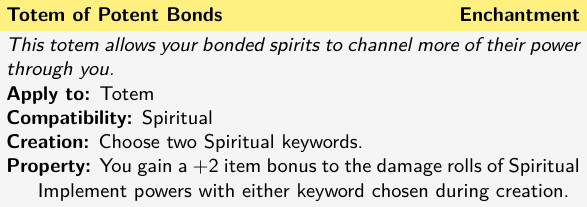
Of course, it’s not just weapons that can benefit from enchantments: magical implements can benefit too.
The Totem of Potent Bonds enchantment makes a totem more effective when using Spiritual powers that have either of a pair of keywords. (Item bonuses affecting Spiritual powers commonly affect a pair of keywords, because there are a lot of these keywords, and it’s common for Spiritual characters to use multiple types of power.)
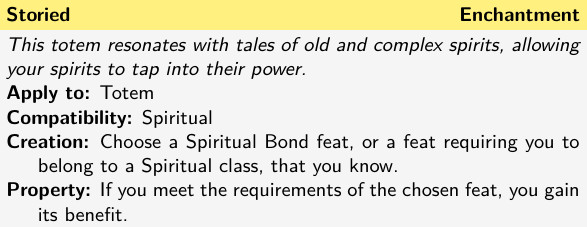
The Storied enchantment, for the totem implements used with Spiritual powers, allows a magical totem to convey the benefit of a feat intended for Spiritual classes. Of course, it only works if the implement’s wielder is actively wielding the implement…and if the wielder is ever deprived of the implement, they also lose the feat, so this is a risky way to gain an extra feat.
Then, there are enchantments for items that wouldn’t normally convey much if any benefit, like gloves, cloaks, and boots.
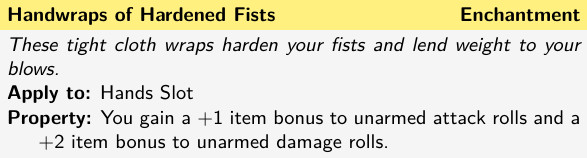
Handwraps of Hardened Fists is an enchantment for items going in the Hands slot like, yes, handwraps, but also applicable to gloves, gauntlets, and even hypothetically mittens. It provides a pair of item bonuses increasing the attack and damage rolls of unarmed attacks, making it an excellent enchantment for a would-be brawler. The downside, however, is that it doesn’t actually provide the benefit of a magical weapon for unarmed strikes: there are ways to get that, though.
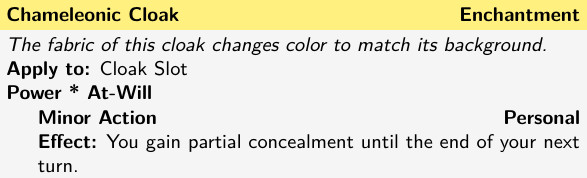
The Chameleonic Cloak is an excellent enchantment for a would-be scout or sniper, letting them blend in and gain concealment even in open terrain. This, in turn, can let them sneak about more easily, since becoming and remaining hidden from enemies using the Stealth skill requires some degree of either cover or concealment from enemies.
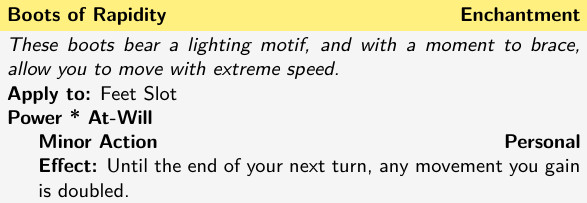
The Boots of Rapidity enchantment has a subtle effect that can be quite powerful if fully understood: at the cost of a minor action, the enchantment’s power grants two turns of effectively doubled movement: in the first turn, the user keeps the normal movement they already had, and if they then take the Run action, can gain twice that much additional movement…and on the second turn, even the initial, normal movement is doubled. The wearer can thus get up to seven times their speed in movement, in just two turns…and that’s not even counting any movement that they could get between turns.
To wrap up this showcase, let me reveal a couple of armor enchantments, including one tied to the Ward powers that I previously hinted at and which we’ll see more of in Wednesday’s post.
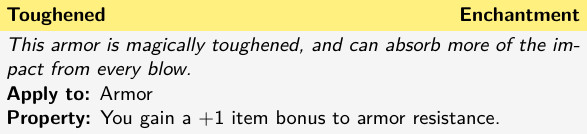

The Toughened and Reinforced enchantments both protect the wearer of magical armor. Toughened increases armor resistance, further reducing most damage taken by a small amount, while Reinforced drastically reduces the damage from serious critical hits.
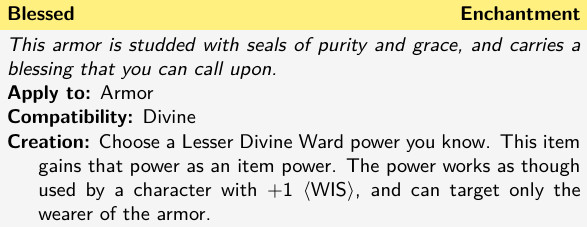
The Blessed enchantment, however, provides access to a Divine Ward power. I’ll go into details on these on Wednesday, alongside their Armament power counterparts, but the short version is that Ward powers provide a character with some kind of defensive benefits; a character can only gain the effect of one Ward power at a time. The Blessed enchantment, carrying a Ward power with it, therefore gives a character access to a defensive power (albeit with probably reduced effectiveness) that they can use if none of their allies are in a position to help them out.
Up Next
On Wednesday, keep an eye out for the next post in my series covering Gwynne of House Midwinter, elf artificer–with a bit more context, now that I’ve revealed the gist of how magical items actually work. And, for the rest of the month, keep an eye out for the occasional magical item worked into some of my other posts!
 Aetrimonde
Leave a comment