
In today’s post, I’m going to be picking out the powers, feat, and equipment for my elf artificer sample character, Gwynne of House Midwinter. I’m also going to be taking this opportunity to introduce three new power keywords that define some unique kinds of power: Armament, Ward, and Summon. While not unique to Arcane powers or artificers, I think these powers work incredibly well with the concept I have for Gwynne, and I’m also going to be putting some extra thought into how these powers interact with her Gadgets class feature.
Powers
I’m envisioning Gwynne as largely a support character who aids her fellow PCs but doesn’t directly do a lot of fighting. So, the list of things I want her powers to be able to do will revolve around how her powers help an ally:
- Help an ally hit harder.
- Help an ally avoid and survive attacks.
- Distract or keep enemies away from an ally.
- Attack an enemy.
As an artificer, Gwynne’s Healing Ward already covers “heal an ally,” so at least initially, I won’t be looking for ways to double up on that. And “attack an enemy” is as much for Gwynne herself to have an attack option as it is for her to be able to put it in a Gadget and hand it off to an ally.
The next consideration, after deciding what Gwynne’s powers should be able to do, is how they should do them. Arcane powers are divided into roughly ten Schools, each one focused on a specific keyword like Fire, Force, Illusion, Teleport, etc. Most of these Schools contain powers filling each of the four niches above, but differ in the specifics. (Fire powers set things on fire, Force powers throw enemies around, etc.)
As mentioned in the skeleton I’ve already come up with for Gwynne’s backstory, the elves of House Midwinter organize solstice celebrations involving grand spectacles and cunningly-made toys and knickknacks. As an artificer, Gwynne already has “knickknacks” covered through the Gadgets feature; to cover “grand spectacles,” I’m going to lean into Illusion magic
So let’s see what we can do with these goals in mind:
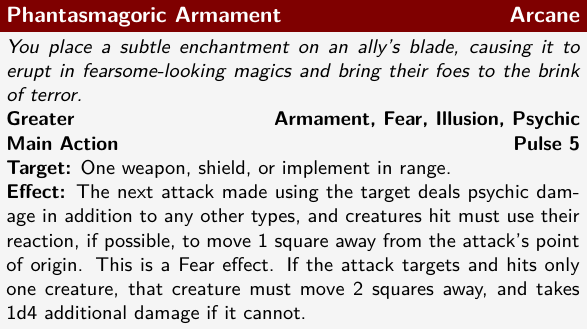
“Help an ally hit harder” is exactly what Armament powers are for. These power target not an ally or an enemy, but an object: specifically, a weapon, shield, or implement. Equipment under the effect of an Armament power becomes mildly magical, enough to overcome some damage resistance as described in my post on magical items. But all Armament powers have further effects, causing the affected weapon to deal additional damage and have additional effects with its attacks.
Phantasmagoric Armament leans toward effects over damage: it allows an ally to make a single attack that causes creatures hit to flee, possibly provoking opportune strikes if used judiciously. If this attack is used against a single foe, they must flee further, and take additional damage from the attack. (About half of all greater Arcane Armament powers have an effect like this, that is more powerful if used on a single enemy.) And the attack also deals partly-psychic damage, which is useful for overcoming armor resistance.
Putting an Armament power into a Gadget lets an ally apply it to their equipment as a minor action and then immediately use it in an attack in the same turn. Thus, Gwynne can give an ally Phantasmagoric Armament in a Gadget, and then they can quickly seize on any opportunity to use it–such as using it to attack an enemy surrounded by the PCs so that it then provokes several opportune strikes when fleeing. As Gadgets, Gwynne’s Armament powers will take the form of a sprig of mistletoe that can be wrapped around the grip of a weapon, shield, or implement.
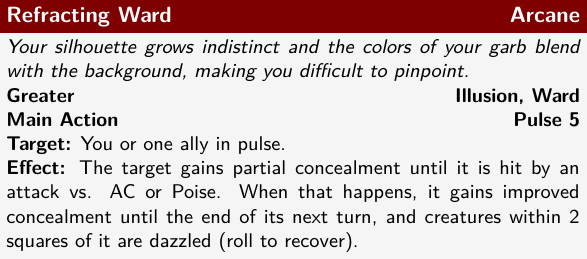
Ward powers are the defensive counterpart to Armament powers, providing an ally with defensive benefits. A creature under a Ward power counts as wearing mildly magical armor, and is thus protected from some creatures’ attacks. In addition to providing bonuses to defenses, many Ward powers have retaliatory effects on attackers when the Ward is broken by an attack that gets through it and hits.
Refracting Ward, as an Illusion Ward power, is a little bit unusual, in that it provides concealment (+2 to AC and Poise vs. melee and ranged attacks) rather than a direct bonus to defenses. This makes it a bit more specialized, in that it doesn’t help against area attacks, but also means that it can be used to help an ally sneak around using Stealth. And, when the ally gets hit, and the Ward breaks, it erupts in a flurry of flashing lights, causing nearby creatures to be dazzled, while the target gains improved concealment (+5 instead of +2) covering their escape.
Ward powers are probably among the less useful to place into a Gadget, since in most cases it would work just as well to use them immediately on an ally. However, there are niche cases where it might make sense, and in the case of Refracting Ward, it could be given to a sneaky ally before they go off scouting, in case they find somewhere that they need to sneak across an open, well-lit area with nowhere to hide, or rush through a group of enemies and hide on the other side. As Gadgets, Gwynne’s Ward powers will take the form of a sprig of holly, to be affixed to an ally’s armor.
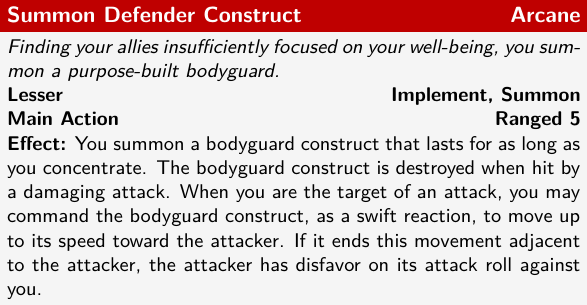
While there are Illusion powers that would “distract or keep enemies away from an ally,” I can’t resist filling this niche with a Summon power instead, in order to further build out Gwynne’s theme and Gadgets. Summon powers have some complex rules, but the gist of them is that they summon or create allies for the caster.
Rules for the Summon Keyword
Unless otherwise noted, creatures summoned by powers with the Summon keyword work as follows:
- A summoned creature is a Medium magical construct. When summoned by a power, it appears in an unoccupied space of your choice within the range of the power that summoned it. A Summon power can summon only a single creature at a time; if re-used, any creatures previously summoned by the same power are destroyed.
- You and your allies are your summoned creatures’ allies, and your enemies are their enemies. Summoned creatures threaten adjacent squares and can flank.
- Summoned creatures can be attacked. A summoned creature has 16 AC, and 14 Brawn, Poise, Wit and Composure.
- Summoned creatures are destroyed when reduced to 0 or fewer hit points. A summoned creature has 16 maximum hit points, and has all of them when summoned. Their healing die is 1d6. They have no resurgences to use, but can regain hit points in other ways.
- Your summoned creatures do not have their own turns or actions. Instead, you command them to take actions using your own actions. As a minor action, you may command your summoned creature to do most of the things any other creature could, such as interact with an object.
- Summon powers may also describe additional actions that a summoned creature can take, in which case the power will also note what action is required to command it. Summoned creatures’ attacks are usually based on your abilities.
- Summoned creatures have a movement speed of 6 squares. They gain movement at the start of your turn and can use it as you direct during your turn.
- Summoned creatures must remain within the range of the power that summoned them. If you move out of range of a summoned creature, or if you move a summoned creature out of range, it immediately expires. If you are killed, the summoned creature immediately expires.
Summon Defender Construct, as a lesser Summon power, summons a relatively weak creature that is destroyed by any amount of damage from an attack (much like a mook). And while it can’t attack, it can be commanded to rush at creatures attacking its summoner to interfere with their attacks.
I actually didn’t realize how great a power this was to put into a Gadget until I was looking through the options for a Summon power to give Gwynne: in a Gadget, it can be used as a minor action, and can be used repeatedly since it’s a lesser power. So Gwynne can hand this out as a Gadget to an ally likely to draw attacks, and they can keep summoning replacement constructs as long as they have minor actions to spare. And, perhaps even more usefully, the constructs can flank, providing a melee-focused ally with their own source of flankers to aid them.
Gwynne’s Summon Defender Construct, as a Gadget, takes the form of a handcarved wooden toy soldier, which when given an order creates a full-sized duplicate of itself. She keeps a wide selection of the figurines, ready to be turned into Gadgets, and carves new ones whenever she meets someone with a suitably interesting appearance. She also hands them out to children, naturally, although she reserves the Gadget-ized versions for dealing with bullying problems.
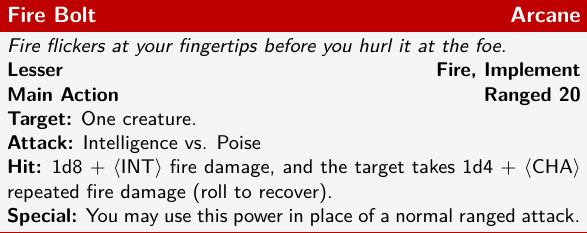
Finally, I do feel the need to give Gwynne an actual offensive power. There are options among the Illusion powers, but they either deal no damage or psychic damage (which is great for dealing with armor resistance, but plain doesn’t work on inanimate objects and mindless creatures like zombies). So I’m going to pick something that’s an actual damaging power, and since Gwynne’s sworn enemies are the Winter Court, who work with ice a lot…I’m going with good old reliable fire.
Fire Bolt is the most basic of Arcane Fire powers: it deals fire damage to a single target, sets it on fire, and as a bonus, can be used as a normal ranged attack. It could make a useful Gadget for a character unlikely to be in the thick of melee, allowing them to get a second ranged attack as a minor action. As a Gadget, Gwynne’s Fire Bolt takes the form of a red-and-white candy cane…flavored with cinnamon and hot chilies.
Feat
Gwynne has access to the usual combination of general-purpose, ancestry-based, and class-based feats, which includes a slate of Arcane School feats that would allow her to specialize in certain kinds of Arcane powers. Here are some examples that Gwynne would find useful at level 0:

As an elf, Gwynne has access to the Swiftfooted feat, building off her Lightfooted feature to further improve her mobility. This could be useful if we put Gwynne in heavier armor.

Improved Armaments would allow Phantasmagoric Armament to also provide a +1 power bonus to the attack made using it, which would be great for reducing the likelihood that the attack just misses and wastes the power.

Ergonomic Gadgets would allow Gwynne’s allies to make use of her Summon Defender Construct and Fire Bolt gadgets without provoking opportune strikes, making Fire Bolt useful to melee characters and Summon Defender Construct useable when the character carrying the Gadget is already beset by enemies.

Warding Gadget creates a synergy between the artificer’s Healing Ward and Gadgets features, giving the artificer a link to creatures carrying their Gadgets so that they can receive a Healing Ward even when separated from the artificer. This would be useful when an ally has scouted ahead and become separated, or if the party has had to spread out to cover attacks from multiple directions.
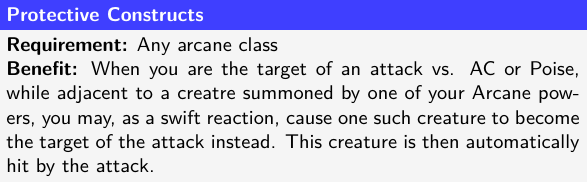
Protective Constructs is an Arcane School feat that would further improve Summon Defender Constructs so that the summoned creatures can outright take attacks aimed at Gwynne. And, because of the wording of Gadgets allowing Gadget-ized powers to still benefit from the artificer’s feats, I would allow Gwynne’s allies to gain the same benefit from creatures they summoned using a Summon Defender Constructs Gadget.
Of these, I think that Ergonomic Gadgets is likely the most immediately useful, so I’ll go with that at level 0.
Equipment
As far as equipment goes, Gwynne will need:
- Armor
- A magical implement (a focus, for Arcane powers).
- A melee weapon (as backup, and perhaps to use her Armament power on if appropriate).
- A basic adventuring kit.
As far as armor goes, Gwynne is proficient with up to chain armor, which contains the following options:
| Armor | AC | AR | Encumbrance | Save Move | Speed | Value | Bulk |
|---|---|---|---|---|---|---|---|
| Maille Shirt (Medium) | 3 | 1 | -1 | 15gp | 6 | ||
| Maille Armor (Medium) | 4 | 1 | -1 | -1 | 20gp | 10 | |
| Maille Hauberk (Heavy) | 5 | 1 | -1 | -1 | -1 | 25gp | 15 |
Because she has +1 <DEX> and <GRA>, one of the medium armors is going to be her best option. (The Maille Hauberk would provide the same AC as Maille Armor, but with an additional speed penalty.) So it’s really a choice between the Maille Shirt, which would give her 15 AC and 1 safe movement, and the Maille Armor, with 16 AC but 0 safe movement. Since Gwynne has Refracting Ward which can boost her AC against most attacks, I’m going to opt for the lower AC and give her a Maille Shirt.
I’m envisioning Gwynne as a precise spellcaster good with the intricate, finicky bits of spells just like she is with the fine details in her woodcarvings. So, I’m going to give her a focus in the form of a wand (which can be wielded at the same time as a one-handed melee weapon). This will run another 20gp.
And speaking of weapons…as an artificer, Gwynne is proficient with military weapons. The Caras Elvaren culture suggests bows and heavy blades as weapons, so I’ll give her a longsword, at 10gp. And because she has Armament powers, and it might be a convenient way of delivering them…I’ll also give her a longbow at another 15gp, plus a pack of 20 arrows at 1gp for the lot.
Finally, the basic adventurer’s kit will run another 15gp, bringing her purchases to a total of 76gp. I’ll add on a set of Thieves’ Tools for another 10gp, since Gwynne is trained in Subterfuge and can use them to disarm traps…and also, a set of Tinker’s Tools, useful for working with machinery. (And we’ll say that her particular set of Tinker’s Tools includes her woodcarving set…) And that leaves her with just 4gp to her name at the start of the game.
I should note here that Gwynne only has -1 <STR>, and this is going to impact how much of this gear she can carry. Carrying capacity is 50 bulk plus 10 per <STR>…so hers will be just 40 bulk. Her armor, focus, weapons, and basic adventurer’s kit will come to 28.8 bulk, the two toolkits will bring that up to 32.8…so Gwynne had better be careful how many toy soldiers she packs, or else she’ll be asking an ally to carry her things for her.
Up Next
Next week, we’ll be putting together all of these decisions and calculating all of Gwynne’s relevant numbers. And then, just in time for the holidays, I’ll wrap this series up in a bow with a post on how Gwynne might advance up to level 5…which, now that I’ve discussed some of how magical items work, will include a few magic items that she might find or make.
Stay tuned!
 Aetrimonde
Leave a comment