
As a preface to my promised rules enabling PCs to construct their own golems, I’m first going to discuss the general rules surrounding allied NPCs, which can come in several different flavors.
Allied NPCs: Three Paradigms
First, I want to discuss what an “allied NPC” can be in a game like Aetrimonde: as I see it, there are three different mechanical roles that an ally can fit into, and all of them are valid additions to a TTRPG system.
Hirelings
A hireling is an NPC who provides the PCs with some service that they have chosen not to do for themselves. The simplest example might be a porter: an assistant whose job is to follow the PCs around carrying gear and equipment they don’t need immediately. (And, also, helping to get loot out of the dungeon and back someplace it could be sold and spent. Dragons’ hoards tend to be heavy…) Other examples of hirelings are the expert translator, wilderness guide, field surgeon, specialized ritualist, etc. who can fill in gaps in the PCs’ skills and perks when necessary for a particular adventure. Horses and other “ordinary” mounts might also be treated as hirelings.
Hirelings generally aren’t expected to fight the PCs’ enemies for them, and in fact if they get involved in combat that’s generally either the result of a mistake on the PCs’ part, or a purposeful choice by the GM to go after them as a way of raising the stakes or forcing an encounter where one victory condition is “keep your hirelings alive.”
In many implementations, PCs get hirelings by…hiring them, at a fixed rate per day depending on their exact skills.
Because they generally have simple, defined roles, and aren’t expected to participate in combat beyond fleeing and trying not to die, rules for hirelings can be simple. However, there are a few pitfalls I’d like to avoid:
- There need to be some kind of rules about how to handle a hireling in a combat encounter, just for those situations where the PCs need to keep them alive. They should have defined hit points and defenses, and there should be some sort of guidelines about when and how it would be appropriate for them to assist in a fight.
- They need to be sturdy enough that players don’t find hirelings more of a burden than a boon: they mustn’t die to a single hit without giving the PCs a chance to save them.
Mercenaries
A mercenary (and I think this use of the term is original on my part) is an NPC who fights alongside the PCs but is controlled by the GM. This makes mercenaries a specific form of what is more generally known as a GMPC. Although they can contribute in a fight, mercenaries are generally expected to be weaker than the PCs (and thus, to not make a huge difference in difficult fights). They represent hired guns, bumbling apprentices, the mad priest who hangs around muttering about prophecy, half-trained steeds, and any other archetype of NPC who is, for the moment, more or less aligned with the PCs’ interests, but might not always act exactly how the PCs hope.
The GM is always free to give the PCs mercenaries (although it’s generally ill-advised to force them on the party), but some PCs might find it interesting to have their character develop a retinue of hangers-on in the form of mercenaries. Mercenaries offer more tactical and narrative options than mere hirelings, like sending them to make a diversionary attack or escort rescued villagers home while the PCs deal with their kidnappers.
Like with hirelings, there are certain things I feel need to be in place for mercenaries to be a viable, usable option for characters:
- Because mercenaries have to be played by the GM, it must be clear that if the PCs want mercenaries, they need to have the GM on board with this idea. There also need to be clear guidelines about what kinds of creatures can become mercenaries, and how powerful they can be.
- Because having mercenaries on their side can make fights easier, there need to be rules about how to take them into account when designing encounters (and allocating loot). In general, when they bring mercenaries into a fight, the PCs should expect to face harder enemies and pay out a share of their loot.
- There should be some kind of reputation mechanism making it harder for the PCs to recruit more mercenaries if they use them as cannon fodder or trap-springers, or if they don’t uphold their end of a contract. This could be as simple as “the GM decides how many mercenaries, and of what kinds, are available to hire,” but I’d like it to be a bit more detailed than that.
Companions
Finally, companions are secondary characters, usually combat capable to some degree, controlled by a player alongside their actual PC. Companions represent squires, loyal bodyguards, faithful retainers, and other archetypes that in various editions of D&D would be built into certain classes as features, like steeds, familiars, and of course animal companions. When they join the PCs in combat, they act exactly how the PCs want them to, because it’s one of the players controlling them.
Like mercenaries, the GM could always give the players companions, if they wanted them, and they can be used narratively, in order to let the PCs accomplish two tasks at once without splitting the party. And, also like mercenaries, companions will require rules or guidelines for designing encounters, splitting loot, and handling reputation.
Where companions differ from mercenaries is that, because it will be a player controlling them, having a companion means that the player gets twice as many turns and twice as much time in the spotlight. So, it needs to be clear that for any of the players to get a companion, not just the GM but the other players need to be on board with the idea.
Aetrimonde’s Implementations
All three kinds of ally NPC have a role to play in Aetrimonde, and the Game Master’s Handbook covers each of them.
Hirelings
The GMH contains a Hiring Help section with a table of typical wage rates for hirelings of different levels of skill, from porters (5sp/day, +2 skill bonus in Athletics and Endurance) to specialized experts (10gp/day, +10 skill bonus in a single skill based on <CUN>, <INT>, <WIS>, or <CHA>, with the equivalent of a relevant Esoteric Knowledge perk).
Hirelings have the stats of summoned creatures, with the exception that they do not immediately die when reduced to 0 hit points, but (like PCs) start making survival rolls. This means they can be downed easily, but allows attentive PCs to ensure they survive. (Whether they keep working for the PCs afterwards may vary…)
Mercenaries
The GMH strongly suggests that mercenaries be Tier 0 Normal creatures chosen from the Bestiary (typically intelligent humanoid ones, but that’s a much weaker suggestion), regardless of the PCs’ level. It also suggests that when the PCs bring mercenaries on an adventure, the GM should plan encounters including half of the mercenaries’ EV in the PCs’ total: this ensures that the PCs and their mercenaries still face enemies that are a reasonable challenge for their combined might.
It is also advised that the treasure handed out for an adventure with mercenaries should be adjusted upwards to match the increased EV of encounters (which is easy enough: the rule of thumb given by the GMH is that on average, the reward for an encounter should include treasure worth 1/10 of its EV, although it’s best if this is “clumped up” a bit to allow some encounters to have bigger treasures). However, mercenaries should get a share of any treasure proportional to their half-EV contribution.
Example of Splitting Loot with a Mercenary
A party of five level 8 PCs (5 x 180 = 900 EV) has two Tier 0 mercenaries (2 x 100 = 200 EV) accompanying them on an adventure. Half of the mercenaries’ EV is 100 EV, raising the PCs’ total to 1000 EV. The mercenaries should get 1/10 of the treasure to split between them.
Over the course of an adventure taking these PCs from level 8 to level 9, they would normally find around 900gp of treasure, but (because of the mercenaries’ added EV), on this adventure they will find closer to 1000gp. The mercenaries will take 100gp, leaving the typical 900gp of treasure for the PCs to split.
Companions
Companions can be more powerful than mercenaries, scaling somewhat with the PCs: the GMH’s recommendation is that companions should be level-appropriate creatures chosen from the Bestiary, or at least should be based on them or built in an equivalent way. Like with mercenaries, it is also suggested that half of a companion’s EV be taken into account when designing encounters, and that companions get their own share of the treasure.
However, it would also be possible to design a companion as a full-fledged PC, with ancestry and class and all the other things that come with being a PC. If designed this way, a companion should be at least 5 levels below the PCs, and their full EV should be used to calculate the encounter budget and their share of the treasure.
In either case, the PC with the companion can, if they want, decide how their companion spends their share of the treasure, perhaps equipping them with magical items if they spend long enough in the PCs’ company to accumulate the funds. It is important to note, however, that this remains the companion’s treasure and equipment, and if they ever part company with the PCs, it goes with them.
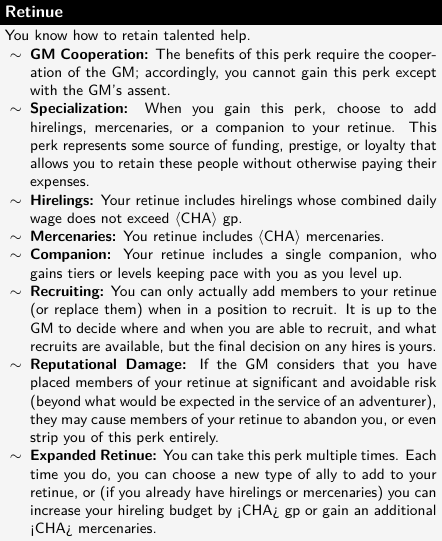
The Retinue Perk
The GMH contains a few character customization options that, for whatever reason, require the cooperation of the GM to make use of. One of these is the Retinue perk, allowing a PC to (with the help of the GM) start accumulating followers.
Up Next
The rules for operating golems treat the golem as a companion…as long as the PC handling it is present and able to give instructions. As for what happens when they’re not…stay tuned!
 Aetrimonde
Leave a comment