
Having dipped a toe into the topic of alchemy with last week’s post on alchemical metals, I’m going to continue on this topic by getting into the actual mechanics of alchemy. There are broadly two kinds of alchemy that the Core Rulebook has support for, and one of them is Volatiles. These are things like explosives, concentrated acids, and alchemist’s fire, that adventurers might deploy against their foes.
Design Goals
Alchemical volatiles are one type of consumable item, and so I’m going to take a brief detour into my design goals for consumables.
The elephant in the room, when it comes to consumables, is that any resources that a PC spends on consumables are resources that they aren’t getting back. When a character spends money on a permanent magical item, that item will make their character more powerful permanently (barring some development where they lose it or sell it off). Spending money on a consumable (or using one that you could have sold) means taking resources that could have gone to a permanent upgrade and instead using them on a temporary benefit. In the long run, a PC who spends their money on consumables will wind up less powerful than one who saves up for permanent items–and this can lead players to hoard consumables “for a fight where we’ll really need them.”
When I’m running an Aetrimonde campaign, I want players to actually use consumables. Getting them to do so depends a lot on individual player psychology, but in general, it requires two things:
First, players need to feel comfortable that by using consumables to overcome problems in the short-term, they are not hampering their characters in the long-term. Which is to say, spending money on consumables, or using up consumables that they could otherwise sell, needs to not significantly reduce a character’s wealth in the long run.
Aetrimonde will handle this with some advice in the GMH’s section on placing treasure in an adventure, which says (summarizing here) that there is an appropriate level of wealth for characters of a given level, and while it’s okay for some of that wealth to be tied up in consumables, or for their wealth to dip a bit when they use a consumable, they shouldn’t ever get locked into a lack of wealth. A GM can handle this by inserting consumables into treasure at roughly the same rate that the players use them, or by occasionally offering a “top-up” of wealth if they notice that a PC’s use of consumables has left them with less wealth and resources than they should nominally have, depending on what works for their campaign. However, a PC shouldn’t immediately get back any resources they spent on consumables: there should be a delay between expending a consumable and being able to replace it, to maintain an element of suspense.
Secondly, players need to feel confident that using a consumable will be effective. If consumables are rarely as effective as using a PC’s own inherent powers (even when those powers aren’t ideal for the situation), then PCs will avoid using them.
As far as Volatiles go, the approach I’ve taken is to make Volatiles less potent than a lesser power, in terms of raw damage, but more reliable: Volatiles deal a small amount of damage or have some other effect that doesn’t require an attack roll, which makes them useful for dealing some guaranteed damage to wipe out a clump of mooks or exploit an enemy’s vulnerability to a specific damage type. But they’re generally not going to do as much damage as a solid hit from a PC’s own lesser powers (much less a greater power). Combined with the variety of available Volatiles covering a wide range of damage types, this makes Volatiles a handy and reliable tool for a sticky situation, but not something that a character will want to break out every turn.
Engaging with the Alchemy Subsystem
Characters can obtain alchemical Volatiles as treasure, or by buying them as available from NPC alchemists, or they can brew them up themselves by taking the Alchemy feat, which functions much like the Enchant Magical Item feat used to engage with the magical items subsystem.
Actually using a Volatile is simple: pull it out from wherever you stored it on your person, perhaps pull a pin or remove a cork, and toss. This usually takes a main action, and that includes pulling it out if it was stored conveniently (i.e. in a pouch or bandolier, not at the bottom of a backpack).
But what is an article on alchemical volatiles without a few examples?
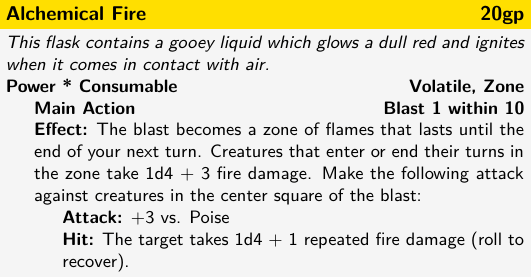
Alchemical Fire is a classic, based on the Greek fire of antiquity. Aetrimonde’s interpretation of the substance emphasizes its tendency to cling as it burns, creating a puddle of flames that denies an area to friend and foe alike–and it can also set a creature it directly hits on fire.
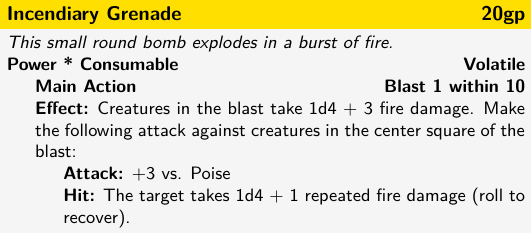
However, Aetrimonde is a setting where the ancient and modern collide…and so there is also the Incendiary Grenade, a more modern, manufactured equivalent to Alchemical Fire that causes immediate damage in its blast, but can still set fire to enemies caught in the center of it.
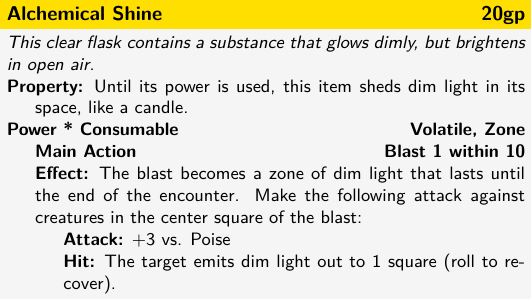
As an example of a Volatile that isn’t directly harmful, consider Alchemical Shine, which has a variety of useful applications. It can shed (admittedly dim) light on part of a battlefield, or be thrown directly at a foe to make the foe itself glow–which is useful for keeping such a foe from hiding, or to track them through dark places. Thrown accurately at an invisible foe, it can even help to reveal them! And if one has no other uses for it, an unopened bottle of Alchemical Shine sheds enough light to substitute for a candle.
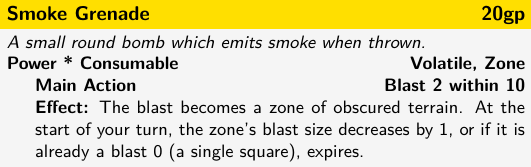
And filling the opposite niche, there is the humble Smoke Grenade, creating a cloud of obscuring smoke that provides concealment, enables stealth, and in a pinch, can be used as a diversion or a visible signal. The cloud lasts three rounds, shrinking each round, which provides adequate time for many kinds of subterfuge.
Up Next
Keep an eye out next week, when I’ll be covering the counterpart to alchemical Volatiles: Potions and Elixirs!
 Aetrimonde
Leave a comment