
Following on from my previous post about alchemical volatiles, today I’m going to cover potions and elixirs, the sort of alchemy that adventurers drink for healing, invigoration, or protection.
Using Potions and Elixirs
Potions and elixirs, with a few exceptions, are magical liquids that interact with mortal biology: they accelerate healing, toughen flesh, sharpen senses, or have other transformative effects on the adventurer who drinks them (or in some cases, dabs them on as ointment or inhales the vapors: the application method for many alchemical volatiles is not non-specific).
A character can drink a potion or elixir as a minor action; if it was stored where they can easily get to it, like in a bandolier or belt pouch, they can draw and drink it in a single minor action. Otherwise, they need to draw it as a separate action first.
Potions generally have short-lived or instantaneous effects, while elixirs have longer-lasting, and often more powerful, effects. Potions can be mixed, but a character can have the benefit of only one elixir at once. Drinking a second elixir before the first wears off neutralizes the effects of both.
Characters with the Alchemy feat are able to brew their own potions and elixirs (and can also make the volatiles discussed in my earlier post).
Examples of Potions and Elixirs
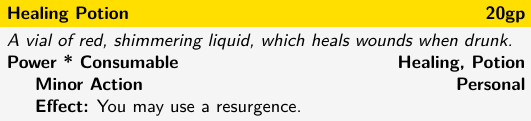
The first potion I’m going to reveal is the humble Healing Potion, without which no fantasy RPG really feels complete. Yes, it’s red because healing potions in most videogames are red. There is only a single potency of healing potion in Aetrimonde, because it simply allows the drinker to use a resurgence, and so it scales with hit points instead of requiring advanced versions for higher-level characters that have significantly more hit points.
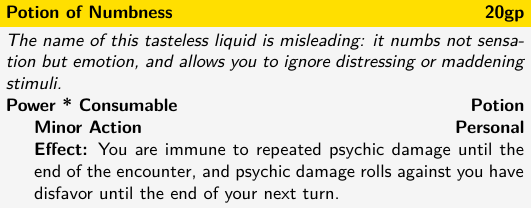
The Potion of Numbness is an in-the-moment defensive potion: it can completely protect a character from repeated psychic damage (which Aetrimonde often uses to represent the madness caused by having looked upon eldritch abominations and other Things Mortals Were Not Meant to See) and reduces the damage they take from other psychic damage.
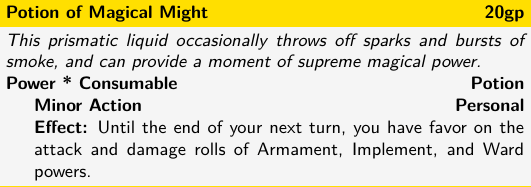
The Potion of Magical Might is a more offensively-minded potion (although it could conceivably be used to make Ward powers retaliate harder against creatures striking their recipients…). It has the straightforward effect of giving a character just under two turns of favor on the attack and damage rolls of magical powers (those with the three keywords listed): great for moments where the PCs finally have a powerful foe on the ropes and need to hit it as hard and as fast as they possibly can.
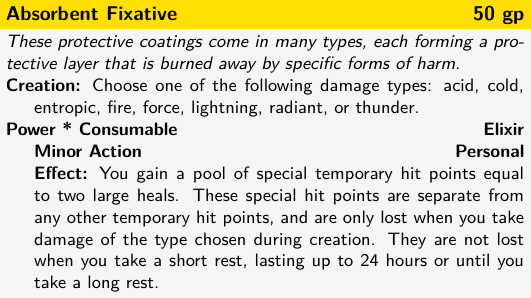
Finally, there is the Absorbent Fixative, an example of several things: it’s an Elixir, having a longer-lasting effect than Potions; it comes in multiple varieties that protect against different types of damage; and at least as far as flavor is concerned, it’s not actually something you drink, but something that you pour over yourself and your equipment to form a protective outer layer. (But of course, this is merely for flavor, and has no real mechanical effect.) At two large heals, Absorbent Fixative actually provides one of the larger healing-ish effects available, which compensates for the fact that it only provides temporary hit points and only protects against a single damage type.
Bio-Alchemy Lore
Now, mechanics are one thing, but alchemy also deserves lore, and I’m someone who knows just enough about chemistry and biology to want some kind of explanation for what a healing potion actually is. Is it a spell bound to a liquid? Is it a miraculous panacea distilled from a rare plant? Is it a chemical compound synthesized with the aid of magic? Well, since I’m lumping potions and elixirs in with alchemy, I’m going to say that it’s a magically transformed substance…and I’ve got more lore where that came from. If this topic interests you, read on: I’m not actually sure whether to put this excerpt in the Core Rulebook or the Aetrimonde Setting chapter of the GMH, but it’ll go in somewhere:
Producing magical substances that interact safely with mortal biology is complicated. Potions and elixirs are not magical spells anchored to a liquid medium, which would be far, far safer: they are literally magical substances activated by contact with living tissue. Small mistakes in concocting potions and elixirs can leave the imbibers dead, or worse…which is why most commonly-available potions and elixirs are derivatives of a very few alchemical processes that are well-understood and difficult to get seriously wrong.
Most of these common alchemical processes originated with the goblins of Gobol Karn, the original alchemists, who are still unsurpassed in the discipline of bio-alchemy. Unlike the techniques of producing alchemical metals, Gobol Karn did not trade away knowledge of bio-alchemy, because they based the structure of their entire society around these secrets, much to the horror and dismay of their contemporaries.
Like most of its contemporary societies, Gobol Karn practiced slavery. Unlike its contemporaries, Gobol Karn used bio-alchemy to render its slaves docile and compliant…and to twist and warp them into new forms suitable for the work to which they were forced. Karnish alchemists were able to produce permanent transformations, making subjects grow into muscle-bound hulks or forcing them into parodies of their original shapes for the amusement of the goblin public.
The eventual collapse of Gobol Karn, caused ironically by the backfiring of the imperial family’s attempts to alchemically enhance themselves, allowed some of the lesser techniques of bio-alchemy to spread from Gobol Karn. The more advanced techniques and formulas, including the ones capable of inducing permanent and hereditary transformations, remain lost.
Many expeditions to the ruins of Gobol Karn are formed in the hopes of finding some fragment of alchemical knowledge in a preserved laboratory or archive, and in fact some such fragments have been recovered. However, the horrors perpetrated by Gobol Karn still loom large in the minds of many authorities: over the centuries, many papyri and tablets brought back from the ruins have been seized and destroyed or hidden for fear of how their contents might be used if they made it into wide circulation.
Modern alchemical research falls into two camps: the respectable camp works by making small, incremental adjustments to proven formulae or by testing new formulae recovered from Gobol Karn and very carefully vetted by reliable alchemists and government censors. The products of such experimentation, when they don’t explode at the first hurdle, are tested first on lab animals and eventually on daring volunteers. Progress in this manner is, naturally, slow.
Disreputable alchemists, meanwhile, haphazardly mix and recombine formulas according to principles based half on superstition and half on fragments of ancient texts that escaped the censors, with a dash of pure madness often thrown in for flavor. The results, when they last long enough to administer without exploding, are generally lethal, and when they aren’t lethal, generally cause horrific mutations or mind-shattering insanity…but occasionally, they produce substances with applications useful enough to make the side effects worthwhile.
Bio-alchemists are therefore viewed with more than a trace of suspicion by the general public. Potions and elixirs not clearly labeled and sealed with the mark of a reputable company or guild are worse than worthless, because they can draw accusations of illicit experimentation (and the companies and guilds are very quick indeed to crack down on unlicensed use of their marks). Nonetheless, a few unaffiliated, unsupervised alchemists brew products outside the usual range of substances…and desperate or foolhardy adventurers might find them worth the risks.
And this isn’t actually just lore! The GMH contains a random-roll table that a GM can use to determine the side effects of imperfect, experimental, or tainted potions and elixirs. (It could also be used, as an optional rule, to determine the effects of mixing multiple elixirs at once…) The GM is intended to roll once per batch of unorthodox alchemy, but could roll whenever the product is consumed if appropriate. Importantly, the only reliable way to determine what side effects a batch of alchemical product has is to try it out on a test subject. A few entries from this table are provided here:
| 4d10 Result | Effects |
|---|---|
| 4 | The drinker dissolves rapidly, and painfully, into a puddle of bloody flesh, but does not die. |
| 15 | The product is psychoactive: 1d10 days after consumption, the user develops a random affliction from among the psychological traumas starting on page [NA]. |
| 20 | The product causes an unusual, noticeable, but ultimately innocuous physical transformation, such as changing skin color, causing eyes to glow, or making hair grow rapidly. Effects last for 5 minutes or until the product wears off, whichever is longer. |
| 33 | The product has both its normal effect and the effect of another, randomly chosen potion or elixir. |
| 40 | The product is unusually potent, and its effects are permanent. Effects that would normally occur once instead occur at the start of the drinker’s every turn. |
For players who want to try their hands at experimental alchemy, the GMH also provides the following suggested framework:
The player should start by specifying a desired product that is a variation on an existing alchemical product: a Healing Potion that grants favor on its healing roll, for example. For each distinct variation like this, the character needs to make a Difficulty 20 Arcana check, with success meaning that the batch has the desired variation but gains a side effect such as one randomly generated from the table; a failure means that the entire batch goes up in smoke instead. If the player wants to create an entirely original alchemical product, then it is up to the GM how many Arcana checks they need to make (and thus how many side effects it could possibly have).
Up Next
I’ve got a couple more posts relating to non-combat encounters planned. I think I might also have a Gazetteer post on Gobol Karn and its ruins…and another that might expand on the dragons I presented last week. Stay tuned!
 Aetrimonde
Leave a comment