
In this penultimate post on non-combat encounters, I’m presenting one example of a nodal encounter designed to capture the complexities of a bank heist: sneaking past guards, cracking vaults, and of course, planning the heist. This is a bare-bones version of a heist, which a GM could adapt to many more specific situations…
Example: The Bank Heist
The PCs are planning to rob a bank: maybe they’re thieves aiming to get rich, or maybe they just need to get their hands on something a villain stashed in their safe deposit box. Regardless of why, this is exactly the sort of situation where a nodal encounter works best, and as part of this example we’re going to demonstrate how to take a complex situation like this and turn it into a nodal encounter.
This is intended to be a big, notable encounter, the sort of thing that could take an entire session, so it’s going to have a lot of nodes and quirks, covering:
- What is the layout of the bank?
- What sort of guards are on-site, and what kind of schedules do they keep?
- What sort of locks, vault doors, etc. will the PCs have to get through?
- What kind of magical protections does the bank have?
- And, how can the PCs learn about all of these defenses?
Let’s start by defining the objective and failure modes: the objective node could be the vault…except what happens if the PCs get into the vault, get their target, and then get caught by the guards on the way out? The objective node should be a clean getaway, where the PCs get out of the bank with their loot. If the PCs are detected by the bank guards at any point, that causes a failure of some kind, but it depends on how and when they are detected:
- If the guards detect them at all (they find where the PCs tunneled in through a wall, or find the vault door open after the PCs have started moving back out), they call for the city watch, who arrive shortly and set up a perimeter around the bank, forcing the PCs to fight their way out.
- If the guards actually catch any of the PCs red-handed, they will have to fight the guards inside the bank as they converge on the PCs who got caught.
- If the PCs are caught on the way in, they can easily call off the heist and retreat, although it means not getting their loot. But if they are caught having already gotten to the vault, or they carry on with the heist after being caught and fighting their way through the guards, then they risk being trapped by the watch when it arrives.
With that in mind, let’s define the layout of the bank and the nature of the guards:
- The bank is a two-story building with a basement, and each floor is divided into three sections, dividing the building into nine locations, plus a tenth “outside” location. There are stairs connecting the middle sections of each floor. On their turns, a character can move to an adjacent location instead of attempting to resolve a node.
- The bank’s main entrance is in the front section of the ground floor, and there is another entrance to the back section of the ground floor as well. There is also a hatch to the roof, and the basement adjoins the basement of a neighboring building.
- The vault is in the back of the basement.
- There are two guard patrols, one that moves about the building, and another that initially stays in the guardroom at the front of the basement. Unless they are responding to a noise, the guards randomly choose a section of the building (other than the vault) and move towards it turn by turn.
- The guards can detect PCs in their section of the building or an adjacent one, unless the PC succeeds on a Stealth check. This check is easier if the PCs are merely adjacent to the guards.
- The guards respond to noises and other events, and can be lured to specific parts of the building in this way. The second time this happens, the mobile guards call for the other patrol to start searching the building; the third time, they call for backup from the city watch or other authorities.
- There is a vantage point in a nearby, unsecured building where an observer can watch the guards’ movements on the ground and second floors, though not the basement.
This gives us some idea of how the encounter might go once the PCs decide to put a plan into action: they will make entry to the bank somewhere, and then try to creep down to the vault while evading the guards. They might even split up, and one team lure the roving guards to a remote part of the building so that they can easily reach the vault. We’ll attach some numbers to these options later…
Next, let’s consider physical and magical security:
- The front and back doors to the bank are of course locked, but the front door is more decorative than sturdy, and can be easily broken down. The roof hatch is unlocked.
- The door to the vault itself is also locked, requiring a difficult Subterfuge check to pick the lock. It could also be blasted open with the right kind of explosives, but that inherently attracts the guards.
- The actual treasure the PCs are after is inside a locked chest, safe deposit box, cage, or other layer of security, which likewise can be picked quietly or broken open loudly.
- There is a spell on the vault, which sounds an alarm if an object that has been in the vault longer than 24 hours is removed from it if a special talisman is not present at the door to the vault. The spell is powered by a focus located in the manager’s office on the top floor.
- The guardroom contains a magical signaling system that can be used to call in the city watch. The patrolling guards can shout from as far away as the ground floor for the guards in the guardroom to use this system, or the guards in the guardroom can use it if they detect the PCs nearby.
Finally: how much of this information can the PCs learn ahead of time, and how much will be a surprise to them when they spring into action? Before launching the heist, the PCs can, on their turns, make appropriate checks to investigate and plan their heist, such as:
- Stealing the bank floorplans from town hall and deciphering them (Subterfuge, followed by Engineering, revealing the bank’s floorplan).
- Getting a bank employee to talk about the bank’s security (Persuasion, learning one piece of information per success; on a failure, no further checks can be made).
- Building an explosive device to blow a hole in the wall from the basement of the adjoining building (Engineering; does not work to blast directly into the vault, which has reinforced walls).
- Stealing a security talisman for the vault from a bank employee (Subterfuge; optionally Deception to prepare a forgery as a replacement to avoid suspicion).
Now, when presenting this encounter to the PCs, it might be helpful to have some kind of diagram to help them understand the layout of the bank and various nodes that can be interacted with. It might also be helpful to construct this diagram using index cards or sticky notes that can be added to the diagram as the PCs discover various nodes.
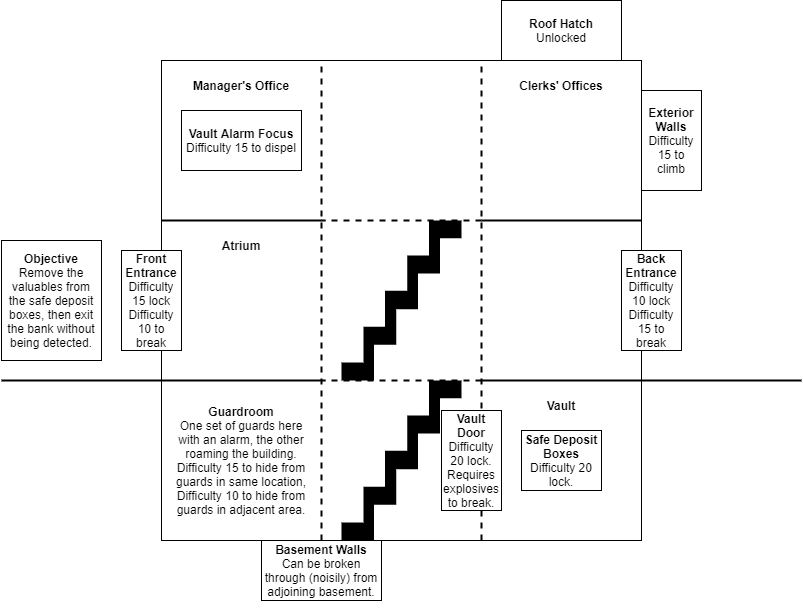
Finally, before running this encounter, it may pay to think about some unusual ways that the PCs might try to resolve certain nodes. In particular, how might they try to neutralize the guards? This is an aspect of the encounter that will differ greatly from group to group: different players, and different characters, will approach the encounter differently, and you as the GM should consider their likely tactics.
- As suggested above, they might try to lure the guards away from the vault (to the upper floor, say) by making noises. The first time they do this should attract the roving patrol; the second should attract both; the third should result in one patrol heading for the guardroom to signal for help.
- Could the PCs sabotage the signaling system once the second patrol leaves the guardroom? This might be doable with Arcana or just by smashing things up. If the signal is broken, might one patrol leave the bank to fetch reinforcements?
- Could the PCs knock the guards out, say by slipping a sleeping potion into their tea or pumping knockout gas into the guardroom? Where could they get the potion or the gas from?
- Is there prep work that the PCs could do by visiting the bank during opening hours before the heist? This might allow them to, say, steal a key or a talisman for the vault alarm, or plant sleeping potion in the guards’ tea stash.
- Most importantly: are the PCs likely to turn the heist into a smash-and-grab where they knock out (or kill) the guards, blast open the vault, and run off with the loot? Some groups might find the smash-and-grab more fun, in which case you might want to scrap the nodal encounter entirely in favor of giving them an interesting fight.
Up Next
I’ll be wrapping up this series on non-combat encounters next week, with some general discussion of how and when to use the various forms I’ve presented here. I’ve also got a Gazetteer post on the Ruins of Gobol Karn (an excellent site for adveture) in the works…and a post on an entirely different type of GM mechanic, which coincidentally builds on the dragon lore I posted a couple of weeks back…
 Aetrimonde
Leave a comment