
Today kicks off my post series creating the fourth sample character for Aetrimonde’s starter kit, who is going to be an inquisitor to fill in a gap in the party left by the previous sample characters. I’m trying a new thing with this series and starting with the class first–which will let me put in a couple of polls letting you pick this inquisitor’s ancestry, class, and other aspects of the character.
Class: Inquisitor
The inquisitor class is designed as the “sneaky” Divine class, more at home with secrecy and subterfuge than paladins, clerics, and crusaders. Here’s what the CRB has to say about inquisitors:
Any organization must eventually reckon with corruption within its ranks, and religious orders are no exception. The priesthood offers authority over the devout, and charlatans, egotists, and heretics sometimes see joining it as a way to amass money, followers, or power. Then there are the dangers posed by Anathema, which are not always mindless undead or ravening demons: many an Anathemaic plot has begun with the infiltration of a temple or community from within.
Inquisitors are anointed priests whose calling is to watch their superiors and fellow-worshippers, and ideally themselves, ensuring that they remain true to the creed of their faith. Of all the anointed priests, inquisitors are most willing and able to grapple with difficult questions of theology, dogma, and morals, and when schisms and heresies arise within a religious order, it is the inquisitors who attempt to resolve it. It is also inquisitors who watch for signs of cults and dark magic, and protect congregants from the depredations of demons, undead, and other unholy monsters. Their divine magic allows them to denounce the wicked (or those who they decide are wicked), metaphysically casting them out as the equivalent of said unholy monsters.
Inquisitors are unusual for anointed priests, in that they are all too familiar with the failings of their orders, and even their own creeds. They tend to be cynical, although most of them would insist that they are merely realists; many inquisitors start down their path when they witness or fall victim to an abuse of power by authority figures in the church, and somehow emerge without their faith being entirely shattered. Most are not attached to a temple or congregation, although major orders in large cities might have an inquisitor or two who rotate between their temples as needed. Like crusaders, inquisitors tend to be itinerant, following whispers of corruption, heresy, or Anathema wherever they lead. Unlike crusaders, they seldom allow themselves to be beholden to the leadership of their church, viewing it as their first duty to keep that leadership honest. At their best, they are grim but benevolent protectors, able to grapple with the failings of their fellow-worshippers while maintaining their own faith. At worst, they can become paranoid extremists, who see heresy in every corner and risk causing more harm than the foes they imagine.
Inquisitors are especially common in the faith of Deum Mocking, whose creed of speaking truth to power encourages the typical inquisitorial mindset. They are also common among worshippers of Deum Veiled, who find acting in secret comes naturally to them, and Deum Knowing, whose search for knowledge can overlap with the hunt for lies and deception.
To summarize: a stereotypical inquisitor is someone who grapples with the flaws and failings of their faith and their religious order, and still holds on to that faith. They concern themselves with threats to their order and congregation that come from within, rather than without, and they are willing to break the letter of their creed to uphold its spirit.
Let’s take a look at the Inquisitor’s class features:
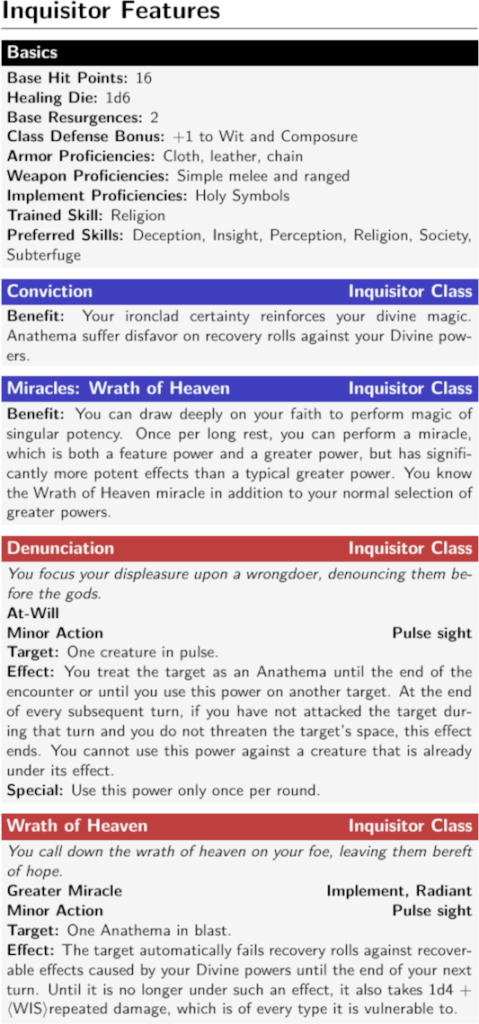
With a mere 16 hit points, 1d6 healing die, and 2 resurgences, Inquisitors have the frailest base stats of any Aetrimonde class, shared with Druids, Shamans, and Wizards. Inquisitor powers and features don’t favor Dexterity or Grace, so most Inquisitors will be wearing maille armor or a maille hauberk, making them slow and giving only mediocre AC with minimal armor resistance.
Inquisitors make up for this relative frailty with a trio of class features that all build on each other, making them incredibly potent:
At the center of the Inquisitor’s toolkit is Conviction, making it substantially harder for Anathema (unholy creatures like demons and undead) to shake off the effects of Divine powers. Anathema blinded by holy light, burning with holy fire, or fixed in place by holy terror will remain so much longer than most foes. (Mathematically, a recoverable effect will last for around 1.81 recovery attempts normally, and 3.45 with disfavor: this about doubles the expected duration of recoverable effects.)
But building on Conviction, there is also Denunciation, allowing the Inquisitor to declare any enemy Anathema, with the only condition being that the Inquisitor has to then engage this enemy by attacking it, or getting in close enough to threaten it with a melee weapon. Aside from subjecting the Denounced enemy to Conviction, this also allows the Inquisitor to target them with certain Divine powers that are usable only against Anathema, and have unusually potent (or just unusual) effects.
And finally, the Inquisitor has Wrath of Heaven, a Miracle power. Each of the Divine classes has a Miracle they can perform: this is a greater power with an especially powerful (if short-lived) effect, which they can use only a single time per long rest. The Inquisitor’s Wrath of Heaven allows them to completely prevent an Anathema (including a creature made Anathema by Denunciation) from succeeding at recovery rolls against their Divine powers: this is an excellent power to use once an Inquisitor has gotten one or two recoverable effects onto an enemy, ensuring that these effects stay in force for at least another full round. And, as a bonus, this Anathema takes repeated damage until it shakes off all of the Inquisitor’s recoverable effects.
These class features combine to make the Inquisitor incredibly dangerous to Anathema—and anyone they decide to treat as one.
Up Next
Next week I’ll be covering this Inquisitor’s heritage and abilities (and giving it a name and background). And I’ll be leaving some of these choices up to you readers! I haven’t done a poll in a while, so now seems like an opportune moment: I’ve yet to cover five of the CRB’s eight ancestry options, and I’ve got an inquisitorial concept that uses each one of the remaining choices, with related faiths. (I’ll be talking more about religion and faith in Aetrimonde in my next post, but I think the names of these faiths are evocative enough to go on.)
 Aetrimonde
Leave a comment