
All right, after a few weeks’ delay, I’m moving ahead with the Inquisitor sample character I started previously. The poll I set up in that post has produced a tie between a human belonging to a nameless Mystery Cult, and a goblin belonging to the Illuminate Society. To break the tie, I’m going with the more interesting ancestry, that being Goblin. So without further ado, I present Ipki Chainbreaker, goblin Inquisitor, member of the Illuminate Society, and worshipper of Deum Radiant.
Ancestry: Goblin
I think the general idea of a goblin is going to be familiar to many an RPG player: generally speaking, goblins in fantasy media are scrawny, cowardly, cunning, and generically evil. I think that there are interesting things to be done with goblins–you may already have read my Gazetteer post on their ancestral homeland–and so I decided early on to “promote” them to a PC ancestry. Here’s how goblins are described in the CRB:
Goblins are the smallest intelligent people on Kaern, and most have slender frames and a hunched posture making them look even smaller. However, goblins possess a wiry strength that makes them dangerous—especially when underestimated. Many goblins of both genders are completely hairless; when a goblin does have hair, it is generally black or a very dark brown. Goblins have skin tones that range from red-brown to gray, and strangely-proportioned bodies, with arms that reach past their knees. They also have alarmingly wide mouths and an assortment of sharp, mismatched teeth. While goblins grow quickly, and are physically mature by the age of 12, they do not reach mental maturity until 18 to 20 years old.
Goblins have pronounced psychological differences compared to humans, likely due to their small size placing them at a physical disadvantage compared to those of larger ancestry. They tend to be uncomfortable when alone and most confident in large, like-minded groups, making them susceptible to groupthink and rabblerousing. They are also twitchy—even paranoid—and constantly ready to flee, hide, or duck behind cover at signs of danger.
I’ve designed goblins to naturally fit into the Lovable Coward trope (warning: TVTropes link). They’re small and weak, and they know it, and are therefore ready to flee when events turn against them. At the same time, they know that they’re stronger in numbers, and so are capable of surprising feats of loyalty in defense of friends and allies.
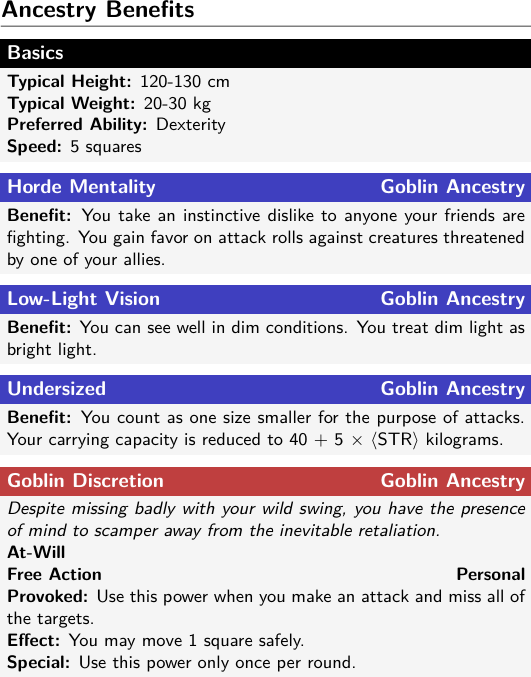
And I’ve done my best to represent these traits in goblin ancestry features, presented here:
Horde Mentality gives goblins a sizeable increase in accuracy when attacking someone in melee with an ally. The goblin doesn’t have to be there in melee with them: they can shoot, cast spells, or just throw things and still benefit from this feature.
Low-Light Vision is a familiar feature (and in fact, I think every one of the sample characters thus far has had it…I swear there are ancestries without it, I just haven’t gotten to them yet!).
Undersized is a novel feature, although like Low-Light Vision it’s shared by multiple ancestries. And to explain how it works I will need to briefly detour into how Aetrimonde handles size: aside from determining the space they take up in a battle, creatures gain a +1 bonus to attack rolls, AC, and Poise against creatures larger than they are, but suffer a -1 penalty to Brawn against such creatures. It is also harder to push larger creatures around or knock them prone. By counting as one size smaller (Small instead of Medium), goblins gain these bonuses (and penalties…) against Medium creatures, and Small creatures fighting a goblin don’t gain these bonuses. Combined with the reduction in carrying capacity, Undersized is a mixed bag, but usually a net positive.
Finally, the goblin ancestry power Goblin Discretion lets them move a very short distance safely after completely missing with an attack. While 1 square may not sound like much, this is enough to get a goblin out of melee range so that they can flee further, or around a corner so that they can take cover and hide. It can also be used with powers allowing a goblin to make multiple attacks (fairly common among Martial powers), letting the goblin reposition between attacks.
Culture: The Unclaimed Reaches
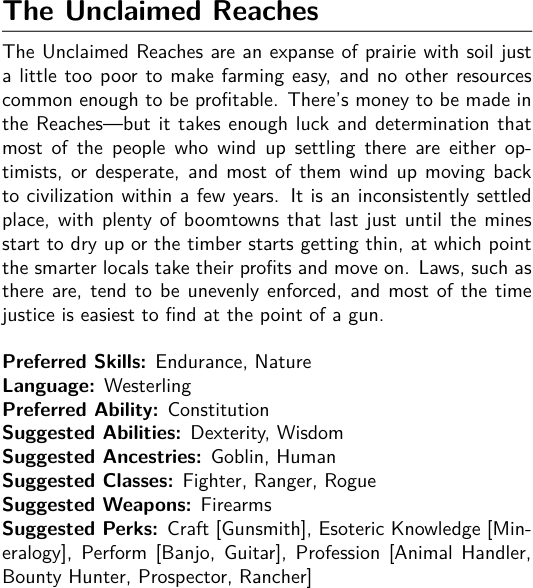
Ipki the inquisitor hails from the Unclaimed Reaches, a Western-themed region between the ruins of Gobol Karn and the borders of civilization. It is resource-poor and lawless, populated by ranchers, prospectors, bandits, and robber barons.
Faith: The Illuminate Society
I haven’t talked about faith for my other sample characters, because it doesn’t have a lot of impact for non-Divine characters (by which I mean: pick what feels flavorful!). But for an Inquisitor, this deserves at least as much consideration as culture and stratum.
The Illuminate Society is a sect that worships Deum Radiant, the god of light…and more importantly to the Society, also the god of truth and hope. The Society is a crusading sect, but their crusade is a social one: its lay members are reformers, activists, and muckrakers, who devote their lives to shedding light on social ills and putting an end to them. An anointed priest of the Illuminate Society, however, is someone who goes into the darkness bringing the light with them: they are liberators of slaves, scourges of tyrants.
And an inquisitor of the Illuminate Society is someone who sneaks into dark places, hunting the evils that lurk therein…
Stratum: Unionist
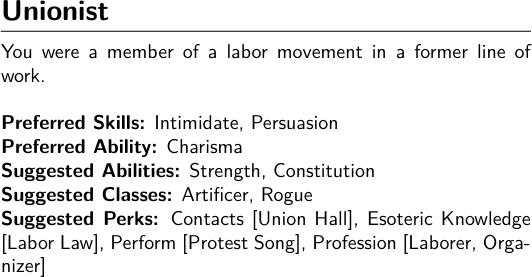
With that in mind, I want to tie Ipki’s backstory to the Unclaimed Reaches’ robber barons. In a lawless region like the Reaches, the wealthy and powerful can afford to skirt the civilized world’s laws against slavery, passing it off as indentured servitude. Mines and factories run by the Reaches’ robber barons often use forced labor “recruited” from goblin tribes and impoverished frontier towns alike.
Enter Ipki: an “indentured worker” who learned the teachings of Deum Radiant from a fellow worker and took the creed to heart. Ipki spread a message of hope and resistance among her fellow slaves, ultimately uniting them in an uprising that ousted the overseers of their mine and seized the means of production for the workers.
Ipki now roams the Unclaimed Reaches freeing slaves and preaching a message of solidarity among fellow workers. As a “lowly” goblin, she can easily pass beneath notice to infiltrate the ranks of enslaved workers…and as an anointed priest of Deum Radiant, she is a natural rallying point for the oppressed and discontented.
Up Next
I’m doing things in a different order building Ipki than I have with past sample characters. And part of this is to create an opportunity for you readers to have more input here! For the next post on Ipki, we’ll be picking out abilities, feats, and powers–but the kind of powers will be up to you! Vote in the poll below to make your preference known:
 Aetrimonde
Leave a comment