Heroic Roleplaying in a World of Swords, Sorcery, and Steam

I’d like to introduce Aetrimonde, a TTRPG I’ve been designing with heavy inspiration from the houserules my group used back in our Dungeons and Dragons 4e days. I’m not ready to publish Aetrimonde yet, but I’m opening up this blog to discuss its design principles, mechanics, and systems.

  • Today, I’ll be continuing with the creation of Gwynne of House Midwinter, elf artificer, and introducing the artificer class!

    The artificer fills a different niche than the two classes I’ve previewed thus far: the fighter is a tough “tanky” character able to protect allies; the skinchanger is a deadly shapeshifter able to quickly bring down foes; the artificer belongs to a third group of classes, designed to empower allies and heal injuries. Let’s take a look at how it accomplishes that:

    Class: Artificer

    Aetrimonde’s artificer represents a specific kind of magician who uses physical tools to aid their practice of magic. Here’s how the core rulebook explains the nature of artifice:

    Arcanists have long used tools to enhance their magic: enchanted implements are prized by all kinds of magic-worker, and the concept of placing spells on objects rather than casting them directly is not a new one. Artificers are unique in that they make magical tools into a core part of their practice. Working with only the pittance of magical power available to most mortals, they create physical objects that substitute for some of the complex memorization and mental gymnastics that other arcanists rely on.

    At their core, an artificer’s tools are mnemonic aids: artificers condition themselves to associate the mental state required by certain spells with specific tools, or specific uses of those tools. Thus, they can quickly reach a specific mindset by waving an implement through a complicated gesture, or tapping out the right series of runes engraved on their armor. An artificer can also imbue their tools with actual magic power: with even a little time to prepare, an artificer can ready a tool to hold and channel part of their magic, and even hand these prepared tools off to allies to use as they see fit. One of the simplest uses of such tools is as a protective talisman or warding device: a physical object that protects against harm and can heal a wounded ally.

    Many artificers find that their talents apply naturally to the creation of magical items, and even those who don’t tend to be passingly familiar with how they work. This expertise allows artificers to rapidly alter the workings of magical items, achieving effects that their original creators might never have expected.

    If wizards are scientists and philosophers who study the nature of magic and how it fits into the cosmos, artificers are the engineers who apply magical principles to practical effect. Artificers are often less concerned with why a novel piece of magic works the way that it does than with how they can interact with, modify, or adapt it for their own purposes.

    Some artificers start out intending to study magic in the tradition of wizardry, which is often more prestigious, but then find that they can get better results using physical tools—or they just enjoy solving practical problems more than they do the abstract theoretical problems involvedin wizardry. Others are mundane craftsmen who began dabbling in magic and gravitated towards a tool-based approach that they found familiar. Some wizards look down on artificers for taking what they view as an easy way out, but almost everyone gives artificers more credence than sorcerers who gain their magic through accidents of birth, or warlocks who dabble in dark magics as a quick and dirty shortcut.
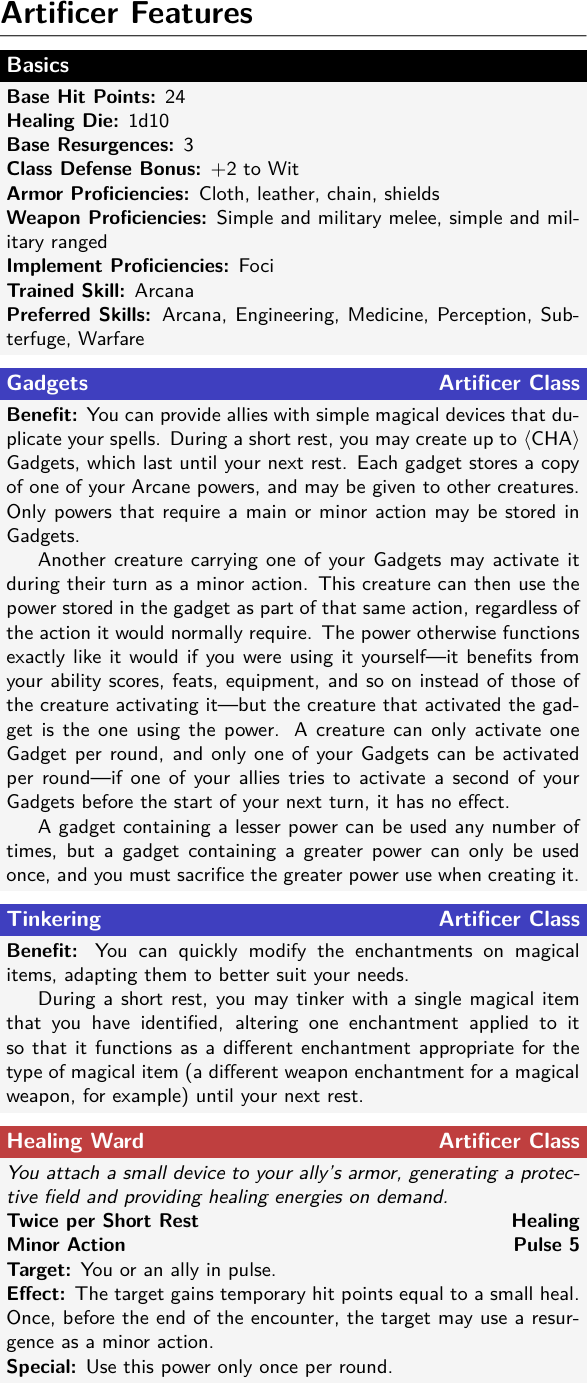
    So let’s take a look at the artificer’s class features:

    Basics

    With 24 base hit points, a 1d10 healing die, and 3 base resurgences, the artificer is only slightly less tough than the fighter. And with armor proficiency up through chainmail and shields, and proficiency with military weapons, they can actually be quite tough in a scrap! But, at their core, artificers are an Arcane class, meaning that they are spellcasters–just unusually tough ones.

    Artificers are of course trained in Arcana, and add a variety of knowledge and practical skills to their preferred skill list. Of note are Engineering, making artificers familiar with ordinary machinery (although the line between magic and machine is often blurred in Aetrimonde) and Subterfuge, allowing an artificer to disarm traps.

    Gadgets

    The first of the artificer’s main class features is Gadgets, which is a long block of rules for a fairly straightforward idea: an artificer can imbue their own spells (Arcane powers) into physical objects, and hand them off to their allies. At its core, this lets allies get off an extra attack per round as a minor action, but it also opens up a bunch of tactical possibilities, by giving allies access to spells that they normally wouldn’t be able to use. (Imagine giving a rogue a Gadget containing a spell of invisibility before they go off to scout, or loading up a fighter with several Gadgets containing powerful close-range spells and sending them into the midst of an enemy horde.)

    Tinkering

    This class feature is analogous to the fighter’s Martial Endurance and the skinchanger’s Spirit Bond features, in that it fits into a niche shared by all of the classes from a particular origin. The Arcane classes are themed around adaptability, and each one has a feature allowing them to quickly change the powers available to them. These features all work differently, however, and the artificer’s Tinkering feature works by modifying magical items. Given time to take a rest and tinker with a magical item, the artificer can change one of its enchantments into whatever enchantment would be most helpful for upcoming challenges.

    As for what this means in practice…well, I’ll be revealing Aetrimonde’s magic item subsystem in December, before we get too much further in building Gwynne.

    Healing Ward

    The Healing Ward class feature power allows the artificer to protect allies from harm. This is built into the artificer class, giving artificers the ability to heal allies without needing to devote their other power choices or their greater power uses to it–although an artificer wanting to focus on healing could do so.

    Healing Ward combines proactive and reactive protection: it both grants temporary hit points (protecting allies from future harm) and allows the recipient to later trigger it to use a resurgence and actually regain hit points.

    Abilities

    Now, as for abilities: Gwynne will want to have Intelligence, Wisdom, and Charisma as her three highest abilities, but each will affect her Arcane powers in different ways:

    • Intelligence will be used in the attack and damage rolls of most Arcane powers, and is the most important of the three unless building an artificer that makes no direct attacks.
    • Wisdom will not inherently improve Arcane powers, but can be used by many Arcane School feats that would allow Gwynne to specialize in certain kinds of Arcane power (like fire or illusions). An artificer (or any Arcane character) with high Wisdom and moderate Charisma will be really good at what they specialize in, and mediocre at everything else.
    • Charisma will improve the secondary effects of many Arcane powers, and will also improve Armament and Ward powers that enhance an ally’s attacks or defenses. (We’ll see some of these when we pick out Gwynne’s powers!) An artificer with high Charisma will be decent with most Arcane powers, but won’t reach the heights possible with specialization.

    Since I want Gwynne to be a well-rounded example of a character, that a new player can easily pick up and play, I’m going to prioritize Intelligence, then Charisma, then Wisdom. This will let a player try out different kinds of Arcane magic without being locked into a specialization.

    Gwynne has Intelligence and Grace as preferred abilities, so I’ll buy +3 <INT>, +2 <CHA>, and +2 <WIS>, for 12 points. And to take advantage of proficiency with chain armor, I’ll also buy +1 <DEX> and +0 <GRA> with the remaining point. After boosting <INT> and <GRA>, this will let her have 15-16 AC, depending on whether she opts for a maille shirt or the heavier maille armor.

    This leaves <STR>, <CON>, and <CUN>. And I think it makes sense to increase <CON> and drop <STR>, which will give her better Brawn defense, hit points, and resurgences.

    Gwynne’s finalized abilities will be:

    -1 STR+1 DEX+0 CUN+2 WIS
    +1 CON+1 GRA+4 INT+2 CHA

    Up Next

    I think perhaps it might be becoming apparent why I gave Gwynne a background as a toymaker: artificer class features revolve around handing out “toys” in the form of Gadgets, Tinkered magic items, and Healing Wards. And there’s a lot of room here to give artificers unique kinds of gadgets: I’ve got some ideas already in mind for Gwynne, but that will have to wait until we get around to selecting her spells in a couple of weeks. Stay tuned!
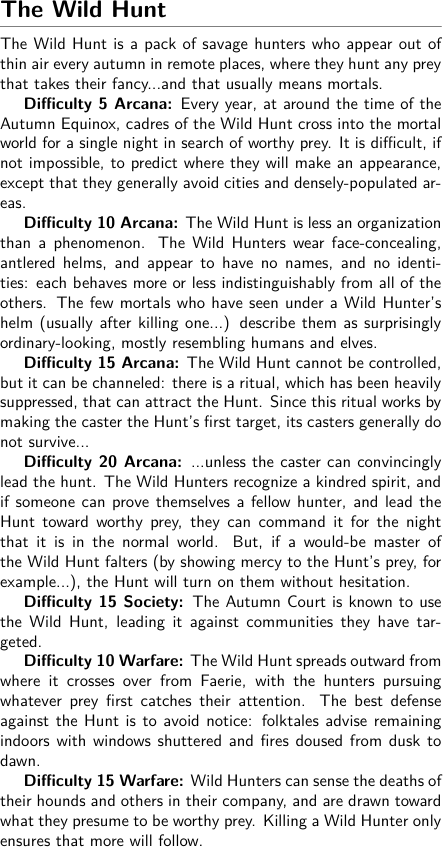
  • In today’s Bestiary post, I’m going to be covering some of the Autumn Court’s allies, and a force straight out of fairy tale and folklore: the Wild Hunt!

    Wild Hunt Lore

    The Wild Hunt, in our world, is a folkloric motif: a chase by a group of supernatural hunters, often led by a historical or mythological figure, associated with ill tidings. I’ve designed Aetrimonde’s Wild Hunt to be a more direct threat: they ride forth in the autumn, often at the direction of the Autumn Court, in search of worthy prey…but they will ride down and slay anyone with the misfortune to cross their path.

    Wild Hunt Lore Details

    The Wild Hunt is intended to be a versatile, self-contained, drop-in villain group: faceless, identityless, and more of a force than an organization. They can be filler, with the PCs just happening to be in the wrong place at the wrong time of autumn, they can be the villains of a short adventure where the PCs foresee their coming and need to protect an isolated village on the night of their hunt, or they can be a recurring threat under the command of another villain, like the Autumn Court.

    Because of this, I’ve designed the enemies associated with the Wild Hunt to work with each other (sort of like the mummies I revealed a while back). Their actions and traits of each type of Wild Hunt enemy interact with those of the others, because I envision all the different types being used together (rather than by themselves, or scattered among non-Wild-Hunt enemies).

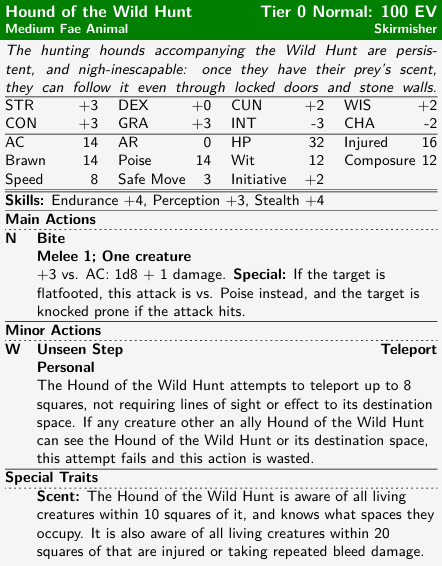
    Hound of the Wild Hunt

    The Wild Hunt uses hunting dogs, but these are no mere mortal hounds: they can pass unseen around their prey, stalking them from the shadows…and passing through solid stone to pursue the Hunt’s prey.

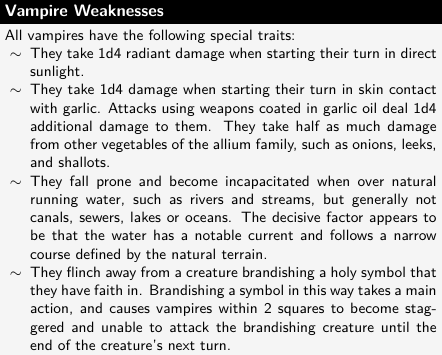
    Hounds of the Wild Hunt are Skirmishers, which in their case is expressed through the Unseen Step ability (which may be familiar if you’ve read one of my Apocrypha posts). This ability lets the Hounds teleport quite a long distance, even to places they can’t see, and even with solid objects in the way…as long as nobody can see them.

    I have used Unseen Step to ratchet up paranoia among the PCs: in the opening stages of an adventure featuring the Wild Hunt, I made it clear that something was stalking the woods surrounding a village that the PCs had stopped in. Then, once they were drawn in and investigating, an NPC fled past them in a panic and barred himself inside a solid building, only for there to be screaming, growling and crashing noises from inside. Once the PCs forced their way in (not made easy by the barred door and other protections) and found the unfortunate victim, there was no sign of the assailant…and no other exits from the building. From that point on, I repeatedly described the PCs with high Perception sensing that they were being watched, and even hearing things moving around them in the underbrush, only to find nothing when they traipsed over to investigate…right up until they chased the presence into a ravine, and an entire pack of hounds appeared behind them.

    The Hounds of the Wild Hunt also have Bite, a frankly rather poor attack that becomes much better against flatfooted enemies, and Scent, a trait ensuring that the Hounds can neither be hidden from nor ambushed. Both are shared with ordinary mortal hounds.

    Wild Hunter and Steed of the Wild Hunt

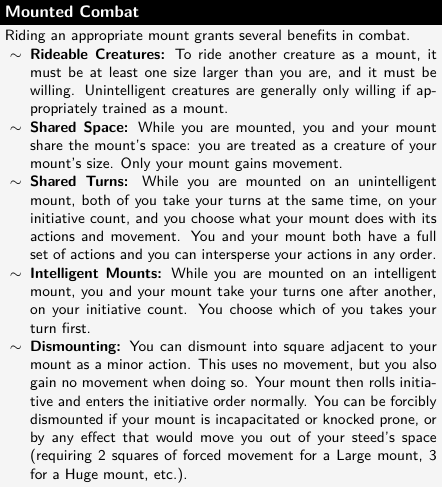
    The next enemy I’m revealing today is actually a twofer, because it’s the first example of Cavalry enemies who fight atop steeds. And in order to explain this, I’ll need to present the Mounted Combat rules included in the GM Handbook (not the Core Rulebook, because mounted combat is sufficiently niche that most players will not need to deal with it).

    Mounted Combat Rules

    Mounted combat can be a serious force-multiplier for PCs and enemies alike: it allows a character to combine their turn with that of their mount, letting them do twice as much. Of course, it doesn’t work in a lot of places where you can’t easily bring a mount, like cramped dungeons, the upper floors of buildings, or royal throne rooms. So for mounted combat to be a large part of a campaign would require planning and cooperation on the part of the GM…but it can be fun if handled well!

    Cavalry enemies are really just two enemies, an enemy and their mount, who take their turns together. Both count towards an encounter’s EV (just as a PC’s mount counts, too). In the case of the Wild Hunters, they ride on Steeds of the Wild Hunt, which look like horses…but are uncommonly willing to eat flesh.

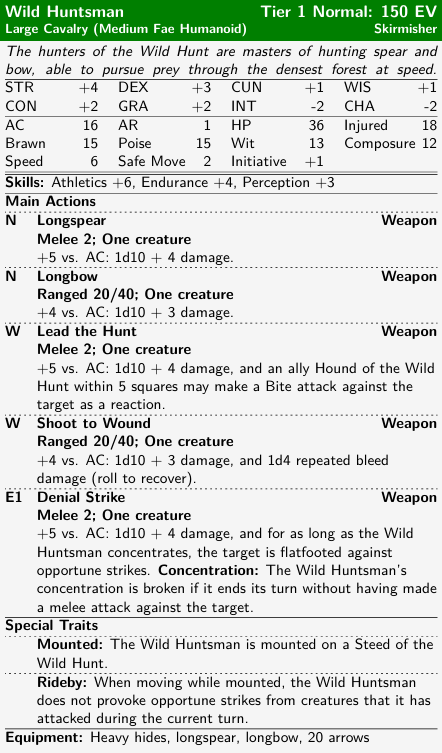
    The Wild Huntsman itself is another Skirmisher like the Hounds, but with much more flexibility: it has both melee and ranged attacks, allowing it to fight at any range, and its attacks are excellent for supporting a pack of Hounds:

    • Lead the Hunt allows the Huntsman to flank a PC with one of their Hounds, and let both of them get off a (much better, thanks to flanking) attack.
    • Shoot to Wound causes creatures to start bleeding, so that the Hounds can Scent them further away.
    • Denial Strike locks down a PC, making them flatfooted against opportune strikes…such as they might provoke when trying to get away from a pack of Hounds that have surrounded them. And since the Hounds can knock prone when attacking a flatfooted creature, this is especially nasty…

    All this is before considering the benefits of being mounted. Rideby lets the Huntsman move through a melee while taking minimal opportune strikes, so long as they attack their primary target first. And then, there’s the bloodthirsty steed…

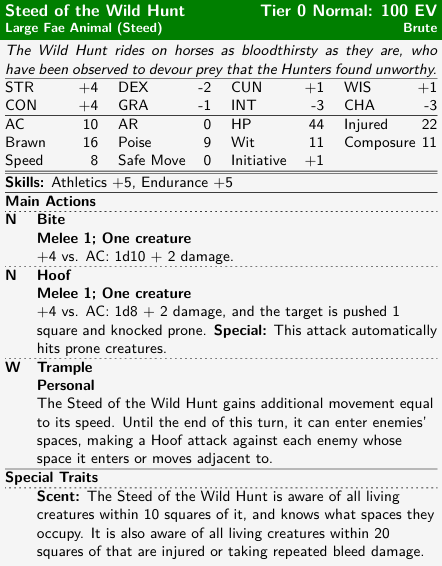
    The Steed of the Wild Hunt is a bit nastier than your average warhorse, thanks to its Bite attack and Scent ability. But the meat of it is the Trample ability, shared by most warhorses. This allows the Steed to plow through a crowd of enemies, knocking them aside like ninepins or crushing them underhoof. So, a Wild Huntsman’s typical turn might look something like this:

    • Spur the Steed to Trample, providing a total of 16 squares of movement.
    • Move toward a priority target, Trampling any enemies in the way.
    • Make a Lead the Hunt or Denial Strike attack against the priority target.
    • Move away from the priority target, Trampling any enemies still in the way.

    And if the Steed’s Hoof attacks manage to knock any enemies prone…all the better for the Hounds of the Wild Hunt, who can easily pounce on the fallen.

    The obvious solution to a Wild Huntsman, for a PC, is to get them off their Steed. This is actually fairly straightforward: anything causing at least 2 squares of forced movement will do it. For that matter, the Steed itself is a big target, and could be shot out from under the Huntsman…which might be the better way of doing things, because if the Hunstman and Steed are separated, they can just act separately.

    But then, there’s the really interesting option for a PC…which is to knock the Huntsman off of their Steed and then try to ride it. To make that work, I’d call for the PC to Grapple the Steed, and then hang on long enough to get their feet into the stirrups. But if they can pull it off, it’s exactly the kind of stunt that might get the Hunt to follow their command…

    Up Next

    Wrapping up this month of the Autumn Court, next week’s Bestiary post will present one of the Autumn Court proper: a Sidhe knave wielding the court’s magic…and capable of calling down the Wild Hunt.

    In the meantime, keep an eye out for the next post on the creation of Gwynne, introducing the artificer class!

  • Today, I’m starting in on the creation of a third sample character: Gwynne of House Midwinter! Gwynne is an elf artificer, a combination I picked out in response to reader polls. So, as is my wont, I’m going to spend this first post in the series discussing Gwynne’s heritage:

    Ancestry: Elf

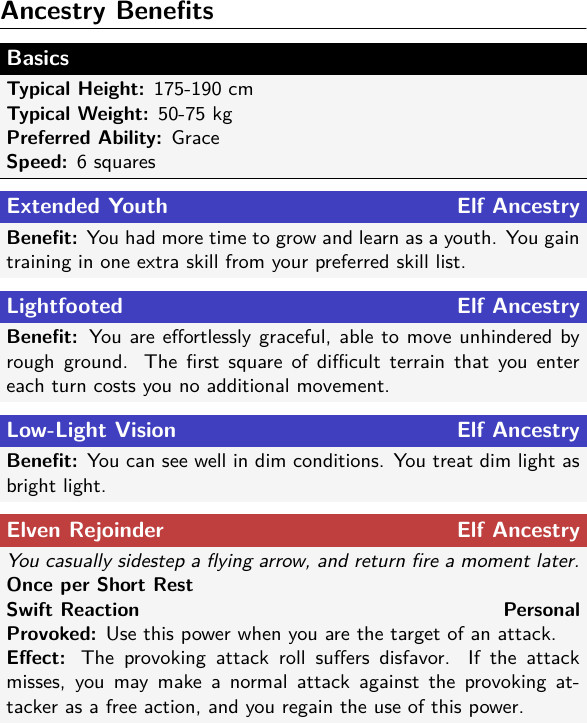
    Aetrimonde’s elves are a toned-down version of the Tolkienesque model common to a lot of RPGs: long-lived, but not immortal; lithe and graceful, but not superhumanly so; inclined to magic, but still with a normal mortal’s potential for it.

    Basics

    With Grace as a preferred ability, elves will have slightly better Poise defense, as well as Armor Coverage if wearing light or medium armor. Grace also influences safe movement, which synergizes with the Lightfooted trait that we’ll get to in a moment. And with a perfectly normal speed of 6 squares, elves can easily be quite mobile.

    Extended Youth

    Representing elves’ long lifespans, which see them reach maturity at around 25, Extended Youth allows elves to be trained in an additional skill from their preferred skill list.

    Lightfooted

    While it doesn’t directly increase elves’ speed, Lightfooted allows elves to move a little further through difficult terrain like brush, mud, and shifting sand, which normally costs twice as much movement.

    Low-Light Vision

    This works just like the versions associated with dwarves and ghouls. I should stress that not every ancestry has low-light vision! It’s a mere coincidence that all three ancestries so far have had it…

    Elven Rejoinder

    The elf ancestry power is Elven Rejoinder, allowing an elf to attempt to resist an attack and respond with a counter. While the flavor text describes gracefully dodging a physical attack, it does also work on attacks vs. Wit or Composure.

    While the rules do not touch on this, the way I would try to run this and similar powers at the table is that the player of an elf character must declare their intent to use this power before the attack is rolled: it does not allow a player to force disfavor on an attack roll after seeing the roll, much less after the GM has determined the effect. However, this requires the GM to be consistent about declaring who is being attacked and giving the player a moment to decide to use the power before they actually roll dice. Depending on how a group prefers to play, they might be more lenient about when the power must be used.

    Like Dwarven Stubbornness and Ghoulish Tenacity, there is a way for elves to regain this power, which is to be missed by the provoking attack. That’s a little more up to chance, but it can be made more reliable using a feat, which we’ll see in a couple of weeks.

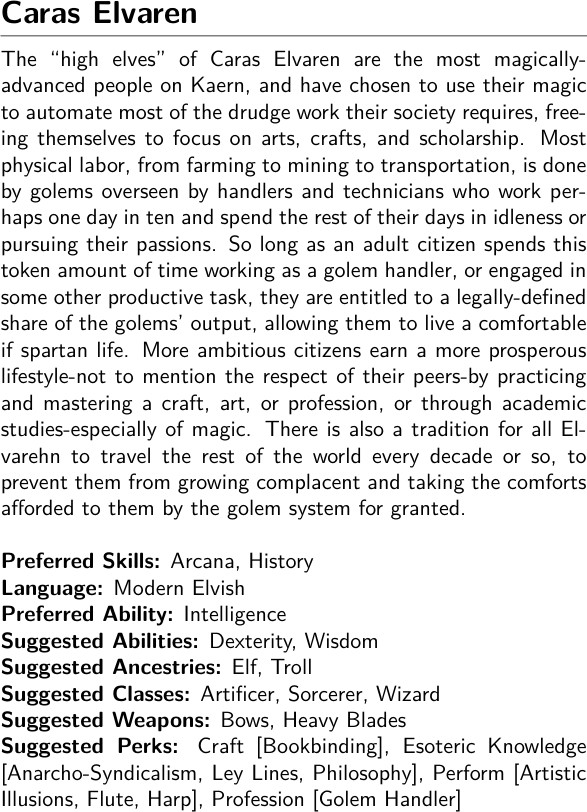
    Culture: Caras Elvaren

    Since Gwynne is an artificer, using Arcane magic, I’m going to design her to fit the “high elf” archetype. In Aetrimonde, “high elf” is a cultural distinction, not a racial one: the high elves are those elves who live in the nation of Caras Elvaren, which is the world’s most magically advanced society. While it isn’t quite post-scarcity, Caras Elvaren is certainly post-hardship: past generations of Elvaren wizards and arcanists poured their magical efforts into building an automated golem labor force, which by the setting’s present day has grown to the point that the nation has eradicated hunger, homelessness, and virtually all drudgery.

    I’ll be revealing more about the nation of Caras Elvaren in some upcoming posts, the same way I did with the Dwarven Federation.

    The Caras Elvaren culture gives Gwynne Intelligence as a preferred ability, which is great: Arcane magic keys off of Intelligence foremost, so this will give her an advantage here.

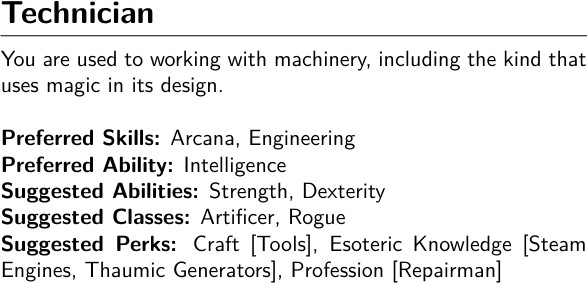
    Stratum: Technician

    And finally, Gwynne will come from the Technician stratum, representing the class of skilled laborers who work with magic and machinery (which are often intertwined in Aetrimonde).

    This gives Gwynne a second instance of Intelligence as a preferred ability, which sort of locks her choices in: since she will want to boost Intelligence, and her only other preferred ability is Grace, she’ll also be boosting it as well.

    Tying It Together

    So how do we fit all this together into Gwynne’s backstory?

    Because Caras Elvaren is so much more magical, and more prosperous, than the rest of Aetrimonde, I’m going to write Gwynne as someone who wasn’t always an adventurer: she’ll be an older elf, closer to middle age (so around 150…), and formerly a small-time artificer who built “ordinary” magical things that the high elves would take for granted but would be extraordinary elsewhere.

    Like toys…

    As for why Gwynne is “of House Midwinter,” and why a former toymaker would take up adventuring…I’ve got ideas on that front, but I think that I will space these out a bit. Some of them deserve more explanation than I think will fit neatly into this post, so I’ll return to them once I’ve revealed a bit more about the nation of Caras Elvaren.

    Up Next

    We now have a basic concept for Gwynne: she’s an older elf, formerly a toymaker, who has taken up adventuring as what you might call a career change. And I’m excited to build on that as we get into the artificer class in next week’s post!

  • Today, I’m going to introduce the members of the Autumn Court, starting with their creations and hangers-on. All of the Sidhe Courts have other creatures of Faerie among their ranks (though always in a subservient position). The Autumn Court attracts allies who, like the Sidhe in charge of the Court, have no use for so-called civilization.

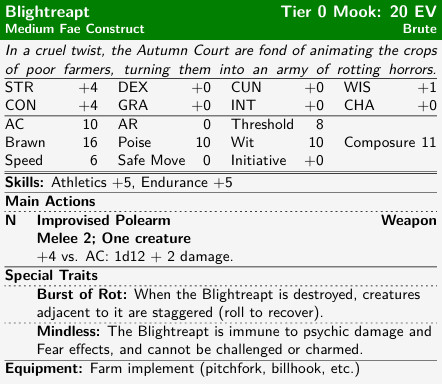
    The Blightreapt

    The Sidhe make use of many disposable soldiers, among them the Blightreapt: scarecrow-like constructs made from farmers’ crops and sent to wreak havoc on their growers.

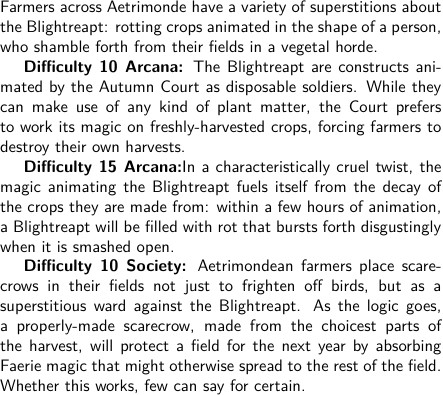
    Blightreapt Lore

    While individually weak, Blightreapt can be animated en masse, with dozens coming from a single field, and in a nasty twist characteristic of Autumn, they render the crops they are made from inedible. The Court often cares not whether a swarm of Blightreapt succeed in overrunning a farming community: in fact, they hope for survivors, in the expectation that they will turn on each other when they realize that they have no crops as winter approaches.

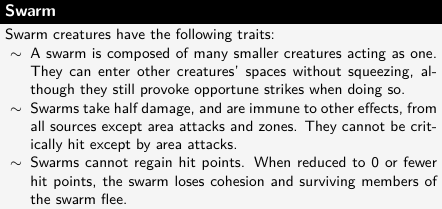
    The Blightreapt fill a similar niche as zombies, although with stats taken to less of an extreme. They can be used as part of a horde, with the added twist that when destroyed, they stagger nearby creatures (due to the nauseating stench of their internal decay as it spills forth).

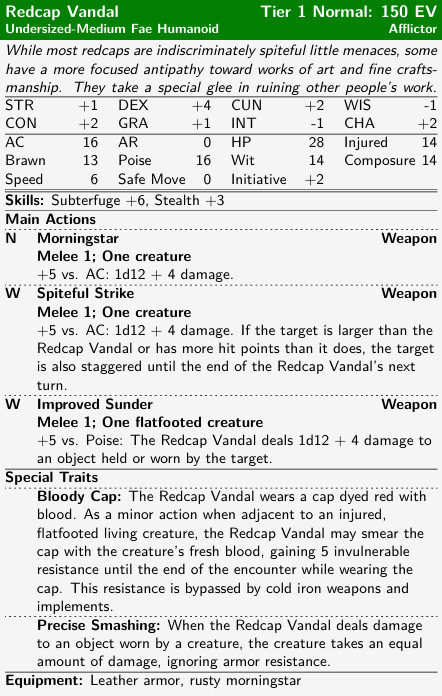
    Redcap Vandal

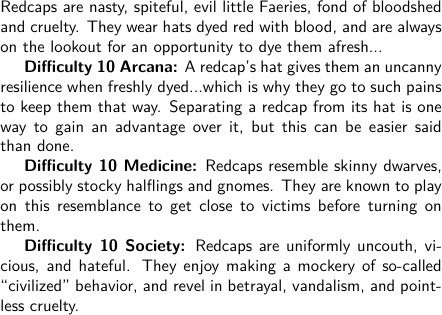
    Aetrimonde’s redcaps are gleefully nasty little fae, fond of endearing themselves to lone travelers only to stick a knife in their back, and destroying the treasured possessions and life’s works of those they cannot slay outright. This makes them fit right in with the Autumn Court, who likewise seek to tear down systems of civilization, spreading distrust and breaking infrastructure and institutions. Redcaps in general, but Vandals most of all, are only too happy to pursue these aims with a little direction from the Court.

    Lore on Redcaps in General

    Redcap Vandals, in particular, enjoy smashing things: the finer and more appreciated, the better. They are Afflictors, but unlike the mummies I’ve previously revealed, Redcap Vandals are Afflictors because of their potential to destroy the PCs’ possessions. (And as any experienced GM knows, that’s one of the surest ways to make the PCs mad at an enemy.)

    The way Redcap Vandals do this is twofold: firstly, they must get an enemy flatfooted, either through typical means like flanking or ambush, or by using Spiteful Strike (an attack common to Redcaps) against larger or tougher PCs. One they have a flatfooted foe, the Vandal can then use Improved Sunder1, dealing damage to an object the PC holds or wears…and if it chooses to damage, say, a PC’s armor, the Precise Smashing trait allows it to deal this damage to the PC, too. This is the first part of the puzzle that a Redcap Vandal presents: it is important to keep flatfooted PCs away from the Vandal, lest they wind up with broken armor in the middle of an adventure.

    Also seen in this statblock is the Bloody Cap trait, also common to Redcaps, and this is the second half of the Vandal’s (and other Redcaps’) puzzle: injured PCs should try to stay out of a Redcap’s reach until they can be healed, because a Redcap gaining 5 invulnerable resistance is a definite problem. If a Redcap does manage to dye its cap, a counter to this would be to use Sunder on its cap, which would remove this resistance. A similar tactic would involve the use of Disarm to steal the cap, and if the PCs are prepared, they could always overcome the resistance with cold iron weapons and implements.

    As one last remark, I’ll draw attention to the Vandal’s size of “Undersized-Medium:” this means that it occupies the same space as a Medium creature (a single square), but has some of the advantages of a smaller creature.2 Some PC ancestries (halfling and goblin) are Undersized and gain these same benefits.

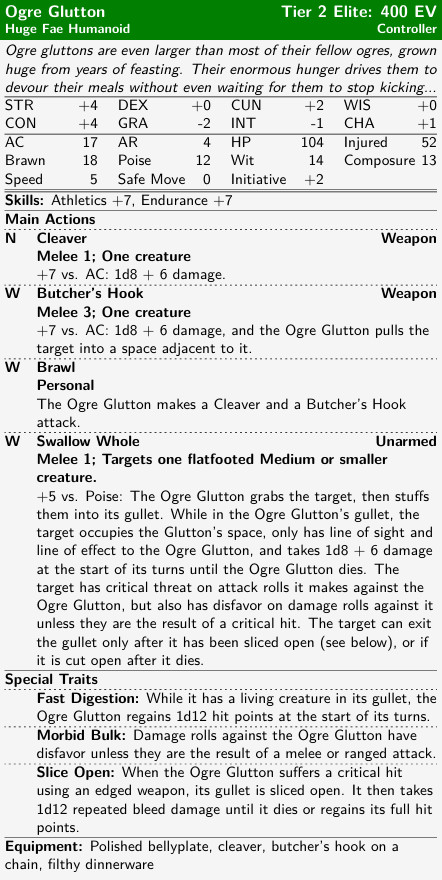
    Ogre Glutton

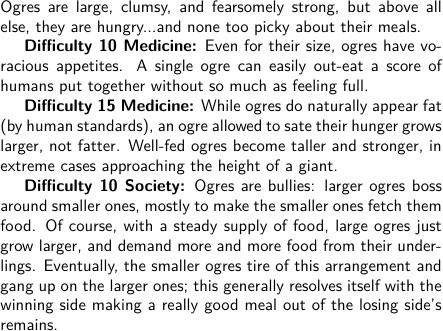
    The design of Aetrimonde’s ogres is centered around hunger: the core of their portrayal is their appetite, which is appropriately huge. The Autumn Court uses ogres much the same way that they use the Blightreapt: to destroy harvests and drive farmers to desperation. A clan of ogres coming “down out of the hills” (or more likely, through a crossing to Faerie) can eat a sizeable farming community out of house, home, and harvest…and that’s before they start in on the farmers for dessert. Ogre Gluttons simply take this to a logical extreme.

    Lore on Ogres in General

    The Ogre Glutton is an Elite enemy and a Controller, and it fulfills this role using its Swallow Whole action…which does exactly what it says in the name. An Ogre Glutton can grab an adjacent, flatfooted PC and stuff them bodily down its gullet, which effectively isolates them. The PC takes damage, cannot be healed by allies (for lack of line of sight and effect), cannot run away, and in fact, cannot really do much of anything except try to cut their way out of the Ogre’s gullet. That the Ogre also gains a bit of regeneration (from Fast Digestion) is merely a bonus.

    Of course, this is a bit of a double-edged sword for the Ogre. Creatures in its gullet have disfavor on damage rolls against it, it’s true…unless they result from a critical hit. And if a creature in its gullet manages to cut their way out, the Glutton starts taking some fairly serious repeated damage. This can happen with a critical hit from outside its gullet too, but critical threat makes it a bit more likely for a creature in its gullet.

    The Glutton has a few other tricks as well: its Brawl action allows it to sling a Butcher’s Hook at a foe just out of range, and reel them in on a chain before taking a swing with a Cleaver. And Morbid Bulk makes the Glutton take just a little less damage from area attacks: bringing it down will require some focused fire from melee and ranged attacks.

    Up Next

    Tune back in Wednesday for the first post in the creation of Gwynne of House Midwinter, elf artificer. And next week, keep an eye out for a continuation of this series dealing with another part of the Autumn Court: the Wild Hunt!

    1. As a side note, Sunder is a combat maneuver that the PCs can use, too. Ordinarily, Sunder gives the target the option of taking damage themselves rather than letting it be dealt to their possessions. (In other words, they can shield an object with their body.) Improved Sunder is a feat that prevents the target of Sunder from taking this option…but Precise Smashing is, for the time being, unique to the Redcap Vandal. ↩︎
    2. Principally, larger creatures (Medium and up) suffer a -1 penalty to attack rolls against the Redcap’s AC and Poise but gain +1 to attack rolls vs. its Brawn; the Redcap gains the opposite effect of +1 to attack rolls vs. larger creatures’ AC and Poise but -1 vs. their Brawn. ↩︎
  • Now that I’ve covered Aetrimonde’s ritual magic subsystem, in my previous post, I’m going to jump into some borderline-apocryphal rituals, themed around the plane of Faerie, that are in limbo and may or may not make it into the core rulebook. Why this indecision? Well, mainly, I’m not yet satisfied with the quality of the rituals I’ve written up for the other planes, and I’d prefer not to favor Faerie. So unless I can make some improvements to the other planar rituals by the time I’m ready to publish the core rules, I’ll be saving them all for later supplements, much like the Faerie powers in my previous Apocrypha post.

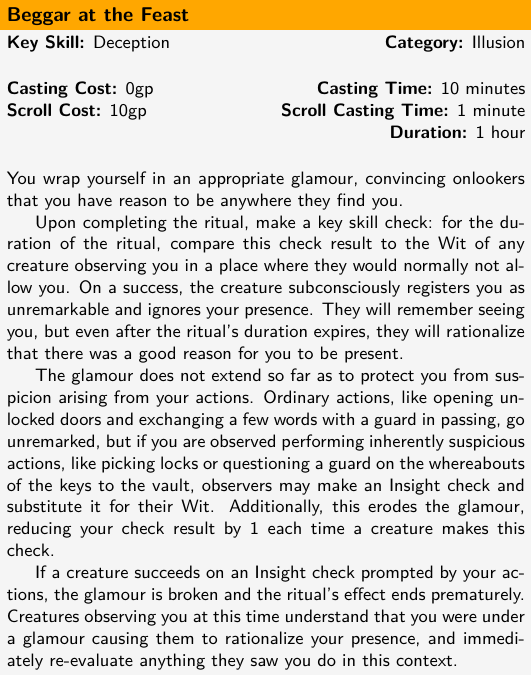
    Beggar at the Feast

    This ritual is inspired by fairy tales about kings going incognito among their people and witches showing up uninvited to a feast. It makes the caster so bland and unremarkable that anyone who sees them, no matter how out of place they are, rationalizes and ignores their presence.

    Now, I mentioned in my first post on ritual magic that I didn’t want rituals to obviate ordinary skill checks and perks. So does Beggar at the Feast make skills like Deception, Disguise, and Stealth obsolete for sneaking around? I’m going to say no, but let me walk through my reasoning:

    Firstly, while Beggar at the Feast makes a character less remarkable, it doesn’t actually help them get into places that they shouldn’t be: it doesn’t open locked doors, much less castle gates, and so in order to make use of it, there needs to be an existing path to where a character needs to be. This is a plus in my view: it creates opportunities for the PCs to work together to, for example, draw out a bunch of guards so that one of the PCs can go back inside with them under the effect of Beggar at the Feast.

    And secondly, Beggar at the Feast actually makes it harder, or at least riskier, to do things like pick locks or pump guards for information. A character relying on regular old Stealth and Deception checks could feasibly talk their way out of trouble if they get caught; if Beggar at the Feast breaks, everyone looking at them (not just the guards, everyone) immediately realizes that they had been placed under a glamour, and that’s the sort of thing that makes a lot of enemies.

    In all, Beggar at the Feast is a specialized tool: great for sneaking into exclusive parties and eavesdropping on private conversations, not so great for robbing vaults or springing allies out of jail.

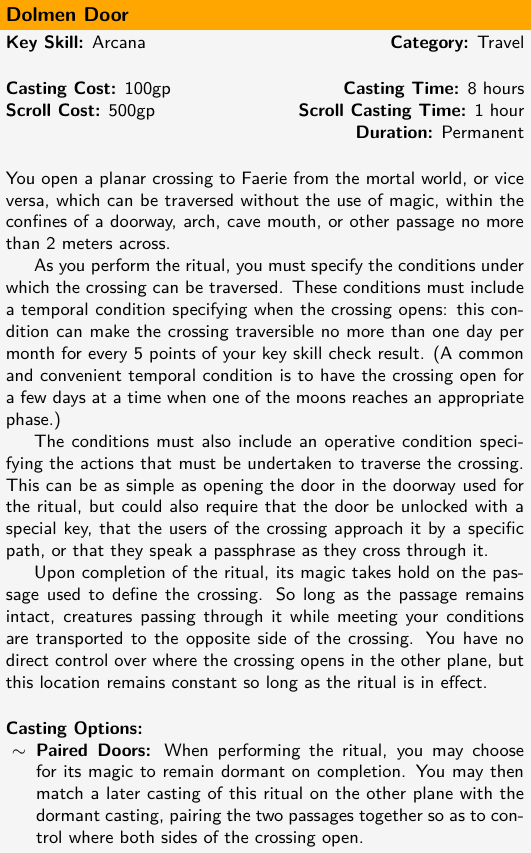
    Dolmen Door

    I previously showed off the Open Planar Crossing ritual, which is one way to create crossings into Faerie and other planes. Dolmen Door is another: more expensive, in terms of reagents, with more restrictions, but if used with planning and forethought, potentially more powerful.

    This ritual was designed specifically to replicate a Narnia-style portal to another world: a door that can be opened (or a cave that can be walked through, or any number of variations) under the right circumstances to cross into another plane. It can be used by anyone, with no need for magic (and for any GMs reading, that makes it a great tool for any Sidhe wanting to move an army into the mortal world…), but it also offers tools to control who can use it through passwords, keys, and other conditions that can be placed on the crossing.

    Dolmen Door also offers a way for the caster to control where both sides of a crossing are, which isn’t easy to achieve with other methods of planar travel. This does require performing the ritual on both sides, though…which makes a great premise for an adventure, in multiple ways:

    • The villain is trying to infiltrate a stronghold to place the other end of a Dolmen Door; they have a scroll, so it will only take them an hour, but that’s an hour that they need to remain uninterrupted. The PCs need to search the stronghold and find where the villain is performing the ritual.
    • The PCs themselves want to open a passage into Faerie (perhaps to evacuate refugees from the Sidhe, or move troops in to support a rebellion). They need it to go to a specific place in Faerie, and that means that they will need to cross into Faerie themselves and make the journey to where they will perform the ritual.

    The one big downside to Dolmen Door is that it only makes a functioning crossing for a few days per (35-day) month. Which is, actually, another great thing from a GM’s perspective, because it allows creating time pressure. (“There is a passage that will take you near to where you must go in Faerie…but once you cross, you must return within three days, or else you may be trapped for years…”)

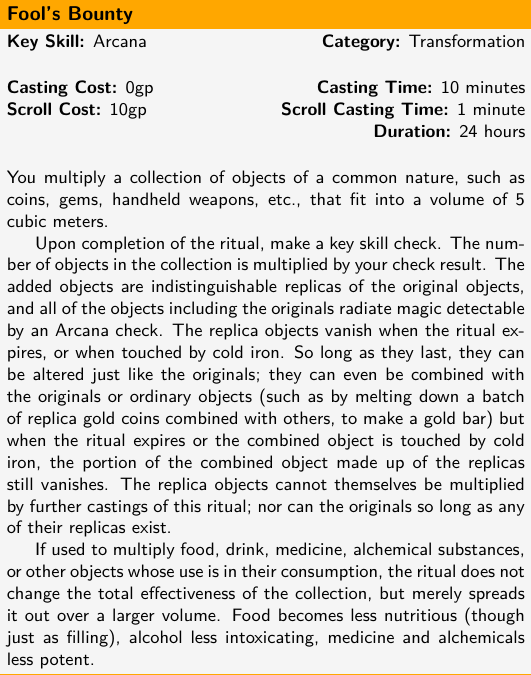
    Fool’s Bounty

    Where do leprechauns get all that gold, anyways? With Fool’s Bounty, we may have an answer. The ritual multiplies ordinary objects (and coins are one of the suggested options…), creating a vast number of temporary replicas. With a good Arcana bonus, and some luck, a caster could easily multiply their available cash by 20 or more, making it a scoundrel character’s dream.

    Of course…there are some subtle pitfalls here, which I’ve gone to pains to insert. (It’s not called Fool’s Bounty for nothing.) Firstly, the ritual makes all the duplicated objects radiate detectable magic. Is every merchant that the PCs want to spend money with going to be able to detect that? Well, no, the provisioner at the general store and the barkeep in the grimy tavern probably won’t have the means to check coinage for magic…but in the far more likely scenario (based on my experience of TTRPG player psychology) where a PC is trying to cheat a merchant of magical items out of a valuable weapon, that merchant is probably able to detect magic, or has a piece of cold iron available. So if the PCs want to pull a scam with this ritual, they’d better come up with a clever one.

    Secondly, the ritual makes identical replicas. So, if the PCs are planning on replicating their weapons to arm a bunch of villagers against raiders…they’d better keep track of which weapon is the real one, lest they find themselves abruptly unarmed 24 hours later.

    The last restriction on Fool’s Bounty is one that I added mainly for flavor (though, also, to prevent the PCs replicating healing potions or alchemist’s fire). You can’t live on food replicated by Fool’s Bounty, unless you want to eat vastly more of it. Which is the basis for another plot: mortals ensnared by the Sidhe, and kept trapped in a neverending night of feasting and dancing, slowly withering away no matter how much they eat… Someone should probably write an adventure about that.

    Up Next

    These aren’t the only Faerie-themed rituals I’ve written, but I think they provide a good taste of what I’m going for in ritual in general: fun, useful, powerful…but not something that trivially solves an adventure without the need to think about the problem.

    This is the last of my Apocrypha posts for the time being: next Wednesday will be the first post in the creation of elf artificer, Gwynne of House Midwinter.

  • Today, I’m going to talk about the first of Aetrimonde’s subsystems, ritual magic.

    I’m defining subsystems to mean parts of the rules that not all characters will necessarily interact with, or interact with in a deep way. Everything I’ve revealed so far (heritage, class, skills, perks, feats, powers, equipment, even how enemies work…) is common to all characters. Ritual magic is not: it’s something that a character must opt into by taking a specific feat or purchasing ritual scrolls. So let’s take a look:

    The Purpose of Ritual Magic

    One of the design goals I’ve discussed for Aetrimonde is Tactical Combat. But, that doesn’t mean that an Aetrimonde campaign should revolve entirely around combat: it’s merely something that the system is designed to be good at handling. Various game designers and ludologists have discussed the “pillars” of RPG gameplay, which can be summarized as combat (fighting things), interaction (talking with NPCs, trying to suss out their motives or persuade them to do things), and exploration (experiencing interesting places and ideas, uncovering secrets, solving puzzles).

    On the player side of the table, Aetrimonde handles interaction and exploration largely through its skill and perk systems. (And it also provides the GM with advice and tools to set up interesting people, places, and challenges.) Ritual magic is an extension to the skill system, allowing characters additional uses for skills. Because interaction and exploration usually take place outside of combat (although I personally enjoy creating the occasional encounter where they overlap), I’ve designed the ritual magic subsystem with the following goals:

    • It should be entirely optional, and not built into any character.
    • It should not significantly eat into character-building resources used to make a character better at combat (feats, powers, etc.).
    • It should offer characters new ways to interact with NPCs or the setting.
    • It should not make ordinary skills and perks obsolete, and should in fact rely on skill and ability checks (which can benefit from perks).
    • It should generally be difficult to use during combat, but if the PCs put together a plan for it (or the GM sets up an opportunity) it should be possible to do so.

    With that in mind, let’s take a look at the implementation:

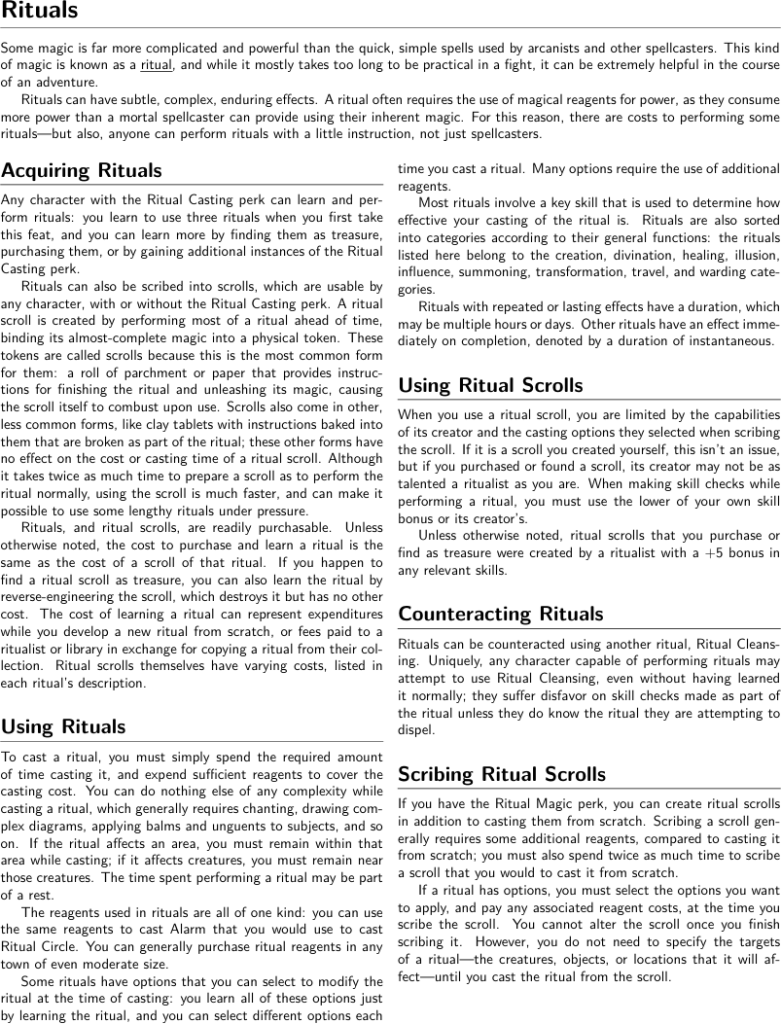
    Ritual Mechanics

    The rules for using ritual magic take up an entire page in the rulebook, but that covers virtually all aspects of learning and using rituals.

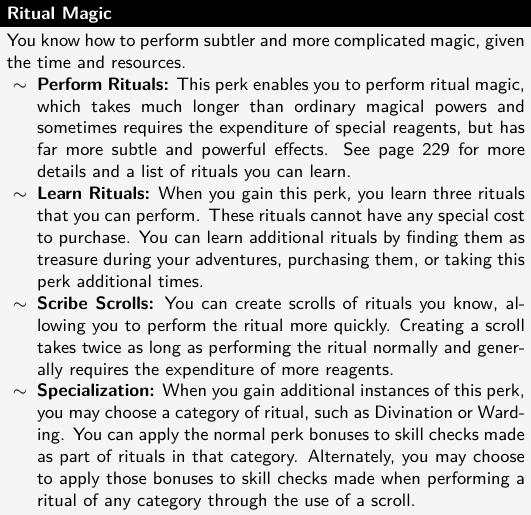
    Ritual Magic Rules

    I’ll also put the actual perk that a character would take to learn ritual magic here: a character who wants to specialize in ritual magic can take this perk multiple times to not just learn several rituals, but also to specialize in certain kinds, applying the benefits of the perk to such rituals.

    The meat of the ritual magic subsystem is the rituals themselves, so I’ll reveal a few of them here.

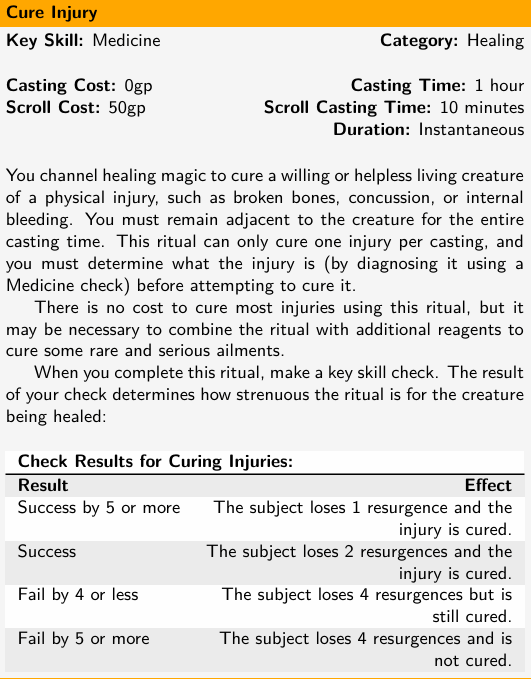
    Cure Injury

    I previously alluded to a Cure Injury ritual when I was discussing afflictions: some of the examples I provided there mentioned that, if the affliction worsened too far, the only way to remove the affliction was with this ritual. So, I’ll start there:

    Cure Injury allows the caster to (hopefully) heal their or an ally’s injury in a mere hour, rather than waiting for it to heal naturally. This has a cost: not a monetary one, unless using a scroll to cure the injury in 10 minutes, but in resurgences: healing an injury so rapidly is stressful for the body, and depending on how well the caster performs the ritual, it can drain the beneficiary of resurgences in the process. If the caster performs especially badly (or it was a really nasty injury, the ritual may even fail to work while still draining the patient. As such, Cure Injury is not necessarily the go-to answer to an injury: it is best reserved for injuries that it is urgent to get rid of, or that have progressed so far that there is no other way to heal them.

    I’ll also mention, while I’m at it, that there are two other, very similar rituals: Cure Ailment cures poison and disease, while Dispel Curse breaks curses.

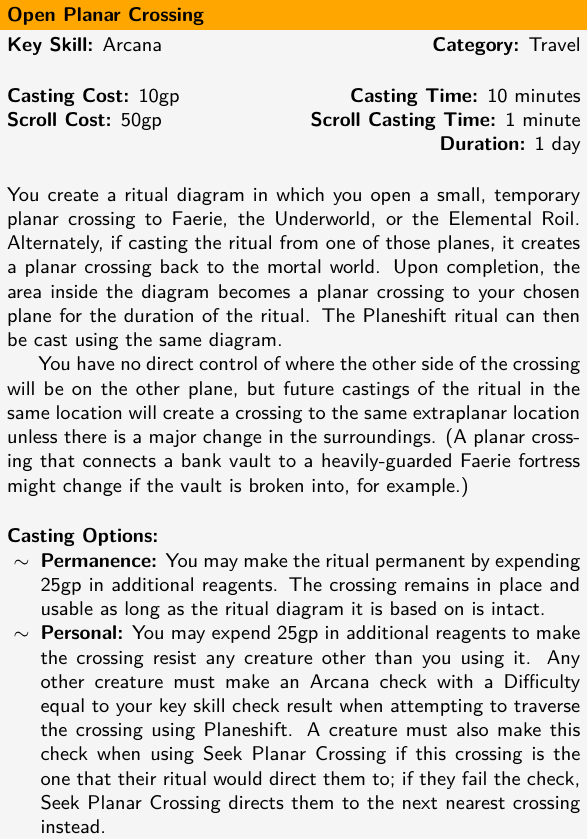
    Open Planar Crossing

    I’ve also recently mentioned the Planeshift ritual and planar crossings. I won’t actually go into the mechanics of Planeshift here, because it’s actually really straightforward and I want to cover some more interesting rituals. Open Planar Crossing allows the caster to tear open their own planar crossing wherever they please. And while they won’t have control over where the other side of the crossing is, it will get them to their plane of choice.

    Open Planar Crossing is partly a tool for GMs, allowing them to easily explain why, for example, a bunch of elementals have appeared out of nowhere to trash a small town: some villain in the Elemental Roil opened a crossing to invade the mortal world, and that’s where it popped up.

    It is also another ritual giving PCs rules for building something: with a little bit of work (and the cooperation of the GM), a group of PCs can search out an appropriate place to open a planar crossing that will put them near to where they want to go on another plane. Or, with a bit more work…they can open an entire network of crossings, located in convenient places to let them travel long distances by passing through other planes as a shortcut.

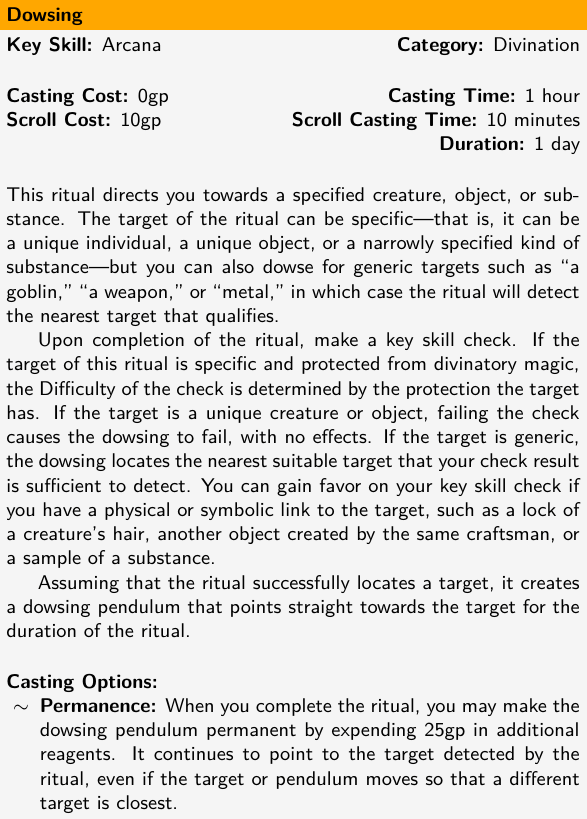
    Dowsing

    Dowsing is a neat utility ritual for PCs, allowing them to easily track down something they’re looking for. This is common enough in many TTRPGs, but I’ve attempted to do two things with it.

    First, I’ve tried to make the ritual generally applicable. D&D, in its many editions, has had oddly specialized spells like Locate Creature, Locate Object, Locate Animals or Plants, Locate City, Locate Water, and Find Traps. Dowsing is, instead, generally applicable, able to find anything from “iron ore” to “my buddy Fred.”

    And secondly, I’ve stylized the ritual. Rather than magically giving the caster knowledge of the location, or even just direction, of what they’re looking for, it create a dowsing pendulum that points them in the right direction. This is perhaps less instantly useful (they have to follow the pendulum until they get to what they’re looking for), but it’s also more helpful when trying to track down a moving target like a fugitive.

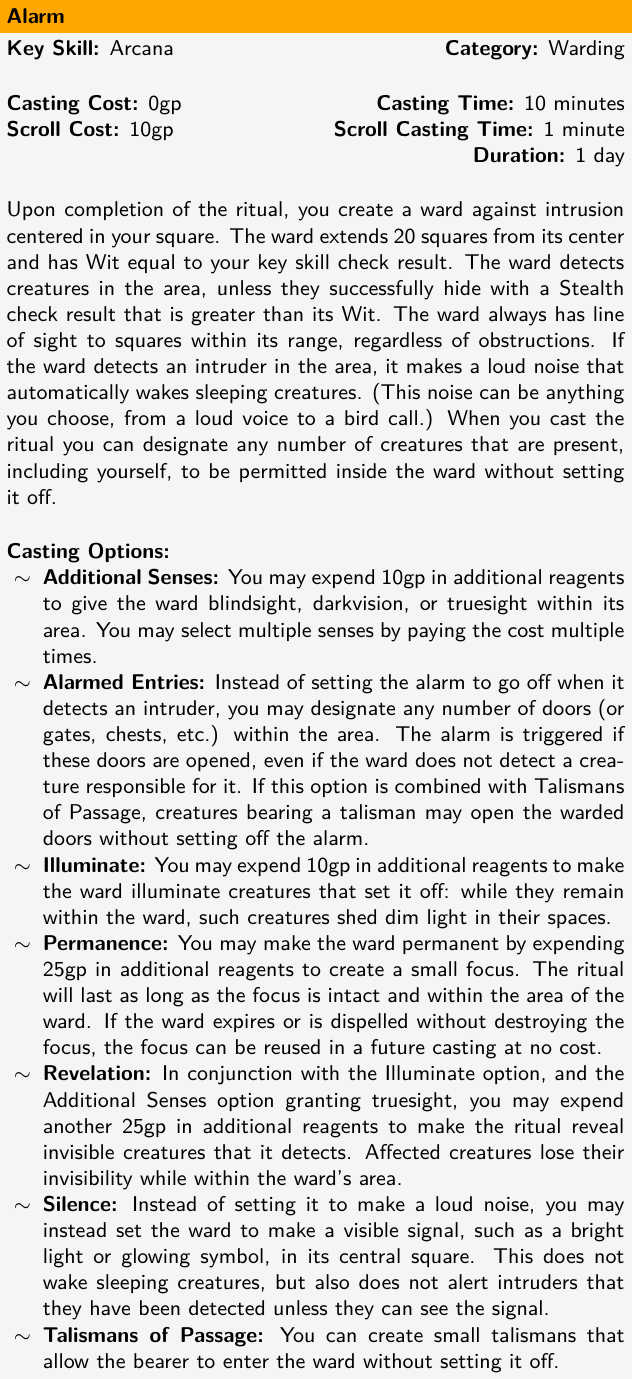
    Alarm

    The last ritual I’ll present today is Alarm, which is an excellent example of just how flexible Aetrimonde’s rituals can be (and that’s convenient, because it’s also the alphabetically first in the book).

    The basic version of Alarm is simple: it creates a sensor that watches over a large area and makes a loud noise if anyone enters the area: great for watching over a campsite if the party is too tired to keep a constant watch, or the terrain would make it easy to sneak up. But, the true value of Alarm is in its casting options: for an additional expenditure of reagents, the ritual can be made to:

    • Spot creatures that are invisible, shrouded in complete darkness, or hidden by fog.
    • Watch for doors being opened instead of watching for unknown creatures.
    • Cause intruders to glow so that they are easier to spot, or even break their invisibility.
    • Last indefinitely.
    • Alert guards with a visible signal instead of an audible one.

    And the last option, I will spend some additional time discussing, because it’s an example of what you might call a sub-subsystem. Many rituals can create talismans (of Passage, of Compulsion, of Interaction, etc…) that alter how the ritual works. The purpose of talismans is to provide some lightweight rules for plot tokens like the magical key that opens the warded door to the villain’s secret passage, or the cursed necklace that allows an evil wizard to possess the wearer. And those rules work for PCs, not just the GM: if they want, players can use Alarm and various other rituals to ward and enhance a home base for themselves, and talismans give them a way to have a “key” to their wards.

    Up Next

    Part of why I’ve covered ritual magic now is so that I can now present my next post, which will be another Apocrypha post, this time on the subject of Faerie rituals. Stay tuned!

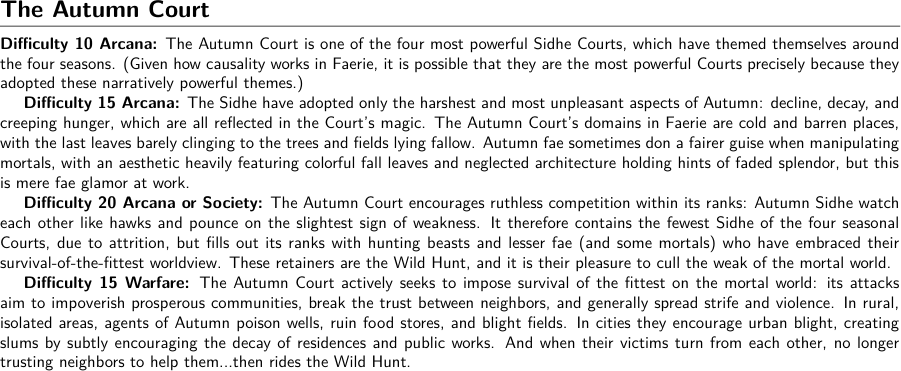
  • Continuing on from my post about the plane of Faerie, today I’m going to cover the Autumn Court, which will be the focus of several posts this month. I won’t be showing off any statblocks in this post, which is more concerned with the lore surrounding Sidhe in general and the Autumn Court in particular, but I’ll have several posts revealing specific enemies later in the month.

    The Sidhe

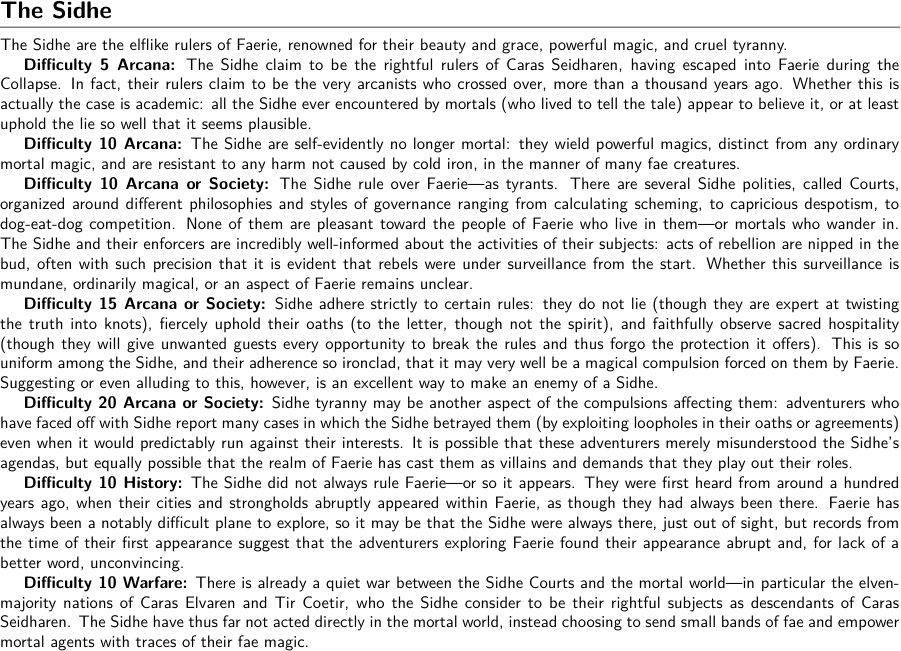
    For starters, let’s take a look at the Bestiary’s lore about the Sidhe in general. Some of this is repetition and summation of information from the campaign setting’s entry on the plane of Faerie, but there is also information about how the Sidhe behave that would be useful to adventurers dealing with them.

    I’ve written the Sidhe to be a slightly postmodern take on fairy-tale villains: they’re almost cartoonishly evil, unable to avoid wicked acts even when they wouldn’t serve their interests…but that doesn’t change the fact that they’re totalitarian despots. Frankly, I would absolutely love to run a faerie-tale spy-thriller campaign, about a bunch of gnomes and pixies rebelling against a frighteningly powerful, and genre-savvy, Sidhe overlord…but alas, there’s only so many campaigns I have time for.

    The Autumn Court

    Now, for the Autumn Court specifically: I’ve picked the Autumn Court as this month’s focus partly because it’s seasonally appropriate…and also, because as of this writing, I find that the Summer and Winter Courts have been a bit overdone in popular media. (See: the Dresden Files, the Iron Fey, Wicked Lovely, arguably Frozen if you squint, etc.)

    Aetrimonde’s Autumn Court are the least “civilized” of the Sidhe: have no use for things like “cooperation” and “mutually beneficial exchange.” They’re social Darwinists, turning their demesnes in Faerie into places where the strong survive and prosper, while the weak serve fearfully. And they’d like to do the same with the mortal world…of course, just how deeply the Autumn Sidhe actually believe in survival of the fittest, as opposed to embracing it because they consider themselves automatically the fittest fae around, is up to the GM.

    The Autumn Court, like all the Courts, isn’t just the Sidhe. They rule the Court, but it contains other faeries as well. I’ve mentioned the Wild Hunt in the lore drop above, but to offer a few suggestions of other fae that would work well in Autumn:

    • The Big Bad Wolf, who preys on little girls bringing food to sick grannies, is exactly the kind of faerie the Autumn Court would embrace. They like predators, they have nothing but contempt for the sick and needy…it’s a perfect match.
    • Redcaps, hateful little faeries that prey on innocent travelers in order to dye their hats in shed blood, are likewise a good match. The same goes for Will-o-Wisps, who lure travelers to their deaths by imitating the light of a lantern.
    • Aetrimonde’s ogres are hungry brutes, and hunger certainly ties into Autumn’s theme: a band of ogres who raid a farming community and carry off their food stores just after harvest time would make a perfect Autumn villain.

    I’ll be revealing some of these enemies, and a few I’m keeping a surprise, over the next few weeks. Stay tuned!
  • In the second part of this week’s introduction to Faerie, I’m going to cover some Sidhe-themed feats powers that I at one point considered for inclusion in the core rulebook, for Arcane characters, before ultimately shelving them. They might eventually see daylight as part of a Faerie- or Arcane-themed supplement, but for now, they remain apocrypha.

    At one point, much earlier in development, Aetrimonde’s warlock class was centered around pacts with otherworldly entities such as the fae. (Much like D&D’s warlock, in fact.) While I’ve since backed off of that characterization, at the time I had written the predecessors these powers to be spells that warlocks and other arcanists could take to become vaguely fae-themed. The powers I’m presenting here have received a brief rewrite to catch them up with how the Aetrimonde system has evolved since then, but are true to the spirit of those early powers.

    Sidhe Powers

    In general, the magic of the Sidhe is based around three pillars: trickery (deceiving the mind), glamour (deceiving the senses), and compulsion (controlling the mind). Individual Sidhe may have other magics, but any Sidhe can be counted on to have some magic related to one of these three pillars.

    Trickery

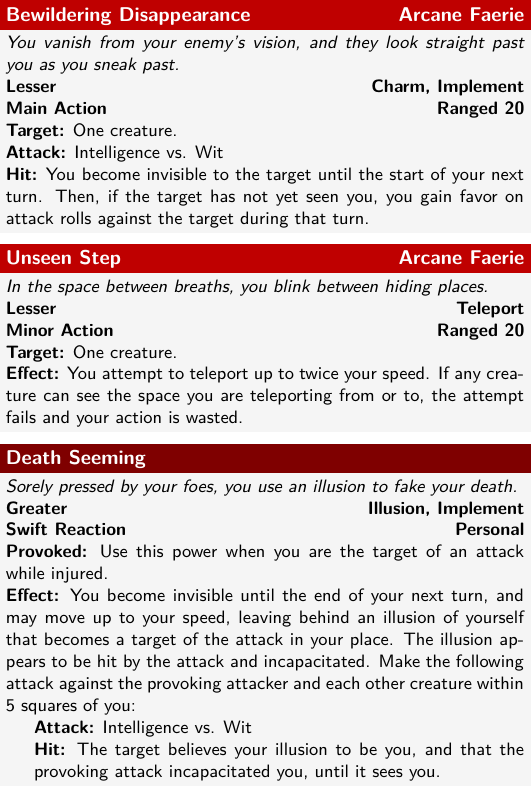
    The Sidhe are fond of invisibility: not merely so that they can attack from hiding (although yes, they will do that too), but so that they can observe mortals unseen, pick apart their flaws and vulnerabilities with taunts and cutting remarks, and drive them to rash action or self-pitying inaction. And, worst come to worst, they will happily fake their deaths and run away to fight another day.

    Bewildering Disappearance is a power designed to enable an ambush on a single creature. Aside from granting invisibility (against that creature only) so that the user can get close without causing alarm, it also grants favor on attack rolls if the user can avoid being spotted until their next turn.

    Unseen Step is a versatile utility spell, letting the user teleport a long distance with just a minor action. It has one drawback, in that it doesn’t work if the user is being observed, or trying to teleport somewhere that is being watched. So, it is more useful outside of combat than it is during it. Also, as one of my playtesters worked out, that very drawback can provide useful information: if it doesn’t work, then you know that either something is watching you (useful when you suspect an ambush), or something is watching where you intend to go (similarly useful to avoid teleporting into an ambush).

    Death Seeming is the ultimate escape spell: usable as a Swift Reaction, taking place before you are hit by an attack that might drop you to 0 hit points, it gives you some brief invisibility, lets you escape the attack, and to cap it all off, leaves behind an illusion that can convince your attacker and other nearby creatures that they actually did kill you. From a GM’s perspective, this is a great power for recurring villains, because it gives them an out to avoid being killed prematurely. For players, it’s a great emergency backup plan if they get overwhelmed.

    Glamour

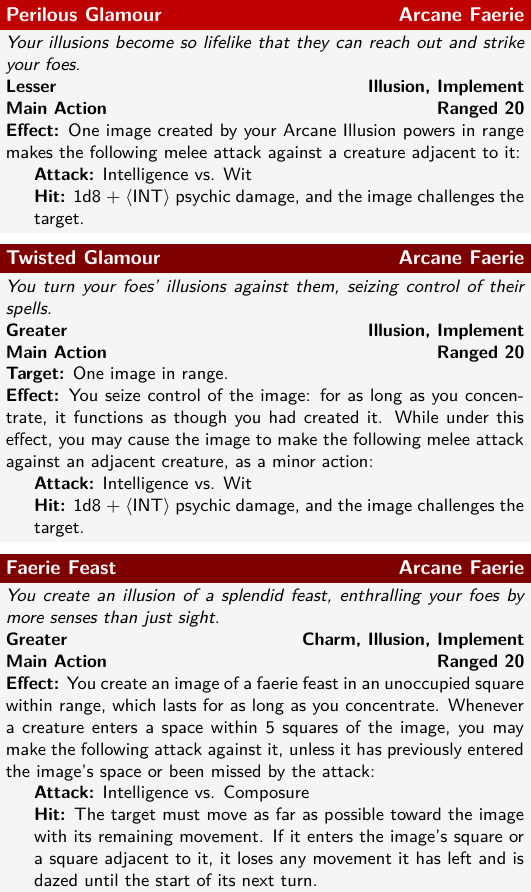
    The Sidhe are also fond of glamour: loosely defined, a kind of illusion that changes what objects seem to be. Not necessarily what they actually look like (although again, the Sidhe will do that too…) but how people perceive them. Glamour can make an armored warrior seem harmless, or a worthless crust of bread seem like a feast. It can also make illusions so real as to actually cause harm…

    Illusions in Aetrimonde

    Without going into unnecessary detail, many Illusion powers create images, which are not creatures but work like them in many ways:

    • Images occupy a space, typically one square.
    • Images can be attacked like a creature, and are automatically hit when attacked, but are unaffected by attacks.
    • Images do not take their own turns.
    • The powers that create images often allow the power’s user to make attacks using the image as a point of reference. (The attack originates from the image, not the user.)
    • Creatures believe an image to be real if they are under the effect of the power that created them. Realizing that an image isn’t real may not have an effect in some cases (such as that of the Illusory Wall, which still blocks line of sight).
    • Creatures with truesight can see images for what they are.

    Perilous Glamour is meant to be used in conjunction with other Illusion powers: it allows an image created by other Illusion powers to reach out with a sword or a claw and attack someone with such verisimilitude that they actually bleed. (As a GM, I have to choke back an evil chuckle at the idea of a dungeon full of non-damaging illusions…followed by an encounter with a Sidhe who can make those harmless illusions fight back.)

    Twisted Glamour is, yes, a twist on Perilous Glamour, representing the Sidhe’s command of illusion: they can seize control of other magicians’ illusions, turning them to their own ends and coincidentally, letting them lash out in the same manner as Perilous Glamour.

    Faerie Feast is a more straightforward Illusion power, creating an image that draws enemies towards it. This can be used to sidetrack enemies, by placing it to the side where it will pull enemies away from their charge, or just to get them to bunch up around the image so that they’re perfect targets for a Fireball. Notably, the power doesn’t work indefinitely: once missed by the power’s attack, targets are immune, as are targets that actually make it into the image’s space (since they then discover that the Faerie Feast is an old crust of bread, if there was actually anything there at all).

    Compulsion

    The final kind of Sidhe magic is one that they fall back on when deceiving the mind or the senses doesn’t work: it simply compels obedience, or forces creatures to act in a way that suits the Sidhe’s purposes.

    There are already a number of Arcane spells that charm or dominate creatures: I won’t get into those here. Sidhe magic has some unique variations on those spells, which can be summed up as “charm with added effects.”

    Charm in Aetrimonde

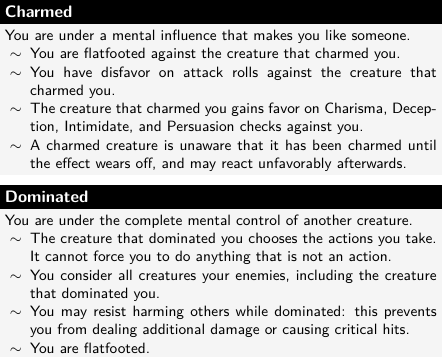
    Charmed is a common condition in Aetrimonde. When charmed:

    • You are flatfooted against the creature that charmed you.
    • You have disfavor on attack rolls against the creature that charmed you.
    • The creature that charmed you gains favor on Charisma, Deception, Intimidate, and Persuasion checks against you.
    • A charmed creature is unaware that it has been charmed until the effect wears off, and may react unfavorably afterwards.

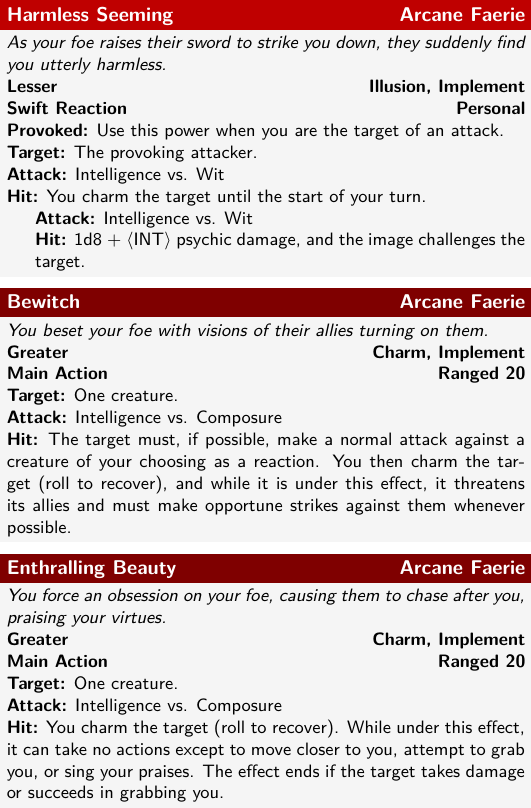
    Harmless Seeming is a reactive Charm spell, letting the user perhaps avoid being hit by an attack, because if it is successful, the attacker then has disfavor on the provoking attack. Unlike a lesser Charm power that did make it into the core rulebook, Harmless Seeming doesn’t keep the target charmed long enough for the user to gain favor on any attack rolls against them.

    Bewitch is a Charm spell with the added benefit of making the charmed creature a danger to their own allies. Best used on a group of enemies who have huddled up defensively, it encourages other enemies to distance themselves from the target. (And to be careful when doing it, lest they provoke opportune strikes.) This is great for disrupting enemies that gain benefits from being adjacent to each other.

    Enthralling Beauty is another Charm spell with a rider, in this case, drastically limiting what actions the target can take. It does generally come at the cost of making the target zero in on the user…but the Sidhe are generally competent enough not to mind this terribly. A mobile character can use this to lead their target on a merry chase, keeping them completely occupied.

    So Why Are These Apocrypha?

    At this point you may be wondering why these powers have been relegated to apocrypha and maybe a later supplement. They’re not extraordinarily weak or powerful compared to other powers I’ve shown off (although I realize that I haven’t yet shown off the Arcane powers that are the most direct comparison, so it’s fair to reserve judgement on that). So what gives?

    Ultimately, it comes down to two things: flavor and mechanics.

    Flavor-wise, I eventually decided that powers in the core rulebook should be relatively generic, so as to make them suitable for as many character concepts and campaigns as possible. These fae-themed powers (and their demon-, undead-, and eldritch-themed counterparts didn’t make the cut, because they were too specific in flavor.

    And mechanically, I found that some of these powers (in particular Bewildering Disappearance, Unseen Step, and Death Seeming) would complicate things for a GM: Bewildering Disappearance would require the GM to keep track of which creatures can and cannot see the power’s user, Unseen Step would require the GM to know whether specific squares are being observed at any time (and could also reveal ambushes anticlimactically, which reduces GMs’ freedom to write plots…), and Death Seeming would again require the GM to keep track of which creatures do and don’t think that the power’s user was dead. So I erred on the side of less mechanically-complicated powers, in general.

    To be clear, I think there’s absolutely room for powers like this in Aetrimonde…I just don’t know that the first book, which I think should generally be relatively simple and balanced, is the place for them. Hence, why I would plan to put them in a supplement later on.

  • Well, it’s November, and that means that this blog is moving along into a new monthly theme: the Autumn Court of Faerie. Of course, the first question that I feel the need to resolve is “What is Faerie?” And to answer that, I’m going to start off with a crash course on Aetrimonde’s cosmology before diving into the nature of Faerie.

    Overview of the Planes

    The mortal world (or material plane, if you prefer) of Aetrimonde exists alongside other planes of existence that are more fantastical than a mere ball of rock and water. And alongside is the operative word here: as best as Aetrimondean arcanists who study such things can explain it, each of the planes including the mortal world “occupy a subspace within some metaphysical topology of higher dimensionality.” Where and when those volumes overlap in mere four-dimensional spacetime, it is possible to pass from a point in one to the corresponding point in another.1 These places where the planes overlap are called planar crossings, and with the proper magic (principally the Plane Shift ritual), mortals can force their way into other planes from within a crossing.

    Planar crossings vary in nature depending on the plane they connect to. In some cases, they are relatively stable, appearing in the same place constantly, or on a reliable schedule. Others are transient, and only appear intermittently when the conditions are right. With the right magic, crossings can be stabilized, holding them in place, but this is not always practical: often, transient crossings open in dangerous situations like storms, or battles, that make it difficult first to perform the appropriate magic and then to keep it intact.

    There are a multitude of small planes, anywhere from a few dozen meters to several hundred kilometers across, clustering close around Aetrimonde, but these are essentially nothing more than a bubble of Aetrimonde that has been four-dimensionally “pinched off” from the main mass: they seldom have any interesting magical properties or unusual residents, although they are sought-after as personal demesnes for powerful arcanists.

    Of more interest are the five-and-a-half known major planes that consistently intersect the mortal world: Faerie, the Underworld, the Elemental Roil, the Heavenly Realm (and its attached Pit of Hell), and the Dreamlands. Each of them has a distinct magical nature and is home to a variety of otherworldly entities.

    Going from Aetrimonde to another plane isn’t something to be done trivially: the planes have dangers that mere mortals are not used to, and they are generally higher-magic than the mortal world. Getting there, however, is fairly straightforward.

    Faerie

    The first of the major planes is Faerie, also called Neverland, and recently, the Realm of the Sidhe. Crossings to Faerie are common and easily identified: stable ones are surrounded by rings of standing stones erected as boundary markers, while transient crossings are generally marked by rings of mushrooms, unseasonal vegetation, or other such natural delineations. Faerie is one of two planes that can have crossings forced open from any location in the mortal world (although predicting where such a crossing will open in Faerie is very much an art). As such, Faerie is the most easily accessible of the major planes. Faerie is the original home of trolls, ogres, gnomes, redcaps, pixies, satyrs, centaurs, and all manner of creatures out of Aetrimonde’s Faerie tales, many of whom have also established a presence in the mortal world.2

    Topology, Not Geometry

    The Realm of Faerie is unlike the mortal world in that it does not have consistent geometry. This is most evident in what would-be explorers refer to as the “Fractal Valley phenomenon.” The Fractal Valley is a well-known location, near to several reliable crossings into Faerie: a valley perhaps a dozen kilometers across on its long axis, but containing, at last count, one thousand, four hundred and twelve square kilometers of area. From the rim of the valley, visitors can see perhaps fifty square kilometers within the valley’s bowl…but take the wrong path through one of the woods dotting the valley floor, or follow the wrong branch of the river, and you can find yourself in a part of the valley not visible from the rim, all the while remaining inside the valley and in sight of the distant mountains and hills at its edge.

    Fractal Valley is merely the best-known and most-studied example of a phenomenon which occurs throughout Faerie: it manifests as forests that you can walk around in ten minutes but not through in a week, rivers where a hundred leagues on their banks is a mere kilometer on their waters, and tunnels in small hills that lead to valleys in massive mountain ranges. The scholars who have studied the phenomenon believe that Faerie occupies a more densely folded section of the metaphysical topology, allowing larger spaces to be contained within smaller ones. It is thus difficult to map Faerie: the most usable maps (for anyone not a student of higher-dimensional geometries) tend to be in the form of atlases mapping out the plane’s small, self-contained spaces and describing the manner in which they connect to each other and the dangers that might befall a traveler.3

    Narrative Causality

    Faerie has no overt perils in the way that some other planes do: the terrain and physical laws (other than the strange topology) are much like the mortal world’s; the food, water, and air are fit for mortal consumption; and while navigation can be difficult, the landscape is at least static, and can be mapped in some sense. The danger in Faerie is that, in addition to physical laws, it appears to be governed by a kind of narrative laws. Visitors to Faerie are advised to read up on their Faerie tales, and attempt not to be drawn into the narrative: avoid interactions with the locals wherever possible, and especially do not accept gifts or offer oaths. The best defense against Faerie’s narrative causality is to be boring.

    If a visitor to Faerie is caught in the narrative (typically signified by an implausible number of interesting events happening to and around them) the best course of action then is to fit oneself into the narrative role of a protagonist. Be kind to traveling peddlers, heed any advice given three times, and above all, do not lie, cheat, steal, or break oaths. Outsiders who fit into a heroic archetype (the knight in shining armor, clever trickster, or wise mystic are most common) tend to find that the complications in their way, while tedious at best and dangerous at worst, are ultimately rewarding. Playing along with the narrative can bring rewards ranging from pots of gold to magic swords…or, sometimes, an opportunity to undergo character development.

    Falling into a villainous role is far more dangerous. Faerie actively discourages craven, jaded, and venal behavior, first by presenting those its perceives as villainous with opportunities and mild incentives to reform. These often resemble traps in the form of object lessons: a stolen purse of gold turns out to be cursed, turning all the coins placed within into lead; a broken oath brings uncommonly bad luck with it, until the oathbreaker makes amends. If a villain fails to take the hint, Faerie then escalates, throwing increasingly lethal obstacles and foes into their path until they leave Faerie or fall to one of them.

    However, in rare cases, Faerie is known to claim villains for its own. Villainy done with style, panache, and a certain amount of self-awareness seems to receive some respect from Faerie, and visitors who can play a villainous role well find that their villainous deeds work out…so long as they aren’t facing an equally good hero. The danger here is that the more a villain plays into Faerie’s narrative, the harder it becomes to break out of their role…ultimately making them a creature of Faerie, and just one more of the plane’s repertoire of plot devices.

    Faerie Tales

    It is unclear where Faerie tales come from: certainly they seem like they could be factual accounts of events that actually did happen in Faerie, but it has also been pointed out that they could instead be the inspiration causing the plane to impose such a narrative. The earliest Faerie tales were part of an oral tradition before being set down in print, and as such their origins are lost to history. Some later tales that entered widespread circulation were commissioned from bards and minstrels, extolling the supposed deeds of various adventurers and heroes, but at least some of these are known to be exaggerations of the real events, or invented from whole cloth.

    Some scholars have attempted to settle the question by looking into more modern additions to the genre. One serious effort compiled a list of children’s stories verifiably written by mortal authors in the last century, and then commissioned several bands of adventurers to visit Faerie and question the inhabitants about events resembling the narrative in these stories. The adventurers who returned did bring back several positive results in which creatures of Faerie reported historical events resembling the narratives in these stories…but always as second-hand accounts. None of the actual participants in these events (and certainly no mortal participants) have ever been identified…and to further muddy the waters, a later study discovered that nearly half of the authors whose stories were included in the earlier effort had submitted their manuscripts pseudonymously and could not actually be identified by their publishers. Conspiracy theorists like to suggest that many published faerie tales are actually the work of faeries, disguised as mortal literature for some nefarious purpose.

    The Sidhe

    Faerie did not used to have rulers. Accounts from a century ago describe Faerie as dotted with small villages, with few of them owing fealty to any authority other than the mayor of a nearest town or a duke in a nearby castle. There were no great cities, and few kings or queens.4

    This changed, with no warning but also no particular chaos or strife, at some point in the last century. Around eighty years back, accounts from visitors to Faerie started describing people in positions of authority, resembling elves and calling themselves the Sidhe,5 along with mentions of great cities and fortresses. Strangely, the residents of Faerie treated these things as entirely ordinary, as though they had always been present.

    The sudden appearance of the Sidhe was rapidly followed by their consolidation of power throughout Faerie. They seized objects and places of power formerly held by trolls, built roads and signposts leading to hidden gnome villages, and conscripted ogres, redcaps, centaurs, and other denizens of Faerie into their armies. All this, they accomplished with little resistance: few of their subjects particularly liked what the Sidhe were doing, but the vast majority quietly acquiesced to their authority. The resistant minority, faced with all the power now held by the Sidhe, were forced to flee into the mortal world or into secret places deep within Faerie’s convoluted topography.

    With a solid grasp on power within Faerie, the Sidhe proceeded to subtly reshape the plane’s narratives. Where once it told stories of noble heroes casting down tyrants in single combat, it now told stories of desperate heroes scrabbling to achieve temporary victories against the nigh-omniscient Sidhe and their ruthlessly efficient enforcers.

    Mortal visitors to Faerie have had few direct interactions with the Sidhe since their sudden appearance, but certain facts have emerged. While their rank and file are indistinguishable from elves, their nobility have magical powers distinct from ordinary mortal magic…and they claim to be the rightful rulers of Caras Seidharen6 (from which they take their name), who escaped the Collapse by fleeing into Faerie. Their magical powers make them evidently no longer mortal, but whether that means they have become creatures of Faerie, beholden to its will, or something else entirely remains to be seen.

    The Genius Loci Hypothesis

    The leading hypothesis on the nature of Faerie is that it is a genius loci: a place with a mind. In this hypothesis, there is an intelligence that suffuses the plane of Faerie, and that enjoys telling stories–and a particular kind of stories, at that, designed to shape the mortals ensnared in them into more heroic individuals (and thus, more interesting to the mind of Faerie). The plane’s convoluted topology, the narrative laws that it enforces, and even the proliferation of faerie tales in the mortal world are its tools used in guiding its stories to a satisfying conclusion.

    It’s not clear how the Sidhe would fit into this hypothesis, if it were true. Some scholars believe that they are a sign that the genius loci’s tastes have shifted, and it is now attempting to tell a different, darker kind of tale using the Sidhe as a plot device. Others believe that the Sidhe are responsible for the shift in the tone of Faerie’s narrative, having used their magic to somehow effect a change in the fundamental nature of the plane. And a few, generally regarded as crackpots, think that the plane’s tastes are influenced by the mortal world, and that recent changes there (the advance of industrialization, the rise of modernity over romanticism, or perhaps the cynicism caused by the Wars of Smoke and Steel) have had corresponding changes in Faerie.

    Plot Hooks

    The nature of Faerie makes it an interesting plot device for GMs to use: its narrative causality can be fun for players to try to work with (or exploit), and because the plane is relatively innocuous (by the standards of the planes), it can be used in low-level adventures without too much work.

    Encounter Hooks

    • A mortal who spent too long in Faerie and fell too deep into a heroic persona has just escaped back to the mortal world, and is having trouble re-adjusting. Too used to the black-and-white morality of Faerie, they keep mistaking mundane things, like moneylenders charging interest or guards making arrests, for villainous plots. The PCs first learn of this when their ordinary adventuring behavior causes this would-be hero to mistake them for a band of brigands.
    • A band of the Sidhe’s enforcers have crossed over from Faerie, and are demanding that the local town hand over the many Fae refugees who settled here after fleeing the Sidhe. The locals are none too eager to hand over people who have become part of their lives, but they are hardly a match for Faerie soldiers…unless some passing adventurers care to get involved.

    Adventure Hooks

    • The PCs need to travel a long distance quickly, and the only option available to them is to cross into Faerie and journey between two crossings that are closer together in the other plane than they are in the mortal world. In order to make their deadline, the PCs desperately need to stay unentangled in Faerie plots…which is tricky for such interesting people as they.
    • A band of renegade Fae hire the PCs as mercenaries to help them strike a blow against Sidhe oppression. Of course, it’s not clear whether these Fae are themselves part of a Faerie narrative, or have broken free of the plane and are acting out of their own free will…
    • Events reminiscent of Faerie tales have been playing out in the mortal world…with anticlimactic twists. The goose’s golden eggs cause devastating price inflation, Little Red Riding Hood has contracted lycanthropy, and the Frog Prince has been transformed into one of those poisonous tropical species, with lethal consequences. Each of these occurrences has claimed more lives than the last, and it is up to the PCs to find the cause and banish the narrative back to Faerie.

    Campaign Hooks

    • The Sidhe have set their sights on the mortal world, and their agents, in the guise of mortal elves but gifted with the Sidhe’s unusual magics, are working to turn Caras Elvaren and Tir Coetir to the service of the Sidhe. The PCs are in a position to expose the agents and forestall this scheme, but the Sidhe themselves are untouchable in their seats of power within Faerie. Ultimately, the only way to unseat them and put a permanent stop to their plans will be to discover how they grew so powerful and cut off the flow of power that the plane of Faerie offers them…

    1. There are other paradigms that attempt to explain this truth, of course. They include the planes being intertwined branches on a great world tree, bubbles in the foam of an astral sea, and so on. The difference is largely academic. ↩︎
    2. Which tend to be of a grimmer (and Grimmer) nature than ours. ↩︎
    3. E.g., “To reach the village of Bellberry in Fractal Valley, enter from the semi-southmetaeastern pass and follow the river in the direction of flow from the left bank. Continue until, while passing beneath a footbridge, the sun abruptly moves to the opposite rim of the valley. If at any point you find yourself inexplicably on the right bank instead of the left, stop immediately and retrace your steps. Avoid kissing any frogs claiming to be princes, especially if brightly-colored.” ↩︎
    4. Certainly too few to account for the population of princes and princesses to be found in Faerie. ↩︎
    5. Pronounced “shay.” ↩︎
    6. Pronounced “shee-DAHren.” See also this previous post. ↩︎
  • I recently wrote about elite enemies, who are designed to feel like more of a challenge than your typical enemy. Elites make for good mini-bosses, foes who pose an outsized threat and who the PCs can feel satisfaction in defeating, but who don’t feel like they deserve a name and plot significance.

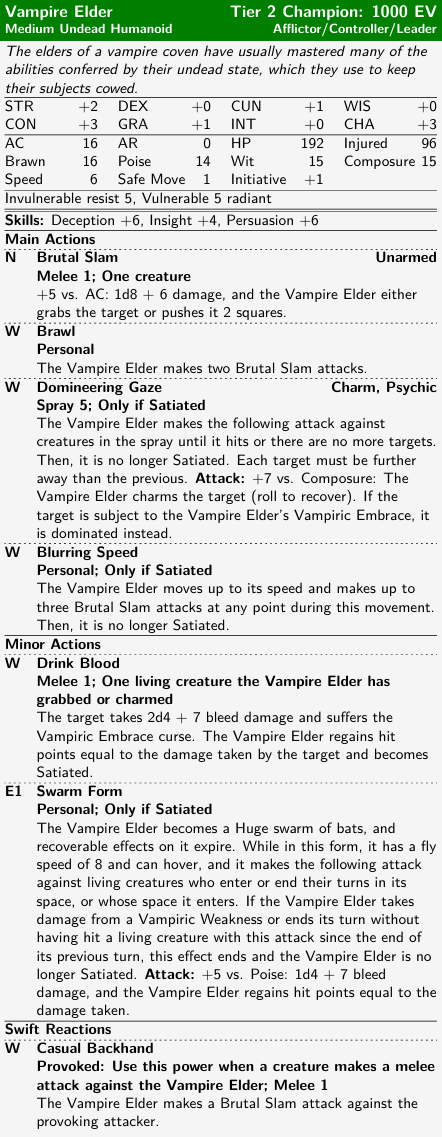
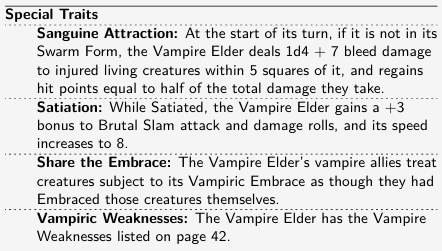
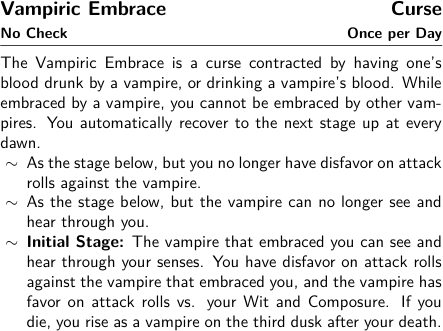
    Today, I’m going to write about Champion enemies, who do fill that role: Champions are designed to fight an entire party of 4-6 PCs by themselves, and they work very well as the ultimate villain of an adventure or campaign arc, or even an entire campaign. Dragons are Champions, as are many powerful demons, faeries, and so on, but for today (Halloween!) I’ll be focusing on some undead.

    Design Goals: Why Champions?

    In my earlier post on Elite enemies, I mentioned some of the reasons why it doesn’t work well to just use a higher-level enemy as an equivalent to two normal enemies: narratively, they don’t really feel like a more powerful enemy, and mechanically, they’re too easy to gang up on. The same concepts apply to the niche I’m filling with Champions, and to an even greater extent.

    Narratively, I want a Champion to feel like it’s actually fighting the entire party at once, not just the one character that manages to get its attention. This is a narrative problem with a mechanical solution: Champions need to be able to attack several characters per round, and they need to be mechanically encouraged (if not actually forced) to spread these attacks around rather than piling them all on one PC.

    Mechanically, the big problem with having a single Champion fight an entire party is that they will be incredibly vulnerable to conditions, even moreso than Elites. A normal enemy is usually about 1/5 of the enemy forces in an encounter, and stunning it leaves the other 4/5 free to act; a Champion is the entire encounter, and stunning it completely neuters the encounter. So, Champions need to have ways to shake off conditions so that they still pose a threat to PCs with access to stuns and other severe conditions.

    With that in mind, here’s my implementation of Champions:

    • Champions have five times the EV and four times the hit points of an equivalent normal enemy.
    • Champions make recovery rolls at the start of their turns instead of the end. This means that while recoverable effects can impede them until the start of their turns like usual, they are less likely to apply during a Champion’s turn.
    • Champions should also suffer reduced effects from, or be outright immune to, a selection of common conditions.
    • Champions should be able to do 4-6 things per round, and 1-2 of them should be when it’s not their turn. Like Elites, they should generally only be able to use one limited-use action per round, but they should definitely have more than one such action, to be spaced out throughout an encounter.
    • Champions should change how they fight during an encounter. This can be as simple as becoming enraged and dealing increased damage with reduced defenses once it is injured, or as complex as gaining new actions and losing others as the PCs whittle down its health. A Champion is going to take the PCs multiple rounds to defeat; changing up how it fights prevents the fight from becoming tedious.
    • Champions should have ways to interact with them tactically, like interruptible actions, ways to remove their condition immunities, or actions they are forced to perform if the PCs meet certain conditions.
    Calibrating Hit Points and Actions

    You may be asking why Champions have four times the hit points of a normal enemy if they’re supposed to be equivalent to five normal enemies. And, for that matter, why they can do only 4-6 things per round if a normal enemy can do 1-2.

    Part of the answer is that this is just received wisdom: D&D 4e contained monsters filling a similar niche to Champions, called Solos, and in the first Monster Manual for 4e, Solos had 5 times the hit points of a normal enemy. This proved to be too much: fights against Solos dragged on and were more tedious than intense. Later Monster Manuals (and errata to the first) reduced Solo hit points and increased their damage to compensate.

    But let’s look at this mathematically, too: in an earlier post I did some math to see what would happen if you increased the number of enemies in an encounter or increased their tier. As I did there, let’s say that a single normal enemy (call it a dragonspawn) takes the PCs r rounds to defeat and does d damage per round until defeated. If we have five dragonspawn that the PCs attack and defeat one after another, their total damage done will be 15rd. If we instead have a single Champion dragon with 5 times the hit points and 5 times the damage (it will take 5r rounds to be defeated and deal 5d damage per round), its total damage done will be 25rd.

    So we need to reduce Champions’ hit points and damage slightly. At 4 times normal hit points, and doing around 3-4 times the damage, this dragon will mathematically do around 12rd to 16rd damage, compared to the 15rd damage of the dragonspawn, which is in the right range.

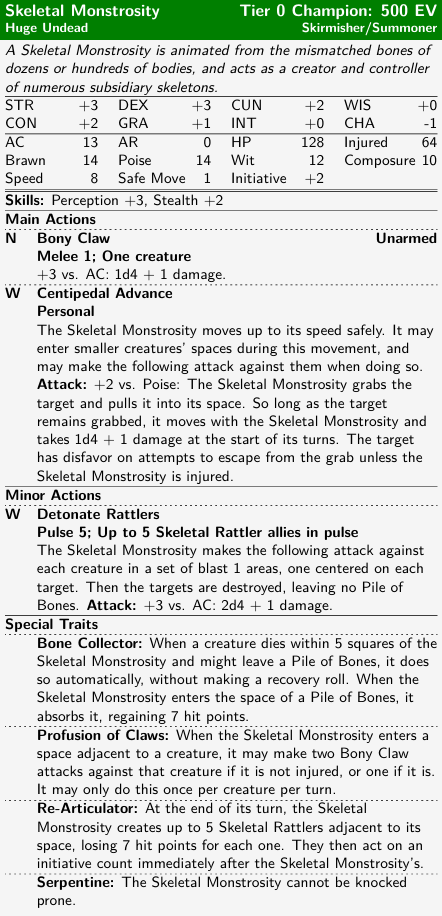
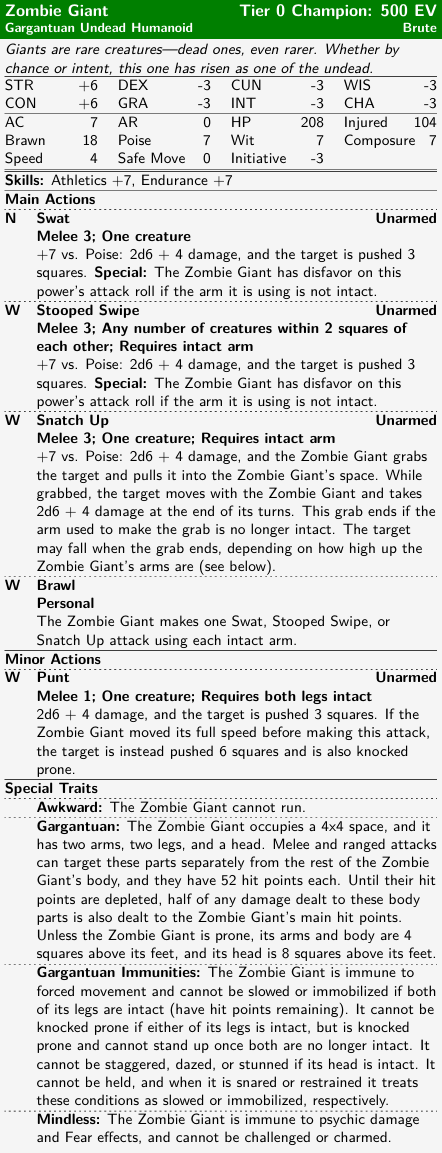
    With all that in mind, let’s look at some Champions!

    Skeletal Monstrosity

    The Skeletal Monstrosity is the sort of monster that makes me wish I’d already found an artist for the Bestiary, because it’s difficult to describe. But, in the absence of a commissioned illustration, I’ll do my best to paint a picture with words: a Skeletal Monstrosity is a vaguely centipedal assemblage of the bones of dozens, if not hundreds, of victims…and it can split off parts of that mass and articulate them into other skeletons under its control.

    I think this is the first Skirmisher enemy I’ve shown; as a reminder, Skirmishers are especially mobile, but not especially dangerous. The Skeletal Monstrosity fits this perfectly: Profusion of Claws allows it to attack each creature it moves adjacent to during a turn (twice, until it’s injured!) and Centipedal Advance allows it to move safely and, if it wants, overrun and engulf PCs.

    The combination of Bone Collector and Re-Articulator allows the Skeletal Monstrosity to create tons of Skeletal Rattler allies, then, once they’ve been destroyed, run over and collect their Piles of Bones in order to re-use them. If I were the GM running a Skeletal Monstrosity (and I have been!), I’d have it simply running around the battlefield, collecting Piles of Bones and making attacks against any PCs it happened to pass by in the process, then popping out a new set of Rattlers. The grab attack that’s part of Centipedal Advance is a great way to separate a PC from their allies, but otherwise not crucial to use.

    Of course, the fact that Skeletal Rattlers represent part of the Skeletal Monstrosity’s hit points can put a damper on things. At 128 hit points, the Monstrosity can only create 9 Rattlers without its hit points dropping into injured range; once it’s taken some damage from the PCs, it may want to limit how many Skeletal Rattlers it has out. (For a more challenging encounter, I would include a bunch of pre-existing Skeletal Rattlers that don’t count against the Monstrosity’s initial hit points.) And since Detonate Rattlers denies the Monstrosity the option of reabsorbing its Rattlers, it is something of a desperation move, to be used only if the PCs have really bunched up and allowed the Rattlers to surround them, so that it can catch several PCs in overlapping blasts.

    The PCs can interact tactically with the Skeletal Monstrosity in a couple of fairly simple ways:

    • Destroying Piles of Bones before the Monstrosity can reabsorb them prevents it from regaining the hit points it used to create Rattlers. If the PCs can catch several in an area attack, it might be worthwhile even if it means not attacking the Monstrosity that turn.
    • Getting the Monstrosity below half hit points and injured makes it easier for any PCs it has engulfed to escape from it. It might therefore be worth a focused effort to bring its hit points down if a vulnerable ally is in its grasp.

    Zombie Giant

    The next Champion I’ll show off is the Zombie Giant, which is…basically what it says on the tin. I’ve previously shown off a variety of zombies, and this one has all of the same basic qualities: slow, awkward, mindless, and incredibly strong and tough.

    What sets the Zombie Giant apart, and prevents it from just being an upgrade of the Zombie Ogre, is that it’s Gargantuan: this is a size category beyond the usual scale (Tiny, Small, Medium, Large, Huge, Colossal), for creatures that are so big that their body parts can be targeted independently. The Zombie Giant is actually on the small size for a Gargantuan, occupying the same space as a Colossal creature, but it has arms, legs, and a head that can be attacked separately from the rest of its body and have their own hit points. Half of any damage dealt to these body parts carries through to the Zombie Giant’s main hit points, so although attacking them isn’t the most efficient way of bringing it down, there are reasons to do so as I’ll get to in a moment.

    Because it’s a zombie, I’ve chosen to give the Zombie Giant relatively few actions that it can take: its Brawl action lets it attack once with each arm, and it can Punt a creature as a minor action if both legs are intact. So that’s only 3 things it can do per round, and none of them are off of its turn…doesn’t that violate the guidelines I laid out above? Technically, yes, but those are just guidelines, after all. I want the Zombie Giant to still feel like a zombie, and giving it actions to take when it’s not its turn runs counter to that. I’ve compensated in a couple of ways: firstly, all of the Zombie Giant’s actions deal relatively high damage, just due to its size, and secondly, its Snatch Up action allows it to keep dealing damage so long as a creature remains in its grasp. Between those factors, I think that this works out.

    How can PCs interact tactically with the Zombie Giant? Well, several ways, but they largely revolve around its Gargantuan-ness.

    • Due to its sheer height, melee-focused characters may have no way to attack the Zombie Giant’s body, which is 4 squares off the ground. They could conceivably climb to the top of some convenient terrain (like, say, the roof of a 2-story house…), but if there isn’t any available, the PCs can instead focus fire on the Zombie Giant’s legs until it comes crashing to the ground and brings its torso into range.
    • The Zombie Giant loses attacks as its various body parts are damaged: once either of its legs is no longer intact, it loses Punt, and once either of its arms is no longer intact, it loses Brawl (or rather, Brawl provides no benefit over Swat, Stooped Swipe, or Snatch Up). This allows the PCs to prioritize specific body parts based on how much difficulty the related attacks are giving them.
    • Damaging certain body parts also removes some of the Zombie Giant’s immunities: taking out a leg makes it susceptible to slow and immobilize effects, and taking out its head allows it to be staggered, dazed, and stunned. If the PCs have access to powers applying these conditions, they may want to take out one or two body parts so that they can make use of them.
    • Finally, if a PC has been Snatched Up and is currently being squeezed to death, one way to get them out of the grab is to destroy the arm in question. It might also help to take out the Zombie Giant’s legs first, because otherwise the PC might fall from 4 squares up, but taking a bit of falling damage is still probably better than taking further damage from remaining in the zombie’s grasp.

    Vampire Elder

    Last but decidedly not least, I think that now is a great time to show you what Valdo the Bat-Eater will be up against when he returns to Der Eisenwald to resume his vampire hunting. Aetrimonde’s vampires have a ton of lore behind them, which I’ll introduce here:

    The Vampire Elder is the leader of a vampire coven, and Valdo’s hunt will inevitably pit him against at least one of these terrors of the night. It has a couple of tiers on the first two Champions I showed here, and it has a big enough bag of tricks that its statblock rolls over onto a second page.

    This is the most complicated enemy I’ve revealed yet, and it has three roles to account for that. The Afflictor role comes from the Vampire Elder’s ability to both inflict and exploit the Vampiric Embrace curse. The Elder’s Drink Blood action inflicts Vampiric Embrace, which by itself lets the Elder see through its victims’ eyes, makes it easier for it to compel them, and makes it harder for them to attack the Elder. But this, coupled with the Domineering Gaze ability, lets the Elder outright dominate PCs, with the effects shown on the right. That is what gives the Elder its Controller role. Finally, the Share the Embrace special quality lets the Elder’s vampire allies (the subordinate vampires of its coven) exploit the Elder’s Vampiric Embrace as their own, working around a restriction of the Embrace.

    Thankfully, the Vampire Elder’s nastiest trick (Domineering Gaze) is one of several abilities that it can only use if Satiated. For each use of these abilities, the Elder must first become Satiated by draining a living creature’s blood. One of the puzzle in a fight with the Elder will revolve around keeping it from drinking blood, whether that means staying out of its grip, resisting the Domineering Gaze…or making preparations before the fight, like bathing in garlic oil.

    The Elder’s other tricks requiring Satiation include Blurring Speed, letting it rush through the midst of the PCs and send them flying, and Swarm Form, allowing it to transform into a swarm of blood-drinking bats. Swarm Form deserves some explanation: as a swarm, the Elder can fly through creatures’ spaces, provoking an opportune strike and taking the opportunity to make an attack of its own. It loses most of its other abilities in this form, but in exchange it takes reduced damage from most sources (a trait shared by all swarms) and its attacks heal it.

    In fact, the Vampire Elder has a huge variety of ways to regain hit points, including its Sanguine Attraction trait that allows it to drain blood from injured (and therefore presumably bleeding) living creatures nearby. A second piece of the puzzle when fighting an Elder is preventing it from healing: this means spreading out so that it cannot attack as many creatures at once in Swarm Form, and staying away from it when injured to avoid healing it (and taking damage) via Sanguine Attraction.

    Of course, no vampire is complete without the traditional weaknesses, and Aetrimonde’s vampires are no exception. Vampire Weaknesses are shared by all vampires, and therefore not listed individually in every vampire’s statblock. These weaknesses help to make fighting vampires more manageable in light of their many, many strengths: prepared parties will go into an encounter with a vampire carrying ropes of garlic and festooned with holy symbols, and vampires’ weaknesses to daylight and running water can offer the PCs strategic options as well.

    Up Next

    And with that, my October undead extravaganza runs to a close. Enjoy your Halloween, and check back in next week for the start of my November theme: the Autumn Court of Faerie.

Is this your new site? Log in to activate admin features and dismiss this message
Log In