Heroic Roleplaying in a World of Swords, Sorcery, and Steam

I’d like to introduce Aetrimonde, a TTRPG I’ve been designing with heavy inspiration from the houserules my group used back in our Dungeons and Dragons 4e days. I’m not ready to publish Aetrimonde yet, but I’m opening up this blog to discuss its design principles, mechanics, and systems.

  • Well, the readers have spoken, and it looks like you’d like to hear more about the Dwarven Federation, where Etterjarl Ragnvald hails from. So, by popular demand, I have a two-part post on this nation! Today, I’ll discuss the Federation’s history and how it came to be; the next post will cover its state in the current day of the setting.

    Summary

    The Dwarven Federation is the only dwarf-majority nation in Aetrimonde (although there are plenty of dwarves living elsewhere, and they have their own distinct cultures). It is a nation not in decline, but in stagnation: the dwarves of the Federation cling to the heritage that was lost to them when their ancient empire of Gjalerbron was destroyed in the Collapse, and the world has started to slowly pass them by. They remain the most skilled stone- and metalworkers in the world…but their advantage is eroding as the rest of the world invents and innovates. Young dwarves are leaving the Federation for better prospects elsewhere, and entire clans are muttering about secession, threatening to shatter the Federation entirely.

    Vital Statistics

    Official Name: Sambandsættirdverga (lit. “Dwarven Federated Clans”)

    Official Capital: Konigstrond (destroyed).

    De Facto Capital: Hasaeti-af-Tapi.

    Official Head of State: High King Torgrim III Unbowed (deceased).

    De Facto Head of State: Ingrid Ingvaldsdottir, Thane of Clan Volsung, Regent for the Unclaimed Throne.

    Primary Inhabitants: Dwarves

    Currency: Kroner (gold), ore (silver), kopar (copper)

    Founding

    The Dwarven Federation arose in the aftermath of the Collapse. Konigstrond, the capital of the dwarven empire of Gjalerbron, had been destroyed in the final battle with the orc horde, taking with it the dwarves’ greatest stores of treasure and knowledge. High King Torgrim was presumed dead, and his heirs missing. Remnants of the horde remained throughout the Ironspine Mountains and were in control of crucial passes, blocking communication and travel between the lesser dwarven cities. In the face of such loss, the dwarves withdrew from the world: the lucky ones, who lived in defensible, self-sufficient valleys, walled them off by collapsing the passes; the less fortunate built redoubts out of old mineshafts and did their best to avoid the attentions of the roaming orcs.

    It took more than a century for the remnants of the orc horde to disperse enough that lines of communication between the surviving enclaves of dwarves could be reopened, and in that time, the enclaves had diverged culturally. Where once the dwarves had been a singular people with a singular culture, they now viewed themselves as distinct clans–and their isolation had given time for perceived slights to mature and grow into grudges. Many of the clans blamed others for the loss of Konigstrond, the death of the king and the disappearance of the royal family, and the generations of isolation and hardship since.

    The first great Thing1 after the Collapse devolved almost instantly into blame and recrimination as these grievances boiled over: there was, according to the historians, “much shouting, pulling of braids,2 and waving of hammers,” and the Thing threatened to dissolve into open warfare. This was only forestalled by Olaf Olafssen II, Thane3 of Clan Ulfenning, who brought forth his elderly father Olaf Olafssen I, the last surviving member of High King Torgrim’s guard and by this point one of the oldest dwarves alive. Olaf I related for the gathered clans the tale of his survival and retreat from the battle of Konigstrond: how he had been injured protecting the High King in the fighting for the lower levels of the city; how the High King bade him lead a column of wounded and civilians out of the city by secret tunnels; how he witnessed from afar the orcs gain the summit of the city and enter the palace, only for the mountain to quake and bury dwarf and orc alike in an avalanche. Most importantly, he related how, as the devastated survivors stopped to rest in their flight, they found the battered crown of the High King, washed up on the banks a mountain stream which flowed from the now ruins of Konigstrond.

    Olaf I produced, for the awestruck thanes, the ancient crown of the High Kings, and bade them remember their ancient duty. Admittedly, the high king and his heirs had never been found, but neither had their bodies: until it was proven that all had perished, the line of kings remained unbroken—and thus, claimed Olaf, the gathered clans were honor-bound to preserve what remained of dwarfdom until the rightful High King could be found and placed on the throne.

    The clans who accepted Olaf I’s tale and his charge formed the Dwarven Federation. While officially still recognizing the deceased High King Torgrim III as their head of state, the clans of the Federation acclaimed Olaf I as a regent for the dead king. However, legal precedent did not legally give a regent all the powers of the High King: he could pass judgement on disputes and perform certain important ceremonial roles, but he could raise no armies, levy no taxes, pass no laws. The regent would be a figurehead until an heir was found. As a stopgap, the clans came to an agreement: within their territories, their thanes would be sovereign. In matters that affected all of dwarfdom, they would confer, and come to a consensus, and all would be honor-bound to act according to the consensus.

    Early History

    The Dwarven Federation’s early history was dominated by two imperatives: the drive to reclaim the dwarves’ lost territory, culture, and knowledge, and the search for the rightful heir to the High King.

    Following the first Thing and Olaf I’s ascent to the regency, the dwarves quickly discovered just how much they had lost in the Collapse: many of the great secrets of their ancestors had been jealously guarded in the guilds and archives of Konigstrond and were lost with the city. They no longer knew the alchemical formulas and processes to create mithril or adamantine, or the intricacies of the runes of power used in their most powerful magic. Much of their history, genealogy, and other records were lost as well, which they viewed as an even worse blow: uncounted ancestors would now go unremembered, their accomplishments lost along with their memorials in Konigstrond’s great necropoli.

    The early centuries of the Dwarven Federation were marked by a series of expeditions decreed by Olaf I and his successors in the regency: every clan was called upon to contribute funding, equipment, and dwarfpower to reclaim territory and track down artifacts and fragments of knowledge that had escaped the Collapse. Soon, however, the expeditions succeeded in reconquering or collecting all of their easily-accomplished goals…leaving Konigstrond and its surrounding territory as the only avenue to regain what remained lost.

    Successive regents poured ever-increasing amounts of blood and treasure into the effort to reclaim Konigstrond. Early expeditions to the ruined capital were promising, unearthing long-lost treasures and volumes of forgotten lore, including the secret of smelting mithril. However, the greatest treasures of Konigstrond were believed to be buried far beneath the mountain, and excavating them would require a permanent position in the Vale of Glories, as the region had come to be called. This, unfortunately, proved problematic.

    The Vale had long since been occupied by orcs who remained after the breaking of their horde, and the orcs living there now were a warlike people. They viewed the ruins of Konigstrond and Caras Seidharen as testaments to orcish might, and while the various orc tribes in the region fought among themselves, the dwarven expeditions posed a unifying threat. Time and time again, the dwarves fought their way to their ruins and began excavating, only for a warlord to emerge among the orcs and lead a horde to drive them back out.

    The repeated failures to reclaim Konigstrond badly weakened morale in the Dwarven Federation. To make matters worse, the effort to find and enthrone an heir to the High King had met with no greater success: countless dwarves came forward claiming to be a descendant of Torgrim III, but none were accepted by the council of Thanes. Some were unable to prove their claim to the stringent standards of dwarven genealogists. Others were simply mistaken, and were sent home with the council’s regrets. A few were pretenders, and these were executed and their clans shamed or exiled.

    Repeated cycles of hope and disappointment changed something in the culture of the Dwarven Federation. The dwarves became more and more gloomy and fatalistic; the clans contributed less and less to each successive expedition; and the Thanes began to dismiss most claims to the throne with only a cursory review of the evidence. In 542 AAC, Regent Audur Astridsdottir proclaimed that no more of the heritage of Gjalerbron could be reclaimed. There would be no more expeditions; no further claims to the throne would be entertained. Henceforth, all that the Federation could hope for was to preserve what was left of their lost glory.

    Recent History

    The Dwarven Federation since Audur’s Proclamation has been a nation in stasis. While innovation and invention are not illegal, per se, they are very strongly frowned upon. Where new ideas or inventions would replace or render obsolete the heritage that the Federation recovered from their ancestral glory, they are shunned and suppressed. The dwarves of the Federation look inward and backward to their history, and aspire to nothing more than what their ancestors possessed.

    Until recently, however, this was enough to make the Federation prosperous and powerful. Such was the ancient dwarves’ mastery of metallurgy, smithing, masonry, and all the other crafts of stone and metal that the fragments of knowledge that their descendants recovered were sufficient for dwarven craftsmen to be renowned throughout the known world. The rich and powerful of every nation came to the dwarves to commission everything from arms and armor to art and architecture. Virtually the only things that the dwarves did not grow wealthy from selling were their tools and techniques, which they guarded jealously and passed on from generation to generation within their clans.

    Eventually, however, this advantage eroded. While the dwarves are still the unquestioned masters of stone- and metalwork, the gap between them and the craftsmen of other nations has narrowed sufficiently that the Federation is no longer the hub of industry that it once was. Increasingly, buyers go elsewhere for their purchases, because while human foundries cannot compete with dwarven master-smiths on quality, they can certainly compete on quantity…and cost. The loss of income from trade has disrupted the dwarven economy, forcing master artisans to let go some of their apprentices, and in a vicious cycle some of these disillusioned, unemployed apprentices have abandoned the Federation for opportunities abroad, further eroding the Federation’s technical advantage.

    The Federation became directly involved in the wars of the Age of Steam a total of three times. Twice, it declared war to secure its claim to rich ore deposits in the face of encroachment by Victovy and the Novan Imperium. The third time, it allied with Tir Coetir in exchange for the repatriation of certain artifacts from Gjalerbron that the wood elves had “recently discovered.” In all three cases, the Federation achieved its objectives through direct application of overwhelming force and promptly sued for peace. For the remainder of the wars, the Federation maintained neutrality and sold arms to all sides.

    During the final exchange of superweapons, after taking casualties as collateral damage from the spread of Tir Coetir’s engineered plague, the Federation unleashed its own weapon in the form of Everwinter, a glacier spirit from the high peaks of the Ironspine mountains. Federation spiritualists had purposefully bound Everwinter but kept it riled up, over a period of decades, to a point just short of breaking its bonds: when pointed in the direction of Tir Coetir and released, it carved a path of icy destruction through the heart of the wood elves’ ancient forest before turning east and ruining the majority of the harvests across the Novan Imperium and Sanctean Primary, causing a borderline famine.


    1. Meeting of the clans. ↩︎
    2. Men and women alike in the Dwarven Federation grow their hair (and beards, for men) long, styling it in intricate braids. In fact, there is an entire language of braids, with different stylings allowing a dwarf to convey information about themselves, like what they do for a living, whether they are married, and so on. Long braids are a mark of age and wisdom; pulling of braids is thus a serious insult. ↩︎
    3. The title for a leader of a clan. ↩︎
  • Today, I’m going to go over how characters–and the enemies they face–scale with level. This is tied into one of Aetrimonde’s core design principles, Solid Level Scaling, so I want to get it right, and that means putting some thought into the math.

    Player Character Scaling

    Let’s start by going over how PCs scale with level. This scaling is split into three parts: some aspects of a character, like defenses, scale automatically as the character’s expertise bonus increases with level. Other aspects, like attacks, do not automatically scale, but a character can improve them by taking feats that allow them to add expertise or otherwise gain a bonus. And finally, a character can gain additional, non-scaling bonuses from magical equipment.

    Built-In Scaling

    From level 0 to level 20, an Aetrimonde PC’s expertise bonus will increase from +2 to +6. By default, this increase translates into an additional:

    • +2 to all defenses (half expertise bonus).
    • +4 to trained skills and any check they have a perk related to (full expertise bonus)
    • +8 to hit points (double expertise bonus).
    • +2 to large heals (half expertise bonus).

    Feat Scaling

    Characters can choose to apply their expertise bonus to certain additional aspects by taking feats. Various feats can allow a character to add:

    • Half expertise to certain attack rolls (attacks using specific kinds of weapons, or magical attacks with specific keywords).
    • Half expertise to armor resistance.
    • Full expertise to certain damage rolls (in the same manner as attack rolls).

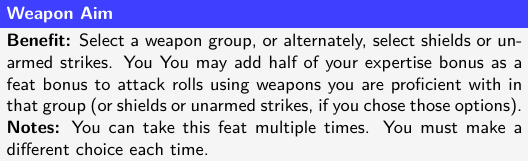
    Because characters do not already add expertise to any of these things, these feats provide a small boost at low levels, which can be valuable in its own right, and that boost gets larger at higher levels. For example, Weapon Aim would grant a +1 bonus to attack rolls using certain weapons at low levels, increasing to +2 at level 10 and +3 at level 20.

    Other feats provide a smaller, constant bonus to aspects of a character that already benefit from expertise:

    • +1 to AC.
    • +1 to Brawn and Poise.
    • +1 to Wit and Composure.
    • +2 to trained skills (one skill per feat).
    • +4 to hit points and +1 to large heals.

    Item Scaling

    Aetrimonde’s magical items are a topic for another post, but for now, suffice to say that magical items can provide a character with additional bonuses equivalent to the constant bonus from feats discussed above. This works out to:

    • +1 to AC.
    • +1 to Brawn and Poise.
    • +1 to Wit and Composure.
    • +2 to trained skills (one skill per item)
    • +4 to hit points and +1 to large heals.
    • +1 to certain attack rolls.
    • +2 to certain damage rolls.
    • +1 to armor resistance.

    Total Possible Scaling

    The greatest possible numeric advancement a character can get from level 0 to level 20 therefore works out to:

    • +4 to all defenses.
    • +4 to all trained skills.
      • An additional +4 to specific trained skills.
    • +16 to hit points.
    • +4 to large heals.
    • +4 to certain attack rolls.
    • +8 to certain damage rolls.
    • +4 to armor resistance.

    To max all of this out (assuming a character specializes in only one kind of attack, and not counting skills, where scaling is purposefully less stringent) would require 7 feats and 7 enchantments applied to magical items. 7 feats are certainly affordable for most characters, since they would have 21 feats by level 20: this leaves 14 feats to customize a character in other ways. 7 enchantments are even more affordable: the magical items that a PC would acquire by level 20 naturally varies depending on the campaign (and how the character spends their money), but the guidelines in the Game Master’s Handbook would allow a character to amass magical items with around 20 enchantments in total.

    Notes on Skill Scaling

    Skills are a little different than other aspects of character scaling, because I don’t necessarily want skill difficulties to increase at the same rate that characters’ skill bonuses do.

    To be more specific, I want the difficulty of a given task, like climbing a rocky cliff, to remain constant so that characters become more likely to succeed as they gain levels. At the same time, I also want characters to be able to tackle more “epic” tasks, like climbing a smooth wall of glass, as they approach level 20. I’ve previously discussed the calibration of skills and difficulties, and I think that this is already in a good place.

    Which is to say, I’m not going to assume that characters fully max out their skills by taking feats and acquiring magical items. Getting +4 to all their trained skills by level 20 is, I think, enough of a difference to make characters feel more skilled all by itself. The option of getting an additional +4 from feats and magic items exists partly for the sake of completeness and symmetry with other scaling factors, and partly for players who really want to max out certain of their characters’ skills.

    Enemy Scaling

    With this in mind, I’m going to balance enemy scaling around the idea that a character will, between level 0 and level 20, max out their numeric advancement in every aspect that matters to them. Support characters that specialize in aiding allies and making few attacks themselves may not see a need to max out their attack and damage scaling, while characters that do not have access to good armor resistance to begin with (like a wizard) might not see the point to maxing it out. But I will assume that a character gets the maximum possible scaling by level 20.

    As I’ve discussed already in my Bestiary posts, enemies are grouped into tiers corresponding to levels where the PCs’ expertise bonus increases. Each tier encompasses 5 levels, so at level 0, Tier 0 enemies are an appropriate challenge, while at level 20, Tier 4 enemies are an appropriate challenge.

    If you’ve been attentive, you may have noticed that all of the maximum scaling bonuses are divisible by 4. This is not a coincidence! The way that I’m going to handle scaling is that, for each tier, enemies gain:

    • +1 to all defenses.
    • +1 to all trained skills.
    • +4 to hit points.
    • +1 to large heals
    • +1 to all attack rolls.
    • +2 to all damage rolls.
    • +1 to armor resistance.

    What does this mean in practice?

    On average, a PC will improve at the same rate as the enemies they face. Over 20 levels, PCs and their enemies will improve by the same amounts (with some exceptions like attacks that a PC has not chosen to fully specialize in, which will become significantly less accurate against high-level foes).

    But, a PC probably won’t improve at exactly the same rate in every aspect. At various levels between 0 and 20, a PC can expect to be ahead of the curve in some aspects and behind in others. For example, a character who takes Weapon Aim and acquires a magical weapon giving them a bonus to attack rolls using it will have a total of +2 to attack rolls (relative to their baseline) by level 5, while level-appropriate enemies will only have gained +1 to defenses. However, if this character hasn’t taken any feats or gotten any items to increase their defenses by level 5, the appropriate enemies will have +1 to attack rolls while they still only have +0 to defenses.

    In these middling levels (from levels 5 to 15, roughly) part of the challenge of the game, and the tradeoffs in character-building, will come from the fact that individual characters, and possibly the entire party, have bad match-ups against certain enemies.

    At lower levels, characters will tend to be quite good at one or two things that they have invested in, relative to the difficulty posed by a typical enemy, but a little subpar in other areas. A low-level character specialized in making their attacks very accurate will do poorly against a Brute enemy, since Brutes tend to be easy to hit anyways, and deal lots of damage that the PC can’t deal with.

    At higher levels, characters will have the resources needed to be a little above par in most areas, but might have one or two glaring weaknesses where they haven’t invested enough to fully keep up with their enemies. A high-level character who has invested in every aspect of their character except their Wit and Composure defenses will suffer dramatically when faced with illusionists and mind-controllers.

    Up Next

    This is where I’m going to leave level scaling for now, but I’ll be following up with a second part looking at some of the math involved here in more detail, to try and see just how much more difficult an enemy becomes when they get adjusted up or down by one tier. Stay tuned!

  • Today, following in the pattern I set with Ragnvald, I’ll be introducing our second sample character’s class (skinchanger) and picking his abilities. This character, you’ll recall, is Valdo the Bat-Eater: a horrifying hero with a background in hunting, and messily devouring, the horrible monsters of Der Eisenwald. Let’s see how he actually accomplishes this:

    Class: Skinchanger

    Skinchanger is not a particularly recognizable name in the milieu of fantasy classes, the way fighter, wizard, and cleric are. So I think I should start off by introducing the lore associated with the class:

    Skinchangers are often misunderstood, and equally often feared, for the powers they gain by bonding spirits can be unsettling. A skinchanger’s bond allows them to draw spirits into themselves, expressing them as changes to their own body. While this is most often done with animal spirits, allowing them to sprout the antlers of a great stag or the claws of a ferocious bear, they can do this with most any spirit, allowing them to turn their skin to stone or gain the strength of an ancient warrior.

    Welcoming spirits into their bodies comes with risks for a skinchanger: while the bodily transformations they provide can be helpful, some spirits will also try to impose mental changes as well. The keen senses of a wolf spirit may allow a skinchanger to track their enemies by scent, but if the skinchanger cannot maintain control of the spirit, it can also give them pack-hunting instincts, or drive them to attack anything that presents itself as prey. The side effects of a transformation grow greater when the spirit is more powerful; the mark of a practiced skinchanger is that they can resist the mental changes forced on them by the most powerful of spirits.

    Of course, not all skinchangers choose to resist when their spirits try to affect their minds. Some of them feel that embracing the strange thoughts and ideas that come to them when in a transformed state allows them to better understand their spirits, deepening their bond. Others simply enjoy the thrill of the hunt when in the form of a wolf, or appreciate the beauty they see in flames when influenced by a spirit of fire.

    While normally a skinwalker’s mental changes are as transitory as the physical ones, there is a danger that they may become permanent, especially if a skinwalker embraces them, or repeatedly comes under the influence of an especially powerful spirit. Once this happens, they often experience a rapid decline into an inhuman mindset, becoming something other than simply mortal.

    The skinchanger class takes part of the lore associated with the druid class of D&D, that being their ability to transform into animals (and other forms, but it is most strongly associated with, and has the most mechanical support for, turning animals). The druid has traditionally been a very broad class with a ton of features letting them fight as well as a fighter when transformed into an animal, plus cast spells almost as well as a cleric or wizard when not. In the interest of having more well-defined classes, I’ve split the druid’s traditional niche apart into the four Spiritual classes, each with a different focus.

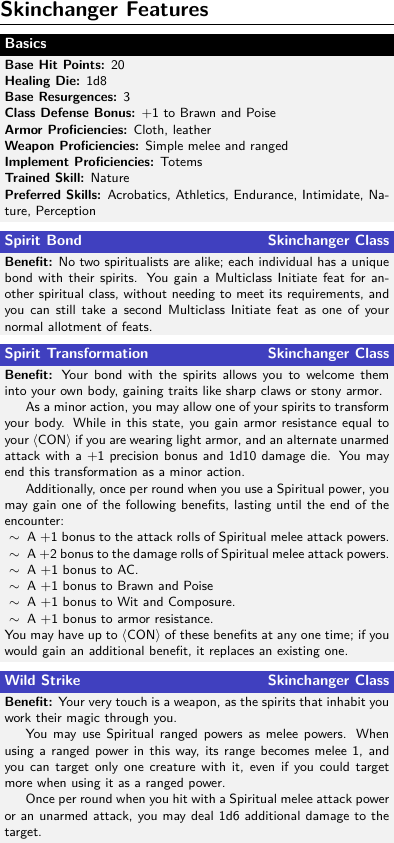
    Let’s take a look at their class features: I’m going to go into more detail here than I did for the fighter class, because I think the skinchanger class is going to be less self-explanatory.

    Basics

    The skinchanger is a lot more fragile than the Fighter. With only 20 base hit points, 3 base resurgences, and 1d8 healing die, it is, on paper, about as tough as a Rogue. However, its features give it a surprising amount of durability in practice…

    Skinchangers gain +1 to Brawn and Poise, based on the resilience and agility of animals. They gain proficiency only with leather armors and simple weapons, but (as with all Spiritual classes) they are also proficient with Totem implements used with Spiritual powers.

    Finally, skinchangers are trained in Nature, and gain a variety of preferred skills suited to surviving in the wilderness (plus Intimidate, which is a natural extension of being able to sprout fangs…).

    Spirit Bond

    All four Spiritual classes gain the same Spirit Bond feature (much as all Martial classes gain the Martial Endurance feature). Spirit Bond gives a skinchanger an extra feat, which must be a Multiclass Initiate feat for another Spiritual class. But what does that mean?

    D&D typically allows multiclassing by taking individual levels of a class. Which is to say, a 4th level character could have 4 levels of fighter, or 2 of fighter and 2 of wizard, or whatever combination you can think of. D&D 4e was an exception to this, and is in fact what I based Aetrimonde’s multiclassing on, with some departures.

    In Aetrimonde, you will always be a member of your original class first and foremost, but you can, by taking multiclass feats, gain some of the features of a second class. Spirit Bond gives Spiritual characters a head start on this process, and does not prevent them from also multiclassing to a third class (which would normally not be allowed). Part of the theme of the Spiritual classes is that they are versatile, and Spirit Bond gives Spiritual characters a broader set of tools from level 0.

    Multiclassing Details

    Multiclassing as far as possible takes a total of up to four feats:

    • [Martial/Arcane/Divine/Spiritual] Dabbler: Makes you count as a member of a class from the appropriate power source, just not any class in particular. (You can take powers of the associated power source and feats requiring to to be, e.g., “Any Arcane class,” but not feats specifically for wizards.) Also grants appropriate weapon and implement proficiencies.
    • [Class] Initiate: Makes you count as a specific class from a power source you already have, and grants a version of one of their class features, with added restrictions on how often you can use it. The Dabbler feat is a necessary prerequisite if multiclassing to a class from a different power source than your original one.
    • Multiclass Adept: Grants an additional class feature from your secondary class (or, in some cases, removes a restriction from the Initiate feature).
    • Multiclass Mastery: Removes the restrictions from the class features gained from the Initiate and Adept feats.

    Importantly, multiclassing will never give you another class’s “signature” feature: you can never gain Martial Endurance if you didn’t start out as a Martial character or Spirit Bond if you didn’t start out as a Spiritual character (and you can’t get them a second time if you did). These are powerful features, and it helps preserve class identities to make them unique to characters that started as that class (rather than being available at the cost of a few feats).

    Spirit Transformation

    The first of the skinchanger’s two unique features contains two parts: firstly, a skinchanger can enter a transformed state where they gain some pretty significant armor resistance and an alternate unarmed attack (which isn’t actually as good as Valdo’s Carnivorous Bite, but still…). The armor resistance is not a bonus, and does not stack with other sources of armor resistance (like hide armor, for example), but with even modest investment in CON this can give Valdo AR on par with plate armor.

    But the meat of Spirit Transformation is the ability to gain a shifting array of bonuses as Valdo uses Spiritual powers. There are 6 bonuses to gain, of which Valdo can keep up to CON at once. (It is becoming apparent that Valdo will want to have good CON for a variety of reasons.) This allows Valdo to tailor himself over a few turns to whatever enemies he winds up facing.

    The second part of Spirit Transformation ties into another part of the theme of Spiritual characters, which is growth. All four Spiritual classes have a class feature of this nature, that gets more powerful as they use Spiritual powers, and many Spiritual powers themselves have effects that get bigger or more powerful over time.

    Wild Strike

    The skinchanger’s second unique feature also has two parts to it. Firstly, it allows a skinchanger to use some Spiritual powers that would normally be long-ranged as melee attacks. Why would this be a good thing? Because using a ranged power while tied up in close combat normally leaves a character open for opportune strikes. Being able to use these powers as melee attacks gives the skinchanger a wider range of powers they can realistically use.

    And, this ties into the second half of the feature, which grants the skinchanger additional damage with Spiritual melee attack powers and unarmed attacks. In the interest of clarity, I’ll confirm here that this additional damage applies to attacks using Valdo’s Carnivorous Bite and Spirit Transformation unarmed attacks, and to Spiritual ranged powers that Valdo uses as melee powers via the first half of this feature.

    Several other classes have additional damage features like this, including the rogue’s Sneak Attack, the warlock’s Law of Contagion, and the crusader’s Vengeful Oath. The amount and circumstances of additional damage varies by class; Wild Strike is the easiest source of additional damage to gain, but provides the smallest amount of damage.

    Abilities

    Next up, let’s pick Valdo’s abilities.

    I haven’t shown any Spiritual powers yet, but they will use Wisdom in their attack and damage rolls, and either Constitution or Intelligence, depending on the type of power, for secondary effects. Valdo will want Constitution over Intelligence: this is partly because of his class features, partly because the powers that work best with Wild Strike will mostly use Constitution, and partly because as a melee-focused character with rogue-level toughness, he needs the extra hit points.

    To get +4 WIS, without WIS being a preferred ability, will cost 10 ability points. However, CON and INT are both preferred abilities, so Valdo will pay another 3 points for +2 CON, boosted to +3, and 1 more point for +1 INT boosted to +2.

    We have positive abilities contributing to Brawn, Wit, and Composure so far, so to round it out, let’s also pay 1 ability point for +1 GRA so that he also has decent Poise. This will bring our ability point cost to 15 points, so we’ll now need to drop two abilities.

    I’ve settled on Valdo being well-intentioned but off-putting, so giving him negative CHA is fitting. I think that he should have at least +0 CUN, since the backstory I’ve written has him survive hunting vampires, and while he doesn’t strictly need STR to use Spiritual melee powers, negative STR would make it especially difficult for him to actually use his unarmed attacks. So, let’s also drop DEX to -1.

    All told, Valdo will have the following abilities, using up his 13 ability points:

    +0 STR-1 DEX+0 CUN+4 WIS
    +3 CON+1 GRA+2 INT-1 CHA

    Up Next

    The next post on Valdo will be a short one covering his skills, perk, and languages. Stay tuned!

  • Aetrimonde supports enemies that are not just a one-to-one equivalent to a PC of an appropriate level. I’ll cover all of these types eventually, but today I’m going to focus on mooks: these are enemies designed to be used in great numbers, without overwhelming either the PCs or the GM who has to run all of them.

    Some of the mooks I’m using as examples today are undead, and I’ll be using more undead as examples in later posts. Let me know what kind of undead you’d like to see more of in later posts!

    Mook Rules

    Mooks are built differently than normal enemies to minimize how much mental load they place on a GM:

    • 5 mooks are equivalent to a single normal monster of the same tier.
    • Mooks do not have hit points. Instead, they have a Threshold value, and they are killed or destroyed when they take that much damage from an attack, or if they take that much damage from any other source and subsequently fail a recovery roll.
      • The Threshold value is calibrated to be between 1/5 and 1/4 of an equivalent normal enemy’s hit points. This means that 5 mooks will be destroyed by 5 typical sources of damage, just like a normal enemy.
    • Mooks have only normal and at-will actions, so there is no need to track which powers they have used or what resources they have expended.
      • A mook will deal the same damage as a normal enemy’s at-will actions. 5 mooks will initially do 5 times the damage of a normal enemy, but their collective damage will drop rapidly as they take damage and are eliminated, especially if the PCs use area attacks to take out several at once. Between this and not having higher-damage, limited-use powers, the total damage 5 mooks can do before being eliminated is roughly the same as a single normal enemy.
    • The only bookkeeping a GM has to do for mooks is to keep track of what conditions have been applied to them, and since many effects that would apply a condition would kill the mook outright with damage, this becomes less of a chore.
    Minions in D&D 4e

    D&D 4e implemented a kind of enemy called minions to fill a similar niche to my mooks, but minions had a few flaws from my perspective:

    • They were destroyed by taking any amount of damage, no matter how small, and never took damage from missed attacks. This made them frankly trivial to clear out with any power that created damaging areas, no matter how little damage it dealt.
    • They also did only a small, fixed amount of damage with their attacks. This removed the suspense of rolling for damage, although not having to roll did slightly speed up combat.
    • Minion was treated as a role in and of itself, and so there were no Brute minions or Assassin minions. All minions therefore felt much the same in combat. I have instead created guidelines on how to adjust a Normal monster of any role to create a mook of the same role.

    Now let’s take a look at a few mooks:

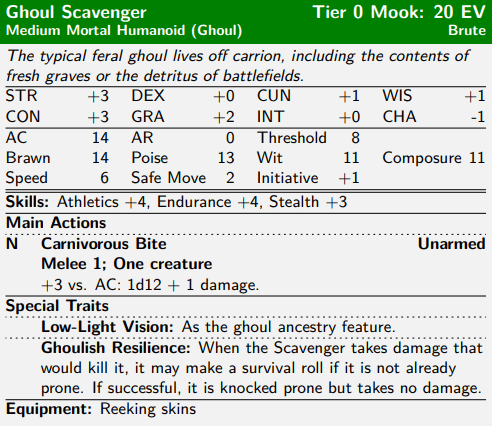
    Ghoul Scavenger

    I’ve already showed off the Ghoul ancestry for PCs, and this gives me an opportunity to show off how some PC ancestry features would be adapted for a mook.

    Like the section on dwarves, the Bestiary section on ghouls contains some additional lore building on what the core rulebook presents PCs with. The Ghoul Scavenger is a feral ghoul as described in this lore: poorly clad in reeking skins, attacking with its mouthful of fangs, and no less dangerous for it. Its role is Brute, indicating that it has relatively poor defenses but loads of hit points, and can do high damage in melee.

    The Ghoul Scavenger indeed has mediocre defenses. And while mooks don’t have hit points, it has a relatively high Threshold of 8, meaning that a typical damage source (1d8 + 4) will fail to kill it more than a third of the time: this gives it the toughness of a Brute.

    All three of the Ghoul Scavenger’s actions and special traits are lifted directly from the ghoul ancestry:

    • Carnivorous Bite is the Scavenger’s normal attack, and is what gives it the high melee damage making it a Brute.
    • Low-Light Vision is another ghoul feature that doesn’t need explanation in its stat block.
    • Ghoulish Resilience is a twist on the Ghoulish Regeneration and Ghoulish Tenacity ancestry features, which would be problematic if given to a mook: the GM would have to track whether each mook had used Ghoulish Tenacity, and would also have to make survival rolls for each one to make use of Ghoulish Regeneration. Ghoulish Resilience captures the essence of these features, which is that a ghoul has a good chance of surviving a lethal blow and standing up again on their next turn, and does it without requiring the GM to track anything other than prone-ness.

    Undead Mooks

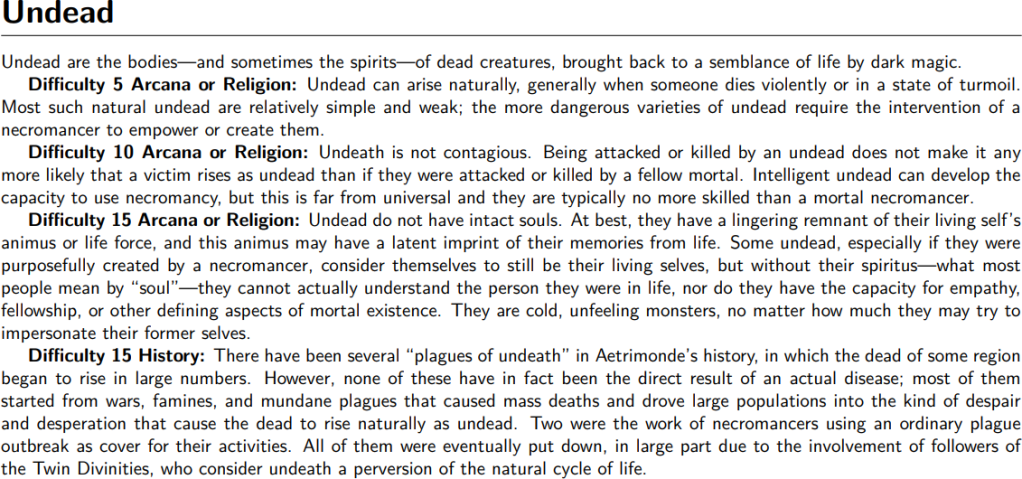
    One great application of the mook rules is for undead mooks: this makes it possible to run the classic “attacked by a horde of undead” encounter. So I think this is a great time to introduce the rules for Aetrimonde’s undead, and then introduce a couple of undead mooks:

    • Undead are not living creatures and do not need to eat, drink, breathe, or sleep.
    • Undead are immune to bleed and poison damage.
    • When critically hit, undead do not suffer critical damage, although damage is still maximized.
    • Undead are destroyed as soon as they are reduced to 0 or fewer hit points, rather than entering the dying state.

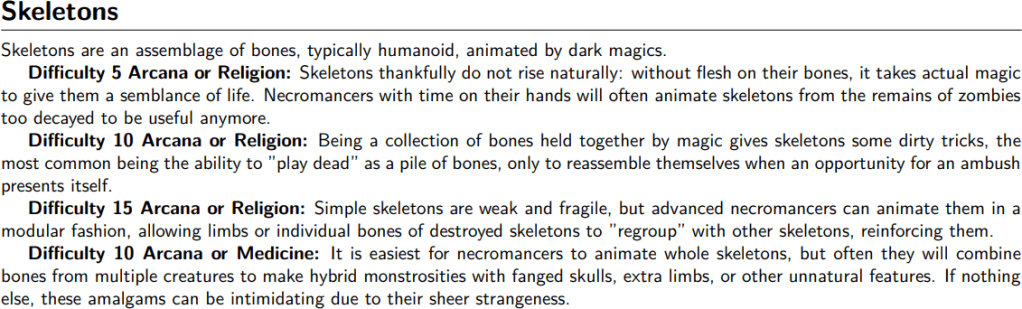
    Undead also have their own lore section:

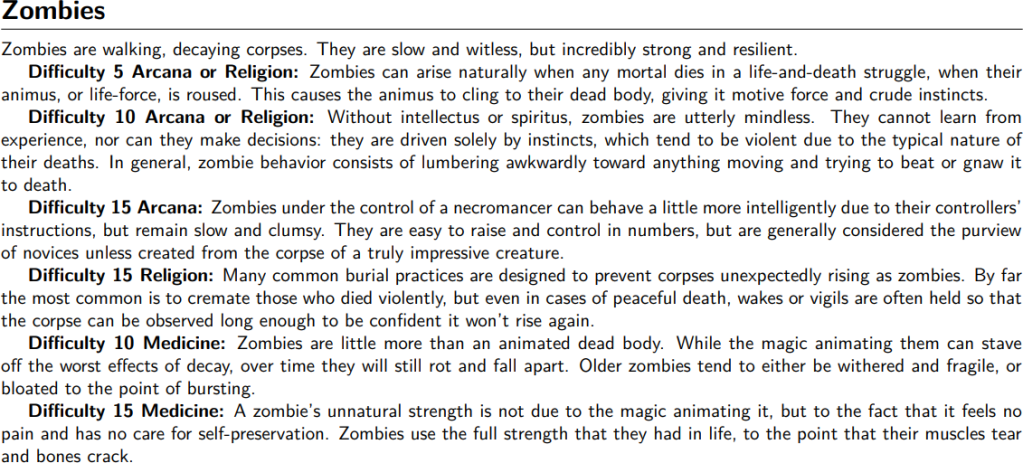
    Zombie Rotter

    First off, there is of course some additional lore about zombies:

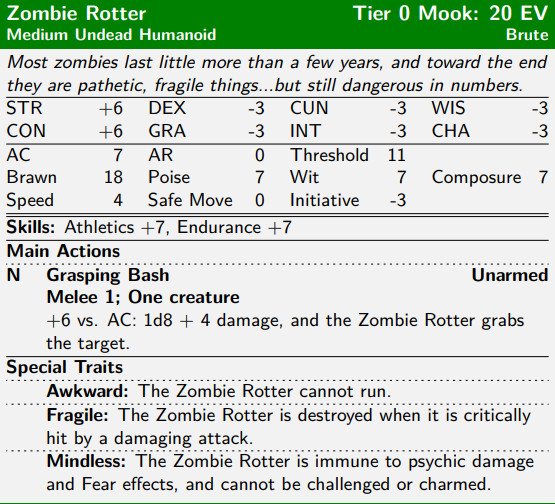
    The Zombie Rotter is another Brute mook like the Ghoul Scavenger, but taken to the extreme. It has absolutely atrocious defenses, with the exception of Brawn, and an incredible Threshold of 11 (meaning it would survive a typical damage source 75% of the time). While its damage isn’t actually that much greater than the Ghoul Scavenger’s (8.5 instead of 7.5), its normal attack lets it grab enemies.

    And, if that weren’t enough, it has the added advantage that it is mindless, and thus immune to a whole slew of psychic damage and control effects.

    The only reason that the Zombie Rotter doesn’t have a higher Tier is that it has downsides to go with these strengths: it’s slow, it can’t run, and it’s destroyed by any damaging critical hit (even if the damage from that wouldn’t break its Threshold, which is entirely possible with weaker attacks at low levels).

    In short, the Zombie Rotter is an absolute terror in close quarters. The Bestiary provides the following advice on actually using the Zombie Rotter and other zombies:

    To ensure that their weaknesses come into play, ensure that encounters with zombies allow the PCs to engage on their terms. This could mean giving the PCs a fortified position that it will take the zombies time to break into or a line of retreat so that they can turn the fight into a fighting withdrawal, or just starting the encounter with the zombies far away so that the PCs have a few rounds to thin them out with ranged attacks.

    The Zombie Rotter doesn’t have a major puzzle element to it, but it pairs nicely with other zombies (who I’ll show off in another post…), who become a lot more threatening to grabbed or otherwise impeded characters. A horde of Rotters with other zombies mixed in can thus form an absolutely tense encounter.

    Skeletal Rattler

    Skeletons animated by necromancy are an entirely different kind of threat than zombies. And they do have to be purposefully created: with no flesh left on their bones, the only way to make an animated skeleton is with magic.

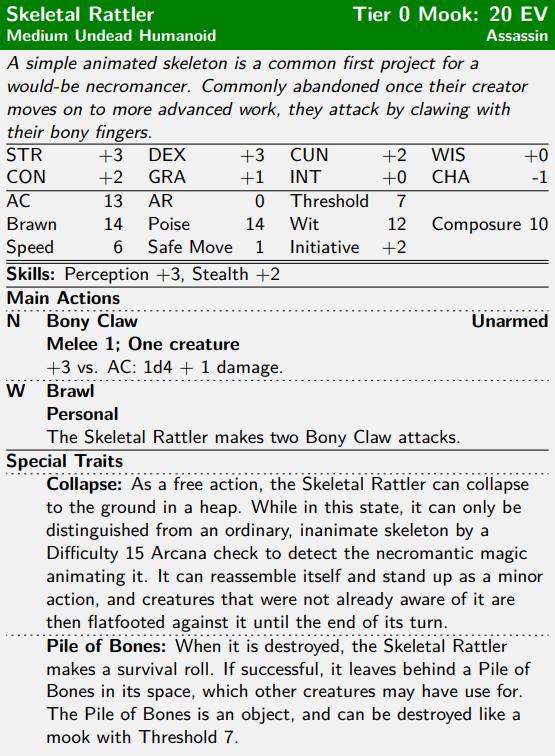
    The Skeletal Rattler is the simplest, weakest skeletal enemy in the Bestiary. Not nearly as durable or as strong as a zombie, it is a subtler enemy with a couple of tricks to pull. The first is that it can ambush the PCs by pretending to be an inanimate skeleton, or blending into a heap of bones (like might be found in a crypt or abattoir). This is what makes it an Assassin.

    But the second of the Rattler’s tricks is that, when destroyed, it leaves behind a Pile of Bones that other enemies (primarily other skeletons) can use. Without spoiling those other skeletal enemies just yet, various of them can use Piles of Bones to gain temporary hit points, bonuses to AC, and extra attacks, or can just reanimate Piles of Bones into more Skeletal Rattlers.

    By themselves, Skeletal Rattlers don’t pose much of a threat. But in an encounter with other, more powerful skeletal enemies, PCs will need to be careful about killing them off: wiping out a horde of Skeletal Rattlers will leave a lot of resources lying around for the other skeletons to use. The PCs can of course just let this happen, but they could also try to dispose of the Rattlers by, say, tossing them off of cliffs, or throwing them into industrial machinery that would destroy the Piles of Bones they leave behind. Or, they could devote some attacks to destroying the Piles of Bones as they create them.

    Up Next

    Skeletons and zombies aren’t the only undead in Aetrimonde. I’ll eventually need to show off some enemies of the other “special” types that are designed to be equivalent to more than one PC; and there are enough undead of these types that I think they’d be great examples. So let me know in the poll up top what kind of undead you’d like to see more of!

  • Today, I’m going to talk about the actual world of Aetrimonde, by which I mean the planet and the solar system that it exists in, and some of the everyday consequences of things like lunar cycles. Notes in italics are out-of-universe references using Earth as a point of comparison.

    I have just enough knowledge of physics that I think I was able to work out the math behind the lunar orbits correctly, but if you’re better at astrophysics than I am and you think I’ve gotten something wrong, let me know!

    Before I get into that, though, I’ve got a poll for you: I’ll be continuing this Gazetteer series by covering the Great Polities of Aetrimonde, which I’ve discussed briefly in a previous post. So, which one would you like to see more about first?

    The Planetary System

    The world of Aetrimonde occupies a planetary system orbiting a yellow sun. Astronomy is an important field of study on Aetrimonde, for reasons discussed below, and local astronomers are aware of six planets in the system, including Aetrimonde itself. However, the more distant of these planets were only discovered recently, and given that there is still plenty of room for telescope makers to improve their craft, the astronomy community suspects that there are still more planets that are still beyond the reach of their vision.

    • Caldimonde, the Forge, closest to the sun, is a scorching hot world. Observations through Aetrimonde’s telescopes are indistinct, but suggest that the planet rotates slowly (just once every three Aetrimondean years), with the side facing the sun growing hot enough to melt stone and metal before cooling as it rotates away.
      • The parts of Caldimonde that are not currently molten are a rust-red, and even before its forge-like environment was discovered, it was associated with Deum Making, god of the forge and of craftsmanship in general. Various legends hold that finishing a work of craftsmanship when Caldimonde is at its zenith will make the result blessed, lucky, or just less likely to break.
    • Nubrimonde, the Jewel, is visibly covered in clouds through telescopes, and is believed to be hot and humid. Even before the invention of the telescope, it was observed to cycle through shades from yellow to violet. More detailed recent observations suggest that the planet has an atmosphere containing several different gases, with some atmospheric process that churns up the gases and periodically brings different ones to the top.
      • Nubrimonde is associated with Deum Reveling, god of, among other concepts, aesthetics. As one of Deum Reveling’s other domains is joy and celebration, there are numerous festivals held at various points of significance during Nubrimonde’s transits. Most of them have no deeper meaning, and are simply excuses to hold large parties.
    • Merimonde, orbiting slightly inside Aetrimonde’s own orbit, is a slightly wetter and warmer planet. Because it is the planet that comes closest to Aetrimonde in its orbit, Merimonde was the first planet that astronomers could view in any detail through their telescopes: it appears to consist mostly of ocean, with no ice caps and only a few, small islands, and is wracked by constant, continent-sized hurricanes. Some astronomers argue that the greenish tint to its oceans are a sign that Merimonde is home to plant life, at the very least.
      • Merimonde is associated with Deum Harmonious, god of nature. Originally this was due to its green coloration, but the association has been reinforced since the theory that it has plantlife became widely known. The transit of Merimonde is considered an especially auspicious time when it coincides with a solstice or equinox, already important dates in the worship of Deum Harmonious.
    • Aetrimonde itself orbits fourth from the sun.
    • Melamonde is a small and apparently frozen world orbiting far beyond Aetrimonde. Viewed through telescopes, it appears to be covered in ice or snow, with jagged peaks of black rock showing through.
      • Melamonde was unknown until the development of powerful telescopes, but it has come to be associated with Deum Untamed, the god of storms and trials. It has no historic association with festivals or folklore, but astrologers (not to be confused with astronomers) have started associating it with periods of hardship such as famines and floods.
    • The final known planet in the system is recently discovered and not yet definitively named, for the measurements reported by the astronomers who discovered it were widely disbelieved. The sixth planet has a radius twelve times that of Aetrimonde, which was previously believed to be the largest object in the system. Like Nubrimonde, it is apparently covered in thick clouds (it is a gas giant, but Aetrimonde’s astronomers haven’t realized such a thing is possible yet), and is orbited by numerous moons, of which fourteen have so far been detected.
      • The unnamed sixth planet does not yet have a strong divine association. Astrologers have very recently started linking it with Deum Veiled, the god of secrets, for having escaped notice for so long.

    Aetrimonde’s Moons

    Aetrimonde itself has three moons:

    • Nomis, the Constant, the White Moon, is the largest and typically closest of the three. (It is about 3.5 times the mass of Luna, Earth’s moon, but 30% further away, appearing about 15% larger in the sky). Aetrimonde’s lunar calendar is based on Nomis’ lunar cycle, which takes just over 35 days.
      • In Aetrimondean folklore, Nomis is associated with the virtues of steadfastness and loyalty, as its short lunar cycle and consistent size makes it a predictable presence in the night sky.
      • Nomis is generally associated with Deum Ruling, the god of laws, kings, and civilization, owing to its constancy as well as the fact that it is generally the largest celestial object in Aetrimonde’s sky.
      • Nomis is often cast as the narrator in classical dramas. In a common style of staging, the actor portraying Nomis moves gradually from one side of the stage to the other to symbolize the passage of time throughout the play, giving narration while in motion and remaining onstage but motionless during the action.
    • Ubris, the Messenger, the Red Moon, is the smallest moon and has the second-closest orbit, but that orbit is eccentric, meaning that Ubris changes in visible size during its lunar cycle. At its closest approach, it appears about a quarter the size of Nomis. Ubris’ lunar cycle takes 191 days, more than half an Aetrimondean year.
      • Ubris is associated with wanderlust and deceit: its red light is bright enough, when it is close to Aetrimonde and Nomis is not in the sky, for thieves and scoundrels to ply their trade, while casting deep enough shadows for them to go unseen.
      • Ubris is sometimes associated with Deum Mocking, the god of trickery and defiance.
      • Folk belief would have it that actions taken under the red moon are subject to the whims of fate: they are unlikely to go exactly as planned, but may turn out for the better as a result.
      • In classical dramas, Ubris is often personified as a character hidden among the ensemble, who provides other characters with advice or objects that become important much later in the play. At that point, the actor portraying Ubris traditionally performs a dramatic reveal, shedding or reversing part of their costume to become clad in red.
    • Exeris, the Stranger, the Black Moon, is the middle-sized of the three moons. It also has an extremely low albedo, and a highly eccentric orbit lasting more than three Aetrimondean years, making it all but invisible except when it is at its closest approach to Aetrimonde, when it passes just inside the orbit of Nomis and appears almost as large.
      • Exeris features in many myths as a harbinger of disaster (likely inspired by historical events discussed below).
      • When it has a divine association, it is with Deum Terminal, the god of endings and change.
      • According to a widespread folk belief, actions taken under the black moon will inevitably lead to disaster, and superstitious people try to remain indoors, doing nothing of import, when Exeris is in the night sky.
      • In classical dramas, Exeris is represented by a masked, silent player clad in black, whose presence in a scene indicates that the action on stage will, regardless of intentions, lead to tragedy.

    Importantly, all three moons orbit Aetrimonde at angles to each other. Nomis and Ubris’ orbits are far enough from each other that they do not exert a significant gravitational pull on each other, but Exeris’ eccentric orbit passes near the other two, and means that it can, and has, come close enough to the other moons to disturb them. There is a close pass between Exeris and the other moons roughly every century, which normally affects their orbits just enough to require recalibrating some tide tables.

    (Non-coplanar lunar orbits are possible in reality, but rare, and indicate a relatively young world. Over time, a planetary system with multiple moons would generally see the moons either crash into the planet, be slingshotted out of the system, or converge into a single orbital plane.)

    However, the second-to-last close pass, which occurred just over a century ago, came close enough to Ubris that the resulting alteration to the Red Moon’s orbit was visible to the naked eye. This, in turn, significantly changed the pattern of the tides and altered some oceanic currents, resulting in a period of severe hurricanes and typhoons as the climate adjusted to its new equilibrium. The storms, thankfully, died down after a period of some ten years, but the events of the Stranger’s Message, as the close pass came to be known, inspired doomsday cults across Aetrimonde. Some believe that the resulting instability contributed to the outbreak of war during the Age of Steam.

    Other Celestial Bodies

    The Aetrimondean system is home to a number of other astronomical phenomena, including the Eye of Heaven, a toroidal nebula strongly resembling an eye, and the Herald of War, a red-tinted comet whose appearance in the night sky has preceded several major wars…probably by coincidence, but the astrologers claim otherwise.

    Tides and Weather

    With three moons in wildly different orbits, Aetrimonde has extremely rough seas, though they are becoming more navigable thanks to advances in shipbuilding, astronomy, and meteorology. In ages past it was only possible to sail the oceans because generations of sailors had charted safe routes through painstaking trial and error, and established sheltered harbors all along Aetrimonde’s coastlines.

    The large mass of Nomis means that tidal forces are already relatively strong (about twice as strong as on Earth), but the presence of two other moons, and in non-coplanar orbits, make the tides far harder to predict, and can create freakishly strong tides at conjunctions where two moons line up closely with the sun over Aetrimonde. Under normal circumstances, astronomers can compute tide tables that are reasonably helpful up to a few months in advance, but when Ubris and Exeris pass close to Aetrimonde, their predictions become much less accurate (though the astronomers are getting better over time).

    Aetrimonde has currents that are not driven by the tides, too, but they are weaker in comparison to tidal currents. Nomis’ tidal currents alone are strong enough that there are very few usefully consistent currents close to the coastline. (Aetrimonde has equivalents to Earth’s Gulf Stream and Antarctic Circumpolar Current, but close to shore, tidal currents are strong enough that they can weaken, cancel out, or redirect these permanent currents at various points in the lunar cycle.) When Ubris and Exeris form a conjunction with Nomis while passing close to the planet, their tidal forces added to Nomis’ can cause devastating tides, flooding coastal towns or completely draining shallow harbors.

    Especially strong tides, such as those during a conjunction, are sometimes enough to bring together warm and cold currents that wouldn’t otherwise meet. This, in turn, causes hurricanes and typhoons that regularly batter coastal areas. Aetrimonde’s meteorologists are only just figuring out how to predict these events: historically, the first sign of an unseasonal storm would be a cloud on the horizon, at which point it was often too late for a ship to find safe harbor. Today, perhaps one in five major storms can be predicted a few days in advance, giving sailors enough advance warning that they can remain in port while it passes…or try to outrun it, if they feel like taking the risk.

    To make all these matters worse, when Exeris makes a close pass with one of the other moons it causes changes to the orbits of both, which requires astronomers and meteorologists alike to recalibrate their models and leaves the tides and weather unpredictable for as much as a year at a time. The Stranger’s Message was particularly bad in this respect, and it took the better part of a decade for seafaring to become as safe as it had been before the Message.

    In short, Aetrimonde’s seas are incredibly dangerous, and not just to ships at sea; coastal regions have to be rebuilt on the regular, and port cities have to be carefully planned to deal with the occasional freak tide. Most ocean-going ships stick close to shore whenever possible, because the risk of a freak storm is such that captains prefer never to be more than a day’s sailing from a safe harbor. Blue-water exploration is a fool’s errand in Aetrimonde, and although astronomers and cartographers are confident that Aetrimonde is far larger than what they have explored and mapped, there is no real effort to find out what lies beyond the edges of the map.

    Sea Magic

    Because of all the dangers associated with the oceans, ship captains hire “sea witches” whenever possible. These are people with some magic making seafaring less dangerous, whether that be outright control of the weather, the ability to predict storms and currents ahead of time, or a divine blessing that ensures a ship will survive rough seas. Some of these people are trained arcanists or anointed priests with other magic to their names, but many just have the one trick letting them sail the oceans without fear.

    Other Tidal Effects

    Aetrimonde’s stronger tidal forces are most apparent in the tides and weather, but the moons’ gravity affects the entire planet and everything on it. Avalanches, landslides, and earthquakes occur more often during conjunctions of the moons, and Aetrimonde’s few volcanoes become more active during these periods as well. Mines are known to shut down operations during a close pass (if the owners have any care for the workers) as a precaution against collapses, and many nations have laws mandating structural inspections of large buildings following a conjunction.

    The Calendar

    Aetrimonde’s solar year is 353.14 days long. The Novan calendar, which is the most widely-used in Aetrimonde, observes a year of 353 days, divided into ten months of 35 days each (matching Nomis’ lunar cycle) with the leftover three days making up a short intercalary month around the winter solstice. Every seven years, the intercalary month is extended by one day, to account for the extra 0.14 days in the solar year.

    The months of the Novan calendar are the unimaginatively named Primus, Secundus, Tertius, Quartus, Quintus, Sextus, Septus, Octus, Novus, and Decus. The intercalary month, which occurs between Decus and Primus and is generally celebrated as a holiday, is named Festus.

    Each month is divided into five weeks of seven days. The names of the days of the week are taken from the old Auran calendar, in which they were associated with the seven gods with the most prestige and power in the old Auran Empire. They are (in order of the associated god’s ascending importance) Luxens, Scirens, Facens, Pugnens, Virtens, Concordens, and Imperens. The days of the intercalary month are considered to be outside of the normal cycle of months and weeks, and are not assigned a day of the week: every month and year thus begins on Luxens and ends on Imperens.

    In the Auran Empire, Imperens was a day given over to religious services and civic duties, and people generally worked the other six. The use of Imperens for religious observations persisted after the Collapse, and spread wherever the Auran calendar was adopted. Recently, labor reforms originating in Waystone have turned Concordens into a second day of rest, although this has not yet spread to the rest of the world.

    The Seasons

    Aetrimonde has an axial tilt just slightly greater than Earth’s, making it experience slightly more severe seasons (though they are also slightly shorter, owing to the shorter year). In the Auran calendar, the seasons are defined to be:

    • Spring from 10 Secundus to 27 Quartus, with the equinox occurring on 17 Tertius.
    • Summer from 28 Quartus to 9 Septus, with the solstice occurring on 1 Sextus.
    • Autumn from 10 Septus to 27 Novus, with the equinox occurring on 19 Octus.
    • Winter from 28 Novus to 9 Secundus, with the solstice occurring on 2 Festus.

    Days, Hours and Minutes

    I preface this section on Aetrimondean timekeeping by saying that I only include it in the interest of worldbuilding, and I strongly recommend that a GM only use it if the players at the table are heavily into roleplaying and want the extra immersion. Otherwise, just pretend that Aetrimonde somehow independently invented the same system of hours and minutes that Earth did.

    The Aetrimondean solar day is almost exactly as long as Earth’s day. Before the invention of accurate timepieces, it was customary to divide the time between dawn and sunset into ten roughly equal hours, and the same for the time between sunset and the next dawn. In the summer, hours would be longer during the day than during the night, and the opposite would be true in the winter, but since nobody could accurately measure time this was not too awful a problem.

    As clocks became reasonably widespread, the world largely adopted a system of timekeeping based on the one invented and imposed by the bureaucrats of the Novan Imperium. This system divides the day into twenty hours (ten each in the morning and the evening) of a hundred minutes, with each minute being further divided into a hundred seconds. An Aetrimondean minute is thus only about 72% as long as an Earth minute, or about 43 Earth seconds.

    The Novan bureaucracy, as may be becoming apparent, very much likes being able to decimalize, or divide things into ten parts. They originally lobbied for there to be only ten hours in the day, but were overruled by the Novan Emperor of the time, who objected to the idea on the grounds that a tenth of a day was far too long a period of time to be useful. (His exact words are reported, perhaps apocryphally, to have been “Once you have doubled the length of the hour, will you then halve the hours of our meetings? I think not.”)

    Campaign Hooks

    Aetrimonde’s unusual planetary system offers several oddities that could be the foundation for an entire high-concept campaign:

    • A wealthy and eccentric shipbuilder has financed the construction of a vessel that can survive the open seas, in order to fulfill his dream of exploring those parts of Aetrimonde more than a few days beyond a safe harbor. The PCs have been recruited as part of the ship’s company; what strange new lands and new civilizations will they discover?
    • Aetrimonde’s astronomers have come to a dreadful conclusion: the Stranger’s Message has put Exeris in a new orbit that will see the Black Moon collide with Nomis within a few short years. The resulting shower of orbital debris will most likely wipe out all life on Aetrimonde. The only hope of averting this lies in recovering and repurposing a variety of artifacts and major rituals, like Orcimedes’ Lever and the Dread Spell of Eternal Night, to readjust the lunar orbits into a more stable configuration.
    • Cosmologists have for some time now claimed that Aetrimonde is an unnatural planet, pointing to “anomalies” like the misaligned lunar orbits as evidence that Aetrimonde is a far younger world than the rest of the planets in the system–too young, they say, to support life. Since Aetrimonde self-evidently has life on it, they have mostly been laughed at. But now, a team of applied cosmothaumatologists have measured intense concentrations of magical activity spread throughout inaccessible regions of Aetrimonde: deep beneath the seas, buried at the edge of the planet’s molten mantle, and even on the far sides of the moons. They believe these loci are actively maintaining Aetrimonde as a habitable world, and are planning an expedition to the most accessible one. Is Aetrimonde an artificial world? If so, what created it? And should mortals really be messing about with whatever keeps their world habitable?
  • I’m excited today, because I get to kick off the post series about a second sample character, who (by popular demand) will be a ghoul skinchanger: this is a combination that I’ve always thought was great from a lore perspective, and yet I’ve never actually built one or seen one played. So, let’s get started:

    This time around I’m not re-building an established character like Ragnvald, so I’m going to be making up this character’s background on the fly as I pick each part of his heritage.

    Ancestry: Ghoul

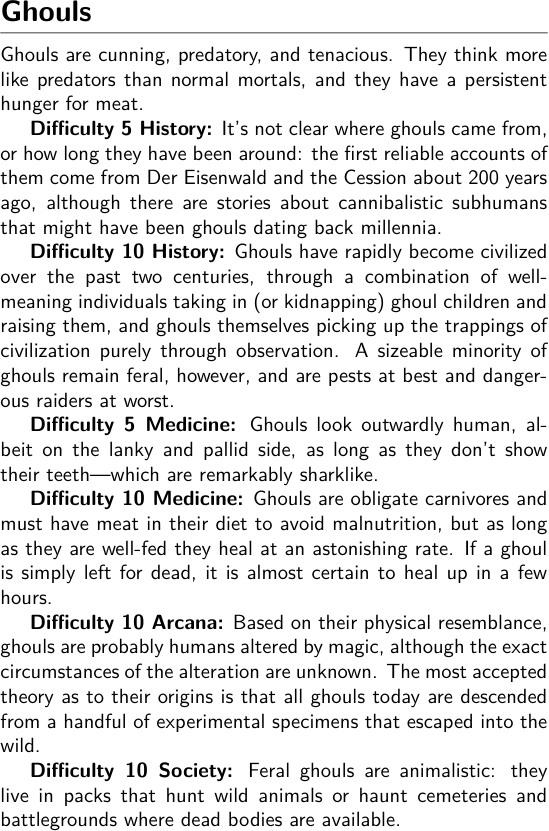
    The ghoul ancestry is going to take some explaining. Dwarves are a familiar enough part of many fantasy settings, and Aetrimonde’s are traditional enough that I didn’t see much need to explain them, but ghouls are one of the odder parts of Aetrimonde. So for starters, here’s what the rulebook has to say about them:

    Ghouls are thought to be humans altered by exposure to the shadowy power of the Underworld. They superficially resemble humans, but have several key differences which can be used to identify them. The most easily spotted is their teeth, which resemble the teeth of a shark, adapted for eating meat. Ghouls also tend to be lean and wiry by human standards, with pallid complexions and dark hair. Ghouls nominally mature at the same rate as humans but (because they often have difficulty gaining acceptance in mainstream society) are often forced to grow up quickly.

    Although they can live on more or less the same diet as humans, ghouls are obligate carnivores: they must have at least some meat in their diet, or suffer from malnutrition. However, a healthy ghoul is extremely difficult to kill: ghouls can survive blows that would kill or mortally wound other creatures, and can recover from almost any injury as long as they have time and a supply of meat. Ghouls have the psychology and instincts of scavengers: they tend to be pragmatic to a flaw, especially where their food is concerned, and they are often blunt-spoken and dismissive of etiquette and social customs.

    So to summarize: ghouls look human until you see their sharp teeth, but they don’t think like humans, they’re incredibly hard to kill, and they have to eat flesh and they don’t often care where it comes from. They’re intended to be among the creepier ancestries of Aetrimonde, and I’ll illustrate that in more detail with a Bestiary post at some point.

    I’m going to lean into the creepiness of ghouls, but not to the extent of making this character an outright villain (after all, I want him to remain a usable character for the starter kit). My general concept so far is that this will be a well-intentioned but poorly-socialized ghoul, who happily does some unsettling things because they don’t bother him and he doesn’t see why they should bother anyone else, either.

    With that in mind, here’s how the ghoul ancestry supports this lore:

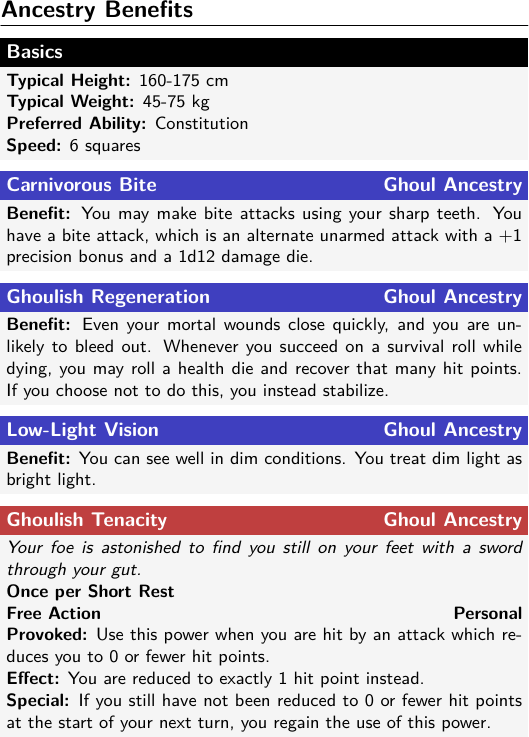
    Basics

    Ghouls are much like humans: they have the same height, only a slightly lower weight (because of the tendency to wiry builds) and the same speed. They also have Constitution as a preferred ability, reflecting their inhuman toughness, although this is actually the smallest of the factors contributing to it.

    Carnivorous Bite

    Ghouls get a much better unarmed attack than other ancestries. A default unarmed attack has +0 precision and 1d4 damage die, so this is a vast improvement.

    Ghoulish Regeneration

    This is the first of the two ghoul features making them unnaturally hard to kill. Normally, when a character is reduced to 0 or fewer hit points, they are incapacitated and start dying: this means they make a survival roll (a Core roll, very rarely with any modifiers) and get closer to death if they roll 10 or less. Rolling 11 or higher is a success, but that just means they don’t get any worse.

    Ghouls, however, can actually regain hit points on a survival roll success. This occurs at the start of their turn, and means that they can possibly get up and get back in the fighting the very turn after they were downed. If they don’t want to do that (which they might not, if they’re currently surrounded by enemies and prefer to play dead), they instead stabilize, meaning they no longer make survival rolls.

    Low-Light Vision

    We’ve seen this feature before, and the ghoul’s version works just like the dwarf version.

    Ghoulish Tenacity

    This is the second feature making ghouls hard to kill. This is a free action allowing a ghoul to survive an attack that would otherwise bring them down and stay on their feet. Like dwarves, ghouls have a way to recover the use of their ancestry power: they just need to avoid being hit and damaged again until the start of their turn.

    Culture: Der Eisenwald

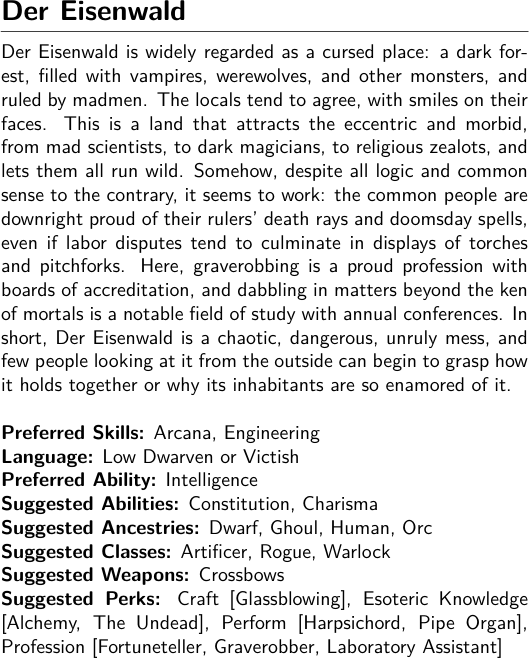
    For culture, I’m going to lean into the creepiness of ghouls, and pick out a suitably creepy culture: Der Eisenwald. As the description to the right hints, Der Eisenwald is inspired by the Transylvania of old Hammer Horror films, filled with mad scientists, vampires, werewolves, and everyday citizens who are equal parts angry mob and loyal lab assistants. Other inspirations that went into Der Eisenwald include Uberwald, of Terry Pratchett’s Discworld novels, and the Europa of Phil and Kaja Foglio’s Girl Genius comic.

    How will this affect the character? Ghouls are predators, and Der Eisenwald contains a lot of things that it is socially acceptable for a ghoul to prey on. This character will be a hunter of things that go bump in the night…even though he arguably is one himself.

    Stratum: Outlaw

    This character concept is starting to come together now: he’ll be an outcast, someone who hunts dangerous things and protects the innocent, despite horrifying them almost as much as the creatures he kills. For a stratum, I want something that makes this character an outcast…or even an outlaw.

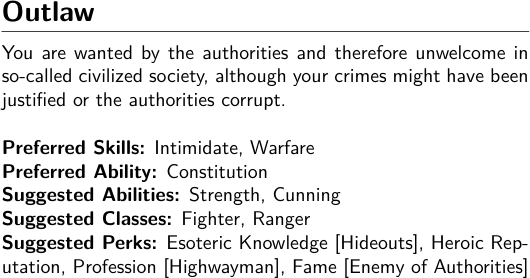
    At the risk of doubling down on Constitution as a preferred ability, I’m going to choose Outlaw as a stratum, and lean into this character being a do-gooder who has run into trouble because of his horrifying methods.

    Bringing it All Together

    So: we have a ghoul from a region haunted by monsters, who hunts horrifying things in part because of his predatory instincts (and appetite for flesh) and is an outlaw. Let’s tie this together into a name and a backstory:

    Valdo the Bat-Eater is a hunter of monsters from Der Eisenwald. As an infant, he was the sole survivor of a nest of feral ghouls that had devoured half the inhabitants of a remote village; the monster hunter who exterminated the nest took pity on the child and did her best to raise him as a human.

    It didn’t take.

    Faced with a child whose prey drive made him unsettlingly good at hide-and-seek, the huntress gave in and trained Valdo in her family trade: killing the horrifying creatures in the dark forests of Der Eisenwald. Valdo proved a natural at it, although as he grew older and more capable he abandoned the traditional sword and crossbow of the Eisenwaldean hunter in favor of fang and claw, as the spirits of the dark forests’ apex predators found him a receptive channeler.

    One might even say that Valdo grew too good at his trade, for he eventually moved on from hunting feral ghouls and escaped laboratory experiments. Seeing no difference between these mindless creatures and the vampires who likewise preyed on the people of Der Eisenwald, he earned his soubriquet by methodically hunting down and devouring an entire coven’s worth of vampire spawn. This, however, attracted the attentions of Der Eisenwald’s elder vampires, and Valdo was forced to flee. He now makes a living as an adventurer, though he still considers himself a hunter of monsters above all else.

    Up Next

    So that’s Valdo: a decisively darker character than Ragnvald, but still a hero at heart even if he doesn’t entirely understand why seeing him messily devour a horrifying monster makes people turn green and flee. In the next post, I’ll cover the skinchanger class, which (as hinted above) allows Valdo to transform into shapes with even more fangs than his natural state.

  • Having finished up character creation for Etterjarl Ragnvald, I’m going to take this post to introduce some enemies out of Aetrimonde’s Bestiary that Ragnvald might fight at level 0. To start with, I’ve picked out some enemies that are most similar to a PC: fellow mortal humanoids.

    The enemies I show off today will fill different roles in an encounter, but future Bestiary posts will focus on specific roles. I’ll get to most if not all of them eventually, but for now, let me know what kind of enemy you’d like to see next:

    Enemy Design Philosophy

    In some editions of D&D, enemies are built in much the same way as PCs, especially when they have an ancestry available to PCs or similar. In this paradigm, they have a class, or something like a class, and a level, and this gives them a set of class features that may or may not actually be useful or interesting when using them as an enemy in a campaign. I’m thinking in particular of D&D 3e and 3.5e, where building a custom enemy or monster could take almost as long as building a regular character. It also caused problems with creating spellcaster enemies, because the guidelines for this were to give the creature spellcasting similar to what a PC would have…except that an enemy spellcaster seldom had to worry about saving their spells for later encounters, and could break out the big guns every turn.

    I’m not going to design enemies this way for Aetrimonde. For one thing, I want enemies to be simple for the GM to create and run, and that means giving them only the features and powers that are necessary to make them an interesting challenge. For another, I want them to be easy to create (if the GM is building their own custom enemies). And to cap it all off, there are factors at play that make enemies built like PCs difficult to balance.

    To cut to the chase, here’s the short version of my philosophy of enemy design:

    • Enemies should have at least three interesting things about them, which in general should include one action they can use every turn, one more powerful action they can’t use as often but will probably get to use at least once in an encounter, and a passive trait that is likely to come into play.
      • Conversely, enemies shouldn’t have “dead weight” to them: if they aren’t going to use it in a fight, it shouldn’t take up space in their entry.
    • Enemies can have PC ancestries and resemble or be based on character classes, but that doesn’t mean they should usually be built like a PC. Their “interesting things” can be based on powers, feats, and features that PCs might have, but they don’t need to have the complete set that a PC would.
      • Many enemies will resemble an incomplete PC, like a half-trained Fighter or an apprentice Wizard. Narratively, that might even be what they are!
      • Rarely, it might make sense for a notable enemy to actually be built like a PC, but this would be an exception to the rule, and they would make for a challenging fight.
    • Because enemies won’t have as many actions or passive traits as PCs, there’s no sense trying to assign a level to an enemy. Instead, I’ll map them onto Tiers corresponding to the levels where PCs’ expertise bonus increases: Tier 0 for level 0, Tier 1 for level 5, and so on.

    Bestiary Lore

    I don’t intend for Aetrimonde’s Bestiary (which is still under construction) to be just a list of interesting enemies to be fought. In what I’ve written so far, I am mixing in lore and information that a GM can use for worldbuilding and reveal to PCs depending on whether they make knowledge checks and how well they roll.

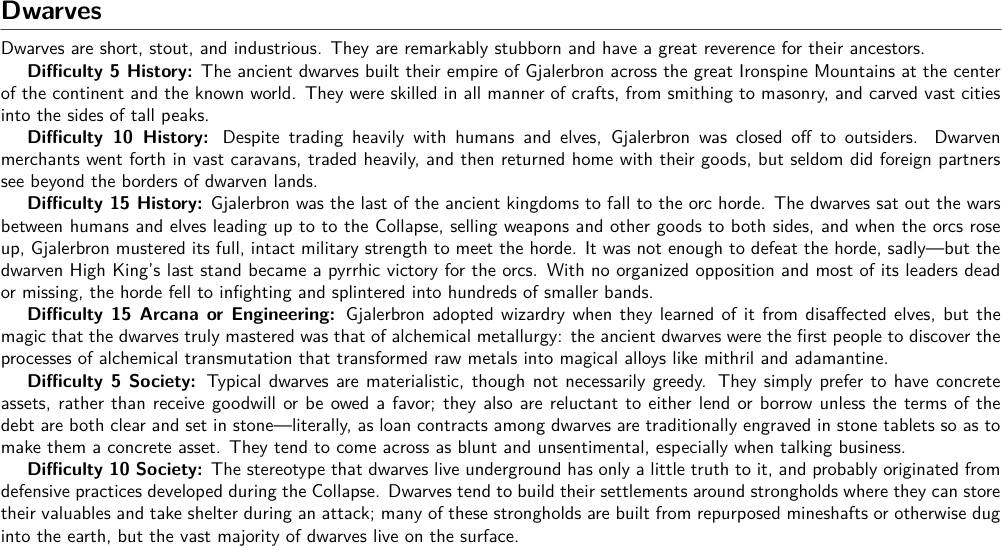
    Since I’ve just spent several weeks building a sample character that’s a dwarf, I think it appropriate that the first enemies I show off from the Bestiary should also be dwarfs. So before I do that, let me also show off some dwarf lore (which expands on what is present in the Core Rulebook).

    The first paragraph here (which doesn’t have an associated Difficulty) is common knowledge that an Aetrimonde character could be counted on to know about dwarves. The rest of this information is locked behind various skill checks, with the most esoteric information needing the best check results.

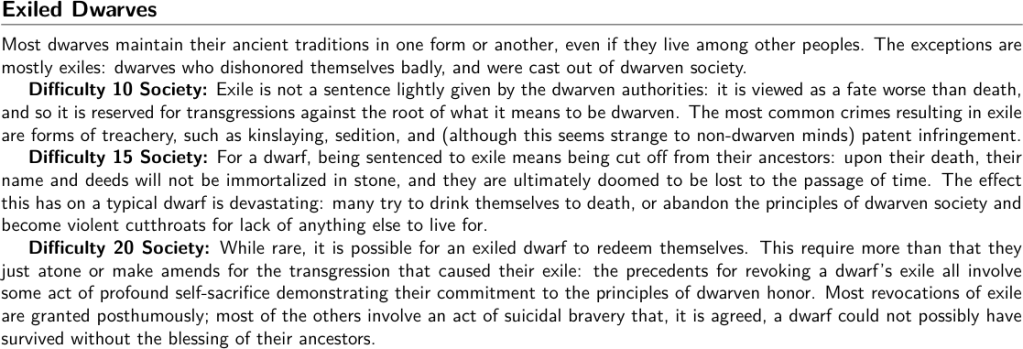
    Some types of enemy are grouped into subsections with additional lore: the first enemy I’m about to show off is a Dwarf Smuggler, which are usually Exiled Dwarves (most dwarves being law-abiding to a fault). Exiled Dwarves have their own lore specific to them:

    Dwarf Smuggler

    Without further ado, here’s the statblock for a Dwarf Smuggler. Since this is the first enemy I’m showing off, let me briefly touch on some of the parts of a monster entry in the style of Aetrimonde’s Bestiary:

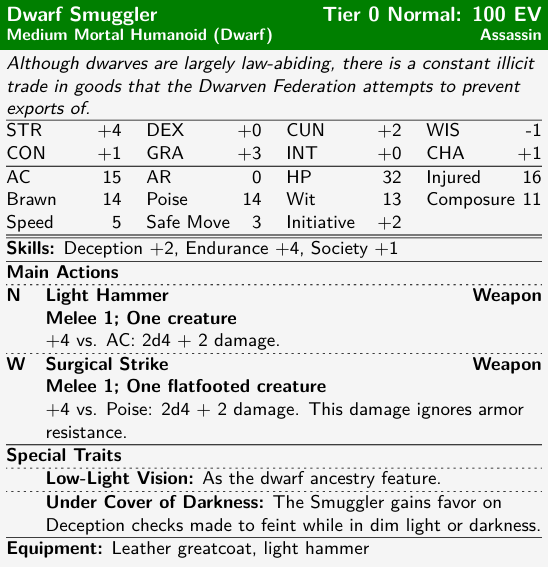
    • Tier 0 Normal: 100 EV” conveys information for the GM about how much of a challenge the Dwarf Smuggler poses. “Tier 0” indicates that this creature is balanced around being a typical challenge for characters at level 0; “Normal” means that this monster is intended to be an equivalent to one PC, as opposed to Elite or Champion monsters that have hit points making them equivalent to two or five PCs, and make attacks to match. (I’ll show off some monsters like this in later posts.) “100 EV” is a numeric value that the GM can use to design an encounter: EV is short for “Encounter Value,” and 100 EV is the value appropriate to one level-0 PC.
    • “Medium Mortal Humanoid (Dwarf)” conveys some basic information about the Dwarf Smuggler: how big it is (Medium, aka 1×1 squares on a grid map), where it comes from (Mortal, so hailing from the material world), its general shape (Humanoid), and in this case a subtype (Dwarf, indicating that yes, this creature has the same ancestry as many PCs).
    • “Assassin” conveys information about the role the monster can fill in a combat encounter: in this case, being an Assassin means that the Dwarf Smuggler is fragile, but has some good attacks that it can use with setup time or favorable terrain. Other roles in the Bestiary include Soldier (has high defenses but not especially dangerous attacks), Protector (makes other monsters harder to kill), and Afflictor (can cause harmful effects to PCs that persist after the end of the encounter). Monsters can have multiple types.

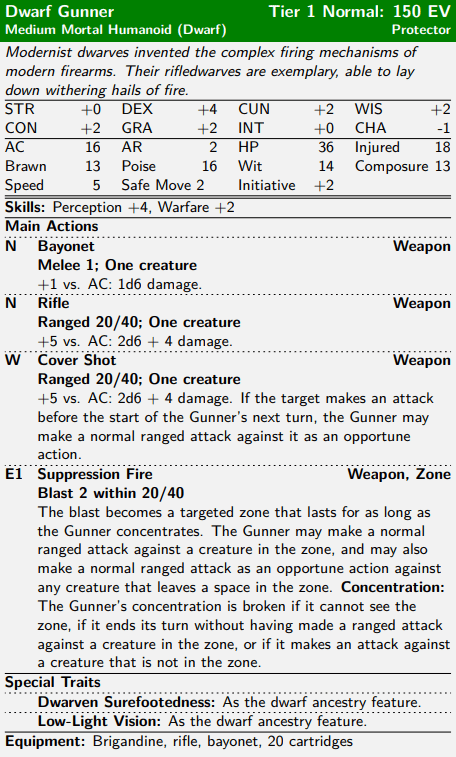
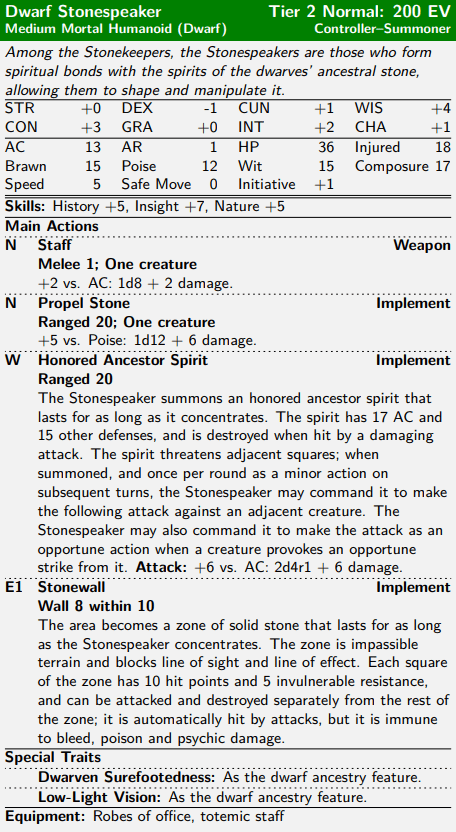
    The next three sections contain the Dwarf Smuggler’s abilities (enemies have the same eight as PCs), defenses and related values like hit points and speed (which again, work much like they do for PCs), and skills (If a skill is listed here, the enemy is considered trained in that skill; otherwise, it is untrained, and its skill modifier is just the relevant ability).

    Following all of this basic information comes the real meat of the Dwarf Smuggler: the Actions it can take and its passive Special Traits. To make it easier for the GM to quickly parse a monster’s entry, actions are divided up by type, although the Dwarf Smuggler only has main actions.

    • Light Hammer is the Dwarf Smuggler’s normal attack (as indicated by the “N” to the left of it). This is essentially equivalent to a PC’s normal attacks, simply adjusted to be a little less accurate and a little less damaging, because this is a Tier 0 enemy.
    • Surgical Strike is a more powerful attack that the Dwarf Smuggler can only use in limited circumstances. It can nominally be used at will (denoted by the “W” to the left of it) but requires that the target be flatfooted, which could be the case if the target is flanked or the Smuggler is hidden from it, but it is an attack against Poise and its damage ignores armor. The Poise defense is typically a little bit lower (by about 2 points, on average) than AC, making Surgical Strike more accurate against the average PC, and it can be incredibly accurate against PCs with low DEX and GRA. It also synergizes with the Smuggler’s special traits…
    • Low-Light Vision is a special trait lifted straight out of the Dwarf features in the Core Rulebook. And, as such, I’m not going to take up space writing out the rule here, especially as it will crop up in basically any Dwarf enemy’s statblock. I’m taking this approach with any ancestry or class feature that doesn’t have values specific to the enemy.
    • Under Cover of Darkness is a more unique special trait, allowing the Dwarf Smuggler an improved chance to feint in darkened areas. Any character can feint, as a use of the Deception skill, so I’m not including the rules for that here, but the Smuggler’s Deception bonus is displayed as one of its trained skills.

    The interaction between Surgical Strike, Low-Light Vision and Under Cover of Darkness–enabling the Dwarf Smuggler to fight very effectively in dark areas–is the first example of how I’m fulfilling my design goal of Combat as Puzzle: fighting Dwarf Smugglers is hard in dark areas, and becomes much easier if the PCs can shine a light on the Smugglers or draw them out of the darkness. That’s a simple puzzle, since the Smuggler isn’t intended to be a complicated enemy, but some other enemies have more complicated mechanics that make for more interesting puzzles.

    Dwarf Gunner

    The Dwarf Gunner fills an entirely different role than the Smuggler. For one thing, the Gunner is a ranged attacker, but on top of that, it’s a Protector, centered around protecting other enemies from the PCs. It’s also a higher tier, which comes with better defenses, attacks, hit points, damage, and so on.

    • The Gunner has two normal attacks: one melee (the Bayonet on its Rifle) and the other ranged (the Rifle itself). The Rifle attack is significantly better than the Bayonet attack, so one way to deal with the Gunner is to get a character close to it so that it can’t effectively use the Rifle.
    • The Gunner’s Cover Shot action is one way that it can protect its allies: this functions a little bit like the Battlefield Challenge feature that Ragnvald has, adapted to work at range: if a Cover Shot attack hits, then if the target makes an attack on its next turn, the Gunner gets to shoot it.
    • Cover Shot gets even nastier when coupled with the Gunner’s final action, Suppression Fire. It can only use this action once per encounter (as denoted by the “E1” to the left of it), but it’s a nasty action: it creates a zone, a persistent area on the battlefield, in which the Gunner can effectively make Rifle attacks as opportune strikes. Any creature moving around in the Suppression Fire zone (leaving its space, not just leaving the zone) will take an attack from the Gunner.
    • The Gunner’s special traits are not particularly linked to its role as a Protector, but its Low-Light Vision lets it attack comfortably into dim light, and Dwarven Surefootedness lets it reduce how far it is pushed around.

    The Dwarf Gunner can present more of a puzzle in combat, especially if it is backing up the right kinds of other enemies (like an entire squad of ranged attackers) or has favorable terrain (like a position with cover overlooking a chokepoint). A well-placed Suppression Fire can give an entire party of PCs second thoughts about trying to move up to melee range, but there are several ways to deal with it:

    • The zone only lasts as long as the Gunner concentrates, so if the PCs can hit it with a powerful enough attack (dealing 9 points of damage) or apply any of the conditions that break concentration, that will put an end to the zone.
    • The PCs could seek an alternate route around the zone and get up close to the Gunner. This is a way for a GM to give characters trained in Athletics or Acrobatics a chance to shine by placing difficult routes around a chokepoint. It also rewards teleportation powers, invisibility, and stealth.
    • They could also tempt the Gunner to attack someone not in the zone, or use a power that blocks its line of sight to the zone.
    • Finally, the PCs could just take cover and wait until the Gunner runs through the 5 shots in their rifle and has to reload.

    Dwarf Stonespeaker

    The Dwarf Stonespeaker is a Tier 2 enemy, which is about the most challenging foe Ragnvald should face at level 0. At 200 EV, two Stonespeakers would be nearly a match for a typical adventuring group, which would include Ragnvald and four allies. Two Dwarf Stonespeakers could be manageable, if a slightly difficult fight; three would be pushing it.

    The Stonespeaker isn’t particularly tough, or particularly damaging in itself: its challenge comes from a combination of two factors.

    • Firstly, it’s a Controller, meaning that its role is to impede the PCs and limit what they can do. In this case, the Stonespeaker has the Stonewall power, allowing it to raise a wall of solid stone; this could be used to split the party and allow the Stonekeeper and its allies to focus on one or two PCs at a time, or it could be used to block a path and give the Stonespeaker and allies time to attack the PCs from range. (It would be especially nasty if coupled with an enemy like the Dwarf Gunner…)
    • Secondly, it’s also a Summoner, and can summon additional enemies to join the fight. In the Stonespeaker’s case, it can summon a single, relatively fragile spirit that lasts only as long as it concentrates…but it can do this repeatedly if the spirits get destroyed. The Stonespeaker effectively gets to attack twice on its subsequent turns.

    The Stonespeaker’s one saving grace is that it can’t concentrate on both Stonewall and its Honored Ancestor Spirit at once, but in an encounter where it has allies, it may have enough time to use both.

    The puzzles presented by the Stonespeaker depend on which of its powers it concentrates on, and how it uses them:

    • If the Stonewall zone is used to split the party, it can be countered by one of the PCs trapped with the Stonespeaker attacking them to break concentration. Of course, if the Stonespeaker has allies, this might be a tricky proposition. The wall can also be broken through by attacks, but with the wall’s invulnerable resistance, that might take some doing: a single attack dealing 15 damage would do it, but it might easily take several characters hacking at it to break through.
    • If the Stonewall zone is instead used to block an approach to the Stonespeaker and allies, the challenge boils down to using the terrain that the GM provides: if there are alternate routes, the PCs can use them, but it might also be possible to find an elevated position and shoot over the wall to break the Stonespeaker’s concentration.
    • Finally, the Honored Ancestor Spirit poses a not-inconsiderable danger: its attacks deal good damage, it can make opportune strikes, and it can help the Stonespeaker or its allies flank a PC. It can be destroyed by an attack, but this means diverting an attack away from other enemies, and the Stonespeaker can always re-summon it.

    A Note on Powers

    These dwarf enemies don’t just draw from the dwarf ancestry: many of their powers are available to PCs, too. Surgical Strike, Cover Shot, and Suppression Fire are all available to Martial classes, while Propel Stone and Stonewall are available to Spiritual classes (like the Skinchanger sample character I’m starting work on). The Honored Ancestor Spirit is not exactly a power available to PCs, but it comes close: the main difference between it and certain Spiritual summoning powers is that it has a different damage die implying that it attacks using a warhammer.

    Up Next

    Now that I’ve established some context by introducing these PC-like enemies, my next Bestiary post will cover some stranger enemies. If you want to see more of a particular type of enemy, let me know in the poll above!

  • Before we move on from Ragnvald, I’d like to preview what Ragnvald might look like as he gains a few levels. Although Aetrimonde has no hard level cap, I plan for the material in the CRB and GMH to support adventures from levels 0-20, which I think ought to provide enough space for development in any campaign.

    For every level gained, a character can pick out a new power, new feat, and new perk. At levels divisible by 5, their expertise bonus also increases by 1, and…that’s it! Aetrimonde characters get all of their class features at level 0 and are ready to go out of the box; becoming more powerful is a matter of learning new tricks (mostly from powers) and putting new twists on old ones (mostly from feats).

    In this post, I’ll cover levels 1-5 of Ragnvald’s career: enough to demonstrate where Ragnvald might be heading, but not so much as to get tedious. For his perks, I’m going to be basing his choices on what happened to Ragnvald in the campaign where I played him, but someone else playing Ragnvald could easily make entirely different choices.

    Level 1

    One thing that Ragnvald doesn’t have in his power selection is a way to attack–and therefore challenge–more than one enemy at once. For starters, he can pick up Cleave, which is a lesser power that offers him the chance to make a second attack against a nearby foe. Coupled with his class features, that also lets him challenge a second enemy on his turn (if the first attack hits). Like Advancing Strike, Cleave also offers him a little bit of mobility that he otherwise lacks, by giving him one square of safe movement that allows him to edge past a foe–again, if his first attack hits..

    For his new feat, Ragnvald will take Improved Battlefield Challenge, which now synergizes with his ability to challenge more than one creature per round. He doesn’t have many uses for his reaction (basically just his Walk it Off power, at the moment) so he won’t suffer too badly from holding it in reserve.

    And, for his new perk, Ragnvald will prepare to continue his legal studies by learning High Dwarven (or Hochdverg), the legal and ceremonial language of the Dwarven Federation. This is considered an ancient language, even though it is still used for official purposes; the Language perk allows Ragnvald to learn High Dwarven only because he is trained in History.

    Level 2

    All of Ragnvald’s powers so far deal relatively standard damage (2d4r1 + 4, using his warhammer), so at level 2, he will pick up a greater power giving him a higher-damage attack. Unfortunately, many high-damage Martial powers require either a two-handed weapon or a light weapon: since he wields a warhammer and a shield, it would be difficult for Ragnvald to make these options work. One option that would work with Ragnvald’s weapon setup is Deadly Strike: this power has no particular weapon requirement, deals increased damage, and has the additional perk of gaining critical threat on its attack roll. Critical threat causes an attack roll to be a critical hit if the dice land totalling 17-20 before modifiers (instead of 18-20, as is normal). This increases the chances of a critical hit from 6% to 10%, and even further if the attack roll also has favor.

    At this point in his adventures, Ragnvald has accumulated some treasure, and can easily afford a suit of plate armor, but he lacks proficiency. He can take the Plate Armor Proficiency feat to remedy this, and will then acquire a suit of Full Plate at the first opportunity, giving him an additional +1 AC and AR over his scale armor. This doesn’t scale with level the way that some other defensive feats would, but he has several levels to go before his expertise bonus gets large enough that it would be better than the benefits of Full Plate.

    Ragnvald’s studies continue, but this time he spends his time learning about the fiefdom he expects to inherit, the Jarldom of Helgenholt. This is represented by an Esoteric Knowledge perk, which he can apply to all sorts of knowledge checks related to the geography, history, and people of Helgenholt. Ragnvald is disappointed to learn that the people of Helgenholt are prosperous, quite happy governing themselves, and unlikely to throw him a parade if he shows up and claims to be their long-lost ruler.

    Level 3

    Ragnvald now has a nice, broad selection of powers: it may be time to start consolidating his options by picking some greater powers in the same niches as his lesser powers, and vice versa. Shield Charge is an interesting complement to Advancing Strike, in that it too applies forced movement, but Shield Charge is also useful as an opener: unlike Advancing Strike, it can be used while charging, allowing Ragnvald to close the distance at the start of combat or catch up with a fleeing enemy. (Also, as a Shield power, he could use it while disarmed of his weapon.)

    By level 3, Ragnvald and his adventuring companions are starting to encounter some more powerful foes, and Ragnvald’s attacks (already slightly inaccurate due to his use of a warhammer) are becoming more so. To try and catch up, Ragnvald now takes Weapon Aim [Hammers], giving him a +1 feat bonus to attack rolls using his warhammer and any other hammers he picks up. This bonus will scale, increasing to +2 at level 10 and +3 at level 20.

    Ragnvald has finally had a chance to actually visit Helgenholt, while he and his fellow adventurers were en route to an adventure putting a stop to gryphon rustling in the high valleys above the town. The locals were, as he glumly predicted, unimpressed with his claim to the Jarldom, but he was pleasantly surprised by the warm reception he and his companions got on the way back through town with a manacled band of captive rustlers in tow. They might not have welcomed him with open arms as their rightful liege, but the town archivist did offer to let him look through their genealogies next time he has some time to spare, and the captain of the town watch has offered him a job if he ever decides to give up on adventuring…and, it is implied, his inheritance. Ragnvald now has the Contacts [Helgenholt] perk, allowing him to call in some favors with the locals if he is ever in the area again.

    Level 4

    To continue consolidating Ragnvald’s powers, let’s give him Overpower as a lesser power equivalent to the Unrelenting Strikes greater power he already has. Overpower is a bit more limited than Unrelenting Strikes, in that it only works on creatures that are already flatfooted, but used correctly and with a bit of luck it can keep an enemy flatfooted for a few turns, and without using a greater power.

    For his feat, let’s try improving Battlefield Challenge by giving Ragnvald the Challenger’s Sunder feat: this will let him try to smash an enemy’s equipment instead of making a regular opportune strike. That’s a little bit niche, since it won’t work on animals or other creatures that don’t have equipment they rely on, but against someone with a weapon or shield they rely on it can be a game-changer. Sundering is a combat maneuver, and any character can attempt it, but this feat will give Ragnvald some extra opportunities to try it. In many cases, an enemy might choose to take damage instead of letting Ragnvald deal the damage to a valuable item, but that still works out in Ragnvald’s favor.

    For his perk, Ragnvald will take another Esoteric Knowledge perk, this time about Dwarven Inheritance Law as he picks up his legal studies again. Ragnvald is beginning to understand just how tenuous his clan’s claim to the Jarldom of Helgenholt really is, and just how silly and wasteful it has been for them to keep pressing it for decades.

    Level 5

    Ragnvald will pick up his first ranged power, Flattening Hurl, to be used with his throwing axes. This is something Ragnvald can use when pursuing a fleeing enemy, or if he starts combat just a little too far away to close with the enemy. (It also has a niche use in pushing enemies off of ledges or into traps, like any power that can push.)

    For his feat, Ragnvald will take Toughness, which synergizes nicely with the hefty armor resistance he already gets from his full plate. Combined with the increased hit points he gets as a result of his expertise bonus increasing from +2 to +3, this will bring his total hit points to 50 and his large heals to 1d12 + 5. (Unlike Weapon Aim, another feat that just grants a numeric bonus, the Toughness feat does not scale based on Ragnvald’s expertise bonus, because hit points and large heals already do so.)

    Finally, as a result of his latest adventure, which brought him in contact with his rival claimant to the Jarldom, Ragnvald has taken some time to think about the futility of a generations-long legal battle over a title and a town that’s getting along fine without a Jarl. He has renounced his clan’s claim and submitted a motion to dissolve the Jarldom entirely, earning the ire not just of his own clan but of all the other claimants. Since this doesn’t map well to any of the perks with specific rules, we will just name this perk “Dwarven Reformer,” and have it apply to any checks related to overcoming the inertia of dwarven traditions and stubbornness.

    Up Next

    This is as far as I’m going to take Ragnvald in this blog, but I think it should give some idea of how a character progresses. I’m going to spend a few posts talking about other things, like the enemies Ragnvald might face in his early adventures, before diving into the next sample character.

  • Having discussed the balancing of attack bonuses and defenses in today’s first post, the last major, overarching point of balance to discuss is damage vs. health.

    Choosing the Point of Balance

    The underlying decision here is not how much damage I want characters and monsters to be able to take, but how many turns it should take a party of PCs to bring down a “typical” enemy with “typical” attacks.

    In my experience, a typical TTRPG campaign involves 4-6 players. I’m going to balance Aetrimonde around having a party of 5 players, and I think it would be appropriate for a typical enemy to be defeated if all 5 players hit it with a “typical” source of damage.

    Typical Damage

    What, then, is a typical source of damage?

    This is something that is already pretty much nailed down: a character will typically be making attacks that use their highest ability for attack and damage rolls, and I’ve already benchmarked that at +4. What about the dice?

    I’m going to treat a typical damage roll as using 1d8 dice.

    • This is the damage of a one-handed weapon with +2 precision (which I’m treating as the typical weapon) and no other notable qualities.
    • I can make this the damage of non-weapon-using powers.

    So, a typical damage roll will be 1d8 + 4, averaging 8.5 damage.

    Setting Hit Points

    I want hit points and damage to be symmetrical, meaning that typical characters and typical monsters have similar hit points and deal similar amounts of damage. But, there are going to be varying types of character (from fragile wizards to mighty warriors) just as there are different types of monster (from fragile skeletons to hulking zombies). I’m going to break them down into four categories of toughness, and assume they have different levels of CON and armor resistance:

    Example ClassExample MonsterTypical CONTypical AR
    WizardImp+00
    RogueSkeleton+11
    ArtificerSatyr+21
    FighterZombie+32

    What remains to be set is each category’s base hit points and how CON translates into additional hit points. I’m going to start by defining a single increment: the difference between adjacent categories is the same as the difference +1 CON makes. Let’s call this increment H, and the base hit points of the Wizard/Imp category B. Then typical hit points will be:

    Example ClassExample MonsterTypical Hit PointsTypical AR
    WizardImpB0
    RogueSkeletonB + 1H + 1H1
    ArtificerSatyrB + 2H + 2H1
    FighterZombieB + 3H + 3H2

    Averaging out the four categories (and assuming each category to be equally likely…) we find that the typical character or monster will have B + 3H hit points, and 1 AR.

    With 1 AR, the actual damage taken from a typical attack will be reduced to 7.5 points. We want a character or monster to be taken out by 5 typical hits, meaning that they survive 4 and are taken down only by the 5th. So this typical character should have between 30 and 37.5 HP.

    Now to pick B and H. I don’t want the most fragile characters to die in a single hit, so setting B = 0 is right out. But, I want the differences between categories to feel significant. The difference between each pair of categories is 2H; let’s make that difference roughly equivalent to damage taken from one typical attack and set H = 4.

    That makes the typical character’s hit points B + 12, and we want this to be between 30 and 37.5. B could be set at either 20 or 24, which would both be a nice multiple of H. Let’s take a look at what each option would do to typical hit points:

    Example ClassExample MonsterTypical Hit Points
    (B = 20)
    Typical Hit Points
    (B = 24)
    Typical Damage Taken
    WizardImp20248.5
    RogueSkeleton28327.5
    ArtificerSatyr36407.5
    FighterZombie44486.5

    I like the B = 20 option more. It puts Wizard-tier creatures solidly in the middle of the range where it takes 3 hits to bring them down (17-25.5 damage) and puts Fighters in the range taking 7 hits (39-45.5 damage).

    So I’ll go with that. One last adjustment I’ll make is to include the expertise bonus in hit points: for reasons of scaling that I’ll cover in a later post, the way I’ll do this is by adding double a character’s expertise to their hit points. And to compensate, I’ll reduce base hit points by 4 (double a level 0’s +2 expertise bonus). So to sum up:

    Example ClassExample MonsterBase Hit PointsTypical Hit Points
    WizardImp1620
    RogueSkeleton2028
    ArtificerSatyr2436
    FighterZombie2844

    Relaxing Assumptions

    Now, let’s at least consider that there will be some deviations from the assumptions I’ve made.

    Firstly, I don’t actually expect every Wizard to have 0 CON and every Fighter to have +3. But, based on observations of player behavior, I think that in practice, many Wizards will have around +1 CON, and many Fighters will have only +2. This is just going to tighten the range of hit points, not affect the “typical” character’s hit points.

    Secondly, I don’t expect every fight to feature characters throwing around “typical” amounts of damage. In fact, I’d be disappointed if it did. Some players will be using higher-damage powers, either because they have heftier weapons, or they chose high-damage powers, or their class gives them some additional damage with appropriate powers. Others will be using low-damage powers because they focus more on supporting allies, or applying nasty conditions, or attacking several enemies at once; these types of powers tend to do less damage. Again, I think this will balance out.

    The one thing that I want to double-check here is greater powers. Many greater powers deal increased damage compared to a lesser counterpart; how likely is it that a character breaking out a greater power can take out an enemy just with that one power?

    A typical single-target, damage-focused greater power might deal 3d8 damage instead of 1d8, and a damage-focused character would likely belong to a class giving them additional damage with their powers (let’s call that 1d8, for the sake of argument). How much is 4d8 + 4 damage, in the grand scheme of things? On average, it’s 22 damage: just enough to take out the absolute most fragile tier of character in one shot. It could get up to 36 damage at its absolute maximum, so it could also take out the next two tiers with a lucky damage roll or a critical hit. But, it’s unlikely to take out a Fighter or comparable character in one blow, which I think is a good place for it to be.

  • It’s a double post today! In this post, I’m going to get into the design and balancing assumptions that ensure a “typical” attacker will hit a “typical” defender about 2/3 of the time. And, in the post that follows, I’ll be going over the related process of balancing damage against hit points.

    Attack Mechanics

    As a refresher on how attacks work: when you make an attack, you make a core roll, add an ability and potentially some other bonuses, and if the total is at least equal to the target’s defense against the attack, it hits.

    In order to hit 2/3 of the time, a typical attack needs to hit when rolling 10 or greater on 2d10. So, a typical attack bonus needs to be 10 less than a typical defense.

    Typical Attacks

    I’m going to continue the assumption that a character has between +3 and +5 for their highest ability, which they use to make attacks with. Splitting the difference, this will make a typical attack bonus +4, and we should have a typical defense be 14.

    I’m ignoring AC for the time being: that will be something of a special case to be tackled later. But we will want the other four defenses to be 14, on average.

    Typical Defenses

    I’ve already discussed in a couple of posts that there are four defenses, and each benefits from adding the higher of a pair of abilities. Before I delve into the exact formula, let me back up a moment and explain why this is the approach taken.

    Abilities into Defenses

    First of all, why have four defenses based on pairs of abilities? Why not one defense per ability? There are a couple of reasons:

    • Many attacks thematically could be opposed by multiple abilities. A firebolt could be opposed by dodging it (Grace) or by throwing up an arm or a shield to protect yourself from the worst of it (Dexterity). A spell of compulsion could be opposed by having the self-awareness to recognize and ignore these external impulses (Wisdom) or by having the sheer presence of will that shuts the compulsion out entirely (Charisma). Giving characters the option to use either of these abilities in their defense makes narrative sense.
    • Mechanically, having eight separate defenses spreads resources very thin. It’s not that odd to have a character with +5 as their high defense and -2 as their low defense, and this would create a 7-point gap between defenses just based on abilities, which could easily widen further based on various bonuses. This would create a situation where a character can virtually never be hit against one defense, and virtually never missed against another. Pairing up abilities reduces the spread of defenses and helps keep them in a range where there is almost always a meaningful uncertainty about whether an attack will hit.

    Next: why the greater of the two abilities in each pair? Why not add both, or add the lesser?

    • This is partly a narrative decision. If you could oppose an attack in two ways, you would naturally choose to do it in the way you’re better at.
    • Also, these three options create different incentives for min-maxing:
      • Adding both abilities incentivizes having both abilities in a pair be equal. The diminishing returns from ability point costs means that it is cheaper to get +2 and +2 than +4 and +0, for example. This encourages homogeneity where smart characters are also cunning, wise ones are also charismatic, etc. it also has the same problem that having eight separate defenses does, in that there could be big gaps between highest and lowest defense.
      • Adding the lesser of the two abilities even further incentivizes having the abilities in each pair be the same, because there is no point in raising one ability above the other unless you have a particular use for it. It also means that a character will not necessarily have a high value in the defense that uses their highest ability, which feels wrong somehow.
      • Adding the greater of the two abilities allows characters to be, e.g., very charismatic but an absolute fool, or street-smart but uneducated, without compromising their defenses. This encourages more diversity of characters and roleplaying, which I am in favor of.

    Defense Formula

    With that settled, why does the formula of 10 + half expertise bonus + higher ability arrive at the average defense being 14?

    I’m going to work from the assumption that a typical character has one of the balanced ability arrays laid out in the Why it Works post on ability generation. I’ll further assume that they put one of the four highest abilities into each of the four ability pairings, so that each of their defenses benefits from one of those high abilities.

    The three arrays have high abilities of:

    +3, +2, +2, +1
    +3, +3, +1, +1
    +4, +2, +1, +1

    Note that, in all three arrays, the average of these abilities is +2. We could define defenses to be 12 + the higher ability from the relevant pair, averaging out to 14.

    However, this omits the boosts from heritage, which (applied to two abilities from these four best) would raise the average ability to +2.5 and the average defense to 14.5.

    Reducing the formula to 11 + the higher relevant ability brings the average defense down to 13.5. To get it back up to 14, we need to somehow give every character either +2 to a single defense or +1 to two of them. This can be a function of class, giving a slight increase to defenses that are appropriate for the class.

    The last thing to do here is bring expertise into it. The expertise bonus is +2 at level 0, so setting the formula to 10 + half expertise + greater ability + class achieves the same result at level 0. As to why using half expertise is the way to go…I’ll leave that for a later post dedicated to level scaling.

    Attacks vs. AC

    I left attacks vs. AC for later, because this is going to be more complicated. As I hinted when discussing the purposes of Dexterity and Grace, the AC defense will be based on one of these two abilities, if a character is wearing light to medium armor. That means that the calculation of an Armor defense will include something other than those abilities, that being the protection afforded by the armor they are wearing.

    There are three kinds of armor: light, medium, and heavy. Light armor allows adding the greater of Dexterity and Grace, medium armor the lesser, and heavy armor neither. Why set the armor types up like this, other than thematic reasons? It’s easiest to see if we look at the levels of AC that can be achieved with typical armors in each group:

    ACLeather Greatcoat (+2)Maille Shirt (+3)Scale Armor (+5)
    14+1 DEX or GRA+0 DEX and GRA
    15+2 DEX or GRA+1 DEX and GRA
    16+3 DEX or GRA+2 DEX and GRAAny DEX or GRA
    17+4 DEX or GRA+3 DEX and GRA
    18+5 DEX or GRA+4 DEX and GRA

    As can be seen here, it’s possible to get 18 AC using light or medium armor. However, getting the highest AC in light and medium armor means investing a lot of ability points into DEX and GRA:

    • To get 18 AC in a leather greatcoat, one needs +5 DEX or GRA. This costs 10 ability points and requires boosting the ability using heritage; virtually the only character who can afford to do that is one that would be DEX-based already, like a rogue. 17 AC is slightly more affordable at 6 points, and could be achievable for a non-DEX-based character, but would leave virtually no ability points for other important abilities.
    • To get 18 AC in a maille shirt, one needs +4 DEX and GRA. In the best-case scenario (a character who can boost both DEX and GRA using their heritage), this costs 12 ability points. The only character for whom that could be worthwhile is a DEX-based character like a ranger or tactician focused on ranged weapons. 17 AC is slightly more affordable at 6 ability points, and actually works decently well for martial characters who want to switch back and forth between melee and ranged weapons…but even then, it leaves basically no margin for secondary abilities like CON or CUN.

    I’m going to treat 16 AC as the typical AC, and not just because that’s the AC achievable with most heavy armor:

    • It costs 3 to 6 points to get 16 AC in a leather greatcoat, depending on whether the character can boost the relevant ability. This is cheap enough to be achievable while also having a +4 in another ability.
    • It likewise costs 2 to 6 points to get 16 AC in a maille shirt.

    16 AC being typical means that the typical attack bonus vs. AC should be +6. How do we get the extra +2 (on top of a +4 ability)?

    Most attacks vs. Armor will be made with weapons. We can give weapons a flat +2 bonus to attack rolls. Or, even better, we can give them a varying bonus to attack rolls, with +2 being the default but having some big, heavy weapons that deal more damage but have only +1 to attacks. Any other attacks vs. AC can have a built in +2 (or so) bonus to bring them up to par.

    Deviations from the Assumptions

    All of this depends on the initial assumptions about how a character’s abilities will be distributed. In practice, it won’t work out so cleanly: there will be characters that boost one of their low abilities, or that put two high abilities in the same pairing, and this will mean that they have lower defenses. And then there are Dexterity-based martial characters (most rogues, plus fighters, rangers, and tacticians focused on ranged weapons), who will find it easy to get their AC quite high, because they already have a high DEX. Is this a problem?

    Not a significant one, I think. I’ve generated a bunch of characters to test out the math behind this balance point, and had some testers generate their own. And it seems that in practice, any character that isn’t purposely built as a joke is going to wind up with their defenses averaging no more than half a point below “typical.”

    Aside from that, the guidelines I’ve developed for designing monsters mean that the monsters suffer from the same issues causing their defenses to be just slightly lower than the setpoint I aim for. So, even to the extent that this is an issue, it should affect both “sides” of the game equally.

Is this your new site? Log in to activate admin features and dismiss this message
Log In