Heroic Roleplaying in a World of Swords, Sorcery, and Steam

I’d like to introduce Aetrimonde, a TTRPG I’ve been designing with heavy inspiration from the houserules my group used back in our Dungeons and Dragons 4e days. I’m not ready to publish Aetrimonde yet, but I’m opening up this blog to discuss its design principles, mechanics, and systems.

  • In my last post, I discussed resolution mechanics used to determine success or failure of actions, and I introduced Aetrimonde’s version: the Core Roll. Today, I’ll cover circumstance mechanics that can alter these and other rolls.

    Warning: this post contains math.


    On top of the resolution mechanic, I also want a circumstance mechanic: something that provides a quick, consistent way to improve or hinder a roll to represent better or worse circumstances.

    Circumstance in Other Systems

    Many systems have circumstance mechanics implemented in various ways:

    • D&D 3.5e heavily used “circumstance modifiers,” situational bonuses and penalties that the GM could hand out to represent helpful or unhelpful circumstances. The size of the modifier could vary and was ultimately up to the GM, although the rules provided examples and guidelines.
    • D&D 4e also used circumstance modifiers, and heavily pressured the GM to just use +2 or -2. It also codified “combat advantage,” a circumstance modifier specifically for attack rolls that you could get from flanking, ambushing, and many other sources, and defaulted to +2.
    • D&D 5e introduced advantage and disadvantage: roll twice, and take the better or worse result. This replaced most circumstance modifiers, removing a little bit of math from the game and generally speeding up play.
    • The Fate system allows players to invoke relevant aspects of characters or situations, generally in exchange for a resource, gaining bonuses to their roll or rerolling the dice.

    Because of Design Goal #2 (Minimize Fiddly Numbers), I want the circumstance mechanic to be non-numeric: nobody should have to do more math, and the GM shouldn’t have to decide how large a modifier should be for the circumstances.

    The advantage/disadvantage mechanic from D&D 5e is mechanically simple: with advantage, you roll twice and keep the better result. With disadvantage, you roll twice and keep the worse result. With both, they cancel out, and you roll normally. There’s no math involved, the GM doesn’t have to decide how large a modifier to give, and a lot of 5e’s actual rules use this mechanic (in addition to recommending that the GM use it to represent different circumstances).

    Let’s take a closer look at the math of this mechanic to figure out just what it does. The mean d20 roll with advantage is 13.82, which is a huge boost from the mean of a plain d20 roll (10.5). The median is further distorted: 15 with advantage, 10.5 without. However, neither of those is the best measure of what advantage would actually do in play: the effectiveness of advantage is going to depend heavily on what you need to roll.

    I’m going to peg the “normal” rate of success in Aetrimonde at 2/3: if you are competent at something but there is still risk involved, you succeed about twice as often as you fail. Assuming that a d20 roll would succeed 65% of the time (needing to roll an 8, as close as you can get to 2/3 on a d20), rolling with advantage succeeds 88% of the time, or 1.35x as often. Disadvantage does the opposite, causing the roll to succeed only 0.65x as often.

    This seems like a good place for advantage, numerically: it shifts the rate of success up or down by about a third for something you’re competent at.

    When does advantage have the largest impact?

    This depends a lot on how you define “largest impact.”

    If the probability you succeed on a d20 roll is X, then the probability you succeed with advantage is 1 – (1 – X)^2, or 2X – X^2.

    In terms of percentage points, this means that the increase in probability of success you get from advantage is (2X – X^2) – (X) or X – X^2. This increase is 0 if you already have 0% probability of success (because advantage won’t let you succeed at an impossible task) or 100% (because there’s no room for improvement). It’s greatest for X = 0.5 or 50%.

    However, in relative terms, the increase in your rate of success is ((2X – X^2) / (X)) – 1, or 1 – X. (For X not equal to 0, which makes it undefined.) The lower your initial rate of success, the more advantage will increase that rate, relative to the initial rate. If you succeed 5% of the time normally, advantage will make you succeed 9.75% of the time, a whopping 95% relative improvement! (Never mind that you probably still won’t succeed…)

    Generally speaking, though, advantage feels useful when you already have a moderate chance of success. If you’re already very likely to succeed, there’s not much point in getting advantage, other than to further reduce the odds of getting that pesky natural 1. And if you’re already very unlikely to succeed, getting advantage won’t hugely increase your odds.

    For my own part, I feel like advantage is worth going for if I’m going to succeed between 30% and 70% of the time: advantage will turn that into 51% to 91%.

    Adapting Advantage and Disadvantage

    Here’s the problem: advantage and disadvantage isn’t going to translate perfectly to Aetrimonde’s 2d10 core roll. Not only will the numbers be different, it’s going to be cumbersome in play to roll 2d10 twice, because you would need to roll 4d10 but keep each pair separate. Sure, most RPG players have at least two sets of dice in different colors, but I don’t want to assume that. It also involves an extra step of mental math, in that you have to total two sets of dice.

    Fortunately, there’s a neat solution, a nice little mechanic inspired by advantage/disadvantage, but adapted for the 2d10 core roll.

    Adding a third d10 to the roll, and keeping only the best two, means that if a core roll succeeds 64% of the time (needing to roll a 10, as close as possible to 2/3 on 2d10), then it will succeed 85% of the time with the third die. This is nice! The math is pretty similar (around this 2/3 success setpoint) to what you would get with a d20 resolution mechanic and the advantage mechanic. The corresponding adaptation of disadvantage (roll 3d10, keep only the two best) is similarly similar. It will be familiar to players of 5e.

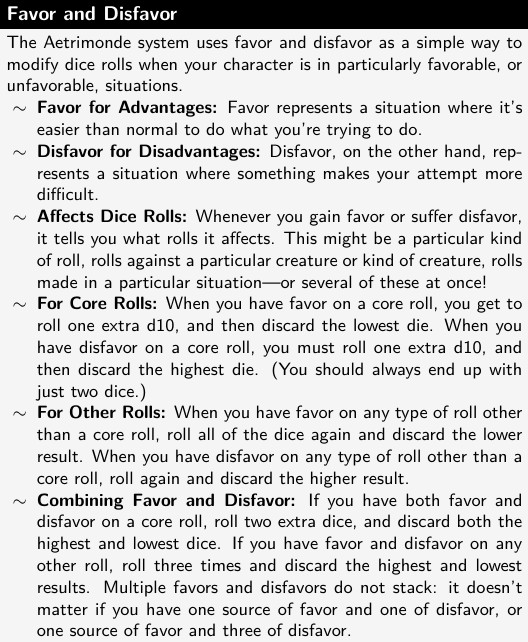
    So this is what Aetrimonde will use as a circumstance mechanic, inspired by advantage/disadvantage. We’ll call it favor/disfavor: if you have favor on a core roll, then you roll an extra d10 and keep the top two. With disfavor, you roll an extra d10 and keep the bottom two. For anything other than core rolls, roll the dice an extra time and keep the higher/lower result.

    That’s the basic idea worked out. Now for some twists…

    Combining Favor and Disfavor

    Having played some 5e, I don’t actually like that advantage and disadvantage on the same roll cancels out. To my mind, if you have both helpful and harmful circumstances when doing something, the way that they affect you should vary based on how good you are at it. If you’re skilled at a task, then you should be able to take better advantage of help and minimize the harm of hindrances, for a net improvement; if you’re unskilled, the opposite should be true.

    This is not actually difficult to make work in our favor/disfavor mechanic! What we will want to do is strengthen the central tendency of a roll without skewing its mean, and one way to do this is by discarding all the extreme results. This would make it so that if you would already be likely to succeed, you become more likely, and if you are unlikely to succeed, you become less likely.

    We can do this just by rephrasing how favor and disfavor work: instead of “roll 3d10 and keep the higher/lower two dice” we will instead say “roll an additional d10 and discard the lowest/highest die.” These instructions are not contradictory: if you have both favor and disfavor, you should roll two additional dice, and discard both the lowest and the highest. Likewise, for favor and disfavor on a non-core roll, you should make the roll three times, and discard the higher and lower results (keeping the middle).
    Stacking Favor or Disfavor

    Since we’ve discussed how favor and disfavor should interact, here’s another question: should multiple sources of favor or disfavor do anything?

    It wouldn’t be that hard to say that for every source of favor you have, you roll an extra d10 for your core roll and discard one of the lowest. But I’m not going to do that, and I think it’s for the same reason that the designers of 5e didn’t make advantage and disadvantage work that way: counting up every instance of favor and disfavor you have would slow down gameplay. Rolling a ton of dice and then figuring out which ones to discard would be slower, too. It’s sufficient for the favor/disfavor mechanic to care about whether you have favor or disfavor, and not how much you have.

    With that in mind, you can see the completed rules for favor and disfavor to the left.

    Up Next

    That’s it on dice mechanics for now. Up next, I’ll discuss resource mechanics that will be common to all characters.
  • For today’s post, I’ll be talking about Aetrimonde’s resolution mechanic, called the core roll, that is used to determine the success or failure of just about every action in the game.


    An RPG needs a resolution mechanic to avoid the cops-and-robbers problem. (“I shot you!” “Nuh-uh!” “Yes so!” and so on.) This is some kind of random process that, in the end, produces a Yes result some of the time and a No result the rest of the time.

    D&D has traditionally used “d20 + Modifier” as its resolution mechanic: roll a d20, add a modifier from your character, and if you beat a target number, you succeed.

    Resolution in Other Systems

    Other RPG systems use different resolution mechanics, which have different properties:

    • Roll + Modifier: Like d20 + Modifier, but with different dice. 3d6 + Modifier has the same mean as d20 + modifier, but a more bell-shaped distribution, and has been mentioned as an optional variant in some D&D sourcebooks. In general, Roll + Modifier is a simple way to determine success or failure: you want to have a bigger modifier, and you hope that the target number is low. This mechanic’s big drawback is that it’s all-or-nothing: it can only handle partial success or partial failure by having multiple target numbers for varying degrees of success.
    • Roll-Under: Commonly based on percentile dice, you roll some dice, add or subtract a number, and try to roll under a target value. This is mathematically equivalent to Roll + Modifier, and is less commonly used because it is counterintuitive: implementations vary, but generally, somewhere in a Roll-Under system, you find that smaller numb.
    • Dice Pool: Roll several dice at once; you get more dice for things you are better at. There are several variants of this:
      • Sum vs. Difficulty: Add up all the dice and try to beat a target number. This works much like Roll + Modifier, except that modifiers come in the form of dice added to the pool.
      • Individual Successes: Each die you roll can be a success or failure (or, possibly, neutral) depending on its result. Try to get a target number of successes. This handles degrees of success very well, by allowing for complications based on the number of failures in a roll. However, the probabilities here are more complicated, and it’s harder to work out the probability of an action’s success on the fly even if the target number is known.

    d20 + Modifier is simple, but it doesn’t actually correspond to the kind of randomness we see in nature or human activity. A d20, like every die, has a uniform probability density, which is to say, every one of its outcomes is equally likely. In the case of the d20, this means that each of the numbers 1-20 has an equal (5%) chance to occur each time you roll the die.

    Unfortunately, most complex real-world randomness we see–like the accuracy of someone shooting a bow, or the speed of someone climbing a cliff–displays some kind of central tendency, meaning that moderate outcomes are more likely than extreme ones. So, I want a resolution mechanic that reflects this.

    There are several ways to get central tendency in a dice roll (See: 3d6 + Modifier, Dice Pools, in the box above) but the absolute simplest way to get a dice roll with central tendency is to use two dice added together. That won’t create a classic bell curve (although using three or more dice would come closer), but it will give us a “peaked” distribution where the most common result (11) has a 10% chance of occurring on each roll, while the most extreme results (2 or 20) each have only a 1% chance. This is good enough to be getting on with, and it has the advantage of not requiring too many dice.

    2d10 + Modifier is simple to learn and not too difficult to predict probabilities for; it uses a pair of dice that come in most dice sets aimed at D&D, which makes it accessible; and as I’ll get to in the next post, it has certain distributional properties that play well with circumstance mechanics. The probability distribution of 2d10 is also sufficiently close to 1d20 and 3d6 that either of these could be patched in as a substitute (because I’m not the only GM who likes to tinker with rules…).

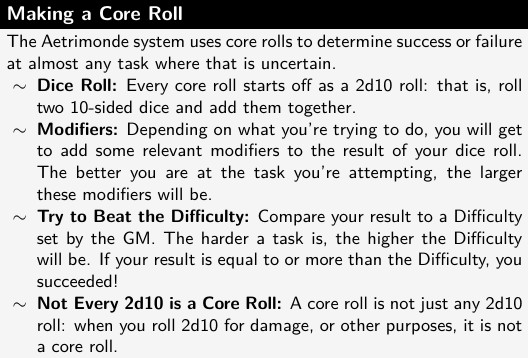
    So yeah, we’ll use 2d10 + Modifier as Aetrimonde’s resolution mechanic. You can see what the rules have to see about it to the left.

    In accordance with the goal of Unified Mechanics, every question of success or failure will be resolved with a core roll. Degrees of success or failure, like the damage from an attack, may be handled with different rolls.

    Up Next

    Yes, it was a short post today. The next post in this series will be longer, and will discuss circumstance mechanics that can alter dice rolls including Core Rolls.

  • When I sat down to take Aetrimonde from a hodgepodge of houserules to a game system that would stand on its own, the list of what I liked and disliked about 4e wasn’t quite the same as what I’ve discussed in my last two posts. For one thing, that was about 10 years ago, and my feelings have shifted a little. I’ve gotten to play 5e and some other game systems since then, and those experiences gave me some new context to work from. 

    The design goals that came from the list haven’t changed much, though. From the start, Aetrimonde has been written with a fairly consistent philosophy behind it.

    The first two parts of this philosophy are simple, because 4e did a decent job of them. I’m largely going to hew closely to the general spirit of 4e’s mechanics, unless I have an overriding reason not to.

    Unified Mechanics

    Every class should use the same core mechanics, and you shouldn’t have to learn entirely new systems to play a character of a new class. 

    Minimize Fiddly Numbers

    As much as possible, bonuses should be something that you factor into your character sheet, not on the fly. 


    The remaining parts are more complicated, because these are things 4e didn’t do to my satisfaction. So, I’m going to briefly discuss what it will take to fulfill these goals:

    Flexible Character Building

    Character classes should be a starting point giving a character tools to fill some intended role. It should then be possible to embrace or branch out of that role, as desired. Thematically similar classes should share options, but their class features should interact differently with them.

    What I intend to do here is give all martial classes a common pool of character options they can pick from, in addition to some specific to their class. The same goes for arcane, divine, and any other kinds of magicians. Different classes within each group may find certain of those options easier to make use of, but none of them should be completely useless to any class. For example, it should be possible to make an effective rogue using heavy, two handed weapons (a sort of thug or pit fighter), even if their class features do not make it a perfect fit.

    Solid Level Scaling

    The math behind level scaling should be consistent and predictable, making it easier to design challenges for a given level of characters.

    This looks simpler than it really is. There are a variety of factors affecting level progression for PCs: level, feats, magic items, etc. For simplicity, a GM shouldn’t have to calculate all these things when designing monsters: monsters’ level scaling should just naturally match up to the sum of all the scaling factors for PCs. To ensure that they match up at all levels, there should be relatively few of these scaling factors. In fact, it would be best if most level scaling came from a single factor, and all other factors were just minor boosts that could be gained anywhere in the level range. (This helps to minimize “bumpy” scaling such as the level 8, 14, and 28 bumps in 4e, where many characters would get both a +1 increase in their half-level bonus and a +1 increase in their ability modifiers, marking a significant increase in power in a single level gain.)

    Flat Power Curve

    Things that are a challenge at low levels should not be irrelevant at high levels, but they should be easier to overcome.

    The factors that go into level scaling should all cover a relatively tight range, small enough that the difference between a minimum-level and maximum-level character is still small enough that they can affect each other meaningfully. However, that means that characters will need to gain something other than numeric increases to make level gains feel meaningful, like additional powers. High-level characters will be more powerful in large part because they have a bigger bag of tricks, rather than because they get to play with larger numbers when using those tricks.

    Narrative-First Character Options

    In designing options for characters, start from the story that you want them to tell, then design mechanics that support them.

    This is honestly the hardest part: Aetrimonde will need a lot of character options. For context, a character class in 4e would have about 80 powers to choose from in its initial release. As a sneak preview, I’m planning to write 16 classes in four groups, which would be 1280 powers if I stick to the 4e numbers. I’m not planning to write quite that many, because I’m giving each group of classes a shared pool of powers and doing away with the redundancies of both leveled powers and siloed classes, but even halving the total that still comes out to 640 powers that will all ideally be interestingly diverse, both mechanically and narratively. It would be really easy if I could come up with interesting mechanics first and justify them with a narrative after the fact, but I’m going to try not to do that.

    Combat as Puzzle

    Aetrimonde is going to go a little further than just having tactical combat as 4e implemented it. 4e did that well, but I want Aetrimonde to support combat encounters that function as a kind of puzzle. While it’s possible to win these encounters through brute force, there is a trick or gimmick that the players can use to their benefit to make the fight much easier. To give one example, a combat as puzzle might involve two enemies who are vulnerable to each others’ attacks, and can be tricked or forced to harm each other if the players figure out how.

    Not every encounter needs to be like this, but the Game Master’s Handbook will need to include suggestions and examples of how to achieve this, and the Bestiary will need to include monsters that can be used this way.


    Up Next

    This concludes the discussion of Aetrimonde’s underlying design philosophy. If I have your interest and Aetrimonde sounds like a game you want to play, read on: next up, I’ll start talking about Aetrimonde’s core mechanics and how they tie into the first two of these goals.

  • In the previous post, I talked about the things that 4e did well for the types of games I wanted to run. But if 4e had been a perfect system for my purposes, I wouldn’t have felt the need to invent houserules, or homebrew content, or eventually, to write Aetrimonde.

    4e got a lot of criticism: some of it warranted, much of it (in my opinion) not. Every new edition of D&D starts a lot of Internet Arguments over whether it’s better than the old one, and I’m going to carefully sidestep all of that by saying up front that no edition of D&D has been good for running the kinds of games I want. This post is about the things that kept me from fully enjoying 4e out of the box, and that eventually made me start writing Aetrimonde.

    Wonky Level Scaling

    “Level scaling” is a catchall term to describe how characters become more powerful as they gain levels, and how the challenges and foes they face should become more powerful at the same time. This is important in tabletop RPGs, because it’s hard for the writers to give a GM guidelines for designing appropriate challenges if characters’ numeric and other attributes don’t scale predictably or smoothly.

    4e tried really hard here…it just didn’t get it quite right. High-level characters in 4e tended to actually feel weaker than low-level ones, because the guidelines used to design and rate monsters meant that level-appropriate monsters felt harder to hit and tougher at high levels, while also hitting the PCs more often.

    4e Design History

    The biggest problem with 4e’s level scaling is that between levels 1 and 30, a PC’s attack bonuses and defenses would nominally increase by about 25 points (+15 from a +1 bonus at every even level, +6 from the magic items a PC was expected to equip themselves with, and +4 from expected ability increases). Meanwhile, monsters’ attack bonuses and defenses would increase by 29 (+1 per level)…meaning that PCs would need to roll 4 higher to hit a level-appropriate monster at level 30, while the monsters would need to roll 4 lower.

    There were also issues with HP and damage scaling: monster HP increased faster than PCs’ HP and their damage, meaning that high level fights turned into a slog of whittling down massive HP pools. This was even worse for 4e’s “Solo” monsters, intended to face an entire party of 5 PCs alone; they had 5 times the HP of a normal monster, and it was rapidly determined that that was about 25% too many.

    I believe part of the reason why 4e’s attack and damage scaling (and maybe HP scaling, too) were wonky is that the designers assumed PCs would always be receiving bonuses from an ally that made up for the difference. This did not turn out to be the case in practice, as players often opted for powers with more direct effects, like greater damage or more healing.

    4e’s designers tried to fix both of these things, although their solutions were naturally limited by the fact that they couldn’t just release a software patch.

    To fix the attack and defense scaling, the Player’s Handbook 2 included feats granting bonuses that closed the gaps between PC and monster attacks and defenses. Unfortunately, this made those feats incredibly powerful compared to every other feat, and became almost compulsory choices. Many GMs (myself included, before I started houseruling more heavily) just gave every PC these feats for free instead.

    Meanwhile, to fix the monster HP problems, the designers altered the formula they used for monster HP in the Monster Manual 2, reducing all monsters’ HP slightly, and adjusting Solo monsters to only have 4 times normal HP. They also released errata for the original Monster Manual, reducing the HP of its monsters to match.

    Steep Power Curve

    4e had a very steep power curve, taking PCs from heroic but very much mortal at level 1, to near-godlike at level 30. The steepness of this curve meant that low-level challenges became irrelevant very quickly as characters gained levels.

    This is the first spot where my critique of 4e becomes really subjective: I want a system where low-level challenges remain relevant, if somewhat easier to overcome, at high levels. Not one where goblins become irrelevant at high levels, or where goblins must steadily be replaced by tougher and tougher goblins.

    5e has taken a big step in this direction, with the introduction of its bounded accuracy design philosophy making it possible for low level characters to at least scratch high level ones, and reducing the gap between low-level and high-level skill bonuses. It still has a problem of rapid HP inflation, such that high level characters have so many HP that you need impractically many low-level enemies to pose a threat to them.

    4e Design History

    To give one example of challenges becoming irrelevant at higher levels, level 1 goblins became difficult to use as credible threats as early as level 6, even in huge numbers, because they could barely hit a level 6 PC and would deal tiny amounts of damage, while the PC could hardly miss them.

    4e dealt with this by introducing what seemed to me to be a numbers treadmill: its encounter design guidelines for GMs suggested that PCs should generally fight enemies within 4 levels of them. Aside from reducing the variety of monsters that a GM could use for a given level of party, this made it difficult to show the PCs’ progress naturally: past a certain point, you couldn’t pit the PCs against enemies they had previously struggled against if you wanted the encounter to still be remotely challenging.

    This also extended to other areas like skill checks: the DMG provided a table of “level-appropriate” DCs for the GM to set, the implication of which was that an “average” difficulty challenge would see a competent PC succeed about half the time at any level. This, again, seemed like a numbers treadmill.

    As far as the table of DCs goes, I believe that this was actually a good idea implemented badly. I have come to interpret the table descriptively, not prescriptively; that is, I view it as saying what DCs are easy, moderate, or hard for a PC to handle at a given level, rather than what DCs they should face at a given level. So when one of my players asks to climb a wall, my first thought to myself is “what level of PC should find this wall moderately challenging?” and I then consult the table for an appropriate DC for that level–which is not, necessarily, the level of the player’s character.

    I don’t think most GMs viewed the table this way.

    Among the failure modes I have read other GMs lamenting are:

    • That their players grumbled about brick walls getting harder to climb as they gained levels.
    • That at high levels, having every wall intended for the PCs to climb be a wall of force (to explain the higher DC) didn’t suit their narrative.
    • That it broke their players’ suspension of disbelief when every wall they wanted to climb turned out be a wall of force at higher levels.

    I think all of these could have been avoided if the DMG’s instructions for using the table of DCs had been a little better thought out…or if the system had been designed so that appropriate DCs did not change so significantly between low and high levels, as is the case in 5e.

    Rigid Character Creation

    This is one area where 4e’s excellent unified mechanics went a step too far, in my opinion.

    Until some of the later books, all PCs gained new powers at exactly the same rate. Every character of a given level would have nearly identical power spreads (featuring the same number of at-will, per-short-rest, and per-long-rest powers, other than a few utility powers). There was no ability to choose between utility and offensive powers, or short-rest and long-rest powers.

    Powers became available for selection only at specific levels, and did not scale: level 23 powers were more powerful than level 13 powers, which were more powerful than level 3 powers, and so on. While you would eventually start replacing your low-level powers with higher-level ones, you would not always find a direct upgrade for powers you liked, forcing you to choose between effective powers and ones that appealed to your character concept. (Also, where there were direct upgrades, it meant taking up a lot of page space to print several versions of the same power.)

    Classes were also tightly siloed, each with a distinct and non-overlapping selection of powers, creating a paradigm where, for example, the sorcerer would either have a power virtually identical to a wizard’s Fireball under a different name, or would have no equivalent power despite that being a very appropriate power for a sorcerer, or would have a power that differed from Fireball seemingly only for the purpose of being distinct. Aside from sometimes breaking suspension of disbelief, this again meant that page space was taken up printing several similar powers for different classes.

    A class’ powers would be largely tailored to work with its class features and its intended role: while this made it harder to build a character that was outright unable to fulfill its role, it also meant that it was harder to give characters the flexibility to step even a little bit out of that role. Early in 4e’s lifecycle, there were no powers supporting a dual-wielding fighter or a warlord using ranged weapons.

    4e Design History

    Some of this did eventually get smoothed out as more books got published.

    The Player’s Handbook 3 introduced three psionic classes that got only at-will and per-long-rest powers, but could augment their at-wills with a limited “power point” resource to be on par with per-short-rest powers. The later Essentials books introduced some simplified variant classes, such as the Slayer and Knight variant fighters that got fewer per-short-rest and no per-long-rest powers.

    Class siloing was loosened by later books introducing additional power choices and alternate class features to enable different playstyles for many classes, and by expansions to 4e’s multiclassing rules, which provided more ways to gain powers from other classes.

    Overly Gamist Design

    Here, we’re going to get into a purely subjective opinion of mine. I eventually came to feel, especially on reading later books in 4e’s lifecycle, that the developers would write powers (or even entire classes) by starting from desired mechanics and adding narrative as an afterthought. Which is to say, I think that the design process might have been along the lines of “for the level 13 cleric powers, we need some to deal radiant, thunder, fire, and lightning damage; two using weapons; two using implements; two that heal; two that buff allies; and two that debuff enemies. Figure out how to cram that into four powers, and then come up with descriptions for the mechanics of each power.”

    I would much prefer that the design process start from the narrative, and that the mechanics grow from that, along the lines of “we need to support clerics that wield holy weapons, call down wrath from the heavens, channel the terrible presence of a deity, apply divine seals and bindings, or just heal and empower their allies. Figure out what mechanics are appropriate for each of those tropes, and work those into a selection of powers.”

    Up Next

    Having now covered both the positive and the negative aspects of 4e, my next post will conclude this series on design philosophy by discussing the design goals I took away from 4e and other games as a basis for Aetrimonde.

  • There’s never going to be a “perfect” RPG system, because different GMs and players and groups will want to tell different stories, in different styles, and no single system is going to be the right one for all of them. 4e was no different: it did some things well, and some things poorly, and I liked it because many of the things it did well were things I wanted out of a system.

    Aetrimonde is not a 4e retroclone: I didn’t set out to write “4e but done better.” But you can definitely see some 4e inspiration in Aetrimonde’s design and mechanics, and that’s because the rules framework of 4e appeals to me more than the framework of any RPG I’ve played before or since. Here’s why:

    Unified Mechanics

    Unlike the editions that came before and after it, 4e used a single resolution and resource system for all characters, with only minor variations. This made it easier for new players to grasp the system, and made it easier for them to play the classes they found interesting without getting bogged down learning additional subsystems.

    Other Editions

    Every character class in 4e (until some of the later books) used the same resources: creating a character of a new class didn’t require you to learn brand-new systems. Compare this to D&D 3.5e, in which many of the later-released classes featured novel systems shared with few or no other classes. (See: Binders, Truenamers, Incarnates, Martial Adepts.) 5e is much better about it, but playing, say, a Champion Fighter doesn’t exactly prepare you to play any kind of spellcaster.

    • To be fair, having classes without resources, or with minimal resources, offered a simpler entry point for new players, who were often advised to play a fighter. However, I think there’s a happy medium between 3.5e’s extremely simple fighters and far more complicated spellcasters, where new players can still jump right into playing a spellcaster if that’s the kind of character they want.

    With few exceptions, the character taking an action made all the relevant rolls: instead of attacks vs. AC and saves using Fortitude, Reflex, or Will, you just had attacks vs. AC, Fortitude, Reflex, or Will. Knowing that when they took an action, they would almost always be the one needing to roll dice for it made the game easier for new players to get the hang of.

    • This does actually complicate writing rules for certain kinds of action. If a spell creates a patch of slippery ice, it’s simple for the rule to be “a creature entering the ice must make a save or fall prone.” Without saves, the equivalent rule needs to be along the lines of “when a creature enters the ice, make an attack vs. its Reflex; if it hits, the creature falls prone” which is both longer, and requires the spellcaster to do things when it’s not their turn. Personally, I think that having everything be an attack simplifies the basic rules enough to be worth some spells getting more complicated in response.

    All Classes Do Interesting Things

    As an extension of its Unified Mechanics, 4e gave martial characters more interesting things to do than just make weapon attacks. Like all classes, they got powers that could be used once per short rest or per long rest, and this put them on a more even footing with spellcasters in terms of being able to contribute to their group.

    Other Editions

    3.5e gave non-spellcasters very few things they could do that weren’t some variation on a weapon attack. (See: Sneak Attack, Power Attack, Trip, Manyshot, etc.) But, because they didn’t have resources comparable to a spellcaster’s spell slots, these options were balanced around being more or less equivalent to a regular attack.

    Spellcasters, by comparison, had spell slots that they regained every day, and their spells were far more powerful than any weapon attack (especially at higher levels). In theory, this would be balanced out by spellcasters eventually running out of spells, while a non-spellcaster would be able to make weapon attacks all day long. In practice, players would often stop to rest once the spellcasters were out of spells, or even just running low.

    5e is much better about this! Not all classes get a resource mechanic allowing them to do interesting things like spellcasters, but they do all at least have a subclass that allows them to if they want.

    Tactical Combat

    D&D in all its editions has been relatively combat-focused, but 4e made some large strides in making combat more interesting and dynamic.

    4e made it very common for characters to be able to relocate enemies, by treating forced movement as a pseudo-condition on par with being slowed or dazed. Fights in 4e tended to involve a lot of movement and jockeying for position as characters tried to push enemies out of cover, away from vulnerable allies, or into traps and hazards.

    Another innovation in 4e was to make it more common for characters to do things on other creatures’ turns, like move out of the way of attacks, heal an ally just before they got hit, or countercharge a charging enemy. Being able to respond immediately to an enemy action, instead of being helpless until their next turn, made combat feel much more interesting.

    Other Editions

    Prior to 4e, combats tended to be relatively static: there were few effects that would push characters around, and they tended to be hard to use unless a character focused on them, so a typical combat would see a lot of movement in the first few turns, and then everyone would stay stationary until they had killed off whoever they were fighting. 5e has kept 4e’s increased emphasis on forced movement, for the better.

    3.5e had introduced, late in its lifecycle, the Immediate action, which it used mainly to allow for casting spells like Feather Fall when it wasn’t the caster’s turn. But because it wasn’t an original part of the system, there were few spells or other abilities that actually used it, and in fact if nobody at the table had the books using it, they might not even know it existed. 4e included the Immediate action from the start and vastly expanded the range of things that could be done with it; 5e has backed off of that slightly but still retains the concept in the form of the Reaction.

    Reduced Mental Load

    Pen and paper games suffer from having lots of fiddly little situational bonuses for players to keep track of. Any experienced RPG player is certainly familiar with the realization that they should have hit with their attack last turn, because their ally had given them a +1 situational bonus that would have made the difference if they’d remembered it.

    4e certainly tried to cut down on how many of these it used: it wasn’t entirely successful, but in my experience it made a good attempt at ensuring situational bonuses were memorable. It also cut down on the overall number of bonuses you could get, and reduced many of them to something you would include in a calculation once, on your character sheet, instead of on the fly.

    A Digression on the Behavioral Economics of Situational Bonuses

    Okay, this isn’t exactly an ideal application of behavioral economics, but that’s what I studied instead of psychology.

    Behavioral economics tries to explain why economic agents sometimes make decisions that our theories say are suboptimal. One of the key concepts here is salience, which I will describe here as “feeling significant.” Actual people have a limited mental load they can carry, and so they sometimes ignore things that aren’t salient when making decisions.

    In RPGs, situational bonuses tend to get forgotten if they aren’t salient. To make a bonus salient, it helps if it is some combination of:

    • Self-Only: Bonuses that another character gives you feel less salient than ones you give yourself.
    • Large: Large bonuses are more likely to make a difference than small ones, and thus more salient.
    • Reliable: Situational bonuses that you get in common situations are more salient than ones you only get once in a blue moon.
    • Consistent: Giving a bonus a name makes it more salient. 4e had a mechanic of combat advantage, which you could get from many sources but always gave a simple +2 bonus to attack rolls.

    4e was good about making situational bonuses one of those four things: it contained large bonuses that other characters could sometimes give you, and small bonuses that you could easily get from other characters, but not small bonuses that other characters only occasionally gave you.

    Other Editions

    Bonus types in 3.5e included ability, alchemical, armor, circumstance, competence, deflection, dodge, enhancement, insight, luck, morale, natural armor, profane, racial, resistance, sacred, shield, and size. Like in 4e, you could only count one bonus of each type, but with so many types, that often didn’t help much.

    Some of these bonuses were incredibly fiddly. Consider one bonus of being a dwarf:

    “Dwarves are exceptionally stable on their feet. A dwarf has a +4 bonus on ability checks made to resist being bull rushed or tripped when standing on the ground (but not when climbing, flying, riding, or otherwise not standing firmly on the ground).”

    This bonus made it harder to push dwarves around or make them prone, but only applied to certain kinds of effect (bull rush or trip) in certain circumstances (standing on the ground) and only if the effect worked in a specific manner (via ability check). Also, a +4 bonus sounds significant, but at higher levels in 3.5e, might not actually have made a difference. Dwarves are Medium creatures; bull rush and trip attempts already gain a +4 bonus for each size category larger than the target the attacker is. At high levels, that +4 would not go far to negate the +16 that a Colossal enemy has, not to mention its likely very high Strength…

    4e’s bonus types included enhancement, proficiency, racial, class, feat, item, and power; of these, the only ones that would usually be situational are power and maybe racial and class. Since you could only “stack” one bonus of each type, this meant you basically only ever had to think about three types of bonus in the middle of the game. 4e was also better about ensuring that bonuses remained relevant even at high levels.

    5e has actually improved on 4e in this regard, with the introduction of its advantage/disadvantage mechanic as a replacement for a lot of situational bonuses. (For more on this, stay tuned for my upcoming post on Resolution Mechanics.)

    Simple GM Prep

    4e tried to take a lot of the guesswork out of GMing by making it easier to design challenges. Among the big ideas it introduced were that it should be easy to tell how much of a challenge monsters would pose for a party, it should be easy to set DCs for tasks the rules didn’t exactly cover, and that it would be nice to provide guidelines for designing non-combat encounters using skill checks.

    4e didn’t actually do any of these things superbly: I’ll talk about some of the reasons it failed to do so in my next post. Despite that, the intent was there, and it was in many ways an improvement over 3.5e, and I liked the direction it tried to go in fulfilling these goals, even if it fell short.

    Other Editions

    3.5e and 5e both rely on the Challenge Rating (CR) system for designing encounters. In theory, a monster’s CR is the level that a party of 4 characters would need to be for the monster to be a reasonable encounter. In practice, that’s not an easy system to use, since encounters with single monsters would get very boring very quickly. The guidelines for working out the effective combined CR of a group of monsters can be very misleading, and so encounter design in both 3.5e and 5e tends to involve a large amount of guesswork on the part of the GM.

    As far as setting appropriate DCs goes, 3.5e took the approach of defining what the DC should be for specific tasks (like climbing a brick wall, or swimming in choppy water) but didn’t give particularly good guidelines on what DCs would be appropriate to expect PCs to handle at various levels.

    5e instead gave a single table of DCs ranging from Very Easy to Impossible, and because skill bonuses don’t change hugely from low level to high level in 5e, this works out reasonably well.

    Neither edition has a great system for designing non-combat encounters using skill checks, and it’s something I hope I can improve on when writing a Game Master’s Handbook.

    Up Next

    Keeping in mind all these things that 4e did well for the kind of game I want to run, I’ll next start in on the things that made me feel houserules were necessary.

  • I’m about to kick off this blog with a series of posts on the design philosophy that Aetrimonde is built on, but before I do that I think it’s for the best to answer a few questions like “what’s Aetrimonde?” and “who are you again?

    What’s This Blog About?

    I’m going to be talking about Aetrimonde, a game I’ve been writing, and introducing its rules and concepts to a wider audience than the handful of playtesters I’ve been working with for a while now. Aetrimonde isn’t a finished game yet: part of why I’ve started this blog is to broaden my audience, but I’m also going to be polishing up some of the rules text for an audience that hasn’t learned the rules by testing them with me. Along the way, I’ll be discussing not just what the rules are, but why I designed them the way that I did.

    My intent is to cap off the first series of blog posts (which will eventually cover Aetrimonde’s Core Rulebook, the CRB, and player-facing content) with the release of, at the very least, a free starter adventure that you can play through at home. But my eventual goal is to work through the writing of a Game Master’s Handbook (GMH) containing advice for running the game, setting information, and a bestiary of monsters, which I aim to publish alongside the Core Rulebook.

    You can expect at least one post per week from me (and I’ll be aiming for two) after the initial series that describes the design goals I have for Aetrimonde. I’ve only a rough guess of how many posts will be in the initial series about core rules, but I expect it to last at least through the end of 2025 if I don’t get carried away and start posting more frequently.

    What’s Aetrimonde?

    Aetrimonde is a system of rules for a tabletop fantasy roleplaying game, much like Dungeons and Dragons. I started seriously writing the system that would become Aetrimonde around 2016, but its ultimate origins lie in the houserules and homebrewed content that I had already created for my campaigns of D&D Fourth Edition all the way back in 2009 or so. I’m going to be referring back to 4e as I discuss a lot of design decisions; this isn’t because Aetrimonde is a 4e retroclone (I haven’t set out to write “4e but better”), but because 4e is the game system that has come closest to supporting my desired style of play, and the style of play that I aim to support with Aetrimonde.

    Aetrimonde is designed to support a different style of fantasy than Dungeons and Dragons generally does, because that’s the kind of game I find fun to run as a GM. I’ll get into more details on this later, but to sum it up in a few bullet points, Aetrimonde is designed to support:

    • Pulp Adventure: Player characters in Aetrimonde are larger than life, but not godlike, even at higher levels. They can cast magical spells, fight their way through hordes of zombies and slay terrible dragons, but they won’t be reshaping the fabric of reality any time soon, and they still have to worry about a knife to the throat while they’re sleeping. Think Indiana Jones, James Bond, Harry Dresden, and Conan the Barbarian, not Elminster, Gilgamesh, or Gandalf.
    • Steampunk and Victorian Fantasy: Things like firearms, grenades, steam-powered golems, and railroads are assumed to be part of the setting of an Aetrimonde campaign. So are magical doomsday devices, flesh golems animated by bottled lightning, and the aforementioned terrible dragons. Aetrimonde contains rules for using these, either as a player or as a GM.
    • Combat as a Puzzle: Aetrimonde’s combat rules and the monsters in its Bestiary make it easy for GMs to keep combat fresh by creating set-piece encounters that require out-of-the-box tactics and teamwork.

    The name Aetrimonde is a little bit of wordplay that amuses me: “monde” being the French for “world,” Aetri-monde is evocative of “Ether-world,” and the pseudo-Victorian setting will certainly have scientists (mad and otherwise) muttering about luminiferous ether. It is also a play on “Autre-monde,” or “other-world,” if you’ll pardon my French again.

    Who Am I?

    I’m Novawhelk. Or at least, that’s the pen name I use for Aetrimonde. True names have power, and so I guard mine carefully.

    I picked up Dungeons and Dragons during my first semester at university, back in the later days of its 3.5th Edition, and adopted 4th Edition as soon as it came out. I’ve been a perpetual GM almost since the start, although every once in a while I get to sit down as a player in someone else’s games (which is where I got most of my experience of 5th edition, Pathfinder, 13th Age, and a few other systems).

    In my professional life, I’m an economist. I’ve studied and taught game theory, among other things, and I’ll probably insert a few digressions here and there on how economics and game theory influenced the design of Aetrimonde.

Is this your new site? Log in to activate admin features and dismiss this message
Log In