
Having finished up character creation for Etterjarl Ragnvald, I’m going to take this post to introduce some enemies out of Aetrimonde’s Bestiary that Ragnvald might fight at level 0. To start with, I’ve picked out some enemies that are most similar to a PC: fellow mortal humanoids.
The enemies I show off today will fill different roles in an encounter, but future Bestiary posts will focus on specific roles. I’ll get to most if not all of them eventually, but for now, let me know what kind of enemy you’d like to see next:
Enemy Design Philosophy
In some editions of D&D, enemies are built in much the same way as PCs, especially when they have an ancestry available to PCs or similar. In this paradigm, they have a class, or something like a class, and a level, and this gives them a set of class features that may or may not actually be useful or interesting when using them as an enemy in a campaign. I’m thinking in particular of D&D 3e and 3.5e, where building a custom enemy or monster could take almost as long as building a regular character. It also caused problems with creating spellcaster enemies, because the guidelines for this were to give the creature spellcasting similar to what a PC would have…except that an enemy spellcaster seldom had to worry about saving their spells for later encounters, and could break out the big guns every turn.
I’m not going to design enemies this way for Aetrimonde. For one thing, I want enemies to be simple for the GM to create and run, and that means giving them only the features and powers that are necessary to make them an interesting challenge. For another, I want them to be easy to create (if the GM is building their own custom enemies). And to cap it all off, there are factors at play that make enemies built like PCs difficult to balance.
To cut to the chase, here’s the short version of my philosophy of enemy design:
- Enemies should have at least three interesting things about them, which in general should include one action they can use every turn, one more powerful action they can’t use as often but will probably get to use at least once in an encounter, and a passive trait that is likely to come into play.
- Conversely, enemies shouldn’t have “dead weight” to them: if they aren’t going to use it in a fight, it shouldn’t take up space in their entry.
- Enemies can have PC ancestries and resemble or be based on character classes, but that doesn’t mean they should usually be built like a PC. Their “interesting things” can be based on powers, feats, and features that PCs might have, but they don’t need to have the complete set that a PC would.
- Many enemies will resemble an incomplete PC, like a half-trained Fighter or an apprentice Wizard. Narratively, that might even be what they are!
- Rarely, it might make sense for a notable enemy to actually be built like a PC, but this would be an exception to the rule, and they would make for a challenging fight.
- Because enemies won’t have as many actions or passive traits as PCs, there’s no sense trying to assign a level to an enemy. Instead, I’ll map them onto Tiers corresponding to the levels where PCs’ expertise bonus increases: Tier 0 for level 0, Tier 1 for level 5, and so on.
Bestiary Lore
I don’t intend for Aetrimonde’s Bestiary (which is still under construction) to be just a list of interesting enemies to be fought. In what I’ve written so far, I am mixing in lore and information that a GM can use for worldbuilding and reveal to PCs depending on whether they make knowledge checks and how well they roll.
Since I’ve just spent several weeks building a sample character that’s a dwarf, I think it appropriate that the first enemies I show off from the Bestiary should also be dwarfs. So before I do that, let me also show off some dwarf lore (which expands on what is present in the Core Rulebook).
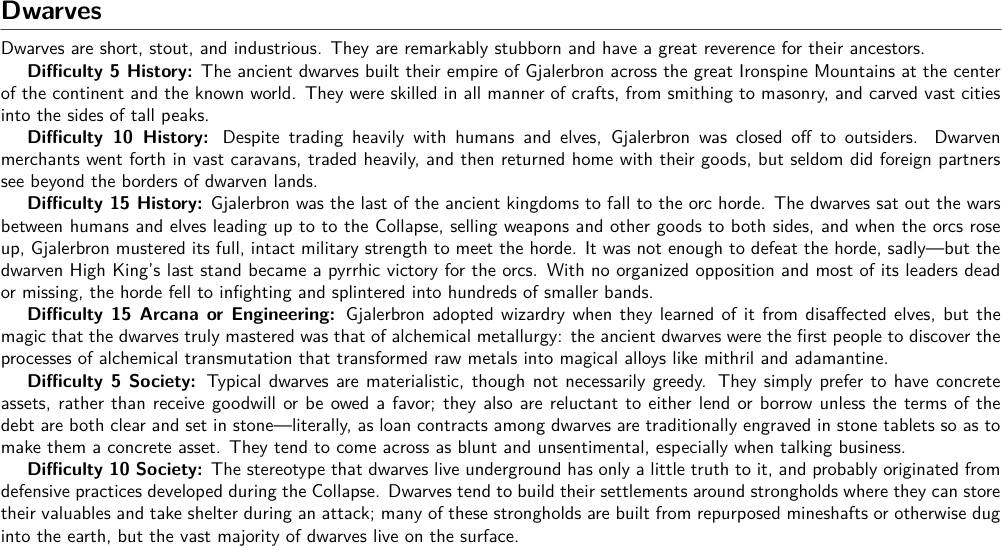
The first paragraph here (which doesn’t have an associated Difficulty) is common knowledge that an Aetrimonde character could be counted on to know about dwarves. The rest of this information is locked behind various skill checks, with the most esoteric information needing the best check results.
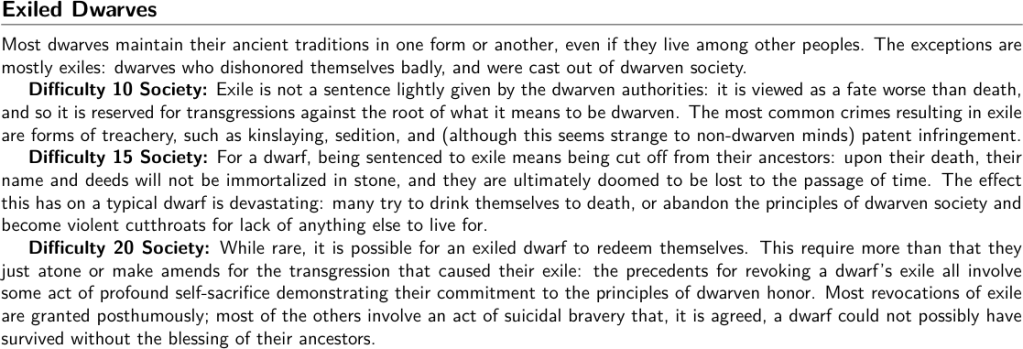
Some types of enemy are grouped into subsections with additional lore: the first enemy I’m about to show off is a Dwarf Smuggler, which are usually Exiled Dwarves (most dwarves being law-abiding to a fault). Exiled Dwarves have their own lore specific to them:
Dwarf Smuggler
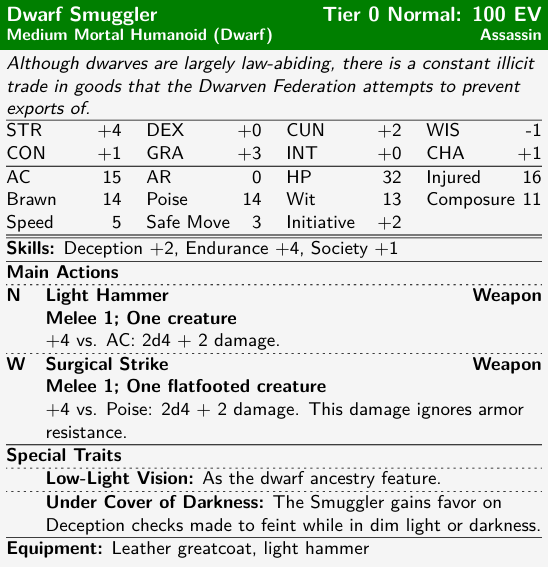
Without further ado, here’s the statblock for a Dwarf Smuggler. Since this is the first enemy I’m showing off, let me briefly touch on some of the parts of a monster entry in the style of Aetrimonde’s Bestiary:
- “Tier 0 Normal: 100 EV” conveys information for the GM about how much of a challenge the Dwarf Smuggler poses. “Tier 0” indicates that this creature is balanced around being a typical challenge for characters at level 0; “Normal” means that this monster is intended to be an equivalent to one PC, as opposed to Elite or Champion monsters that have hit points making them equivalent to two or five PCs, and make attacks to match. (I’ll show off some monsters like this in later posts.) “100 EV” is a numeric value that the GM can use to design an encounter: EV is short for “Encounter Value,” and 100 EV is the value appropriate to one level-0 PC.
- “Medium Mortal Humanoid (Dwarf)” conveys some basic information about the Dwarf Smuggler: how big it is (Medium, aka 1×1 squares on a grid map), where it comes from (Mortal, so hailing from the material world), its general shape (Humanoid), and in this case a subtype (Dwarf, indicating that yes, this creature has the same ancestry as many PCs).
- “Assassin” conveys information about the role the monster can fill in a combat encounter: in this case, being an Assassin means that the Dwarf Smuggler is fragile, but has some good attacks that it can use with setup time or favorable terrain. Other roles in the Bestiary include Soldier (has high defenses but not especially dangerous attacks), Protector (makes other monsters harder to kill), and Afflictor (can cause harmful effects to PCs that persist after the end of the encounter). Monsters can have multiple types.
The next three sections contain the Dwarf Smuggler’s abilities (enemies have the same eight as PCs), defenses and related values like hit points and speed (which again, work much like they do for PCs), and skills (If a skill is listed here, the enemy is considered trained in that skill; otherwise, it is untrained, and its skill modifier is just the relevant ability).
Following all of this basic information comes the real meat of the Dwarf Smuggler: the Actions it can take and its passive Special Traits. To make it easier for the GM to quickly parse a monster’s entry, actions are divided up by type, although the Dwarf Smuggler only has main actions.
- Light Hammer is the Dwarf Smuggler’s normal attack (as indicated by the “N” to the left of it). This is essentially equivalent to a PC’s normal attacks, simply adjusted to be a little less accurate and a little less damaging, because this is a Tier 0 enemy.
- Surgical Strike is a more powerful attack that the Dwarf Smuggler can only use in limited circumstances. It can nominally be used at will (denoted by the “W” to the left of it) but requires that the target be flatfooted, which could be the case if the target is flanked or the Smuggler is hidden from it, but it is an attack against Poise and its damage ignores armor. The Poise defense is typically a little bit lower (by about 2 points, on average) than AC, making Surgical Strike more accurate against the average PC, and it can be incredibly accurate against PCs with low DEX and GRA. It also synergizes with the Smuggler’s special traits…
- Low-Light Vision is a special trait lifted straight out of the Dwarf features in the Core Rulebook. And, as such, I’m not going to take up space writing out the rule here, especially as it will crop up in basically any Dwarf enemy’s statblock. I’m taking this approach with any ancestry or class feature that doesn’t have values specific to the enemy.
- Under Cover of Darkness is a more unique special trait, allowing the Dwarf Smuggler an improved chance to feint in darkened areas. Any character can feint, as a use of the Deception skill, so I’m not including the rules for that here, but the Smuggler’s Deception bonus is displayed as one of its trained skills.
The interaction between Surgical Strike, Low-Light Vision and Under Cover of Darkness–enabling the Dwarf Smuggler to fight very effectively in dark areas–is the first example of how I’m fulfilling my design goal of Combat as Puzzle: fighting Dwarf Smugglers is hard in dark areas, and becomes much easier if the PCs can shine a light on the Smugglers or draw them out of the darkness. That’s a simple puzzle, since the Smuggler isn’t intended to be a complicated enemy, but some other enemies have more complicated mechanics that make for more interesting puzzles.
Dwarf Gunner
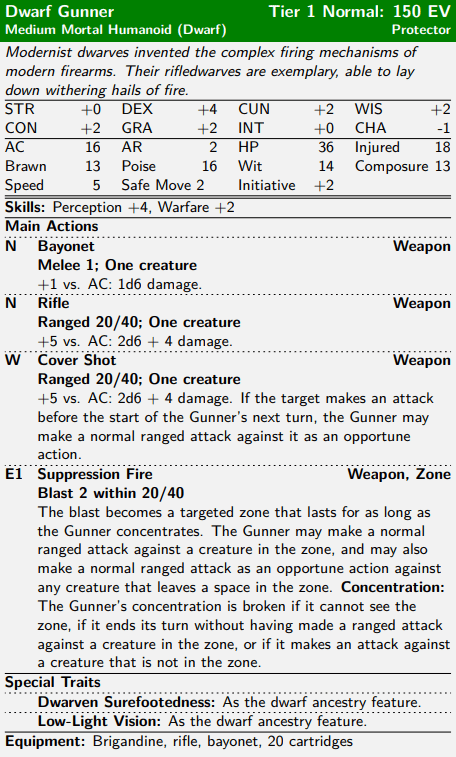
The Dwarf Gunner fills an entirely different role than the Smuggler. For one thing, the Gunner is a ranged attacker, but on top of that, it’s a Protector, centered around protecting other enemies from the PCs. It’s also a higher tier, which comes with better defenses, attacks, hit points, damage, and so on.
- The Gunner has two normal attacks: one melee (the Bayonet on its Rifle) and the other ranged (the Rifle itself). The Rifle attack is significantly better than the Bayonet attack, so one way to deal with the Gunner is to get a character close to it so that it can’t effectively use the Rifle.
- The Gunner’s Cover Shot action is one way that it can protect its allies: this functions a little bit like the Battlefield Challenge feature that Ragnvald has, adapted to work at range: if a Cover Shot attack hits, then if the target makes an attack on its next turn, the Gunner gets to shoot it.
- Cover Shot gets even nastier when coupled with the Gunner’s final action, Suppression Fire. It can only use this action once per encounter (as denoted by the “E1” to the left of it), but it’s a nasty action: it creates a zone, a persistent area on the battlefield, in which the Gunner can effectively make Rifle attacks as opportune strikes. Any creature moving around in the Suppression Fire zone (leaving its space, not just leaving the zone) will take an attack from the Gunner.
- The Gunner’s special traits are not particularly linked to its role as a Protector, but its Low-Light Vision lets it attack comfortably into dim light, and Dwarven Surefootedness lets it reduce how far it is pushed around.
The Dwarf Gunner can present more of a puzzle in combat, especially if it is backing up the right kinds of other enemies (like an entire squad of ranged attackers) or has favorable terrain (like a position with cover overlooking a chokepoint). A well-placed Suppression Fire can give an entire party of PCs second thoughts about trying to move up to melee range, but there are several ways to deal with it:
- The zone only lasts as long as the Gunner concentrates, so if the PCs can hit it with a powerful enough attack (dealing 9 points of damage) or apply any of the conditions that break concentration, that will put an end to the zone.
- The PCs could seek an alternate route around the zone and get up close to the Gunner. This is a way for a GM to give characters trained in Athletics or Acrobatics a chance to shine by placing difficult routes around a chokepoint. It also rewards teleportation powers, invisibility, and stealth.
- They could also tempt the Gunner to attack someone not in the zone, or use a power that blocks its line of sight to the zone.
- Finally, the PCs could just take cover and wait until the Gunner runs through the 5 shots in their rifle and has to reload.
Dwarf Stonespeaker
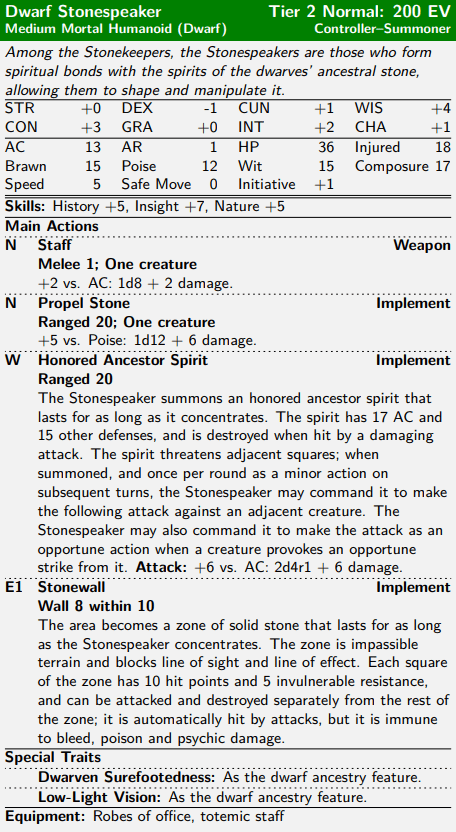
The Dwarf Stonespeaker is a Tier 2 enemy, which is about the most challenging foe Ragnvald should face at level 0. At 200 EV, two Stonespeakers would be nearly a match for a typical adventuring group, which would include Ragnvald and four allies. Two Dwarf Stonespeakers could be manageable, if a slightly difficult fight; three would be pushing it.
The Stonespeaker isn’t particularly tough, or particularly damaging in itself: its challenge comes from a combination of two factors.
- Firstly, it’s a Controller, meaning that its role is to impede the PCs and limit what they can do. In this case, the Stonespeaker has the Stonewall power, allowing it to raise a wall of solid stone; this could be used to split the party and allow the Stonekeeper and its allies to focus on one or two PCs at a time, or it could be used to block a path and give the Stonespeaker and allies time to attack the PCs from range. (It would be especially nasty if coupled with an enemy like the Dwarf Gunner…)
- Secondly, it’s also a Summoner, and can summon additional enemies to join the fight. In the Stonespeaker’s case, it can summon a single, relatively fragile spirit that lasts only as long as it concentrates…but it can do this repeatedly if the spirits get destroyed. The Stonespeaker effectively gets to attack twice on its subsequent turns.
The Stonespeaker’s one saving grace is that it can’t concentrate on both Stonewall and its Honored Ancestor Spirit at once, but in an encounter where it has allies, it may have enough time to use both.
The puzzles presented by the Stonespeaker depend on which of its powers it concentrates on, and how it uses them:
- If the Stonewall zone is used to split the party, it can be countered by one of the PCs trapped with the Stonespeaker attacking them to break concentration. Of course, if the Stonespeaker has allies, this might be a tricky proposition. The wall can also be broken through by attacks, but with the wall’s invulnerable resistance, that might take some doing: a single attack dealing 15 damage would do it, but it might easily take several characters hacking at it to break through.
- If the Stonewall zone is instead used to block an approach to the Stonespeaker and allies, the challenge boils down to using the terrain that the GM provides: if there are alternate routes, the PCs can use them, but it might also be possible to find an elevated position and shoot over the wall to break the Stonespeaker’s concentration.
- Finally, the Honored Ancestor Spirit poses a not-inconsiderable danger: its attacks deal good damage, it can make opportune strikes, and it can help the Stonespeaker or its allies flank a PC. It can be destroyed by an attack, but this means diverting an attack away from other enemies, and the Stonespeaker can always re-summon it.
A Note on Powers
These dwarf enemies don’t just draw from the dwarf ancestry: many of their powers are available to PCs, too. Surgical Strike, Cover Shot, and Suppression Fire are all available to Martial classes, while Propel Stone and Stonewall are available to Spiritual classes (like the Skinchanger sample character I’m starting work on). The Honored Ancestor Spirit is not exactly a power available to PCs, but it comes close: the main difference between it and certain Spiritual summoning powers is that it has a different damage die implying that it attacks using a warhammer.
Up Next
Now that I’ve established some context by introducing these PC-like enemies, my next Bestiary post will cover some stranger enemies. If you want to see more of a particular type of enemy, let me know in the poll above!
 Aetrimonde
Leave a comment