
Aetrimonde supports enemies that are not just a one-to-one equivalent to a PC of an appropriate level. I’ll cover all of these types eventually, but today I’m going to focus on mooks: these are enemies designed to be used in great numbers, without overwhelming either the PCs or the GM who has to run all of them.
Some of the mooks I’m using as examples today are undead, and I’ll be using more undead as examples in later posts. Let me know what kind of undead you’d like to see more of in later posts!
Mook Rules
Mooks are built differently than normal enemies to minimize how much mental load they place on a GM:
- 5 mooks are equivalent to a single normal monster of the same tier.
- Mooks do not have hit points. Instead, they have a Threshold value, and they are killed or destroyed when they take that much damage from an attack, or if they take that much damage from any other source and subsequently fail a recovery roll.
- The Threshold value is calibrated to be between 1/5 and 1/4 of an equivalent normal enemy’s hit points. This means that 5 mooks will be destroyed by 5 typical sources of damage, just like a normal enemy.
- Mooks have only normal and at-will actions, so there is no need to track which powers they have used or what resources they have expended.
- A mook will deal the same damage as a normal enemy’s at-will actions. 5 mooks will initially do 5 times the damage of a normal enemy, but their collective damage will drop rapidly as they take damage and are eliminated, especially if the PCs use area attacks to take out several at once. Between this and not having higher-damage, limited-use powers, the total damage 5 mooks can do before being eliminated is roughly the same as a single normal enemy.
- The only bookkeeping a GM has to do for mooks is to keep track of what conditions have been applied to them, and since many effects that would apply a condition would kill the mook outright with damage, this becomes less of a chore.
Minions in D&D 4e
D&D 4e implemented a kind of enemy called minions to fill a similar niche to my mooks, but minions had a few flaws from my perspective:
- They were destroyed by taking any amount of damage, no matter how small, and never took damage from missed attacks. This made them frankly trivial to clear out with any power that created damaging areas, no matter how little damage it dealt.
- They also did only a small, fixed amount of damage with their attacks. This removed the suspense of rolling for damage, although not having to roll did slightly speed up combat.
- Minion was treated as a role in and of itself, and so there were no Brute minions or Assassin minions. All minions therefore felt much the same in combat. I have instead created guidelines on how to adjust a Normal monster of any role to create a mook of the same role.
Now let’s take a look at a few mooks:
Ghoul Scavenger
I’ve already showed off the Ghoul ancestry for PCs, and this gives me an opportunity to show off how some PC ancestry features would be adapted for a mook.
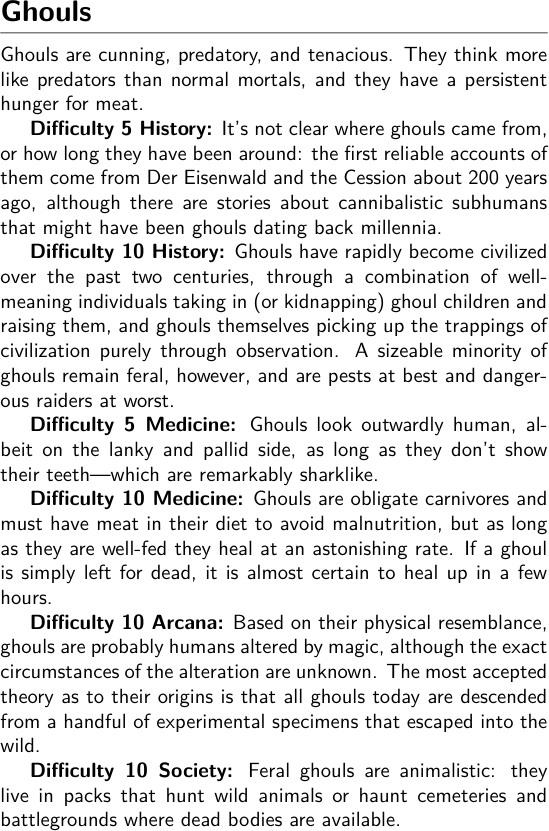
Like the section on dwarves, the Bestiary section on ghouls contains some additional lore building on what the core rulebook presents PCs with. The Ghoul Scavenger is a feral ghoul as described in this lore: poorly clad in reeking skins, attacking with its mouthful of fangs, and no less dangerous for it. Its role is Brute, indicating that it has relatively poor defenses but loads of hit points, and can do high damage in melee.
The Ghoul Scavenger indeed has mediocre defenses. And while mooks don’t have hit points, it has a relatively high Threshold of 8, meaning that a typical damage source (1d8 + 4) will fail to kill it more than a third of the time: this gives it the toughness of a Brute.
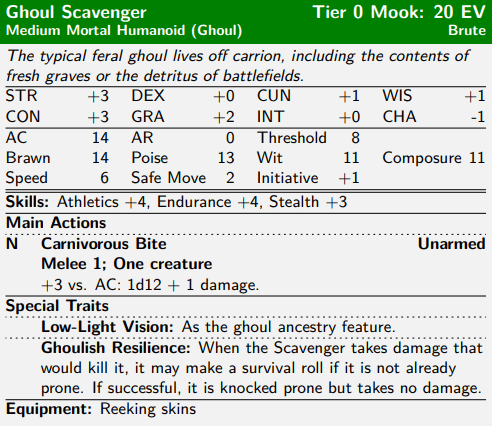
All three of the Ghoul Scavenger’s actions and special traits are lifted directly from the ghoul ancestry:
- Carnivorous Bite is the Scavenger’s normal attack, and is what gives it the high melee damage making it a Brute.
- Low-Light Vision is another ghoul feature that doesn’t need explanation in its stat block.
- Ghoulish Resilience is a twist on the Ghoulish Regeneration and Ghoulish Tenacity ancestry features, which would be problematic if given to a mook: the GM would have to track whether each mook had used Ghoulish Tenacity, and would also have to make survival rolls for each one to make use of Ghoulish Regeneration. Ghoulish Resilience captures the essence of these features, which is that a ghoul has a good chance of surviving a lethal blow and standing up again on their next turn, and does it without requiring the GM to track anything other than prone-ness.
Undead Mooks
One great application of the mook rules is for undead mooks: this makes it possible to run the classic “attacked by a horde of undead” encounter. So I think this is a great time to introduce the rules for Aetrimonde’s undead, and then introduce a couple of undead mooks:
- Undead are not living creatures and do not need to eat, drink, breathe, or sleep.
- Undead are immune to bleed and poison damage.
- When critically hit, undead do not suffer critical damage, although damage is still maximized.
- Undead are destroyed as soon as they are reduced to 0 or fewer hit points, rather than entering the dying state.
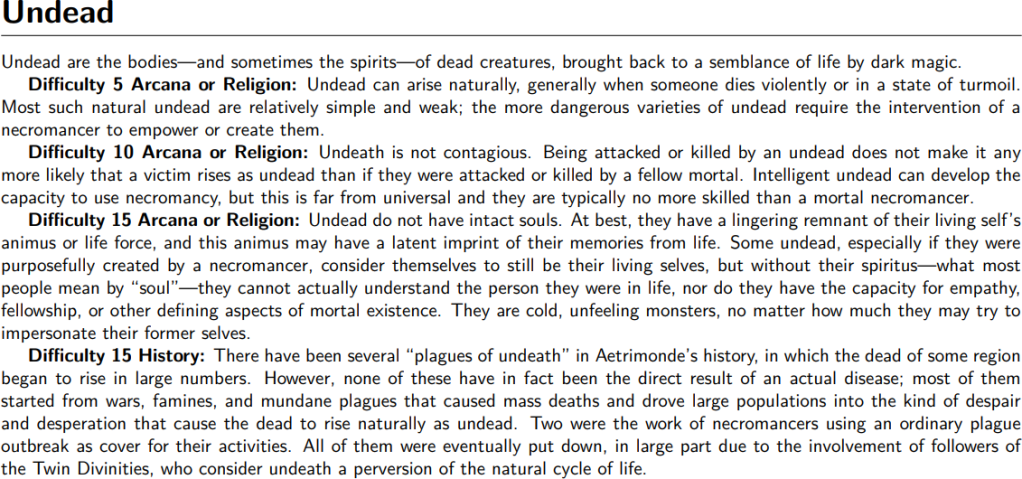
Undead also have their own lore section:
Zombie Rotter
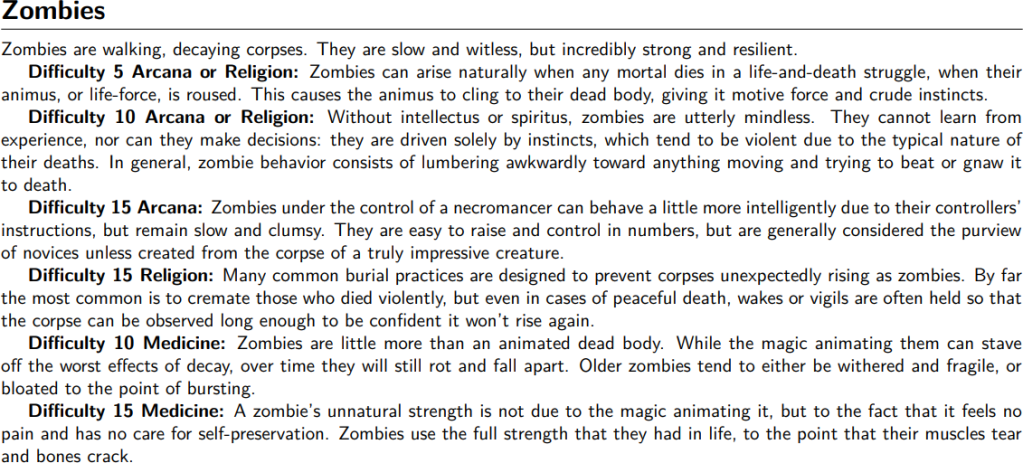
First off, there is of course some additional lore about zombies:
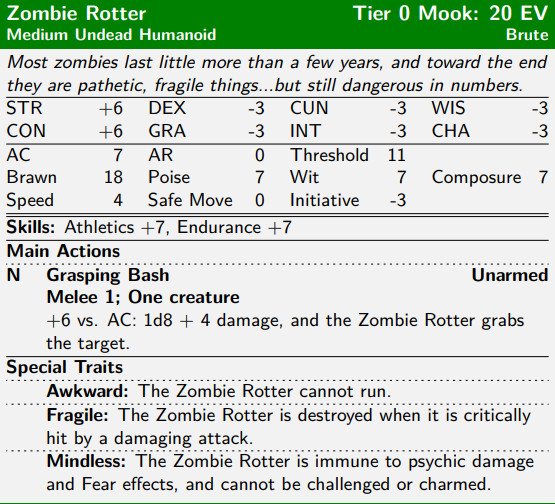
The Zombie Rotter is another Brute mook like the Ghoul Scavenger, but taken to the extreme. It has absolutely atrocious defenses, with the exception of Brawn, and an incredible Threshold of 11 (meaning it would survive a typical damage source 75% of the time). While its damage isn’t actually that much greater than the Ghoul Scavenger’s (8.5 instead of 7.5), its normal attack lets it grab enemies.
And, if that weren’t enough, it has the added advantage that it is mindless, and thus immune to a whole slew of psychic damage and control effects.
The only reason that the Zombie Rotter doesn’t have a higher Tier is that it has downsides to go with these strengths: it’s slow, it can’t run, and it’s destroyed by any damaging critical hit (even if the damage from that wouldn’t break its Threshold, which is entirely possible with weaker attacks at low levels).
In short, the Zombie Rotter is an absolute terror in close quarters. The Bestiary provides the following advice on actually using the Zombie Rotter and other zombies:
To ensure that their weaknesses come into play, ensure that encounters with zombies allow the PCs to engage on their terms. This could mean giving the PCs a fortified position that it will take the zombies time to break into or a line of retreat so that they can turn the fight into a fighting withdrawal, or just starting the encounter with the zombies far away so that the PCs have a few rounds to thin them out with ranged attacks.
The Zombie Rotter doesn’t have a major puzzle element to it, but it pairs nicely with other zombies (who I’ll show off in another post…), who become a lot more threatening to grabbed or otherwise impeded characters. A horde of Rotters with other zombies mixed in can thus form an absolutely tense encounter.
Skeletal Rattler
Skeletons animated by necromancy are an entirely different kind of threat than zombies. And they do have to be purposefully created: with no flesh left on their bones, the only way to make an animated skeleton is with magic.
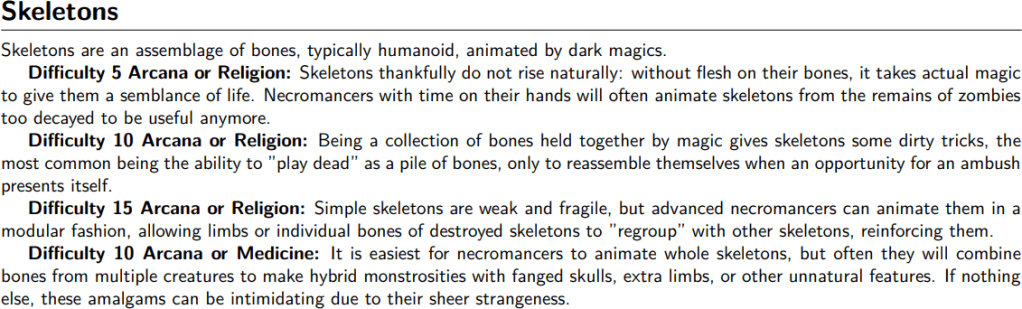
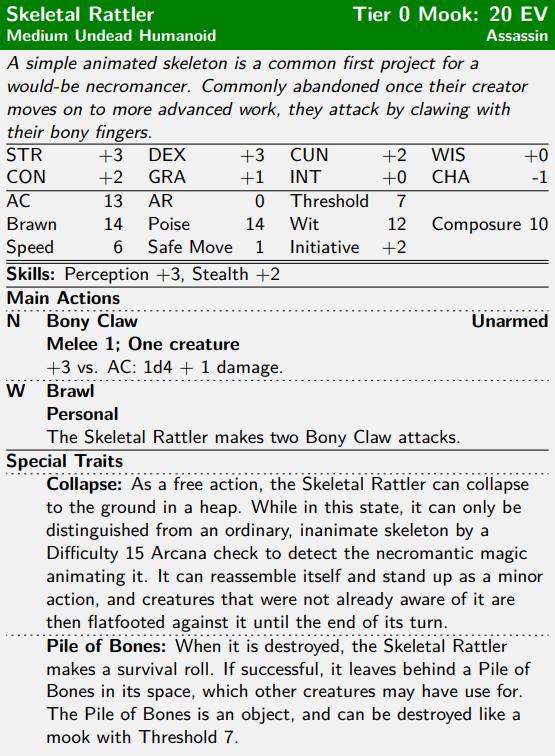
The Skeletal Rattler is the simplest, weakest skeletal enemy in the Bestiary. Not nearly as durable or as strong as a zombie, it is a subtler enemy with a couple of tricks to pull. The first is that it can ambush the PCs by pretending to be an inanimate skeleton, or blending into a heap of bones (like might be found in a crypt or abattoir). This is what makes it an Assassin.
But the second of the Rattler’s tricks is that, when destroyed, it leaves behind a Pile of Bones that other enemies (primarily other skeletons) can use. Without spoiling those other skeletal enemies just yet, various of them can use Piles of Bones to gain temporary hit points, bonuses to AC, and extra attacks, or can just reanimate Piles of Bones into more Skeletal Rattlers.
By themselves, Skeletal Rattlers don’t pose much of a threat. But in an encounter with other, more powerful skeletal enemies, PCs will need to be careful about killing them off: wiping out a horde of Skeletal Rattlers will leave a lot of resources lying around for the other skeletons to use. The PCs can of course just let this happen, but they could also try to dispose of the Rattlers by, say, tossing them off of cliffs, or throwing them into industrial machinery that would destroy the Piles of Bones they leave behind. Or, they could devote some attacks to destroying the Piles of Bones as they create them.
Up Next
Skeletons and zombies aren’t the only undead in Aetrimonde. I’ll eventually need to show off some enemies of the other “special” types that are designed to be equivalent to more than one PC; and there are enough undead of these types that I think they’d be great examples. So let me know in the poll up top what kind of undead you’d like to see more of!
 Aetrimonde
Leave a comment