
I recently wrote about elite enemies, who are designed to feel like more of a challenge than your typical enemy. Elites make for good mini-bosses, foes who pose an outsized threat and who the PCs can feel satisfaction in defeating, but who don’t feel like they deserve a name and plot significance.
Today, I’m going to write about Champion enemies, who do fill that role: Champions are designed to fight an entire party of 4-6 PCs by themselves, and they work very well as the ultimate villain of an adventure or campaign arc, or even an entire campaign. Dragons are Champions, as are many powerful demons, faeries, and so on, but for today (Halloween!) I’ll be focusing on some undead.
Design Goals: Why Champions?
In my earlier post on Elite enemies, I mentioned some of the reasons why it doesn’t work well to just use a higher-level enemy as an equivalent to two normal enemies: narratively, they don’t really feel like a more powerful enemy, and mechanically, they’re too easy to gang up on. The same concepts apply to the niche I’m filling with Champions, and to an even greater extent.
Narratively, I want a Champion to feel like it’s actually fighting the entire party at once, not just the one character that manages to get its attention. This is a narrative problem with a mechanical solution: Champions need to be able to attack several characters per round, and they need to be mechanically encouraged (if not actually forced) to spread these attacks around rather than piling them all on one PC.
Mechanically, the big problem with having a single Champion fight an entire party is that they will be incredibly vulnerable to conditions, even moreso than Elites. A normal enemy is usually about 1/5 of the enemy forces in an encounter, and stunning it leaves the other 4/5 free to act; a Champion is the entire encounter, and stunning it completely neuters the encounter. So, Champions need to have ways to shake off conditions so that they still pose a threat to PCs with access to stuns and other severe conditions.
With that in mind, here’s my implementation of Champions:
- Champions have five times the EV and four times the hit points of an equivalent normal enemy.
- Champions make recovery rolls at the start of their turns instead of the end. This means that while recoverable effects can impede them until the start of their turns like usual, they are less likely to apply during a Champion’s turn.
- Champions should also suffer reduced effects from, or be outright immune to, a selection of common conditions.
- Champions should be able to do 4-6 things per round, and 1-2 of them should be when it’s not their turn. Like Elites, they should generally only be able to use one limited-use action per round, but they should definitely have more than one such action, to be spaced out throughout an encounter.
- Champions should change how they fight during an encounter. This can be as simple as becoming enraged and dealing increased damage with reduced defenses once it is injured, or as complex as gaining new actions and losing others as the PCs whittle down its health. A Champion is going to take the PCs multiple rounds to defeat; changing up how it fights prevents the fight from becoming tedious.
- Champions should have ways to interact with them tactically, like interruptible actions, ways to remove their condition immunities, or actions they are forced to perform if the PCs meet certain conditions.
Calibrating Hit Points and Actions
You may be asking why Champions have four times the hit points of a normal enemy if they’re supposed to be equivalent to five normal enemies. And, for that matter, why they can do only 4-6 things per round if a normal enemy can do 1-2.
Part of the answer is that this is just received wisdom: D&D 4e contained monsters filling a similar niche to Champions, called Solos, and in the first Monster Manual for 4e, Solos had 5 times the hit points of a normal enemy. This proved to be too much: fights against Solos dragged on and were more tedious than intense. Later Monster Manuals (and errata to the first) reduced Solo hit points and increased their damage to compensate.
But let’s look at this mathematically, too: in an earlier post I did some math to see what would happen if you increased the number of enemies in an encounter or increased their tier. As I did there, let’s say that a single normal enemy (call it a dragonspawn) takes the PCs r rounds to defeat and does d damage per round until defeated. If we have five dragonspawn that the PCs attack and defeat one after another, their total damage done will be 15rd. If we instead have a single Champion dragon with 5 times the hit points and 5 times the damage (it will take 5r rounds to be defeated and deal 5d damage per round), its total damage done will be 25rd.
So we need to reduce Champions’ hit points and damage slightly. At 4 times normal hit points, and doing around 3-4 times the damage, this dragon will mathematically do around 12rd to 16rd damage, compared to the 15rd damage of the dragonspawn, which is in the right range.
With all that in mind, let’s look at some Champions!
Skeletal Monstrosity
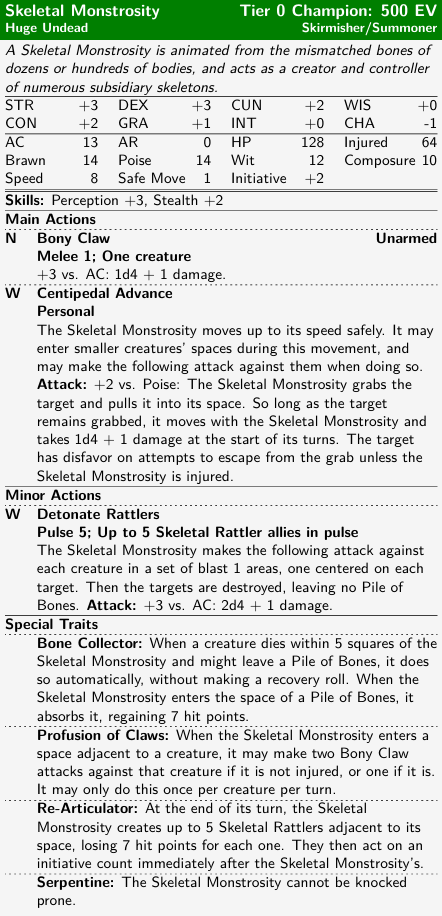
The Skeletal Monstrosity is the sort of monster that makes me wish I’d already found an artist for the Bestiary, because it’s difficult to describe. But, in the absence of a commissioned illustration, I’ll do my best to paint a picture with words: a Skeletal Monstrosity is a vaguely centipedal assemblage of the bones of dozens, if not hundreds, of victims…and it can split off parts of that mass and articulate them into other skeletons under its control.
I think this is the first Skirmisher enemy I’ve shown; as a reminder, Skirmishers are especially mobile, but not especially dangerous. The Skeletal Monstrosity fits this perfectly: Profusion of Claws allows it to attack each creature it moves adjacent to during a turn (twice, until it’s injured!) and Centipedal Advance allows it to move safely and, if it wants, overrun and engulf PCs.
The combination of Bone Collector and Re-Articulator allows the Skeletal Monstrosity to create tons of Skeletal Rattler allies, then, once they’ve been destroyed, run over and collect their Piles of Bones in order to re-use them. If I were the GM running a Skeletal Monstrosity (and I have been!), I’d have it simply running around the battlefield, collecting Piles of Bones and making attacks against any PCs it happened to pass by in the process, then popping out a new set of Rattlers. The grab attack that’s part of Centipedal Advance is a great way to separate a PC from their allies, but otherwise not crucial to use.
Of course, the fact that Skeletal Rattlers represent part of the Skeletal Monstrosity’s hit points can put a damper on things. At 128 hit points, the Monstrosity can only create 9 Rattlers without its hit points dropping into injured range; once it’s taken some damage from the PCs, it may want to limit how many Skeletal Rattlers it has out. (For a more challenging encounter, I would include a bunch of pre-existing Skeletal Rattlers that don’t count against the Monstrosity’s initial hit points.) And since Detonate Rattlers denies the Monstrosity the option of reabsorbing its Rattlers, it is something of a desperation move, to be used only if the PCs have really bunched up and allowed the Rattlers to surround them, so that it can catch several PCs in overlapping blasts.
The PCs can interact tactically with the Skeletal Monstrosity in a couple of fairly simple ways:
- Destroying Piles of Bones before the Monstrosity can reabsorb them prevents it from regaining the hit points it used to create Rattlers. If the PCs can catch several in an area attack, it might be worthwhile even if it means not attacking the Monstrosity that turn.
- Getting the Monstrosity below half hit points and injured makes it easier for any PCs it has engulfed to escape from it. It might therefore be worth a focused effort to bring its hit points down if a vulnerable ally is in its grasp.
Zombie Giant
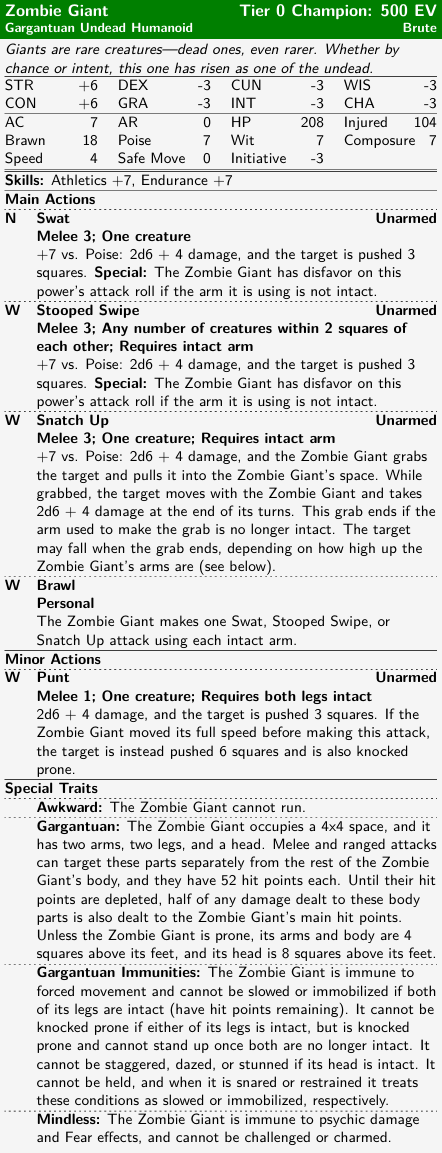
The next Champion I’ll show off is the Zombie Giant, which is…basically what it says on the tin. I’ve previously shown off a variety of zombies, and this one has all of the same basic qualities: slow, awkward, mindless, and incredibly strong and tough.
What sets the Zombie Giant apart, and prevents it from just being an upgrade of the Zombie Ogre, is that it’s Gargantuan: this is a size category beyond the usual scale (Tiny, Small, Medium, Large, Huge, Colossal), for creatures that are so big that their body parts can be targeted independently. The Zombie Giant is actually on the small size for a Gargantuan, occupying the same space as a Colossal creature, but it has arms, legs, and a head that can be attacked separately from the rest of its body and have their own hit points. Half of any damage dealt to these body parts carries through to the Zombie Giant’s main hit points, so although attacking them isn’t the most efficient way of bringing it down, there are reasons to do so as I’ll get to in a moment.
Because it’s a zombie, I’ve chosen to give the Zombie Giant relatively few actions that it can take: its Brawl action lets it attack once with each arm, and it can Punt a creature as a minor action if both legs are intact. So that’s only 3 things it can do per round, and none of them are off of its turn…doesn’t that violate the guidelines I laid out above? Technically, yes, but those are just guidelines, after all. I want the Zombie Giant to still feel like a zombie, and giving it actions to take when it’s not its turn runs counter to that. I’ve compensated in a couple of ways: firstly, all of the Zombie Giant’s actions deal relatively high damage, just due to its size, and secondly, its Snatch Up action allows it to keep dealing damage so long as a creature remains in its grasp. Between those factors, I think that this works out.
How can PCs interact tactically with the Zombie Giant? Well, several ways, but they largely revolve around its Gargantuan-ness.
- Due to its sheer height, melee-focused characters may have no way to attack the Zombie Giant’s body, which is 4 squares off the ground. They could conceivably climb to the top of some convenient terrain (like, say, the roof of a 2-story house…), but if there isn’t any available, the PCs can instead focus fire on the Zombie Giant’s legs until it comes crashing to the ground and brings its torso into range.
- The Zombie Giant loses attacks as its various body parts are damaged: once either of its legs is no longer intact, it loses Punt, and once either of its arms is no longer intact, it loses Brawl (or rather, Brawl provides no benefit over Swat, Stooped Swipe, or Snatch Up). This allows the PCs to prioritize specific body parts based on how much difficulty the related attacks are giving them.
- Damaging certain body parts also removes some of the Zombie Giant’s immunities: taking out a leg makes it susceptible to slow and immobilize effects, and taking out its head allows it to be staggered, dazed, and stunned. If the PCs have access to powers applying these conditions, they may want to take out one or two body parts so that they can make use of them.
- Finally, if a PC has been Snatched Up and is currently being squeezed to death, one way to get them out of the grab is to destroy the arm in question. It might also help to take out the Zombie Giant’s legs first, because otherwise the PC might fall from 4 squares up, but taking a bit of falling damage is still probably better than taking further damage from remaining in the zombie’s grasp.
Vampire Elder
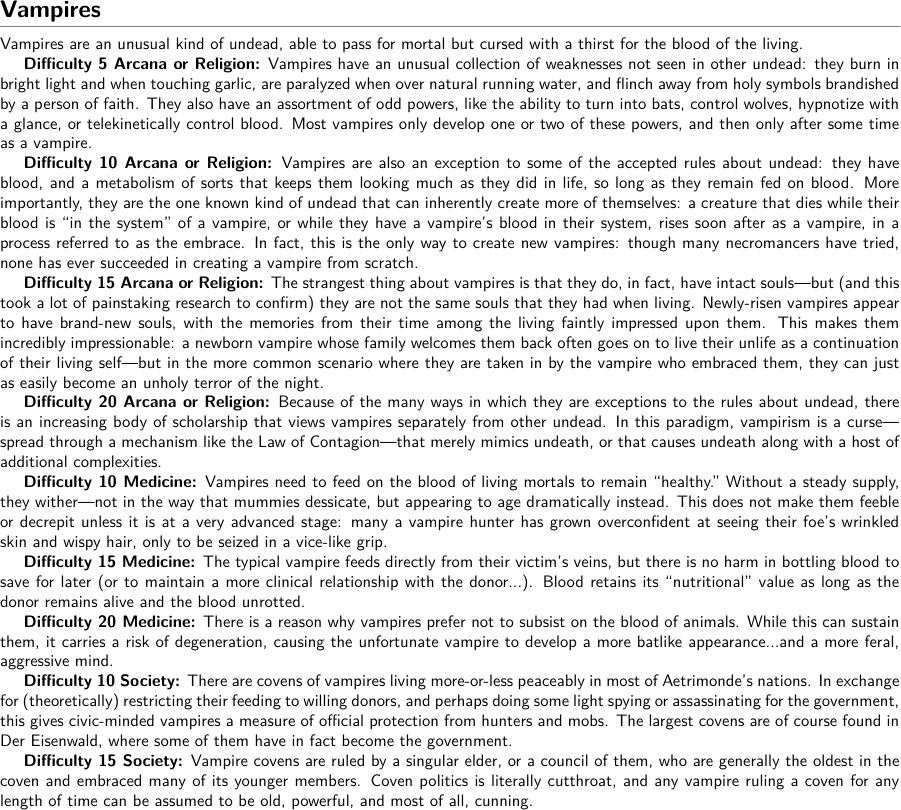
Last but decidedly not least, I think that now is a great time to show you what Valdo the Bat-Eater will be up against when he returns to Der Eisenwald to resume his vampire hunting. Aetrimonde’s vampires have a ton of lore behind them, which I’ll introduce here:
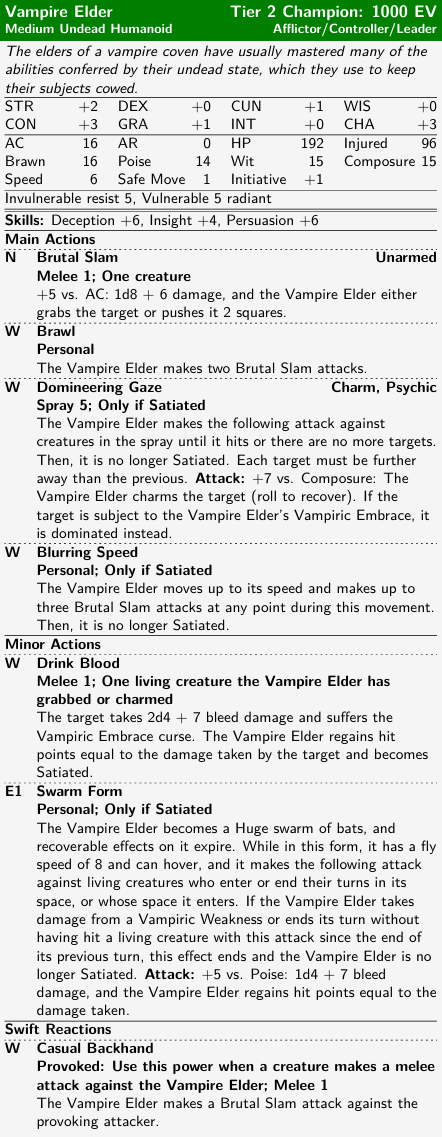
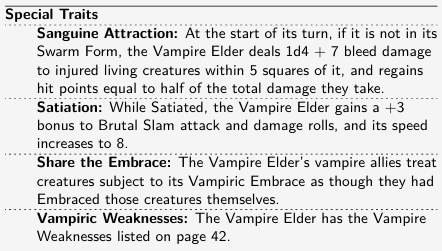
The Vampire Elder is the leader of a vampire coven, and Valdo’s hunt will inevitably pit him against at least one of these terrors of the night. It has a couple of tiers on the first two Champions I showed here, and it has a big enough bag of tricks that its statblock rolls over onto a second page.
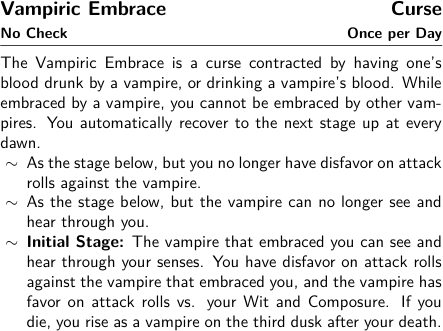
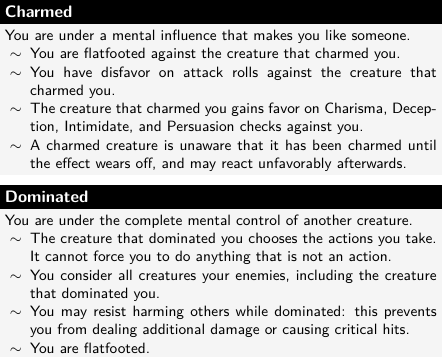
This is the most complicated enemy I’ve revealed yet, and it has three roles to account for that. The Afflictor role comes from the Vampire Elder’s ability to both inflict and exploit the Vampiric Embrace curse. The Elder’s Drink Blood action inflicts Vampiric Embrace, which by itself lets the Elder see through its victims’ eyes, makes it easier for it to compel them, and makes it harder for them to attack the Elder. But this, coupled with the Domineering Gaze ability, lets the Elder outright dominate PCs, with the effects shown on the right. That is what gives the Elder its Controller role. Finally, the Share the Embrace special quality lets the Elder’s vampire allies (the subordinate vampires of its coven) exploit the Elder’s Vampiric Embrace as their own, working around a restriction of the Embrace.
Thankfully, the Vampire Elder’s nastiest trick (Domineering Gaze) is one of several abilities that it can only use if Satiated. For each use of these abilities, the Elder must first become Satiated by draining a living creature’s blood. One of the puzzle in a fight with the Elder will revolve around keeping it from drinking blood, whether that means staying out of its grip, resisting the Domineering Gaze…or making preparations before the fight, like bathing in garlic oil.
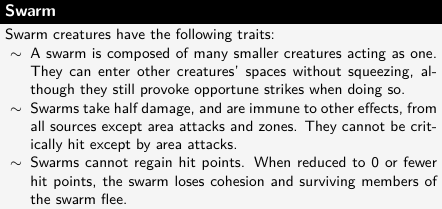
The Elder’s other tricks requiring Satiation include Blurring Speed, letting it rush through the midst of the PCs and send them flying, and Swarm Form, allowing it to transform into a swarm of blood-drinking bats. Swarm Form deserves some explanation: as a swarm, the Elder can fly through creatures’ spaces, provoking an opportune strike and taking the opportunity to make an attack of its own. It loses most of its other abilities in this form, but in exchange it takes reduced damage from most sources (a trait shared by all swarms) and its attacks heal it.
In fact, the Vampire Elder has a huge variety of ways to regain hit points, including its Sanguine Attraction trait that allows it to drain blood from injured (and therefore presumably bleeding) living creatures nearby. A second piece of the puzzle when fighting an Elder is preventing it from healing: this means spreading out so that it cannot attack as many creatures at once in Swarm Form, and staying away from it when injured to avoid healing it (and taking damage) via Sanguine Attraction.
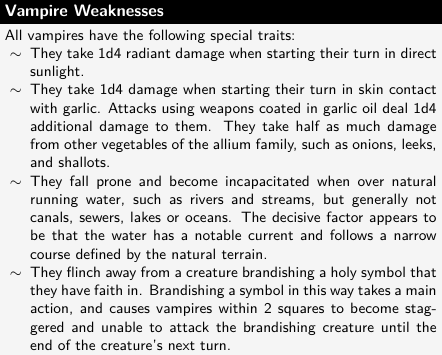
Of course, no vampire is complete without the traditional weaknesses, and Aetrimonde’s vampires are no exception. Vampire Weaknesses are shared by all vampires, and therefore not listed individually in every vampire’s statblock. These weaknesses help to make fighting vampires more manageable in light of their many, many strengths: prepared parties will go into an encounter with a vampire carrying ropes of garlic and festooned with holy symbols, and vampires’ weaknesses to daylight and running water can offer the PCs strategic options as well.
Up Next
And with that, my October undead extravaganza runs to a close. Enjoy your Halloween, and check back in next week for the start of my November theme: the Autumn Court of Faerie.
 Aetrimonde
Leave a comment