
In today’s Bestiary post, I’m going to be covering some of the Autumn Court’s allies, and a force straight out of fairy tale and folklore: the Wild Hunt!
Wild Hunt Lore
The Wild Hunt, in our world, is a folkloric motif: a chase by a group of supernatural hunters, often led by a historical or mythological figure, associated with ill tidings. I’ve designed Aetrimonde’s Wild Hunt to be a more direct threat: they ride forth in the autumn, often at the direction of the Autumn Court, in search of worthy prey…but they will ride down and slay anyone with the misfortune to cross their path.
Wild Hunt Lore Details
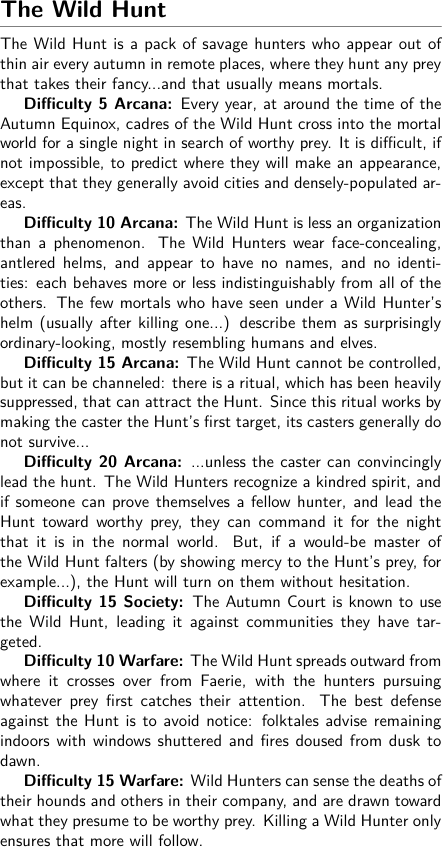
The Wild Hunt is intended to be a versatile, self-contained, drop-in villain group: faceless, identityless, and more of a force than an organization. They can be filler, with the PCs just happening to be in the wrong place at the wrong time of autumn, they can be the villains of a short adventure where the PCs foresee their coming and need to protect an isolated village on the night of their hunt, or they can be a recurring threat under the command of another villain, like the Autumn Court.
Because of this, I’ve designed the enemies associated with the Wild Hunt to work with each other (sort of like the mummies I revealed a while back). Their actions and traits of each type of Wild Hunt enemy interact with those of the others, because I envision all the different types being used together (rather than by themselves, or scattered among non-Wild-Hunt enemies).
Hound of the Wild Hunt
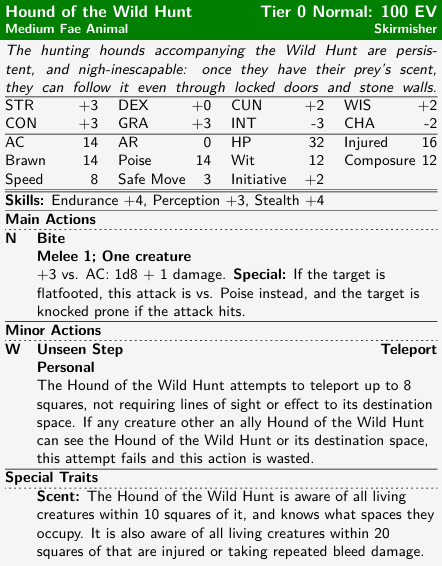
The Wild Hunt uses hunting dogs, but these are no mere mortal hounds: they can pass unseen around their prey, stalking them from the shadows…and passing through solid stone to pursue the Hunt’s prey.
Hounds of the Wild Hunt are Skirmishers, which in their case is expressed through the Unseen Step ability (which may be familiar if you’ve read one of my Apocrypha posts). This ability lets the Hounds teleport quite a long distance, even to places they can’t see, and even with solid objects in the way…as long as nobody can see them.
I have used Unseen Step to ratchet up paranoia among the PCs: in the opening stages of an adventure featuring the Wild Hunt, I made it clear that something was stalking the woods surrounding a village that the PCs had stopped in. Then, once they were drawn in and investigating, an NPC fled past them in a panic and barred himself inside a solid building, only for there to be screaming, growling and crashing noises from inside. Once the PCs forced their way in (not made easy by the barred door and other protections) and found the unfortunate victim, there was no sign of the assailant…and no other exits from the building. From that point on, I repeatedly described the PCs with high Perception sensing that they were being watched, and even hearing things moving around them in the underbrush, only to find nothing when they traipsed over to investigate…right up until they chased the presence into a ravine, and an entire pack of hounds appeared behind them.
The Hounds of the Wild Hunt also have Bite, a frankly rather poor attack that becomes much better against flatfooted enemies, and Scent, a trait ensuring that the Hounds can neither be hidden from nor ambushed. Both are shared with ordinary mortal hounds.
Wild Hunter and Steed of the Wild Hunt
The next enemy I’m revealing today is actually a twofer, because it’s the first example of Cavalry enemies who fight atop steeds. And in order to explain this, I’ll need to present the Mounted Combat rules included in the GM Handbook (not the Core Rulebook, because mounted combat is sufficiently niche that most players will not need to deal with it).
Mounted Combat Rules
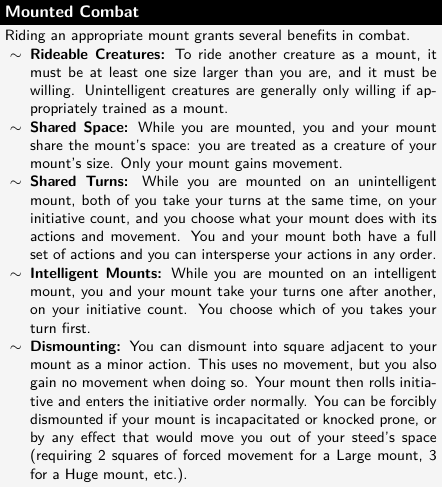
Mounted combat can be a serious force-multiplier for PCs and enemies alike: it allows a character to combine their turn with that of their mount, letting them do twice as much. Of course, it doesn’t work in a lot of places where you can’t easily bring a mount, like cramped dungeons, the upper floors of buildings, or royal throne rooms. So for mounted combat to be a large part of a campaign would require planning and cooperation on the part of the GM…but it can be fun if handled well!
Cavalry enemies are really just two enemies, an enemy and their mount, who take their turns together. Both count towards an encounter’s EV (just as a PC’s mount counts, too). In the case of the Wild Hunters, they ride on Steeds of the Wild Hunt, which look like horses…but are uncommonly willing to eat flesh.
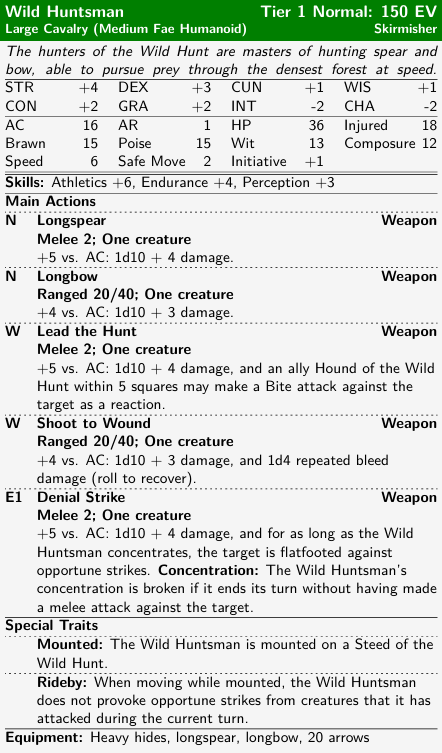
The Wild Huntsman itself is another Skirmisher like the Hounds, but with much more flexibility: it has both melee and ranged attacks, allowing it to fight at any range, and its attacks are excellent for supporting a pack of Hounds:
- Lead the Hunt allows the Huntsman to flank a PC with one of their Hounds, and let both of them get off a (much better, thanks to flanking) attack.
- Shoot to Wound causes creatures to start bleeding, so that the Hounds can Scent them further away.
- Denial Strike locks down a PC, making them flatfooted against opportune strikes…such as they might provoke when trying to get away from a pack of Hounds that have surrounded them. And since the Hounds can knock prone when attacking a flatfooted creature, this is especially nasty…
All this is before considering the benefits of being mounted. Rideby lets the Huntsman move through a melee while taking minimal opportune strikes, so long as they attack their primary target first. And then, there’s the bloodthirsty steed…
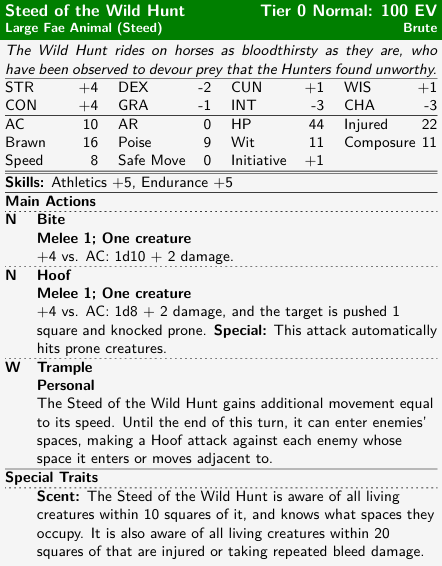
The Steed of the Wild Hunt is a bit nastier than your average warhorse, thanks to its Bite attack and Scent ability. But the meat of it is the Trample ability, shared by most warhorses. This allows the Steed to plow through a crowd of enemies, knocking them aside like ninepins or crushing them underhoof. So, a Wild Huntsman’s typical turn might look something like this:
- Spur the Steed to Trample, providing a total of 16 squares of movement.
- Move toward a priority target, Trampling any enemies in the way.
- Make a Lead the Hunt or Denial Strike attack against the priority target.
- Move away from the priority target, Trampling any enemies still in the way.
And if the Steed’s Hoof attacks manage to knock any enemies prone…all the better for the Hounds of the Wild Hunt, who can easily pounce on the fallen.
The obvious solution to a Wild Huntsman, for a PC, is to get them off their Steed. This is actually fairly straightforward: anything causing at least 2 squares of forced movement will do it. For that matter, the Steed itself is a big target, and could be shot out from under the Huntsman…which might be the better way of doing things, because if the Hunstman and Steed are separated, they can just act separately.
But then, there’s the really interesting option for a PC…which is to knock the Huntsman off of their Steed and then try to ride it. To make that work, I’d call for the PC to Grapple the Steed, and then hang on long enough to get their feet into the stirrups. But if they can pull it off, it’s exactly the kind of stunt that might get the Hunt to follow their command…
Up Next
Wrapping up this month of the Autumn Court, next week’s Bestiary post will present one of the Autumn Court proper: a Sidhe knave wielding the court’s magic…and capable of calling down the Wild Hunt.
In the meantime, keep an eye out for the next post on the creation of Gwynne, introducing the artificer class!
 Aetrimonde
Leave a comment