
In today’s post, wrapping up November’ series on the Autumn Court of Faerie, I’m going to at long last reveal an actual member of the Autumn Court!
The statblock I’m presenting here is representative of Knaves of Autumn, but there is a lot of variety: I highly recommend that if a Knave of Autumn (or any of the Courts) is going to be a recurring villain, a GM should give them some variant abilities separating them from the “generic” version. But before I get into the statblock, let me take a brief detour into the concept I based this Autumn Knave on:
Design Concept
I generally start designing major enemies (like Champion-tier ones) with three big-picture concepts. In the case of the Knave of Autumn, here are the three that I settled on when I sat down to brainstorm:
- Control of the Narrative: The Knave of Autumn is tied into the magic of Faerie: it is a focus for the plane’s narrative, and can draw mortals into the narrative against their will.
- Tarnished Glory: The Autumn Sidhe outwardly embrace an aesthetic of tarnished glory: they use glamour and illusion to garb themselves in ancient-looking armor and faded robes, and dwell in the crumbling ruins of grand edifices. Autumn’s Knaves weave this aesthetic into their Control of the Narrative: they have a palpable aura of venerable, ancient grace and wisdom, and it is difficult for mortals to bring themselves to oppose them.
- Vicious Killers: But, behind the glamour, Knaves of Autumn (and all the rest of the Court) are vicious killers. When they don’t get their way (when their Tarnished Glory fails to sway mortals to their side…), they abandon the glamour and unleash their inner savagery…including through any mortals who did succumb to their spell.
Next, with these three concepts in place, comes the general mechanics:
- Control of the Narrative is best represented through a Charm effect (Charmed creatures are flatfooted and have disfavor on attack rolls against their charmers) of some kind. And it should be passive, or at least, reactive: mortals fall under the Knave’s spell mainly just by being it its presence.
- Tarnished Glory gives me a more specific flavor for the Knave’s Charm effect: when a PC tries to attack the Knave, they are overcome with veneration for its ancient wisdom. This can be a swift reaction.
- Vicious Killers, however, suggests that the Knave should have a “mode change” midway through a fight, as it realizes that it won’t be able to bring the PCs entirely under its spell. So Tarnished Glory should work only until this mode change…but after the mode change, the Knave should be able to force some violent actions on its charmed creatures. (And in order to make it likely that it has some charmed creatures after the change, it should be difficult to shake off the charm effect, at least until the change.)
Now: all of these concepts form some interesting ideas for mechanics going into the Knave, but they’re all about passive and reactive mechanics. What should the Knave actually do with its turns?
The mode change between Tarnished Glory and Vicious Killers gives me a good concept here, too: before the change, the Knave should fight in the manner of a chivalrous, graceful knight…while afterward, it should more resemble a crazed killer. It should have melee attacks, and a different set of them in each phase.
And, since the mode change is forming so much of the Knave’s concept, the change itself should be a significant event during which the Knave transforms.
So let’s see how all of these ideas come together into a statblock:
Knave of Autumn
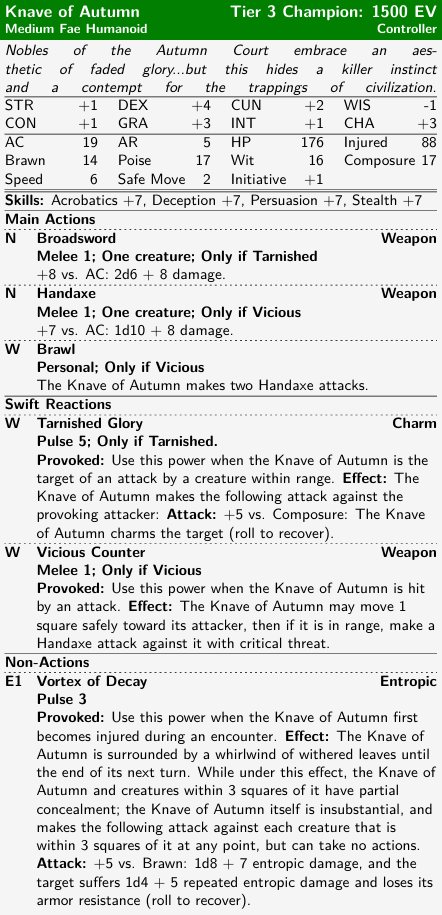
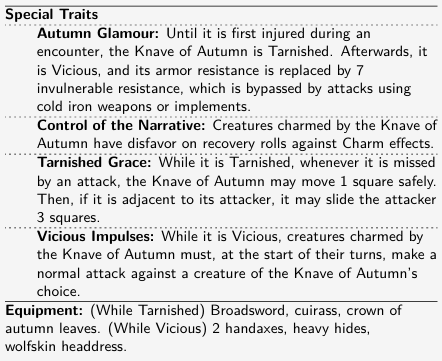
The biggest mechanics in the Knave of Autumn are Autumn Glamour and Vortex of Decay:
- Autumn Glamour both defines the two phases of a fight with the Knave (Tarnished vs. Vicious), and alters its defenses. In the earlier Tarnished phase, the Knave has high but tier-appropriate armor resistance of 5; in the Vicious phase, it has higher (and more useful) invulnerable resistance of 7, but it can be bypassed by cold iron weapons and implements, which a prepared groups of PCs can be counted on to have.
- Vortex of Decay provides a short transitory phase marking the change from Tarnished to Vicious. When it is first injured (reduced to half hit points) during a fight, the Knave erupts in a vortex of withered leaves: this conceals it from view while it transforms (and switches equipment), and it also becomes insubstantial (takes half damage except from area attacks). This lasts until the end of the Knave’s next turn, which allows it to move into the midst of the PCs and make the Vortex of Decay’s attack against several of them.
The Knave’s Charm ability has different effects in each stage:
- While Tarnished, the Knave can charm its attackers using Tarnished Glory, which as a swift reaction means that if the attacker is successfully charmed, its attack becomes less likely to hit.
- When it becomes Vicious, it can no longer charm attackers, but Vicious Instincts forces those it has already charmed to attack each other at the start of their turns until they break free of the charm effect.
- Control of the Narrative makes the Knave’s charm effects difficult to break out of, ensuring that Vicious Impulses has charmed PCs to work on.
The Knave also fights differently in its two phases:
- While Tarnished, it makes a single Broadsword attack on its turn, and can use Tarnished Grace to evade and reposition its attacker when missed by an attack.
- When Vicious, the Knave can make two Handaxe attacks on its turn, and a Vicious Counter attack when hit by an attack.
All in all, I think that the Autumn Knave does a good job of capturing the general concept I started with (vicious savagery behind a veneer of nobility), while also providing interesting mechanics for a fight.
The Knave doesn’t actually have a lot of combat-as-puzzle mechanics, though. (I wouldn’t consider the mode shift to be a puzzle, really, just a gimmick to spice up an encounter.) There is a bit of a puzzle element to Tarnished Glory (which can be countered by attacking from out of its range) and Vicious Impulses (which can be countered by charmed PCs positioning themselves to not have good angles of attack on their allies). And if the PCs have foreknowledge of the Knave’s mechanics (if it’s a recurring villain, for example), there is an opportunity for them to try to trigger the change from Tarnished to Vicious at a good moment, when few of them are charmed. But most of the challenge in the Knave will come from its mode change.
Up Next
Well, this wraps up my “official” month of Faerie and Autumn Court content. But, if you’ve been reading my first couple of posts on Gwynne of House Midwinter, my third sample character, you’ve also been getting a preview of my December theme: elves and magical toys items! Stay tuned for content including a history of Caras Elvaren, mechanics for creating and using magical items, and more!
 Aetrimonde
Leave a comment