
I had originally planned to continue discussing non-combat encounters in today’s post, but the third type of encounter has proven to deserve at least two posts to itself. So while I rework that post, I instead have a Bestiary post…on those most proud and arrogant, fierce and destructive, cunning and manipulative creatures: dragons!
Dragon Lore
If there is any creature type deserving of some interesting lore, it is dragons. I’ve made a point of giving Aetrimondean dragons some unique twists on the traditional flying, firebreathing lizard formula:
Dragons are flying, firebreathing reptiles that hoard treasure, snatch livestock, and otherwise make life difficult for mortals.
Difficulty 5 Arcana or Medicine: Dragons are inherently magical creatures: their fiery breath comes from no biological or chemical process, but rather from their magical nature.
Difficulty 10 Arcana or Medicine: A dragon’s magic is also necessary to let them move under their own weight, much less fly: while dragons are not the largest creatures in existence, they are far swifter and more agile than any creature that large—much less a flying one—has any right to be.
Difficulty 15 Arcana or Medicine: As dragons grow older, they also get bigger, and their magic more powerful—up to a point. Eventually, dragons grow so gargantuan that their magic cannot keep up. Beyond this age—at around five centuries old—most dragons withdraw to their prepared lair, and spend increasing lengths of time in torpor, building up reserves of magic to allow them ever-briefer periods of activity. (Author’s Note: This provides a fun explanation/justification for why a group of adventurers might be able to sneak up on and slay a dragon, while noisier solutions, like an army, could not.)
Difficulty 20 Arcana or Medicine: Dragons are perhaps unique among Aetrimonde’s natural creatures in that they appear to self-actualize: they grow into the shape that they want to have. Proud, destructive dragons grow large and physically powerful, cunning, predatory dragons grow lithe and swift, and so on. This extends to their fiery breath: some dragons, as they age, replace their fire with poison, lightning, or even more unusual breaths. (Author’s Note: This nudges GMs to stat out their own, unique dragons with abilities based on the unique niche they’ve chosen for themselves.)
Difficulty 5 Arcana or Society: Adult dragons are compulsive hoarders: they collect treasure merely to have it, and it is incredibly difficult to get a dragon to part with any of their possessions, even when offered an extremely one-sided trade. They are more likely to incinerate any mortal with the temerity to bargain with them and seize their trade goods as an “inconvenience fee.”
Difficulty 10 Arcana or Society: Young dragons (“drakes”) often have mindsets like ordinary mortals, and can even assimilate into mortal societies. Often, this is aided by spells allowing them to change shape, taking on a mortal guise. However, the hoarding instinct usually takes hold at around 200 years of age, and at this point they find it much harder to deal with mortals as anything like equals.
Difficulty 15 Arcana or Society: Dragon hoards are often imagined to be heaps of gold and jewels, and dragons seldom turn down an offer of such valuables, but individual dragons generally have specific tastes. There are dragons who specifically hoard books, weapons, art…and more unusual things, like rare stamps, taxidermied animals, signatures of famous mortals, the crowns of powerful monarchs, and in one known case, powerful monarchs themselves. (Author’s Note: This establishes dragons as collectors, not just hoarders. That gives GMs some new options for using dragons as patrons, who might want adventurers to collect something interesting for them, or as the guardians of unusual MacGuffins.)
Difficulty 20 Arcana or Society: A tiny minority of adult dragons are able to interact somewhat constructively with mortal society, but only by fitting into a niche where their hoarding behavior is actually beneficial. Some of Aetrimonde’s finest museums and libraries are in actuality the hoards of dragons—and woe betide the thief who attempts to remove a dragon’s books from its collection. And in a more notorious example, the reserves of certain merchant banks are also “guaranteed” by the great and terrible dragon, Viridithrase the Avaricious, who acquired the banks via an exceptionally hostile takeover and emptied their vaults into her hoard. The banks’ surviving board members, faced with an angry mob of depositors, issued claim slips theoretically entitling bearers to draw on Viridithrase’s hoard—thus inventing paper money, and eventually, fractional reserve banking. (Author’s Note: Okay, this last one is largely for my own amusement as an economist. But it also establishes some rare ways in which dragons interact with society.)
Difficulty 10 Religion or Society: Many dragons, as they approach the age at which they have to undergo torpor, begin to cultivate mortal followers as a means of acting outside of their lairs. Often, they simply pay their agents with trinkets and “spare change” they don’t care to keep in their hoards, but they are also known to develop cults around themselves.
Difficulty 10 Warfare: Drakes can be overcome by a conventional military with sufficient training, equipment, and preparation. Elder dragons can be overcome by anyone who catches them in their torpor (although making it through their prepared defenses without rousing them is more of a challenge). It is adult dragons, just at the cusp of requiring torpor, who are the true danger: they are powerful enough to ruin entire towns and provinces, active enough to do so regularly, and they rouse easily from their infrequent torpors, making it a challenge to catch them unawares. (Author’s Note: This provides GMs with some context for just how powerful various ages of dragons are considered in-world.)
One Family of Dragons
The Bestiary contains multiple “families” of dragons based on different niches of self-actualization. I’m going to reveal just one in this post: the family of large, fierce, proud dragons that are a direct physical threat. These three statblocks could represent the same dragon at three stages of its life, but this is only one way that a dragon of this mindset could grow and mature.
Fierce Dragonet
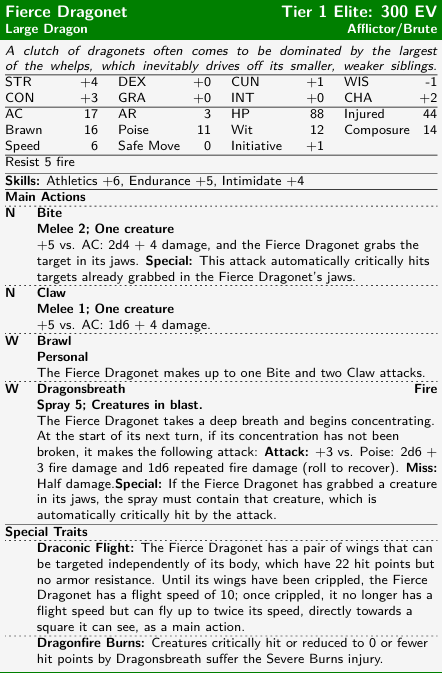
The Fierce Dragonet statblock represents a “teenage” dragon, old enough to be independent but not developed into the terror that an adult dragon represents. This particular dragonet might even be called a “teenage jock” dragon, because it is primarily a physical threat. Even as a Tier 1 Elite, it packs multiple nasty tricks:
- With its Brawl action, it can make up to three attacks on its turn. Its Bite attack is the most dangerous of these just based on its combination of higher damage and longer reach (which, yes, does let the Fierce Dragonet make opportune strikes against creatures that rush up toward it), but it becomes far more deadly in conjunction with two special traits:
- The Bite attack allows the dragonet to grab a target with its jaws, and subsequently automatically critically hits (dealing 12 damage, guaranteed) creatures grabbed in this way. But even worse, creatures grabbed in the dragonet’s jaws are also exposed to Dragonsbreath…
- And here we get to Aetrimonde’s implementation of a dragon’s fire breath. In many RPGs, a dragon has to wait between breath attacks, and is often at the mercy of the dice to determine how long it takes to recharge. I’ve taken a different approach: an Aetrimondean dragon can breathe fire as often as it likes…but it has to take a deep breath first. This telegraphs to the PCs that there will shortly be a gout of flame that they should spread out or move away from…and that they could, conceivably, do something to interrupt the dragon before it can exhale. This would require them to deal 22 damage in a single hit, but that’s not out of the question with a greater power or a lucky critical hit. But speaking of critical hits, Dragonsbreath automatically critically hits creatures grabbed in the dragonet’s jaws.
- The dragonet naturally has wings, and can fly…until the PCs poke enough holes in them that it loses most of its mobility.
- And last, but definitely not least, the dragonet’s fire has the potential to cause an affliction, specifically Severe Burns, a decidedly nasty affliction that can entirely incapacitate a PC, even if the damage itself didn’t suffice.
Rampaging Drake
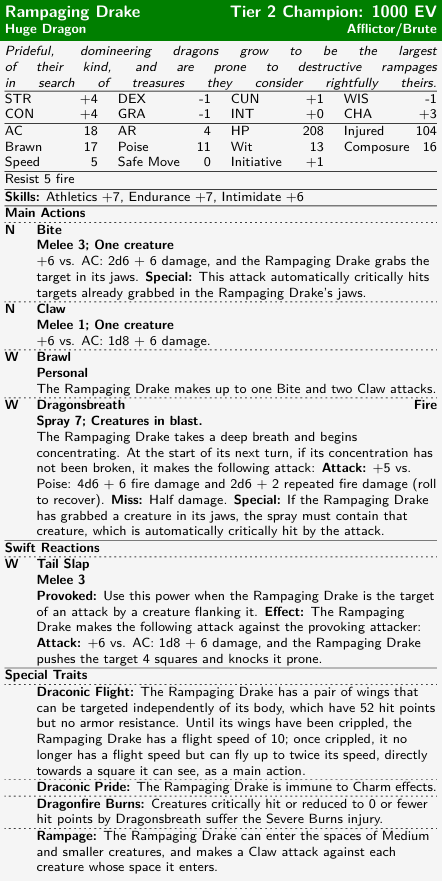
The Rampaging Drake statblock represents a Fierce Dragonet with one or two more centuries of growth. As such, it has all of the same actions and traits as the Fierce Dragonet, with some new added twists:
- The Bite attack has even further increased reach, out to 3 squares, which coupled with the drake’s increased size, means it can lock down a large part of the battlefield with opportune strikes. Bite, and also Claw, have larger damage dice due to the drake’s larger size, as well as its higher tier.
- Dragonsbreath likewise has increased damage dice, for both the initial and repeated fire damage, and a larger area of effect. Also, with the Rampaging Drake being a Champion instead of an Elite, it becomes much harder to break its concentration, requiring a whopping 52 damage from one hit…which is still within the realm of possibility, if just barely, from a critical hit with a greater power.
- The first of the drake’s brand-new twists is Tail Slap, making it a terrible idea to attack the drake from flanking. A sweep of the drake’s tail can not only deal some unexpected damage, it can knock a flanking attacker back and prone…and as a swift reaction, this means that the attacker will no longer be in position to make their attack, leading to a completely wasted action.
- The Rampage special trait allows the Rampaging Drake even more attacks by moving through or over smaller creatures…but it does come at the cost of opportune strikes, which those creatures get to make as the drake enters their spaces.
- Finally, as a Champion-grade creature, the drake gains outright immunity to Charm effects, representing the impossibility of overpowering an adult dragon’s will.
Cataclysm Dragon
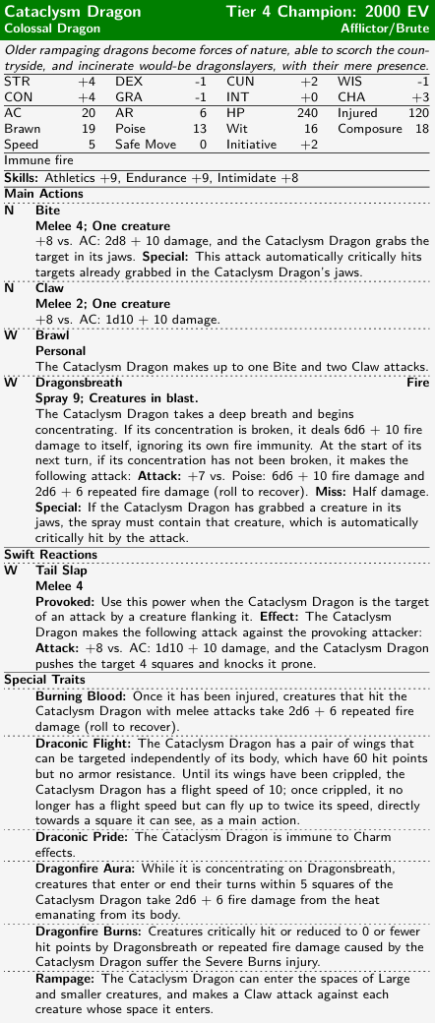
Finally, we have the Cataclysm Dragon, representing an adult dragon derived from the Fierce Dragonet and Rampaging Dragon, at the age where it has to enter torpor every once in a while. The Cataclysm Dragon embodies and emanates dragonfire, scorching foes with the heat of its body…on top of all the same traits as the Rampaging Dragon.
- For starters, the Cataclysm Dragon is outright immune to fire. This is a Tier 4 enemy, which PCs might be able to face at around level 10, at which point even characters specializing in fire damage should have some alternate attacks available to work around this. But see below…
- The Bite and Claw attacks again have larger damage dice, higher damage bonuses, and more reach, with even the Claw attacks having reach 2 at this point.
- Dragonsbreath again has increased damage and area, and at this point a critical hit (against a PC grabbed in the dragon’s jaws, for example) will deal a whopping 46 automatic fire damage…enough to put some serious hurt on just about any PC. However, this comes with a vulnerability, albeit one that is difficult to seize on: if the PCs somehow manage to deal the necessary 60 (!) damage to break its concentration, the Cataclysm Dragon’s fire breath burns out of control, and hot enough even to overcome its fire immunity. This adds an extra 6d6 + 10 fire damage on top of whatever critical hit managed to break its concentration!
- The Cataclysm Dragon has two new abilities making it increasingly difficult to fight it: Burning Blood kicks in once the dragon has been injured (i.e. is below half health), and inflicts repeated fire damage on any character who hits it with a melee attack. And Dragonfire Aura causes it to inflict fire damage to nearby creatures while concentrating on its Dragonsbreath. Combined, it can be incredibly dangerous to face a Cataclysm Dragon in close combat…which is fitting for a creature representing the pinnacle of draconic physicality.
Up Next
Of course, even the Cataclysm Dragon represents a dragon just barely at adulthood. There are older and more powerful dragons out there, biding their time in torpor and occasionally coming out to burn, pillage, and destroy. We might see one of those shortly…
 Aetrimonde
Leave a comment