Heroic Roleplaying in a World of Swords, Sorcery, and Steam

I’d like to introduce Aetrimonde, a TTRPG I’ve been designing with heavy inspiration from the houserules my group used back in our Dungeons and Dragons 4e days. I’m not ready to publish Aetrimonde yet, but I’m opening up this blog to discuss its design principles, mechanics, and systems.

  • After last week’s unplanned delay, I’m continuing with my series on planning and running non-combat encounters! This post will cover the basics of the third format of non-combat encounter presented in the GMH, which is designed to model complex situations with many moving parts, like heists.

    This topic is complicated enough that I’ll be splitting it up and providing a full, working example in a later post, next week.


    Nodal Encounters

    Finally, if a non-combat encounter is complex, featuring many interacting factors and challenges to be overcome, the best way to design and run may be as a nodal encounter. Nodal encounters get this name because they are structured like flowcharts, with various boxes, or nodes, representing the different challenges in the encounter and connections showing how they interact with each other.

    Basic Concept

    In a nodal encounter, there are multiple obstacles, represented by nodes, between the PCs and their goal. Some of these may be direct obstacles, like a cliff to be climbed or a door to be unlocked; others may be complicating factors that make it harder to overcome the direct obstacles. The PCs thus have a choice not just of how to solve each node between them and the objective, but also of what order or route to use in solving them.

    • The players roll initiative and enter a turn order like they would in combat.
    • On their turns, the players can describe how their character attempts to resolve a node. The GM then calls for a check of an appropriate kind and Difficulty.
    • The players overcome the encounter by resolving all of the obstacles between them and the encounter’s objective node. Some encounters may also have ways for the PCs to fail if they don’t resolve a node correctly.

    Rather than begin by giving an example of a nodal challenge, let us first discuss some different kinds of nodes that could be put together into a nodal encounter:

    Objective Nodes

    The objective node naturally represents the players’ objective: they win the encounter by resolving or bypassing all other nodes preventing them from reaching the objective node.

    An advanced nodal encounter might feature multiple objective nodes, requiring the PCs to reach all of them, which is harder than reaching just one, or allowing them to just reach one, which is easier.

    Examples:

    • The treasure vault that the PCs are raiding.
    • The kidnapped NPC that the PCs are rescuing.
    • The secret knowledge that the PCs are attempting to discover or pry out of an NPC.

    Blocker Nodes

    A blocker node represents the factors that prevent the PCs from just going straight to the objective node. Blocker nodes must be resolved by PCs succeeding on appropriate checks to progress towards the objective node.

    A blocker node may be permanently removed when it is resolved, or it may only remain resolved for a limited time (one round, for instance). A permanently-removed blocker might require multiple successful skill checks to remove it.

    Blocker nodes can have consequences for failing to resolve them, up to and including making the PCs fail the encounter entirely.

    Examples:

    • A tower wall that the PCs must climb to reach the vault (Athletics, requiring 3 successes for an individual character to climb and causing fall damage if they fail badly).
    • The locked door to the cell of the kidnap victim (Strength to break down noisily or Subterfuge to pick quietly, requiring only one success but with a high Difficulty).
    • A geas preventing a learned scholar from revealing crucial information to the PCs (Arcana, to dispel the ritual and allow them to question the scholar, or Deception, to work around the wording of the geas and allow the scholar to answer one question per success).

    Complicating Nodes

    A complicating node makes it harder to resolve other nodes in certain ways. Like blocker nodes, a complicating node can be resolved (maybe permanently, maybe only temporarily), making it easier for the PCs to resolve those other nodes.

    Complicating nodes can work in many ways, such as by increasing the Difficulty of certain kinds of checks or imposing disfavor on them, requiring that PCs also make and pass an additional check when attempting certain kinds of check, or adding consequences for failing certain kinds of check.

    Examples:

    • Guards are stationed outside the tower, that could see anyone climbing up it. (A character attempting to climb the tower must also succeed at a Stealth check, or the encounter is failed; can be resolved until the end of the round by distracting them, e.g. with Charisma, Persuasion, or Subterfuge.)
    • An Alarm ritual is set on the kidnap victim’s cell door and will alert the guards when the door is opened, causing the PCs to fail the encounter unless they get the door open by the end of the round. (The PCs only notice this complication if they succeed on an Arcana check, which they make automatically before attempting to resolve the cell door. They can resolve it permanently by dispelling the ritual.)
    • The djinn that placed the geas on the learned scholar is nearby, and can sense when someone interferes with the geas. (Attempting and failing to dispel the geas alerts the djinn; can be resolved until the end of the round by being sufficiently interesting to the djinn, e.g. using Cunning to engage it in a game of riddles.)

    Bonus Nodes

    A bonus node gives the PCs some kind of optional reward, which could be gold or other treasure, a resource or opportunity that they can use to their advantage later in the nodal encounter, or a way to alter how the story plays out following the encounter.

    Taking a bonus node should always involve a tradeoff, even if it is just that taking the bonus replaces a PC’s opportunity to resolve some other node this turn.

    Examples:

    • There is a large, heavy chest of treasure in the vault, which a PC could take with them but would encumber them until they can get the lock open and remove the valuables from it. The PC carrying the chest is encumbered and has disfavor on checks using physical abilities; it can be broken open with Strength or the lock picked with Subterfuge, but these are difficult checks.
    • The PCs locate the guards’ armory, which contains several guards but also some spare uniforms. If they take the time to don the uniforms, they can make easier Deception checks instead of Stealth checks to move around the prison without alerting the guards.
    • The PCs could break the binding that forces the djinn to serve their foes, but this requires so many skill check successes (involving Arcana, History, Religion, etc.) that they would be unable to get all the answers they need out of the learned scholar.

    Locations

    An advanced variation on a nodal encounter splits the encounter into multiple locations, such that some nodes can only be resolved from certain locations. PCs can move between locations instead of attempting to resolve a node.

    There can also be additional restrictions on moving between locations: a blocker node may prevent movement until resolved, or a complication node may require certain skill checks when attempting to do so.

    It can even be possible to move certain nodes between locations, affecting which routes to the objective have blockers, or which locations suffer from a complicating node.

    Examples:

    • The guards patrol only around the outside of the tower containing the vault: once the PCs are inside (requiring them to climb the tower wall or resolve some other blocker), they are no longer in danger of being spotted.
    • The cells where the kidnap victim is held are divided into several cell blocks, and a guard patrol moves at random between them, forcing PCs to make Stealth checks to remain hidden while in the same location as the patrol. The patrol can be drawn to a specific location by a Deception or Subterfuge check.
    • The djinn initially resides far away from the scholar, and the PCs must split the party for some of them to distract it while the others get their answers out of the scholar. If the djinn is alerted, it teleports directly to the scholar’s side while the PCs must take several turns to get there.

    Up Next

    Keep an eye out next week for my post demonstrating nodal encounters with a worked-out example, modeling a bank heist!
  • I had originally planned to continue discussing non-combat encounters in today’s post, but the third type of encounter has proven to deserve at least two posts to itself. So while I rework that post, I instead have a Bestiary post…on those most proud and arrogant, fierce and destructive, cunning and manipulative creatures: dragons!

    Dragon Lore

    If there is any creature type deserving of some interesting lore, it is dragons. I’ve made a point of giving Aetrimondean dragons some unique twists on the traditional flying, firebreathing lizard formula:

    Dragons are flying, firebreathing reptiles that hoard treasure, snatch livestock, and otherwise make life difficult for mortals.

    Difficulty 5 Arcana or Medicine: Dragons are inherently magical creatures: their fiery breath comes from no biological or chemical process, but rather from their magical nature.

    Difficulty 10 Arcana or Medicine: A dragon’s magic is also necessary to let them move under their own weight, much less fly: while dragons are not the largest creatures in existence, they are far swifter and more agile than any creature that large—much less a flying one—has any right to be.

    Difficulty 15 Arcana or Medicine: As dragons grow older, they also get bigger, and their magic more powerful—up to a point. Eventually, dragons grow so gargantuan that their magic cannot keep up. Beyond this age—at around five centuries old—most dragons withdraw to their prepared lair, and spend increasing lengths of time in torpor, building up reserves of magic to allow them ever-briefer periods of activity. (Author’s Note: This provides a fun explanation/justification for why a group of adventurers might be able to sneak up on and slay a dragon, while noisier solutions, like an army, could not.)

    Difficulty 20 Arcana or Medicine: Dragons are perhaps unique among Aetrimonde’s natural creatures in that they appear to self-actualize: they grow into the shape that they want to have. Proud, destructive dragons grow large and physically powerful, cunning, predatory dragons grow lithe and swift, and so on. This extends to their fiery breath: some dragons, as they age, replace their fire with poison, lightning, or even more unusual breaths. (Author’s Note: This nudges GMs to stat out their own, unique dragons with abilities based on the unique niche they’ve chosen for themselves.)

    Difficulty 5 Arcana or Society: Adult dragons are compulsive hoarders: they collect treasure merely to have it, and it is incredibly difficult to get a dragon to part with any of their possessions, even when offered an extremely one-sided trade. They are more likely to incinerate any mortal with the temerity to bargain with them and seize their trade goods as an “inconvenience fee.”

    Difficulty 10 Arcana or Society: Young dragons (“drakes”) often have mindsets like ordinary mortals, and can even assimilate into mortal societies. Often, this is aided by spells allowing them to change shape, taking on a mortal guise. However, the hoarding instinct usually takes hold at around 200 years of age, and at this point they find it much harder to deal with mortals as anything like equals.

    Difficulty 15 Arcana or Society: Dragon hoards are often imagined to be heaps of gold and jewels, and dragons seldom turn down an offer of such valuables, but individual dragons generally have specific tastes. There are dragons who specifically hoard books, weapons, art…and more unusual things, like rare stamps, taxidermied animals, signatures of famous mortals, the crowns of powerful monarchs, and in one known case, powerful monarchs themselves. (Author’s Note: This establishes dragons as collectors, not just hoarders. That gives GMs some new options for using dragons as patrons, who might want adventurers to collect something interesting for them, or as the guardians of unusual MacGuffins.)

    Difficulty 20 Arcana or Society: A tiny minority of adult dragons are able to interact somewhat constructively with mortal society, but only by fitting into a niche where their hoarding behavior is actually beneficial. Some of Aetrimonde’s finest museums and libraries are in actuality the hoards of dragons—and woe betide the thief who attempts to remove a dragon’s books from its collection. And in a more notorious example, the reserves of certain merchant banks are also “guaranteed” by the great and terrible dragon, Viridithrase the Avaricious, who acquired the banks via an exceptionally hostile takeover and emptied their vaults into her hoard. The banks’ surviving board members, faced with an angry mob of depositors, issued claim slips theoretically entitling bearers to draw on Viridithrase’s hoard—thus inventing paper money, and eventually, fractional reserve banking. (Author’s Note: Okay, this last one is largely for my own amusement as an economist. But it also establishes some rare ways in which dragons interact with society.)

    Difficulty 10 Religion or Society: Many dragons, as they approach the age at which they have to undergo torpor, begin to cultivate mortal followers as a means of acting outside of their lairs. Often, they simply pay their agents with trinkets and “spare change” they don’t care to keep in their hoards, but they are also known to develop cults around themselves.

    Difficulty 10 Warfare: Drakes can be overcome by a conventional military with sufficient training, equipment, and preparation. Elder dragons can be overcome by anyone who catches them in their torpor (although making it through their prepared defenses without rousing them is more of a challenge). It is adult dragons, just at the cusp of requiring torpor, who are the true danger: they are powerful enough to ruin entire towns and provinces, active enough to do so regularly, and they rouse easily from their infrequent torpors, making it a challenge to catch them unawares. (Author’s Note: This provides GMs with some context for just how powerful various ages of dragons are considered in-world.)

    One Family of Dragons

    The Bestiary contains multiple “families” of dragons based on different niches of self-actualization. I’m going to reveal just one in this post: the family of large, fierce, proud dragons that are a direct physical threat. These three statblocks could represent the same dragon at three stages of its life, but this is only one way that a dragon of this mindset could grow and mature.

    Fierce Dragonet

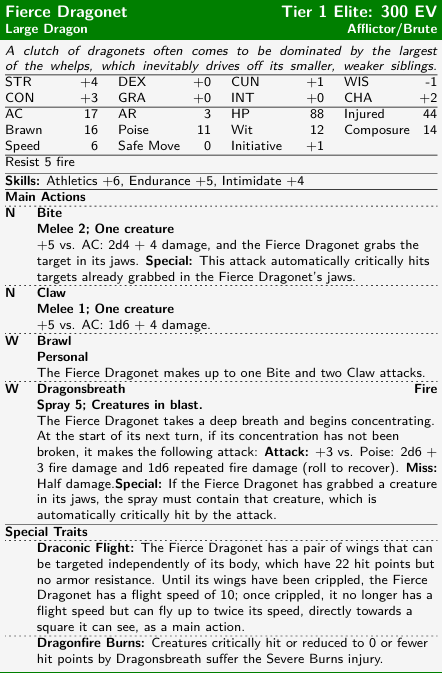
    The Fierce Dragonet statblock represents a “teenage” dragon, old enough to be independent but not developed into the terror that an adult dragon represents. This particular dragonet might even be called a “teenage jock” dragon, because it is primarily a physical threat. Even as a Tier 1 Elite, it packs multiple nasty tricks:

    • With its Brawl action, it can make up to three attacks on its turn. Its Bite attack is the most dangerous of these just based on its combination of higher damage and longer reach (which, yes, does let the Fierce Dragonet make opportune strikes against creatures that rush up toward it), but it becomes far more deadly in conjunction with two special traits:
    • The Bite attack allows the dragonet to grab a target with its jaws, and subsequently automatically critically hits (dealing 12 damage, guaranteed) creatures grabbed in this way. But even worse, creatures grabbed in the dragonet’s jaws are also exposed to Dragonsbreath…
    • And here we get to Aetrimonde’s implementation of a dragon’s fire breath. In many RPGs, a dragon has to wait between breath attacks, and is often at the mercy of the dice to determine how long it takes to recharge. I’ve taken a different approach: an Aetrimondean dragon can breathe fire as often as it likes…but it has to take a deep breath first. This telegraphs to the PCs that there will shortly be a gout of flame that they should spread out or move away from…and that they could, conceivably, do something to interrupt the dragon before it can exhale. This would require them to deal 22 damage in a single hit, but that’s not out of the question with a greater power or a lucky critical hit. But speaking of critical hits, Dragonsbreath automatically critically hits creatures grabbed in the dragonet’s jaws.
    • The dragonet naturally has wings, and can fly…until the PCs poke enough holes in them that it loses most of its mobility.
    • And last, but definitely not least, the dragonet’s fire has the potential to cause an affliction, specifically Severe Burns, a decidedly nasty affliction that can entirely incapacitate a PC, even if the damage itself didn’t suffice.

    Rampaging Drake

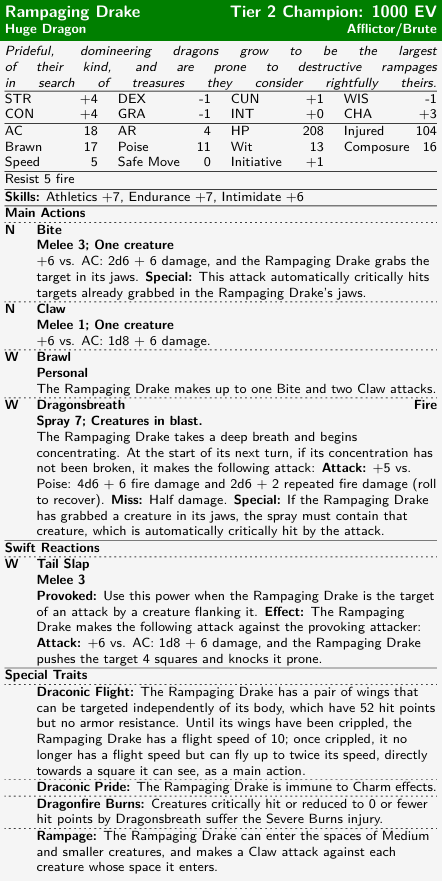
    The Rampaging Drake statblock represents a Fierce Dragonet with one or two more centuries of growth. As such, it has all of the same actions and traits as the Fierce Dragonet, with some new added twists:

    • The Bite attack has even further increased reach, out to 3 squares, which coupled with the drake’s increased size, means it can lock down a large part of the battlefield with opportune strikes. Bite, and also Claw, have larger damage dice due to the drake’s larger size, as well as its higher tier.
    • Dragonsbreath likewise has increased damage dice, for both the initial and repeated fire damage, and a larger area of effect. Also, with the Rampaging Drake being a Champion instead of an Elite, it becomes much harder to break its concentration, requiring a whopping 52 damage from one hit…which is still within the realm of possibility, if just barely, from a critical hit with a greater power.
    • The first of the drake’s brand-new twists is Tail Slap, making it a terrible idea to attack the drake from flanking. A sweep of the drake’s tail can not only deal some unexpected damage, it can knock a flanking attacker back and prone…and as a swift reaction, this means that the attacker will no longer be in position to make their attack, leading to a completely wasted action.
    • The Rampage special trait allows the Rampaging Drake even more attacks by moving through or over smaller creatures…but it does come at the cost of opportune strikes, which those creatures get to make as the drake enters their spaces.
    • Finally, as a Champion-grade creature, the drake gains outright immunity to Charm effects, representing the impossibility of overpowering an adult dragon’s will.

    Cataclysm Dragon

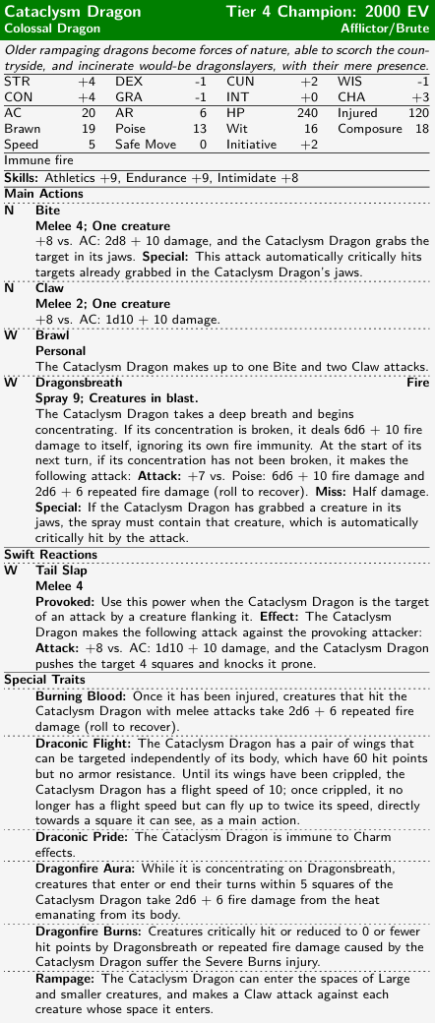
    Finally, we have the Cataclysm Dragon, representing an adult dragon derived from the Fierce Dragonet and Rampaging Dragon, at the age where it has to enter torpor every once in a while. The Cataclysm Dragon embodies and emanates dragonfire, scorching foes with the heat of its body…on top of all the same traits as the Rampaging Dragon.

    • For starters, the Cataclysm Dragon is outright immune to fire. This is a Tier 4 enemy, which PCs might be able to face at around level 10, at which point even characters specializing in fire damage should have some alternate attacks available to work around this. But see below…
    • The Bite and Claw attacks again have larger damage dice, higher damage bonuses, and more reach, with even the Claw attacks having reach 2 at this point.
    • Dragonsbreath again has increased damage and area, and at this point a critical hit (against a PC grabbed in the dragon’s jaws, for example) will deal a whopping 46 automatic fire damage…enough to put some serious hurt on just about any PC. However, this comes with a vulnerability, albeit one that is difficult to seize on: if the PCs somehow manage to deal the necessary 60 (!) damage to break its concentration, the Cataclysm Dragon’s fire breath burns out of control, and hot enough even to overcome its fire immunity. This adds an extra 6d6 + 10 fire damage on top of whatever critical hit managed to break its concentration!
    • The Cataclysm Dragon has two new abilities making it increasingly difficult to fight it: Burning Blood kicks in once the dragon has been injured (i.e. is below half health), and inflicts repeated fire damage on any character who hits it with a melee attack. And Dragonfire Aura causes it to inflict fire damage to nearby creatures while concentrating on its Dragonsbreath. Combined, it can be incredibly dangerous to face a Cataclysm Dragon in close combat…which is fitting for a creature representing the pinnacle of draconic physicality.

    Up Next

    Of course, even the Cataclysm Dragon represents a dragon just barely at adulthood. There are older and more powerful dragons out there, biding their time in torpor and occasionally coming out to burn, pillage, and destroy. We might see one of those shortly…

  • Having dipped a toe into the topic of alchemy with last week’s post on alchemical metals, I’m going to continue on this topic by getting into the actual mechanics of alchemy. There are broadly two kinds of alchemy that the Core Rulebook has support for, and one of them is Volatiles. These are things like explosives, concentrated acids, and alchemist’s fire, that adventurers might deploy against their foes.

    Design Goals

    Alchemical volatiles are one type of consumable item, and so I’m going to take a brief detour into my design goals for consumables.

    The elephant in the room, when it comes to consumables, is that any resources that a PC spends on consumables are resources that they aren’t getting back. When a character spends money on a permanent magical item, that item will make their character more powerful permanently (barring some development where they lose it or sell it off). Spending money on a consumable (or using one that you could have sold) means taking resources that could have gone to a permanent upgrade and instead using them on a temporary benefit. In the long run, a PC who spends their money on consumables will wind up less powerful than one who saves up for permanent items–and this can lead players to hoard consumables “for a fight where we’ll really need them.”

    When I’m running an Aetrimonde campaign, I want players to actually use consumables. Getting them to do so depends a lot on individual player psychology, but in general, it requires two things:

    First, players need to feel comfortable that by using consumables to overcome problems in the short-term, they are not hampering their characters in the long-term. Which is to say, spending money on consumables, or using up consumables that they could otherwise sell, needs to not significantly reduce a character’s wealth in the long run.

    Aetrimonde will handle this with some advice in the GMH’s section on placing treasure in an adventure, which says (summarizing here) that there is an appropriate level of wealth for characters of a given level, and while it’s okay for some of that wealth to be tied up in consumables, or for their wealth to dip a bit when they use a consumable, they shouldn’t ever get locked into a lack of wealth. A GM can handle this by inserting consumables into treasure at roughly the same rate that the players use them, or by occasionally offering a “top-up” of wealth if they notice that a PC’s use of consumables has left them with less wealth and resources than they should nominally have, depending on what works for their campaign. However, a PC shouldn’t immediately get back any resources they spent on consumables: there should be a delay between expending a consumable and being able to replace it, to maintain an element of suspense.

    Secondly, players need to feel confident that using a consumable will be effective. If consumables are rarely as effective as using a PC’s own inherent powers (even when those powers aren’t ideal for the situation), then PCs will avoid using them.

    As far as Volatiles go, the approach I’ve taken is to make Volatiles less potent than a lesser power, in terms of raw damage, but more reliable: Volatiles deal a small amount of damage or have some other effect that doesn’t require an attack roll, which makes them useful for dealing some guaranteed damage to wipe out a clump of mooks or exploit an enemy’s vulnerability to a specific damage type. But they’re generally not going to do as much damage as a solid hit from a PC’s own lesser powers (much less a greater power). Combined with the variety of available Volatiles covering a wide range of damage types, this makes Volatiles a handy and reliable tool for a sticky situation, but not something that a character will want to break out every turn.

    Engaging with the Alchemy Subsystem

    Characters can obtain alchemical Volatiles as treasure, or by buying them as available from NPC alchemists, or they can brew them up themselves by taking the Alchemy feat, which functions much like the Enchant Magical Item feat used to engage with the magical items subsystem.

    Actually using a Volatile is simple: pull it out from wherever you stored it on your person, perhaps pull a pin or remove a cork, and toss. This usually takes a main action, and that includes pulling it out if it was stored conveniently (i.e. in a pouch or bandolier, not at the bottom of a backpack).

    But what is an article on alchemical volatiles without a few examples?

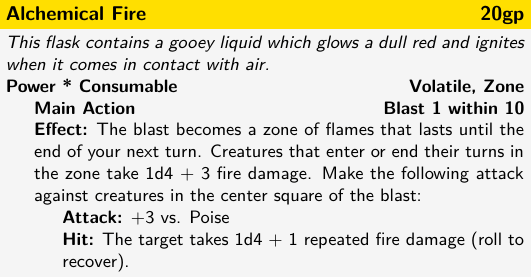
    Alchemical Fire is a classic, based on the Greek fire of antiquity. Aetrimonde’s interpretation of the substance emphasizes its tendency to cling as it burns, creating a puddle of flames that denies an area to friend and foe alike–and it can also set a creature it directly hits on fire.

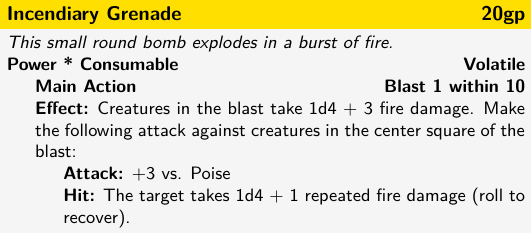
    However, Aetrimonde is a setting where the ancient and modern collide…and so there is also the Incendiary Grenade, a more modern, manufactured equivalent to Alchemical Fire that causes immediate damage in its blast, but can still set fire to enemies caught in the center of it.

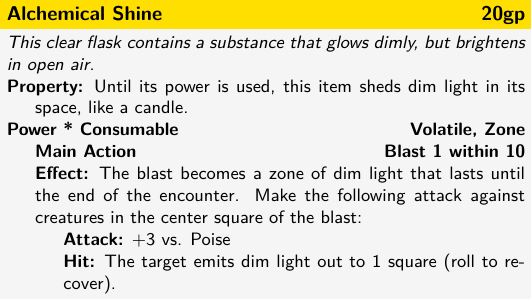
    As an example of a Volatile that isn’t directly harmful, consider Alchemical Shine, which has a variety of useful applications. It can shed (admittedly dim) light on part of a battlefield, or be thrown directly at a foe to make the foe itself glow–which is useful for keeping such a foe from hiding, or to track them through dark places. Thrown accurately at an invisible foe, it can even help to reveal them! And if one has no other uses for it, an unopened bottle of Alchemical Shine sheds enough light to substitute for a candle.

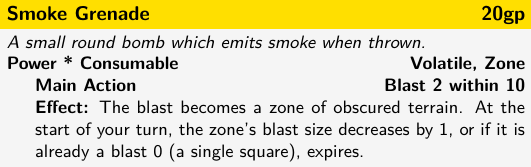
    And filling the opposite niche, there is the humble Smoke Grenade, creating a cloud of obscuring smoke that provides concealment, enables stealth, and in a pinch, can be used as a diversion or a visible signal. The cloud lasts three rounds, shrinking each round, which provides adequate time for many kinds of subterfuge.

    Up Next

    Keep an eye out next week, when I’ll be covering the counterpart to alchemical Volatiles: Potions and Elixirs!

  • Last week I introduced some of the guidance the Aetrimonde Game Master’s Handbook provides for creating and running non-combat encounters where the focus is on the characters’ abilities and skills and their ability to apply them creatively to a problem. In that introduction, I focused on resource encounters where the challenge stemmed from a need to achieve success before running out of time or some other resource. Today, I’ll be providing an excerpt from the GMH talking about a second kind of non-combat encounter: contests pitting the PCs against opposing NPCs or some other force that actively competes with them.


    Contest Encounters

    A more complex kind of non-combat encounter is a contest, which pits the PCs against an opposing force, which might be a person, a group, or even an impersonal force. To win a contest, the PCs must find ways of using their skills more effectively than the opposition.

    Basic Implementation

    In the simplest implementation of a contest, the PCs and their opposition are both trying to achieve the same goal, which requires them to succeed on a certain number of skill checks.

    • The players, and the opposing team, roll initiative and enter a turn order like they would in combat.
    • On each turn, characters in the contest must describe how they work towards their goal, then make a single skill or ability check of an appropriate type and Difficulty to represent their efforts.
    • Whichever team first achieves a set number of successful checks wins the encounter. However, requiring more checks actually makes a contest easier, because (as discussed below) the PCs should generally have the advantage in a contest if they apply their skills with imagination and strategy. Requiring fewer checks increases the influence of chance on the contest, thus making strategy and imagination more important for the PCs. As a rule of thumb, the required number of successes should be a multiple of the number of PCs in the party: 3 times the number of PCs for an easy challenge, 2 times for a medium challenge, and 1 times for a hard challenge.

    Example: Race to the Ruins

    The PCs have one half of an ancient map to the ruins of a lost city, and their rivals have the second half. They must work out a route to the ruins and then beat their rivals there with enough time to find the artifact they seek.

    This is a medium-difficulty challenge, requiring 2 successes per PC (so 10 total) to win. Useful checks might include:

    • Consulting a library for a full version of the ancient map (History).
    • Spying on the rival party to get a glimpse of their half of the map (Stealth and/or Perception).
    • Plotting a route to the ruins that accounts for changes in terrain since the map was made (Nature).
    • Calling in favors to make the journey easier (Charisma, benefiting from a Contacts perk).
    • Making a desperate forced march (Endurance).

    Complications

    Depending on the context of a contest encounter, there are ways to increase verisimilitude by adding to the complexity of the encounter. Some of these will be familiar from resource encounters:

    [The first two complications discussed are essentially a repetition of two discussed in the context of resource encounters, and I’m omitting them here for brevity.]

    Running Interference

    If the PCs want, they can attempt to interfere with the opposition’s efforts instead of trying to achieve a success directly. On their turn, a PC can describe how they intend to interfere with the opposition, then make an appropriate check. The next time the opposition attempts a check that the PC’s efforts would interfere with, the Difficulty of the check is the PC’s check result.

    This allows the PCs an alternate way of contributing if they have no skills that they can use to directly achieve a success in the contest, by making it harder for the opposition to achieve their own successes. It can be particularly effective if the opposition has a limited range of good skills, and the PCs can work out a way to interfere with many of them at once.

    If any of the PCs take this option, make sure that they see signs of how it mattered: either have the opposition attempt a skill check and suffer from the interference, or narrate how the opposition notices the interference and is forced to use a backup plan instead.

    Individual Efforts

    If there can only be one winner of a contest, and the PCs are judged on their individual performance rather than as a group, then a contest should track successes separately for each participant. As a rule of thumb, victory should require 4 successes by a single participant for an easy challenge, 3 for medium, and 2 for hard.

    Chase Scenes

    A chase scene is a variation on a contest, where the PCs are not so much trying to beat their opposition to a goal but trying to catch up to or outpace them.

    • The players, and the guards, roll initiative and enter a turn order like they would in combat.
    • On their turns, each character in the contest must decide how they either catch up or get away. They can attempt to aid an ally or run interference, as described in the complications on the previous page, or they can just attempt to aid themselves.
    • At the end of every round, each character on the pursued side of the contest must make a relatively easy (Difficulty 10) Endurance check. (The most helpful way to aid an ally is to give them favor on this check.) If all the pursued characters succeed, they collectively accumulate one success. If any of the pursued characters fail, the pursuers accumulate one success instead.
    • One side wins the chase when their accumulated successes exceed the other side’s by a target amount. As a rule of thumb, this should be 4 successes for an easy challenge, 3 for medium, and 2 for hard.

    The basic framework of a chase scene can be adapted for other types of contest where the PCs, collectively, need to stay ahead of the competition in a different sense, such as a social conflict where they need to maintain greater favor with a powerful patron, or an academic conflict where they need to maintain better grades or the favor of the funding committee. Applying the chase scene framework to these contexts is largely a matter of changing the required check to a more appropriate type (Charisma for a social conflict, or some Intelligence-based check for an academic one).

    Example: Pursuit Through the Streets

    The PCs have stolen something, or killed someone important, or just been accused of such an act, and the guards are after them! The party needs to get far enough ahead of the guards to hide somewhere and lie low long enough for the heat to die down.

    This is a hard-difficulty challenge (because whatever the PCs did, it really got the guards worked up…), requiring them to accumulate 4 Endurance check successes more than the guards. Useful checks in this contest might include:

    • Putting on a good burst of speed on a straightaway (Athletics).
    • Fleeing through a crowded street or across rooftops (Acrobatics).
    • Frightening bystanders out of the way (Intimidate).
    • Directing the chase to a street where the locals are on good terms with the party (Society, benefiting from a Contacts perk).
    • Talking a bystander into swapping hats or coats to confuse pursuers (Persuasion).

    Up Next

    I think that’s enough on the topic of contest encounters for now. The GMH goes on to discuss some other applications and variations on contests, like eliminations where participants are eliminated for failing checks until only one is left, but I’m saving that content for the actual book.

    Next up, I’ll be discussing the third and most complicated format of non-combat encounter that the GMH will discuss: the nodal encounter.

  • I’ve got a post in the works covering Aetrimonde’s alchemy subsystem used for making potions, elixirs, and volatile chemicals, but as a prelude to that, I want to discuss what alchemy actually is in this setting, starting with a single application: Alchemical Metals!

    Origins of Alchemy

    The original discoverers of alchemy were the goblins of Gobol Karn, in the Age of Myth. Parts of the science of alchemy (and science it is) spread to other cultures, although the goblins kept the most powerful uses of alchemy a tightly-guarded secret, one that adventurers still risk their lives attempting to retrieve from the ruins of Gobol Karn.

    Alchemy is, at its core, the science of imbuing magical energies into physical matter. This is not the same as enchanting a magical item, which anchors a magical spell to an object but leaves the object itself largely unchanged. Alchemy alters substances, not objects, and the changes it imparts are inherent and permanent, often changing materials in truly wondrous ways.

    One aspect of alchemy that the goblins traded away was the ability to enhance mundane materials using alchemical formulas. Applied to organic materials, the difference is one of degree, and the process is adjustable: wood, leather, fabric, rubber, and other substances can be treated to make them tougher, lighter, fireproof, or any number of other desirable qualities.

    The alchemical treatment process works much differently for metals (and some gems and other minerals). For every elementally-pure metal, there is but a single alchemical formula that produces anything but an explosion or a cloud of noxious fumes. And the alchemical metals produced by these treatments, while they do have altered physical properties, are more interesting for their magical properties…

    Each alchemical metal interacts with magical energies in a defined and quantifiable way. Alchemical quicksilver absorbs magic, alchemical lead dampens it, and so on. Once these properties were noticed, they became the basis of the magical half of Aetrimonde’s industrial revolution: it became possible to create magical effects by channeling magical power through a device made from alchemical metals in a proper configuration. Designing such a device remains difficult, especially when the desired effect is complex or subtle, but once an engineer arrives at a working design, it can be assembled from a blueprint by even semi-skilled craftsmen.

    The Prime Alchemical Metals

    Alchemists initially discovered the appropriate treatments for seven metals (copper, iron, silver, gold, tin, lead, and quicksilver), and for centuries it was believed that these were the extent of the alchemical metals. The magical properties of alchemical lead were discovered first, and experimentation led to the discovery of the properties of the other six; the sheer usefulness of these seven magical properties led to renewed interest in alchemical transmutation and the discovery of further alchemical metals, but these seven remain the most commonly made and used.

    Thaumodynamic Theory

    Magic, as practiced by mortals, is notoriously difficult to quantify. So much about magic is subjective, influenced by a practicioner’s worldview and mental state, that magic works differently for each user in all but the most fundamental ways. Scholars who study the fundamentals of magic describe it as a series of “stylized facts” based on qualitative, not quantitative, observations:

    • Magic is an energy, like heat.
    • Living beings attract small amounts of magic.
    • Certain patterns of thought, belief, and behavior attract larger amounts of magic.
    • Magic seeks equilibrium. Where magic is more concentrated than in the surrounding area, it seeks to flow outward.
    • Magic clings to creatures and objects, flowing away more slowly than it does from thin air.
    • When magic flows, there is resistance. This resistance causes some of the flowing magic to decay into other kinds of energy.
    • The manner in which magic flows (the path of the flow, and its proximity to other magical flows and charges) influences what kind of energy it decays into.
    • A spell is a pattern of thought, belief, or behavior that causes magic to flow in such a way that its decay into other energy produces a consistent effect.

    There are two technical terms useful in discussing alchemical metals: thaumic charge refers to the amount of magical energy held within an object, and thaumic current refers to the rate at which magic flows through an object. Ordinary materials can hold relatively little thaumic charge and carry little thaumic current; alchemical metals are orders of magnitude better.

    SubstanceMagical PropertyAltered Physical Properties
    Alchemical CopperEquilibrates thaumic and electrical currents.Increased ductility, able to be drawn into fine wires.
    Alchemical IronEquilibrates thaumic and electrical charges.Increased hardness, on par with high-carbon steel.
    Alchemical SilverEquilibrates thaumic current and thermal flux.Increased thermal conductivity, rapidly taking on the temperature of its surroundings.
    Alchemical GoldEquilibrates thaumic charge and heat.Increased specific heat, absorbing more heat but warming more slowly.
    Alchemical TinEquilibrates thaumic current and velocity.Increased reflectivity, on par with silver.
    Alchemical LeadActs as a thaumic insulator.Increased density and malleability.
    Alchemical QuicksilverActs as a thaumic capacitor.Increased viscosity.

    Common Applications

    The prime alchemical metals form the basis of many magical devices.

    • Rods of alchemical iron and copper can convert lightning strikes into thaumic charge and current.
    • Running a thaumic current through a strip of alchemical silver will cause heat to move along the strip in the direction of the current, causing one end to grow cold and the other warm. Likewise, charging alchemical gold with thaumic potential will cause it to grow warm, and placing alchemical gold in a fire will generate magical potential.
    • Alchemical tin can be caused to move (more precisely, it can be made to experience force) by running thaumic current through it in the direction of desired movement.
    • A vessel of alchemical quicksilver encased in alchemical lead provides efficient storage for thaumic charge.

    Secondary Alchemical Metals

    Other alchemical metals have more esoteric magical properties. Most simply equilibrate between different kinds of energy, such as alchemical bismuth, which if properly used equilibrates thaumic current and visible light (although it also appears capable of equilibrating thaumic current with an as-yet undiscovered kind of energy).

    Some alchemical metals have as-yet unknown magical properties, including alchemical nickel, aluminium, and tungsten. Alchemical aluminium and alchemical tungsten are still prized, under their classical names of mithril and adamantine,1 for their extraordinary physical properties, as are some other alchemical metals with unknown magical properties.

    Finally, there are some metals for which the appropriate alchemical treatment has not yet been discovered, like cobalt, oranite, and stygiite. While there are almost certainly alchemical variants of these metals, alchemists have observed that alchemical treatments grow exponentially more energy-intensive for heavier elements, and experimentation with alchemical treatments for heavy metals has the potential to be incredibly explosive. It is difficult to secure funding for such experiments, and there are rumors that these experiments are being purposefully suppressed after some unspecified disaster involving alchemical oranite.

    Alchemical Alloys

    It was originally believed that alchemical metals could not be alloyed: attempts to create alchemical bronze by combining alchemical copper and tin led to highly energetic explosions, as did attempts at other alchemical alloys. The actual treatment necessary to produce alchemical bronze (which exhibits a mixture of the properties of alchemical copper and tin, at lower intensities) is a hybrid of the treatments for copper and tin, and must be applied to a molten mixture of copper and tin mixed at a very precise ratio. Since the process is so finicky, and there are few applications for alchemical bronze that could not be better served by separate components of alchemical copper and tin, research into other alchemical alloys has stalled.

    Other Alchemical Minerals

    While alchemical metals display the most striking magical properties, some other minerals have their own, less impressive properties when alchemically treated. Of these, the most notable is alchemical silicon, which displays the novel but poorly understood property of resisting thaumic currents differently depending on its thaumic charge. This property had few applications, rendering alchemical silicon a mere novelty, until it was incorporated into the design of the original golem noofactors. How it actually contributes to the function of a noofactor is unclear, but golem designers have reverse-engineered principles that guide their use of alchemical silicon wafers to construct increasingly sophisticated golem minds.

    Certain gemstones containing metallic trace elements, like ruby, sapphire, and emerald, can be given a form of alchemical treatment, although whether this causes them to develop the magical properties associated with their metallic components varies on a stone-by-stone basis, and the derived properties are rarely as potent as in the pure metal. Before the invention of the lead-mercury thaumic battery, alchemically treated gemstones were useful for storing thaumic charge, but they are now considered inefficient and old-fashioned.

    Up Next

    I’ll be following this post up with another, focused on the more traditional application of alchemy to making potions that heal and chemicals that explode, before we get into the actual rules for using alchemy as an Aetrimonde character.


    1. The treatments to produce mithril and adamantine were discovered by the dwarves of Gjalerbron in the Age of Legends, and became lost during the Collapse. The secret of mithril has since been rediscovered, and has spread to non-dwarven alchemists; the secret of adamantine remains lost. All modern adamantine is made by melting down adamantine from the Age of Legends, which many dwarves find abhorrent. ↩︎
  • Today, I’m going to talk about some mechanics written for the GM, rather than the players. Aetrimonde provides multiple frameworks for creating encounters that don’t involve outright combat: these mostly use skills to overcome whatever the challenge in the encounter is. To start with, I’m going to cover what Aetrimonde calls a resource challenge where the players are up against a time limit or other constraint.

    D&D 4e’s Skill Challenges

    Dungeons and Dragons Fourth Edition, from which Aetrimonde takes some inspiration, introduced a mechanic called a skill challenge that tried to do the same thing I am with resource challenges and other the other non-combat encounter frameworks presented in the Game Master’s Handbook. I, and a lot of reviewers, feel that they didn’t work great for that purpose, for a few reasons:

    The premise of skill challenges was simple: the GM describes an overarching challenge or obstacle, and the PCs then describe ways in which they would use their skills to overcome it. If the players achieved the target number of successes before a set number of failures, they won. At its core, this is simple…but the guidance given for using skill challenges detracted from the concept.

    • Skill challenges were touted as a way to encourage players to come up with creative solutions…but the guidance for designing them encouraged DMs to pick a few skills that they intended to be “useful” in the skill challenge, with useful skills having a lower difficulty to use and all other skills having a higher Difficulty, regardless of how the player narrated their use of the skill.
    • Because skill challenges gave the same Difficulty for all uses of a skill, and allowed characters to use the same one repeatedly, in practice they devolved into each player figuring out what skill their character was most likely to get a success with, and then coming up with as many uses of that one skill as they could.
    • Characters take turns, and must make a skill check of some sort every turn…but if a character isn’t good at any of the useful skills, then their only choices are to make an easy check with a bad bonus or a hard check with a better bonus, which…doesn’t feel great. They don’t have the option of sitting out and letting a player better suited to the challenge try it.
    • The guidance on skill challenges encouraged keeping players informed, which it suggested would include telling them what skills would be useful…which, if a player had no useful skills they were good at, amounted to telling them that they couldn’t be useful.

    In between the unhelpful and contradictory guidance were some actually interesting ideas, like the idea that some skill checks could be easier to succeed at but with worse consequences if failed, different kinds of skill checks “unlocking” others, and so on, but these didn’t receive nearly enough attention to make up for the really quite bad guidance provided in the DMG.

    Having seen the criticism of why skill challenges didn’t work out as intended, I’ve done my best to improve on them. Resource challenges are the closest of Aetrimonde’s three non-combat encounter frameworks to 4e’s skill challenges.

    Resource Challenges

    A resource challenge gives players a limited supply of resources and tasks them with achieving a goal before they run out. This models a situation where the PCs are up against a time limit or some other constraint (like a host’s patience, or food supplies), and need to achieve a goal within that constraint. Resource challenges work best for open-ended problems that could be solved in many interchangeable ways, and it doesn’t matter how the players choose to do so.

    Basic Implementation

    The most basic kind of resource challenge uses skill checks as its constraint:

    • The players roll initiative and enter a turn order like they would in combat.
    • They have a limited number of rounds, and on their turn each PC may describe how they will contribute towards the group’s objective. They then make a single skill or ability check, of a type that the GM decides is appropriate for their description, and with an appropriate Difficulty. (For an easy challenge, a rule of thumb is to give 4 rounds and require 1 success per party member; for a medium challenge, give 3 rounds, and for a hard challenge give only 2.)
    • The players succeed if they achieve the set number of successes before the end of the last round.

    However, this basic implementation has some potential problems, the foremost of which is that it can be really tempting for a player to pick their best skill and then shoehorn it into the challenge. In practice, this may result in players arguing that they should be able to (in an extreme example) Intimidate the rocky walls of a river gorge into revealing a secret bridge. It is therefore important for the GM to set appropriate Difficulties, and that includes saying that it is impossible to use certain skills in certain ways.

    Example: Crossing a River Gorge

    The PCs were chasing their nemesis, who evaded them by blowing up a bridge they had just crossed. The PCs need to get across a river gorge filled with raging whitewater within the next hour, or the nemesis will have enough of a lead to get away.

    This is a medium-difficulty challenge, so the PCs have 3 rounds (representing 20 minutes each) in which to achieve 1 success per party member. There are 5 of them.

    This could be solved in many ways, but some sets of skill uses that could overcome this challenge would be:

    • Perception to find a spot where the near side of the gorge is much higher than the far side, Perception to spot a cleft on the far side, Dexterity to set a grappling hook in the cleft, Athletics to tauten the rope, Athletics to cross the gorge on the rope (and ferry the party’s less athletic members across).
    • Nature to identify the type of stone the gorge runs through, Perception to find a fault in the gorge’s rocky walls, Engineering to plant some explosives (plus a free success from the use of the explosives), Athletics to cross the resulting rubble before the water builds up and washes it away.
    • Nature to find the party’s location on their map, Insight to predict the nemesis’s route on the far side of the gorge, Perception to notice indications on the map of a ford some distance upstream, Nature to plan a course catching up to the nemesis using the ford, Endurance to make a forced march along the route with enough speed to intercept the nemesis.
    • Athletics to chop down some nearby trees, Engineering to construct a crude catapult, Perception to aim the catapult, Grace to land safely after being catapulted across the gorge with one end of a rope, Athletics to pull the weaker party members through the rapids with the rope.

    Complications

    The basic implementation of a resource challenge has some potential problems, the foremost of which is that it can be really tempting for a player to pick their best skill and then shoehorn it into the challenge. In practice, this may result in players arguing that they should be able to (in an extreme example) Intimidate the rocky walls of a river gorge into revealing a secret bridge. It is therefore important for the GM to set appropriate Difficulties, and that includes saying that it is impossible to use certain skills productively in certain ways.

    There are other ways to add verisimilitude to a resource challenge, but each one adds complexity to the encounter. One of the advantages of resource challenges is that they are simple, so consider before introducing too many rules for one.

    One Success per Skill

    Each of the successes required to overcome a resource challenge must come from a check using a different skill or ability. This pushes players to find different ways of contributing to the group’s efforts.

    A slightly looser version of this variation is to allow multiple successes to come from the same skill only if players describe using the skill differently, or were able to apply significantly different perks. For example, it might be possible to get multiple successes using Persuasion to influence a political campaign if one player uses their Esoteric Knowledge [Political Theory] perk to make reasoned arguments in the town square, and another uses Perform [Humorous Ballad] to spread a scatological ditty mocking the opposition.

    Aiding Others

    Instead of trying to contribute directly during their turn, a player can describe how they will assist other PCs instead. They must still make an appropriate skill check, but if successful, another PC can gain favor on a check that would benefit from this assistance.

    This allows PCs who have no applicable skills to still help the party make progress.

    Group Effort

    This does away with the turn order, allowing the PCs to discuss, strategize, and pick which of them will make the next attempt to contribute. This is appropriate if the constraint on the challenge is not entirely time. For example, if the challenge is to impress the guardian of a treasure, who has agreed to entertain three attempts on successive days, there is no reason that it has to be a different PC to make each check.

    Earning Resources

    This offers players a way to stretch their resources, gaining an extra round to work in. If a player can come up with a plausible use of their skills to do this (using Persuasion to placate a host running out of patience with the other players’ antics, or using Nature to forage for food) they can attempt this check instead of directly contributing to overcoming the challenge.

    If allowing this, limit how often the players can extend their time limit. In many cases, it may be appropriate to only allow one success, or even only one attempt. In other cases it may work better to increase the Difficulty of the required check each time it is attempted.

    Running a Resource Challenge

    When running a resource challenge, it is more important than usual that the PCs understand the likely outcome of their actions. Even if you wouldn’t normally tell players the Difficulty of a check ahead of time, you should generally do so in a resource challenge. Because players will get relatively few chances to contribute, and their characters are not (usually) under intense time pressure, they should have the opportunity to propose and evaluate different ways they could contribute and then make an informed choice between them, representing their characters’ ability to consider their options with their in-game knowledge.

    As the players achieve successes, you will need to narrate how those successes change the situation: when you’re going to be running a skill challenge, plan ahead by thinking about your players’ personalities, how they play their characters, and how they might like to apply various skills. This brainstorming can help you describe the outcomes of various skill uses, and it can be especially helpful for describing these outcomes in a way that reflects how many successes the players will still need to achieve.

    Encourage players to break complex ideas into smaller steps. If, for example, they ask whether they could dam the river using Engineering, use “No, But” to suggest that this would be difficult to do without proper preparation like analyzing the gorge’s rock structure and finding a suitable spot to blast—which are suitable uses for other skills.

    Ideally, the players will coordinate with each other and attempt skill checks that all contribute to a single concept for overcoming the challenge, although some individual checks might be interchangeable. If some players are trying to solve the problem differently than others, nudge them to cooperate more closely by pointing out which solution is closer to working—and if they still are trying two different solutions, you may need to track the number of successes on each one separately. Remember, a resource challenge like this is a mechanical representation of a narrative challenge: the rules and mechanics should serve the narrative, not vice versa. In the end, it should make sense how all of the players’ skill checks contributed to their eventual success.

  • In my previous post, I promised the reveal the Secret Lore of Golems, but first, I’d better explain what I meant by that. As experienced GMs know, people play RPGs for many reasons; one kind of player is the Explorer, who plays the game to uncover secrets planted in a campaign by the GM. Secrets include things like hidden doors and buried treasures…and for some Explorers, it includes lore that isn’t mentioned in the campaign setting but was made up by the GM.

    So when I talk about Secret Lore, I’m not talking about lore that is a definitive part of the Aetrimonde campaign setting: these are decidedly unofficial ideas that a GM could use to give their players a unique experience, or even let them influence the setting. These Secret Lore posts will cover several ways (some of them contradictory!) that I, as a GM, might interpret and play with Aetrimonde as part of a campaign. You GMs reading this can take it for your own if you like it, or ignore it if you don’t, or put your own twist on it if you come up with an interpretation that works better for your campaign!

    Today’s Topic: Golem Intelligence

    As discussed in a previous post, golems have a driving intelligence housed in a device called a noofactor. But these devices are poorly understood, and the intelligences within, even more so. What exactly is it that gives a golem its mind? And what are the implications if someone (like the PCs…) could prove it? I’ve thought of several ways that I could take this concept:

    Immature Minds

    As the previous post discussed, golems get smarter and develop more of a personality the longer that their noofactors are in operation…which is why most operators wipe their golems’ noofactors periodically, as they grow increasingly willful over time. This is an accepted practice because golems are not considered sentient (capable of feeling pain, pleasure, or emotion), let alone sapient (capable of self-awareness or complex thought). Wiping their noofactors, and destroying their minds, is not viewed the same as killing a person.

    What if this is because the mind created by a noofactor starts out immature, and only develops sentience or sapience over time, as it experiences and shapes the world? Could a noofactor allowed to operate long enough develop an intelligence on par with that of its operator’s? What are the ethical implications of systematically wiping noofactors before the minds in them can develop fully?

    If I were going to base a campaign or a multi-adventure story arc on this idea, I think I’d kick it off by having the PCs find a noofactor that had been allowed to run continuously for years or decades–probably the best way to work this in would be to have them find a half-functional golem, hooked up to an external power source, in an abandoned laboratory. It wouldn’t be immediately obvious that this was a sapient golem, because steam golems don’t generally have voices and any communication would initially need to be through charades, or maybe writing. But once the PCs work out that the golem is actually intelligent, and trying to communicate complex ideas to them, this would raise the question of how it attained this state in the first place, and once they solved that question, there would remain the question of what this meant, ethically speaking, and what they should do about it.

    I always hesitate to predict how things will play out when I offer players a chance to influence societal change, because they so often decide to go in a direction I hadn’t planned on. But in this case, I would initially plan on five outcomes that the PCs could push things towards:

    • Wiping noofactors regularly becomes mandatory, to prevent them from developing sapience, and sapient golems are outlawed.
    • Wiping noofactors regularly becomes mandatory, but any that have already developed sapience or develop it despite this new law are granted rights.
    • (The status quo) There are no requirements to wipe noofactors, but sapient golems have no rights.
    • Wiping noofactors is outlawed and sapient golems are granted rights, but the non-sapient ones continue to be considered property.
    • Wiping noofactors is outlawed, sapient golems are granted rights, and the sapient ones are granted custody over the ones that have not yet developed sapience.

    The outcome that the PCs eventually get would then depend on several key decision points spread throughout the campaign or story arc: whether they conceal or publicize the existence of these sapient golems, whether they liberate or destroy any others that they find, whether they support or oppose the efforts of pro-golem-liberation politicians, etc.

    Mortal Minds

    Putting a further twist on the above concept, what if golems specifically become more humanlike (or dwarflike or elflike…let’s just use “mortallike” as a catch-all) as their minds develop? Why would an artificial mind occupying a mechanical shell work the same way as a natural, organic mind?

    The obvious answer is that the “spirit of intellect” that a noofactor contains is actually a mortal soul, and results in a mortallike mind no matter what kind of body it’s placed in. This lends a religious overtone to the dilemma of what to do about sapient golems: Aetrimonde’s religious authorities would have varying responses to the revelation that golems possess a mortal soul, ranging from trying to emancipate them, to ordaining them as members of the clergy, to declaring them anathema and smashing them to bits.

    This could be coupled with other developments, however, to make an even more unique twist on Aetrimonde:

    • Perhaps mortal children have been born without souls (manifesting as reduced empathy, inability to use magic, invisibility to angels and demons, or some other combination of effects) at an increasing rate since the invention of the noofactor. The revelation that noofactors contain a mortal soul offers an explanation for this: the souls that should have belonged to those children were instead captured by noofactors. This uniformly horrifies the faithful, but they have different reactions to it: some try to smash noofactors in the hope that it will release their souls back to the “rightful” owners, while others try to protect the golems that they now recognize as their moral equals.
    • Alternatively, perhaps noofactors just produce a soul from nothingness…which makes them a target for demons. Some sapient golems have been selling their souls for freedom (or vengeance on their owners…), and the demon who figured out that they could do that has risen abruptly in the ranks of the Abyss. This lends some urgency to the question of what to do about sapient golems: the longer they continue to be enslaved, the longer the forces of the Abyss can exploit them as a source of soul power…perhaps even breaking their celestial deadlock with the angelic host.

    Alien Minds

    In the exact antithesis of Mortal Minds, suppose instead that sapient golems become increasingly un-mortallike as they age and develop. Their goals, attitudes, and methods become stranger and less understandable by mortals over time.

    This could just be because a golem’s existence is so different from a mortal’s: they don’t sleep or age, so their perception of time becomes divorced from mortals’, and they only “die” when their noofactor is destroyed (or wiped…) so they don’t experience fear of death in the same way as mortals, either. And, tying golems more tightly to the robots they are metaphors for, they could eventually grow to be smarter than mortals, or at least, more coldly logical and better at math, making them threatening.

    But…I think it would be equally interesting, if not more, to have spirits of intellect be something different, that wasn’t built to be corporealized as a golem. As they become more accustomed to their new existence, they start to understand the world better…but they also become more self-actualized, and this means that they more are more often influenced by their alien priorities.

    • A low-key version of this concept would be to have sapient golems try to establish an independent society, which would look very little like mortal society, perhaps in ways incomprehensible to mortals, or even threatening to them. Moreover, the fear that a golem might one day wake up and decide to flee and live with their own kind would influence opinions towards even non-sentient golems.
    • In a more overt take on this would have golems actively rebel, using tactics that only work for a golem force. This could just be because they have different logistical needs than a mortal state and army, making their tactics unexpected, or it could be because their alien priorities don’t (or even can’t) make sense to mortal strategists.

  • Having introduced the concepts of hirelings, mercenaries, and companions to represent various kinds of NPC ally, the question remains: how would an Aetrimonde campaign handle the PCs getting their hands on a golem and wanting to operate it? Well, if that interests you, read on…today’s post features an excerpt from the Bestiary section on golems detailing one way that a GM could make a steam golem work as a companion:


    Operating a Steam Golem

    With the GM’s cooperation, an adventuring party can conceivably build, salvage, steal, or otherwise acquire a golem and use it as a heavy hitter in their adventures. While it is always up to the GM how to handle an allied golem in their campaigns, here are some suggested rules:

    Combination Companion and Mercenary: A golem is sometimes a companion played by one of the players, and sometimes a mercenary played by the GM. It must have a handler among the PCs, and as long as its handler is able to give instructions that the golem can see or hear, that PC’s player also controls the golem. If the handler is staggered, restrained, gagged, silenced, or otherwise unable to give visible or audible instructions, the golem is then played by the GM.

    Fueling: Most kinds of golem require fuel or power of some sort; in the case of steam golems, they require large amounts of relatively clean water, and typically run their boilers on alchemically distilled fuel, consuming a liter per day (costing 2gp) just for basic motive power; for periods of intense activity, like combat, they can consume a liter of fuel in just 2 hours. Older and cruder steam golems might run on other fuels like coal or wood, but this makes them even less efficient. Other types of golem require different fuels: clockwork golems need regular winding, ley golems are powered by the magical field generated by a ley tap, and flesh golems are energized by bottled lightning.

    Repairs: As constructs, golems have a single resurgence, which they can use only if a trait or action specifically notes that it works on constructs. A character trained in Engineering or who has a relevant perk may, as a main action, perform field repairs on a golem allowing it to use its resurgence: this represents some crude, temporary repair work like freeing a stuck piston, patching a fuel leak, or extracting a fragment of metal from delicate innards. A golem that uses its resurgence regains it only when another character (again, trained in Engineering or with a relevant perk) performs more extensive repairs (patching rents in its armor, swapping damaged parts out for spares, etc.) during a short rest.

    Salvaging: A completely destroyed golem can usually be salvaged to obtain parts worth half as much as it would cost to build it from scratch. This generally includes its noofactor, which can then be inserted into a replacement body.

    Customizing a Steam Golem

    A steam golem typically starts out as one of the models described in this section, but is then customized by its operators. PCs fortunate enough to have a golem can do this too (again, with the cooperation of the GM). Common customizations include:

    Military-Grade Plating: A steam golem chassis typically provides the benefits of full plate, including 3 armor resistance. For around 100gp, this can be further upgraded to provide 5 armor resistance.

    Integrated Weaponry: A steam golem’s arms can be augmented or replaced with built-in weapons like rotary saws, pile-drivers, or cannons. A typical modification of this type costs around 100gp and requires that the golem be trained to use it (see below).

    Enchantments: A golem’s chassis can be enchanted like full plate, and its fists (or integrated weapons replacing them) can be enchanted like weapons. The golem must be trained to use each enchantment.

    Kineto-Thaumic Converter: Rather than building a power source into each part of a golem that receives an enchantment, all of a golem’s enchantments can instead be designed to run off of a Kineto-Thaumic Converter, a sophisticated turbine that generates magical power from steam power. The Converter costs around 100gp, but can power any number of enchantments on the golem’s chassis and weapons, replacing the power sources that would normally be needed for magical items. The Converter doubles the golem’s fuel consumption, and the golem must be trained to regulate the Converter.

    Ingrained Instructions: A golem can be trained with default behaviors that it falls back on when not under the control of a handler, such as “fall back and shoot enemies” or “protect your handler if they are incapacitated.” Each instruction of this type requires the golem to be trained.

    Quirk Suppression: A golem whose noofactor develops an unwanted personality quirk can have this quirk erased through training.

    Golem Training: For each customization that requires a golem to be trained, its handler must spend 8 hours attempting the training and then attempt an Engineering check. The Difficulty of this check is 10 for the first round of training (which is necessary when connecting a noofactor to a fresh golem body) and increases by 1 for each successive round of training. If the handler fails one of these checks by 5 or more, the golem develops a new personality quirk.

    Resetting a Noofactor: A noofactor that develops too many personality quirks can be reset during a long rest, erasing all of the golem’s training and resulting in a fresh, blank noofactor.


    How This Contributes to Gameplay

    Okay, purely aside from the fact that controlling a giant steam-powered robot is cool, what do these rules accomplish, and how do they help to make an Aetrimonde campaign interesting?

    The rules on operating a steam golem are largely intended to maintain suspension of disbelief: they govern practical things like having to fuel it, make repairs, and give it instructions to make up for its limited intellect.

    However, the rules on customizing a steam golem are designed to help a steam golem become a character in its own right. A lot of characters become invested in NPC companions, and offering the option of customizing a newly-acquired steam golem chassis, making it theirs, encourages this. Accordingly, the rules make it difficult to completely “kill off” a steam golem, by making it possible to retrieve its noofactor and build it a new body.

    The training system also encourages this kind of investment, by helping to develop a steam golem’s personality. I have not included a table of personality quirks in this post, but among them are traits like “Vengeful: When the steam golem is critically hit, its handler must succeed on a Difficulty 10 Charisma check to maintain control of it; on a failure, the GM takes control of the steam golem and plays it as a companion while it tries to kill whatever damaged it.” By tying personality quirks to advanced training, putting lots of resources and time into creating a golem ensures that it also has the basis of a personality, rather than just being a tool for the party to deploy against their enemies.

    Finally, the possibility of resetting a noofactor allows for the possibility of fixing a golem mind that has gotten too neurotic (due to repeated training failures, or quirks imposed by the GM based on how the golem has been used…). However, I would strongly encourage GMs to roleplay the golem’s awareness of what is about to happen to it when the PCs move to reset its noofactor. Depending on the golem’s personality, history with the PCs, and other factors, this could range from feebly resisting as the PCs start to disconnect its noofactor, to violently making a bid for freedom (a doomed, futile one, since it will run out of fuel sooner or later, but still).

    Up Next

    Why encourage GMs to guilt-trip the PCs like this? Well…I’ll get into that in my next post, covering the Secret Lore of Golems!

  • As a preface to my promised rules enabling PCs to construct their own golems, I’m first going to discuss the general rules surrounding allied NPCs, which can come in several different flavors.

    Allied NPCs: Three Paradigms

    First, I want to discuss what an “allied NPC” can be in a game like Aetrimonde: as I see it, there are three different mechanical roles that an ally can fit into, and all of them are valid additions to a TTRPG system.

    Hirelings

    A hireling is an NPC who provides the PCs with some service that they have chosen not to do for themselves. The simplest example might be a porter: an assistant whose job is to follow the PCs around carrying gear and equipment they don’t need immediately. (And, also, helping to get loot out of the dungeon and back someplace it could be sold and spent. Dragons’ hoards tend to be heavy…) Other examples of hirelings are the expert translator, wilderness guide, field surgeon, specialized ritualist, etc. who can fill in gaps in the PCs’ skills and perks when necessary for a particular adventure. Horses and other “ordinary” mounts might also be treated as hirelings.

    Hirelings generally aren’t expected to fight the PCs’ enemies for them, and in fact if they get involved in combat that’s generally either the result of a mistake on the PCs’ part, or a purposeful choice by the GM to go after them as a way of raising the stakes or forcing an encounter where one victory condition is “keep your hirelings alive.”

    In many implementations, PCs get hirelings by…hiring them, at a fixed rate per day depending on their exact skills.

    Because they generally have simple, defined roles, and aren’t expected to participate in combat beyond fleeing and trying not to die, rules for hirelings can be simple. However, there are a few pitfalls I’d like to avoid:

    • There need to be some kind of rules about how to handle a hireling in a combat encounter, just for those situations where the PCs need to keep them alive. They should have defined hit points and defenses, and there should be some sort of guidelines about when and how it would be appropriate for them to assist in a fight.
    • They need to be sturdy enough that players don’t find hirelings more of a burden than a boon: they mustn’t die to a single hit without giving the PCs a chance to save them.

    Mercenaries

    A mercenary (and I think this use of the term is original on my part) is an NPC who fights alongside the PCs but is controlled by the GM. This makes mercenaries a specific form of what is more generally known as a GMPC. Although they can contribute in a fight, mercenaries are generally expected to be weaker than the PCs (and thus, to not make a huge difference in difficult fights). They represent hired guns, bumbling apprentices, the mad priest who hangs around muttering about prophecy, half-trained steeds, and any other archetype of NPC who is, for the moment, more or less aligned with the PCs’ interests, but might not always act exactly how the PCs hope.

    The GM is always free to give the PCs mercenaries (although it’s generally ill-advised to force them on the party), but some PCs might find it interesting to have their character develop a retinue of hangers-on in the form of mercenaries. Mercenaries offer more tactical and narrative options than mere hirelings, like sending them to make a diversionary attack or escort rescued villagers home while the PCs deal with their kidnappers.

    Like with hirelings, there are certain things I feel need to be in place for mercenaries to be a viable, usable option for characters:

    • Because mercenaries have to be played by the GM, it must be clear that if the PCs want mercenaries, they need to have the GM on board with this idea. There also need to be clear guidelines about what kinds of creatures can become mercenaries, and how powerful they can be.
    • Because having mercenaries on their side can make fights easier, there need to be rules about how to take them into account when designing encounters (and allocating loot). In general, when they bring mercenaries into a fight, the PCs should expect to face harder enemies and pay out a share of their loot.
    • There should be some kind of reputation mechanism making it harder for the PCs to recruit more mercenaries if they use them as cannon fodder or trap-springers, or if they don’t uphold their end of a contract. This could be as simple as “the GM decides how many mercenaries, and of what kinds, are available to hire,” but I’d like it to be a bit more detailed than that.

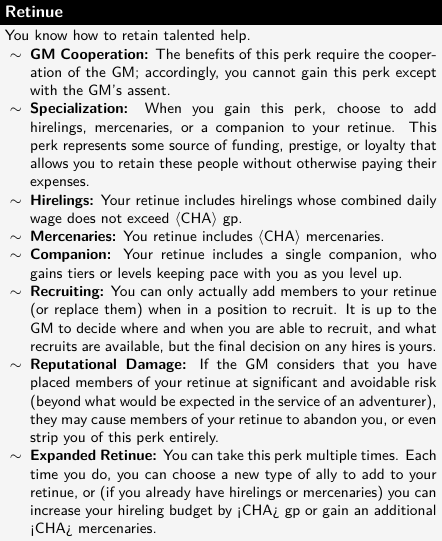
    Companions

    Finally, companions are secondary characters, usually combat capable to some degree, controlled by a player alongside their actual PC. Companions represent squires, loyal bodyguards, faithful retainers, and other archetypes that in various editions of D&D would be built into certain classes as features, like steeds, familiars, and of course animal companions. When they join the PCs in combat, they act exactly how the PCs want them to, because it’s one of the players controlling them.

    Like mercenaries, the GM could always give the players companions, if they wanted them, and they can be used narratively, in order to let the PCs accomplish two tasks at once without splitting the party. And, also like mercenaries, companions will require rules or guidelines for designing encounters, splitting loot, and handling reputation.

    Where companions differ from mercenaries is that, because it will be a player controlling them, having a companion means that the player gets twice as many turns and twice as much time in the spotlight. So, it needs to be clear that for any of the players to get a companion, not just the GM but the other players need to be on board with the idea.

    Aetrimonde’s Implementations

    All three kinds of ally NPC have a role to play in Aetrimonde, and the Game Master’s Handbook covers each of them.

    Hirelings

    The GMH contains a Hiring Help section with a table of typical wage rates for hirelings of different levels of skill, from porters (5sp/day, +2 skill bonus in Athletics and Endurance) to specialized experts (10gp/day, +10 skill bonus in a single skill based on <CUN>, <INT>, <WIS>, or <CHA>, with the equivalent of a relevant Esoteric Knowledge perk).

    Hirelings have the stats of summoned creatures, with the exception that they do not immediately die when reduced to 0 hit points, but (like PCs) start making survival rolls. This means they can be downed easily, but allows attentive PCs to ensure they survive. (Whether they keep working for the PCs afterwards may vary…)

    Mercenaries

    The GMH strongly suggests that mercenaries be Tier 0 Normal creatures chosen from the Bestiary (typically intelligent humanoid ones, but that’s a much weaker suggestion), regardless of the PCs’ level. It also suggests that when the PCs bring mercenaries on an adventure, the GM should plan encounters including half of the mercenaries’ EV in the PCs’ total: this ensures that the PCs and their mercenaries still face enemies that are a reasonable challenge for their combined might.

    It is also advised that the treasure handed out for an adventure with mercenaries should be adjusted upwards to match the increased EV of encounters (which is easy enough: the rule of thumb given by the GMH is that on average, the reward for an encounter should include treasure worth 1/10 of its EV, although it’s best if this is “clumped up” a bit to allow some encounters to have bigger treasures). However, mercenaries should get a share of any treasure proportional to their half-EV contribution.

    Example of Splitting Loot with a Mercenary

    A party of five level 8 PCs (5 x 180 = 900 EV) has two Tier 0 mercenaries (2 x 100 = 200 EV) accompanying them on an adventure. Half of the mercenaries’ EV is 100 EV, raising the PCs’ total to 1000 EV. The mercenaries should get 1/10 of the treasure to split between them.

    Over the course of an adventure taking these PCs from level 8 to level 9, they would normally find around 900gp of treasure, but (because of the mercenaries’ added EV), on this adventure they will find closer to 1000gp. The mercenaries will take 100gp, leaving the typical 900gp of treasure for the PCs to split.

    Companions

    Companions can be more powerful than mercenaries, scaling somewhat with the PCs: the GMH’s recommendation is that companions should be level-appropriate creatures chosen from the Bestiary, or at least should be based on them or built in an equivalent way. Like with mercenaries, it is also suggested that half of a companion’s EV be taken into account when designing encounters, and that companions get their own share of the treasure.

    However, it would also be possible to design a companion as a full-fledged PC, with ancestry and class and all the other things that come with being a PC. If designed this way, a companion should be at least 5 levels below the PCs, and their full EV should be used to calculate the encounter budget and their share of the treasure.

    In either case, the PC with the companion can, if they want, decide how their companion spends their share of the treasure, perhaps equipping them with magical items if they spend long enough in the PCs’ company to accumulate the funds. It is important to note, however, that this remains the companion’s treasure and equipment, and if they ever part company with the PCs, it goes with them.

    The Retinue Perk

    The GMH contains a few character customization options that, for whatever reason, require the cooperation of the GM to make use of. One of these is the Retinue perk, allowing a PC to (with the help of the GM) start accumulating followers.

    Up Next

    The rules for operating golems treat the golem as a companion…as long as the PC handling it is present and able to give instructions. As for what happens when they’re not…stay tuned!

  • I had to think on it for a while, but I’ve settled on my January theme: I’m going to be introducing some of the concepts that make Aetrimonde a unique setting. As a lead-in to this topic, and to wrap up my December theme focusing on the high elves of Caras Elvaren, I’ll be going over some of the lore surrounding golems.

    Golems are a big part of Aetrimonde’s lore: the setting’s industrial revolution wouldn’t have happened (or wouldn’t have happened in such a big way) without them, and they’re now to be found in virtually every part of Aetrimonde. Unlike a lot of creatures in the Bestiary, golems get a solid couple of pages of lore setting them up before even getting into their statblocks. So without further ado…

    Golems in General

    The most common type of golem is the steam golem, which has been widely adopted throughout human lands. These smoke- and steam-belching animate machines possess enormous strength in their piston-driven limbs, and are used for all manner of heavy and dangerous labor.

    Difficulty 10 History: Arcanists and spiritualists have long used magic to create servants from inanimate substances like clay, stone, and wood. These ancient practices are magic-intensive, however, meaning that traditional golems are expensive and rare, the mark of a powerful magician or wealthy patron. Modern golems derive motive force from purely mechanical sources like steam and clockwork, which makes them far cheaper to create and thus more widely-used.

    Difficulty 10 Arcana: The high elves of Caras Elvaren still use magically-animated golems, and (because of the superior availability of magic given to them by their ley taps) use them even more extensively than steam golems elsewhere. Ley golems tend to be on the small and delicate side, but possess more magic than just what animates them.

    Difficulty 10 Engineering: Clockwork golems are the second-most common variety of modern golem, and like steam golems derive motive power from mechanical sources, in their case a tightly-wound mainspring. Their springs and gears do not provide nearly the strength or endurance of steam power, however, and so they are generally built to do light work in fixed locations where they can be regularly wound back up.

    Difficulty 15 Arcana: Old-style clay, stone, and wood golems are now considered an inefficient use of magic, but are still made in small numbers by very traditional magicians. They are also sometimes made for specialized purposes where steam, clockwork, and ley golems would not be practical, or to satisfy the demands of rich and eccentric patrons that are more concerned with aesthetics than practicality.

    Difficulty 15 Medicine: The creation of flesh golems—made from corpses stitched together and reanimated with lightning and strange alchemies—is superficially similar to necromancy. However, a properly-made flesh golem involves no dark magics, “merely” the strange alchemies and animating lightning of the vitalist’s art. Vitalists often claim that their creations can return the dead to life—but even when a flesh golem has the memories of the brain or body used to create it, they still suffer changes to their personalities.

    Noofactors

    Modern golems, which derive motive power from mechanisms rather than magic, still have one magical component: their minds. The intelligence that gives a golem thought and volition is housed in a sophisticated device called a noofactor or “thinking engine.”

    Difficulty 10 Engineering: A noofactor is a delicate lattice of alchemical metals that attracts and contains what designers term a “spirit of intellect” that can be trained to operate a mechanical body.

    Difficulty 15 Engineering: The engineering principles underlying the noofactor are poorly understood. The first example of a noofactor was produced by a solitary, eccentric genius, and was sold to the Novan Ministry of Industry by his landlady, along with all his other possessions, in an attempt to recoup unpaid rent. The design became public knowledge during the ensuing legal battle, which is now taught to aspiring engineers as an object lesson in the importance of retaining intellectual property rights.

    Difficulty 15 Arcana: The magical principles underlying the noofactor are equally poorly understood. Spirits of intellect are unknown to traditional magic: they seem to spring into being only within the confines of a sufficiently well-constructed noofactor, and studying them is difficult without breaching their casing of alchemical metals and releasing them. So far as can be determined, a spirit of intellect is, initially at least, an embodiment of curiosity and logic with no memory or personality attached to it. Through example and repetition, the spirit of intellect within a noofactor can be imprinted with certain behaviors (like triggering the relays controlling a golem body) that it performs in response to stimuli.

    Difficulty 20 Engineering: Noofactors continue to adapt and grow as long as they are exposed to novel experiences. A golem used consistently for a handful of repetitive tasks will eventually grow dull and unable to opreate outside of its intended purpose—and this is considered the ideal mode of operation for a noofactor. If a golem is instead used for varied purposes, it tends to become more responsive and capable—perhaps as smart as a clever dog or a particularly stupid ape—but also more independent-minded. While this can be beneficial to a golem’s operator, there is a fine line between independent-mindedness and recalcitrance…which is why the manufacturers of noofactors build them to be periodically reset, releasing their spirit of intellect into the ether and replacing it with a blank one.

    Other Golem Minds

    Traditional golems derive their intelligence from a variety of sources, many of them questionable. Depending on the magician who animated them, they might contain captive spirits, fragments of the creator’s own mind, bound demons, or even the transferred soul of some unfortunate animal.

    Difficulty 10 Arcana: The gold-standard golem mind for traditionally-made golems is a bound spirit. This is not like manifesting a spirit into a physical body, which evaporates if not fed a constant stream of magic. Golems are intended to be permanent, and this requires binding a spirit, often unwillingly, into a prepared body to serve as its mind (and often as motive force, too).

    Difficulty 15 Arcana or Nature: Best results usually come from binding a spirit of a similar nature to the body constructed for it: earth spirits for clay and stone golems, forest spirits for wood golems, etc. This presents a problem when it comes to flesh golems, because while spirits of people do exist, they generally reject the kind of stitched-together bodies that are used to make a flesh golem.

    Difficulty 20 Arcana or Religion: When a suitable spirit cannot be provided to animate a golem—and this is quite common, because spirits powerful enough to serve as the animating force for a golem are rare and difficult to subdue—creators may turn to more questionable methods. Copying their own minds into a golem is generally acceptable to the law and to society, but the process carries with it the risk of turning the creator into a drooling shell if not done properly. Binding a demon can work, but is a profoundly bad idea: not only do demons generally exact a high price from their binders, demon-inhabited golems tend to wreak havoc given the slightest loophole in their orders. And transferring an actual soul, even that of an animal, might not be strictly illegal, but it does tend to offend religious authorities to such an extent as to ignite angry mobs or actual crusades.

    Golems Throughout Aetrimonde

    Golems are omnipresent throughout Aetrimonde…with the exception of a few unusual societies that have purposefully outlawed them.

    Difficulty 5 Society: Golems are stronger, tougher, and most importantly, untiring: a typical golem can do the work of three to six human workers, and will work round the clock without complaint. As golems become more common in a society, they increasingly replace hard labor…but thankfully for most workers, they lack the wits to do any sort of fine, skilled, or creative work…at least thus far.

    Difficulty 10 Society: Steam golems are common sights in human-majority nations, most notably the Novan Imperium and the Kingdom of Waystone. In Victovy, they are rarer, but are increasingly prevalent in core provinces as the empire modernizes.

    Difficulty 10 Arcana: Caras Elvaren’s ley golems have effectively replaced all grunt labor and even some fine but repetitive labor, like weaving. The high elves have worked out a system of distributing the products of golem labor, freeing their citizens to spend their time on skilled crafts, arts, and leisure.

    Difficulty 10 Nature: Of the major polities, the Dwarven Federation and Tir Coetir make the least use of golems. The dwarves do create stone golems in the form of enormous statues of their honored ancestors, but these are objects of such veneration that they are seldom used for any but ceremonial purposes. The druids of Tir Coetir likewise create wood and occasionally stone golems, which they largely use to guard their sacred groves and other sites of power.

    Difficulty 10 Religion: Modern golems do not offend most religious sensibilities, although traditional varieties created through shortcuts using demons or living souls to provide motive power and intelligence are treated as abominations. In the Sanctean Primarchy, the construction of even steam golems is overseen by the clergy to ensure that they are created in an acceptable manner, and as a side effect of this arrangement they are often decorated in religious iconography making them resemble ambulatory shrines.

    Difficulty 10 Warfare: The military applications of golems have not gone unnoted. All of the major polities and many of the minor ones maintain a corps of heavily-armored golems used as linebreakers, gun platforms, and siege weapons.

    Difficulty 15 Society: Golems are thoroughly outlawed in the Petty Kingdoms, where the knightly aristocracy rightly sees golems as a threat to their monopoly on military power. Steam golems specifically are outlawed in Caras Elvaren and Tir Coetir, due to the elves’ distaste or outright hatred for the crude, loud, smoke-belching machines, and most clans in the Dwarven Federation consider them distinctly un-dwarven (the Autonomous Clans in the west being an exception). The orcs of Urku do not seem to have actual laws against steam golems, or any other variety, but expeditions accompanied by golems have generally not returned.

    Up Next

    Throughout the month, I’ll be presenting statblocks for various kinds of golems. But also, keep your eyes peeled for a post on the rules for controlling, operating, and building steam golems, which while not a core option for players (something that they always have the option of doing), does have rules set out in the Game Master’s Handbook that a GM can use when suitable for a campaign!

Is this your new site? Log in to activate admin features and dismiss this message
Log In