Heroic Roleplaying in a World of Swords, Sorcery, and Steam

I’d like to introduce Aetrimonde, a TTRPG I’ve been designing with heavy inspiration from the houserules my group used back in our Dungeons and Dragons 4e days. I’m not ready to publish Aetrimonde yet, but I’m opening up this blog to discuss its design principles, mechanics, and systems.

  • In today’s post, I’m going to reveal a couple of creatures from the Bestiary that build on the lore I’ve revealed for Caras Elvaren, nation of the high elves.

    High Elf Militiaman
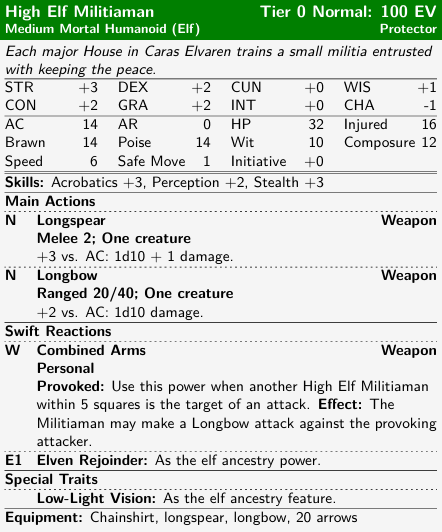
    For starters, let’s take a look at the High Elf Militiaman, who is representative of Caras Elvaren’s citizen militias.

    The Militiaman is very much a jack of all trades: it has a melee and a ranged attack, but neither is especially accurate or hard-hitting, and it has reasonable hit points but mediocre defenses. The thing that makes it interesting, as an enemy for the PCs to fight, is that it has a variety of ways to punish attacks against it and its allies:

    • Its Longspear melee attack, with reach 2, allows it to make an opportune strike before a PC can close to melee range with it (unless the PC also has reach, of course).
    • The Elven Rejoinder power allows it to possibly evade and counter when it is the target of an attack, and it can be used repeatedly if the Militiaman is successful in evading attacks.
    • The Combined Arms power allows multiple Militiamen to loose arrows at an enemy attacking a single ally among them. Since it, like Elven Rejoinder, is a swift reaction, these attacks can potentially preempt the provoking attack by bringing down an attacker mid-swing.

    In total, this means that a group of High Elf Militiamen, positioned appropriately, can force the PCs to suffer through a bunch of attacks in order to attack the Militiamen…but once the PCs get through all those attacks, the Militiamen will not stand up well to prolonged combat.

    Of course, if we coupled a group of Militiamen with other Protectors, they could become a real pain to deal with…

    Leoir-Type Ley Golem
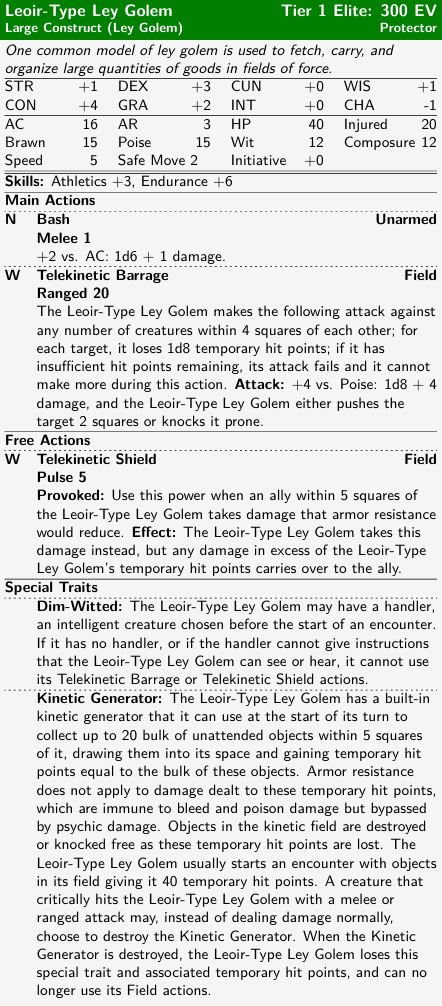
    Caras Elvaren’s labor golems are not intended to do any fighting, but as large, strong, durable machines, they could be repurposed for such. And that’s before taking into consideration the magic built into them…

    The Leoir-Type Ley Golem represents a general-purpose labor golem used for hefting and carrying heavy things. But since the high elves have such abundant access to magic, the Leoir-Type doesn’t just have a big pair of hands: it lifts things with magical fields…which can be repurposed to throw things like a miniature siege weapon.

    The core of the Leoir-Type is its Kinetic Generator special trait, which allows it to lift whatever objects are handy (crates, barrels, dropped weapons, rubble, etc., depending on the circumstances of the encounter) and form them into a floating ablative shield that absorbs attacks. You may note that the Leoir-Type has the hit points of a normal enemy despite being Elite, which is because it starts a typical encounter with temporary hit points making up the difference.

    • This is of course dependent on there being objects like this to pick up; one way to counter a Leoir-Type would be to lure it into an area clear of useful detritus, or use spells that cleared detritus away from it. Much of this would be up to the GM, but as always, I would encourage the GM to reward innovative tactics like this, and work with the PCs to give them some way of doing this.
      • I also suggest that if there are interesting objects for the Leoir-Type to pick up, it would be appropriate to change the damage type of its Telekinetic Barrage action (to, say, fire, if it had collected a bunch of alchemist’s fire vials…).
    • The other thing that could easily counter the Kinetic Generator is a lucky (or carefully-prepared) critical hit, crippling the arcane apparatus that generates the field. Attacks with critical threat, especially coupled with favor on attack rolls, offer a fairly good chance of getting such a critical hit. A critical hit early in the encounter can completely wipe out the Leoir-Type’s temporary hit points, a devastating blow.

    The Leoir-Type’s other abilities mostly build on Kinetic Generator: Telekinetic Barrage allows the Leoir-Type to throw the objects in its field, losing some temporary hit points but knocking enemies back, while Telekinetic Shield allows it to absorb damage for nearby allies.

    • Because Telekinetic Barrage drains the ley golem’s temporary hit points, it might be loath to make attacks if hard-pressed. This depends on how aggressively the GM chooses to play it (or its handler).
    • Telekinetic Shield, as a free action, cannot be used if the Leoir is staggered or otherwise prevented from taking actions. Staggering it, or attacking from ambush, could be used to attack another creature it is protecting without Telekinetic Shield coming into play.

    Finally, the Leoir-Type is Dim-Witted, and requires another intelligent creature to be its handler in order to use its more powerful actions. Attacking this handler is a great way to shut down those actions…but the handler will very likely be staying in range to benefit from Telekinetic Shield, and it might require some added effort to deal with the handler.

    Coupling a Leoir-Type with a group of Militiamen could drastically improve the Militiamen’s survivability, especially with proper tactics. But the Leoir-Type is just a civilian-grade ley golem that might be repurposed in grave circumstances. What would a purpose-built military ley golem look like?

    Sciath-Type Ley Golem
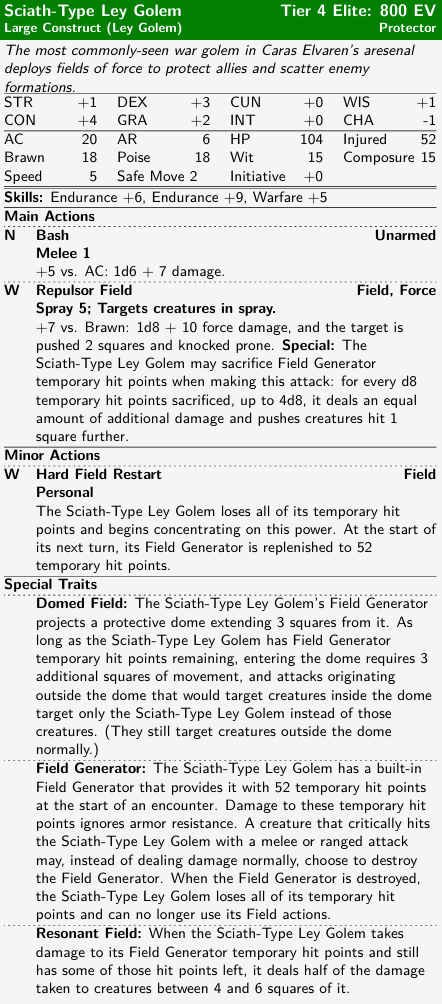
    Lorewise, the Sciath-Type Ley Golem is a militarized evolution of the Leoir-Type. It fills much the same role (intercepting attacks aimed at nearby allies) but achieves it with purpose-built magical fields, rather than by holding physical objects in the way.

    Much like the Leoir-Type, the Sciath-Type has a special trait that forms the core of its function in combat. Field Generator gives the Sciath-Type a fixed number of temporary hit points, but does not allow replenishing them in the way of the Leoir-Type’s Kinetic Generator. And, like the Leoir-Type, the Sciath-Type is vulnerable to critical hits. However, these temporary hit points do not form part of its “normal” hit points as an Elite enemy, and it still has other ways of replenishing and interacting with them:

    • The Domed Field special trait allows the Sciath-Type to passively absorb damage for nearby creatures. This works particularly well against area attacks, since if an attack targets several creatures inside the protective dome, the Sciath-Type only becomes a target of the attack once. However, the Domed Field can be countered easily by pushing inside the protective dome (although this will take some extra movement, and might require getting up close and then pushing in on the next turn).
    • The Resonant Field special trait disperses damage dealt to the Sciath-Type’s Field Generator temporary hit points…which makes that tactic of getting close and then pushing inside the protective dome a lot more dangerous. If the PCs decide to try and bring down the protective dome the hard way, by overwhelming it with attacks, they will need to stay well back while doing so.
    • Repulsor Field provides the Sciath-Type a great way of keeping the PCs away from it, especially if they have gotten close in the hopes of pushing through the dome on their next turns. It also offers the option of sacrificing the strength of its protective dome to deal more damage (and no, this does not trigger Resonant Field, since it is not actually taking damage).
    • Finally, once the Sciath-Type runs out of temporary hit points, it can perform a Hard Field Restart, restoring them to full with just a minor action and a round of concentration. The prospect of the Sciath-Type regaining 52 temporary hit points is a daunting one: fortunately, the PCs can prevent this, if they can manage to break the Sciath-Type’s concentration within a round.

    The best way to deal with a Sciath-Type Ley Golem might be to hammer its Domed Field from range, and then rush in and batter it to bits before it can restart the field. Other strategies include pushing into the protective dome and attacking from inside of it, or hoping for a lucky critical to cripple the Field Generator.

    I’m proud of the design of the Sciath-Type, not just as an interesting enemy to fight but as a bit of worldbuilding: I think that the parallels between it and the Leoir-Type show how Elvaren armorers adapted the capabilities of a civilian labor golem into a machine of war.

    Elvaren Sono-Artificer
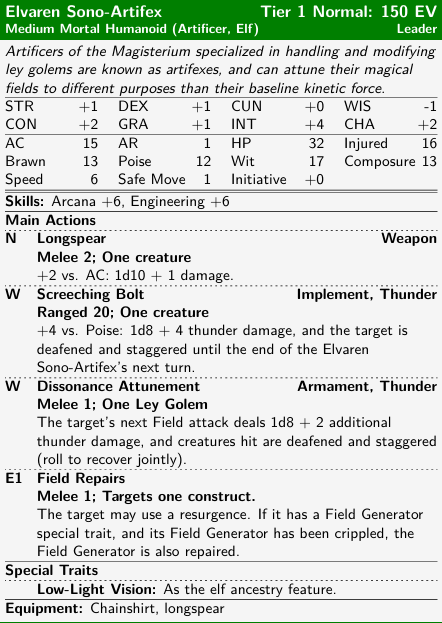
    As the last enemy discussed today, let me introduce the Elvaren Sono-Artifex, who is actually part of some apocrypha: at one point I got a bit carried away and designed a whole series of Artifex enemies, each a specialist in a different kind of magic, and able to tune ley golems’ fields to that kind of magic. But, in retrospect, they all filled the same kind of role, and took up entirely too much space in the Bestiary.

    Still, I like the idea of having artificers who (lore-wise) use Tinkering on their ley golems to produce different effects: perhaps I’ll put them in a supplement focused on Caras Elvaren, or something.

    The Sono-Artifex has a decent normal attack in Screeching Bolt, but its real value is in its support abilities.

    • Dissonance Attunement, an Armament power specifically for Ley Golems, allows them to deal additional thunder damage while also deafening and staggering (via disorientation) enemies hit.
    • Field Repairs allows the Sono-Artifex to restore a construct creature’s hit points, and also potentially fix a Field Generator damaged by a critical hit. This can drastically improve a Ley Golem’s hit points.

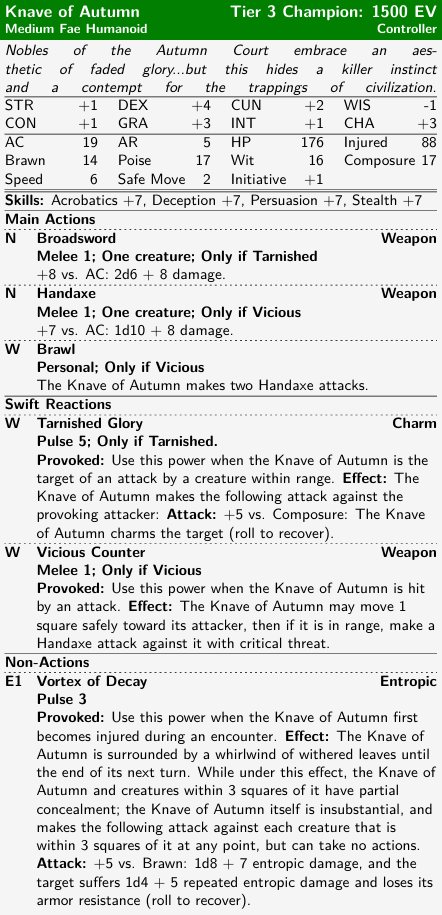
    Now, the GMH strongly discourages doubling up on Protector enemies in an encounter, which can turn it into a slog. But if the goal of an encounter were to demonstrate just how resilient the Elvaren military can be, with its advanced magics…I invite the readers to contemplate an encounter containing a Sciath-Type Ley Golem, Elvaren Sono-Artifex, and three or so High Elf Militiamen. At 1250 EV, this would be a decent challenge for five level 12 characters, and would feature a vast array of ways to deter and pre-empt attacks.

    Up Next

    I’m currently travelling, but I hope to get one more post out before the New Year…I just haven’t decided what yet. Assuming I can put together a coherent post from the various airport lounges I’ll be in for the next few days, the next post should be out on the 31st…otherwise it may have to wait for the 4th. Stay tuned!
  • As a special Boxing Day post, I’m going to revisit Ragnvald and Valdo, to provide them some magical items of their own!

    Ragnvald

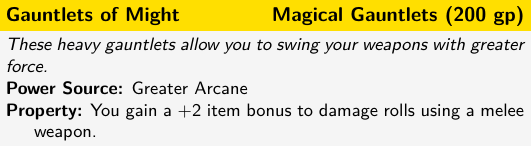
    One magical item that Ragnvald will seek out early on (he could easily afford to have them made around level 2) is a pair of Gauntlets of Might, putting some extra force behind the blows of his warhammer. This is a nice, straightforward enchantment, creating a pair of gauntlets (or gloves, or what have you) that grant an item bonus to melee weapon damage rolls. It does have the slight drawback that, unlike an enchantment applied directly to a melee weapon to grant that weapon a similar bonus, it does not actually make Ragnvald’s melee attacks magical. But, it does apply to any melee weapon Ragnvald wields in these gauntlets, making him less tied to a single melee weapon.

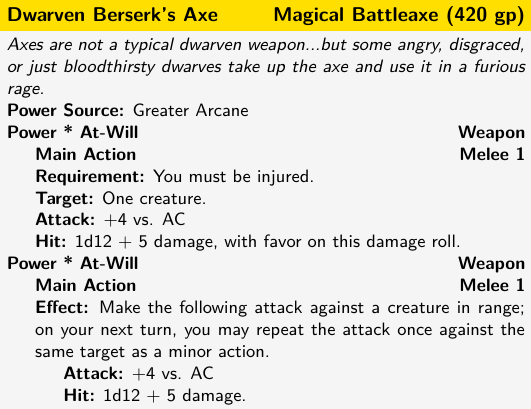
    Later in his adventures, Ragnvald obtains a Dwarven Berserk’s Axe…a magical weapon that he has conflicted feelings about. Not only is it not his preferred type of weapon (a hammer), not only does it prevent him from using his shield, but to top things off there are social connotations to dwarves wielding axes that he’s not eager to labor under. On the other hand, it’s an actual magical weapon…and one that lets him hit much harder than his warhammer, to boot.

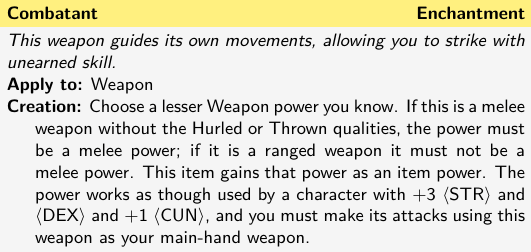
    The Dwarven Berserk’s Axe is created by applying the Combatant weapon enchantment twice to a battleaxe. Combatant allows a weapon to have a (limited-effectiveness) Martial power as an item power, and the Dwarven Berserk’s Axe gains the Furious Strike and Rapid Strikes powers. Wielding the Berserk’s Axe, Ragnvald can alternately unleash higher-damage attacks (using the favor on damage rolls of Furious Strike) or a series of many attacks that are still quite damaging (by repeatedly using Rapid Strikes and following it up with the extra attack as a minor action).

    While the powers of the Dwarven Berserk’s Axe do not use Ragnvald’s full abilities (being limited to +3 <STR>), it partly makes up for that with its greater power source, which conveys a built-in +1 item bonus to its own powers’ attack rolls and a +2 item bonus to their damage rolls. These item powers won’t be quite as good as Ragnvald’s inherent powers…but when Ragnvald really wants to do damage, and doesn’t need to focus as much on protecting his allies, the Berserk’s Axe gives him some niche options.

    The decision to carry, if not consistently use, a Dwarven Berserk’s Axe marks Ragnvald’s growing willingness to buck traditional dwarven society and his departure from his hard-line clan.

    Valdo

    Because of his frankly awful AC, Valdo will be looking for some defensive options early on. An Amulet of Deflection is one item that he would pounce on should it show up in a treasure hoard: while it doesn’t provide the same benefits as a suit of magical armor, it also doesn’t conflict with armor, allowing Valdo to use armor with enchantments that do other things than just granting bonuses to AC. And as a side note, the Deflection enchantment is also available for magical rings.

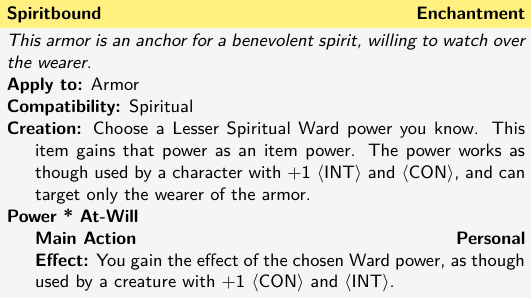
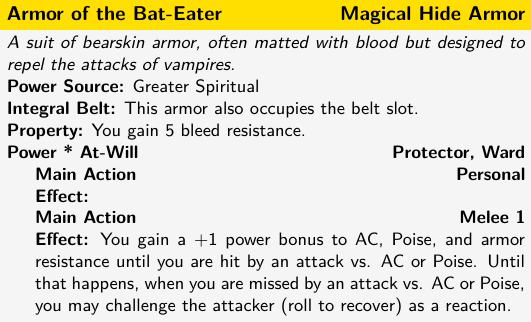
    As Valdo prepares to return to Der Eisenwald and complete his eradication of the vampire coven that forced him out, he will also commission himself a suit of what he considers vampire-proof armor, by invoking and binding the spirits of some of the vampires’ victims into a suit of bear-hide armor.

    The Spiritbound armor enchantment carries a Ward power with it, and Valdo (by swearing an oath to avenge the vampires’ many victims) is able to prepare a version of this enchantment carrying the Bond of Oaths power, which (aside from further improving his abysmal AC while the power is active) allows him to challenge foes who fail to hit him with their attacks.

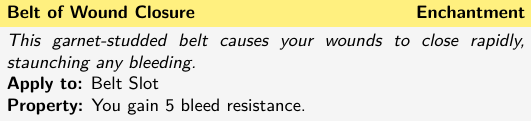
    His armor’s second enchantment is actually an enchantment for belt-slot items, but in commissioning this armor, Valdo will specify that the armor occupies the belt slot (as well as the usual body slot), enabling it to accept enchantments for the belt slot. This, in turn, allows him to apply the Belt of Wound Closure enchantment, giving him some sizeable resistance to bleed damage…such as that predictably dealt by vampires.

    With this armor, Valdo is now prepared to return to his monster-hunting roots, and conclusively deal with the nest of vampires that has so vexed him. After that…who knows what further adventures might lie in store?

  • Well, it’s Christmas Eve, and I’m going to wrap up creating Gwynne of House Midwinter. If it’s not clear, I couldn’t resist the urge to make Gwynne a tongue-in-cheek take on a Christmas elf, especially because (once I worked out what the timing would be) I’d be wrapping her posts up today.

    So like with the previous two sample characters, I’ll be finishing by showcasing one way that Gwynne could advance to level 5. Unlike with those two, I’ll also be showcasing some magical items that Gwynne will be making herself…

    Level 1

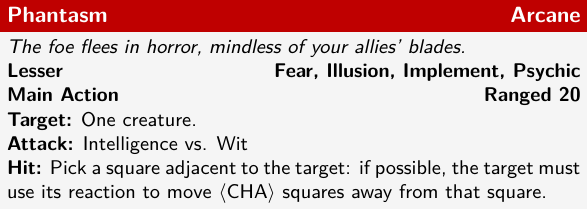
    By the time she gains her first level, Gwynne has only just gotten her first taste of adventuring. And one of the first things she will have picked up on is that she really, really can’t handle it when a bunch of Autumn thugs gang up and surround her. So, as a partial solution to this problem, she’s going to pick up Phantasm…which doesn’t directly solve her problem, but she’s saving up for a magical item…and in the meantime, she does have allies who will love getting to swing away as their foes flee.

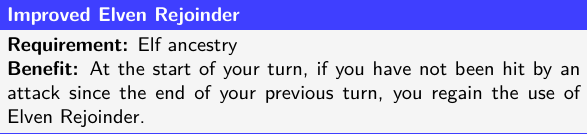
    She will also take the Improved Elven Rejoinder feat, allowing her a way of regaining her Elven Rejoinder power after it fails to save her from an attack. This is because, again, she keeps getting surrounded by enemies, and no matter how she tries to dodge, she inevitably gets hit eventually…

    As her level-1 perk, Gwynne will take Contacts, specifically with some old classmates from her Magisterium-run academy, who like her are not fond of the changes being wrought by the pact with Winter.

    Level 2

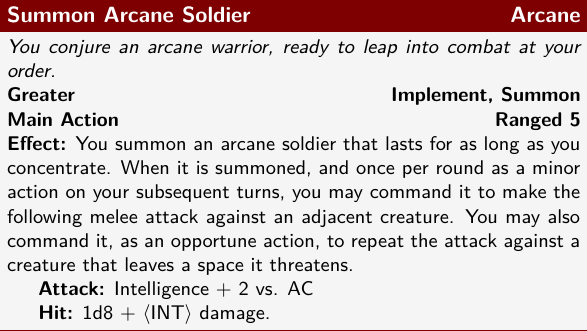
    Gwynne continues to expand on her capabilities as a force-multiplier, and in this case, she does so literally, picking the Summon Arcane Soldier power as an offensive version of her Summon Defender Construct power. This uses her concentration, but it synergizes very nicely with Phantasm. Unlike her Defender Construct summons, Arcane Soldiers have an actual attack, which they can make when summoned, then once per round using Gwynne’s minor actions, and as opportune actions when provoked by the movement of an enemy. As a greater power, Summon Arcane Soldier will not be repeatedly usable in a gadget, but it will make an excellent emergency tool for her allies, who can deploy it as a last-minute distraction as they make an escape, or to cause some chaos as they sneak by a group of guards. And if Gwynne chose, she could hand out a pair of these Gadgets to allies, and use the power herself, to summon a total of three of these constructs for an encounter.

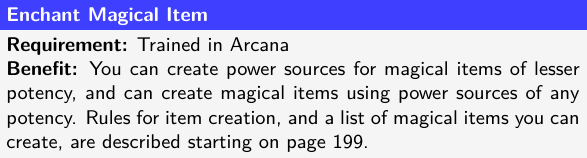
    Gwynne has by now saved up some funds that she will use to build herself a magical item…just as soon as she takes the Enchant Magical Item feat allowing her to do so.

    And now comes the question: what will she be making with this feat? Gwynne continues to have trouble handling herself in melee, with her abysmal <STR>, and so she will build herself a magical weapon overcoming that weakness.

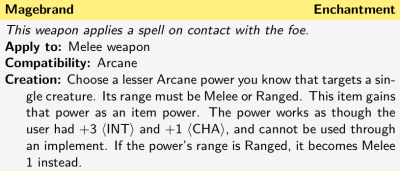
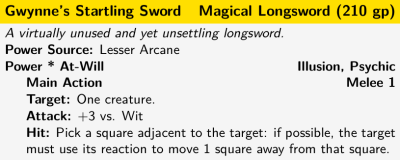
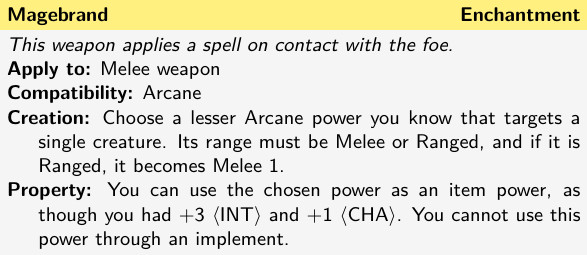
    The Magebrand enchantment allows placing an Arcane power into a melee weapon, and in the process turning the power into a melee power. Coupled with Gwynne’s Phantasm power, this creates a sword that can be just tapped against an enemy to make them flee into the waiting blades of Gwynne’s allies…or back off far enough that she can do some fleeing herself. To the left are the “raw” Magebrand enchantment, and the abbreviated form of the magical item made by applying it to Gwynne’s longsword.

    As her perk for this level, Gwynne will take the Esoteric Knowledge [Faerie Law] perk, giving her some additional insight into how Sidhe pacts work and how she might ensnare Winter-sworn agents using the wording of their bargains.

    Level 3

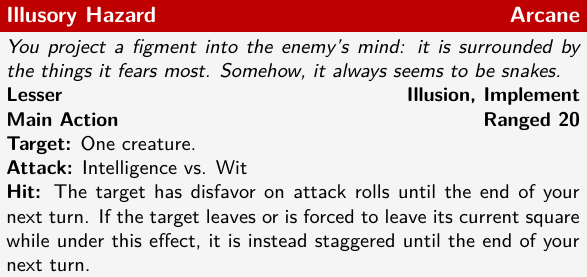
    Gwynne continues to find nasty tricks that combine with Phantasm, this time picking up Illusory Hazard. This power causes a foe to see themselves surrounded by dangerous things, which might by itself be enough to keep the foe from moving…but if it chooses nonetheless to move, or is forced to move by, say, Phantasm, it then becomes staggered. This combination is a little tricky to pull off on Gwynne’s own because of how quickly Illusory Hazard wears off, but if she passes one power or the other (or a Phantasmagoric Armament) to an ally, they can work together to use this to its full effect.

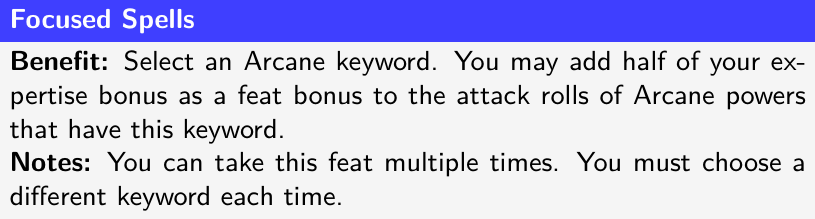
    At this point most of Gwynne’s attack powers have the Illusion keyword, and this seems like a good time to make them more accurate. The Focused Spells feat will let her add her expertise to her attack rolls with these powers, thus keeping up with the more powerful enemies she has begun to face.

    Gwynne is still a friend to all children, and as her level 3 perk will take Perform [Illusory Pantomime], allowing her to put on one-woman children’s plays. She no longer relies on a cast of actors to hang her illusions on, as she did in the service of House Midwinter’s solstice spectaculars, but conjures her cast out of thin air…which is also a handy way to distract the guards of the Houses she now suspects to be controlled by the Winter Court, as her allies sneak in to do some pilfering.

    Level 4

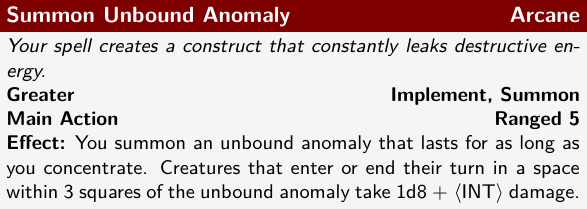
    Gwynne will keep picking up more spells to make enemies move and provoke opportune strikes or suffer the effect of Illusory Hazard. In this case, she picks up Summon Unbound Anomaly, another Summon power, but this time one that creates a dangerous, uncontrolled nexus of magical energies. While it deals damage, it does so without an attack roll, based on proximity alone: it therefore encourages enemies to either flee or use their attacks to destroy it (which is also a desirable outcome).

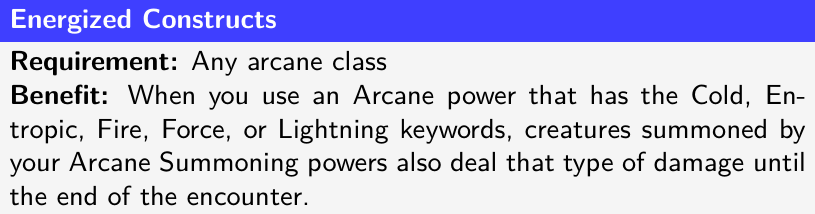
    And with the addition of this third Summon power to her repertoire, Gwynne will also take the Energized Constructs feat, allowing her to add the fire damage of her Fire Bolt power (or any other damage types she later picks up among her Arcane powers) to her constructs: a powerful tool against the frozen servants of the Winter Court.

    In their last adventure, Gwynne and her allies ensnared and exposed the leadership of a minor House as Winter-sworn agents. This came as no comfort to the rank-and-file members of the House, who were discovered to be suffering from a variety of Sidhe bargains that they had been tricked into. Gwynne has sworn to break the victims’ curses and return to them their memories, true names, and everything else that the Sidhe took from them, and is now a minor celebrity among those freed from Winter. Gwynne takes the perk Fame [Victims of the Winter Court].

    Level 5

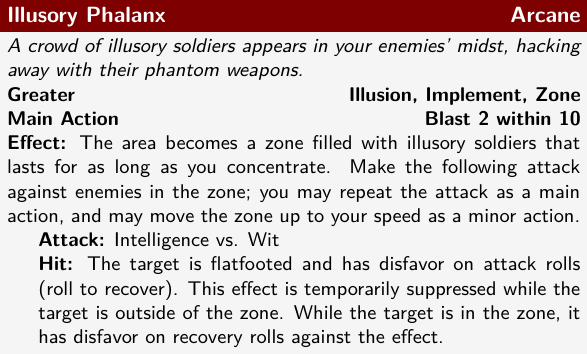
    As she hits level 5, Gwynne will lean further into trickery: she has a variety of summoning powers…but why not make it look like she has even more? The Illusory Phalanx power creates an entire crowd of images that Gwynne can make appear as a horde or shield wall of summoned creatures. Combined with actual summoning spells, Gwynne can make this especially convincing…and if she gets her allies to help out (since she can’t concentrate on both at once) she can scatter summoned Arcane Soldiers among the zone of illusions. Together, this creates an area in which enemies are distracted by the illusion, but unable to escape the zone without taking opportune strikes from the summoned creatures. And it only gets better if Gwynne’s allies themselves are in the zone and ready to strike as well…

    Because Gwynne now has so many tricks that rely on combining multiple of her powers together via Gadgets, it makes sense to let her create as many as possible. So, she will take the Extra Gadgets feat, giving her an extra Gadget that she can create during each rest (bringing her total to 3).

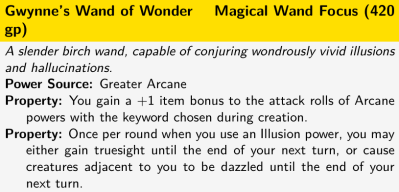
    Gwynne has now saved up some more funds, and (with the aid of a greater power source that she found in the vaults of a Winter-sworn agent she and her allies exposed), she will now make herself another magical item, this time a magical wand helping to make her illusions more convincing.

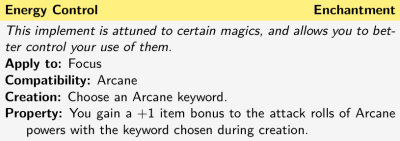
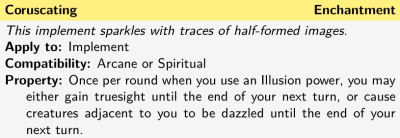
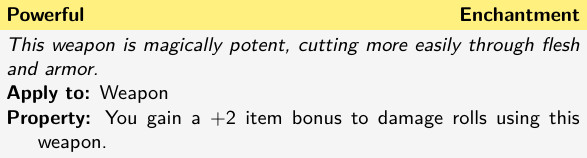
    A greater power source allows Gwynne to combine two enchantments on the same item: Gwynne will use the Energy Control enchantment to make her Illusion powers more convincing (i.e. having a higher attack bonus), building on the bonus she already has from Focused Spells. And the Coruscating enchantment will allow her Illusion powers to “spill over,” dazzling creatures around her, which is another way for her to get out of trouble if surrounded. (It applies to the melee-ranged version of Phantasm in her Startling Sword, too!)

    As her perk for this level. Gwynne will take Ritual Magic, and as her three initial choices will learn the rituals Dispel Curse (in order to, hopefully, free the victims of Sidhe curses), Fabricate (for its usefulness in creating cold iron weapons, which must not be worked with fire), and Planeshift (allowing her, and her now cold-iron-armed allies, to take the fight into Faerie itself).

    Up Next

    And that wraps up Gwynne of House Midwinter. In the next year, I’ll be putting together at least one more sample character in this blog, and having already revealed the Fighter, Skinchanger, and Artificer, I’ve decided that this next sample character will be an Inquisitor, a Divine class able to denounce enemies as wicked and bind them with holy magics. Keep an eye out for some polls where you can decide what kind of inquisitor this next character will be…

  • Picking up where I left off previously, today’s Gazetteer post will cover the government and society of Caras Elvaren, the magical post-hardship nation of the high elves.

    Government

    Caras Elvaren’s government has been described variously as “vestigial,” “impotent,” and “as close to anarchy as anything called a government can get.” The foundational principle that the nation should have no rulers has manifested in a system of government in which it is very difficult for anyone to exercise authority or accumulate political power.

    In principle, Caras Elvaren is a direct democracy, in which every citizen has a vote in the National Assembly. Of course, since actually attending sessions of the Assembly and casting a vote is more time-consuming than most elves would like, the House system has stepped in to fill the gap. As the smallest unit of political organization in the country, one of a House’s obligations is to aggregate and cast votes in the Assembly on behalf of its members. The exact mechanism by which a House does this is allowed to vary, and is generally written in to the House’s bylaws. Some merely act as an intermediary, aggregating the votes of members by ballot and reporting the totals to the Assembly. In others, the membership chooses a delegate trusted to make decisions on their behalf, and throws their collective voting power behind the delegate’s decisions. Many Houses exist for the sole purpose of providing members effective representation in the Assembly, and make no claims on their members’ share of the golem or magic ration except what they need to conduct accurate polls and organize votes.

    The Assembly nominally has the power to pass laws binding all Elvaren citizens, but given the anti-authoritarian leanings of most Houses, it rarely passes any but the simplest and least controversial laws. Murder, theft, arson, and other straightforward crimes against the person or property are naturally illegal throughout Caras Elvaren, and those committing these crimes are investigated, detained, tried, and sentenced by Arbiter Houses that have been recognized by the Assembly to be temperate and even-handed arbiters of justice. Many Houses have laws of their own, but these govern only their own members, and they cannot impose prison sentences or corporal or capital punishment. Punishments for crimes within a House are most often social or financial, with the harshest possible punishment being ejection from the House with the nature of the criminal’s offense being publicized for the benefit of the general public. Minor crimes between Houses, if the victim does not receive satisfactory compensation from the perpetrator’s House, can be taken to arbitration by one of the Arbiter Houses for a small fee.

    The Assembly also historically had the power to determine the level of support the elven people would grant the Magisterium, in the form of labor, food, and other supplies levied from each House, and the amount of magic the Magisterium would return to the people, in the form of mage-hours. Since the development of the ley taps, the nature of this power has changed: since the golem labor force supplies virtually all of the labor underpinning Elvaren society, the Assembly instead negotiates with the Magisterium to determine the balance of golem-hours and mage-hours the Magisterium will grant the elven people. While both have steadily increased over the years, in general when the Assembly requests an increase in mage-hours to support the magic ration, the Magisterium counters by reserving more golem-hours for itself as compensation. The Assembly also determines how golem- and mage-hours will be allocated, dividing them between the common rations granted to all citizens, and additional grants given to Houses that perform needed and beneficial work for the good of the nation, like the Arbiter Houses.

    The Assembly is led by an elected Speaker, who in theory has the power to make demands of any House in the nation, or even the Magisterium itself. However, this power is essentially useless, because a House can at any time withdraw its support of the Speaker: if the Speaker made any demands that the Assembly did not already agree upon, they would promptly cease to be Speaker. Speakers’ actual power, such as it is, is limited to conducting Caras Elvaren’s foreign and military affairs, and even then, they are subject to close and contentious oversight by the Assembly.

    Outside observers have noted that Elvaren society rests precariously on the political neutrality of the Magisterium. If the elven arcanists had any political ambitions, they would be able to withhold both golem labor and the magic ration, grinding the nation to a standstill. Those with a closer viewpoint understand that the Magisterium, in its dual functions as educators and guild for Caras Elvaren’s arcanists, actively promotes a culture of detached disinterest in worldly affairs among its membership. From their enrollment as students onward, members of the Magisterium are encourage to enjoy the material comforts that their membership offers, delve into esoteric magical studies, and seek advancement in the Magisterium’s convoluted system of ranks and grades. And if all else fails, they can always be embroiled in interdepartmental rivalries and bureaucratic red tape to keep them too busy for actual politics.

    An often-overlooked third arm of government is composed of Caras Elvaren’s military Houses. Because Caras Elvaren does have a military, even if it is small and almost as anarchic as the rest of its government. Most of the nation’s armed forces are citizen militias, organized as joint ventures between the Houses of various townships, but these are trained and backed by a solid core of professional soldiers belonging to a handful of militarized Houses. These Houses are trusted with powerful arcane weaponry, including enchanted arms and armor, potent war-golems, and other destructive magics not known to the public. But they are entirely dependent on the continued goodwill of both the Assembly and the Magisterium, who can cut off the flow of supplies or magic if a militarized House shows signs of going rogue.

    Political Situation

    At present, there are three contenders for the de facto Elvaren head of state, each one representing one of the three arms of government. Gwetheir ap Wridd is Archmage of the Magisterium, and largely preoccupied with operating the ley taps and golem corps and ensuring that they continue to meet the growing demands of the citizenry. Melianthe Cerunna is Speaker for the Assembly, and is largely responsible for this preoccupation, having rallied the Assembly to demand a steady increase in the golem ration. The third member of this triumvirate is Brynmor, Princeps of House Meilyr, which is one of the largest militarized House.

    The largest political problem facing Caras Elvaren is the reappearance of the Sidhe, and their attempts to reassert their dominion over the elven people. Of particular import is the Autumn Court, which has taken the utopian abundance of Caras Elvaren as a grave affront. The Court has made several attempts, of increasing scale and success, to sabotage ley taps and subvert golems. The most recent of these saw a labor golem cadre used to breach security at a major ley tap and send it into an intentional overload. Although it was prevented from detonating by the efforts of its Magisterium operators, at the cost of their lives, the tap still underwent a meltdown that left large parts of its city magically irradiated and uninhabitable.

    In the aftermath of the meltdown, at least one House secretly took a once-unthinkable step, and entered into a pact with the Winter Court to prevent any further attacks by the other Courts. Winter’s first act after the pact was sealed was to disclose to the Assembly the presence of numerous agents of the other Courts in various Houses–though not, of course, their own. Nor has the House that made this pact come forward, or been named by Winter. The existence of so many Sidhe-sworn agents in their midst, including an entire House sworn to Winter, has broken much of the trust among the Houses at a time when a unified front is most important. The Archmage, Speaker, and Princeps are each pursuing their own contingency plans to deal with the attacks by Autumn and the pact with Winter, but since they cannot be absolutely sure of the others’ allegiance, are not cooperating and often working at cross-purposes with each other.

    Foreign Relations

    Caras Elvaren is on broadly good terms with each of Aetrimonde’s other major polities, but is not close with any. It was instrumental in brokering the peace at the end of the Wars of Smoke and Steel, having remained largely neutral throughout, but remains aloof and hands-off with the rest of the world.

    This is largely because of the country’s use of the ley taps: other nations would eagerly adopt the technology that powers the elves’ high standard of living…but the elves are painfully aware that the same technology can be used to create enormously destructive devices. More to the point, they are loath to let details of the technology spread outside the Magisterium, in fear that this knowledge could be used to sabotage their own ley taps. Caras Elvaren is therefore incredibly cautious about letting foreigners even lay eyes on the inside of a ley tap, and has collectively decided that the best way to keep the technology to themselves is to hold themselves apart from the rest of the world.

    That aside, the high elves are generally altruistic, even philanthropic, in their dealings with other nations. They export vast quantities of healing potions, produced with the aid of the ley taps’ magic, alongside other humanitarian magics, and they do so at or below cost in many cases. This earns them a certain amount of goodwill, even as foreigners grumble and protest their unwillingness to share the underlying technology that makes them possible.

    Society

    Elvaren society is one of leisure and self-fulfillment: with no real need to work, most citizens spend long stretches of their long lives engaged in arts, self-improvement, or just plain idleness. They move between Houses often, based on which one best serves their current interests. Virtually all citizens eventually find a calling, whether that is art, scholarship, service, or some other field, and devote themselves to it even if they do take frequent sabbaticals.

    In Caras Elvaren’s earlier history, members of a House generally lived under one roof. This is no longer generally the case, although most Houses have a headquarters compound where the House leadership resides, and a House whose members are all engaged in some joint activity (like artists’ colonies or sporting teams) often has them living together. But for the most part, members of a House can obtain its benefits without all living together.

    Architecture

    Caras Elvaren is heavily urbanized, but with much attention paid to making its cities fit seamlessly into their surroundings. Many Elvaren cities are located in the middle of forests, with tall, graceful towers artfully built to pierce through the canopy without unnecessarily disturbing the trees. Elvaren city-dwellers largely live on top of each other, with the tallest towers stretching to twenty or thirty floors of living space.

    However, the tallest structure in any Elvaren settlement is invariably the local ley tap, which while not always the center of the settlement, is generally close by. Despite many efforts by Elvaren architects and ley engineers, it is impossible to disguise the distinctive hourglass shape of a ley tap without compromising on its efficiency. More modern installations have attempted to place ley taps in depressions and surround them with towers to minimize their impact on the skyline, with mixed success.

    Economy

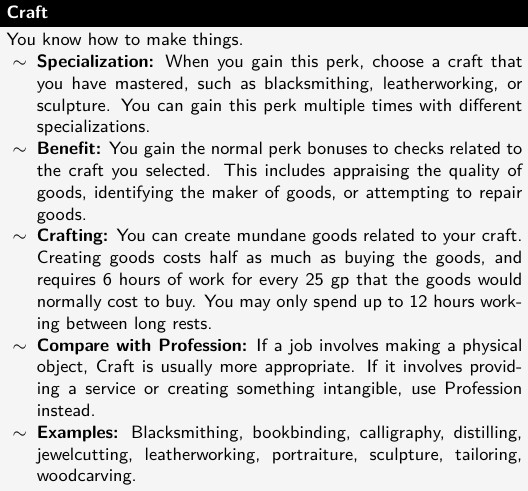
    While Caras Elvaren’s golems perform most of the drudge labor that supports their post-hardship standard of living, this does not supply everything that people need or desire. A citizen can draw on their basic ration for raw materials like timber and cloth, and even some simple manufactured goods like eating utensils and clothing, but everything the golems produce is utilitarian and unadorned. The artisan economy consists of skilled and even hobbyist craftspeople who transform golem-made materials into finer goods for the discerning customer, or provide services (like musical performances or specialist education) that the golems do not.

    While the basic ration has a monetary value, and for ease of accounting uses the standard gold, silver, and copper pieces to set “prices” for the various goods and services that the golems can supply, it is purposefully difficult to convert the basic ration into hard money instead of a value in a ledger. Citizens can sign over fractions of their ration to merchants in exchange for goods and services, but to get cash for it requires redeeming it for goods and then physically transporting them to a merchant who will pay for them, and this is technically fraud (although there are so many ways around this law that it is seldom prosecuted). Actual money in Caras Elvaren nominally has to be earned, through labor performed for other people or by doing something that the Assembly has allocated grant funding for.

    Many Houses are formed to give a group of citizens a legal framework to pool their resources in a common enterprise as part of the artisan economy. When joining an Artisan House, citizens are generally required to sign over a percentage of their basic ration on an ongoing basis, which the House can then put towards its enterprise. Usually, this means buying tools and workspace that the members share, but in larger and more established Houses it might also be spent on continued professional training for members, or subcontracting other Houses to do less specialized work.

    Religion

    For a society with such heavy emphasis on the arcane, citizens of Caras Elvaren are surprisingly devout. Part of this is simply that with so little need to toil, they have more time in which to contemplate spiritual matters…and part of it is that the largest religion in the nation is the worship of Deum Reveling, god of among other things art, music, theater, and what might be loosely termed “living the good life.”

    If one were to pick a date and an Elvaren town at random, it would be virtually guaranteed that there was some kind of religious festival (probably for Deum Reveling, who is also the god of festivals…) going on there, or at the very least, in a neighboring town. High elven religious practices tend to lean toward lavish ceremonies rife with symbolism, allusion, and interpretive performances, and are very light on dogma and liturgy, which makes them opaque even to fellow-worshippers of the same gods but different traditions.

    Plot Hooks

    Caras Elvaren offers a variety of ways to work it into a campaign:

    Encounter Hooks

    • An inexperienced ley golem handler has given their charge some incredibly conflicting orders, and it is now running amok through a busy market. As customers trying to shop in that market, the PCs must either figure out how to break the golem out of its cycle of ill-conceived instructions…or just hit it until it stops moving.
    • An arcanist among the PCs has grievously offended a Magisterium arcanist, who complained and got the PCs blacklisted by the entire Magisterium…just as they were hoping to buy some magical equipment. The PCs must find some way to resolve the grievance, which might involve doing the arcanist a favor, or alternately, showing them up in a formal arcane duel.

    Adventure Hooks

    • The PCs have been hoodwinked by a past employer, who has paid them in Elvaren ration scrip…which can only be redeemed in Caras Elvaren, and only for goods and raw materials for which they have little use. They must find some way to convert the scrip into hard cash, which will likely involve a trip to Caras Elvaren.
    • An Elvaren artificer has broken with the Magisterium, and is selling advanced weaponry to the highest bidder…and they claim to know how to build a ley tap. Nobody wants that kind of armament getting out in the wild, and there is a price on the artificer’s head…for anyone willing to fight through their now very well-armed customers.

    Campaign Hooks

    • The pact with Winter has insulated Caras Elvaren from the depredations of the Autumn Court, but Winter’s influence is no less dangerous. The PCs belong to an organization that wants to rid Caras Elvaren of Sidhe influence, which will mean exposing and neutralizing the agents of Winter who swore the pact…and then fighting off Autumn and any of the other Courts that renew their operations. Ultimately, it may even mean breaking the Sidhe’s source of power, or gaining such an advantage over them that they can be forced into a pact that constrains them.

    Up Next

    Next week, I’ll be wrapping up this series on Caras Elvaren by revealing some characteristically Elvaren foes, including a variety of ley golem. Stay tuned!

  • I’m almost done with Gwynne of House Midwinter, elf artificer (and blatant holiday elf…). Today, I’ll be filling in the numbers based on all the choices made in the previous posts.

    Health and Healing

    As an artificer, Gwynne has a base of 24 hit points; expertise brings that to 28, and +1 <CON> will bring it up to 32, making her squishier than either Valdo or Ragnvald. Her injury value will be 16.

    The artificer class also provides 3 base resurgences, increased to 4 by Gwynne’s <CON>. A resurgence or other large heal will restore 1d10 + 2 hit points.

    Gwynne has fewer hit points than Ragnvald, or even Valdo, and I think that reinforces my decision to design her as a support character. She won’t be able to take a lot of hits, and should remain far from the thick of a fight.

    Defenses

    As always, defenses are 10 + half Gwynne’s expertise bonus (+1) + some other relevant values:

    • AC: 15 = 11 + 3 (maille shirt) + 1 (<GRA>)
    • Brawn: 12 = 11 + 1 (<CON>)
    • Poise: 12 = 11 + 1 (<GRA>)
    • Wit: 17 = 11 + 2 (artificer) + 4 (<INT>)
    • Composure: 13 = 11 + 2 (<WIS>)

    So Gwynne is going to be getting hit a lot, except by attacks vs. her Wit (like illusions, feints, etc.). She can perhaps fix that by using her Ward power on herself, which will do a lot to protect her against AC and Poise.

    Attacks and Damage

    Gwynne has only three attacks worth noting: her longsword, her longbow, and her Fire Bolt power. Each uses a different ability:

    • The longsword, using <STR>, has a +2 precision bonus, but with -1 <STR>, the total attack bonus will be a paltry +1, and it will deal only 1d8 – 1 damage.
    • The longbow will be a little bit better: with +1 precision and +1 <DEX>, it will have a +2 attack bonus and deal 1d10 + 1 damage. (No risk of rolling 0 damage here, although it will still suffer heavily against anything with notable armor resistance…)
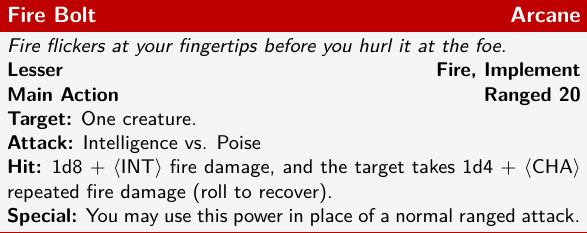
    • However, Fire Bolt is much better, since it uses Gwynne’s +4 <INT>. With a +4 vs. Poise attack bonus, dealing 1d8 + 4 fire damage and 1d4 + 2 (based on +2 <CHA>) repeated fire damage, this will be Gwynne’s mainstay when she has to do her own fighting.

    Skills

    Gwynne’s maille shirt comes with a -1 encumbrance penalty, which must be factored into her skills:

    Acrobatics +0History +6 (Trained)Persuasion +2
    Arcana +6 (Trained)Insight +4 (Trained)Religion +4
    Athletics -2Intimidate +2Society +4
    Deception +2Medicine +6 (Trained)Stealth +0
    Endurance +0Nature +4Subterfuge +2 (Trained)
    Engineering +6 (Trained)Perception +2 (Trained)Warfare +4

    Gwynne has broadly decent skill bonuses, thanks to her high <INT> being used in knowledge skills like Nature, and her moderate <CHA> being used in social skills. Where she suffers is in physical skills, where she has poor-to-awful abilities, not to mention encumbrance.

    Movement

    With base speed of 6, a maille shirt with no movement penalties, and +1 <GRA>, Gwynne is moderately mobile: she can, at least, step back away from an attacker in order to throw a Fire Bolt, although if she gets surrounded she may have trouble getting away. The Lightfooted elf feature will also be helpful when she needs to move through rough terrain.

    Carrying Capacity

    Gwynne’s -1 <STR> will give her a low carrying capacity at 40kg of bulk. Between her armor, weapons, and various other pieces of kit, she’s already pushing this limit a little bit.

    Initiative

    Like Valdo, Gwynne has +0 <CUN> and thus +0 initiative, meaning that she’ll generally not be going first in a fight. Unlike Valdo, Gwynne doesn’t have the powers that would reward ambushing. This isn’t actually the worst thing: as a support character, going later in the initiative order can let Gwynne see what the other combatants do and then provide healing and support as needed.

    Up Next

    Gwynne is almost finished: like Ragnvald and Valdo before her, I’ll wrap up by walking through one way that she could advance through the first few levels of her adventuring career. And, since I’ve now introduced some of the mechanics behind magical items, we’ll be covering some items that she might find, buy, or make during those levels!

    In the meantime, here’s Gwynne’s level-0 character sheet:

  • Today, in order to provide some additional context for Gwynne’s backstory, I’m going to present some of the lore of Caras Elvaren.

    Summary

    Caras Elvaren was first settled during the Age of Glories by elf dissidents and exiles looking to avoid the attentions of the sorcerer-kings of Caras Seidharen. During the Collapse, these scattered enclaves banded together, took in elven refugees from the east, and built themselves into a more egalitarian successor to the Seidharen magocracy. Today, Caras Elvaren is a post-hardship (though not yet post-scarcity) society, built on the tireless labor of automata, fueled by an endless supply of magical energy drawn from Aetrimonde’s ley lines…but this utopian state of affairs is a delicate one, supported by fragile infrastructure that certain forces now work to dismantle.

    Vital Statistics

    Official Name: Caras Elvaren
    Capital: Cathrach Talsien
    Official Head of State: None
    De Facto Heads of State: Gwetheir ap Wridd, Archmage of the Academy; Melianthe Cerunna,
    Speaker for the Assembly; and/or Brynmor, Princeps of House Meilyr, depending on who you
    ask.
    Primary Inhabitants: Elves, trolls, gnomes
    Currency: Statum (gp), obol (sp), morion (cp). Also drachma (electrum, 4 sp).

    Founding

    In order to understand how Caras Elvaren became what it is today, one must start by discussing its predecessor. The ancient elven kingdom of Caras Seidharen was the most magically advanced nation of its age, but this did not make it a pleasant place to live–quite the opposite, in fact. It was a magocracy, a government ruled by the magically talented, and in these elder days before wizardry and artifice became widespread, this largely meant rule by sorcerous bloodlines and the occasional warlock whose studies into Aetrimonde’s deep magics bore fruit.

    In such an environment, magic became a tool of oppression: the rulers of Caras Seidharen bound invisible spirits to serve as spies, and used geases to compel their subjects to inform on their neighbors. And what magic was not used to ensure their continued reign, they expended on vanity projects like palaces made of enchanted glass and fountains that spouted and endless supply of wine. The concept of turning magic to civic purposes–of using it to raise the standard of living for lesser talents, or even the nonmagical population–was not even considered.

    The sorcerer-kings and witch-lords of Caras Seidharen collectively had grand territorial ambitions, and so they permitted their subjects, especially the troublesome and discontented ones, to leave and establish colonies in distant lands. These colonies were forced to remain small (to prevent them from forming a center of power to rival Caras Seidharen) and insular (to keep them from forming ties with rival powers), but other than that they were largely ignored, and in some of them, the seeds of rebellion took root…

    If not for the Collapse, there might eventually have been a civil war as Seidharen colonies broke away from their homeland. But as it happened, the Collapse saw the center of Caras Seidharen’s power destroyed, its rulers killed or vanished, and many common elves displaced. Many of these refugees found their way to former colonies, and in the cluster of colonies that would become Caras Elvaren, the refugees’ shock and horror at the pointlessness of the Collapse mingled with the locals’ rebellious leanings, forming the basis of a new political philosophy.

    Caras Elvaren was founded on two principles. Firstly, there ought be no laws or rulers except those that the people consented to. And secondly, magic should serve the welfare of the people, not the other way around. Building a functioning society on these principles required a delicate balancing act: on the one hand, it was necessary to place constraints on the use of magic, to ensue that practicioners did not wind up in charge again; but on the other, in order to have magic used for civic purposes, it would be necessary to reward practicioners for practicing magic and putting it to constructive ends. The resulting compromise has come to be called the Arrangement: so long as arcanists refrained from exercising political power and employed their magic in the service of the people of Caras Elvaren, the people would ensure that arcanists enjoyed a privileged and relatively luxurious position in society.

    Early History

    The first few centuries were rough on Caras Elvaren, as they were for most nations in the wake of the Collapse. The influx of refugees badly strained the colonies that had banded together under the Elvaren banner, and at times there were struggles to keep the citizenry fed.

    The system of rationing imposed during these harsh times led to the first of Caras Elvaren’s enduring civic institutions, the House system. Initially, rations were issued to family units, but this rapidly proved inefficient: in light of the lack of housing, communal living became the norm, and having a member of each household individually collect and then re-pool their rations was cumbersome. The rationing system rapidly evolved to issue rations to each household based on the number of people living under each roof, for ease of administration (and because it allowed for a fairer distribution of rationed products, like firewood, that could be shared by larger groups). Distributing the household’s rations among its residents then became a matter for the household to settle privately. Because it was possible (though sometimes difficult, in those early years) for elves to leave one household and join another, taking their ration entitlements with them, many systems were devised for fairly distributing a household’s rations.

    Among the rations issued by the fledgling Elvaren government was the magic ration, entitling a household to the work of an arcanist under the Arrangement for a fixed number of hours per year. Initially, citizens largely used the magic ration on an individual basis, requesting magical healing for injuries sustained in their flight from Caras Seidharen, magical repairs to tools and belongings, or just magic to help carry heavy loads or clear land. However, as the initial crisis passed, households were able to use their magic rations for permanent improvements, like magical lamps and heat sources that replaced the need for oil and firewood. Larger households pooling and saving up their magic rations could arrange to employ an arcanist year-round to give them good weather for their crops, or commission enchanted tools like self-propelled plows or automated spinning wheels.

    These magical conveniences remained the province of large and well-organized households, however, and as households grew and merged to take advantage of these economies of scale, it began to stretch the definition of “household.” As some households reached hundreds of members, and their actual houses became sprawling compounds that nonetheless still shared one roof, it became necessary for the Elvaren government to recognize this consequence of their rationing system, and loosen the legal definition of households. Under the new title of Houses, households became the smallest unit of political organization in Caras Elvaren: while it would no longer be required for all the members of a House to live under one roof, the government would issue rations to the House based on its membership, and it would be up to the House’s leadership to divide the rations fairly. And because leaving a House would no longer even necessarily require moving out, this further encouraged House leadership to set up, and adhere to, fair and equitable rules.

    Meanwhile, the Arrangement and the magic ration led to a similar system of rules and rations among Caras Elvaren’s arcanists. The need to organize arcanists into work details in response to citizens’ use of their magic rations, and to train more arcanists in response to the demand, led to the creation of the Magisterium, an organization that became one part arcanists’ guild, one part academy of magic…and one part self-regulatory body, ensuring that its membership held to the Arrangement. Arcanists who agreed to answer requests made using the magic ration, and to keep far away from politics, could expect to be housed, fed, and clothed sumptuously in the Magisterium’s facilities. And the Magisterium set rules for which of its members could take which work requests, creating systems of professional certification, seniority, and so on that ensured citizens could expect a consistent response to their use of the magic ration. Cynical minds have often observed that with all the workplace politics of the Magisterium, it’s no surprise that Elvaren arcanists have generally been willing to stay out of ordinary politics…

    Recent History

    In 319 AAC, a journeyman artificer in a backwater Magisterium tower simultaneously blew himself out of a third-story window and made a discovery that redefined Caras Elvaren’s approach to magical engineering. Arcanists since time immemorial had known about Aetrimonde’s ley lines, naturally-occurring flows of magic deep beneath the earth. In a few places where these flows came closer to the surface, it was possible for magicians to harness them, gaining a noticeable increase in their spells’ power. The journeyman, of the name Aediswyr, had idly wondered if a magical device could be made to tap into a ley line–and his fourth prototype was so unexpectedly efficient at doing so that the resultant flow of magic overwhelmed the device’s physical form, the safety circle containing it during the test run, and the emergency ward that Aediswyr, already moving towards the window, hastily put up between him and the explosively overloading device.

    The Magisterium could hardly fail to notice such a discovery, and Aediswyr received both a promotion in grade and an official caution for insufficient safety precautions before he was out of his sickbed. Aediswyr’s Ethereal Resonator was reverse-engineered1 by the Magisterium to safely harness the energy it drew from the ley lines. It was an overwhelming success, and the most pressing question in the higher ranks of the Magisterium overnight became what to do with such an abundant power source. It was eventually pointed out that if positioned with enough precision on a junction of ley lines, the Ethereal Resonator could be scaled up almost indefinitely, to the point that a sufficiently large model could remotely power typical magical devices for miles around, even with the enormous efficiency losses such a use would incur.

    The first ley tap, as the facilities are known, went online two years later in a remote farming village, where it proved capable of powering the entire community’s specially-enchanted magical farm implements. “Specially-enchanted” is perhaps a misleading term, because the only thing special about the enchantments was their lack of an internal power source: the ley tap enabled the creation of commercial-grade magical items as much as 90% more cost-effectively, and was quickly rolled out across Caras Elvaren.

    Three centuries of abundantly available magic has transformed Caras Elvaren. Not content to just power enchanted tools, the Magisterium’s Ley Tap Commission put to work every artificer they could spare building a golem labor force powered by the taps. The golems, organized and administrated by the Magisterium, have now replaced virtually all hard physical labor in the nation. Their labor produces the bulk of Elvaren food and raw materials, and an increasing share of other goods and services including clothing, housing, and transportation. And, under the auspices of the Magisterium, all citizens are entitled to a share of the golems’ labor: enough to live stably and securely, if not lavishly, on–and if they want a greater share, they can earn it, by spending just a few hours per week working as a handler for golems on tasks that require supervision.

    The ley taps and the golem workforce have made Caras Elvaren a relative utopia. But for those in the know–the arcanists of the Ley Tap Commission and the Golem Labor Administration–it is a very delicate thing, reliant on advanced magi-machinery and thaumaturgical engineering.2 All of Elvaren society is dependent on the taps, the golems, and the bureaucracy that manages both; if something in this system were to break, if the institutions that support it were somehow disrupted, it could easily lead to starvation and chaos. And that is before considering that the ley taps, machines a hundred meters and more tall, are themselves based on a device that exploded in its first test run…

    Up Next

    Check back next week for the second part of this series, covering Caras Elvaren’s society, politics, and current events!


    1. Aediswyr protested the usurpation of his personal project by the Magisterium, and was reminded that any spell, enchantment, or device produced by an arcanist working under the auspices of the Magisterium became the intellectual property of the Magisterium, to be held in trust for future generations of the Elvaren people. ↩︎
    2. Aediswyr himself had a brief career in the Ley Tap Commission, which he ended by resigning in protest of the plan to place ley taps in populated areas. He spent more than a decade publishing increasingly unhinged pamphlets decrying the use of his invention, before vanishing. Conspiracy theorists have connected his disappearance to an industrial accident the next year, in which the prototype of the Mark II Ley Tap underwent premature initiation and melted itself into a thousand tons of magically-polluted slag. ↩︎
  • In today’s post, I’m going to be picking out the powers, feat, and equipment for my elf artificer sample character, Gwynne of House Midwinter. I’m also going to be taking this opportunity to introduce three new power keywords that define some unique kinds of power: Armament, Ward, and Summon. While not unique to Arcane powers or artificers, I think these powers work incredibly well with the concept I have for Gwynne, and I’m also going to be putting some extra thought into how these powers interact with her Gadgets class feature.

    Powers

    I’m envisioning Gwynne as largely a support character who aids her fellow PCs but doesn’t directly do a lot of fighting. So, the list of things I want her powers to be able to do will revolve around how her powers help an ally:

    • Help an ally hit harder.
    • Help an ally avoid and survive attacks.
    • Distract or keep enemies away from an ally.
    • Attack an enemy.

    As an artificer, Gwynne’s Healing Ward already covers “heal an ally,” so at least initially, I won’t be looking for ways to double up on that. And “attack an enemy” is as much for Gwynne herself to have an attack option as it is for her to be able to put it in a Gadget and hand it off to an ally.

    The next consideration, after deciding what Gwynne’s powers should be able to do, is how they should do them. Arcane powers are divided into roughly ten Schools, each one focused on a specific keyword like Fire, Force, Illusion, Teleport, etc. Most of these Schools contain powers filling each of the four niches above, but differ in the specifics. (Fire powers set things on fire, Force powers throw enemies around, etc.)

    As mentioned in the skeleton I’ve already come up with for Gwynne’s backstory, the elves of House Midwinter organize solstice celebrations involving grand spectacles and cunningly-made toys and knickknacks. As an artificer, Gwynne already has “knickknacks” covered through the Gadgets feature; to cover “grand spectacles,” I’m going to lean into Illusion magic

    So let’s see what we can do with these goals in mind:

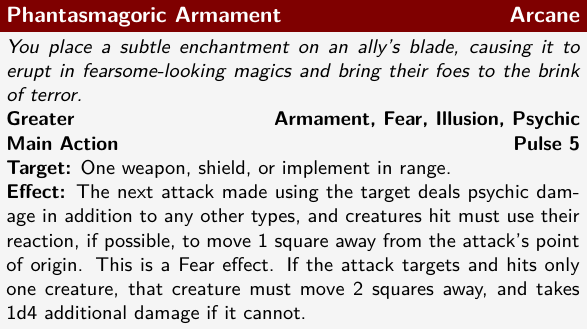
    “Help an ally hit harder” is exactly what Armament powers are for. These power target not an ally or an enemy, but an object: specifically, a weapon, shield, or implement. Equipment under the effect of an Armament power becomes mildly magical, enough to overcome some damage resistance as described in my post on magical items. But all Armament powers have further effects, causing the affected weapon to deal additional damage and have additional effects with its attacks.

    Phantasmagoric Armament leans toward effects over damage: it allows an ally to make a single attack that causes creatures hit to flee, possibly provoking opportune strikes if used judiciously. If this attack is used against a single foe, they must flee further, and take additional damage from the attack. (About half of all greater Arcane Armament powers have an effect like this, that is more powerful if used on a single enemy.) And the attack also deals partly-psychic damage, which is useful for overcoming armor resistance.

    Putting an Armament power into a Gadget lets an ally apply it to their equipment as a minor action and then immediately use it in an attack in the same turn. Thus, Gwynne can give an ally Phantasmagoric Armament in a Gadget, and then they can quickly seize on any opportunity to use it–such as using it to attack an enemy surrounded by the PCs so that it then provokes several opportune strikes when fleeing. As Gadgets, Gwynne’s Armament powers will take the form of a sprig of mistletoe that can be wrapped around the grip of a weapon, shield, or implement.

    Ward powers are the defensive counterpart to Armament powers, providing an ally with defensive benefits. A creature under a Ward power counts as wearing mildly magical armor, and is thus protected from some creatures’ attacks. In addition to providing bonuses to defenses, many Ward powers have retaliatory effects on attackers when the Ward is broken by an attack that gets through it and hits.

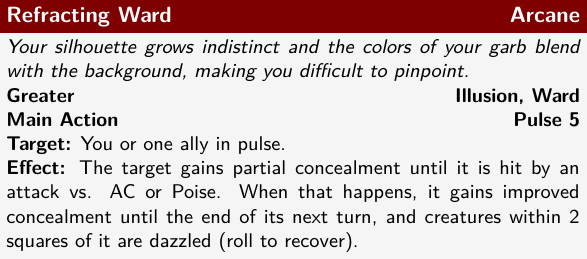
    Refracting Ward, as an Illusion Ward power, is a little bit unusual, in that it provides concealment (+2 to AC and Poise vs. melee and ranged attacks) rather than a direct bonus to defenses. This makes it a bit more specialized, in that it doesn’t help against area attacks, but also means that it can be used to help an ally sneak around using Stealth. And, when the ally gets hit, and the Ward breaks, it erupts in a flurry of flashing lights, causing nearby creatures to be dazzled, while the target gains improved concealment (+5 instead of +2) covering their escape.

    Ward powers are probably among the less useful to place into a Gadget, since in most cases it would work just as well to use them immediately on an ally. However, there are niche cases where it might make sense, and in the case of Refracting Ward, it could be given to a sneaky ally before they go off scouting, in case they find somewhere that they need to sneak across an open, well-lit area with nowhere to hide, or rush through a group of enemies and hide on the other side. As Gadgets, Gwynne’s Ward powers will take the form of a sprig of holly, to be affixed to an ally’s armor.

    While there are Illusion powers that would “distract or keep enemies away from an ally,” I can’t resist filling this niche with a Summon power instead, in order to further build out Gwynne’s theme and Gadgets. Summon powers have some complex rules, but the gist of them is that they summon or create allies for the caster.

    Rules for the Summon Keyword

    Unless otherwise noted, creatures summoned by powers with the Summon keyword work as follows:

    • A summoned creature is a Medium magical construct. When summoned by a power, it appears in an unoccupied space of your choice within the range of the power that summoned it. A Summon power can summon only a single creature at a time; if re-used, any creatures previously summoned by the same power are destroyed.
    • You and your allies are your summoned creatures’ allies, and your enemies are their enemies. Summoned creatures threaten adjacent squares and can flank.
    • Summoned creatures can be attacked. A summoned creature has 16 AC, and 14 Brawn, Poise, Wit and Composure.
    • Summoned creatures are destroyed when reduced to 0 or fewer hit points. A summoned creature has 16 maximum hit points, and has all of them when summoned. Their healing die is 1d6. They have no resurgences to use, but can regain hit points in other ways.
    • Your summoned creatures do not have their own turns or actions. Instead, you command them to take actions using your own actions. As a minor action, you may command your summoned creature to do most of the things any other creature could, such as interact with an object.
    • Summon powers may also describe additional actions that a summoned creature can take, in which case the power will also note what action is required to command it. Summoned creatures’ attacks are usually based on your abilities.
    • Summoned creatures have a movement speed of 6 squares. They gain movement at the start of your turn and can use it as you direct during your turn.
    • Summoned creatures must remain within the range of the power that summoned them. If you move out of range of a summoned creature, or if you move a summoned creature out of range, it immediately expires. If you are killed, the summoned creature immediately expires.

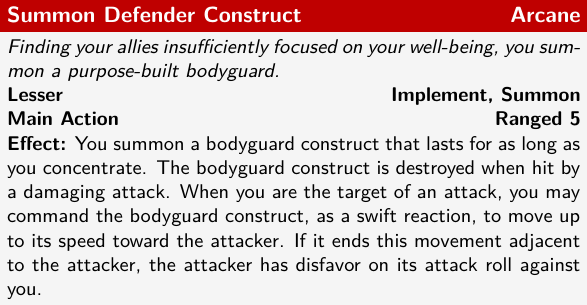
    Summon Defender Construct, as a lesser Summon power, summons a relatively weak creature that is destroyed by any amount of damage from an attack (much like a mook). And while it can’t attack, it can be commanded to rush at creatures attacking its summoner to interfere with their attacks.

    I actually didn’t realize how great a power this was to put into a Gadget until I was looking through the options for a Summon power to give Gwynne: in a Gadget, it can be used as a minor action, and can be used repeatedly since it’s a lesser power. So Gwynne can hand this out as a Gadget to an ally likely to draw attacks, and they can keep summoning replacement constructs as long as they have minor actions to spare. And, perhaps even more usefully, the constructs can flank, providing a melee-focused ally with their own source of flankers to aid them.

    Gwynne’s Summon Defender Construct, as a Gadget, takes the form of a handcarved wooden toy soldier, which when given an order creates a full-sized duplicate of itself. She keeps a wide selection of the figurines, ready to be turned into Gadgets, and carves new ones whenever she meets someone with a suitably interesting appearance. She also hands them out to children, naturally, although she reserves the Gadget-ized versions for dealing with bullying problems.

    Finally, I do feel the need to give Gwynne an actual offensive power. There are options among the Illusion powers, but they either deal no damage or psychic damage (which is great for dealing with armor resistance, but plain doesn’t work on inanimate objects and mindless creatures like zombies). So I’m going to pick something that’s an actual damaging power, and since Gwynne’s sworn enemies are the Winter Court, who work with ice a lot…I’m going with good old reliable fire.

    Fire Bolt is the most basic of Arcane Fire powers: it deals fire damage to a single target, sets it on fire, and as a bonus, can be used as a normal ranged attack. It could make a useful Gadget for a character unlikely to be in the thick of melee, allowing them to get a second ranged attack as a minor action. As a Gadget, Gwynne’s Fire Bolt takes the form of a red-and-white candy cane…flavored with cinnamon and hot chilies.

    Feat

    Gwynne has access to the usual combination of general-purpose, ancestry-based, and class-based feats, which includes a slate of Arcane School feats that would allow her to specialize in certain kinds of Arcane powers. Here are some examples that Gwynne would find useful at level 0:

    As an elf, Gwynne has access to the Swiftfooted feat, building off her Lightfooted feature to further improve her mobility. This could be useful if we put Gwynne in heavier armor.

    Improved Armaments would allow Phantasmagoric Armament to also provide a +1 power bonus to the attack made using it, which would be great for reducing the likelihood that the attack just misses and wastes the power.

    Ergonomic Gadgets would allow Gwynne’s allies to make use of her Summon Defender Construct and Fire Bolt gadgets without provoking opportune strikes, making Fire Bolt useful to melee characters and Summon Defender Construct useable when the character carrying the Gadget is already beset by enemies.

    Warding Gadget creates a synergy between the artificer’s Healing Ward and Gadgets features, giving the artificer a link to creatures carrying their Gadgets so that they can receive a Healing Ward even when separated from the artificer. This would be useful when an ally has scouted ahead and become separated, or if the party has had to spread out to cover attacks from multiple directions.

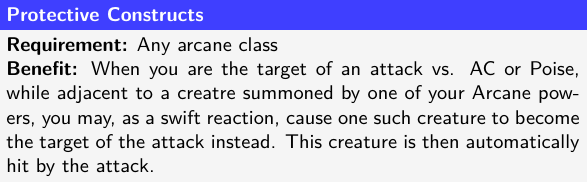
    Protective Constructs is an Arcane School feat that would further improve Summon Defender Constructs so that the summoned creatures can outright take attacks aimed at Gwynne. And, because of the wording of Gadgets allowing Gadget-ized powers to still benefit from the artificer’s feats, I would allow Gwynne’s allies to gain the same benefit from creatures they summoned using a Summon Defender Constructs Gadget.

    Of these, I think that Ergonomic Gadgets is likely the most immediately useful, so I’ll go with that at level 0.

    Equipment

    As far as equipment goes, Gwynne will need:

    • Armor
    • A magical implement (a focus, for Arcane powers).
    • A melee weapon (as backup, and perhaps to use her Armament power on if appropriate).
    • A basic adventuring kit.

    As far as armor goes, Gwynne is proficient with up to chain armor, which contains the following options:

    ArmorACAREncumbranceSave MoveSpeedValueBulk
    Maille Shirt (Medium)31-115gp6
    Maille Armor (Medium)41-1-120gp10
    Maille Hauberk (Heavy)51-1-1-125gp15

    Because she has +1 <DEX> and <GRA>, one of the medium armors is going to be her best option. (The Maille Hauberk would provide the same AC as Maille Armor, but with an additional speed penalty.) So it’s really a choice between the Maille Shirt, which would give her 15 AC and 1 safe movement, and the Maille Armor, with 16 AC but 0 safe movement. Since Gwynne has Refracting Ward which can boost her AC against most attacks, I’m going to opt for the lower AC and give her a Maille Shirt.

    I’m envisioning Gwynne as a precise spellcaster good with the intricate, finicky bits of spells just like she is with the fine details in her woodcarvings. So, I’m going to give her a focus in the form of a wand (which can be wielded at the same time as a one-handed melee weapon). This will run another 20gp.

    And speaking of weapons…as an artificer, Gwynne is proficient with military weapons. The Caras Elvaren culture suggests bows and heavy blades as weapons, so I’ll give her a longsword, at 10gp. And because she has Armament powers, and it might be a convenient way of delivering them…I’ll also give her a longbow at another 15gp, plus a pack of 20 arrows at 1gp for the lot.

    Finally, the basic adventurer’s kit will run another 15gp, bringing her purchases to a total of 76gp. I’ll add on a set of Thieves’ Tools for another 10gp, since Gwynne is trained in Subterfuge and can use them to disarm traps…and also, a set of Tinker’s Tools, useful for working with machinery. (And we’ll say that her particular set of Tinker’s Tools includes her woodcarving set…) And that leaves her with just 4gp to her name at the start of the game.

    I should note here that Gwynne only has -1 <STR>, and this is going to impact how much of this gear she can carry. Carrying capacity is 50 bulk plus 10 per <STR>…so hers will be just 40 bulk. Her armor, focus, weapons, and basic adventurer’s kit will come to 28.8 bulk, the two toolkits will bring that up to 32.8…so Gwynne had better be careful how many toy soldiers she packs, or else she’ll be asking an ally to carry her things for her.

    Up Next

    Next week, we’ll be putting together all of these decisions and calculating all of Gwynne’s relevant numbers. And then, just in time for the holidays, I’ll wrap this series up in a bow with a post on how Gwynne might advance up to level 5…which, now that I’ve discussed some of how magical items work, will include a few magic items that she might find or make.

    Stay tuned!

  • In a recent post on the creation of Gwynne, elf artificer, I revealed the artificer class’s Tinkering feature, which allows them to temporarily modify an enchantment on a magical item. But at the time, I didn’t go into details about what an enchantment was.

    Well, today I’m going to be revealing the basics of Aetrimonde’s magical item system, which includes defining these enchantments!

    Subsystem Design Goals

    I’m treating magical items, or rather, the creation of magical items, as a subsystem: players do not have to interact with magical items beyond finding them as treasure when the GM places them as such, and then using them. Even an artificer, who has a class feature involving magical items, does not need to interact with magical items all that much more deeply than the average player. But if a player wants to create magical items (as would be very, very thematic for an artificer), I want Aetrimonde to have rules support for that!

    When setting out to design this subsystem, I had some thoughts on how magic items should fit into the Aetrimonde setting:

    • Relatively simple magical items should be relatively common and easy to create. Aetrimonde is undergoing its version of the Industrial Revolution, and industry, in Aetrimonde, covers magic. Narratively, there should be a thriving magical-engineering industry pumping out these simple magical items using regular, widely-known processes. This means that these should be relatively easy to acquire, even if they are expensive.
    • Conversely, more powerful magical items should be rarer: these are the works of master craftsmen and singular geniuses at the pinnacle of their craft, and not producible by replicable processes that can be industrialized. These artifacts are the sort of magical item that would be the object of a quest, or a plot device.

    It’s much easier to devise rules for the former type of magical item, created according to standardized procedures, and so this is the kind that Aetrimonde’s magical item subsystem will cover. One-of-a-kind artifacts will remain the province of the GM to create (although if a player wants the creation of such an item to be a part of their character’s arc, I strongly encourage the GM to work with them on it).

    I have some further thoughts about the kind of magic that should be present in these standardized magical items:

    • One kind of enchantment these kind of items can carry should simply enhance their innate nature, making weapons sharper, armor more resilient, and implements better channels for magic. These enchantments can be reflected by providing an item bonus to something that the item is already used for (damage rolls for weapons, AC for armor, attack rolls for specific kinds of magic for implements, etc.).
    • A second kind of enchantment should make an item do something that it wouldn’t normally, but that is thematically appropriate for the kind of item. These enchantments can create things like thrown weapons that return to the wielder, cloaks that let the wielder glide, or boots that cling to walls.
    • A third kind of enchantment should allow ordinary Arcane, Divine, and Spiritual magic (the kind represented in powers and feats for the respective classes) to be set into a physical object. These enchantments can provide their owners with powers and even feats that they wouldn’t otherwise have.

    And finally, I have some mechanical goals for this subsystem:

    • It should be possible to find not just complete magical items as treasure, but also components for them that a character who has opted to interact with item creation (or a friendly NPC) can use to make items to order. This lets a GM put part of a magical item into a treasure at low levels instead of an entire (valuable and expensive) item. It also lets a GM nudge their PCs in a particular direction by, say, providing components that are specifically for a fire-based magical item.
    • Any bonuses provided by items should be noticeable, but not game-changing. As a rule of thumb, item bonuses should be equivalent to the effect of having +2 expertise. In other words, item bonuses should grant +1 to attacks/defenses/armor resistance, +2 to damage, +4 to hit points, etc. It shouldn’t be possible to stack these, and they definitely shouldn’t scale with level.
    • The most powerful magical items should be an inefficient use of resources, encouraging players to have more, but less powerful, items. (And, also, making powerful magical items a noteworthy piece of loot…) Coupled with item bonuses being only an incremental bonus, this will nudge players away from being overly reliant on single powerful items that cannot be taken from them without making their character impossible to play.

    So let’s take a look at the implementation:

    Defining Magical Items

    Before setting rules for how magical items can be made, let’s define what magical items do and how PCs can interact with them. The full rules for magical items take up a couple of pages, so I’ll be summarizing here:

    Basic Benefits of Magical Items

    Magical weapons, shields, and implements can bypass the invulnerable resistance (a resistance applying to all types of damage from all sources, which is more comprehensive than armor resistance) of some powerful, supernatural creatures like demons and faeries. This is noted in the creatures’ stat blocks; it is not a universal property of invulnerable resistance.

    Likewise, magical armor and shields provide additional protections against the attacks of some creatures, like ghosts and wraiths, that can just reach through non-magical armor and shields.

    Identifying Magical Items

    The basic benefits of magical items work even if a character isn’t aware that it’s magical, but their more advanced and intention-driven benefits don’t. The Arcana skill is necessary to detect that a magical item is magical and work out what it can do in order to use it. It takes two Arcana checks to fully understand a magical item: more powerful ones are easier to detect as magical, but harder to figure out the functions of.

    Properties and Powers

    Magical items can provide properties and powers.

    Item properties are near-passive benefits, like feats and the features of classes and ancestries: they do have to be purposefully turned on, but can be left running indefinitely…or as long as the item is properly worn or wielded.

    Item powers work essentially like a character’s own lesser and greater (and feature) powers, with the exception that they do not, generally, benefit from the user’s feats and bonuses. In fact, many item powers that replicate Martial, Arcane, Divine, or Spiritual powers override the user’s own abilities with their own, generally mediocre, values. This is for two purposes; the first is to ensure that a character’s own powers are generally better than those granted by an item; the second is to ensure that a character can use such powers that would normally require abilities that they don’t have (as in the case of a Divine character with an item granting an Arcane power, for example).

    Creating Magical Items

    With those general concepts out in the open, let’s look at how a standard magical item is created:

    A magical item is created by combining:

    • A base item, which must be a well-made but mundane example of an appropriate physical item like a weapon or a pair of boots.
    • A power source, which provides the inexhaustible supply of power needed to create a permanent magical item.
    • One or more enchantments, which channel the power source’s magic into particular effects.

    Power Sources

    A power source serves two functions in a magical item: it determines how many enchantments the item can support, and it also determines, in many cases, the potency of the item’s powers. More powerful sources can support more enchantments and provides bonuses to the attack and damage rolls of the item’s properties and powers. (Which is not the same thing as bonuses to ordinary attack and damage rolls using the item, as in the case of a normal attack using a magical weapon.)

    Power sources can be Arcane, Divine, or Spiritual, depending on which character class the creator has. (If the creator is none of those types of class, they choose one.)

    Enchantments

    This is the real meat of a magical item, determining what it can do that a nonmagical item could not. Enchantments can be Arcane, Divine, or Spiritual, and can only be applied to a magical item with the same type of power source.

    Enchantments are what determine the properties and powers of a standard magical item, and there is a wide variety in the core rulebook, of which I’ll reveal several today. Let’s start with some simple ones, that might be applied to a magical weapon:

    The Accurate and Powerful enchantments are straightforward and universal (can be applied to an item with any kind of power source), and both contribute to the most basic concept of a “magical weapon.” Accurate would make a sword more likely to strike true; Powerful would make it bite deeper when it does.

    And with these two enchantments, I can give a first example of how an artificer’s Tinkering feature can be used: if the artificer or their ally has an Accurate magical sword, but doesn’t feel the need for an item bonus to attack rolls, the Artificer can temporarily alter the Accurate enchantment into a Powerful enchantment, giving the weapon greater damage instead of greater accuracy.

    …or, the artificer could perhaps get creative, and instead transform the Accurate enchantment into a Magebrand enchantment.

    Magebrand can only be applied to melee weapons with Arcane power sources, but can be incredibly versatile. It requires that the creator make a decision when applying the enchantment (including through Tinkering), choosing an Arcane power that they themselves know and storing it in the enchantment. The weapon’s wielder can then use this power, albeit at what is likely lesser potency than the item’s creator could have. The choice would be permanent when applied as a normal enchantment, but an artificer using Tinkering can choose a different power each time they use the feature to change an enchantment to Magebrand.

    In many cases, Magebrand may be a better choice for Tinkering than Powerful: while it doesn’t inherently grant a bonus to damage, the wide range of damage types available with Arcane powers means that this can give an ally a power that exploits an enemy’s vulnerability, such as a Fire power when facing flammable mummies. It can also be used to “double-up” on a useful power that the Artificer has and wants to share with the rest of the party, much like the artificer’s Gadgets feature. Magebrand also makes ranged powers into melee powers, making them more useful for allies likely to be in the thick of battle.

    Of course, it’s not just weapons that can benefit from enchantments: magical implements can benefit too.

    The Totem of Potent Bonds enchantment makes a totem more effective when using Spiritual powers that have either of a pair of keywords. (Item bonuses affecting Spiritual powers commonly affect a pair of keywords, because there are a lot of these keywords, and it’s common for Spiritual characters to use multiple types of power.)

    The Storied enchantment, for the totem implements used with Spiritual powers, allows a magical totem to convey the benefit of a feat intended for Spiritual classes. Of course, it only works if the implement’s wielder is actively wielding the implement…and if the wielder is ever deprived of the implement, they also lose the feat, so this is a risky way to gain an extra feat.

    Then, there are enchantments for items that wouldn’t normally convey much if any benefit, like gloves, cloaks, and boots.

    Handwraps of Hardened Fists is an enchantment for items going in the Hands slot like, yes, handwraps, but also applicable to gloves, gauntlets, and even hypothetically mittens. It provides a pair of item bonuses increasing the attack and damage rolls of unarmed attacks, making it an excellent enchantment for a would-be brawler. The downside, however, is that it doesn’t actually provide the benefit of a magical weapon for unarmed strikes: there are ways to get that, though.

    The Chameleonic Cloak is an excellent enchantment for a would-be scout or sniper, letting them blend in and gain concealment even in open terrain. This, in turn, can let them sneak about more easily, since becoming and remaining hidden from enemies using the Stealth skill requires some degree of either cover or concealment from enemies.

    The Boots of Rapidity enchantment has a subtle effect that can be quite powerful if fully understood: at the cost of a minor action, the enchantment’s power grants two turns of effectively doubled movement: in the first turn, the user keeps the normal movement they already had, and if they then take the Run action, can gain twice that much additional movement…and on the second turn, even the initial, normal movement is doubled. The wearer can thus get up to seven times their speed in movement, in just two turns…and that’s not even counting any movement that they could get between turns.

    To wrap up this showcase, let me reveal a couple of armor enchantments, including one tied to the Ward powers that I previously hinted at and which we’ll see more of in Wednesday’s post.

    The Toughened and Reinforced enchantments both protect the wearer of magical armor. Toughened increases armor resistance, further reducing most damage taken by a small amount, while Reinforced drastically reduces the damage from serious critical hits.

    The Blessed enchantment, however, provides access to a Divine Ward power. I’ll go into details on these on Wednesday, alongside their Armament power counterparts, but the short version is that Ward powers provide a character with some kind of defensive benefits; a character can only gain the effect of one Ward power at a time. The Blessed enchantment, carrying a Ward power with it, therefore gives a character access to a defensive power (albeit with probably reduced effectiveness) that they can use if none of their allies are in a position to help them out.

    Up Next

    On Wednesday, keep an eye out for the next post in my series covering Gwynne of House Midwinter, elf artificer–with a bit more context, now that I’ve revealed the gist of how magical items actually work. And, for the rest of the month, keep an eye out for the occasional magical item worked into some of my other posts!

  • In this next post covering a third sample character, elf artificer Gwynne of House Midwinter, we’ll be going over choices of skills, perk, and languages.

    Skills

    Gwynne has some overlap in her preferred skills:

    • Arcana and History (Caras Elvaren culture)
    • Arcana and Engineering (Technician stratum)
    • Arcana, Engineering, Medicine, Perception, Subterfuge, and Warfare (Artificer class)

    So Gwynne only has seven preferred skills, one of which (Arcana) she’s required to have by the Artificer class. She next gets to pick five other preferred skills to be trained in; she gets one extra due to the Extended Youth elf ancestry feature.

    Frankly, it makes more sense to decide which preferred skill Gwynne won’t be trained in. I don’t see this former toymaker being particularly warlike, so we’ll rule out Warfare, and she’ll be trained in all the others.

    And for her final choice of skill, which can be any of the eighteen, Gwynne will be trained in…Insight. I’m increasingly working to a theme here, and it will help if she can tell who’s naughty and nice.

    Gwynne’s trained skill bonuses (before any encumbrance penalties) will thus be:

    • Arcana +6
    • Engineering +6
    • History +6
    • Insight +4
    • Medicine +6
    • Perception +2
    • Subterfuge +3

    It helps that so many of Gwynne’s trained skills key off of her high Intelligence!

    Perk

    I think there’s only one reasonable choice for Gwynne’s perk, given the theme I’m working to. As a former toymaker, Gwynne will have the Craft [Elven Children’s Toy] perk. Will this be as directly useful in adventuring as Etterjarl Ragnvald’s Craft [Clockwork]? I’ve no idea, really. I suppose it may depend on how many children Gwynne runs into.

    Languages

    In addition to the campaign’s common language, which we’ll presume to be the default of Westerling, Gwynne also gets to speak Modern Elven due to her Caras Elvaren culture.

    Up Next

    Coming up next, we’ll be taking a look at the kinds of powers, feats, and equipment that Gwynne can choose from, including some Armament and Ward powers that are especially appropriate for an artificer. Stay tuned!

  • In today’s post, wrapping up November’ series on the Autumn Court of Faerie, I’m going to at long last reveal an actual member of the Autumn Court!
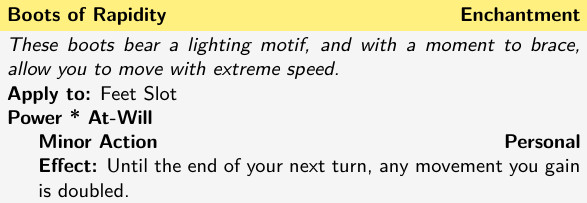
    The statblock I’m presenting here is representative of Knaves of Autumn, but there is a lot of variety: I highly recommend that if a Knave of Autumn (or any of the Courts) is going to be a recurring villain, a GM should give them some variant abilities separating them from the “generic” version. But before I get into the statblock, let me take a brief detour into the concept I based this Autumn Knave on:

    Design Concept

    I generally start designing major enemies (like Champion-tier ones) with three big-picture concepts. In the case of the Knave of Autumn, here are the three that I settled on when I sat down to brainstorm:

    • Control of the Narrative: The Knave of Autumn is tied into the magic of Faerie: it is a focus for the plane’s narrative, and can draw mortals into the narrative against their will.
    • Tarnished Glory: The Autumn Sidhe outwardly embrace an aesthetic of tarnished glory: they use glamour and illusion to garb themselves in ancient-looking armor and faded robes, and dwell in the crumbling ruins of grand edifices. Autumn’s Knaves weave this aesthetic into their Control of the Narrative: they have a palpable aura of venerable, ancient grace and wisdom, and it is difficult for mortals to bring themselves to oppose them.
    • Vicious Killers: But, behind the glamour, Knaves of Autumn (and all the rest of the Court) are vicious killers. When they don’t get their way (when their Tarnished Glory fails to sway mortals to their side…), they abandon the glamour and unleash their inner savagery…including through any mortals who did succumb to their spell.

    Next, with these three concepts in place, comes the general mechanics:

    • Control of the Narrative is best represented through a Charm effect (Charmed creatures are flatfooted and have disfavor on attack rolls against their charmers) of some kind. And it should be passive, or at least, reactive: mortals fall under the Knave’s spell mainly just by being it its presence.
    • Tarnished Glory gives me a more specific flavor for the Knave’s Charm effect: when a PC tries to attack the Knave, they are overcome with veneration for its ancient wisdom. This can be a swift reaction.
    • Vicious Killers, however, suggests that the Knave should have a “mode change” midway through a fight, as it realizes that it won’t be able to bring the PCs entirely under its spell. So Tarnished Glory should work only until this mode change…but after the mode change, the Knave should be able to force some violent actions on its charmed creatures. (And in order to make it likely that it has some charmed creatures after the change, it should be difficult to shake off the charm effect, at least until the change.)

    Now: all of these concepts form some interesting ideas for mechanics going into the Knave, but they’re all about passive and reactive mechanics. What should the Knave actually do with its turns?

    The mode change between Tarnished Glory and Vicious Killers gives me a good concept here, too: before the change, the Knave should fight in the manner of a chivalrous, graceful knight…while afterward, it should more resemble a crazed killer. It should have melee attacks, and a different set of them in each phase.

    And, since the mode change is forming so much of the Knave’s concept, the change itself should be a significant event during which the Knave transforms.

    So let’s see how all of these ideas come together into a statblock:

    Knave of Autumn

    The biggest mechanics in the Knave of Autumn are Autumn Glamour and Vortex of Decay:

    • Autumn Glamour both defines the two phases of a fight with the Knave (Tarnished vs. Vicious), and alters its defenses. In the earlier Tarnished phase, the Knave has high but tier-appropriate armor resistance of 5; in the Vicious phase, it has higher (and more useful) invulnerable resistance of 7, but it can be bypassed by cold iron weapons and implements, which a prepared groups of PCs can be counted on to have.
    • Vortex of Decay provides a short transitory phase marking the change from Tarnished to Vicious. When it is first injured (reduced to half hit points) during a fight, the Knave erupts in a vortex of withered leaves: this conceals it from view while it transforms (and switches equipment), and it also becomes insubstantial (takes half damage except from area attacks). This lasts until the end of the Knave’s next turn, which allows it to move into the midst of the PCs and make the Vortex of Decay’s attack against several of them.

    The Knave’s Charm ability has different effects in each stage:

    • While Tarnished, the Knave can charm its attackers using Tarnished Glory, which as a swift reaction means that if the attacker is successfully charmed, its attack becomes less likely to hit.
    • When it becomes Vicious, it can no longer charm attackers, but Vicious Instincts forces those it has already charmed to attack each other at the start of their turns until they break free of the charm effect.
    • Control of the Narrative makes the Knave’s charm effects difficult to break out of, ensuring that Vicious Impulses has charmed PCs to work on.

    The Knave also fights differently in its two phases:

    • While Tarnished, it makes a single Broadsword attack on its turn, and can use Tarnished Grace to evade and reposition its attacker when missed by an attack.
    • When Vicious, the Knave can make two Handaxe attacks on its turn, and a Vicious Counter attack when hit by an attack.

    All in all, I think that the Autumn Knave does a good job of capturing the general concept I started with (vicious savagery behind a veneer of nobility), while also providing interesting mechanics for a fight.

    The Knave doesn’t actually have a lot of combat-as-puzzle mechanics, though. (I wouldn’t consider the mode shift to be a puzzle, really, just a gimmick to spice up an encounter.) There is a bit of a puzzle element to Tarnished Glory (which can be countered by attacking from out of its range) and Vicious Impulses (which can be countered by charmed PCs positioning themselves to not have good angles of attack on their allies). And if the PCs have foreknowledge of the Knave’s mechanics (if it’s a recurring villain, for example), there is an opportunity for them to try to trigger the change from Tarnished to Vicious at a good moment, when few of them are charmed. But most of the challenge in the Knave will come from its mode change.

    Up Next

    Well, this wraps up my “official” month of Faerie and Autumn Court content. But, if you’ve been reading my first couple of posts on Gwynne of House Midwinter, my third sample character, you’ve also been getting a preview of my December theme: elves and magical toys items! Stay tuned for content including a history of Caras Elvaren, mechanics for creating and using magical items, and more!

Is this your new site? Log in to activate admin features and dismiss this message
Log In