Heroic Roleplaying in a World of Swords, Sorcery, and Steam

I’d like to introduce Aetrimonde, a TTRPG I’ve been designing with heavy inspiration from the houserules my group used back in our Dungeons and Dragons 4e days. I’m not ready to publish Aetrimonde yet, but I’m opening up this blog to discuss its design principles, mechanics, and systems.

  • To wrap up this series on non-combat encounters, I’m going to share an excerpt from the GMH providing advice on how to actually use non-combat encounters in an adventure. My previous excerpts have covered how to construct non-combat encounters of various types, but this advice is more about when and how to work a non-combat encounter into an adventure.


    Advice on Using Non-Combat Encounters

    To be clear, there are many ways to design a non-combat encounter beyond the three general kinds discussed above and their variations, and you as a GM can and should experiment with them and try out new twists and ideas. But with these basics in mind, the next question is: how can non-combat encounters add to a campaign?

    For starters, non-combat encounters are for modeling complex situations: simple tasks like opening a lock, jumping across a gap, or recalling information about a monster don’t warrant a non-combat encounter. Instead, reserve non-combat encounters for situations with multiple moving parts, requiring multiple skill checks to resolve and offering players the chance to show off their out-of-the-box thinking.

    But this still leaves several ways to work non-combat encounters into the structure of your campaign:

    Discrete Encounters

    The simplest way to add non-combat encounters to your campaign is in the same way as combat encounters. This as a discrete encounter that the players start, run through, and finish before moving on to the next stage of their adventure, and the examples of non-combat encounters on the previous pages are designed with this structure in mind.

    Resource and contest encounters are fairly straightforward, and you can employ them regularly in this capacity. Nodal encounters are more complicated, requiring more prep time, and are more like set-piece combat encounters—and should be used with around the same regularity, at once or twice per adventure.

    Interleaved with Combat Encounters

    Large and complicated non-combat encounters—particularly nodal encounters—can be broken up into phases separated by combat encounters, keeping the PCs on their toes.

    Resource and contest encounters can be broken up by a combat encounter at the start or end of each non-combat round. This can model a desperate forced march, coming under periodic attack from enemy forces, or a series of formalized duels or battles with each side having opportunities to tilt the odds in their favor ahead of time. You can have the results of the non-combat encounter influence the details of the combat encounters, or vice-versa, or both.

    As mentioned above, combat can be a consequence of failing a nodal encounter, or of failing to resolve specific nodes. Nodal encounters can also just have some nodes in the flowchart be combat encounters, allowing the PCs to resolve them by winning the fight. These combat nodes can be blockers, complications, or bonuses—and they can be influenced by various other complication or bonus nodes, giving the PCs additional enemies to fight, or allies or weapons that they can use to gain an advantage.

    Combined with Combat Encounters

    It’s also possible to combine combat and non-combat encounters, creating something with aspects of both. This is easiest to do with resource and contest encounters, but with enough planning and thought, a nodal encounter could be worked into a combat encounter (but it would probably need to be a big set-piece encounter).

    A mid-combat resource encounter might give players a limited number of rounds in which to do something that affects the wider combat encounter, like seal off a source of enemy reinforcements, or prevent cultists from summoning their eldritch master. To accomplish this, the PCs would need to come up with a plan, and then make the appropriate skill checks. Depending on the setup, this might require them to reach certain places on the battlefield by fighting through enemies.

    A contest encounter combined with combat would likewise require the players to succeed on certain skill checks faster than an opposing team (likely the enemies in the encounter) can do the same, with the added twist that the outcome of the contest affects the combat. The non-combat part of the encounter might allow one side or the other to seize control of a powerful weapon by fighting over its control stations, or to summon a powerful monster to aid their side in combat. As with resource encounters, making the necessary skill checks can require the combatants to be in specific locations, which for contest encounters turns into a kind of king-of-the-hill scenario.

    Woven Through an Adventure

    Finally, it’s also possible to weave a non-combat encounter through an entire adventure, or even a whole campaign. In this structure, the PCs (and their opposition, as applicable) would get to make their skill checks at narratively appropriate points in the adventure (say, after achieving certain plot-relevant goals) instead of in a regular turn order.

    Making a resource or contest encounter work as part of an adventure will likely require careful attention to the passage of time, with checks being made every day, week, or month (depending on the time scale of the adventure). This could be used to model a looming threat, like the arrival of a hostile army that the PCs must prepare to fight, or a research effort where the PCs and their opposition are vying to decipher a code or piece together a historical mystery. The outcome of this encounter can then influence details of the adventure’s climax, like how many enemies the PCs have to fight or whether the PCs or their enemies arrive at the site of the final battle first and have the advantage of being on the defensive.

    Nodal encounters are even better suited for weaving through an adventure, though, especially if the adventure is non-linear. The nodes of the nodal encounter can be hidden at first and revealed as the PCs progress through various parts of the adventure; completing the nodal encounter can then require backtracking and revisiting earlier parts of the adventure once the PCs discover and resolve nodes later in the adventure that make earlier nodes feasible to resolve.


    Up Next

    Well, that wraps up the GMH’s material on non-combat encounters (or at least what I’m sharing here: the GMH contains additional examples of each type of encounter that I’ve omitted here for brevity). I hope this illustrates the sort of advice that the GMH provides for GMs who want to write their own content for adventures in Aetrimonde; I’ll be returning to GM mechanics later on, to discuss similar advice for designing combat encounters, adventures, campaigns, settings, and so on.

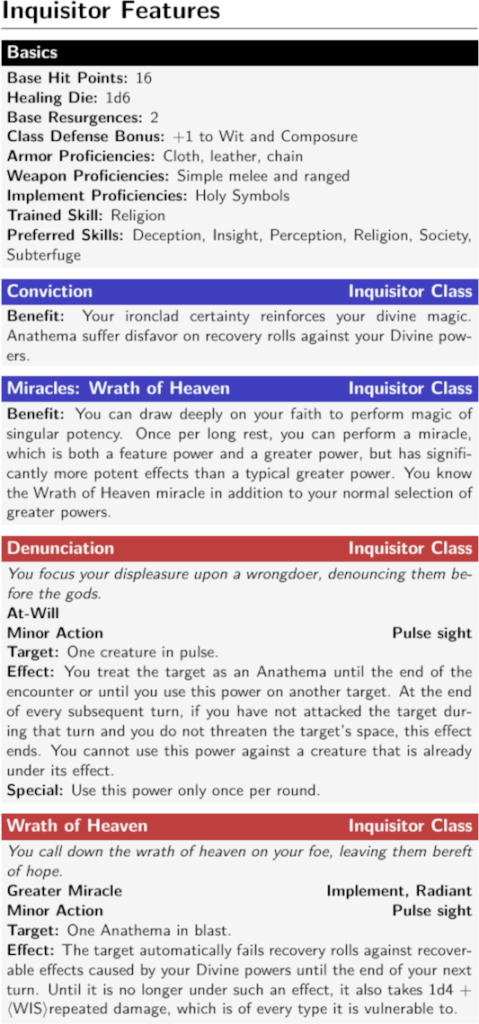
    But for now, I’m going to be moving on to a new series, covering a fourth sample character! Since the first three were a martial, spiritual, and arcane character, that leaves one origin I haven’t covered yet: the divine characters, who gain power from a deity or creed. And, based on the first three characters (the tough Fighter, deadly Skinchanger, and protective Artificer), I know which of the divine classes I’ll be covering: the Inquisitor, whose denunciation renders their foes helpless before the displeasure of the gods.

    Stay tuned!

  • Having recently dropped a lot of lore relating to alchemy, I’m going to top it off by discussing some lore related to Gobol Karn, ancient birthplace of the alchemical arts…and a lot of horrific atrocities committed using them.

    The ruins of Gobol Karn are presented as one setting for classic dungeon-crawl adventures in Aetrimonde: they are your classic ancient ruins, filled with treasure, traps, and monsters. Unlike the Dwarven Federation and Caras Elvaren, Gobol Karn is not a functioning polity in the setting’s present day, and so its entry in the campaign setting doesn’t focus so much on culture and politics–because it doesn’t have any. This entry is designed to inspire GMs to write adventures set in the ruins of Gobol Karn, by conveying a concept and tone: these are the fallen ruins of a great and terrible civilization, still haunted by remnants of the atrocities it committed and the mistakes that laid it low.


    The Ruins of Gobol Karn

    Gobol Karn, at its height, laid claim to the entire south of the continent, but even at the peak of its power it remained a singular, megalopolis-sized city state. The goblin imperial family was large and riven with infighting, and from the earliest days of the empire its Emperors and Empresses understood that they could not allow a potential rival to establish a separate seat of power. They kept their rivals close, and took pains to prevent their outlying fortresses, slave camps, and other outposts from becoming self-sufficient settlements that might grow into a rival’s base of power. And so Gobol Karn grew into something like an anthill, with a vast population held close at hand, where their rulers could keep an eye on them. The city itself sprawled, forming a warren of cyclopean structures built from black basalt and held upright, in many cases, because they were packed so tightly together that they simply had no room to collapse.

    Feeding a population of such density required the efforts of vast cohorts of laborers, slaves, and beasts of burden, and as the goblins perfected their grasp of alchemy, the difference between these castes vanished. Alchemy made laborers and slaves stronger and more docile, at the same time it made working animals smarter and more biddable. But this use of alchemy eventually proved to be a key factor in Gobol Karn’s downfall. It first caused problems when alchemically-altered animals escaped from captivity and began to breed true in the wild: among them were gryphics, the ancestors of modern gryphons and hippogryphs, which became a hazard to life and limb in outlying parts of the city where they would nest atop towers and prey on slaves and citizens alike. But worse than the predators were the vermin: altered rats and mice and rabbits, created by ill-conceived experiments and freak lab accidents, that became an ecological catastrophe when they were introduced into the wild. And worst of all were the plants: artificial crops intended to feed the city’s endless mouths but which choked out all other vegetation and drained the soil of life.

    Gobol Karn did not fall in a day, or even a year: it took a decade, during which the empire was wracked by repeated famines, leading to uprisings, leading to palace coups, leading to riots, leading finally to fires which swept through the city. The chaos broke the imperial family’s hold on the populace, not to mention their slaves, and there was ultimately a diaspora as the inhabitants of the great city abandoned it in search of somewhere that food still grew. The ecological damage remained localized to Gobol Karn due to climatic factors: the invasive crops that had been designed for the warm south failed to thrive in the cooler north (to the great relief of the other polities of the time), and the animals rapidly became the targets of organized hunts (those that weren’t found to be useful and domesticated). But the south of the continent remains in large part barren, as a legacy of Gobol Karn’s ecological tampering.

    The desolation is most severe immediately around the city of Gobol Karn, and there are stranger things to be found here too: alchemical experiments that ran out of control as their creators escaped the city, bizarre cross-bred creatures that evolved in the selection pressures of the abandoned warrens, and the inbred goblinoid descendants of the imperial family’s political prisoners who were left to rot in the dungeons beneath the palace. The city is incredibly dangerous, and all the moreso for its tight quarters and the ravages of centuries. Gobol Karn was never extensively mapped, and it is now half-buried in silt blown in from the wastelands. The parts of the city still exposed to daylight have long been exhaustively looted, but many buried buildings in the lower levels of the city have been preserved, and the catacombs and tunnels have barely been touched. Delving into them means digging into long-buried chambers, where one can never be sure what unnatural creatures lurk through the next doorway or around the next corner…

    The dangers of delving into the goblin ruins are not only in the ruins themselves. Further from the city, the wastes are inhabited by rivalrous tribes of goblins, who remember little of their ancient empire and are more concerned with eking out an existence from the inhospitable land. Some of them consider their ancestral ruins cursed, avoiding them like the plague; others dare to venture within, hunting alchemical beasts for food and hides, or scavenging artifacts to sell to adventurers and merchants not brave enough to enter the ruins for themselves. Many of the northern tribes continue their ancestors’ slave-taking traditions, raiding outlying villages in the Unclaimed Reaches for captives and loot; virtually all of the tribes attack travelers opportunistically, if they have the advantage of numbers or are able to make an effective ambush. And most of them have learned, in recent years, that adventurers heading to the ruins carry valuable supplies…while ones coming back might have found something valuable.


    Up Next

    That’s it for Gobol Karn, at least for now. I have my own take on what Gobol Karn was like before it collapsed, but unless there’s great demand to hear about it, I’m going to keep these thoughts to myself and let other GMs develop their own versions as their campaigns demand. In the meantime, keep an eye out for the concluding post on non-combat encounters, and some more dragons…

  • In this penultimate post on non-combat encounters, I’m presenting one example of a nodal encounter designed to capture the complexities of a bank heist: sneaking past guards, cracking vaults, and of course, planning the heist. This is a bare-bones version of a heist, which a GM could adapt to many more specific situations…


    Example: The Bank Heist

    The PCs are planning to rob a bank: maybe they’re thieves aiming to get rich, or maybe they just need to get their hands on something a villain stashed in their safe deposit box. Regardless of why, this is exactly the sort of situation where a nodal encounter works best, and as part of this example we’re going to demonstrate how to take a complex situation like this and turn it into a nodal encounter.

    This is intended to be a big, notable encounter, the sort of thing that could take an entire session, so it’s going to have a lot of nodes and quirks, covering:

    • What is the layout of the bank?
    • What sort of guards are on-site, and what kind of schedules do they keep?
    • What sort of locks, vault doors, etc. will the PCs have to get through?
    • What kind of magical protections does the bank have?
    • And, how can the PCs learn about all of these defenses?

    Let’s start by defining the objective and failure modes: the objective node could be the vault…except what happens if the PCs get into the vault, get their target, and then get caught by the guards on the way out? The objective node should be a clean getaway, where the PCs get out of the bank with their loot. If the PCs are detected by the bank guards at any point, that causes a failure of some kind, but it depends on how and when they are detected:

    • If the guards detect them at all (they find where the PCs tunneled in through a wall, or find the vault door open after the PCs have started moving back out), they call for the city watch, who arrive shortly and set up a perimeter around the bank, forcing the PCs to fight their way out.
    • If the guards actually catch any of the PCs red-handed, they will have to fight the guards inside the bank as they converge on the PCs who got caught.
    • If the PCs are caught on the way in, they can easily call off the heist and retreat, although it means not getting their loot. But if they are caught having already gotten to the vault, or they carry on with the heist after being caught and fighting their way through the guards, then they risk being trapped by the watch when it arrives.

    With that in mind, let’s define the layout of the bank and the nature of the guards:

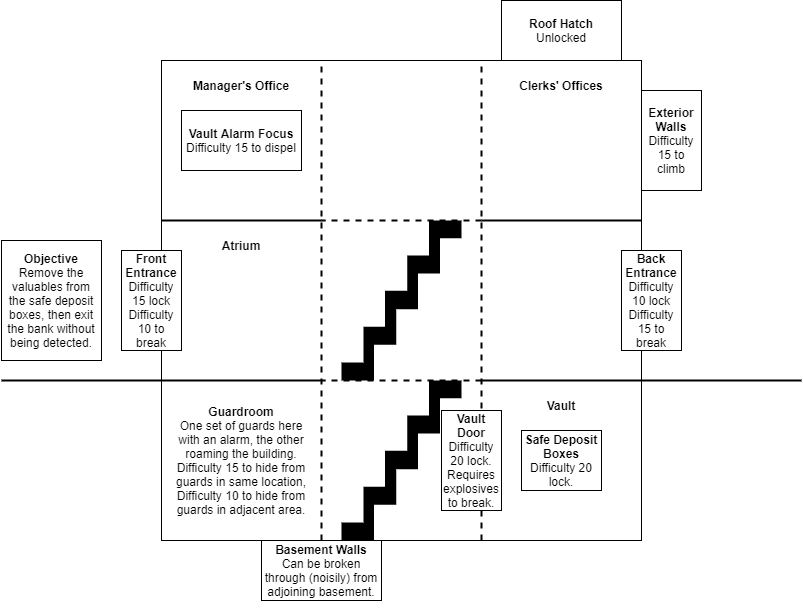
    • The bank is a two-story building with a basement, and each floor is divided into three sections, dividing the building into nine locations, plus a tenth “outside” location. There are stairs connecting the middle sections of each floor. On their turns, a character can move to an adjacent location instead of attempting to resolve a node.
    • The bank’s main entrance is in the front section of the ground floor, and there is another entrance to the back section of the ground floor as well. There is also a hatch to the roof, and the basement adjoins the basement of a neighboring building.
    • The vault is in the back of the basement.
    • There are two guard patrols, one that moves about the building, and another that initially stays in the guardroom at the front of the basement. Unless they are responding to a noise, the guards randomly choose a section of the building (other than the vault) and move towards it turn by turn.
    • The guards can detect PCs in their section of the building or an adjacent one, unless the PC succeeds on a Stealth check. This check is easier if the PCs are merely adjacent to the guards.
    • The guards respond to noises and other events, and can be lured to specific parts of the building in this way. The second time this happens, the mobile guards call for the other patrol to start searching the building; the third time, they call for backup from the city watch or other authorities.
    • There is a vantage point in a nearby, unsecured building where an observer can watch the guards’ movements on the ground and second floors, though not the basement.

    This gives us some idea of how the encounter might go once the PCs decide to put a plan into action: they will make entry to the bank somewhere, and then try to creep down to the vault while evading the guards. They might even split up, and one team lure the roving guards to a remote part of the building so that they can easily reach the vault. We’ll attach some numbers to these options later…

    Next, let’s consider physical and magical security:

    • The front and back doors to the bank are of course locked, but the front door is more decorative than sturdy, and can be easily broken down. The roof hatch is unlocked.
    • The door to the vault itself is also locked, requiring a difficult Subterfuge check to pick the lock. It could also be blasted open with the right kind of explosives, but that inherently attracts the guards.
    • The actual treasure the PCs are after is inside a locked chest, safe deposit box, cage, or other layer of security, which likewise can be picked quietly or broken open loudly.
    • There is a spell on the vault, which sounds an alarm if an object that has been in the vault longer than 24 hours is removed from it if a special talisman is not present at the door to the vault. The spell is powered by a focus located in the manager’s office on the top floor.
    • The guardroom contains a magical signaling system that can be used to call in the city watch. The patrolling guards can shout from as far away as the ground floor for the guards in the guardroom to use this system, or the guards in the guardroom can use it if they detect the PCs nearby.

    Finally: how much of this information can the PCs learn ahead of time, and how much will be a surprise to them when they spring into action? Before launching the heist, the PCs can, on their turns, make appropriate checks to investigate and plan their heist, such as:

    • Stealing the bank floorplans from town hall and deciphering them (Subterfuge, followed by Engineering, revealing the bank’s floorplan).
    • Getting a bank employee to talk about the bank’s security (Persuasion, learning one piece of information per success; on a failure, no further checks can be made).
    • Building an explosive device to blow a hole in the wall from the basement of the adjoining building (Engineering; does not work to blast directly into the vault, which has reinforced walls).
    • Stealing a security talisman for the vault from a bank employee (Subterfuge; optionally Deception to prepare a forgery as a replacement to avoid suspicion).

    Now, when presenting this encounter to the PCs, it might be helpful to have some kind of diagram to help them understand the layout of the bank and various nodes that can be interacted with. It might also be helpful to construct this diagram using index cards or sticky notes that can be added to the diagram as the PCs discover various nodes.

    Finally, before running this encounter, it may pay to think about some unusual ways that the PCs might try to resolve certain nodes. In particular, how might they try to neutralize the guards? This is an aspect of the encounter that will differ greatly from group to group: different players, and different characters, will approach the encounter differently, and you as the GM should consider their likely tactics.

    • As suggested above, they might try to lure the guards away from the vault (to the upper floor, say) by making noises. The first time they do this should attract the roving patrol; the second should attract both; the third should result in one patrol heading for the guardroom to signal for help.
    • Could the PCs sabotage the signaling system once the second patrol leaves the guardroom? This might be doable with Arcana or just by smashing things up. If the signal is broken, might one patrol leave the bank to fetch reinforcements?
    • Could the PCs knock the guards out, say by slipping a sleeping potion into their tea or pumping knockout gas into the guardroom? Where could they get the potion or the gas from?
    • Is there prep work that the PCs could do by visiting the bank during opening hours before the heist? This might allow them to, say, steal a key or a talisman for the vault alarm, or plant sleeping potion in the guards’ tea stash.
    • Most importantly: are the PCs likely to turn the heist into a smash-and-grab where they knock out (or kill) the guards, blast open the vault, and run off with the loot? Some groups might find the smash-and-grab more fun, in which case you might want to scrap the nodal encounter entirely in favor of giving them an interesting fight.

    Up Next

    I’ll be wrapping up this series on non-combat encounters next week, with some general discussion of how and when to use the various forms I’ve presented here. I’ve also got a Gazetteer post on the Ruins of Gobol Karn (an excellent site for adveture) in the works…and a post on an entirely different type of GM mechanic, which coincidentally builds on the dragon lore I posted a couple of weeks back…

  • Following on from my previous post about alchemical volatiles, today I’m going to cover potions and elixirs, the sort of alchemy that adventurers drink for healing, invigoration, or protection.

    Using Potions and Elixirs

    Potions and elixirs, with a few exceptions, are magical liquids that interact with mortal biology: they accelerate healing, toughen flesh, sharpen senses, or have other transformative effects on the adventurer who drinks them (or in some cases, dabs them on as ointment or inhales the vapors: the application method for many alchemical volatiles is not non-specific).

    A character can drink a potion or elixir as a minor action; if it was stored where they can easily get to it, like in a bandolier or belt pouch, they can draw and drink it in a single minor action. Otherwise, they need to draw it as a separate action first.

    Potions generally have short-lived or instantaneous effects, while elixirs have longer-lasting, and often more powerful, effects. Potions can be mixed, but a character can have the benefit of only one elixir at once. Drinking a second elixir before the first wears off neutralizes the effects of both.

    Characters with the Alchemy feat are able to brew their own potions and elixirs (and can also make the volatiles discussed in my earlier post).

    Examples of Potions and Elixirs

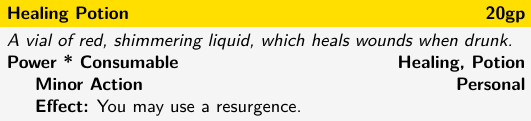
    The first potion I’m going to reveal is the humble Healing Potion, without which no fantasy RPG really feels complete. Yes, it’s red because healing potions in most videogames are red. There is only a single potency of healing potion in Aetrimonde, because it simply allows the drinker to use a resurgence, and so it scales with hit points instead of requiring advanced versions for higher-level characters that have significantly more hit points.

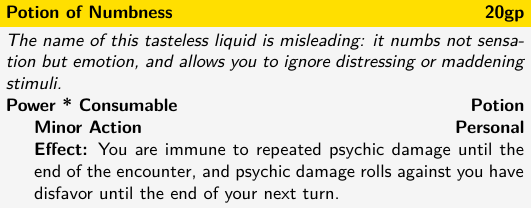
    The Potion of Numbness is an in-the-moment defensive potion: it can completely protect a character from repeated psychic damage (which Aetrimonde often uses to represent the madness caused by having looked upon eldritch abominations and other Things Mortals Were Not Meant to See) and reduces the damage they take from other psychic damage.

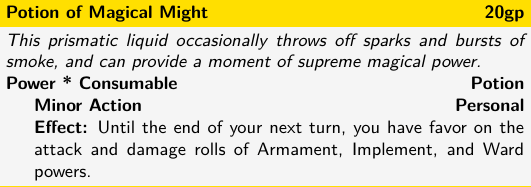
    The Potion of Magical Might is a more offensively-minded potion (although it could conceivably be used to make Ward powers retaliate harder against creatures striking their recipients…). It has the straightforward effect of giving a character just under two turns of favor on the attack and damage rolls of magical powers (those with the three keywords listed): great for moments where the PCs finally have a powerful foe on the ropes and need to hit it as hard and as fast as they possibly can.

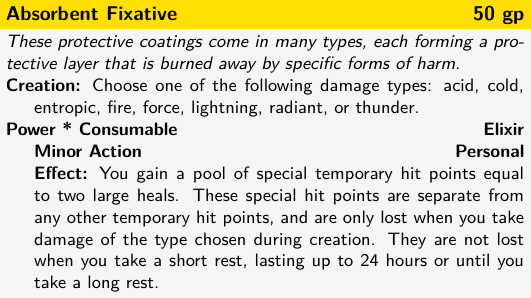
    Finally, there is the Absorbent Fixative, an example of several things: it’s an Elixir, having a longer-lasting effect than Potions; it comes in multiple varieties that protect against different types of damage; and at least as far as flavor is concerned, it’s not actually something you drink, but something that you pour over yourself and your equipment to form a protective outer layer. (But of course, this is merely for flavor, and has no real mechanical effect.) At two large heals, Absorbent Fixative actually provides one of the larger healing-ish effects available, which compensates for the fact that it only provides temporary hit points and only protects against a single damage type.

    Bio-Alchemy Lore

    Now, mechanics are one thing, but alchemy also deserves lore, and I’m someone who knows just enough about chemistry and biology to want some kind of explanation for what a healing potion actually is. Is it a spell bound to a liquid? Is it a miraculous panacea distilled from a rare plant? Is it a chemical compound synthesized with the aid of magic? Well, since I’m lumping potions and elixirs in with alchemy, I’m going to say that it’s a magically transformed substance…and I’ve got more lore where that came from. If this topic interests you, read on: I’m not actually sure whether to put this excerpt in the Core Rulebook or the Aetrimonde Setting chapter of the GMH, but it’ll go in somewhere:


    Producing magical substances that interact safely with mortal biology is complicated. Potions and elixirs are not magical spells anchored to a liquid medium, which would be far, far safer: they are literally magical substances activated by contact with living tissue. Small mistakes in concocting potions and elixirs can leave the imbibers dead, or worse…which is why most commonly-available potions and elixirs are derivatives of a very few alchemical processes that are well-understood and difficult to get seriously wrong.

    Most of these common alchemical processes originated with the goblins of Gobol Karn, the original alchemists, who are still unsurpassed in the discipline of bio-alchemy. Unlike the techniques of producing alchemical metals, Gobol Karn did not trade away knowledge of bio-alchemy, because they based the structure of their entire society around these secrets, much to the horror and dismay of their contemporaries.

    Like most of its contemporary societies, Gobol Karn practiced slavery. Unlike its contemporaries, Gobol Karn used bio-alchemy to render its slaves docile and compliant…and to twist and warp them into new forms suitable for the work to which they were forced. Karnish alchemists were able to produce permanent transformations, making subjects grow into muscle-bound hulks or forcing them into parodies of their original shapes for the amusement of the goblin public.

    The eventual collapse of Gobol Karn, caused ironically by the backfiring of the imperial family’s attempts to alchemically enhance themselves, allowed some of the lesser techniques of bio-alchemy to spread from Gobol Karn. The more advanced techniques and formulas, including the ones capable of inducing permanent and hereditary transformations, remain lost.

    Many expeditions to the ruins of Gobol Karn are formed in the hopes of finding some fragment of alchemical knowledge in a preserved laboratory or archive, and in fact some such fragments have been recovered. However, the horrors perpetrated by Gobol Karn still loom large in the minds of many authorities: over the centuries, many papyri and tablets brought back from the ruins have been seized and destroyed or hidden for fear of how their contents might be used if they made it into wide circulation.

    Modern alchemical research falls into two camps: the respectable camp works by making small, incremental adjustments to proven formulae or by testing new formulae recovered from Gobol Karn and very carefully vetted by reliable alchemists and government censors. The products of such experimentation, when they don’t explode at the first hurdle, are tested first on lab animals and eventually on daring volunteers. Progress in this manner is, naturally, slow.

    Disreputable alchemists, meanwhile, haphazardly mix and recombine formulas according to principles based half on superstition and half on fragments of ancient texts that escaped the censors, with a dash of pure madness often thrown in for flavor. The results, when they last long enough to administer without exploding, are generally lethal, and when they aren’t lethal, generally cause horrific mutations or mind-shattering insanity…but occasionally, they produce substances with applications useful enough to make the side effects worthwhile.

    Bio-alchemists are therefore viewed with more than a trace of suspicion by the general public. Potions and elixirs not clearly labeled and sealed with the mark of a reputable company or guild are worse than worthless, because they can draw accusations of illicit experimentation (and the companies and guilds are very quick indeed to crack down on unlicensed use of their marks). Nonetheless, a few unaffiliated, unsupervised alchemists brew products outside the usual range of substances…and desperate or foolhardy adventurers might find them worth the risks.


    And this isn’t actually just lore! The GMH contains a random-roll table that a GM can use to determine the side effects of imperfect, experimental, or tainted potions and elixirs. (It could also be used, as an optional rule, to determine the effects of mixing multiple elixirs at once…) The GM is intended to roll once per batch of unorthodox alchemy, but could roll whenever the product is consumed if appropriate. Importantly, the only reliable way to determine what side effects a batch of alchemical product has is to try it out on a test subject. A few entries from this table are provided here:

    4d10 ResultEffects
    4The drinker dissolves rapidly, and painfully, into a puddle of bloody flesh, but does not die.
    15The product is psychoactive: 1d10 days after consumption, the user develops a random affliction from among the psychological traumas starting on page [NA].
    20The product causes an unusual, noticeable, but ultimately innocuous physical transformation, such as changing skin color, causing eyes to glow, or making hair grow rapidly. Effects last for 5 minutes or until the product wears off, whichever is longer.
    33The product has both its normal effect and the effect of another, randomly chosen potion or elixir.
    40The product is unusually potent, and its effects are permanent. Effects that would normally occur once instead occur at the start of the drinker’s every turn.

    For players who want to try their hands at experimental alchemy, the GMH also provides the following suggested framework:

    The player should start by specifying a desired product that is a variation on an existing alchemical product: a Healing Potion that grants favor on its healing roll, for example. For each distinct variation like this, the character needs to make a Difficulty 20 Arcana check, with success meaning that the batch has the desired variation but gains a side effect such as one randomly generated from the table; a failure means that the entire batch goes up in smoke instead. If the player wants to create an entirely original alchemical product, then it is up to the GM how many Arcana checks they need to make (and thus how many side effects it could possibly have).

    Up Next

    I’ve got a couple more posts relating to non-combat encounters planned. I think I might also have a Gazetteer post on Gobol Karn and its ruins…and another that might expand on the dragons I presented last week. Stay tuned!

  • After last week’s unplanned delay, I’m continuing with my series on planning and running non-combat encounters! This post will cover the basics of the third format of non-combat encounter presented in the GMH, which is designed to model complex situations with many moving parts, like heists.

    This topic is complicated enough that I’ll be splitting it up and providing a full, working example in a later post, next week.


    Nodal Encounters

    Finally, if a non-combat encounter is complex, featuring many interacting factors and challenges to be overcome, the best way to design and run may be as a nodal encounter. Nodal encounters get this name because they are structured like flowcharts, with various boxes, or nodes, representing the different challenges in the encounter and connections showing how they interact with each other.

    Basic Concept

    In a nodal encounter, there are multiple obstacles, represented by nodes, between the PCs and their goal. Some of these may be direct obstacles, like a cliff to be climbed or a door to be unlocked; others may be complicating factors that make it harder to overcome the direct obstacles. The PCs thus have a choice not just of how to solve each node between them and the objective, but also of what order or route to use in solving them.

    • The players roll initiative and enter a turn order like they would in combat.
    • On their turns, the players can describe how their character attempts to resolve a node. The GM then calls for a check of an appropriate kind and Difficulty.
    • The players overcome the encounter by resolving all of the obstacles between them and the encounter’s objective node. Some encounters may also have ways for the PCs to fail if they don’t resolve a node correctly.

    Rather than begin by giving an example of a nodal challenge, let us first discuss some different kinds of nodes that could be put together into a nodal encounter:

    Objective Nodes

    The objective node naturally represents the players’ objective: they win the encounter by resolving or bypassing all other nodes preventing them from reaching the objective node.

    An advanced nodal encounter might feature multiple objective nodes, requiring the PCs to reach all of them, which is harder than reaching just one, or allowing them to just reach one, which is easier.

    Examples:

    • The treasure vault that the PCs are raiding.
    • The kidnapped NPC that the PCs are rescuing.
    • The secret knowledge that the PCs are attempting to discover or pry out of an NPC.

    Blocker Nodes

    A blocker node represents the factors that prevent the PCs from just going straight to the objective node. Blocker nodes must be resolved by PCs succeeding on appropriate checks to progress towards the objective node.

    A blocker node may be permanently removed when it is resolved, or it may only remain resolved for a limited time (one round, for instance). A permanently-removed blocker might require multiple successful skill checks to remove it.

    Blocker nodes can have consequences for failing to resolve them, up to and including making the PCs fail the encounter entirely.

    Examples:

    • A tower wall that the PCs must climb to reach the vault (Athletics, requiring 3 successes for an individual character to climb and causing fall damage if they fail badly).
    • The locked door to the cell of the kidnap victim (Strength to break down noisily or Subterfuge to pick quietly, requiring only one success but with a high Difficulty).
    • A geas preventing a learned scholar from revealing crucial information to the PCs (Arcana, to dispel the ritual and allow them to question the scholar, or Deception, to work around the wording of the geas and allow the scholar to answer one question per success).

    Complicating Nodes

    A complicating node makes it harder to resolve other nodes in certain ways. Like blocker nodes, a complicating node can be resolved (maybe permanently, maybe only temporarily), making it easier for the PCs to resolve those other nodes.

    Complicating nodes can work in many ways, such as by increasing the Difficulty of certain kinds of checks or imposing disfavor on them, requiring that PCs also make and pass an additional check when attempting certain kinds of check, or adding consequences for failing certain kinds of check.

    Examples:

    • Guards are stationed outside the tower, that could see anyone climbing up it. (A character attempting to climb the tower must also succeed at a Stealth check, or the encounter is failed; can be resolved until the end of the round by distracting them, e.g. with Charisma, Persuasion, or Subterfuge.)
    • An Alarm ritual is set on the kidnap victim’s cell door and will alert the guards when the door is opened, causing the PCs to fail the encounter unless they get the door open by the end of the round. (The PCs only notice this complication if they succeed on an Arcana check, which they make automatically before attempting to resolve the cell door. They can resolve it permanently by dispelling the ritual.)
    • The djinn that placed the geas on the learned scholar is nearby, and can sense when someone interferes with the geas. (Attempting and failing to dispel the geas alerts the djinn; can be resolved until the end of the round by being sufficiently interesting to the djinn, e.g. using Cunning to engage it in a game of riddles.)

    Bonus Nodes

    A bonus node gives the PCs some kind of optional reward, which could be gold or other treasure, a resource or opportunity that they can use to their advantage later in the nodal encounter, or a way to alter how the story plays out following the encounter.

    Taking a bonus node should always involve a tradeoff, even if it is just that taking the bonus replaces a PC’s opportunity to resolve some other node this turn.

    Examples:

    • There is a large, heavy chest of treasure in the vault, which a PC could take with them but would encumber them until they can get the lock open and remove the valuables from it. The PC carrying the chest is encumbered and has disfavor on checks using physical abilities; it can be broken open with Strength or the lock picked with Subterfuge, but these are difficult checks.
    • The PCs locate the guards’ armory, which contains several guards but also some spare uniforms. If they take the time to don the uniforms, they can make easier Deception checks instead of Stealth checks to move around the prison without alerting the guards.
    • The PCs could break the binding that forces the djinn to serve their foes, but this requires so many skill check successes (involving Arcana, History, Religion, etc.) that they would be unable to get all the answers they need out of the learned scholar.

    Locations

    An advanced variation on a nodal encounter splits the encounter into multiple locations, such that some nodes can only be resolved from certain locations. PCs can move between locations instead of attempting to resolve a node.

    There can also be additional restrictions on moving between locations: a blocker node may prevent movement until resolved, or a complication node may require certain skill checks when attempting to do so.

    It can even be possible to move certain nodes between locations, affecting which routes to the objective have blockers, or which locations suffer from a complicating node.

    Examples:

    • The guards patrol only around the outside of the tower containing the vault: once the PCs are inside (requiring them to climb the tower wall or resolve some other blocker), they are no longer in danger of being spotted.
    • The cells where the kidnap victim is held are divided into several cell blocks, and a guard patrol moves at random between them, forcing PCs to make Stealth checks to remain hidden while in the same location as the patrol. The patrol can be drawn to a specific location by a Deception or Subterfuge check.
    • The djinn initially resides far away from the scholar, and the PCs must split the party for some of them to distract it while the others get their answers out of the scholar. If the djinn is alerted, it teleports directly to the scholar’s side while the PCs must take several turns to get there.

    Up Next

    Keep an eye out next week for my post demonstrating nodal encounters with a worked-out example, modeling a bank heist!

  • I had originally planned to continue discussing non-combat encounters in today’s post, but the third type of encounter has proven to deserve at least two posts to itself. So while I rework that post, I instead have a Bestiary post…on those most proud and arrogant, fierce and destructive, cunning and manipulative creatures: dragons!

    Dragon Lore

    If there is any creature type deserving of some interesting lore, it is dragons. I’ve made a point of giving Aetrimondean dragons some unique twists on the traditional flying, firebreathing lizard formula:

    Dragons are flying, firebreathing reptiles that hoard treasure, snatch livestock, and otherwise make life difficult for mortals.

    Difficulty 5 Arcana or Medicine: Dragons are inherently magical creatures: their fiery breath comes from no biological or chemical process, but rather from their magical nature.

    Difficulty 10 Arcana or Medicine: A dragon’s magic is also necessary to let them move under their own weight, much less fly: while dragons are not the largest creatures in existence, they are far swifter and more agile than any creature that large—much less a flying one—has any right to be.

    Difficulty 15 Arcana or Medicine: As dragons grow older, they also get bigger, and their magic more powerful—up to a point. Eventually, dragons grow so gargantuan that their magic cannot keep up. Beyond this age—at around five centuries old—most dragons withdraw to their prepared lair, and spend increasing lengths of time in torpor, building up reserves of magic to allow them ever-briefer periods of activity. (Author’s Note: This provides a fun explanation/justification for why a group of adventurers might be able to sneak up on and slay a dragon, while noisier solutions, like an army, could not.)

    Difficulty 20 Arcana or Medicine: Dragons are perhaps unique among Aetrimonde’s natural creatures in that they appear to self-actualize: they grow into the shape that they want to have. Proud, destructive dragons grow large and physically powerful, cunning, predatory dragons grow lithe and swift, and so on. This extends to their fiery breath: some dragons, as they age, replace their fire with poison, lightning, or even more unusual breaths. (Author’s Note: This nudges GMs to stat out their own, unique dragons with abilities based on the unique niche they’ve chosen for themselves.)

    Difficulty 5 Arcana or Society: Adult dragons are compulsive hoarders: they collect treasure merely to have it, and it is incredibly difficult to get a dragon to part with any of their possessions, even when offered an extremely one-sided trade. They are more likely to incinerate any mortal with the temerity to bargain with them and seize their trade goods as an “inconvenience fee.”

    Difficulty 10 Arcana or Society: Young dragons (“drakes”) often have mindsets like ordinary mortals, and can even assimilate into mortal societies. Often, this is aided by spells allowing them to change shape, taking on a mortal guise. However, the hoarding instinct usually takes hold at around 200 years of age, and at this point they find it much harder to deal with mortals as anything like equals.

    Difficulty 15 Arcana or Society: Dragon hoards are often imagined to be heaps of gold and jewels, and dragons seldom turn down an offer of such valuables, but individual dragons generally have specific tastes. There are dragons who specifically hoard books, weapons, art…and more unusual things, like rare stamps, taxidermied animals, signatures of famous mortals, the crowns of powerful monarchs, and in one known case, powerful monarchs themselves. (Author’s Note: This establishes dragons as collectors, not just hoarders. That gives GMs some new options for using dragons as patrons, who might want adventurers to collect something interesting for them, or as the guardians of unusual MacGuffins.)

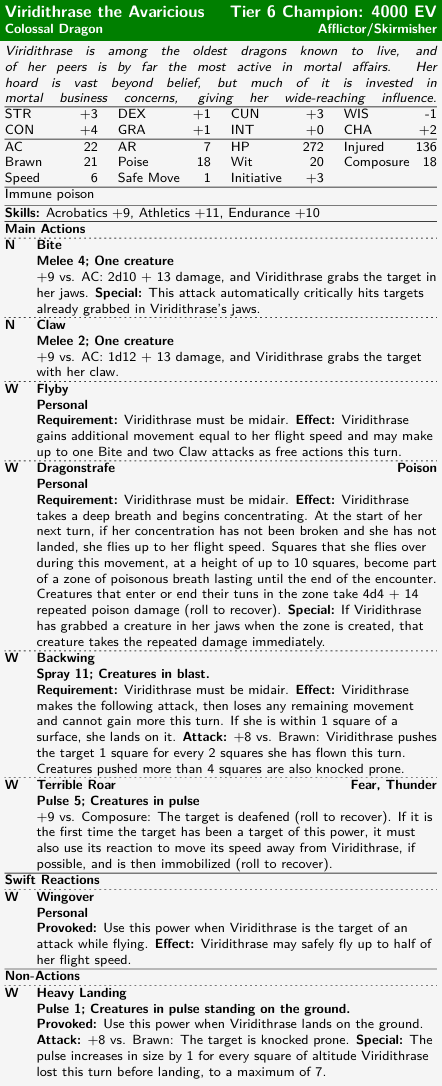
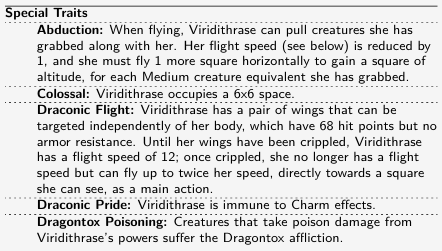
    Difficulty 20 Arcana or Society: A tiny minority of adult dragons are able to interact somewhat constructively with mortal society, but only by fitting into a niche where their hoarding behavior is actually beneficial. Some of Aetrimonde’s finest museums and libraries are in actuality the hoards of dragons—and woe betide the thief who attempts to remove a dragon’s books from its collection. And in a more notorious example, the reserves of certain merchant banks are also “guaranteed” by the great and terrible dragon, Viridithrase the Avaricious, who acquired the banks via an exceptionally hostile takeover and emptied their vaults into her hoard. The banks’ surviving board members, faced with an angry mob of depositors, issued claim slips theoretically entitling bearers to draw on Viridithrase’s hoard—thus inventing paper money, and eventually, fractional reserve banking. (Author’s Note: Okay, this last one is largely for my own amusement as an economist. But it also establishes some rare ways in which dragons interact with society.)

    Difficulty 10 Religion or Society: Many dragons, as they approach the age at which they have to undergo torpor, begin to cultivate mortal followers as a means of acting outside of their lairs. Often, they simply pay their agents with trinkets and “spare change” they don’t care to keep in their hoards, but they are also known to develop cults around themselves.

    Difficulty 10 Warfare: Drakes can be overcome by a conventional military with sufficient training, equipment, and preparation. Elder dragons can be overcome by anyone who catches them in their torpor (although making it through their prepared defenses without rousing them is more of a challenge). It is adult dragons, just at the cusp of requiring torpor, who are the true danger: they are powerful enough to ruin entire towns and provinces, active enough to do so regularly, and they rouse easily from their infrequent torpors, making it a challenge to catch them unawares. (Author’s Note: This provides GMs with some context for just how powerful various ages of dragons are considered in-world.)

    One Family of Dragons

    The Bestiary contains multiple “families” of dragons based on different niches of self-actualization. I’m going to reveal just one in this post: the family of large, fierce, proud dragons that are a direct physical threat. These three statblocks could represent the same dragon at three stages of its life, but this is only one way that a dragon of this mindset could grow and mature.

    Fierce Dragonet

    The Fierce Dragonet statblock represents a “teenage” dragon, old enough to be independent but not developed into the terror that an adult dragon represents. This particular dragonet might even be called a “teenage jock” dragon, because it is primarily a physical threat. Even as a Tier 1 Elite, it packs multiple nasty tricks:

    • With its Brawl action, it can make up to three attacks on its turn. Its Bite attack is the most dangerous of these just based on its combination of higher damage and longer reach (which, yes, does let the Fierce Dragonet make opportune strikes against creatures that rush up toward it), but it becomes far more deadly in conjunction with two special traits:
    • The Bite attack allows the dragonet to grab a target with its jaws, and subsequently automatically critically hits (dealing 12 damage, guaranteed) creatures grabbed in this way. But even worse, creatures grabbed in the dragonet’s jaws are also exposed to Dragonsbreath…
    • And here we get to Aetrimonde’s implementation of a dragon’s fire breath. In many RPGs, a dragon has to wait between breath attacks, and is often at the mercy of the dice to determine how long it takes to recharge. I’ve taken a different approach: an Aetrimondean dragon can breathe fire as often as it likes…but it has to take a deep breath first. This telegraphs to the PCs that there will shortly be a gout of flame that they should spread out or move away from…and that they could, conceivably, do something to interrupt the dragon before it can exhale. This would require them to deal 22 damage in a single hit, but that’s not out of the question with a greater power or a lucky critical hit. But speaking of critical hits, Dragonsbreath automatically critically hits creatures grabbed in the dragonet’s jaws.
    • The dragonet naturally has wings, and can fly…until the PCs poke enough holes in them that it loses most of its mobility.
    • And last, but definitely not least, the dragonet’s fire has the potential to cause an affliction, specifically Severe Burns, a decidedly nasty affliction that can entirely incapacitate a PC, even if the damage itself didn’t suffice.

    Rampaging Drake

    The Rampaging Drake statblock represents a Fierce Dragonet with one or two more centuries of growth. As such, it has all of the same actions and traits as the Fierce Dragonet, with some new added twists:

    • The Bite attack has even further increased reach, out to 3 squares, which coupled with the drake’s increased size, means it can lock down a large part of the battlefield with opportune strikes. Bite, and also Claw, have larger damage dice due to the drake’s larger size, as well as its higher tier.
    • Dragonsbreath likewise has increased damage dice, for both the initial and repeated fire damage, and a larger area of effect. Also, with the Rampaging Drake being a Champion instead of an Elite, it becomes much harder to break its concentration, requiring a whopping 52 damage from one hit…which is still within the realm of possibility, if just barely, from a critical hit with a greater power.
    • The first of the drake’s brand-new twists is Tail Slap, making it a terrible idea to attack the drake from flanking. A sweep of the drake’s tail can not only deal some unexpected damage, it can knock a flanking attacker back and prone…and as a swift reaction, this means that the attacker will no longer be in position to make their attack, leading to a completely wasted action.
    • The Rampage special trait allows the Rampaging Drake even more attacks by moving through or over smaller creatures…but it does come at the cost of opportune strikes, which those creatures get to make as the drake enters their spaces.
    • Finally, as a Champion-grade creature, the drake gains outright immunity to Charm effects, representing the impossibility of overpowering an adult dragon’s will.

    Cataclysm Dragon

    Finally, we have the Cataclysm Dragon, representing an adult dragon derived from the Fierce Dragonet and Rampaging Dragon, at the age where it has to enter torpor every once in a while. The Cataclysm Dragon embodies and emanates dragonfire, scorching foes with the heat of its body…on top of all the same traits as the Rampaging Dragon.

    • For starters, the Cataclysm Dragon is outright immune to fire. This is a Tier 4 enemy, which PCs might be able to face at around level 10, at which point even characters specializing in fire damage should have some alternate attacks available to work around this. But see below…
    • The Bite and Claw attacks again have larger damage dice, higher damage bonuses, and more reach, with even the Claw attacks having reach 2 at this point.
    • Dragonsbreath again has increased damage and area, and at this point a critical hit (against a PC grabbed in the dragon’s jaws, for example) will deal a whopping 46 automatic fire damage…enough to put some serious hurt on just about any PC. However, this comes with a vulnerability, albeit one that is difficult to seize on: if the PCs somehow manage to deal the necessary 60 (!) damage to break its concentration, the Cataclysm Dragon’s fire breath burns out of control, and hot enough even to overcome its fire immunity. This adds an extra 6d6 + 10 fire damage on top of whatever critical hit managed to break its concentration!
    • The Cataclysm Dragon has two new abilities making it increasingly difficult to fight it: Burning Blood kicks in once the dragon has been injured (i.e. is below half health), and inflicts repeated fire damage on any character who hits it with a melee attack. And Dragonfire Aura causes it to inflict fire damage to nearby creatures while concentrating on its Dragonsbreath. Combined, it can be incredibly dangerous to face a Cataclysm Dragon in close combat…which is fitting for a creature representing the pinnacle of draconic physicality.

    Up Next

    Of course, even the Cataclysm Dragon represents a dragon just barely at adulthood. There are older and more powerful dragons out there, biding their time in torpor and occasionally coming out to burn, pillage, and destroy. We might see one of those shortly…

  • Having dipped a toe into the topic of alchemy with last week’s post on alchemical metals, I’m going to continue on this topic by getting into the actual mechanics of alchemy. There are broadly two kinds of alchemy that the Core Rulebook has support for, and one of them is Volatiles. These are things like explosives, concentrated acids, and alchemist’s fire, that adventurers might deploy against their foes.

    Design Goals

    Alchemical volatiles are one type of consumable item, and so I’m going to take a brief detour into my design goals for consumables.

    The elephant in the room, when it comes to consumables, is that any resources that a PC spends on consumables are resources that they aren’t getting back. When a character spends money on a permanent magical item, that item will make their character more powerful permanently (barring some development where they lose it or sell it off). Spending money on a consumable (or using one that you could have sold) means taking resources that could have gone to a permanent upgrade and instead using them on a temporary benefit. In the long run, a PC who spends their money on consumables will wind up less powerful than one who saves up for permanent items–and this can lead players to hoard consumables “for a fight where we’ll really need them.”

    When I’m running an Aetrimonde campaign, I want players to actually use consumables. Getting them to do so depends a lot on individual player psychology, but in general, it requires two things:

    First, players need to feel comfortable that by using consumables to overcome problems in the short-term, they are not hampering their characters in the long-term. Which is to say, spending money on consumables, or using up consumables that they could otherwise sell, needs to not significantly reduce a character’s wealth in the long run.

    Aetrimonde will handle this with some advice in the GMH’s section on placing treasure in an adventure, which says (summarizing here) that there is an appropriate level of wealth for characters of a given level, and while it’s okay for some of that wealth to be tied up in consumables, or for their wealth to dip a bit when they use a consumable, they shouldn’t ever get locked into a lack of wealth. A GM can handle this by inserting consumables into treasure at roughly the same rate that the players use them, or by occasionally offering a “top-up” of wealth if they notice that a PC’s use of consumables has left them with less wealth and resources than they should nominally have, depending on what works for their campaign. However, a PC shouldn’t immediately get back any resources they spent on consumables: there should be a delay between expending a consumable and being able to replace it, to maintain an element of suspense.

    Secondly, players need to feel confident that using a consumable will be effective. If consumables are rarely as effective as using a PC’s own inherent powers (even when those powers aren’t ideal for the situation), then PCs will avoid using them.

    As far as Volatiles go, the approach I’ve taken is to make Volatiles less potent than a lesser power, in terms of raw damage, but more reliable: Volatiles deal a small amount of damage or have some other effect that doesn’t require an attack roll, which makes them useful for dealing some guaranteed damage to wipe out a clump of mooks or exploit an enemy’s vulnerability to a specific damage type. But they’re generally not going to do as much damage as a solid hit from a PC’s own lesser powers (much less a greater power). Combined with the variety of available Volatiles covering a wide range of damage types, this makes Volatiles a handy and reliable tool for a sticky situation, but not something that a character will want to break out every turn.

    Engaging with the Alchemy Subsystem

    Characters can obtain alchemical Volatiles as treasure, or by buying them as available from NPC alchemists, or they can brew them up themselves by taking the Alchemy feat, which functions much like the Enchant Magical Item feat used to engage with the magical items subsystem.

    Actually using a Volatile is simple: pull it out from wherever you stored it on your person, perhaps pull a pin or remove a cork, and toss. This usually takes a main action, and that includes pulling it out if it was stored conveniently (i.e. in a pouch or bandolier, not at the bottom of a backpack).

    But what is an article on alchemical volatiles without a few examples?

    Alchemical Fire is a classic, based on the Greek fire of antiquity. Aetrimonde’s interpretation of the substance emphasizes its tendency to cling as it burns, creating a puddle of flames that denies an area to friend and foe alike–and it can also set a creature it directly hits on fire.

    However, Aetrimonde is a setting where the ancient and modern collide…and so there is also the Incendiary Grenade, a more modern, manufactured equivalent to Alchemical Fire that causes immediate damage in its blast, but can still set fire to enemies caught in the center of it.

    As an example of a Volatile that isn’t directly harmful, consider Alchemical Shine, which has a variety of useful applications. It can shed (admittedly dim) light on part of a battlefield, or be thrown directly at a foe to make the foe itself glow–which is useful for keeping such a foe from hiding, or to track them through dark places. Thrown accurately at an invisible foe, it can even help to reveal them! And if one has no other uses for it, an unopened bottle of Alchemical Shine sheds enough light to substitute for a candle.

    And filling the opposite niche, there is the humble Smoke Grenade, creating a cloud of obscuring smoke that provides concealment, enables stealth, and in a pinch, can be used as a diversion or a visible signal. The cloud lasts three rounds, shrinking each round, which provides adequate time for many kinds of subterfuge.

    Up Next

    Keep an eye out next week, when I’ll be covering the counterpart to alchemical Volatiles: Potions and Elixirs!

  • Last week I introduced some of the guidance the Aetrimonde Game Master’s Handbook provides for creating and running non-combat encounters where the focus is on the characters’ abilities and skills and their ability to apply them creatively to a problem. In that introduction, I focused on resource encounters where the challenge stemmed from a need to achieve success before running out of time or some other resource. Today, I’ll be providing an excerpt from the GMH talking about a second kind of non-combat encounter: contests pitting the PCs against opposing NPCs or some other force that actively competes with them.


    Contest Encounters

    A more complex kind of non-combat encounter is a contest, which pits the PCs against an opposing force, which might be a person, a group, or even an impersonal force. To win a contest, the PCs must find ways of using their skills more effectively than the opposition.

    Basic Implementation

    In the simplest implementation of a contest, the PCs and their opposition are both trying to achieve the same goal, which requires them to succeed on a certain number of skill checks.

    • The players, and the opposing team, roll initiative and enter a turn order like they would in combat.
    • On each turn, characters in the contest must describe how they work towards their goal, then make a single skill or ability check of an appropriate type and Difficulty to represent their efforts.
    • Whichever team first achieves a set number of successful checks wins the encounter. However, requiring more checks actually makes a contest easier, because (as discussed below) the PCs should generally have the advantage in a contest if they apply their skills with imagination and strategy. Requiring fewer checks increases the influence of chance on the contest, thus making strategy and imagination more important for the PCs. As a rule of thumb, the required number of successes should be a multiple of the number of PCs in the party: 3 times the number of PCs for an easy challenge, 2 times for a medium challenge, and 1 times for a hard challenge.

    Example: Race to the Ruins

    The PCs have one half of an ancient map to the ruins of a lost city, and their rivals have the second half. They must work out a route to the ruins and then beat their rivals there with enough time to find the artifact they seek.

    This is a medium-difficulty challenge, requiring 2 successes per PC (so 10 total) to win. Useful checks might include:

    • Consulting a library for a full version of the ancient map (History).
    • Spying on the rival party to get a glimpse of their half of the map (Stealth and/or Perception).
    • Plotting a route to the ruins that accounts for changes in terrain since the map was made (Nature).
    • Calling in favors to make the journey easier (Charisma, benefiting from a Contacts perk).
    • Making a desperate forced march (Endurance).

    Complications

    Depending on the context of a contest encounter, there are ways to increase verisimilitude by adding to the complexity of the encounter. Some of these will be familiar from resource encounters:

    [The first two complications discussed are essentially a repetition of two discussed in the context of resource encounters, and I’m omitting them here for brevity.]

    Running Interference

    If the PCs want, they can attempt to interfere with the opposition’s efforts instead of trying to achieve a success directly. On their turn, a PC can describe how they intend to interfere with the opposition, then make an appropriate check. The next time the opposition attempts a check that the PC’s efforts would interfere with, the Difficulty of the check is the PC’s check result.

    This allows the PCs an alternate way of contributing if they have no skills that they can use to directly achieve a success in the contest, by making it harder for the opposition to achieve their own successes. It can be particularly effective if the opposition has a limited range of good skills, and the PCs can work out a way to interfere with many of them at once.

    If any of the PCs take this option, make sure that they see signs of how it mattered: either have the opposition attempt a skill check and suffer from the interference, or narrate how the opposition notices the interference and is forced to use a backup plan instead.

    Individual Efforts

    If there can only be one winner of a contest, and the PCs are judged on their individual performance rather than as a group, then a contest should track successes separately for each participant. As a rule of thumb, victory should require 4 successes by a single participant for an easy challenge, 3 for medium, and 2 for hard.

    Chase Scenes

    A chase scene is a variation on a contest, where the PCs are not so much trying to beat their opposition to a goal but trying to catch up to or outpace them.

    • The players, and the guards, roll initiative and enter a turn order like they would in combat.
    • On their turns, each character in the contest must decide how they either catch up or get away. They can attempt to aid an ally or run interference, as described in the complications on the previous page, or they can just attempt to aid themselves.
    • At the end of every round, each character on the pursued side of the contest must make a relatively easy (Difficulty 10) Endurance check. (The most helpful way to aid an ally is to give them favor on this check.) If all the pursued characters succeed, they collectively accumulate one success. If any of the pursued characters fail, the pursuers accumulate one success instead.
    • One side wins the chase when their accumulated successes exceed the other side’s by a target amount. As a rule of thumb, this should be 4 successes for an easy challenge, 3 for medium, and 2 for hard.

    The basic framework of a chase scene can be adapted for other types of contest where the PCs, collectively, need to stay ahead of the competition in a different sense, such as a social conflict where they need to maintain greater favor with a powerful patron, or an academic conflict where they need to maintain better grades or the favor of the funding committee. Applying the chase scene framework to these contexts is largely a matter of changing the required check to a more appropriate type (Charisma for a social conflict, or some Intelligence-based check for an academic one).

    Example: Pursuit Through the Streets

    The PCs have stolen something, or killed someone important, or just been accused of such an act, and the guards are after them! The party needs to get far enough ahead of the guards to hide somewhere and lie low long enough for the heat to die down.

    This is a hard-difficulty challenge (because whatever the PCs did, it really got the guards worked up…), requiring them to accumulate 4 Endurance check successes more than the guards. Useful checks in this contest might include:

    • Putting on a good burst of speed on a straightaway (Athletics).
    • Fleeing through a crowded street or across rooftops (Acrobatics).
    • Frightening bystanders out of the way (Intimidate).
    • Directing the chase to a street where the locals are on good terms with the party (Society, benefiting from a Contacts perk).
    • Talking a bystander into swapping hats or coats to confuse pursuers (Persuasion).

    Up Next

    I think that’s enough on the topic of contest encounters for now. The GMH goes on to discuss some other applications and variations on contests, like eliminations where participants are eliminated for failing checks until only one is left, but I’m saving that content for the actual book.

    Next up, I’ll be discussing the third and most complicated format of non-combat encounter that the GMH will discuss: the nodal encounter.

  • I’ve got a post in the works covering Aetrimonde’s alchemy subsystem used for making potions, elixirs, and volatile chemicals, but as a prelude to that, I want to discuss what alchemy actually is in this setting, starting with a single application: Alchemical Metals!

    Origins of Alchemy

    The original discoverers of alchemy were the goblins of Gobol Karn, in the Age of Myth. Parts of the science of alchemy (and science it is) spread to other cultures, although the goblins kept the most powerful uses of alchemy a tightly-guarded secret, one that adventurers still risk their lives attempting to retrieve from the ruins of Gobol Karn.

    Alchemy is, at its core, the science of imbuing magical energies into physical matter. This is not the same as enchanting a magical item, which anchors a magical spell to an object but leaves the object itself largely unchanged. Alchemy alters substances, not objects, and the changes it imparts are inherent and permanent, often changing materials in truly wondrous ways.

    One aspect of alchemy that the goblins traded away was the ability to enhance mundane materials using alchemical formulas. Applied to organic materials, the difference is one of degree, and the process is adjustable: wood, leather, fabric, rubber, and other substances can be treated to make them tougher, lighter, fireproof, or any number of other desirable qualities.

    The alchemical treatment process works much differently for metals (and some gems and other minerals). For every elementally-pure metal, there is but a single alchemical formula that produces anything but an explosion or a cloud of noxious fumes. And the alchemical metals produced by these treatments, while they do have altered physical properties, are more interesting for their magical properties…

    Each alchemical metal interacts with magical energies in a defined and quantifiable way. Alchemical quicksilver absorbs magic, alchemical lead dampens it, and so on. Once these properties were noticed, they became the basis of the magical half of Aetrimonde’s industrial revolution: it became possible to create magical effects by channeling magical power through a device made from alchemical metals in a proper configuration. Designing such a device remains difficult, especially when the desired effect is complex or subtle, but once an engineer arrives at a working design, it can be assembled from a blueprint by even semi-skilled craftsmen.

    The Prime Alchemical Metals

    Alchemists initially discovered the appropriate treatments for seven metals (copper, iron, silver, gold, tin, lead, and quicksilver), and for centuries it was believed that these were the extent of the alchemical metals. The magical properties of alchemical lead were discovered first, and experimentation led to the discovery of the properties of the other six; the sheer usefulness of these seven magical properties led to renewed interest in alchemical transmutation and the discovery of further alchemical metals, but these seven remain the most commonly made and used.

    Thaumodynamic Theory

    Magic, as practiced by mortals, is notoriously difficult to quantify. So much about magic is subjective, influenced by a practicioner’s worldview and mental state, that magic works differently for each user in all but the most fundamental ways. Scholars who study the fundamentals of magic describe it as a series of “stylized facts” based on qualitative, not quantitative, observations:

    • Magic is an energy, like heat.
    • Living beings attract small amounts of magic.
    • Certain patterns of thought, belief, and behavior attract larger amounts of magic.
    • Magic seeks equilibrium. Where magic is more concentrated than in the surrounding area, it seeks to flow outward.
    • Magic clings to creatures and objects, flowing away more slowly than it does from thin air.
    • When magic flows, there is resistance. This resistance causes some of the flowing magic to decay into other kinds of energy.
    • The manner in which magic flows (the path of the flow, and its proximity to other magical flows and charges) influences what kind of energy it decays into.
    • A spell is a pattern of thought, belief, or behavior that causes magic to flow in such a way that its decay into other energy produces a consistent effect.

    There are two technical terms useful in discussing alchemical metals: thaumic charge refers to the amount of magical energy held within an object, and thaumic current refers to the rate at which magic flows through an object. Ordinary materials can hold relatively little thaumic charge and carry little thaumic current; alchemical metals are orders of magnitude better.

    SubstanceMagical PropertyAltered Physical Properties
    Alchemical CopperEquilibrates thaumic and electrical currents.Increased ductility, able to be drawn into fine wires.
    Alchemical IronEquilibrates thaumic and electrical charges.Increased hardness, on par with high-carbon steel.
    Alchemical SilverEquilibrates thaumic current and thermal flux.Increased thermal conductivity, rapidly taking on the temperature of its surroundings.
    Alchemical GoldEquilibrates thaumic charge and heat.Increased specific heat, absorbing more heat but warming more slowly.
    Alchemical TinEquilibrates thaumic current and velocity.Increased reflectivity, on par with silver.
    Alchemical LeadActs as a thaumic insulator.Increased density and malleability.
    Alchemical QuicksilverActs as a thaumic capacitor.Increased viscosity.

    Common Applications

    The prime alchemical metals form the basis of many magical devices.

    • Rods of alchemical iron and copper can convert lightning strikes into thaumic charge and current.
    • Running a thaumic current through a strip of alchemical silver will cause heat to move along the strip in the direction of the current, causing one end to grow cold and the other warm. Likewise, charging alchemical gold with thaumic potential will cause it to grow warm, and placing alchemical gold in a fire will generate magical potential.
    • Alchemical tin can be caused to move (more precisely, it can be made to experience force) by running thaumic current through it in the direction of desired movement.
    • A vessel of alchemical quicksilver encased in alchemical lead provides efficient storage for thaumic charge.

    Secondary Alchemical Metals

    Other alchemical metals have more esoteric magical properties. Most simply equilibrate between different kinds of energy, such as alchemical bismuth, which if properly used equilibrates thaumic current and visible light (although it also appears capable of equilibrating thaumic current with an as-yet undiscovered kind of energy).

    Some alchemical metals have as-yet unknown magical properties, including alchemical nickel, aluminium, and tungsten. Alchemical aluminium and alchemical tungsten are still prized, under their classical names of mithril and adamantine,1 for their extraordinary physical properties, as are some other alchemical metals with unknown magical properties.

    Finally, there are some metals for which the appropriate alchemical treatment has not yet been discovered, like cobalt, oranite, and stygiite. While there are almost certainly alchemical variants of these metals, alchemists have observed that alchemical treatments grow exponentially more energy-intensive for heavier elements, and experimentation with alchemical treatments for heavy metals has the potential to be incredibly explosive. It is difficult to secure funding for such experiments, and there are rumors that these experiments are being purposefully suppressed after some unspecified disaster involving alchemical oranite.

    Alchemical Alloys

    It was originally believed that alchemical metals could not be alloyed: attempts to create alchemical bronze by combining alchemical copper and tin led to highly energetic explosions, as did attempts at other alchemical alloys. The actual treatment necessary to produce alchemical bronze (which exhibits a mixture of the properties of alchemical copper and tin, at lower intensities) is a hybrid of the treatments for copper and tin, and must be applied to a molten mixture of copper and tin mixed at a very precise ratio. Since the process is so finicky, and there are few applications for alchemical bronze that could not be better served by separate components of alchemical copper and tin, research into other alchemical alloys has stalled.

    Other Alchemical Minerals

    While alchemical metals display the most striking magical properties, some other minerals have their own, less impressive properties when alchemically treated. Of these, the most notable is alchemical silicon, which displays the novel but poorly understood property of resisting thaumic currents differently depending on its thaumic charge. This property had few applications, rendering alchemical silicon a mere novelty, until it was incorporated into the design of the original golem noofactors. How it actually contributes to the function of a noofactor is unclear, but golem designers have reverse-engineered principles that guide their use of alchemical silicon wafers to construct increasingly sophisticated golem minds.

    Certain gemstones containing metallic trace elements, like ruby, sapphire, and emerald, can be given a form of alchemical treatment, although whether this causes them to develop the magical properties associated with their metallic components varies on a stone-by-stone basis, and the derived properties are rarely as potent as in the pure metal. Before the invention of the lead-mercury thaumic battery, alchemically treated gemstones were useful for storing thaumic charge, but they are now considered inefficient and old-fashioned.

    Up Next

    I’ll be following this post up with another, focused on the more traditional application of alchemy to making potions that heal and chemicals that explode, before we get into the actual rules for using alchemy as an Aetrimonde character.


    1. The treatments to produce mithril and adamantine were discovered by the dwarves of Gjalerbron in the Age of Legends, and became lost during the Collapse. The secret of mithril has since been rediscovered, and has spread to non-dwarven alchemists; the secret of adamantine remains lost. All modern adamantine is made by melting down adamantine from the Age of Legends, which many dwarves find abhorrent. ↩︎
  • Today, I’m going to talk about some mechanics written for the GM, rather than the players. Aetrimonde provides multiple frameworks for creating encounters that don’t involve outright combat: these mostly use skills to overcome whatever the challenge in the encounter is. To start with, I’m going to cover what Aetrimonde calls a resource challenge where the players are up against a time limit or other constraint.

    D&D 4e’s Skill Challenges

    Dungeons and Dragons Fourth Edition, from which Aetrimonde takes some inspiration, introduced a mechanic called a skill challenge that tried to do the same thing I am with resource challenges and other the other non-combat encounter frameworks presented in the Game Master’s Handbook. I, and a lot of reviewers, feel that they didn’t work great for that purpose, for a few reasons:

    The premise of skill challenges was simple: the GM describes an overarching challenge or obstacle, and the PCs then describe ways in which they would use their skills to overcome it. If the players achieved the target number of successes before a set number of failures, they won. At its core, this is simple…but the guidance given for using skill challenges detracted from the concept.

    • Skill challenges were touted as a way to encourage players to come up with creative solutions…but the guidance for designing them encouraged DMs to pick a few skills that they intended to be “useful” in the skill challenge, with useful skills having a lower difficulty to use and all other skills having a higher Difficulty, regardless of how the player narrated their use of the skill.
    • Because skill challenges gave the same Difficulty for all uses of a skill, and allowed characters to use the same one repeatedly, in practice they devolved into each player figuring out what skill their character was most likely to get a success with, and then coming up with as many uses of that one skill as they could.
    • Characters take turns, and must make a skill check of some sort every turn…but if a character isn’t good at any of the useful skills, then their only choices are to make an easy check with a bad bonus or a hard check with a better bonus, which…doesn’t feel great. They don’t have the option of sitting out and letting a player better suited to the challenge try it.
    • The guidance on skill challenges encouraged keeping players informed, which it suggested would include telling them what skills would be useful…which, if a player had no useful skills they were good at, amounted to telling them that they couldn’t be useful.

    In between the unhelpful and contradictory guidance were some actually interesting ideas, like the idea that some skill checks could be easier to succeed at but with worse consequences if failed, different kinds of skill checks “unlocking” others, and so on, but these didn’t receive nearly enough attention to make up for the really quite bad guidance provided in the DMG.

    Having seen the criticism of why skill challenges didn’t work out as intended, I’ve done my best to improve on them. Resource challenges are the closest of Aetrimonde’s three non-combat encounter frameworks to 4e’s skill challenges.

    Resource Challenges

    A resource challenge gives players a limited supply of resources and tasks them with achieving a goal before they run out. This models a situation where the PCs are up against a time limit or some other constraint (like a host’s patience, or food supplies), and need to achieve a goal within that constraint. Resource challenges work best for open-ended problems that could be solved in many interchangeable ways, and it doesn’t matter how the players choose to do so.

    Basic Implementation

    The most basic kind of resource challenge uses skill checks as its constraint:

    • The players roll initiative and enter a turn order like they would in combat.
    • They have a limited number of rounds, and on their turn each PC may describe how they will contribute towards the group’s objective. They then make a single skill or ability check, of a type that the GM decides is appropriate for their description, and with an appropriate Difficulty. (For an easy challenge, a rule of thumb is to give 4 rounds and require 1 success per party member; for a medium challenge, give 3 rounds, and for a hard challenge give only 2.)
    • The players succeed if they achieve the set number of successes before the end of the last round.

    However, this basic implementation has some potential problems, the foremost of which is that it can be really tempting for a player to pick their best skill and then shoehorn it into the challenge. In practice, this may result in players arguing that they should be able to (in an extreme example) Intimidate the rocky walls of a river gorge into revealing a secret bridge. It is therefore important for the GM to set appropriate Difficulties, and that includes saying that it is impossible to use certain skills in certain ways.

    Example: Crossing a River Gorge

    The PCs were chasing their nemesis, who evaded them by blowing up a bridge they had just crossed. The PCs need to get across a river gorge filled with raging whitewater within the next hour, or the nemesis will have enough of a lead to get away.

    This is a medium-difficulty challenge, so the PCs have 3 rounds (representing 20 minutes each) in which to achieve 1 success per party member. There are 5 of them.

    This could be solved in many ways, but some sets of skill uses that could overcome this challenge would be:

    • Perception to find a spot where the near side of the gorge is much higher than the far side, Perception to spot a cleft on the far side, Dexterity to set a grappling hook in the cleft, Athletics to tauten the rope, Athletics to cross the gorge on the rope (and ferry the party’s less athletic members across).
    • Nature to identify the type of stone the gorge runs through, Perception to find a fault in the gorge’s rocky walls, Engineering to plant some explosives (plus a free success from the use of the explosives), Athletics to cross the resulting rubble before the water builds up and washes it away.
    • Nature to find the party’s location on their map, Insight to predict the nemesis’s route on the far side of the gorge, Perception to notice indications on the map of a ford some distance upstream, Nature to plan a course catching up to the nemesis using the ford, Endurance to make a forced march along the route with enough speed to intercept the nemesis.
    • Athletics to chop down some nearby trees, Engineering to construct a crude catapult, Perception to aim the catapult, Grace to land safely after being catapulted across the gorge with one end of a rope, Athletics to pull the weaker party members through the rapids with the rope.

    Complications

    The basic implementation of a resource challenge has some potential problems, the foremost of which is that it can be really tempting for a player to pick their best skill and then shoehorn it into the challenge. In practice, this may result in players arguing that they should be able to (in an extreme example) Intimidate the rocky walls of a river gorge into revealing a secret bridge. It is therefore important for the GM to set appropriate Difficulties, and that includes saying that it is impossible to use certain skills productively in certain ways.

    There are other ways to add verisimilitude to a resource challenge, but each one adds complexity to the encounter. One of the advantages of resource challenges is that they are simple, so consider before introducing too many rules for one.

    One Success per Skill

    Each of the successes required to overcome a resource challenge must come from a check using a different skill or ability. This pushes players to find different ways of contributing to the group’s efforts.

    A slightly looser version of this variation is to allow multiple successes to come from the same skill only if players describe using the skill differently, or were able to apply significantly different perks. For example, it might be possible to get multiple successes using Persuasion to influence a political campaign if one player uses their Esoteric Knowledge [Political Theory] perk to make reasoned arguments in the town square, and another uses Perform [Humorous Ballad] to spread a scatological ditty mocking the opposition.

    Aiding Others

    Instead of trying to contribute directly during their turn, a player can describe how they will assist other PCs instead. They must still make an appropriate skill check, but if successful, another PC can gain favor on a check that would benefit from this assistance.

    This allows PCs who have no applicable skills to still help the party make progress.

    Group Effort

    This does away with the turn order, allowing the PCs to discuss, strategize, and pick which of them will make the next attempt to contribute. This is appropriate if the constraint on the challenge is not entirely time. For example, if the challenge is to impress the guardian of a treasure, who has agreed to entertain three attempts on successive days, there is no reason that it has to be a different PC to make each check.

    Earning Resources

    This offers players a way to stretch their resources, gaining an extra round to work in. If a player can come up with a plausible use of their skills to do this (using Persuasion to placate a host running out of patience with the other players’ antics, or using Nature to forage for food) they can attempt this check instead of directly contributing to overcoming the challenge.

    If allowing this, limit how often the players can extend their time limit. In many cases, it may be appropriate to only allow one success, or even only one attempt. In other cases it may work better to increase the Difficulty of the required check each time it is attempted.

    Running a Resource Challenge

    When running a resource challenge, it is more important than usual that the PCs understand the likely outcome of their actions. Even if you wouldn’t normally tell players the Difficulty of a check ahead of time, you should generally do so in a resource challenge. Because players will get relatively few chances to contribute, and their characters are not (usually) under intense time pressure, they should have the opportunity to propose and evaluate different ways they could contribute and then make an informed choice between them, representing their characters’ ability to consider their options with their in-game knowledge.

    As the players achieve successes, you will need to narrate how those successes change the situation: when you’re going to be running a skill challenge, plan ahead by thinking about your players’ personalities, how they play their characters, and how they might like to apply various skills. This brainstorming can help you describe the outcomes of various skill uses, and it can be especially helpful for describing these outcomes in a way that reflects how many successes the players will still need to achieve.

    Encourage players to break complex ideas into smaller steps. If, for example, they ask whether they could dam the river using Engineering, use “No, But” to suggest that this would be difficult to do without proper preparation like analyzing the gorge’s rock structure and finding a suitable spot to blast—which are suitable uses for other skills.

    Ideally, the players will coordinate with each other and attempt skill checks that all contribute to a single concept for overcoming the challenge, although some individual checks might be interchangeable. If some players are trying to solve the problem differently than others, nudge them to cooperate more closely by pointing out which solution is closer to working—and if they still are trying two different solutions, you may need to track the number of successes on each one separately. Remember, a resource challenge like this is a mechanical representation of a narrative challenge: the rules and mechanics should serve the narrative, not vice versa. In the end, it should make sense how all of the players’ skill checks contributed to their eventual success.