
Today, I’ve got a post about one kind of mad science that the PCs can get their hands on and use, even if none of them have themselves succumbed to mad science and started warping the laws of nature. And that’s death rays! Every self-respecting mad scientist has to have a death ray of some sort: it’s a matter of pride (and if you build one big enough, that really helps in an effort to conquer the world, or at least the neighboring castle). But after the PCs have whipped up the mob, handed out torches and pitchforks, unchained the experiments and pushed the big red buttons on the machinery, they’re going to want to test-fire the death ray…and you need some rules for that.
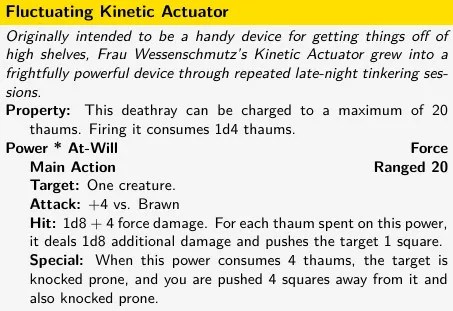
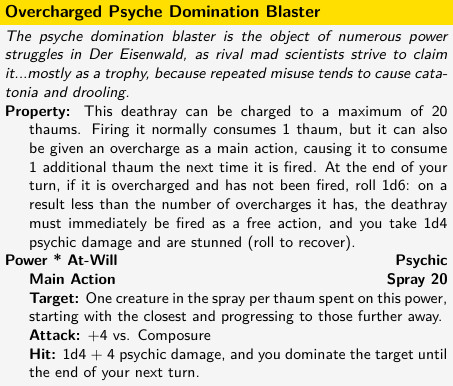
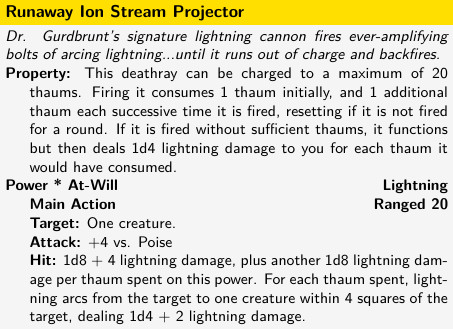
Aetrimonde’s death rays are mostly associated with mad scientists: anyone can use them, but it’s mad scientists who create them, and they tend to be…erratic…when anybody else uses them. Nonetheless, PCs who get their hands on a mad scientist’s death ray (possibly after letting them be torn to shreds by their own creation) are likely going to try test-firing it…so it helps to have rules for such a thing. To the left are a selection of handy examples, giving guidelines for how to design such a thing for your campaign. As for how they work in general:
- A death ray is not a weapon, and cannot benefit from feats like Weapon Aim.
- Death rays have a built-in energy supply that powers their attacks, and can be charged to full capacity during a long rest.
- Their attacks consume a variable amount of energy, with greater effects the more energy they draw. It may be entirely random, or may be somewhat controllable.
- Firing off an especially powerful attack from a death ray has drawbacks: it may be likely to injure the wielder, take several turns to get it to full power, or just be an inefficient use of the energy supply.
- The examples shown here are roughly equivalent to a greater magical weapon (valued at around 400 gp).
The examples here show off how those principles can be combined:
- The Fluctuating Kinetic Actuator makes an attack with random potency: it might deal a mere 2d8 + 4 damage, or could go all the way up to 5d8 + 4, pushing the target 4 squarers and knocking it prone. But at the high end of the scale, it suffers from a slight recoil problem, blasting the user backwards and off their feet.
- The Overcharged Psyche Domination Blaster offers a very rare thing: a reusable, instant-effect domination attack. It also generally requires that you get right up close to the intended target, so that it’s the nearest viable creature, takes several turns to charge up if you want multiple targets, and has a small chance of misfiring and stunning you if you do try to charge it up.
- The Runaway Ion Stream Projector is the least chaotic of these examples: its attack just gets more powerful (and chews through more of the energy supply) each turn that you fire it, going from 2d8 + 4 all the way up to 7d8 + 4…if you manage to fire it six turns in a row. And if you do, well…that last shot would consume a 21st thaum, meaning that it subsequently deals 6d4 lightning damage to you.
All of these death rays can be useful, but they have a niche…and using them outside of that niche may do more harm than good. Which is exactly how the products of mad science ought to be viewed, frankly: use them for a purpose, and don’t try to adapt or tinker with them.


Leave a Reply