
Keeping on with October’s theme of mad science, today I’m going to cover one of the fun aspects of Aetrimonde, and something that lots of players might aspire to command in a campaign: airships!
Broadly speaking, there are four kinds of flight available to PCs in Aetrimonde:
- Flight magic letting a character fly under their own power is rare, and for good reason: it takes practice and skill, and getting it wrong while sixty feet in the air has a low survival rate. The safest variety allows a caster to transform into something with wings, but (lore-wise) even this requires practice using them.
- Flying steeds like gryphons, hippogryphs, giant eagles, and (stretching the definition slightly) flying carpets can carry a character into the air, and work under the mounted combat rules.
- Magical airships were invented around a hundred years back, and are the most common mode of flight, although they don’t offer the agile, independent flight of spells or steeds. (This is the kind of airship we’ll be focusing on today.)
- Balloons and zeppelins are only about twenty years old, and are slower and less controllable than airships although they can carry heavier cargoes.
Design and Engineering
Magical airships are an accidental by-product of mad science: the device that allows them to fly, called a gravitational inversion-displacement engine, is what a team of artificers managed to create while trying to copy the levitation device that a mad scientist used to terrorize a remote stretch of the Ironspine Mountains. While the original device provided actual weightlessness in a bubble about two meters across, the gravitational inversion-displacement engine works differently. Gravitational inversion engines, capable of reversing gravity in a small volume through a complex arrangement of alchemical metals and magical fluxes, have long been known but are profoundly power-hungry: the key insight gleaned from the mad levitation device permitted this power draw to be much reduced by displacing an equal and opposite gravitational attraction onto a separate volume.
In practice, the gravitational inversion-displacement engine is employed to exert an upward pseudo-gravitational force on a sphere of dense material (typically alchemically-treated lead), while displacing the equivalent force onto a much larger volume of air far below. A set of sufficiently large engines, firmly coupled to the frame of a ship, can thus be used to hold it in the air and make it rise and fall by varying the strength of the effect.
Power for an airship’s inversion-displacement engines is usually supplied by a steam engine and thaumokinetic converter able to turn its kinetic power output into magical current. Forward thrust and additional maneuvering power likewise usually comes from steam power that turns propellers or turbines, although some airships are also equipped with sails, steering vanes, or other apparatus for steering and propulsion.
The overall effect of this general system results in airships that resemble naval ships lifted into the sky. Some models put more effort into aerodynamics, with sealed, streamlined hulls and aerodynamic shrouds for the propellers, but the classic design is simply a multi-decked sailing ship, stripped of its masts and sails and with a set of propellers mounted on outriggers like a catamaran. This has a significant practical benefit in addition to being visually striking: a naval-style airship can, in case of a mechanical or thaumaturgical failure, make an emergency landing in the nearest body of water. It may sink shortly thereafter, since airship hulls are not always watertight (especially after a rough splashdown), but it serves as an important safety feature.
Societal Role
Early airships were rapidly adopted by military forces, and saw widespread deployment during the wars of the Age of Steam. Early attempts to use them in the same manner as naval vessels ended in failure with terrible casualties, as airships proved far more mechanically vulnerable than sailing ships or ironclads, no matter how much they were armored. By the end of the wars, airship doctrine had dictated a fast-attack role, performing low-altitude strafing using hills and mountains as cover, or rapidly landing troops and taking off again. However, the sheer weight of artillery that an airship could carry did serve to make aerial cavalry, mounted on gryphons and other flying steeds, effectively obsolete.
Airship production was dedicated almost entirely to the military during the wars, but since they drew to the close, demilitarized airships and new construction have entered civilian service as couriers, passenger liners, and light freighters. While more expensive to operate than naval and rail transport, airships are significantly faster, and thus ideal for time-sensitive dispatches, perishable cargoes, and travelers in a hurry. There are established airship routes connecting many capitols and major cities, and a small number of independent airships that well-financed adventurers could hire for transportation or even a bit of close air support.
Airship facilities come in two varieties. The simpler and more common are landing fields, with adjustable scaffolds that can support airship hulls of a variety of shapes while their engines are off. Unfortunately, bringing an airship to ground level is a difficult and dangerous process: the inversion-displacement engines that carry them aloft generate a severe downdraft, and as an airship approaches a landing field it whips up a terrible tempest that can endanger ground crews and waiting passengers alike. Even worse, as the airship reaches ground level, its displacement field must be carefully adjusted, because the effect grows much stronger once the field encompasses denser dirt and stone. The final moments of bringing an airship in for a landing require that the displacement field be drastically attenuated, and with the field at its weakest a mistake can be fatal.
The better variety of airship facility are docking cradles: elevated structures that allow an airship to come in for a landing without bringing its displacement close to the ground. These must be built at least 200 meters in the air to accommodate typical displacement fields, and so they are most convenient to build cantilevered off the edges of tall, sheer cliffs. In the absence of suitable terrain, they can be built atop sturdy towers at great expense…which is why the tower variety are mostly built only in major cities.
Use in a Campaign
As mentioned already, airships can be used as a plot device enabling PCs to travel faster, move cargoes, or provide covering fire or rapid extraction at critical moments of a campaign. A typical airship can travel at 150km per hour, about 50 times the overland speed of PCs on foot and 2-3 times faster than a train (although the smaller airships that PCs might initially get their hands on could be even faster). Plus, they can perhaps pick up or drop off from locations in the wilderness that would otherwise be near-impossible to reach.
But owning an airship is a common aspiration for a PC or even an entire group of them, so here are a few ways to tie an airship into a campaign:
- Acquisition: Airships are rare, and each new hull produced is generally spoken for years in advance. Unless they have an incredibly wealthy and powerful patron (and that is something you could work into a campaign), acquiring a brand-new airship is likely out of the question. Second-hand airships, however, are more reasonable for the PCs to acquire, whether as a reward for a job well done, a prize in a high-stakes card game, or as a prize seized from its previous owners.
- Upkeep: Once the PCs own an airship, they have new and pressing expenses. Actually flying the ship will require fuel (coal or alchemical fuel) and large quantities of water, but the costs keep racking up even when it’s on the ground: there are maintenance costs, fees for commercial docking slips, and wages for the crew (which the PCs will need for any but the smallest airships, and even then they will need a crew if they want the airship to operate while they’re not on board). These expenses put pressure on the PCs to find paying work, which can motivate them to take on bigger adventures with higher stakes than they’d normally opt for.
- Equipment: A stock airship is useful enough for a party of PCs, but there are plenty of aftermarket add-ons that they might be interested in finding and bringing aboard. Shipboard weapons like cannons and ballistae are obvious choices for adventurers getting into scrapes, but there are other things that they might find useful, like shipboard laboratories, winches for dropping onto the battlements of enemy fortresses or bringing up big, heavy treasure, and magical wards to prevent scrying and keep unwanted boarders out.
- Facilities: Adventurers with an airship may not want to be at the mercy of commercial airship facilities…especially if they operate in a legal grey area through smuggling or privateering. At that point, they may want to establish a landing field or even a docking cradle under their exclusive control…which they could also grow into a base of operations with its own facilities or even a staff of followers and assistants.
Battlemaps
All this discussion would be incomplete without giving an example of an airship your PCs could fly…and fight…aboard. So I’ve got one! This set of maps depicts a mid-sized (30 meters, about the size of Queen Anne’s Revenge, the flagship of the infamous pirate Blackbeard) sail-powered airship, making it the sort of quiet, stealthy vessel that might be used by smugglers, blockade runners, and intelligence operations.
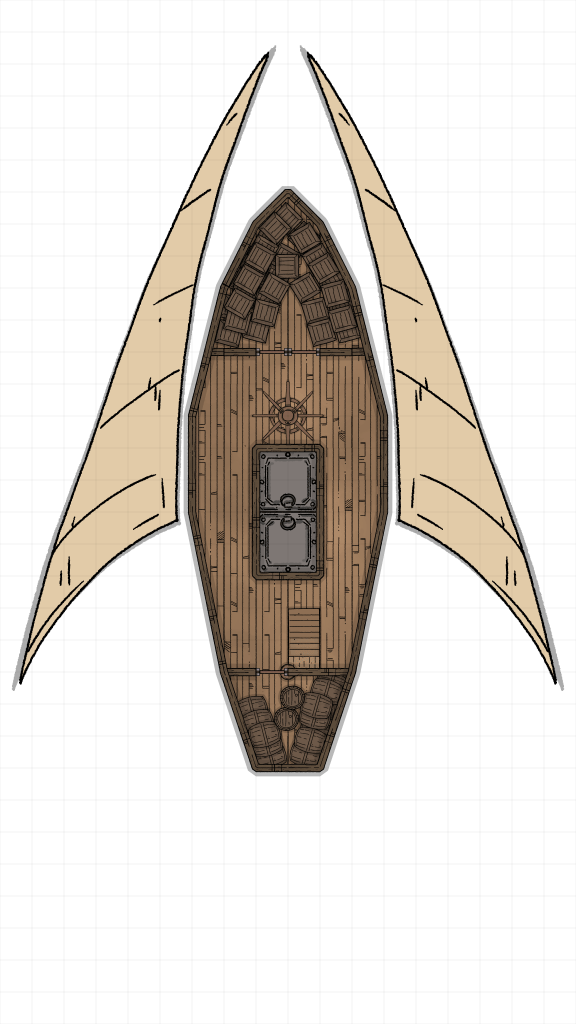
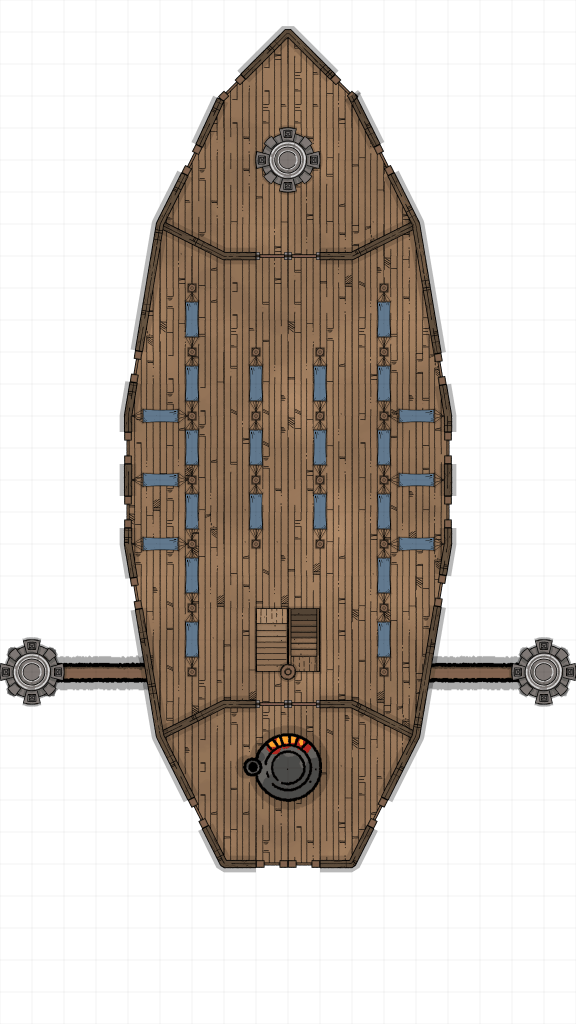
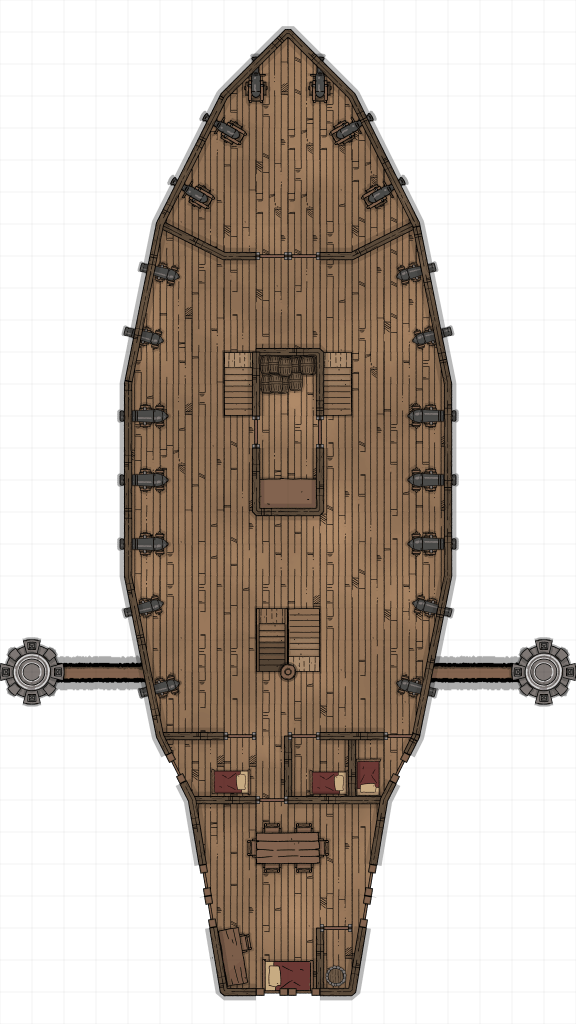
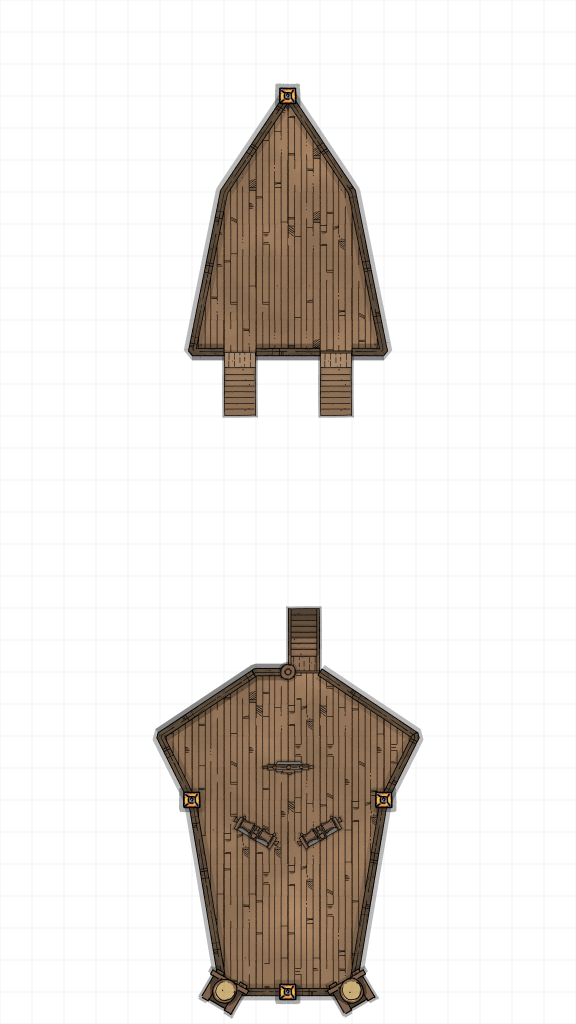
The five maps are designed to be used as a set of stacked tiles (in a virtual tabletop that allows for it), so that you can design a running fight where the PCs fight their way up from the cargo hatches or down from the quarterdeck, as appropriate. For ease of use, I’m also providing .zip files of both plain .png images and also .dd2vtt files that can be imported into virtual tabletops like Roll20 and FoundryVTT (using the Universal Battlemap Importer module), complete with things like walls..


Leave a Reply