
A while back, when I covered mooks, I hinted that Aetrimonde would also support enemies designed to be equivalent to multiple PCs. Today, I’m going to show off the first type of enemies like this: Elites, which are designed to be level-appropriate challenges for two PCs.
Design Goals: Why Elites?
The question that attentive readers may be asking themselves right now is “why do you need a special kind of enemy to be equivalent to two PCs?” I’ve shown off enemies of a few different tiers so far, and a pattern emerges: a Tier 0 enemy is worth 100 EV, and for every two additional tiers, their EV doubles. So if you want an enemy to be twice the challenge of a level-appropriate enemy…why not just pick an enemy from two tiers up?
The first part of the answer is narrative. Sometimes a GM wants to tell a story pitting the PCs against a foe who is more powerful than a mere mortal, like an ogre, or demon, or some of the more dangerous kinds of undead. Higher-tier enemies more challenging because they are marginally more capable, with slightly higher defenses, damage, etc., but this doesn’t make them feel appropriately powerful to model these powerful supernatural beings. I want Elites to feel more than mortal, and that will take mechanical changes relative to normal enemies.
The second part of the answer is mathematical. An enemy two tiers up can easily feel “unfair,” because they will have attack rolls and defenses two points higher (on average): this moves their chances of hitting from around 55% to 72%, and their chances of being hit from around 72% to 55%, which is a massive shift. They’ll also have an extra 8 hit points, 2 armor resistance, and a whopping +4 damage. So in short, an enemy 2 tiers above the PCs will be much harder to hit, take less damage when they are hit, and hit like a freight train when they attack. Which is not to say there isn’t a niche for this, but sometimes you want an enemy who is more powerful, but not so overwhelmingly so. Elites are designed to work like two normal enemies rolled into one: twice the actions, twice the hit points, but not significantly harder to hit or better at hitting.
My implementation of Elites gives them the following traits:
- Elites have twice as many hit points as an equivalent normal enemy of the same tier. This makes them take about twice as much effort to defeat as a normal enemy.
- The first recovery roll an Elite makes at the end of its turn automatically succeeds. Since Elites choose the order to make recovery rolls in (or rather, the GM chooses for them), this makes it harder for the PCs to keep really nasty recoverable effects on them.
- Elites should be able to do 2-3 things per round, although they should not, generally, be able to use two limited-use actions per round, and it’s good if one of those things is something they do when it’s not their turn. This gives them around twice the offensive power of a normal enemy (who can generally do 1-2 things per round), but it spreads them out so that they don’t just pile a ton of damage on one character, all at once.
The overall effect here is that an Elite enemy can be dropped into an encounter to replace two normal enemies, and it will take about the same amount of effort to defeat but deal a little less damage (or have a little less effect, for enemies that do things other than deal damage).
With that in mind, let’s take a look at some Elites:
Zombie Ogre
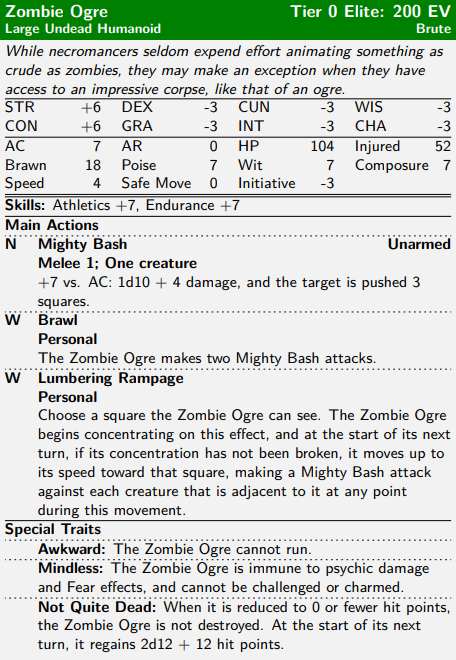
The Zombie Ogre is a zombie animated from a big corpse, like that of an ogre. It’s not just bigger and tougher than an ordinary Zombie Walker (see details below for comparison), it can use that size and toughness to rampage through a group of PCs.
This is the first Large enemy we’ve seen; this means that it takes up a 2×2 space in combat, and smaller creatures gain a +1 bonus to attack rolls vs. its AC and Poise…which are already so awful for the Zombie Ogre that it doesn’t make a lot of difference.
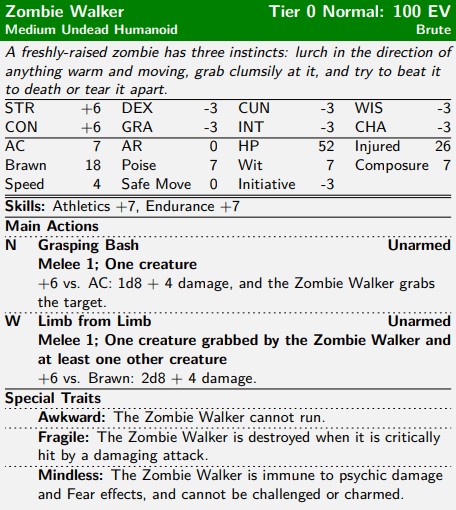
As an Elite counterpart to the Zombie Walker, the Zombie Ogre does indeed have exactly twice as many hit points. It also does slightly more damage with its normal attack (due to being larger), and has a Brawl action. Many creatures (particularly Elite one) have a Brawl action, which generally allows them to make two or more attacks. All Brawl attacks must be made, if possible, before the creature can do anything else, but they take place in sequence and in theory the attacker could be interrupted partway through. The Zombie Ogre may actually have trouble making both of its Brawl attacks, because each Mighty Bash would push its target away, and thus out of range.
This is also a great point for me to introduce one style of action that I’m building into many of the creatures in the Bestiary, which is the “interruptible” action. That’s not a defined term in the rules, but the concept of it is that actions like Lumbering Rampage are powerful, but their actual effect is delayed, and there are ways for PCs to either stop the enemy from following through (such as by breaking the Zombie Ogre’s concentration, in this case, which would take something dealing 26 damage to it, or somehow stunning it) or just get out of the way. Some interruptible actions can also be turned against the user or their allies: in this case, the PCs could shove their enemies into the path of the Lumbering Charge and let the Zombie Ogre trample them.
Zombie Walker
Skeletal Amalgam
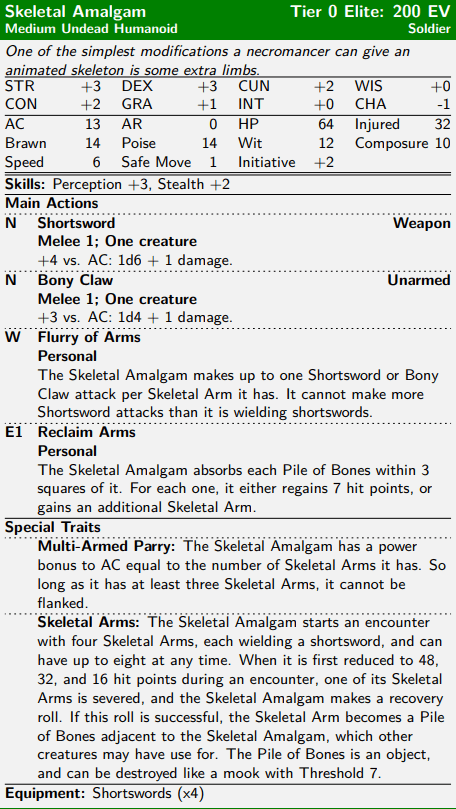
A Skeletal Amalgam is something a necromancer might make when they have a whole bunch of partial skeletons: a vaguely humanoid figure with extra arms sprouting in every direction.
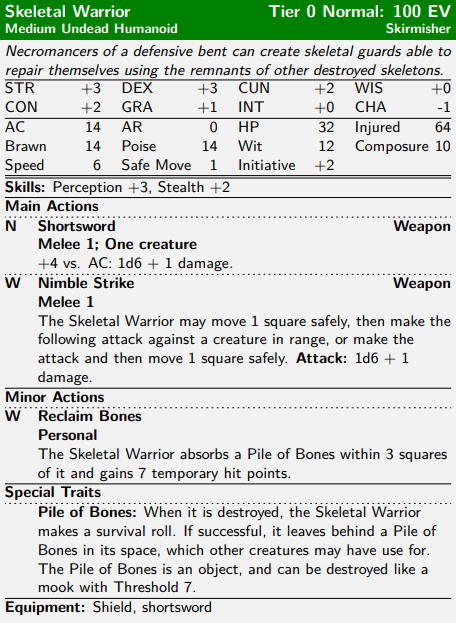
As an upgrade of the Skeletal Warrior (see below for comparison), the Skeletal Amalgam is initially armed with the same shortsword…in every one of its four arms. And it can attack with all four of those arms at once, if it likes, using its Brawl-like Flurry of Arms action. However, its number of arms can fluctuate over the course of an encounter, losing them as the PCs damage it to certain thresholds, or gaining more from the Piles of Bones left behind by other skeletal enemies.
The Skeletal Amalgam is classed as a soldier, but if you’re just looking at its defenses in the statblock, it might not be clear why. With a mere 13 AC, it certainly doesn’t look much like a Soldier. But the Multi-Armed Parry special trait makes up for this: with +1 AC per Skeletal Arm, its actual AC will start out at 17, and can get as high as 21 if a Skeletal Amalgam manages to acquire its maximum of eight arms. And, as long as it keeps at least three arms, it cannot be flanked (due to having an arm in every direction to parry with).
The Skeletal Amalgam benefits a lot from also having a lot of other skeletal enemies in an encounter. Skeletal Rattler mooks provide a steady supply of Piles of Bones that the Skeletal Amalgam can absorb. Skeletal Warriors (below) can also provide Piles of Bones, but they also have uses for Piles of Bones, so they might compete with Skeletal Amalgams unless it’s a very large encounter. Skeletons also have terrible Composure and mediocre Wit, and unlike zombies they aren’t Mindless, so can be easily confused or controlled with illusions and mind-altering magic.
The weaknesses of Skeletal Amalgams, and skeletons in general, are less pronounced than those of zombies, but they do exist. Primarily, while they can make a lot of attacks, all of those attacks are individually quite weak. PCs with high armor resistance will have a field day shrugging off attack after attack, quite possibly taking no damage from low rolls.
Skeletal Warrior
Up Next
Now that I’ve introduced the mechanics of Elite enemies, I’ll be sprinkling them into future Bestiary posts. Keep your eyes peeled!
 Aetrimonde
Leave a comment