
Based on the poll I put out with the first Bestiary post, you readers would like to see some Afflictor enemies, who have consequences for the PCs that last longer than the end of a fight. In keeping with my undead and eerie theme for October, I’m going to use another kind of Aetrimonde’s undead to demonstrate Afflictors: mummies!
In order to do Afflictors justice, though, I’ll need to introduce some mechanics for how those consequences work: the titular Afflictions.
How Afflictions Work
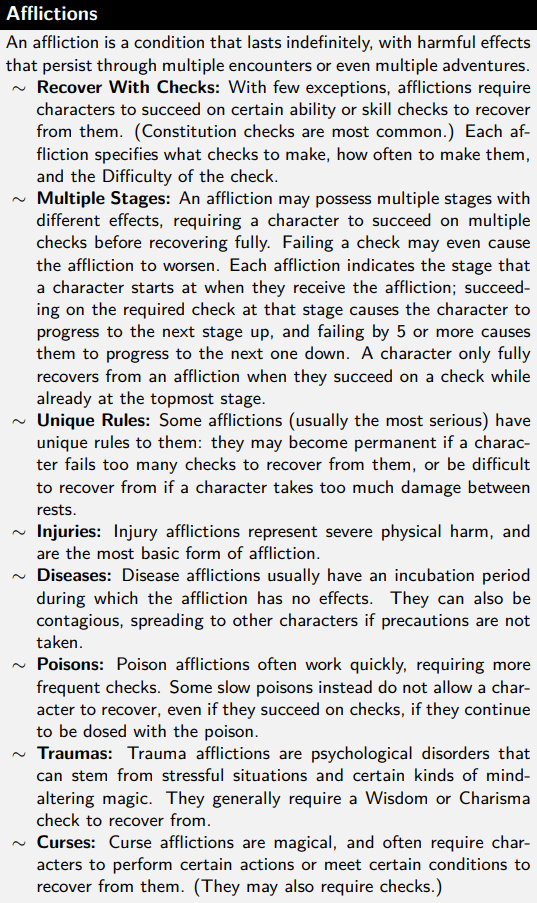
The rules for Afflictions are influenced by disease and poison rules from multiple editions of D&D, which I’ve adapted and generalized to create a framework that can also model things like broken limbs and magical curses. In general, Afflictions:
- Have long-lasting effects on a PC.
- Require the PC to succeed on checks to recover. These are generally Constitution checks for injuries, poisons, and diseases, but curses and psychic traumas can call for more esoteric types of check.
- Have multiple stages that they progress through: they may start off worse and gradually get better, or they may have a check Difficulty high enough that a PC actually gets worse.
Affliction Rules in Detail
Examples of Afflictions
Today’s post will focus on mummies and one specific affliction that they can cause, but I’d also like to provide some other examples of afflictions. These and many others are included in the Game Master’s Handbook for a GM to use, whether as something caused by an enemy, the result of a trap, or just a consequence of wading through sewers.
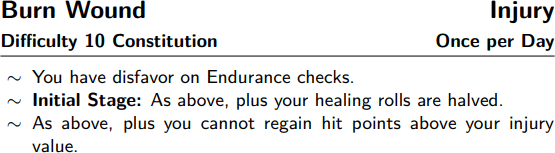
A Burn Wound is among the simpler afflictions there is, having no particular rules to it. Once they receive the Burn Wound, characters start at the second stage, reducing their healing received and Endurance checks. They then must make a Difficulty 10 Constitution check every day to recover from it; if they get 5 or less, they instead get worse, and their maximum hit points are also halved. Burn Wounds are an appropriate injury for enemies to cause with high-damage fire attacks. (Dragons are Afflictor enemies, because they can cause Burn Wounds with their breath attacks.)
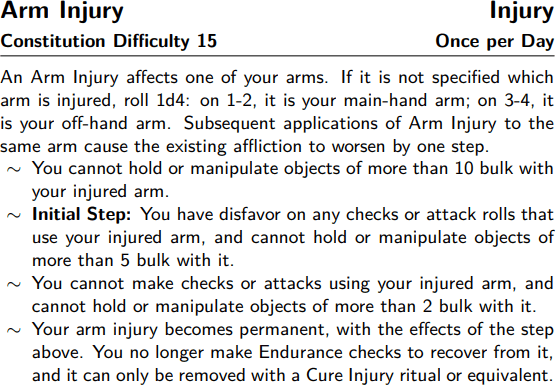
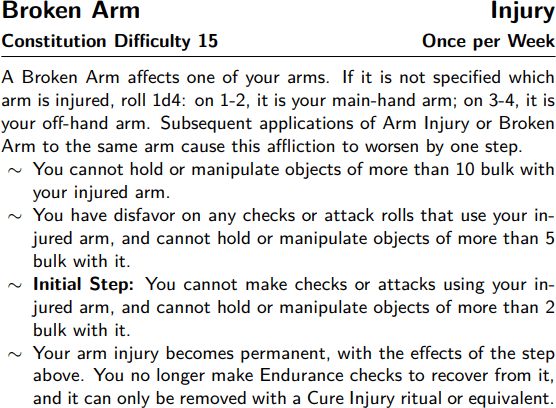
An Arm Injury is a little more complicated, both in that it affects a specific arm and can be made worse by repeated injuries, and also that it can become a chronic condition: if a character fails too many checks to recover from it, the effect becomes permanent at its most severe step. Arm Injuries represent an injury to the muscle or joints of an arm; a separate Broken Arm condition covers injuries that break the bone. Arm Injuries are an appropriate affliction to be caused by bladed weapons; Broken Arms (being more serious and taking longer to recover from) are more likely to be caused by something like a giant grabbing a character by the arm and squeezing, or a sadistic redcap smashing their arm with a hammer.
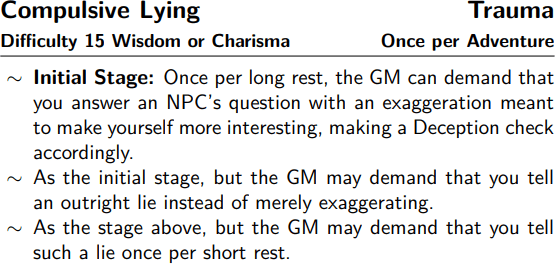
Compulsive Lying is a Trauma, which could be an aftereffect of mind-altering magic, or it could be caused by more mundane psychological stress, like being imprisoned and subjected to interrogation and torture. It allows the GM to compel a character to do things not in their best interests, by telling exaggerations or lies in a way that may backfire on them. A character with good Deception might be able to get away with this…but a character with poor Charisma and no training may wind up developing a reputation as a liar.
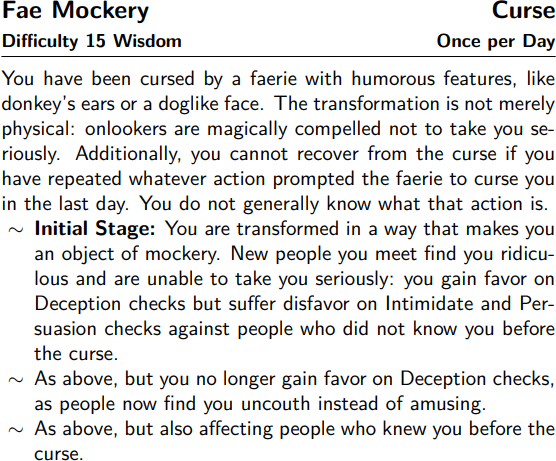
Fae Mockery is a Curse straight out of A Midsummer Night’s Dream, causing a character to become risible to anyone who didn’t already know them…at first. If a character persists in whatever behavior irked a faerie enough to curse them, and worse, badly fails a few checks to recover, they can wind up irritating people instead of amusing them. Eventually, they may even find that their old friends now can’t get over their amusing new features.
Afflictions are not the only mechanic that would make an enemy an Afflictor (some Afflictors do things like steal, damage, or destroy PCs’ equipment, for example) but they are the most common. So how do Afflictor enemies use afflictions? Let’s look at some mummies:
Mummy Lore
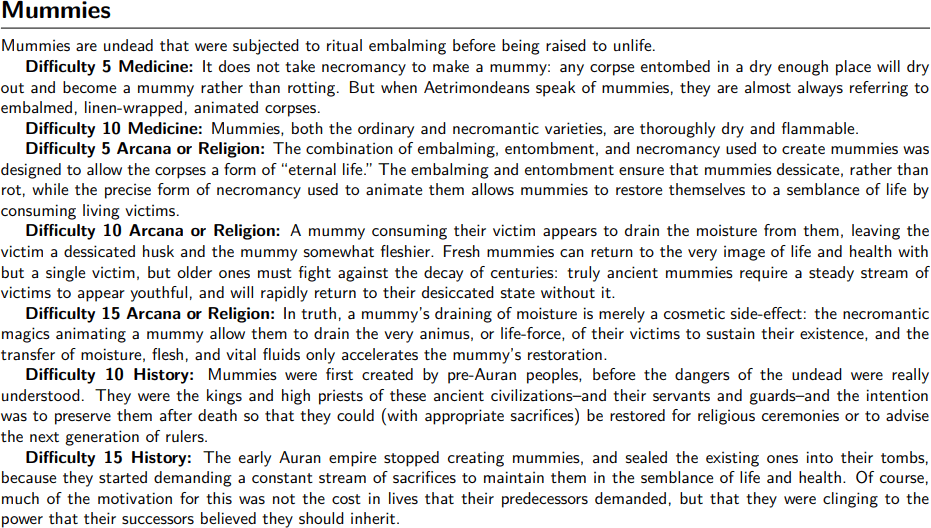
Mummies are undead that were subjected to ritual embalming before being raised to unlife. They have all of the usual undead lore, plus a unique origin in Aetrimondean history:
Mummified Bodyguard
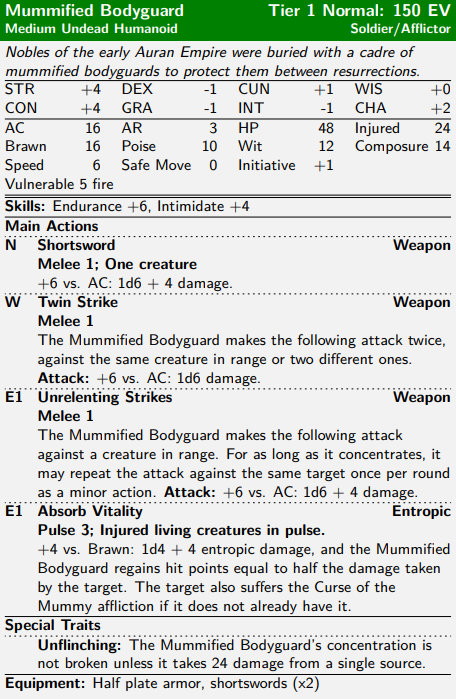
The most basic mummy that the PCs could encounter is a Mummified Bodyguard, subjected to the mummification process to guard the tombs of mummified rulers. Thanks to armor worn over their wrappings, they have decent AC and other defenses, and are therefore classed as a Soldier as well as an Afflictor. Also contributing to their Soldier role is the combination of Unrelenting Strikes and Unflinching, allowing the Mummified Bodyguard to unleash a nigh-uninterruptible flurry of accurate, though not particularly damaging attacks.
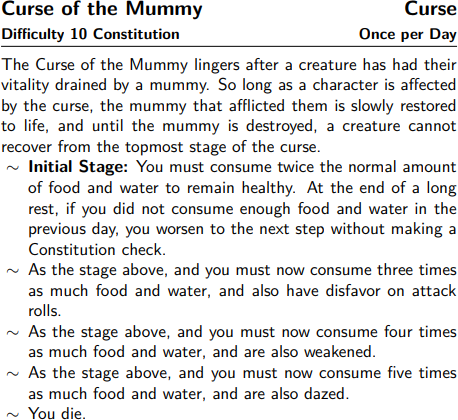
The Afflictor role of the Mummified Bodyguard comes into play with its Absorb Vitality action. As described in the lore, mummies are able to drain the vitality–and moisture, and bodily humours–of victims, and this action is found on all mummies. It allows them to deal damage to nearby injured, living creatures, and regain hit points equal to the damage, but most importantly, it places the Curse of the Mummy on the unfortunate targets hit.
The Curse of the Mummy is an affliction allowing a mummy to derive sustenance from their unfortunate victims, causing them to wither away into a desiccated husk unless they consume ever-increasing amounts of food and drink to make up for it. Ultimately, if players repeatedly roll terribly (or run out of supplies, as might happen in the middle of the wilderness), the curse may kill them outright.
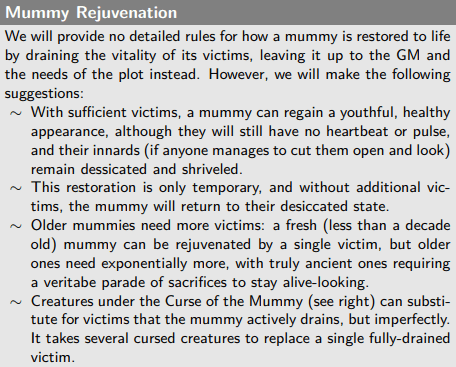
Details of how draining a victim rejuvenates a mummy are one point where I’m not going to provide detailed rules, instead leaving it up to GMs. Depending on what their plot demands, a mummy might instantly regain some of their youthful, lively appearance (a la the titular villain of the 1999 film), or it might be a more gradual process where it takes time for the mummy to look more lifelike. Instead of detailed rules, I instead provide a few suggestions that GMs are free to use or ignore as they find suitable for their campaigns.
Mummified Priest
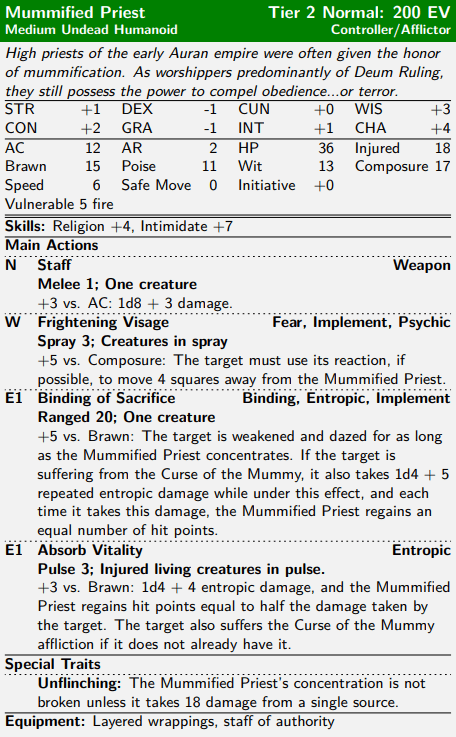
The Mummified Priest poses more of a challenge to PCs, due to how it interacts with the Curse of the Mummy. While it has the same Absorb Vitality action that the Mummified Bodyguard has, it’s actually less effective (because the action is based off Constitution, and the Priest’s is lower).
However, it makes up for this with its Binding of Sacrifice action, which imposes some nasty conditions (weakened, making a PC deal half damage, and dazed, limiting them to a single action per turn and making them flatfooted). It gets much, much worse against PCs already under the effect of the Curse of the Mummy, though, causing repeated entropic damage that allows the Priest to simultaneously regain hit points.
The Mummified Priest is classed as a Controller as well as Afflictor because of the conditions caused by Binding of Sacrifice, and because of its other action, Frightening Visage (which is actually a power available to Divine PCs…). Aside from forcing PCs to move back from the Mummified Priest, and using up their reactions, this can also force them to take opportune strikes from other enemies if they have gotten well mixed-in.
Using a Mummified Priest
Because the Mummified Priest interacts with PCs that already suffer from the Curse of the Mummy, there are a couple of great ways for a GM to use a Mummified Priest:
- In a single encounter, a Mummified Priest could be added to a bunch of Mummified Bodyguards, increasing the threat they pose with Absorb Vitality. In this setup, the Priest should be able to stay well back from the fighting, perhaps with the aid of favorable terrain, while the Bodyguards mix it up in melee. And once one of the PCs has contracted the Curse of the Mummy, the Priest can use Binding of Sacrifice to seriously impede that PC, forcing the party to try to break its concentration or just kill it quickly to release their ally from the curse.
- In a more extended adventure, an early encounter with Mummified Bodyguards could lead to one or more PCs contracting the Curse of the Mummy. This would be a good time to start tracking supplies of food and water, especially if the PCs are out in the wilderness: the need to consume additional supplies puts pressure on the party, and subsequent encounters including Mummified Priests can encourage them to try and break the curse before proceeding.
Mummified Noble
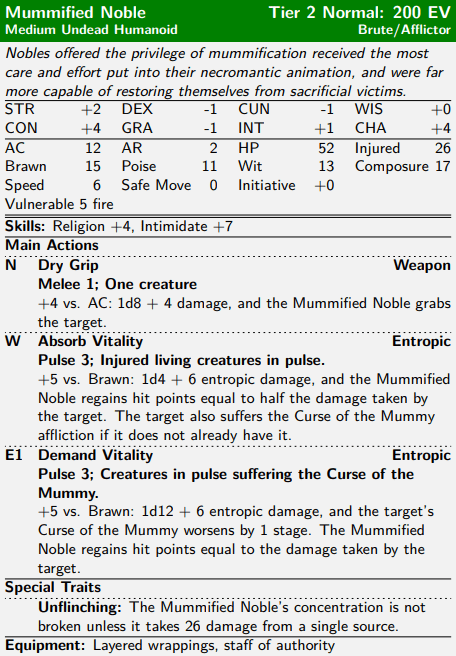
The Mummified Noble is a comparatively simple enemy to run, because it really only has one trick in two potencies. Thanks to the extra effort put into its necromantic animation, the Noble can use Absorb Vitality at will, not just once per encounter.
Replacing Absorb Vitality as a once-per-encounter power is Demand Vitality, which is not quite a straight upgrade. Demand Vitality targets only creatures that have already contracted the Curse of the Mummy: on the one hand, this means that it needs more setup for Demand Vitality to be effective, but on the other, it means that the PCs will have a harder time avoiding it. Whereas it’s possible for the PCs to keep themselves healed above half HP, so that they are not injured and therefore not a valid target for Absorb Vitality, there are few to no ways of breaking the Curse of the Mummy mid-fight: this means that any PC that already has the Curse of the Mummy going into a fight with a Mummified Noble is going to be a target for Demand Vitality.
The other aspect of Demand Vitality that I will highlight is that, rather than applying an affliction, it makes an affliction worse. Suddenly having to deal with an additional penalty (especially one of the nastier ones in the lower stages) for an entire fight can be a nasty shock for the PCs.
Using a Mummified Noble
Because it really only has two variations of the one trick (an attack that deals entropic damage in a pulse, allowing it to regain hit points based on damage done, and applying/worsening an affliction), the Mummified Noble can be hit-or-miss if used in isolation. If the PCs mostly avoid becoming valid targets for its two main powers, it will likely wind up swiping ineffectually at them, maybe grabbing one or two and dealing some paltry damage. It is better to use the Mummified Noble as a climactic encounter after the PCs have already encountered other mummies and some of them have contracted the Curse of the Mummy.
Up Next
There is one other variety of mummy in the Bestiary, but I’m saving it for another post that will cover enemies designed to be equivalent to more than one PC. Keep an eye out for it soon!


Leave a Reply