
Today, I’m going to be picking up after my brief hiatus by covering some of the goblins appearing in the Bestiary, specifically goblins that might appear in the Unclaimed Reaches.
Goblins are a staple of RPGs, where they usually appear as weak low-level enemies that the PCs can mow down in droves. While there are a few goblins fitting this role in the Bestiary, I’m attempting to be a bit more nuanced with them. I confess to being a little uncomfortable with the use of always-evil intelligent creatures in RPGs (which I suppose puts me in good company; Tolkien’s struggle to reconcile the evil nature of orcs with his belief in free will has its own Wikipedia page). So, have a look at some of the more interesting and developed goblins that the Bestiary presents…for PCs to mow down in droves, if that’s what your campaign needs.
Goblin Raider
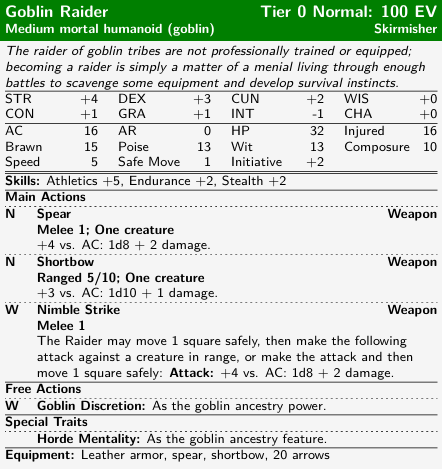
The tribal goblins of the Unclaimed Reaches aren’t all hostile: some of them have an uneasy coexistence with the settlers moving in from the north. But surviving in the Reaches is hard enough that when push comes to shove, most tribal goblins will resort to raiding soft targets for supplies. Goblin Raiders are the “professional” warrior class among tribal goblins, and they are no mindless rabble or ravening horde: they’re cautious, clever, even tactical…although their favored tactics revolve around running away to fight another day.
The Goblin Raider is a Skirmisher: mobile, evasive, but not particularly sturdy or hard-hitting. In fact, this is almost an archetypal Skirmisher: the Raider has both melee and ranged attacks, of roughly equal effectiveness, and it has multiple options to let it get out of an inconvenient position.
Nimble Strike allows the Raider to get an extra square of safe movement in, to either push through enemy lines and attack a high-priority PC, or to attack, disengage, and then retreat all in one turn.
Goblin Discretion (as seen with Ipki Chainbreaker) allows a second square of safe movement after making an attack and missing: combined with Nimble Strike, this lets the Raider step safely in, attack, and if the attack doesn’t work out, make a hasty retreat.
Goblin Unsoothsayer
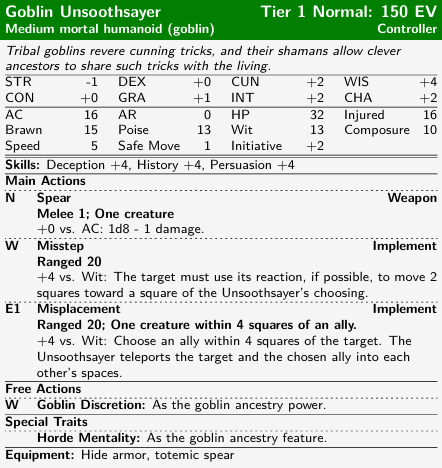
Being the smallest intelligent people in Aetrimonde, goblins are forced to rely more on trickery than brute force. Even their magicians, who certainly aren’t held back by their small stature, tend to use illusion and subterfuge more than directly offensive magics. The Goblin Unsoothsayer has two tricks in its repertoire, both of them based on Spiritual powers available to PCs. (And the Unsoothsayer itself is, lorewise, similar to the Shaman class for PCs.)
Misstep forces a PC not just to use up its reaction (which can mess with some PCs’ clever tricks), but to move in a chosen direction. This isn’t ordinary forced movement, which is generally safe for the creature being forced to move: it requires the target to use an action and actually move…which provokes opportune strikes. Using it on a PC already surrounded by a bunch of the Unsoothsayer’s allies can be really nasty…
And it only gets worse when coupled with Misplacement, which swaps an enemy with an ally, and makes it easy to get a PC abruptly surrounded by goblins. As a bonus, it can also abruptly put a goblin in the middle of the PCs…
With these two tricks combined, the Unsoothsayer can cause some serious havoc, and it makes for an excellent way to upset a group of PCs who have well-planned tactics revolving around positioning, forcing them to think on their feet.
Goblin Alchemist
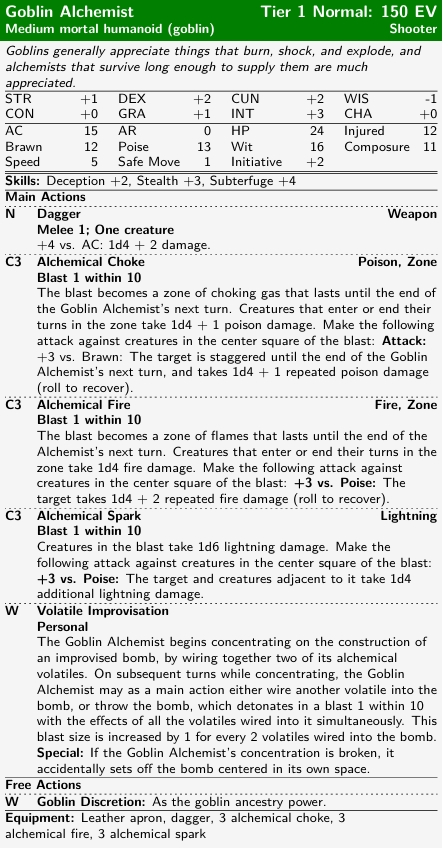
The Goblin Alchemist is a Shooter, an enemy focused on ranged combat, with a variety of attacks and a nasty trick up its sleeve for the PCs to interact with. I’ve presented a few monsters with telegraphed attacks; this is another variation on the same concept, in which a creature gradually powers up an attack until it becomes a pressing threat to deal with.
Unlike virtually all creatures in the Bestiary, the Alchemist lacks at-will actions or attacks, other than its pathetically weak Dagger attack. Instead, it carries an ample supply of alchemical volatiles, which function exactly like they would for the PCs. The nine flasks that the Alchemist carries are enough to see the Alchemist through any but the most drawn-out encounters even throwing one every round. (And if the PCs manage to defeat the Alchemist before it gets through all of its volatiles, that’s some extra loot they can claim…).
The focus on volatiles makes the Alchemist a very flexible enemy; the volatiles presented in its statblock provide plenty of repeated damage coupled with control effects, but they can be swapped out for others to tailor an enemy for a specific encounter: it would be trivial to give a Goblin Alchemist access to Alchemical Shine, for making the PCs into brightly-glowing targets in a pitch-black cave, or Fragmentation Grenades for raw damage.
However, the Alchemist’s real gimmick is its Volatile Improvisation action, allowing it to strap several volatiles together into a single large bomb. There is no limit on how big a bomb this can create: left to its own devices for many rounds, an Alchemist could conceivably strap together all nine of its volatiles, creating a monster of an explosion dealing 3d6 + 3d4 + 3 immediate damage, plus quite a bit of repeated damage, in a blast 5 (an area 11 squares across…). Bringing a Goblin Alchemist down quickly is therefore a high priority for the PCs.
Fortunately, Volatile Improvisation has a built-in way to do that: if the Alchemist takes as little as 6 damage (1/4 of its maximum hit points, enough to break its concentration), it drops and detonates its own bomb. This could be quite the deterrent for a PC attacking it in melee, but a well-placed shot from range could do it safely, and the damage from the explosion can further soften the Alchemist up.
In my next Bestiary post, I’m planning to show off a few of the monsters created by goblin alchemy: some of them are still used as beasts of war, while others have escaped into the wild and bred true.


Leave a Reply