
Today, since I’m gearing up to write Aetrimonde’s starter adventure (and if you haven’t voted on a setting for that adventure yet—please do! I want feedback here…), I’m going to talk about adventure structure: the way that scenes link together in an adventure to form a plot that the players can work through. The structure of an adventure determines both player agency (which we want!) and the amount of work that has to go into writing and preparing the adventure (which isn’t bad—I sometimes enjoy the challenge of writing and prepping big, complex adventures—but is sometimes inconvenient).
The excerpt I have for you today comes from the section of the GMH dealing with running adventures: the topic also comes up later in the same chapter, when the book discusses writing them, and there the book provides guidance on how to use adventure structure to manage pacing, create tension, and give players agency.
An adventure is a collection of scenes that relate to each other—but those scenes can connect together in a variety of ways that make an adventure feel and play differently. Depending on your players’ tastes, your own ambition, and the amount of time you have to devote to a campaign, you may want an adventure with a specific structure.
Linear

In a linear adventure, the scenes largely have a set order, and the players have to play through them sequentially. That makes linear adventures simple to run (and write), which is great for GMs that have limited prep time and groups that play in short sessions , but also it limits player agency. Linear adventures are good representations of plots like:
- Fighting through a ruin, fortress, or other environment with multiple chambers filled with enemies, one after the other (oftentimes called a dungeon”).
- A journey along a fixed route, with encounters at set points along the way.
- Withstanding a lengthy siege where enemy attacks come in a set order.
Branching
A branching adventure allows the players to choose which scene to engage with next (which direction to go”) at certain points. However, there are still well-defined start and end points to the adventure, and the players’ choices at these branching points is not about where they’re going in the end so much as how to get there. Branching adventures are good structures for plots like:
- Hunting down a foe based on a handful of clues that each suggests a different course of action.
- A journey where the route is only roughly set ahead of time, allowing for (or requiring) detours and diversions.
- Helping to besiege a city, with multiple ways that the players can help undermine the defenses, culminating in a decisive battle.
There are several ways to have an adventure branch:
Optional Branches
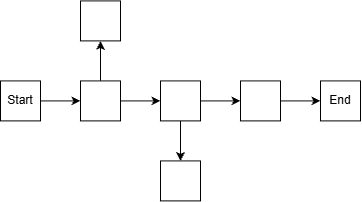
Optional branches present the players with some scenes (in sequences that can be as short as a single scene) that they don’t have to succeed in, or even engage with at all, to complete the adventure. Optional branches can provide the players with:
- Changes of pace to break up a section of adventure with many scenes of a similar nature.
- Opportunities to learn secret lore, gain allies, or find loot that would be helpful but not required later in the adventure.
- Challenging fights or other encounters to test themselves against, without making it necessary to overcome them.
The drawback of optional branches is that the players may simply not engage with them, wasting the effort that went into writing and preparing them.
Alternate Routes
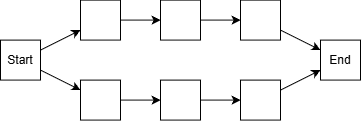
An adventure with alternate routes contains two or more distinct sets of scenes that are equally viable ways to proceed through the adventure. Ultimately, though, alternate routes all lead to the same destination in the adventure. Alternate routes can give the players:
- A way to avoid encounters they’re not prepared for, like challenging fights when the party is already wounded.
- A choice of storylines, letting them advance the story in the way they find most interesting.
- A choice of rewards, letting the players pick the most valuable option.
As with optional branches, alternate routes mean that whichever routes the players don’t pick (assuming they don’t or can’t go back to them later) are wasted effort for the GM—but with careful planning, you can set up the choice of route at the end of one session, so that you know which material to prepare before the next one. If alternate routes are exclusive (the players can only choose one), it may also cause the players to feel that they missed out on something interesting in the routes they didn’t choose.
Multiple Requirements
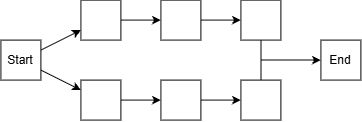
An adventure with multiple requirements presents the players with several tasks they need to undertake before they can reach the adventure’s climax, but gives them the option of completing them in any order. They might even be able to switch between them, going partway before one branch before going back and trying out another. However, in the end the players will need to play all the way through each of these branches.
Adventures with multiple requirements offers many of the same benefits as ones with alternate routes, and they avoid the problem of wasted effort writing and preparing scenes that the players don’t see, as is an issue with optional branches and alternate routes. However, multiple requirements also offer the players less agency, in that they will end up playing through all of the material in the adventure and only get to choose the order of it.
Branched Endings
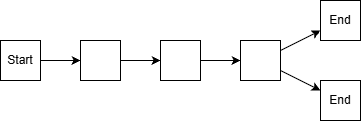
An adventure with a mostly linear structure may have branched endings, similar to alternate routes but leading to different versions of the adventure’s ending. This might give the players choices of how and where to fight the adventure’s villain in a decisive confrontation, let them influence the fate of the town or region where the adventure took place, or force them to choose between saving an NPC ally or the treasure hoard they were seeking.
The players’ choices, successes and failures earlier in the adventure may influence the choices available to them in this endgame. Siding with one faction over another might give the PCs access to different allies in a final battle; succeeding at optional objectives like keeping magical artifacts from being destroyed could give the PCs a way to avert a dilemma and both save their beloved NPC ally and lay claim to a treasure hoard before it is buried.
You can absolutely mix and match different forms of branching to have an adventure with alternate routes through one section, multiple requirements through another, and optional scenes and encounters scattered throughout.
Mesh
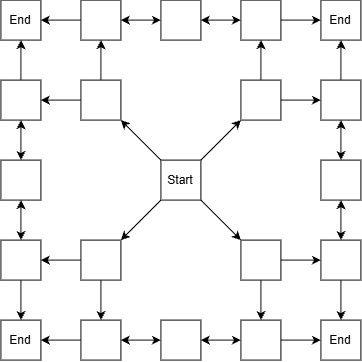
A mesh adventure does not have the well-defined end point of a linear or branching adventure. Instead, each scene connects to other scenes in defined ways, such that overcoming the challenges in certain scenes unlocks access to others, and the players can move more or less freely to any scene they’ve unlocked. Because of this interconnectedness, if you were to draw out the connections between scenes, the resulting diagram would resemble a mesh (or spiderweb!).
Mesh adventures may have a single ending that can be reached from several other scenes, which is similar to a branching adventure with alternate routes or multiple requirements, depending on whether the players need to complete just one scene to reach the ending, or several. They may alternately have several possible endings, like an adventure with branched endings, or they may not have a true ending but rather several different sets of events that occur (giving the players a similar sense of accomplishment to an ending) as they complete key scenes, but allowing them to experience all of them at their own pace.
The mesh structure provides players with the greatest degree of agency, but requires more design work from the author and prep work from the GM. Mesh adventures are good for plots like:
- A murder investigation where the players start with some clues leading to encounters which themselves contain more clues once overcome.
- Exploring a ruined city or a stretch of wilderness where points of interest are uncovered bit by bit.
- Prosecuting a war, where the players can freely choose what theater of the war to lend their aid.
So that’s the GMH’s take on adventure structure: the diagrams I’ve included here are rough drafts (because I’m definitely not a graphic designer, nor an artist), but I think get the concept across. I’ve thought about ways to convey other information, like where in an adventure it might be safe to rest, or whether it’s possible to backtrack to previous scenes, but I think that these diagrams benefit from being simple.
One more reminder: go vote on the setting for the sample adventure! I don’t need to be told what to write about, but I think it’d be fun to crowdsource my inspiration for this…
 Aetrimonde
Leave a comment