Heroic Roleplaying in a World of Swords, Sorcery, and Steam

I’d like to introduce Aetrimonde, a TTRPG I’ve been designing with heavy inspiration from the houserules my group used back in our Dungeons and Dragons 4e days. I’m not ready to publish Aetrimonde yet, but I’m opening up this blog to discuss its design principles, mechanics, and systems.

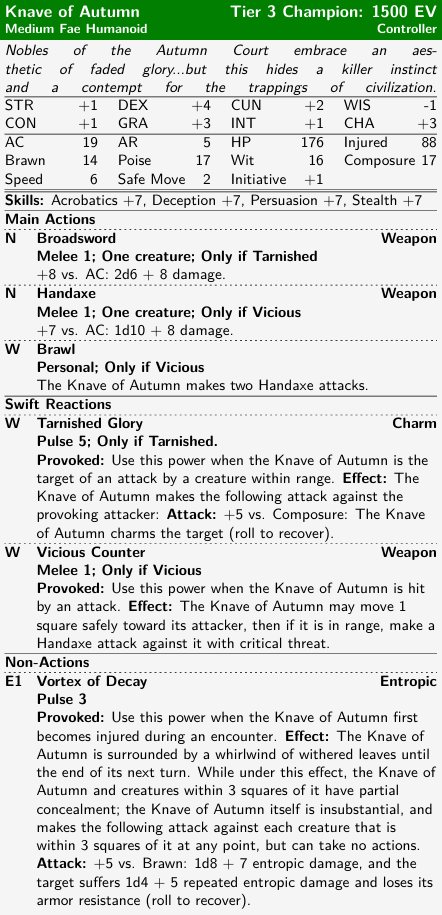
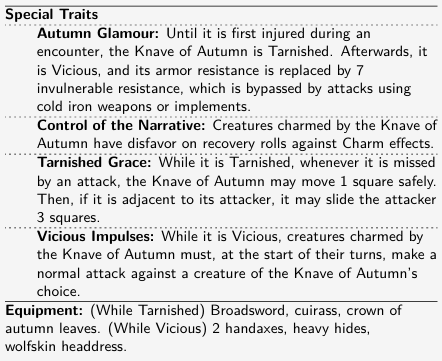
  • Continuing on from my post about the plane of Faerie, today I’m going to cover the Autumn Court, which will be the focus of several posts this month. I won’t be showing off any statblocks in this post, which is more concerned with the lore surrounding Sidhe in general and the Autumn Court in particular, but I’ll have several posts revealing specific enemies later in the month.

    The Sidhe

    For starters, let’s take a look at the Bestiary’s lore about the Sidhe in general. Some of this is repetition and summation of information from the campaign setting’s entry on the plane of Faerie, but there is also information about how the Sidhe behave that would be useful to adventurers dealing with them.

    I’ve written the Sidhe to be a slightly postmodern take on fairy-tale villains: they’re almost cartoonishly evil, unable to avoid wicked acts even when they wouldn’t serve their interests…but that doesn’t change the fact that they’re totalitarian despots. Frankly, I would absolutely love to run a faerie-tale spy-thriller campaign, about a bunch of gnomes and pixies rebelling against a frighteningly powerful, and genre-savvy, Sidhe overlord…but alas, there’s only so many campaigns I have time for.

    The Autumn Court

    Now, for the Autumn Court specifically: I’ve picked the Autumn Court as this month’s focus partly because it’s seasonally appropriate…and also, because as of this writing, I find that the Summer and Winter Courts have been a bit overdone in popular media. (See: the Dresden Files, the Iron Fey, Wicked Lovely, arguably Frozen if you squint, etc.)

    Aetrimonde’s Autumn Court are the least “civilized” of the Sidhe: have no use for things like “cooperation” and “mutually beneficial exchange.” They’re social Darwinists, turning their demesnes in Faerie into places where the strong survive and prosper, while the weak serve fearfully. And they’d like to do the same with the mortal world…of course, just how deeply the Autumn Sidhe actually believe in survival of the fittest, as opposed to embracing it because they consider themselves automatically the fittest fae around, is up to the GM.

    The Autumn Court, like all the Courts, isn’t just the Sidhe. They rule the Court, but it contains other faeries as well. I’ve mentioned the Wild Hunt in the lore drop above, but to offer a few suggestions of other fae that would work well in Autumn:

    • The Big Bad Wolf, who preys on little girls bringing food to sick grannies, is exactly the kind of faerie the Autumn Court would embrace. They like predators, they have nothing but contempt for the sick and needy…it’s a perfect match.
    • Redcaps, hateful little faeries that prey on innocent travelers in order to dye their hats in shed blood, are likewise a good match. The same goes for Will-o-Wisps, who lure travelers to their deaths by imitating the light of a lantern.
    • Aetrimonde’s ogres are hungry brutes, and hunger certainly ties into Autumn’s theme: a band of ogres who raid a farming community and carry off their food stores just after harvest time would make a perfect Autumn villain.

    I’ll be revealing some of these enemies, and a few I’m keeping a surprise, over the next few weeks. Stay tuned!

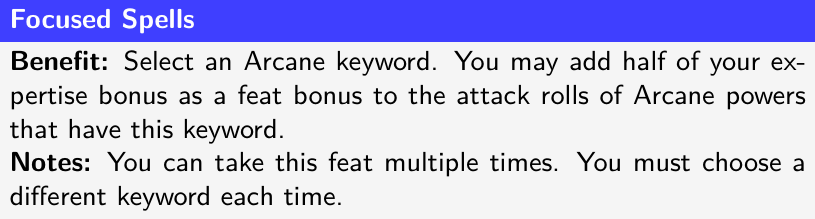
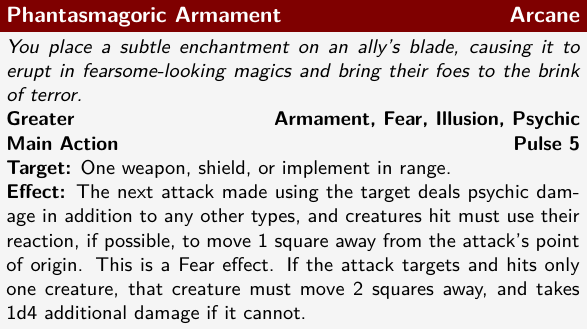
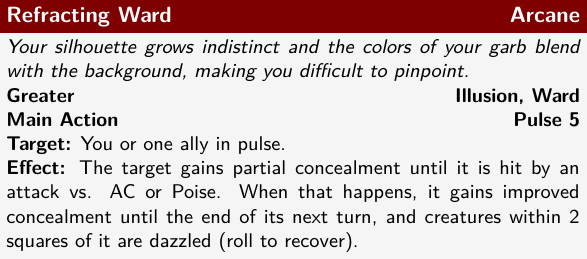
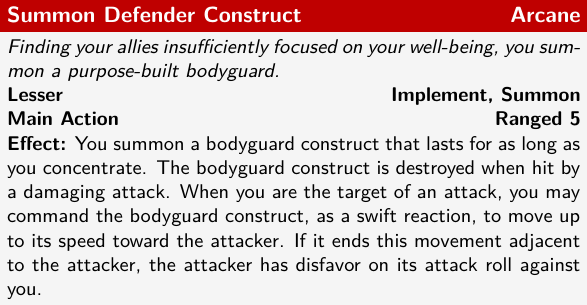
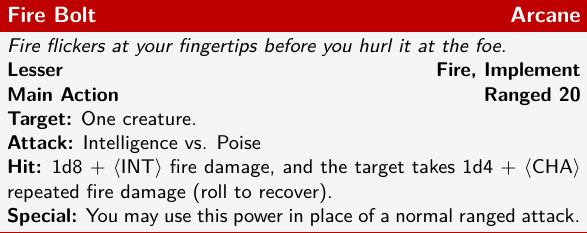
  • In the second part of this week’s introduction to Faerie, I’m going to cover some Sidhe-themed feats powers that I at one point considered for inclusion in the core rulebook, for Arcane characters, before ultimately shelving them. They might eventually see daylight as part of a Faerie- or Arcane-themed supplement, but for now, they remain apocrypha.

    At one point, much earlier in development, Aetrimonde’s warlock class was centered around pacts with otherworldly entities such as the fae. (Much like D&D’s warlock, in fact.) While I’ve since backed off of that characterization, at the time I had written the predecessors these powers to be spells that warlocks and other arcanists could take to become vaguely fae-themed. The powers I’m presenting here have received a brief rewrite to catch them up with how the Aetrimonde system has evolved since then, but are true to the spirit of those early powers.

    Sidhe Powers

    In general, the magic of the Sidhe is based around three pillars: trickery (deceiving the mind), glamour (deceiving the senses), and compulsion (controlling the mind). Individual Sidhe may have other magics, but any Sidhe can be counted on to have some magic related to one of these three pillars.

    Trickery

    The Sidhe are fond of invisibility: not merely so that they can attack from hiding (although yes, they will do that too), but so that they can observe mortals unseen, pick apart their flaws and vulnerabilities with taunts and cutting remarks, and drive them to rash action or self-pitying inaction. And, worst come to worst, they will happily fake their deaths and run away to fight another day.

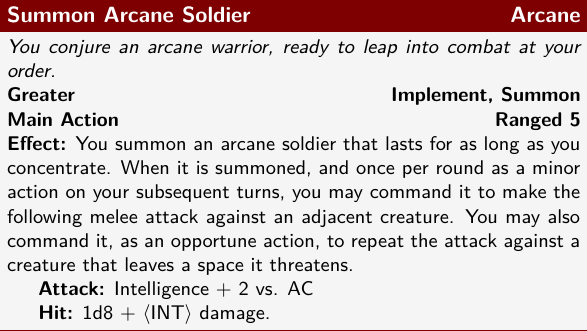
    Bewildering Disappearance is a power designed to enable an ambush on a single creature. Aside from granting invisibility (against that creature only) so that the user can get close without causing alarm, it also grants favor on attack rolls if the user can avoid being spotted until their next turn.

    Unseen Step is a versatile utility spell, letting the user teleport a long distance with just a minor action. It has one drawback, in that it doesn’t work if the user is being observed, or trying to teleport somewhere that is being watched. So, it is more useful outside of combat than it is during it. Also, as one of my playtesters worked out, that very drawback can provide useful information: if it doesn’t work, then you know that either something is watching you (useful when you suspect an ambush), or something is watching where you intend to go (similarly useful to avoid teleporting into an ambush).

    Death Seeming is the ultimate escape spell: usable as a Swift Reaction, taking place before you are hit by an attack that might drop you to 0 hit points, it gives you some brief invisibility, lets you escape the attack, and to cap it all off, leaves behind an illusion that can convince your attacker and other nearby creatures that they actually did kill you. From a GM’s perspective, this is a great power for recurring villains, because it gives them an out to avoid being killed prematurely. For players, it’s a great emergency backup plan if they get overwhelmed.

    Glamour

    The Sidhe are also fond of glamour: loosely defined, a kind of illusion that changes what objects seem to be. Not necessarily what they actually look like (although again, the Sidhe will do that too…) but how people perceive them. Glamour can make an armored warrior seem harmless, or a worthless crust of bread seem like a feast. It can also make illusions so real as to actually cause harm…

    Illusions in Aetrimonde

    Without going into unnecessary detail, many Illusion powers create images, which are not creatures but work like them in many ways:

    • Images occupy a space, typically one square.
    • Images can be attacked like a creature, and are automatically hit when attacked, but are unaffected by attacks.
    • Images do not take their own turns.
    • The powers that create images often allow the power’s user to make attacks using the image as a point of reference. (The attack originates from the image, not the user.)
    • Creatures believe an image to be real if they are under the effect of the power that created them. Realizing that an image isn’t real may not have an effect in some cases (such as that of the Illusory Wall, which still blocks line of sight).
    • Creatures with truesight can see images for what they are.

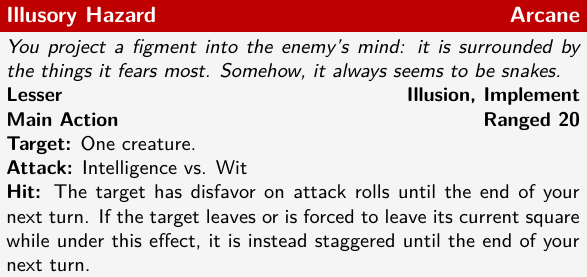
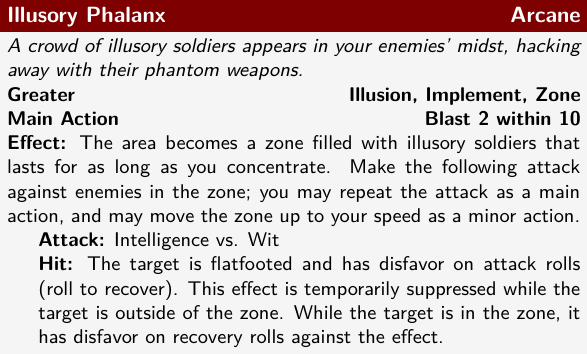
    Perilous Glamour is meant to be used in conjunction with other Illusion powers: it allows an image created by other Illusion powers to reach out with a sword or a claw and attack someone with such verisimilitude that they actually bleed. (As a GM, I have to choke back an evil chuckle at the idea of a dungeon full of non-damaging illusions…followed by an encounter with a Sidhe who can make those harmless illusions fight back.)

    Twisted Glamour is, yes, a twist on Perilous Glamour, representing the Sidhe’s command of illusion: they can seize control of other magicians’ illusions, turning them to their own ends and coincidentally, letting them lash out in the same manner as Perilous Glamour.

    Faerie Feast is a more straightforward Illusion power, creating an image that draws enemies towards it. This can be used to sidetrack enemies, by placing it to the side where it will pull enemies away from their charge, or just to get them to bunch up around the image so that they’re perfect targets for a Fireball. Notably, the power doesn’t work indefinitely: once missed by the power’s attack, targets are immune, as are targets that actually make it into the image’s space (since they then discover that the Faerie Feast is an old crust of bread, if there was actually anything there at all).

    Compulsion

    The final kind of Sidhe magic is one that they fall back on when deceiving the mind or the senses doesn’t work: it simply compels obedience, or forces creatures to act in a way that suits the Sidhe’s purposes.

    There are already a number of Arcane spells that charm or dominate creatures: I won’t get into those here. Sidhe magic has some unique variations on those spells, which can be summed up as “charm with added effects.”

    Charm in Aetrimonde

    Charmed is a common condition in Aetrimonde. When charmed:

    • You are flatfooted against the creature that charmed you.
    • You have disfavor on attack rolls against the creature that charmed you.
    • The creature that charmed you gains favor on Charisma, Deception, Intimidate, and Persuasion checks against you.
    • A charmed creature is unaware that it has been charmed until the effect wears off, and may react unfavorably afterwards.

    Harmless Seeming is a reactive Charm spell, letting the user perhaps avoid being hit by an attack, because if it is successful, the attacker then has disfavor on the provoking attack. Unlike a lesser Charm power that did make it into the core rulebook, Harmless Seeming doesn’t keep the target charmed long enough for the user to gain favor on any attack rolls against them.

    Bewitch is a Charm spell with the added benefit of making the charmed creature a danger to their own allies. Best used on a group of enemies who have huddled up defensively, it encourages other enemies to distance themselves from the target. (And to be careful when doing it, lest they provoke opportune strikes.) This is great for disrupting enemies that gain benefits from being adjacent to each other.

    Enthralling Beauty is another Charm spell with a rider, in this case, drastically limiting what actions the target can take. It does generally come at the cost of making the target zero in on the user…but the Sidhe are generally competent enough not to mind this terribly. A mobile character can use this to lead their target on a merry chase, keeping them completely occupied.

    So Why Are These Apocrypha?

    At this point you may be wondering why these powers have been relegated to apocrypha and maybe a later supplement. They’re not extraordinarily weak or powerful compared to other powers I’ve shown off (although I realize that I haven’t yet shown off the Arcane powers that are the most direct comparison, so it’s fair to reserve judgement on that). So what gives?

    Ultimately, it comes down to two things: flavor and mechanics.

    Flavor-wise, I eventually decided that powers in the core rulebook should be relatively generic, so as to make them suitable for as many character concepts and campaigns as possible. These fae-themed powers (and their demon-, undead-, and eldritch-themed counterparts didn’t make the cut, because they were too specific in flavor.

    And mechanically, I found that some of these powers (in particular Bewildering Disappearance, Unseen Step, and Death Seeming) would complicate things for a GM: Bewildering Disappearance would require the GM to keep track of which creatures can and cannot see the power’s user, Unseen Step would require the GM to know whether specific squares are being observed at any time (and could also reveal ambushes anticlimactically, which reduces GMs’ freedom to write plots…), and Death Seeming would again require the GM to keep track of which creatures do and don’t think that the power’s user was dead. So I erred on the side of less mechanically-complicated powers, in general.

    To be clear, I think there’s absolutely room for powers like this in Aetrimonde…I just don’t know that the first book, which I think should generally be relatively simple and balanced, is the place for them. Hence, why I would plan to put them in a supplement later on.

  • Well, it’s November, and that means that this blog is moving along into a new monthly theme: the Autumn Court of Faerie. Of course, the first question that I feel the need to resolve is “What is Faerie?” And to answer that, I’m going to start off with a crash course on Aetrimonde’s cosmology before diving into the nature of Faerie.

    Overview of the Planes

    The mortal world (or material plane, if you prefer) of Aetrimonde exists alongside other planes of existence that are more fantastical than a mere ball of rock and water. And alongside is the operative word here: as best as Aetrimondean arcanists who study such things can explain it, each of the planes including the mortal world “occupy a subspace within some metaphysical topology of higher dimensionality.” Where and when those volumes overlap in mere four-dimensional spacetime, it is possible to pass from a point in one to the corresponding point in another.1 These places where the planes overlap are called planar crossings, and with the proper magic (principally the Plane Shift ritual), mortals can force their way into other planes from within a crossing.

    Planar crossings vary in nature depending on the plane they connect to. In some cases, they are relatively stable, appearing in the same place constantly, or on a reliable schedule. Others are transient, and only appear intermittently when the conditions are right. With the right magic, crossings can be stabilized, holding them in place, but this is not always practical: often, transient crossings open in dangerous situations like storms, or battles, that make it difficult first to perform the appropriate magic and then to keep it intact.

    There are a multitude of small planes, anywhere from a few dozen meters to several hundred kilometers across, clustering close around Aetrimonde, but these are essentially nothing more than a bubble of Aetrimonde that has been four-dimensionally “pinched off” from the main mass: they seldom have any interesting magical properties or unusual residents, although they are sought-after as personal demesnes for powerful arcanists.

    Of more interest are the five-and-a-half known major planes that consistently intersect the mortal world: Faerie, the Underworld, the Elemental Roil, the Heavenly Realm (and its attached Pit of Hell), and the Dreamlands. Each of them has a distinct magical nature and is home to a variety of otherworldly entities.

    Going from Aetrimonde to another plane isn’t something to be done trivially: the planes have dangers that mere mortals are not used to, and they are generally higher-magic than the mortal world. Getting there, however, is fairly straightforward.

    Faerie

    The first of the major planes is Faerie, also called Neverland, and recently, the Realm of the Sidhe. Crossings to Faerie are common and easily identified: stable ones are surrounded by rings of standing stones erected as boundary markers, while transient crossings are generally marked by rings of mushrooms, unseasonal vegetation, or other such natural delineations. Faerie is one of two planes that can have crossings forced open from any location in the mortal world (although predicting where such a crossing will open in Faerie is very much an art). As such, Faerie is the most easily accessible of the major planes. Faerie is the original home of trolls, ogres, gnomes, redcaps, pixies, satyrs, centaurs, and all manner of creatures out of Aetrimonde’s Faerie tales, many of whom have also established a presence in the mortal world.2

    Topology, Not Geometry

    The Realm of Faerie is unlike the mortal world in that it does not have consistent geometry. This is most evident in what would-be explorers refer to as the “Fractal Valley phenomenon.” The Fractal Valley is a well-known location, near to several reliable crossings into Faerie: a valley perhaps a dozen kilometers across on its long axis, but containing, at last count, one thousand, four hundred and twelve square kilometers of area. From the rim of the valley, visitors can see perhaps fifty square kilometers within the valley’s bowl…but take the wrong path through one of the woods dotting the valley floor, or follow the wrong branch of the river, and you can find yourself in a part of the valley not visible from the rim, all the while remaining inside the valley and in sight of the distant mountains and hills at its edge.

    Fractal Valley is merely the best-known and most-studied example of a phenomenon which occurs throughout Faerie: it manifests as forests that you can walk around in ten minutes but not through in a week, rivers where a hundred leagues on their banks is a mere kilometer on their waters, and tunnels in small hills that lead to valleys in massive mountain ranges. The scholars who have studied the phenomenon believe that Faerie occupies a more densely folded section of the metaphysical topology, allowing larger spaces to be contained within smaller ones. It is thus difficult to map Faerie: the most usable maps (for anyone not a student of higher-dimensional geometries) tend to be in the form of atlases mapping out the plane’s small, self-contained spaces and describing the manner in which they connect to each other and the dangers that might befall a traveler.3

    Narrative Causality

    Faerie has no overt perils in the way that some other planes do: the terrain and physical laws (other than the strange topology) are much like the mortal world’s; the food, water, and air are fit for mortal consumption; and while navigation can be difficult, the landscape is at least static, and can be mapped in some sense. The danger in Faerie is that, in addition to physical laws, it appears to be governed by a kind of narrative laws. Visitors to Faerie are advised to read up on their Faerie tales, and attempt not to be drawn into the narrative: avoid interactions with the locals wherever possible, and especially do not accept gifts or offer oaths. The best defense against Faerie’s narrative causality is to be boring.

    If a visitor to Faerie is caught in the narrative (typically signified by an implausible number of interesting events happening to and around them) the best course of action then is to fit oneself into the narrative role of a protagonist. Be kind to traveling peddlers, heed any advice given three times, and above all, do not lie, cheat, steal, or break oaths. Outsiders who fit into a heroic archetype (the knight in shining armor, clever trickster, or wise mystic are most common) tend to find that the complications in their way, while tedious at best and dangerous at worst, are ultimately rewarding. Playing along with the narrative can bring rewards ranging from pots of gold to magic swords…or, sometimes, an opportunity to undergo character development.

    Falling into a villainous role is far more dangerous. Faerie actively discourages craven, jaded, and venal behavior, first by presenting those its perceives as villainous with opportunities and mild incentives to reform. These often resemble traps in the form of object lessons: a stolen purse of gold turns out to be cursed, turning all the coins placed within into lead; a broken oath brings uncommonly bad luck with it, until the oathbreaker makes amends. If a villain fails to take the hint, Faerie then escalates, throwing increasingly lethal obstacles and foes into their path until they leave Faerie or fall to one of them.

    However, in rare cases, Faerie is known to claim villains for its own. Villainy done with style, panache, and a certain amount of self-awareness seems to receive some respect from Faerie, and visitors who can play a villainous role well find that their villainous deeds work out…so long as they aren’t facing an equally good hero. The danger here is that the more a villain plays into Faerie’s narrative, the harder it becomes to break out of their role…ultimately making them a creature of Faerie, and just one more of the plane’s repertoire of plot devices.

    Faerie Tales

    It is unclear where Faerie tales come from: certainly they seem like they could be factual accounts of events that actually did happen in Faerie, but it has also been pointed out that they could instead be the inspiration causing the plane to impose such a narrative. The earliest Faerie tales were part of an oral tradition before being set down in print, and as such their origins are lost to history. Some later tales that entered widespread circulation were commissioned from bards and minstrels, extolling the supposed deeds of various adventurers and heroes, but at least some of these are known to be exaggerations of the real events, or invented from whole cloth.

    Some scholars have attempted to settle the question by looking into more modern additions to the genre. One serious effort compiled a list of children’s stories verifiably written by mortal authors in the last century, and then commissioned several bands of adventurers to visit Faerie and question the inhabitants about events resembling the narrative in these stories. The adventurers who returned did bring back several positive results in which creatures of Faerie reported historical events resembling the narratives in these stories…but always as second-hand accounts. None of the actual participants in these events (and certainly no mortal participants) have ever been identified…and to further muddy the waters, a later study discovered that nearly half of the authors whose stories were included in the earlier effort had submitted their manuscripts pseudonymously and could not actually be identified by their publishers. Conspiracy theorists like to suggest that many published faerie tales are actually the work of faeries, disguised as mortal literature for some nefarious purpose.

    The Sidhe

    Faerie did not used to have rulers. Accounts from a century ago describe Faerie as dotted with small villages, with few of them owing fealty to any authority other than the mayor of a nearest town or a duke in a nearby castle. There were no great cities, and few kings or queens.4

    This changed, with no warning but also no particular chaos or strife, at some point in the last century. Around eighty years back, accounts from visitors to Faerie started describing people in positions of authority, resembling elves and calling themselves the Sidhe,5 along with mentions of great cities and fortresses. Strangely, the residents of Faerie treated these things as entirely ordinary, as though they had always been present.

    The sudden appearance of the Sidhe was rapidly followed by their consolidation of power throughout Faerie. They seized objects and places of power formerly held by trolls, built roads and signposts leading to hidden gnome villages, and conscripted ogres, redcaps, centaurs, and other denizens of Faerie into their armies. All this, they accomplished with little resistance: few of their subjects particularly liked what the Sidhe were doing, but the vast majority quietly acquiesced to their authority. The resistant minority, faced with all the power now held by the Sidhe, were forced to flee into the mortal world or into secret places deep within Faerie’s convoluted topography.

    With a solid grasp on power within Faerie, the Sidhe proceeded to subtly reshape the plane’s narratives. Where once it told stories of noble heroes casting down tyrants in single combat, it now told stories of desperate heroes scrabbling to achieve temporary victories against the nigh-omniscient Sidhe and their ruthlessly efficient enforcers.

    Mortal visitors to Faerie have had few direct interactions with the Sidhe since their sudden appearance, but certain facts have emerged. While their rank and file are indistinguishable from elves, their nobility have magical powers distinct from ordinary mortal magic…and they claim to be the rightful rulers of Caras Seidharen6 (from which they take their name), who escaped the Collapse by fleeing into Faerie. Their magical powers make them evidently no longer mortal, but whether that means they have become creatures of Faerie, beholden to its will, or something else entirely remains to be seen.

    The Genius Loci Hypothesis

    The leading hypothesis on the nature of Faerie is that it is a genius loci: a place with a mind. In this hypothesis, there is an intelligence that suffuses the plane of Faerie, and that enjoys telling stories–and a particular kind of stories, at that, designed to shape the mortals ensnared in them into more heroic individuals (and thus, more interesting to the mind of Faerie). The plane’s convoluted topology, the narrative laws that it enforces, and even the proliferation of faerie tales in the mortal world are its tools used in guiding its stories to a satisfying conclusion.

    It’s not clear how the Sidhe would fit into this hypothesis, if it were true. Some scholars believe that they are a sign that the genius loci’s tastes have shifted, and it is now attempting to tell a different, darker kind of tale using the Sidhe as a plot device. Others believe that the Sidhe are responsible for the shift in the tone of Faerie’s narrative, having used their magic to somehow effect a change in the fundamental nature of the plane. And a few, generally regarded as crackpots, think that the plane’s tastes are influenced by the mortal world, and that recent changes there (the advance of industrialization, the rise of modernity over romanticism, or perhaps the cynicism caused by the Wars of Smoke and Steel) have had corresponding changes in Faerie.

    Plot Hooks

    The nature of Faerie makes it an interesting plot device for GMs to use: its narrative causality can be fun for players to try to work with (or exploit), and because the plane is relatively innocuous (by the standards of the planes), it can be used in low-level adventures without too much work.

    Encounter Hooks

    • A mortal who spent too long in Faerie and fell too deep into a heroic persona has just escaped back to the mortal world, and is having trouble re-adjusting. Too used to the black-and-white morality of Faerie, they keep mistaking mundane things, like moneylenders charging interest or guards making arrests, for villainous plots. The PCs first learn of this when their ordinary adventuring behavior causes this would-be hero to mistake them for a band of brigands.
    • A band of the Sidhe’s enforcers have crossed over from Faerie, and are demanding that the local town hand over the many Fae refugees who settled here after fleeing the Sidhe. The locals are none too eager to hand over people who have become part of their lives, but they are hardly a match for Faerie soldiers…unless some passing adventurers care to get involved.

    Adventure Hooks

    • The PCs need to travel a long distance quickly, and the only option available to them is to cross into Faerie and journey between two crossings that are closer together in the other plane than they are in the mortal world. In order to make their deadline, the PCs desperately need to stay unentangled in Faerie plots…which is tricky for such interesting people as they.
    • A band of renegade Fae hire the PCs as mercenaries to help them strike a blow against Sidhe oppression. Of course, it’s not clear whether these Fae are themselves part of a Faerie narrative, or have broken free of the plane and are acting out of their own free will…
    • Events reminiscent of Faerie tales have been playing out in the mortal world…with anticlimactic twists. The goose’s golden eggs cause devastating price inflation, Little Red Riding Hood has contracted lycanthropy, and the Frog Prince has been transformed into one of those poisonous tropical species, with lethal consequences. Each of these occurrences has claimed more lives than the last, and it is up to the PCs to find the cause and banish the narrative back to Faerie.

    Campaign Hooks

    • The Sidhe have set their sights on the mortal world, and their agents, in the guise of mortal elves but gifted with the Sidhe’s unusual magics, are working to turn Caras Elvaren and Tir Coetir to the service of the Sidhe. The PCs are in a position to expose the agents and forestall this scheme, but the Sidhe themselves are untouchable in their seats of power within Faerie. Ultimately, the only way to unseat them and put a permanent stop to their plans will be to discover how they grew so powerful and cut off the flow of power that the plane of Faerie offers them…

    1. There are other paradigms that attempt to explain this truth, of course. They include the planes being intertwined branches on a great world tree, bubbles in the foam of an astral sea, and so on. The difference is largely academic. ↩︎
    2. Which tend to be of a grimmer (and Grimmer) nature than ours. ↩︎
    3. E.g., “To reach the village of Bellberry in Fractal Valley, enter from the semi-southmetaeastern pass and follow the river in the direction of flow from the left bank. Continue until, while passing beneath a footbridge, the sun abruptly moves to the opposite rim of the valley. If at any point you find yourself inexplicably on the right bank instead of the left, stop immediately and retrace your steps. Avoid kissing any frogs claiming to be princes, especially if brightly-colored.” ↩︎
    4. Certainly too few to account for the population of princes and princesses to be found in Faerie. ↩︎
    5. Pronounced “shay.” ↩︎
    6. Pronounced “shee-DAHren.” See also this previous post. ↩︎
  • I recently wrote about elite enemies, who are designed to feel like more of a challenge than your typical enemy. Elites make for good mini-bosses, foes who pose an outsized threat and who the PCs can feel satisfaction in defeating, but who don’t feel like they deserve a name and plot significance.

    Today, I’m going to write about Champion enemies, who do fill that role: Champions are designed to fight an entire party of 4-6 PCs by themselves, and they work very well as the ultimate villain of an adventure or campaign arc, or even an entire campaign. Dragons are Champions, as are many powerful demons, faeries, and so on, but for today (Halloween!) I’ll be focusing on some undead.

    Design Goals: Why Champions?

    In my earlier post on Elite enemies, I mentioned some of the reasons why it doesn’t work well to just use a higher-level enemy as an equivalent to two normal enemies: narratively, they don’t really feel like a more powerful enemy, and mechanically, they’re too easy to gang up on. The same concepts apply to the niche I’m filling with Champions, and to an even greater extent.

    Narratively, I want a Champion to feel like it’s actually fighting the entire party at once, not just the one character that manages to get its attention. This is a narrative problem with a mechanical solution: Champions need to be able to attack several characters per round, and they need to be mechanically encouraged (if not actually forced) to spread these attacks around rather than piling them all on one PC.

    Mechanically, the big problem with having a single Champion fight an entire party is that they will be incredibly vulnerable to conditions, even moreso than Elites. A normal enemy is usually about 1/5 of the enemy forces in an encounter, and stunning it leaves the other 4/5 free to act; a Champion is the entire encounter, and stunning it completely neuters the encounter. So, Champions need to have ways to shake off conditions so that they still pose a threat to PCs with access to stuns and other severe conditions.

    With that in mind, here’s my implementation of Champions:

    • Champions have five times the EV and four times the hit points of an equivalent normal enemy.
    • Champions make recovery rolls at the start of their turns instead of the end. This means that while recoverable effects can impede them until the start of their turns like usual, they are less likely to apply during a Champion’s turn.
    • Champions should also suffer reduced effects from, or be outright immune to, a selection of common conditions.
    • Champions should be able to do 4-6 things per round, and 1-2 of them should be when it’s not their turn. Like Elites, they should generally only be able to use one limited-use action per round, but they should definitely have more than one such action, to be spaced out throughout an encounter.
    • Champions should change how they fight during an encounter. This can be as simple as becoming enraged and dealing increased damage with reduced defenses once it is injured, or as complex as gaining new actions and losing others as the PCs whittle down its health. A Champion is going to take the PCs multiple rounds to defeat; changing up how it fights prevents the fight from becoming tedious.
    • Champions should have ways to interact with them tactically, like interruptible actions, ways to remove their condition immunities, or actions they are forced to perform if the PCs meet certain conditions.
    Calibrating Hit Points and Actions

    You may be asking why Champions have four times the hit points of a normal enemy if they’re supposed to be equivalent to five normal enemies. And, for that matter, why they can do only 4-6 things per round if a normal enemy can do 1-2.

    Part of the answer is that this is just received wisdom: D&D 4e contained monsters filling a similar niche to Champions, called Solos, and in the first Monster Manual for 4e, Solos had 5 times the hit points of a normal enemy. This proved to be too much: fights against Solos dragged on and were more tedious than intense. Later Monster Manuals (and errata to the first) reduced Solo hit points and increased their damage to compensate.

    But let’s look at this mathematically, too: in an earlier post I did some math to see what would happen if you increased the number of enemies in an encounter or increased their tier. As I did there, let’s say that a single normal enemy (call it a dragonspawn) takes the PCs r rounds to defeat and does d damage per round until defeated. If we have five dragonspawn that the PCs attack and defeat one after another, their total damage done will be 15rd. If we instead have a single Champion dragon with 5 times the hit points and 5 times the damage (it will take 5r rounds to be defeated and deal 5d damage per round), its total damage done will be 25rd.

    So we need to reduce Champions’ hit points and damage slightly. At 4 times normal hit points, and doing around 3-4 times the damage, this dragon will mathematically do around 12rd to 16rd damage, compared to the 15rd damage of the dragonspawn, which is in the right range.

    With all that in mind, let’s look at some Champions!

    Skeletal Monstrosity

    The Skeletal Monstrosity is the sort of monster that makes me wish I’d already found an artist for the Bestiary, because it’s difficult to describe. But, in the absence of a commissioned illustration, I’ll do my best to paint a picture with words: a Skeletal Monstrosity is a vaguely centipedal assemblage of the bones of dozens, if not hundreds, of victims…and it can split off parts of that mass and articulate them into other skeletons under its control.

    I think this is the first Skirmisher enemy I’ve shown; as a reminder, Skirmishers are especially mobile, but not especially dangerous. The Skeletal Monstrosity fits this perfectly: Profusion of Claws allows it to attack each creature it moves adjacent to during a turn (twice, until it’s injured!) and Centipedal Advance allows it to move safely and, if it wants, overrun and engulf PCs.

    The combination of Bone Collector and Re-Articulator allows the Skeletal Monstrosity to create tons of Skeletal Rattler allies, then, once they’ve been destroyed, run over and collect their Piles of Bones in order to re-use them. If I were the GM running a Skeletal Monstrosity (and I have been!), I’d have it simply running around the battlefield, collecting Piles of Bones and making attacks against any PCs it happened to pass by in the process, then popping out a new set of Rattlers. The grab attack that’s part of Centipedal Advance is a great way to separate a PC from their allies, but otherwise not crucial to use.

    Of course, the fact that Skeletal Rattlers represent part of the Skeletal Monstrosity’s hit points can put a damper on things. At 128 hit points, the Monstrosity can only create 9 Rattlers without its hit points dropping into injured range; once it’s taken some damage from the PCs, it may want to limit how many Skeletal Rattlers it has out. (For a more challenging encounter, I would include a bunch of pre-existing Skeletal Rattlers that don’t count against the Monstrosity’s initial hit points.) And since Detonate Rattlers denies the Monstrosity the option of reabsorbing its Rattlers, it is something of a desperation move, to be used only if the PCs have really bunched up and allowed the Rattlers to surround them, so that it can catch several PCs in overlapping blasts.

    The PCs can interact tactically with the Skeletal Monstrosity in a couple of fairly simple ways:

    • Destroying Piles of Bones before the Monstrosity can reabsorb them prevents it from regaining the hit points it used to create Rattlers. If the PCs can catch several in an area attack, it might be worthwhile even if it means not attacking the Monstrosity that turn.
    • Getting the Monstrosity below half hit points and injured makes it easier for any PCs it has engulfed to escape from it. It might therefore be worth a focused effort to bring its hit points down if a vulnerable ally is in its grasp.

    Zombie Giant

    The next Champion I’ll show off is the Zombie Giant, which is…basically what it says on the tin. I’ve previously shown off a variety of zombies, and this one has all of the same basic qualities: slow, awkward, mindless, and incredibly strong and tough.

    What sets the Zombie Giant apart, and prevents it from just being an upgrade of the Zombie Ogre, is that it’s Gargantuan: this is a size category beyond the usual scale (Tiny, Small, Medium, Large, Huge, Colossal), for creatures that are so big that their body parts can be targeted independently. The Zombie Giant is actually on the small size for a Gargantuan, occupying the same space as a Colossal creature, but it has arms, legs, and a head that can be attacked separately from the rest of its body and have their own hit points. Half of any damage dealt to these body parts carries through to the Zombie Giant’s main hit points, so although attacking them isn’t the most efficient way of bringing it down, there are reasons to do so as I’ll get to in a moment.

    Because it’s a zombie, I’ve chosen to give the Zombie Giant relatively few actions that it can take: its Brawl action lets it attack once with each arm, and it can Punt a creature as a minor action if both legs are intact. So that’s only 3 things it can do per round, and none of them are off of its turn…doesn’t that violate the guidelines I laid out above? Technically, yes, but those are just guidelines, after all. I want the Zombie Giant to still feel like a zombie, and giving it actions to take when it’s not its turn runs counter to that. I’ve compensated in a couple of ways: firstly, all of the Zombie Giant’s actions deal relatively high damage, just due to its size, and secondly, its Snatch Up action allows it to keep dealing damage so long as a creature remains in its grasp. Between those factors, I think that this works out.

    How can PCs interact tactically with the Zombie Giant? Well, several ways, but they largely revolve around its Gargantuan-ness.

    • Due to its sheer height, melee-focused characters may have no way to attack the Zombie Giant’s body, which is 4 squares off the ground. They could conceivably climb to the top of some convenient terrain (like, say, the roof of a 2-story house…), but if there isn’t any available, the PCs can instead focus fire on the Zombie Giant’s legs until it comes crashing to the ground and brings its torso into range.
    • The Zombie Giant loses attacks as its various body parts are damaged: once either of its legs is no longer intact, it loses Punt, and once either of its arms is no longer intact, it loses Brawl (or rather, Brawl provides no benefit over Swat, Stooped Swipe, or Snatch Up). This allows the PCs to prioritize specific body parts based on how much difficulty the related attacks are giving them.
    • Damaging certain body parts also removes some of the Zombie Giant’s immunities: taking out a leg makes it susceptible to slow and immobilize effects, and taking out its head allows it to be staggered, dazed, and stunned. If the PCs have access to powers applying these conditions, they may want to take out one or two body parts so that they can make use of them.
    • Finally, if a PC has been Snatched Up and is currently being squeezed to death, one way to get them out of the grab is to destroy the arm in question. It might also help to take out the Zombie Giant’s legs first, because otherwise the PC might fall from 4 squares up, but taking a bit of falling damage is still probably better than taking further damage from remaining in the zombie’s grasp.

    Vampire Elder

    Last but decidedly not least, I think that now is a great time to show you what Valdo the Bat-Eater will be up against when he returns to Der Eisenwald to resume his vampire hunting. Aetrimonde’s vampires have a ton of lore behind them, which I’ll introduce here:

    The Vampire Elder is the leader of a vampire coven, and Valdo’s hunt will inevitably pit him against at least one of these terrors of the night. It has a couple of tiers on the first two Champions I showed here, and it has a big enough bag of tricks that its statblock rolls over onto a second page.

    This is the most complicated enemy I’ve revealed yet, and it has three roles to account for that. The Afflictor role comes from the Vampire Elder’s ability to both inflict and exploit the Vampiric Embrace curse. The Elder’s Drink Blood action inflicts Vampiric Embrace, which by itself lets the Elder see through its victims’ eyes, makes it easier for it to compel them, and makes it harder for them to attack the Elder. But this, coupled with the Domineering Gaze ability, lets the Elder outright dominate PCs, with the effects shown on the right. That is what gives the Elder its Controller role. Finally, the Share the Embrace special quality lets the Elder’s vampire allies (the subordinate vampires of its coven) exploit the Elder’s Vampiric Embrace as their own, working around a restriction of the Embrace.

    Thankfully, the Vampire Elder’s nastiest trick (Domineering Gaze) is one of several abilities that it can only use if Satiated. For each use of these abilities, the Elder must first become Satiated by draining a living creature’s blood. One of the puzzle in a fight with the Elder will revolve around keeping it from drinking blood, whether that means staying out of its grip, resisting the Domineering Gaze…or making preparations before the fight, like bathing in garlic oil.

    The Elder’s other tricks requiring Satiation include Blurring Speed, letting it rush through the midst of the PCs and send them flying, and Swarm Form, allowing it to transform into a swarm of blood-drinking bats. Swarm Form deserves some explanation: as a swarm, the Elder can fly through creatures’ spaces, provoking an opportune strike and taking the opportunity to make an attack of its own. It loses most of its other abilities in this form, but in exchange it takes reduced damage from most sources (a trait shared by all swarms) and its attacks heal it.

    In fact, the Vampire Elder has a huge variety of ways to regain hit points, including its Sanguine Attraction trait that allows it to drain blood from injured (and therefore presumably bleeding) living creatures nearby. A second piece of the puzzle when fighting an Elder is preventing it from healing: this means spreading out so that it cannot attack as many creatures at once in Swarm Form, and staying away from it when injured to avoid healing it (and taking damage) via Sanguine Attraction.

    Of course, no vampire is complete without the traditional weaknesses, and Aetrimonde’s vampires are no exception. Vampire Weaknesses are shared by all vampires, and therefore not listed individually in every vampire’s statblock. These weaknesses help to make fighting vampires more manageable in light of their many, many strengths: prepared parties will go into an encounter with a vampire carrying ropes of garlic and festooned with holy symbols, and vampires’ weaknesses to daylight and running water can offer the PCs strategic options as well.

    Up Next

    And with that, my October undead extravaganza runs to a close. Enjoy your Halloween, and check back in next week for the start of my November theme: the Autumn Court of Faerie.

  • For the last post on Valdo the Bat-Eater, I’m going to provide a peek at how Valdo might advance over the course of his early adventures. Partly, I’m going to use this to show off some different kinds of Spiritual powers, because the powers I’ve given him to start with, which are tied to animal spirits, are only about a quarter of the powers available to Spiritual characters.

    As with any character, Valdo gains a power, a feat, and a perk per level.

    Level 1

    I’m building Valdo partly as an ambush predator; he has one power already that has heightened effects against flatfooted creatures. What he still needs is a way to make his ambushes easier. So, let’s give him Forest Growth, which will let him create an area of difficult and impeding terrain. Being difficult terrain, which costs twice as much movement, is useful, but the part of this power that will help Valdo pull of ambushes is that it is impeding terrain, which grants cover (one of two ways to hide) if line of effect passes through it. Like many Spiritual powers, the zone gets larger the longer Valdo concentrates, until it reaches a maximum size of 4 (which is to say, every square within 4 of the zone’s center) and then expires. This power has the Plant keyword, one of the keywords associated with elemental spirits.

    One thing that Valdo currently lacks is a good normal attack: he has good melee attacks, but they’re all powers, not anything that he can use to make an opportune strike with any kind of accuracy. Let’s fix that by taking Spirit-Touched Natural Weapons: in addition to letting Valdo use <WIS> instead of <STR> for normal unarmed attacks (including Carnivorous Bite!), it gives him the benefit of a lesser magical weapon and implement, which can overcome some forms of damage resistance.

    Finally, his perk: after fleeing Der Eisenvald and falling in with some adventurers, Valdo realizes that he needs a way of supporting himself. Luckily, he already has a calling, but he will now formalize his training as a monster hunter, and take the Profession [Monster Hunter] perk. In addition to giving him the benefit of training on checks related to the professional side of monster hunting (things like finding work, outfitting an expedition, and recruiting hirelings), it lets him earn a little extra cash in the downtime between adventures. This will not amount to much, but it could let him afford an extra healing potion every once in a while, which is nothing to sneeze at.

    Level 2

    With his newfound ability to create a stand of trees in which to hide, Valdo is now even better situated for ambushing than he was before. Let’s lean into this: Cunning Slash is essentially an upgraded version of Feline Cunning as a greater power, dealing even more damage to flatfooted creatures.

    And, further increasing his damage, Valdo will also take Mighty Spirits, allowing him to add his expertise bonus (+2, increasing to +3 as soon as level 5) to the damage rolls of certain Spiritual powers. This feat allows Valdo to choose two keywords that it applies to; since all of his damaging powers are either Bear or Panther powers, he’ll choose those two keywords.

    For his perk at this level, Valdo will take Contacts [Eisenvaldean Hunters]. He’s had enough time to cool off after fleeing Der Eisenvald, and he’s now thinking of going back and finishing off the vampires he offended earlier in his career…but when he does, he’s going in prepared.

    Level 3

    Valdo continues to seek allies in anticipation of a return to Der Eisenvald, but mortal hunters are not his only allies. He takes Irate Spirit as his power this level, allowing him to summon forth a spirit that piles on to his allies’ attacks. This power has the Destroyer keyword, which is associated with ancient spirits; these are most commonly spirits of ancient people, but since Valdo is a skinchanger, we’ll instead flavor this power as calling up the spirit of a great predatory beast. It won’t benefit from the Mighty Spirits feat Valdo took at his last level, since it lacks the Bear or Panther keyword, but it’ll still be a nice source of extra damage in conjunction with his allies’ attacks.

    Summoning Powers

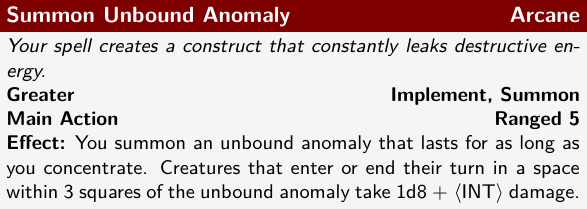
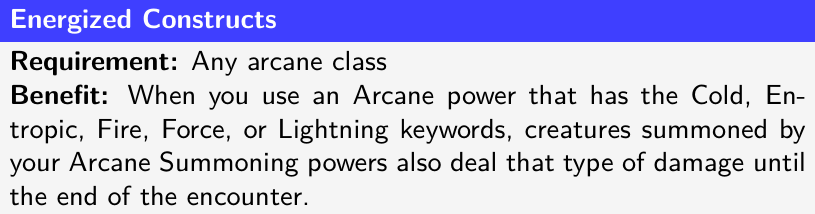
    Summoning powers like Irate Spirit create a semi-independent creature that follows the instructions of the summoner. They take their turns simultaneously with the summoner, who can use their own actions to command that the summoned creature do things during their turn; many summoned creatures, like the Irate Spirit, can also be commanded to do certain things between the summoner’s turns. Summoned creatures have their own supply of movement and their own pool of hit points, although creatures summoned by lesser powers are generally destroyed as soon as they take damage.

    Let’s continue making Valdo’s powers more deadly by taking Razor Claws, allowing his already quite damaging Panther powers to also make their targets bleed out. A creature taking repeated damage incurs that damage at the end of each of their turns (rolling for damage each time), typically until they succeed on a recovery roll. Repeated damage does benefit from bonuses to damage rolls, so thanks to Mighty Spirits, this 1d4 damage already becomes 1d4 + 2. Adding in that bleed damage ignores armor resistance, this will make Valdo’s Panther powers increasingly deadly.

    Valdo is increasingly confused by the way that his preferred tactics (leaping onto a monster from hiding and messily tearing it to ribbons) makes people turn green and flee. So, for his perk, he will take Esoteric Knowledge [Ordinary Human Behavior]. It remains to be seen whether his painstaking observation of human behavior allows him to relate better to his would-be rescuees…

    Level 4

    Another thing that Valdo still lacks is a way to deal with several enemies at once. Let’s give him one using Thrashing Claws, which as a Bear power benefits from his Mighty Spirits feat but not Razor Claws. It will still be enough to help get him out of situations where he’s surrounded by a few weaker enemies.

    Valdo is beginning to feel the cost of his quite low AC; to shore that up, he will take Defensive Expertise, which gives a simple +1 feat bonus to AC.

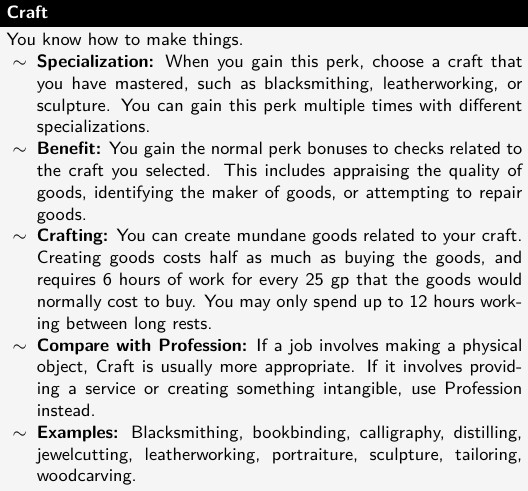
    Valdo continues to make plans for his vengeful return to Der Eisenvald, and practices making a variety of holy symbols that he can use, in a pinch, to fend off a vampire. He gains the Craft [Holy Symbol] perk.

    Level 5

    As part of his preparations for another round of vampire hunting, Valdo bonds a spirit of the desert that one of his adventures takes him to, allowing him to call on the brutally punishing sun of the deep sands…even at night, and even indoors. This gives him the Sunbake power, which he can use to great effect against vampires: in addition to weakening them so that they can’t harm him as easily, it also exploits their vulnerability to the sun! It gives Valdo a nice ranged attack (far better than his hunting crossbow would be…) but because it’s a Spiritual ranged power, he can also use it as a melee attack via his Wild Strike class feature. Sunbake has the Desert keyword, one of the keywords associated with spirits of the land.

    Valdo will also take the Landsense feat, since he gained the Spirit Domain power by multiclassing to Wakener. This will help him out by letting him be aware of any pesky vampires that have the bright idea to try to ambush him while he’s trying to ambush them.

    Finally, as one of his last steps before embarking on his great vampire hunt, Valdo will read every book he can find about vampires, hoping that it will prove useful. He gains the Esoteric Knowledge [Vampirism] perk.

    Up Next

    This wraps up Valdo the Bat-Eater! I’m going to take a break from character creation posts for a couple of weeks, but when I get back to them, I’ll be starting the third sample character, an elf artificer named Guinne of House Midwinter.

  • I’ve shown off enough enemies, and discussed how they scale in difficulty, that I think today is a great time to share some of the guidance that the GM Handbook has for building encounters.

    The Encounter Metric

    Every enemy has an Encounter Value (EV) that represents how difficult they are to defeat, based on their tier and type. The PCs also have an EV, based on their levels, and you can judge roughly how difficult an encounter will be by comparing the total EV of the enemies (and hazards and traps and so on) in an encounter to the total EV of the PCs. Depending on how these two totals compare, an encounter will fall into four rough levels of difficulty:

    • An encounter where the enemies have around two-thirds the EV of the PCs is an easy encounter. An easy encounter still presents a little bit of a challenge, but it is not something that the PCs will have to really plan out their tactics in.
    • An encounter where the enemies have around the same EV as the PCs is a normal encounter. You can expect a normal encounter to do enough damage to the PCs that they use up an average of one resurgence each, either during the encounter or when patching themselves up afterward. Because PCs regain a resurgence with every encounter they triumph over, they should, on average, lose no net resurgences from a normal encounter. Of course, depending on how they play, the damage might be distributed unevenly, so that one character comes out ahead and one is badly wounded…but them’s the breaks. A normal encounter is unlikely to cause character death, even if the PCs use poor tactics or have some poor rolls.
    • An encounter where the enemies have around one-and-one-half times the EV of the PCs is a hard encounter. A hard encounter will likely see all the PCs taking enough damage to cause a net loss of resurgences even after their triumph; there can be a risk of character death, but it is minor unless the PCs both roll badly and use bad tactics.
    • An encounter where the enemies have around twice or more the EV of the PCs is a climactic encounter, best reserved for the end of a long adventure when the PCs come face to face with the villain. A challenging encounter will almost certainly require the party to take a long rest afterwards, because they will use up a lot of resurgences, consumables, and other resources even if they use good tactics. And, there is a very real risk of character death regardless of how they play.

    As an example, a party of five level-6 PCs each have an EV of 160, making the party’s total EV 800. So encounters for this party would be:

    • Easy at around 550 EV.
    • Normal at around 800 EV.
    • Hard at around 1200 EV.
    • Climactic at around 1600 EV.

    In addition to telling you how difficult an encounter will be, EV also helps to design encounters from scratch. You can start by deciding how challenging you want the encounter to be and calculating an appropriate EV total for your PCs and that level of difficulty: this is called the encounter metric. Then, just pick appropriate enemies whose EV sums up to roughly your encounter metric.

    Picking Enemies

    You can absolutely fill out an encounter budget by picking enemies, if not at random, then with just a cursory glance at their EV. But, you can improve the quality of your encounters by taking a few other things into consideration:

    Story Considerations

    Aetrimonde is first and foremost a roleplaying game, and that means that the story you’re telling should be a factor in the encounters you build for it. If the villain of an adventure is an evil industrialist plotting to take over the world with his army of mechanical soldiers, then at least some of the fights during the adventure should probably include mechanical soldiers as enemies, and there are some other kinds of enemies that you should probably avoid, like nature-loving elves and traditionalist dwarves.

    This is not to say that every encounter during an adventure has to revolve around the adventure’s main plot. There are lots of ways to work in an encounter featuring unrelated enemies:

    • A villain could have groups of soldiers that he has hired, tricked, threatened, or mind-controlled into fighting for him, and who are therefore different from the rest of his forces.
    • There could be a secondary antagonist group that is allied with your main villain, but includes different kinds of enemies.
    • A secondary antagonist could also be opposed to both the main villain and the party, and become involved in the adventure because they’re trying to take advantage of the PCs’ actions to achieve their own goals.
    • Mindless and unintelligent creatures, like zombies, constructs, and animals, could be included as enemies in an adventure that doesn’t revolve around them because they are territorial, out of control, or just in the way of the PCs.
    • Traditional dungeon-delving adventures can include a wide variety of enemies whose only relation to each other is that they were brought into the dungeon by its builder. They might be there to guard it, they might be prisoners who’ve broken loose, or they might be the builder’s experiments, for example.

    If there’s a particular enemy that you want to use (because it has interesting mechanics, for example), and you just can’t find a way to work it into the story, then it’s time to exert your DM’s prerogative and re-flavor it so that it seems like a different kind of creature that would fit in better. This might involve:

    • Changing a creature’s name, type and description to something more appropriate for the adventure. (Example: Renaming a Zombie Walker to Brainwashed Muscle, and making it a Mortal Humanoid.)
    • Giving a creature different weapons and armor to suit a different culture, and adjusting its stats accordingly. (Example: Giving an Elf Archer a rifle and renaming it a Dark Elf Gunman.)
    • Adjusting the names, descriptions, and damage types of a creature’s powers to resemble a different kind of enemy. (Example: Changing a Fire Elemental’s powers to deal both fire and entropic damage, and renaming it a Hellfire Spirit.)
    • Outright replacing some of a creature’s powers with ones more appropriate to a different kind of creature. (Example: Replacing an Elf Blademaster’s Deadly Grace power with the Dwarven Stubbornness power and renaming it a Dwarf Blademaster.)

    Tier Considerations

    Aetrimonde is designed to make it possible for low-level enemies to still challenge powerful characters in sufficient numbers, and for low-level characters to handle powerful enemies in small numbers, but there are limits to this.

    Especially weak enemies (more than 2 tiers below the party) will have a much harder time hitting with attacks, and will almost always be hit by the PCs’ attacks. Fighting such weak enemies can make the PCs feel powerful, but fights with numerous weak enemies tend to take a long time just due to the number of creatures there are with turns to track and dice to roll, and it can get tedious quickly.

    Especially powerful enemies (more than 2 tiers above the party) similarly have a much easier time hitting with attacks, and will be hit less often by the PCs’ attacks. Fighting such powerful enemies can also become boring, not because they don’t pose a challenge, but because PCs that roll badly, or just don’t have a good set of powers for fighting a particular enemy, may spend several turns trying and failing to contribute to the fight.

    In general, avoid designing encounters exclusively using enemies more than 2 tiers away from the PCs. Instead, mix them in with enemies that are closer to the PCs’ tier. It usually works best to combine especially weak enemies with other enemies that are at or slightly above the PCs’ tier, and especially strong enemies with other enemies that are at or slightly below the PCs’ tier. (Combining especially strong and especially weak enemies just gets you the worst of both worlds.)

    Role Considerations

    The second thing to take into account when picking enemies for an encounter is their roles, and what that means for how an encounter with them may play out.

    Firstly, an encounter should generally not consist entirely of the same kind of enemy, or even of enemies with the same role:

    • Assassins, Brutes, and Shooters all deal high damage. Encounters with many enemies of these roles tend to be high-intensity, with PCs taking a lot of damage in a short time, which increases the odds of character death.
    • Controllers can be frustrating to deal with, because they prevent players from using their characters in the way that they want to.
    • Leaders are force-multipliers who make other enemies more dangerous. Often, multiple Leaders stack dangerously, creating one (or several) incredibly powerful enemies that can overwhelm the PCs. This is especially the case when combining Leaders with other enemies more than 2 tiers above the party.
    • Protectors are also force-multipliers, but they make other enemies more resilient. Multiple Protectors can turn an encounter into a slog, where neither the PCs nor the enemies can make much headway. Like with Leaders, it’s especially bad when combining Protectors with enemies more than 2 tiers above the PCs.
    • Soldiers have great defenses, making them difficult to bring down. An encounter with lots of Soldiers will be a slog like one with lots of Protectors.

    Secondly, some enemy roles will perform differently against certain kinds of PC. It can be fun to throw a challenge at the PCs every once in a while that they have trouble dealing with, but there is a fine line between a challenge and an unpleasant slog of a battle where nothing they can do works well. Keep an eye on the PCs in your party, and if a lot of them fall into the same niche, use certain enemy roles with caution:

    • Melee-focused PCs can have trouble dealing with Shooters (because Shooters can attack from a long ways away) and Skirmishers (because Skirmishers have ways to avoid being tied down in melee).
    • Ranged-focused PCs can have trouble dealing with Brutes and Soldiers, both of which like to get up close where it’s difficult to use ranged powers.
      • Especially pay attention to Soldiers’ defenses: if a majority of your PCs use attacks vs. one particular defense, avoid using Soldiers who have excellent values in that defense. Otherwise, encounters may become a slog.
    • Also pay attention to Controllers’ attacks, and avoid using Controllers whose attacks target a defense most of your PCs have low values in. If the party is consistently subject to nasty conditions, the fight becomes not just a slog, but unfun.

    Finally, the two “special” roles of Afflictor and Summoner should always be used sparingly:

    • It is decidedly unfun for PCs to be constantly dealing with injury, poison, and curses. Use Afflictors in only one, perhaps two, encounters per adventure.
    • Summoners increase the number of enemies in the encounter, sometimes drastically. To prevent this becoming a drain on your own concentration, use only one or two Summoners in any encounter.

    EV Adjustments

    Finally, there are circumstances where it’s appropriate to adjust some enemies’ EV up or down (by 20-40%, usually) to account for other facets of an encounter:

    • Adjust Assassin EV up if the encounter provides especially good ways for the Assassin to set up (e.g. darkness, heavy concealment, etc.) and down if the Assassin has no good way to set up (e.g. bright light everywhere, no cover, etc.).
    • Adjust Brute EV up if it starts the encounter very close to the PCs, or the encounter is in tight quarters where the PCs can not escape easily; adjust down if it starts very far from the PCs.
    • Adjust Shooter EV up if it starts the encounter with the PCs at the very edge of its attack range, or it has terrain making it hard to effectively attack it (e.g. a wall with arrow slits); adjust down if it starts very close to the PCs.
    • Adjust Skirmisher EV up if the encounter provides terrain that especially favors the Skirmisher (e.g. lots of cliffs for a Skirmisher with a climb speed) and down if the encounter is in tight quarters where the Skirmisher cannot move easily.

    Up Next

    With all of these considerations in mind, keep an eye out for my next post on encounter design, where I’ll be building an encounter using some of these lovely undead I’ve been showing off!

  • Today in my October series on Aetrimonde’s creepiest undead, I’m talking wights!

    Aetrimonde’s wights share an origin: they are created undead, given necromantic magic by the necromancers who animated them. The extra care, effort, and embalming fluid that go into creating a wight means that they are more of a threat than a mere zombie. There are several common varieties, animated for different purposes, and we’ll be looking at three of them today.

    Barrow Wight

    Barrow wights are undead guards buried in the barrow mounds of ancient kings from Aetrimonde’s more primitive days. Barrow wights first entered the popular consciousness via the Lord of the Rings, where they were the bodies of ancient kings animated by evil spirits, and possessed of a fell, icy grip.1

    Aetrimonde’s wights are not the product of evil spirits, but they certainly have the fell grip. With Dragging Grasp, they can grab an enemy and drag them into the open, and with Shoulder Charge, they can grab an enemy and knock them prone. The real danger of their grip comes from Draining Grasp: once in their grip, PCs will be weakened (dealing half damage) and take entropic damage every turn they remain grabbed. If a PC gets grabbed, they and their allies will want to somehow break the grab quickly.

    Barrow Wights don’t have nearly the HP of zombies, but they also don’t have the weaknesses. They have decent defenses and some armor resistance (which is what makes them Soldiers), and, thanks to Dead Flesh, they can’t easily be brought down by fireballs and lightning bolts. To fight a Barrow Wight, some PC will almost certainly have to get up close and personal with them.

    Murder Wight

    Rather than guardians, murder wights are animated to serve as a necromancer’s elite killers. Able to blend in among the living by flensing fresh corpses, murder wights get close to their targets before knifing them and giving them a wound that will not heal.

    The Assassin role, as a reminder, is for enemies that can deal high damage, with the proper setup. A Murder Wight is a twist on this formula: it does need setup to be most effective, but it’s easy setup: they need their foe to be flatfooted so that they can use Entropic Stab. Once they hit with Entropic Stab, though…their best move is to run away, because the repeated entropic damage offers no way to end it other than killing the Murder Wight or getting far away from it. A Murder Wight that can break line of sight and hide, or run through a door and lock it behind it, forces PCs to hunt it down before the entropic damage brings down their ally.

    Apostle Wight

    An apostle wight is that rarest of things, an undead creature that can create more of its kind. They are animated by skilled, powerful necromancers with a horde large enough that they need lieutenants to manage it.

    Apostle Wights are Protectors, designed to make other enemies harder to kill. They accomplish this in a couple of ways:

    • Aura of Undeath removes other undead creatures’ vulnerabilities (like wraiths’ and vampires’ vulnerability to radiant damage), and grants them immunity to entropic damage. Worse, it allows them to heal (or at least, gain temporary hit points) from taking the entropic damage they are immune to.
    • And the Apostle Wight has multiple ways to deal entropic damage that will heal their undead allies. Death Toll and Withering Shroud2 both deal entropic damage in an area of effect, allowing the Apostle Wight to both attack the PCs and heal allies in one turn. Better yet, Withering Shroud is a concentration power, allowing the Apostle Wight to start it up and then combine it with Death Toll on later turns.

    Apostle Wights are Summoners as well, able to animate dead humanoids as Zombie Walker mooks. In a battle with only the PCs present, this is not the worst thing to deal with…but in a fight with civilians around, who can’t survive nearly as much punishment as PCs, it puts a great deal of pressure on the PCs to avoid collateral damage.

    1. https://en.wikipedia.org/wiki/Barrow-wight ↩︎
    2. Both of these powers, incidentally, are Arcane powers available to PCs. Entropomancy is not the same thing as necromancy, but necromancers who did not first practice entropomancy are few and far between. ↩︎
  • All right, it’s time for another math-heavy post today, as I’m going to be filling in all the numbers for Valdo the Bat-Eater.

    Health and Healing

    The skinchanger class gives Valdo 20 base hit points. His <CON> will give him another 12, and he will get 4 from expertise, for a total of 36 hit points. His injury value will be 18.

    Valdo gets 3 base resurgences from his class, and another 3 from <CON>, for 6 total. With a 1d8 healing die, he will get 1d8 hit points from a small heal and 1d8 + 4 from a large heal.

    This makes Valdo a little bit tougher than the average character, despite his rogue-level base hit points and toughness.

    Defenses

    As always, Valdo’s defenses are 10 + half his expertise bonus (+1) + some other relevant values:

    • AC: 14 = 11 + 2 (leather greatcoat) + 1 (<GRA>)
    • Brawn: 15 = 11 + 1 (skinchanger) + 3 (<CON>)
    • Poise: 13 = 11 + 1 (skinchanger) + 1 (<GRA>)
    • Wit: 13 = 11 + 2 (<INT>)
    • Composure: 15 = 11 + 4 (<WIS>)

    Unfortunately, Valdo is going to have terrible AC. However, he makes up slightly for this with his Spirit Transformation, which gives him armor resistance equal to his +3 <CON>. So Valdo will be getting hit a lot, but can blunt a lot of the impacts. Thankfully, his other defenses are more reasonable.

    Attacks and Damage

    Valdo has four different ways he can attack, and they’re all going have different attack bonuses and damage.

    His Carnivorous Bite attack will be based on Strength, like any unarmed attack; with +0 <STR>, this means he will have a +1 attack bonus (due to Carnivorous Bite’s precision bonus) and deal a plain 1d12 damage.

    Likewise, his Spirit Transformation unarmed attack will have a +1 attack bonus and deal a plain 1d10 damage. Since it’s strictly worse than Carnivorous Bite (for the moment; there are feats that would improve it…), there’s not really much point in putting it on a character sheet.

    Valdo’s totemic hunting crossbow, aside from being an implement for his Spiritual powers, is a weapon with +2 precision and 1d10 damage, but due to Valdo’s -1 <DEX>, he will only have a +1 attack bonus and deal 1d10 – 1 damage.

    And finally, there are his actual Spiritual powers, three of which are attacks. All three are based on Wisdom, but each has different attack and damage rolls:

    • Feline Cunning has an inherent +2 bonus to attack rolls, making its total attack bonus +6, and deals 1d8 + <WIS> + <CON>, totaling 1d8 + 7. It’s also an attack vs. Poise, rather than AC.
    • Bounding Leap also has the inherent +2 bonus, and so its total attack bonus is also +6 (but vs. AC). Its damage is 2d8 + <WIS>, or 2d8 + 4 total.
    • Ursine Pin lacks the inherent +2 bonus, so its total attack bonus is +4, but vs. Brawn. Its damage is 1d8 + <WIS>, or 1d8 + 4 total.

    Skills

    Valdo’s leather greatcoat does apply a -1 encumbrance penalty, which applies to physical skills (those based on Strength, Constitution, Dexterity, and Grace). So taking this into account, his skill bonuses will be:

    Acrobatics +0History +2Persuasion -1
    Arcana +4Insight +4Religion +2
    Athletics -1Intimidate +1Society +2
    Deception -1Medicine +2Stealth +2
    Endurance +4Nature +4Subterfuge -2
    Engineering +4Perception +2Warfare +2

    Movement

    Valdo is going to be more mobile than Ragnvald: in addition to having higher base speed, at 6 squares, he has +1 <GRA>, allowing him to move 1 square if he chooses to move safely. Bounding Leap also gives him a way to make hit-and-run attacks without getting tied up in melee.

    Carrying Capacity

    With +0 <STR>, Valdo has a perfectly typical carrying capacity of 50 bulk. His starting equipment weighs in at just about half that, so he’s got plenty of room for more loot.

    Initiative

    With +0 <CUN>, Valdo has +0 initiative, meaning that he’ll likely be acting after Ragnvald in most encounters…if he didn’t start the encounter himself by leaping on the enemy from hiding.

    Up Next

    I’m almost done with Valdo here, but like I did with Ragnvald, I’m going to wrap up by showing some ways that Valdo could advance and develop up to level 5. This will include some examples of Spiritual powers that branch out away from Valdo’s core fantasy as a skinchanger and show what Ancestor, Elemental, and Land powers look like.

    And in the meantime, you can take a look at Valdo’s character sheet (with some improvements over the earlier version I used for Ragnvald, which I’ve since updated).

  • Today, I’m going to follow on from my previous post on level scaling and take a look at how PCs would fare against enemies of higher and lower tiers. This post may be best viewed on a larger screen, because there are some large tables in it.

    Accuracy

    As a baseline, let’s take a look at the accuracy of a PC facing an enemy of their tier, and vice versa.

    In the previous post, I discussed how PCs will advance if they max out every aspect of their character, which is to say, they’ll gain +4 to attacks and defenses over 20 levels. While in practice this won’t necessarily be a smooth progression of +1 every 5 levels/1 tier, we’ll assume that for purposes of this discussion.

    The math for enemy design that I have settled on provides enemies with that same +1 per tier as they advance, but they start with a slight handicap, equivalent to about 5 levels of advancement. This means a PC will hit a level-appropriate enemy on a 9 instead of a 10 (72% of the time), and the enemy will hit the PC on an 11 (55%).

    If a PC faces an enemy 1 tier higher, then both they and the enemy will hit on a 10 (64%). So the PC will be 64/72 = 89% as effective offensively as when they faced an enemy at their tier, and the enemy will be 64/55 = 116% as effective. Together, this translates into the PC being 89/116 = 75% as effective when fighting an enemy 1 tier higher, just from accuracy effects.

    If they are fighting an enemy 1 tier lower, then the PC is 79/72 = 110% as effective, and the enemy 45/55 = 82% as effective. Overall, the accuracy effects will make the PC 134% as effective from accuracy effects. (Though more of this will come from the enemy being less accurate than the PC being more so.)

    If you’re noticing that 134% is roughly the reciprocal of 75%, very good! This is designed into the system, and means that the overall difference in accuracy going one tier down should feel about as big as the difference going one tier up.

    Damage

    Calculating the difference in difficulty that comes from damage is going to be more complicated than it was for accuracy. This is because with every tier, typical damage increases by 2, armor resistance by 1., and hit points by 4.

    Let’s start with one concrete example: a Tier 0 PC vs. a Tier 0 enemy. The PC will deal typical damage of 8.5, and the enemy will typically have 0 AR and 28 HP. So the PC will deal 30% of the enemy’s HP per hit.

    The enemy will deal 6.5 typical damage, against 1 AR and 32 HP. This will be 17% of the PC’s HP.

    Applying the same math to different tier pairings, we can fill out the following tables for a PC facing an on-tier enemy…

    TierPC DamageEnemy AREnemy HP% DamageEnemy DamagePC ARPC HP% Damage% Damage Ratio
    08.502830%6.513217%1.77
    110.513230%8.523618%1.64
    212.523629%10.534019%1.56
    314.534029%12.544419%1.49
    416.544428%14.554820%1.44

    …an enemy one tier higher…

    TierPC DamageEnemy AREnemy HP% DamageEnemy DamagePC ARPC HP% Damage% Damage Ratio
    08.513223%8.513223%1.00
    110.523624%10.523624%1.00
    212.534024%12.534024%1.00
    314.544424%14.544424%1.00
    416.554824%16.554824%1.00

    …and an enemy one tier lower:

    TierPC DamageEnemy AREnemy HP% DamageEnemy DamagePC ARPC HP% Damage% Damage Ratio
    0
    110.502838%6.523613%3.00
    212.513236%8.534014%2.61
    314.523635%10.544415%2.35
    416.534034%12.554816%2.16

    Overall Effectiveness

    Coupling these values with accuracy, we can compute A PC’s relative effectiveness against an enemy a tier above or below them. We’ll define this overall effectiveness as the accuracy effectiveness computed above (0.75 vs. a tier above, 1.34 vs. a tier below), times the % Damage Ratio for an enemy a tier above or below, divided by the % Damage Ratio for an on-tier enemy.

    Tier% Damage Ratio vs. Equal TierAccuracy Factor vs. Tier Above% Damage Ratio vs. +1 TierEffectiveness vs. Tier AboveAccuracy Factor vs. Tier Below% Damage Ratio vs. Tier BelowEffectiveness vs. Tier Below
    01.770.751.00 0.42
    11.640.751.000.461.343.002.44
    21.560.751.000.481.342.612.25
    31.490.751.000.501.342.352.12
    41.440.751.000.521.342.162.02

    So what does this tell us? Well, just numerically, a PC will be around half as effective, or a little less at low levels, against enemies a tier higher than they are, and around twice as effective, or a little more at low levels, against enemies a tier lower than they are.

    EV Scaling

    Now, we want to take this result (that each 1-tier difference makes an enemy about twice as difficult) and translate it into a rating that captures how difficult the enemy is. And you’d think that the way to do that is to have the rating double with each tier added to an enemy. But, there’s a problem with that…

    When building an encounter, there are two easy ways to adjust its difficulty: you can adjust the difficulty of the individual enemies, holding their number constant…or you can adjust the number of enemies, holding the difficulty of the enemies constant. The problem is that these two factors work on different scales.

    If you take every enemy in an encounter and bump them all up by one tier (adjusting their stats, or replacing them with similar enemies of a higher tier), that doubles the difficulty of the encounter, as we’ve just seen.

    But if you instead double the number of enemies in the encounter, this actually quadruples the difficulty of the encounter, because it will take twice as much work (and twice as many rounds) for the PCs to defeat them, and in that time, the enemies will collectively be dealing twice as much damage per round since there are twice as many of them.

    What About AoE Damage?

    The assumption that twice as many enemies will take twice as long to defeat is based on the PCs using single-target attacks. In practice, many PCs will have access to area attacks or other ways to attack more than one enemy per turn: these tend to do less damage than equivalent single-target attacks, but more damage total if they can catch enough enemies with them.

    Having more enemies in an encounter means that they will likely be more densely packed, making area damage more effective. This will slightly reduce how long it takes to defeat a hypothetical twice-as-large encounter.

    On the other hand, having twice the damage output means that the PCs will likely need to fight more cautiously, passing up opportunities to deal damage in favor of healing themselves or staying in defensible positions. This will slightly increase how long it takes to defeat a hypothetical twice-as-large encounter.

    And, with twice as many enemies, they will find it more easy to flank the PCs. This will slightly increase the damage they deal before being defeated.

    In playtesting, these three factors have appeared to roughly cancel each other out.

    What About Focus Fire?

    In reality, the enemies in an encounter won’t all be defeated at the same time. If the PCs focus their attacks on one enemy at a time, this will reduce the overall damage they take.

    Consider an encounter with, let’s say, four goblin warriors that each take the PCs r rounds to defeat, and deal d damage per round until defeated. They collectively deal 4d damage for the first r rounds, 3d damage for the next r rounds, etc., for a total of 10dr damage.

    An encounter with eight goblin warriors will instead have them dealing 8d damage for the first r rounds, 7d damage, for the next r rounds, etc., for a total of 36dr damage. That’s almost four times as much.

    So the idea that doubling the number of enemies quadruples the difficulty of the encounter holds even with the PCs focusing fire.

    The problem here is that doubling the number of enemies in the encounter will only double the total EV of the enemies, while quadrupling the encounter’s difficulty. We want to make it so that raising all of the enemies by two tiers, which will also quadruple the encounter’s difficulty, also doubles the encounter’s total EV. This means we want the EV scale to scale something like this:

    Level / TierEV (Option 1)EV (Option 2)
    0 / 0100100
    1110108
    2120116
    3130124
    4140132
    5 / 1150140
    6160152
    7170164
    8180176
    9190188
    10 / 2200200
    11220216
    12240232
    13260248
    14280264
    15 / 3300280
    16320304
    17340328
    18360352
    19380376
    20 / 4400400

    The first option uses rounder numbers and is likely easier for a GM to remember and use for that reason, but the second option will give slightly smoother scaling. The differences are relatively small, and in any case this is largely meant as a rough guide to encounter difficulty, so I’m going to go with the first option.

    Fewer Enemies of Higher Tier

    In the details about focus fire above, I did some math to show that doubling the number of enemies still roughly quadruples the encounter’s difficulty, even with the PCs using focused fire. Let’s apply the same approach to consider what happens when substituting higher-tier enemies for lower-tier ones does:

    Consider an encounter with four goblin knights that are individually twice as difficult as the goblin warriors. For simplicity, assume that “twice as difficult” means that they take 1.4r rounds to defeat and deal 1.4d damage per round, so that the damage an individual goblin knight could deal before being defeated is 1.96dr, or roughly twice as much. This encounter will have the goblins deal 5.6d damage for the first 1.4r rounds, 4.2d damage for the next 1.4r rounds, etc., for a total of 19.6dr damage before the last one is defeated. Which is, yes, about twice as much in total as the four goblin warriors.

    But (and this is the complicated bit), two goblin knights, which it’s tempting to assume would be equivalent to the four goblin warriors, would deal only 5.88dr damage before being defeated. This is because halving the number of enemies cuts the encounter difficulty to roughly 1/4, and making the individual enemies twice as difficult only brings it back up to roughly 1/2. You would actually need between two and three of the goblin knights to have an encounter of roughly the same difficulty as the goblin (three would deal 11.76dr damage), and this is what the EV scales above accomplish.

    If we say, for the sake of argument, that goblin warriors are Tier 0, then their combined EV is 400; the goblin knights, being twice as difficult, must be Tier 1, and the combined EV of three of them is 450 (or 420, using the more precise scale), which is pretty close to an appropriate EV for an encounter that would deal 11.76dr damage when compared to four goblin warriors dealing 10dr.

    In Practice

    All of the above is theoretical and purely numeric. I did use this math to help me calibrate PC and enemy level scaling, but it’s not enough to rely on numbers alone: the pure math misses a few factors that are difficult to model simply.

    One factor is that at higher levels, both PCs and their enemies will also have a wider selection of actions and special traits. For enemies at least, some of these will be, for lack of a better word, “nastier” than at low levels. Some high-level enemies can do things like teleport out of a battle and bring back reinforcements, which is not a factor at low levels. PCs have their own nasty tricks at higher levels, due to how certain powers and feats can be combined in a way that is greater than the sum of the parts.

    So, I’ve run some playtests, pitting groups of PCs against variations of the same encounter that used enemies at their tier, a tier above, and a tier below, with their numbers adjusted accordingly. The consensus? There are definitely differences in how these encounters played out and felt…but they’re small, and the encounters felt similarly difficult, which I think vindicates my scaling here.

  • Today, in the second half of my coverage of the Dwarven Federation, I’m going to be covering the nation’s current state, meaning government, politics, and society. And, I’ll cap it off by providing some suggestions for plot hooks that could be used to tie the Federation into a campaign!

    Government

    The Dwarven Federation is, as the name declares, a federation, but it is a federation of clans rather than states or cities. Dwarven clans are a combination of an extended family unit and a family-run business: in the Federation, they are also a political unit capable of not just holding territory, but also raising armies to defend it and passing and enforcing laws within it.

    A clan’s jurisdiction extends only to the borders of its own territory, which depending on the clan may consist of as little as a compound of buildings where its people live and work, or as much as a range of mountains and valleys. Most clans fall into the former category, with their claimed territory entirely surrounded by the territory of another, more powerful clan to which they owe a form of fealty. Where a dwarf of one clan must venture into the territory of another whose laws differ, their rights and obligations are governed by treaties between the respective clans, which can grow exceedingly complex.

    Outright war between clans is rare, but they do compete, and they often use legal and economic strategies to undermine rivals’ access to resources or drive them into bankruptcy. The Regent is the arbiter of last recourse for conflicts between clans, with the power to order that a clan’s territory and assets be seized by a claimant, or (in extraordinary cases) that a clan be dissolved entirely and its people exiled.

    While in theory every clan’s Thane sits upon the High Council, and receives voting power proportional to the population of their clan, in practice the council is dominated by the handful of ancient, wealthy and powerful clans that control the bulk of the Federation’s territory. Because the minor clans occupy territory entirely surrounded by these major clans, they can be leaned on to vote in a bloc with the Thane whose clan surrounds them. The major clans are not a constant, however: their number has fluctuated between five and eleven over the centuries, as political and economic maneuvering bankrupted some clans and elevated new ones.

    Legally, the High Council cannot pass laws for the Federation as a whole, any more than the regent can. However, the Thanes are bound by tradition and honor to respect and uphold any consensus reached by the High Council. In practice, this means that if a sufficient majority of the council agrees on a policy, the dissenters must either fall in line and implement the policy, or secede from the Federation. Some clans, holding territory on the borders of the Federation, have chosen to secede over the centuries, but this is a rare event: leaving the Federation means being cut off from the greatest repositories of Dwarven heritage, and is therefore a last resort for any clan with the slightest respect for that heritage.

    Among the policy decisions that the High Council confers on are matters of foreign policy, military strategy, taxation, trade, and of course the election of new Regents. The Regency is a position for life, which is one reason why only elderly dwarves are ever seriously considered for it. (The other, of course, is that only a dwarf who has spent an entire lifetime developing an understanding of dwarven culture and heritage could possibly command the respect necessary to wield the position’s ceremonial power effectively.)

    Political Situation

    At present, the Regent for the Unclaimed Throne is Ingrid Ingvaldsdottir, who has held the position for four years. She is a progressive and a reformer, by the standards of the Federation, which is to say, she does not immediately call for the exile of any dwarf to offer up an idea without precedent in the annals of dwarven history.

    Ingvaldsdottir was elected Regent in response to the growing economic crisis that has seen dispossessed apprentices leaving the Federation in droves, and has caused the more modern clans in the west of the Federation to start muttering about seceding en masse. Unfortunately, she was elected by the barest of margins, as a compromise candidate carried by a coalition of the modernist and mercantilist factions on the council against the traditionalists; the traditionalists were barely restrained from seceding themselves by their dedication to preserving the Federation and their heritage. While she received enough support to claim the Regency, this does not translate into enough support to make the council reach consensus on the cultural reforms she believes are necessary to arrest the Federation’s slow descent into irrelevance.

    The traditionalist opposition on the high council is led by Olaf Olafssen XXIII, who is indeed a direct descendant of the first Regent. Clan Ulfenning remains a powerful clan, and one of the few to continue efforts to reclaim further pieces of the heritage of Gjalerbron or identify an heir to the throne after Audur’s Proclamation. Olaf XXIII would sooner see the Federation broken than permit any reforms that, as he sees it, devalue Dwarven tradition and heritage. He and his allies are biding their time, but are rumored to be preparing for a political counterstroke as soon as Ingvaldsdottir overreaches.

    Foreign Relations

    The Federation is on good terms with Waystone, which forms one of their largest remaining export markets, and Caras Elvaren, due to their shared history of loss during the Collapse. Formerly, they were friendly to Tir Coetir, but the wood elves’ reckless release of their engineered plagues during the last wars soured this relationship.

    Relations with the Novan Imperium are complex: the Imperium is home to a sizeable dwarf population, but these are largely exiled or expatriate dwarves who do not agree with the Federation’s backward-looking culture.

    Society

    Clans are of course the center of the Federation’s society: members of a clan work closely with each other, and as a rule they also live, feast, celebrate, and worship together as well. A typical clan is semi-communal: individuals and smaller family units within the clan own their own homes within a shared compound, and accumulate wealth in the form of a claim to the clan’s assets and funds. Clans also generally provide members with access to communal meals, medical care, legal services, and more. There is of course variation between clans: some are totally communal, with members residing in barracks or dormitories and owning only personal effects. Others are less so, with members largely managing their own affairs independent of the clan.

    Dwarves are initially born into their parents’ clan (or one of their clans, as marriages across clan lines are not uncommon). They are not bound to a clan, though: while there is pressure for young dwarves to apprentice in their birth clan’s trades, a dwarf who finds no appeal in this can always seek to be adopted into a clan more suited to their interests. So, too, can they join another clan by marriage. The right to join any clan that would have them is one of the most traditional rights in dwarven tradition, and no clan would dare infringe upon it.

    This is not to say that there are not costs to changing clans. Dwarves are expected to pay for the training they receive as part of an apprenticeship, and if they or their family do not have the money to pay for this outright, they incur a debt to the clan in which they apprentice. There are other ways to incur a debt to one’s clan, and changing clans with such a debt on the books requires that someone–the dwarf themselves, their family, or the clan adopting them–pay it off before they can leave. The most traditional clans can be utterly ruthless about this, and often the only way for a dwarf with debts but no prospects to leave is for them to flee the Federation entirely. More commonly, though, a dwarf changing clans merely has their debt purchased by their new clan, if it isn’t paid off entirely by their friends and relations as a parting gift.

    In theory, a clan’s Thane rules by decree, but in practice, because clans are so tight-knit and because members can leave without too much difficulty, they are run on a democratic basis. Dwarves traditionally respect age and experience, though, and so the clan’s Thane is very often just the oldest dwarf in the clan, and advised by a council of other elder dwarves. In smaller clans, this council is often informal, and consists of elders discussing matters over a meal as the rest of the clan listens in from further down the table. In larger clans, a council may be formalized, with elders assuming ministerial posts and meeting in a dignified salurhropa.1

    To found a new clan, a dwarf must first receive permission from their Thane—who does not have to seek permission from anyone else, strictly speaking, but it is traditional for Thanes of minor clans to get the approval of the major Thane to whom they give fealty. This permission is generally granted in recognition of some great accomplishment, but it is also sometimes used to resolve schisms within a clan by allowing a disgruntled faction to strike out on their own. Once permission is given, founding the new clan is a matter of attracting clan members, claiming or buying a territory, and of course, having the founding recorded and recognized by neighboring clans.

    Architecture

    Towns and cities in the Dwarven Federation are generally carved into the sides of rocky hills, cliffs, and mountains. This is done in imitation of the ancient city of Konigstrond, which was built into an entire mountain, from base to peak. Where they have no suitable outcroppings to carve into, the dwarves of the Federation will instead build out of cut stone, but since the Federation occupies a mountainous region, this is quite rare. Additionally, while they do not usually build so deep that their homes cannot open onto the outdoors, the Federation is dotted with strongholds repurposed from old mine shafts.

    Economy

    The Dwarven Federation produces stone- and metalwork of unsurpassed quality, much of it commissioned by foreign customers through various merchants and brokers. This export market has shrunk in recent years due to advancements in foreign manufacturing, but is still represents a major source of income for the Federation.

    The dwarves need this foreign income, because they are barely self-sufficient for food. The high mountains are not suited for farming, and dwarven agriculture consists almost exclusively of farming rye and other hardy grains, and raising flocks of sheep and goats in higher pastures. This does not make for a varied diet, and the Federation imports large quantities of foodstuffs. There is a market for dwarven beer and spirits (and some “exotic” cheeses) abroad, but this is a niche and low-volume trade.

    Religion

    Federation dwarves mostly worship the same Pantheon as Aetrimonde’s other societies, performing the same rites and believing in the same afterlife. But due to their unique cultural baggage, dwarves are far more concerned with being remembered by the living once they have passed on: this is expressed through what is essentially a second religion practiced in parallel to ordinary worship. Every clan supports a Stonekeeper, who is equal parts priest, historian, and genealogist. The Stonekeepers keep records of every clan member’s notable acts—for good or for ill—and, upon a dwarf’s death, their clan’s Stonekeeper constructs for them a fitting stone monument, carved with a summary of their greatest achievements so that they can be remembered for posterity.

    The highest posthumous honor for a dwarf of the Federation is to achieve the status of Venerated Ancestor and be immortalized in stone as one of the colossal statues that dot the Federation’s settlements. These are created by specialist Stonekeepers when a worthy dwarf dies, and they become focuses of veneration for the immortalized dwarf’s descendants. In times of strife, these statues can be animated by Stonekeeper shamans, who are able to imbue the stone with the spirit of dwarfs long dead and remind them of their deeds in life. This allows departed dwarves to provide guidance to the living–or if the need is great, to take up fittingly colossal arms and armor, and march to the defense of their homes.

    Stonekeepers are common in many dwarf communities, but the dwarves of the Federation take them more seriously than most. Dwarves traveling far from their clan’s territory are expected to carry a passport attested to by their Stonekeeper, summarizing their deeds and character and serving as an introduction to clans that are unfamiliar with them. Should a dwarf do something of note that comes to the attention of another clan’s Stonekeeper, it is within their purview to make an addendum to their passport for the attention of their home clan’s Stonekeeper.

    Plot Hooks

    A trip to the Dwarven Federation could see the PCs getting into all sorts of adventures, especially if anyone among them is themselves a dwarf.

    Encounter Hooks

    • A dwarf among the PCs who is not from the Federation, and does not share its culture, could run into trouble due to not having a suitable passport. This is the mark of an exiled or shamed dwarf, and simply being near any sort of criminal activity could cause suspicious guards to try to detain them.
    • Most dwarves do not expect outsiders to adhere to the same restrictions they place on themselves. Some fundamentalists do, however, and for them, outsiders bearing such things as firearms, clockwork, or anything steam-powered are an affront that they might try to drive off violently.

    Adventure Hooks

    • One of the PCs has decided to commission a new weapon from the finest smith they can find, who naturally happens to be a dwarf. Of course, such a renowned artisan doesn’t offer their services to every adventurer who wanders into their shop…but as it happens, they have a job that needs doing, and if the PC can take care of it for them (perhaps dragging their allies along), this master craftsman will grant the PC the privilege of buying something bespoke from them.
    • The PCs have come across what appears to be an ancient piece of dwarven craftsmanship in the last ruin they delved into. The Federation is a natural place to seek out information about its origins (and value…), but upon visiting and consulting an expert on such things, they find themselves caught in the middle of a struggle: many different clans believe they have a claim to this relic, and while some would be perfectly willing to pay a finders’ fee, some of the others prefer to send assassins. Now, the PCs must figure out exactly what it is they found, and work out what the appropriate thing to do with it is…without incurring the eternal wrath of any of the claimants.
    • The political deadlock in the Federation has come to a head, as Clan Ulfenning has backed the claim of a purported heir to the Unclaimed Throne. Dwarf clans across Aetrimonde are now forced to choose between Ulfenning and the Regent, and a civil war in the Federation appears likely. In the middle of all this, the PCs are quietly commissioned (as known, impartial observers) to investigate the supposed heir’s background and determine if they are genuine, honestly mistaken…or a pretender put forth to derail the Regent’s planned reforms.

    Campaign Hooks

    • After centuries of waiting, the Federation is at long last planning a new expedition to the ruins of Konigstrond, and the PCs have been recruited for it. The expedition will require fighting through the Vale of Glories to the ruined city, establishing a secure perimeter, and then painstakingly clearing the collapsed tunnels leading to the ancient dwarves’ most secure vaults deep within the mountain. All the while, the expedition will no doubt face attacks from the orcs who now call the Vale home…not to mention looters and thieves eager to help themselves to dwarven relics, and almost certainly some inter-clan disputes over any valuable finds. All told, it promises to be an exciting opportunity for adventurers…

    Up Next

    I’m going to follow this up by discussing two nations that are foils to the Dwarven Federation: Caras Elvaren and Tir Coetir, the two nations of the elves. Stay tuned!


    1. Meeting hall, literally translated “hall of shouting.” The typical Federation dwarf being both opinionated and stubborn means that clan governance is raucous…but often entertaining. Salurhropa are traditionally engineered for acoustics, allowing a large audience to hear exactly what imprecations are being hurled by debaters. ↩︎