Heroic Roleplaying in a World of Swords, Sorcery, and Steam

I’d like to introduce Aetrimonde, a TTRPG I’ve been designing with heavy inspiration from the houserules my group used back in our Dungeons and Dragons 4e days. I’m not ready to publish Aetrimonde yet, but I’m opening up this blog to discuss its design principles, mechanics, and systems.

  • Today’s post is going to be math-heavy, as we take all the decisions from the last several posts and work out the relevant numbers for Ragnvald’s character sheet.

    Health and Healing

    Let’s start with hit points. The fighter class gives Ragnvald 28 base hit points, to which he will add 4 times his CON (+12) and double his expertise bonus (+4) for a total of 44 hit points.

    At half HP or below, Ragnvald will enter the injured state, which changes how certain rules affect him; this will occur at 22 hit points. He will also die if he reaches -22 hit points.

    The fighter class also gives Ragnvald 4 base resurgences, to which he adds his CON (+3), for 7 total. And it gives him a 1d12 healing die, meaning that he will roll 1d12 when he receives small heals. When he receives large heals, he will add his CON and half his expertise bonus, which comes to 1d12 + 4. (This averages 10.5, which keen readers will notice is just under one-quarter of his maximum hit points; this is by design. A typical character will recover just under a quarter of their maximum HP, on average, from a large heal such as using a resurgence.)

    All this makes Ragnvald quite tough: a typical character has around 32 HP, and only 4-5 resurgences. But then, the fighter class is geared around getting enemies to attack Ragnvald rather than his allies, so Ragnvald will need that toughness.

    Defenses

    We will now calculate Ragnvald’s five defenses, which are all 10 + half of his expertise bonus (+1) + some other relevant values:

    • AC: 17 = 11 + 5 (scale armor) + 1 (shield)
    • Brawn: 16 = 11 + 4 (STR) + 1 (class)
    • Poise: 12 = 11 + 1 (GRA)
    • Wit: 13 = 11 + 1 (CUN) + 1 (class)
    • Composure: 13 = 11 + 2 (CHA)

    Ragnvald has good AC and Brawn but mediocre to poor other defenses. (16 is a typical AC; 14 is typical of other defenses. Ragnvald averages 0.2 points less than typical, and it is largely because his highest two abilities, STR and CON, contribute to the same defense.)

    While not exactly a defense, Ragnvald also has 2 armor resistance (AR) from his scale armor. This will reduce any damage he takes, other than bleed, poison, or psychic damage, by 2. A common damage source at level 0 will be averaging around 6-7 points of damage before resistance, so Ragnvald will reduce that by almost a third. It will, however, be less effective against singular big hits like some monsters can dish out.

    Attacks and Damage

    Ragnvald is convenient to calculate attack and damage rolls for, because virtually all of his ways of attacking work the same way.

    To start with, if Ragnvald makes a normal attack with his warhammer, he will just need to add his STR (+4) and the warhammer’s precision (+1) to his core roll, for a total of +5. If this attack hits (vs. AC), it will deal the warhammer’s damage (2d4r1) plus his STR (+4).

    All of Ragnvald’s offensive powers feature the same attack and damage (assuming he is using his warhammer to make the attacks). Convenient!

    But, he also has a pair of throwing axes, so let’s calculate attacks and damage for those: they have the same precision and also use STR for their attacks (even when thrown), so they will have a +5 attack bonus; the only difference from the warhammer is that they have 1d6 damage dice, so their damage will be 1d6 + 4 (again, even when thrown).

    Many characters will have several different sets of attack and damage bonuses, as in the case of a ranger who uses both swords and a bow, or a wizard who carries a staff. Ragnvald is unusually simple in that all of his attacks have the same bonuses.

    Skills

    Ragnvald is trained in six skills, and these are the only ones where his skill bonus will be any different from the related ability. Training allows him to add his expertise bonus into the skill bonus, so his bonus in these skills will be:

    • Athletics (STR): +6
    • Endurance (CON): +5
    • History (INT): +1
    • Perception (CUN): +3
    • Persuasion (CHA): +4
    • Society (INT): +1

    Many characters wearing armor would suffer an Encumbrance penalty to skills based on STR, CON, DEX, or GRA. Ragnvald doesn’t, by virtue of being a dwarf.

    Movement

    As a dwarf, Ragnvald’s base speed is 5 (slightly below average). He is also wearing scale armor, which would normally reduce his speed further, except that by virtue of being a dwarf, he gets to ignore that. His speed remains 5, meaning that he can normally move 5 squares on his turn.

    Ragnvald may not want to move an entire 5 squares on his turn, especially if he is surrounded by enemies: leaving a square threatened by an enemy provokes an opportune strike from it. Ragnvald can, in theory, choose to move safely on his turn: he must do this before using any movement, but it allows him to move a reduced distance without provoking opportune strikes. The reduced distance is equal to his GRA, which is 1; however, his scale armor applies a -1 penalty to his safe movement. So if Ragnvald moves safely, he only gets to move 0 squares; there’s not much point to that.

    This is one of Ragnvald’s big weaknesses: once surrounded by enemies, he has a hard time repositioning safely. However, his Advancing Strike power goes some way towards fixing that: he can, if he hits, push an enemy back and move 1 square safely towards it. This counts against his movement for the turn, but gets around his normal inability to move safely due to his low GRA and armor.

    Carrying Capacity

    A typical Aetrimonde character can carry up to 50 bulk of items, plus another 10 bulk per point of STR. What is bulk, you ask? It’s essentially weight (and is measured in kilograms), but with an added adjustment to account for how awkwardly-shaped things are. A long ladder, such as might snag on every protruding tree root or low cave ceiling, for example, would have bulk exceeding its actual weight because of the care that you would have to take while carrying it.

    With +4 STR, Ragnvald can carry up to 90 bulk without penalty, which is more than enough for the equipment he has picked out.

    Initiative

    The last value to be calculated here is initiative, which determines the order of turns in a fight or other tense situation. Initiative is equal to CUN, which in Ragnvald’s case is +1.

    Up Next

    The last thing I’m going to do in this post series is preview what Ragnvald might look like as he advances a few levels. After that final post, I’ll take a brief break from character creation to touch on some other topics, and then get to work making the character requested in my ancestry and class polls.

    This is the point where I have to confess that I screwed something up in WordPress and accidentally deleted the original polls while making an edit to the posts they were in. I have the results from before I made this mistake, and taken together with the results from after my mistake, I have a pair of ties on my hands:

    • For ancestry, there is a tie between Elf and Ghoul.
    • For class, there is a tie between Artificer and Skinchanger.

    So here’s what I’m going to do: Ghoul Skinchanger is a fun, lore-friendly combination that I actually haven’t tinkered much with, so I’m going to use that for the next sample character. And then I’m going to build an Elf Artificer as the third sample character, because that’s also a lore-friendly combination.

    In the meantime, enjoy Ragnvald’s completed level-0 character sheet! This is based on an editable HTML character sheet I’ve put together, although it’s quite bare-bones at the moment.
  • Today’s post will cover the last (mechanical) choices made when creating a character: powers, feats, and starting equipment.

    Powers

    Powers are special things a character can do (mostly for combat), that most other characters cannot. They include among other things special sword strikes and tactics, spells of fire and lightning, divinely granted healing, and the ability to grow fangs and bite your foes.

    Because Ragnvald is a fighter, one of the four Martial classes, he gets to pick Martial powers (the aforementioned special sword strikes and tactics among them). At level 0, he gets to pick four, of which one must be lesser and one must be greater.

    I envision Ragnvald as a quintessential dwarf fighter, which means heavy armor, melee weapon, and shield. There are plenty of suitable Martial powers (200 in total, of which around 40% are melee powers), so let’s narrow it down: as a frontline fighter, some useful things Ragnvald should be able to do include:

    • Push enemies around.
    • Keep enemies from moving around him.
    • Do something to make enemies fight at a disadvantage.
    • Do something to keep himself alive in a bad situation.

    Let’s try and cover these bases with the four powers available.

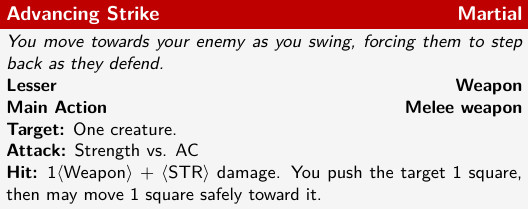
    Firstly, moving enemies around: this is something Ragnvald might need to do repeatedly in order to push forward or keep enemies back. Let’s make sure it’s a lesser power, so that it costs no resources. Advancing Strike fits the bill: this lets Ragnvald push an enemy 1 square and then move safely towards it to close the gap. (I’ll talk about safe movement in detail in a later post; for the time being it is enough to understand that this lets Ragnvald move back towards the enemy he just pushed without being attacked himself.)

    This is the first attack power I’ve revealed, so I’ll take a moment to dissect it:

    • The power’s range is “Melee weapon,” meaning it is based off of the weapon Ragnvald uses to make the attack. For most weapons, this is 1 square; for polearms, it is 2 squares.
    • The power targets one creature.
    • The power’s attack being Strength vs. AC means that Ragnvald will make a core roll adding his Strength and (because this power has the Weapon keyword) the precision of his weapon. If the total is at least equal to the target’s AC, the attack will hit.
    • The “1<Weapon> + <STR>” notation indicates that, if the attack hits, it will deal damage based on Ragnvald’s weapon, plus his STR. The rest of this line describes how Ragnvald pushed his foe back and can follow it…again, if he hits. None of these things happen if the attack misses.

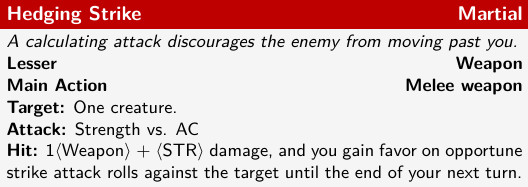
    Next, keeping enemies from moving around him. While the Battlefield Superiority class feature goes some ways towards this, let’s lean into it and try to make Ragnvald even “stickier.” Hedging Strike (right) will synergize nicely. This will make Ragnvald’s opportune strikes even more accurate, beyond even the bonus he gets from the Battlefield Superiority class feature. If he hits an enemy with Hedging Strike, that enemy will face a very accurate opportune strike if it then moves.

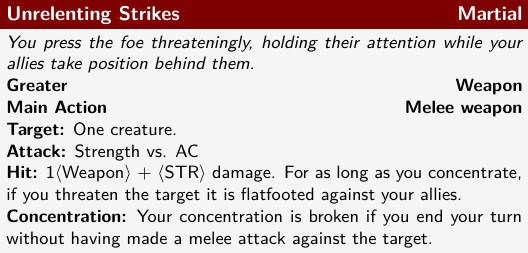
    Ragnvald is going to have plenty of armor resistance with heavy armor. If he needs to place an enemy at a disadvantage, it’s probably because he’s dealing with one big enemy who can punch through it, not a bunch of small ones. Unrelenting Strikes (left) is a greater power that Ragnvald can use to make an enemy flatfooted against his adventuring allies.

    This flatfootedness applies only if Ragnvald threatens his foe (is in melee range and not staggered/dazed/etc.), and only as long as he keeps making melee attacks against it. However, he can first use Unrelenting Strikes against an enemy, and then (if he hits) use Hedging Strike on subsequent turns: this keeps his enemy flatfooted, and makes it much harder for the enemy to get away, because Ragnvald will have favor on opportune strikes against it.

    This is the first power I’ve shown that uses concentration: a character can concentrate on one effect at once, which might be a series of weapon attacks like this, or a magical spell. Concentration can be broken by taking a significant amount of damage, by conditions such as being stunned, or by power-specific requirements like in this case.

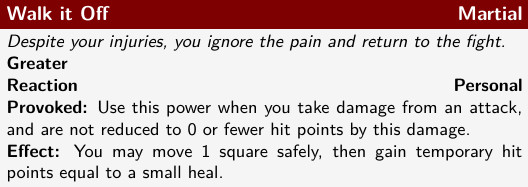
    Finally, keeping himself alive. Ragnvald can get a lot of healing from his second wind, thanks to his Dwarven Stubbornness ancestry feature. What he really needs, in a tight spot, is something that will keep him alive until he gets a chance to use it on his turn. Walk it Off (right) will give him some temporary hit points if he takes damage from an attack and is worried about surviving until his turn.

    This is a reaction power, and as all reactions, is Provoked by a specific event. In this case, Ragnvald can use this power when he is damaged but not downed by an attack, and can then safely move a short distance and gain temporary hit points equal to a small heal (which is generally equal to one healing die, in Ragnvald’s case a d12). This can get Ragnvald out of a sticky position and also give him a few temporary hit points to make up for the damage he took.

    Feat

    Feats are passive traits that alter other aspects of a character: they may increase defenses, grant bonuses to certain damage, cause extra effects to occur when attacking or using powers, or improve class or ancestry features, among many other possible benefits.

    Like virtually all characters, Ragnvald gets one feat at level 0. Here are several options that would improve various aspects of Ragnvald:

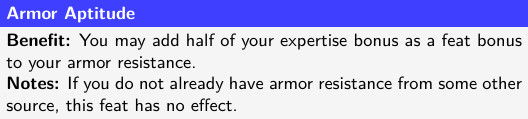
    Armor Aptitude will give Ragnvald a +1 bonus to armor resistance (scaling at higher levels!), which would be especially good against low-damage attacks like those made by groups of weak enemies. It would be less useful against single, powerful attacks.

    Dwarven Second Wind will give Ragnvald a second use of his second wind, and by extension a third use of Dwarven Stubbornness. Of course, using his second wind takes a main action that he would normally use to attack, so he will only get full use of it if he needs healing badly.

    Improved Battlefield Challenge will let Ragnvald make multiple Battlefield Challenge attacks per round, where he could normally only make one. But, it will require that he forgo using his reaction, which he could normally use for Walk it Off.

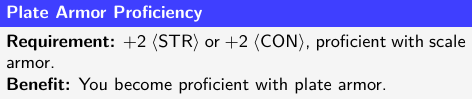
    Plate Armor Proficiency will let Ragnvald wear plate armors without the (sizeable) penalties of doing so without proficiency. If he can afford the cost of plate armor, this could net him an additional +1 AC and +1 armor resistance over the armors he is currently proficient with. However, it would not scale at higher levels like Armor Aptitude.

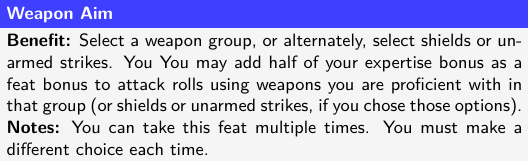
    Weapon Aim would give Ragnvald a +1 feat bonus to his attacks with one weapon group (axes, heavy blades like longswords, hammers, etc.). Ragnvald would apply this feat to whatever kind of melee weapon he decides to equip himself with. This could compensate for using an imprecise weapon like a warhammer, and would also scale at higher levels.

    Since I need to pick just one, I’m going with Dwarven Second Wind for its added durability (and thematicness!), but the other options here will remain useful options as Ragnvald levels up and picks out more feats.

    Starting Equipment

    Ragnvald now has 100gp to buy equipment, which is standard for a level-0 Aetrimonde character. There are a few must-buy items that Ragnvald should pick out first: armor, a shield, and a one-handed melee weapon.

    Armor and Shield

    Armor adds to a character’s AC and armor resistance. It comes in several varieties and can be grouped into light, medium, and heavy armor. When wearing light armor, a character can add the greater of their DEX or GRA to their AC as well as the bonus from the armor. When wearing medium armor, they can instead add the lesser of those abilities, and when wearing heavy armor they can add neither.

    Strengths and Weaknesses of Armor Groups

    The three armor groups are good for different things: light armor can give a character higher AC (easily 17 before feat and item bonuses, less easily 18) at a relatively low cost in ability points, but offers little to no AR. Medium armor can give similarly high AC and better AR, but it either requires more investment of ability points, or reduces the character’s ability to move. Heavy armor doesn’t allow for quite as high AC unless a character is proficient with plate, the heaviest type of armor, and definitely reduces a character’s ability to move, but offers some of the best AR and requires no ability points at all.

    Ragnvald has poor DEX and GRA. He will want heavy armor, and he is proficient with scale armors, of which there are two medium and one heavy type:

    ArmorACAREncumbranceSave MoveSpeedValueBulk
    Brigandine (Medium)32-220gp10
    Lamellar Armor (Medium)42-2-125gp15
    Scaled Hauberk (Heavy)52-2-1-130gp20

    The heaviest scale armor is a scaled hauberk, which offers +5 AC and 2 AR, but will slow and encumber Ragnvald…or would, if he wasn’t a dwarf. Since Ragnvald can ignore the speed and encumbrance penalties (though not the safe movement penalty) of scale armor, that’s what he will wear.

    Shields are easy: a shield is a shield. Ragnvald will buy one for the added +1 AC. Together, the armor and shield cost 35gp.

    Weapons

    Ragnvald wants a weapon he can wield with his shield, meaning a one-handed weapon. There are two properly dwarfish weapons like this: the warhammer and the light pick. Here they are, presented alongside a longsword for comparison:

    WeaponPrecisionDamageValueBulkProperties
    Light Pick+21d6r210gp2Critical Potential
    Longsword+21d810gp2Solid
    Warhammer+12d4r210gp2Solid

    The warhammer has only +1 precision, but will reliably deliver an average of 6 damage: the 2d4r1 notation means to roll 2d4, rerolling any 1s. Not only does this have central tendency, making low rolls unlikely, it will never roll less than 4. Most hammers have similar traits. It can also be wielded in both hands due to the Solid property, changing its damage to 2d4r2 (rerolling 2s as well as 1s) and increasing its average damage to 7.

    The light pick instead has +2 precision, but deals 1d6r2 damage, averaging only 4.5 damage. However, it has the Critical Potential quality, meaning that on a critical hit it will deal an extra 1d6r2 damage (beyond what critical hits normally do, which is a matter for another post). Again, this is typical of picks.

    By comparison, the longsword has the same precision and average damage as the light pick, but its damage is less consistent, ranging from 1-8 instead of 3-6. Also, instead of Critical Potential, it has Solid like the warhammer, and could be wielded in both hands to make its damage 1d8r2.

    Ragnvald will take the warhammer, and will loudly extol its superiority over the “plebeian” pick. That costs him another 10gp.

    Ragnvald will also want some kind of ranged weapon for emergencies. While he could take a crossbow or an untraditional firearm, he lacks the DEX to really be any good with them. Instead, he will pick up a hurled weapon.

    Unlike thrown weapons, which base their attack and damage rolls on DEX, hurled weapons use STR, which Ragnvald has in spades. His options are the javelin or the throwing axe.

    WeaponPrecisionDamageRangeValueBulkProperties
    Javelin+11d65/102gp1Hurled
    Throwing Axe+11d65/105gp1Hurled

    The axe is not precisely a dwarfish weapon, being more associated with orcs, but it’s better than a wimpy little twig of a spear (an elven weapon if ever Ragnvald saw one) even if it costs more. Ragnvald will take two, for another 10gp.

    Other Useful Equipment

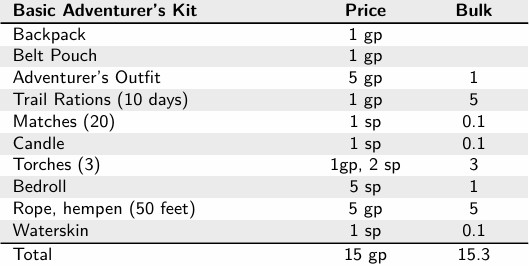
    With 45gp unspent, Ragnvald can afford some extras. For starters, he’ll pick up a Basic Adventurer’s Kit (left) costing 15gp. This contains all the basics for an adventurer: a backpack and belt pouch for carrying things; durable clothing; food and a waterskin; light sources; a bedroll for camping; and the ever-useful coil of rope.

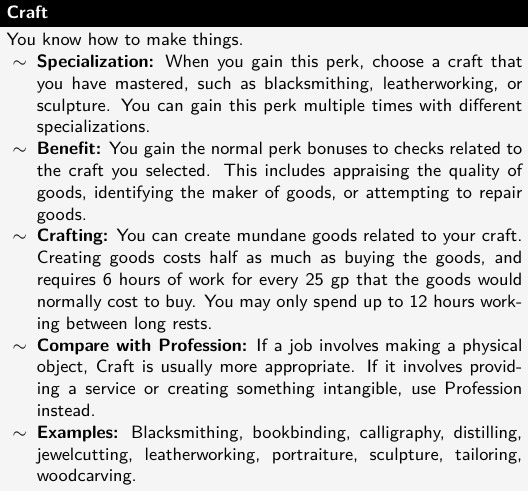
    And, with almost the last of his gold, Ragnvald will buy a tinker’s kit and a stopwatch, playing into his secret fascination with clockwork. Each would normally cost 10gp, but because of his Craft perk, Ragnvald will actually have built the watch from parts at a cost of just 5gp.

    Ragnvald is now well outfitted, and even has 15gp left over for incidentals on his first adventure!

    Up Next

    This was the last of the posts making choices for Ragnvald. The next post will be math-heavy, as we compute things like hit points, defenses, and attack and damage bonuses for Ragnvald’s weapons and powers.

  • As I’ve just gone over how skills work, I thought today would be a good opportunity to cover some of the design decisions that went into skill and ability checks.

    Typical Skill and Ability Checks

    Unlike attacks, where I have benchmarked things so that a typical character will have +4 in the ability they use for most attacks, a character can have a lot of variation in their skill and ability checks:

    • Their abilities can range from -2 to +5.
    • They may or may not be trained in the skill.
    • They also may or may not have a relevant perk in any situation.

    I’m going to define a typical ability or skill check as:

    • Having +3 (the midpoint of the positive ability modifiers, +1 to +5) in the relevant ability,
    • Either being trained or having a relevant perk, but not both. (Granting +2 from expertise at level 0.)
    • Not being impeded by encumbrance.

    This will give a +5 bonus in a skill at level 0.

    Deviations from the Norm

    However, this leaves a lot of room for variation: a character with +5 in a relevant ability, or both training and a perk, or that has specialized in a skill, will be significantly better than is typical. This could give a bonus as high as +10 with favor at the high end, although+7 or +5 with favor is probably more usual.

    It’s also possible to be significantly worse than is typical, such as by just having a bad ability or lacking training or perks, or being encumbered by armor. This could give bonuses as low as -5, although +2 is probably more usual.

    I’m okay with both of these departures from the “typical.” Skills aren’t like attacks, where I want all characters to have broadly similar chances of success when attacking in their preferred method. What I want to accomplish with skills is that all characters have broadly similar chances of success with skills that they are decent at, while retaining variation between characters in the same skill.

    That is to say, I want a wizard to be roughly as good at Arcana and Intelligence checks as a rogue is at Subterfuge and Dexterity checks. But I don’t need the wizard to be just as good as the rogue at Subterfuge, and in fact I think it’s better for the game if the rogue is better at Subterfuge than other characters.

    Why is this, you ask? When making attacks, characters must succeed on their own merits, and so need to have attack bonuses in a tight range. With skills, it is generally the case that the party succeeds based on the merits of whichever of them is best. (Exceptions exist, like with Deception and Stealth, where one character doing poorly can screw things up for everyone.)

    In other words, a typical party should contain a character who is typical (if perhaps not excellent) in most skills. +3 ability, with training or a perk, seems to me to be a pretty good definition of typical here, making it possible for a character to be typical, or close to it, in a wider range of skills.

    Typical Difficulties

    To achieve the targeted 2/3 odds of success, I would like the typical Difficulty to be about 5 points higher than the typical skill or ability check bonus. That means it should be 15, which is a conveniently round number. But, there should also be unusually easy Difficulties, where even below-average characters can have decent odds of success, and unusually hard Difficulties, where even a decently skilled character may struggle.

    I’m going to set Difficulties based on this idea of 15 being typical, with deviations of ±2 being fairly common, and ±5 being more significant. Which is to say, most Difficulties should be between 10 and 20.

    Extreme Difficulties

    I’m not a fan of the style of GMing that requires a skill check to not choke on your food. Nor do I recommend setting skill checks that are so high as to be virtually impossible for characters to make (especially if they gate off the party’s path forward…).

    About the lowest Difficulty that is worth using is 5: this is just high enough that a character bad at the check has a noticeable chance of failing, and I would not bother slowing down play to make a character who is actually good at the check roll.

    There is more room for extremely high Difficulties: for instance, I include locks with Difficulty 25 in the list of purchasable equipment. That is a high enough Difficulty that only a very skilled character would have a decent chance to open it in a single attempt, but a decently- skilled character could get it if they work at it long enough. Again, I would try to avoid slowing down play by making a character roll unless there are consequences to failure (like setting off a trap or somehow breaking their tools): instead, if they have ample time and at least +5 Subterfuge, I would simply let them open it after working on it during a rest.

    Example Difficulties

    To give some examples of difficulties fitting into this paradigm, I shall present some examples from the Athletics, Perception, and Society skills:

    DifficultyAthleticsPerceptionSociety
    10Climb a rough stone wall.Hear shouting through a wall.Find one resident in a small village.
    13Climb a worked stone wall, with the aid of a rope.…And from 6 meters away.Find one resident in a welcoming mid-sized town.
    15Climb a worked stone wall.Eavesdrop on a nearby conversation.Find a good tavern in a large metropolis.
    17Hold position on a worked stone wall using one hand.Spot one person in a crowd at 70 meters.Locate an assassin-for-hire hiding in his tiny, close-knit hometown.
    20Climb in a narrow space between two slabs of glass.Spot one person in an identifally-dressed crowd.Find one resident in a large metropolis.
  • Today’s post will cover the skills, perk, and languages of Etterjarl Ragnvald, the dwarf fighter I’ve been building.

    Skills

    Aetrimonde’s skills are things that adventurers commonly need to do, and can be trained in. Things that require raw talent, like lifting a heavy object, aren’t skills, they just use a character’s abilities. Nor are a lot of uncommon things that not every adventurer would find a use for (these are covered by perks, so read on…).

    When a skill comes into play, the GM will call for a skill check: this means to make a core roll and add your modifier in the relevant skill. This modifier is a relevant ability (each skill specifies one) plus an additional bonus if you are trained in the skill, and at higher levels potentially some other bonuses. I will save calculating this for a later post in which I do all of the math, though.

    Preferred Skills

    As we saw in the previous post in this series, a character’s culture, stratum, and class give them certain preferred skills. There are 18 skills in total; a character is automatically trained in one skill determined by their class, chooses four others from their preferred skill list, and can then choose one final skill that can be any of the 18.

    The 18 Skills
    Acrobatics (GRA)History (INT)Persuasion (CHA)
    Arcana (INT)Insight (WIS)Religion (INT)
    Athletics (STR)Intimidate (CHA)Society (INT)
    Deception (CHA)Medicine (INT)Stealth (GRA)
    Endurance (CON)Nature (INT)Subterfuge (DEX)
    Engineering (INT)Perception (CUN)Warfare (INT)

    Ragnvald’s preferred skills list includes:

    • Endurance and History, from the Dwarven Federation culture.
    • History and Society, from the Aristocrat stratum.
    • Athletics, Endurance, Intimidate, Medicine, Perception, and Warfare, from the Fighter class.

    There are overlaps here! Ragnvald gets History and Endurance from two different sources; this does nothing special, although there is a feat (more on this in the next post) that would benefit this kind of doubling up.

    Ragnvald is automatically trained in Athletics, per the Fighter class. He will also be trained in Endurance, History, Perception, and Society, from his preferred skill list. And for his final trained skill, he will choose Persuasion.

    For the most part, I’m going to leave the math of character creation for a later post, but I will calculate skill bonuses here. A skill bonus is equal to the relevant ability, plus a character’s expertise bonus if they are trained in the skill. For skills based on physical abilities (Strength, Constitution, Dexterity, or Grace), a character may incur an encumbrance penalty from wearing armor or carrying heavy loads. Ragnvald will be wearing heavy armor, but thanks to being a dwarf can ignore encumbrance.

    This is the first time I’ve mentioned the expertise bonus, which is the sole factor in how characters scale with level. A character’s expertise bonus starts at +2 at level 0, and increases by a further +1 for every 5 levels they have. Aside from skills, the expertise bonus is always used to calculate defenses and hit points, and characters can apply it to attack and damage rolls in areas they specialize in.

    So, at level 0, with his +2 expertise bonus, Ragnvald will have the following bonuses in his trained skills:

    • Athletics (Strength): +6
    • Endurance (Constitution): +5
    • History (Intelligence): +1
    • Perception (Cunning): +3
    • Persuasion (Charisma): +3
    • Society (Intelligence): +1

    In all of his other skills, Ragnvald’s skill bonus will just be his ability bonus.

    Perk

    A perk, in Aetrimonde, is a more narrow area of specialization than a skill, and one that often doesn’t have the detailed rules that skills do, with predefined things it can be used for and Difficulties for the various tasks. Although some perks have rules, you can also choose to define your own, like “Frequent Traveler” or “Cosmopolitan Upbringing.”

    Aside from any specific rules, a perk allows you to add your expertise bonus when making any ability check or skill check that you aren’t trained in, or gain favor on any that you are trained in, if you can convince the GM that the perk is related to the task at hand.

    Many of Ragnvald’s skills are chosen to reflect his background as a lawyer in training and his clan’s deep fixation on their glorious past. Rather than double down on this, let’s give him an unrelated perk that broadens his character. In fact, let’s use the perk to give him a dark secret foreshadowing some eventual character development: despite his outwardly traditional appearance, Ragnvald is fascinated with sophisticated clockwork (decidedly not a traditional dwarfish craft) and has started tinkering with it in private. This will be represented by the Craft [Clockwork] perk. (See general rules for Craft perks, left)

    This will allow Ragnvald to construct clockwork devices like stopwatches cheaper than he could buy them. He can also apply the perk to, for example, Engineering checks made to repair a clockwork device, or History checks about the development of clockwork through the years.

    Languages

    The last things I’ll cover in this post are the languages Ragnvald knows.

    Every PC in an Aetrimonde campaign is assumed to speak one language in common. The Aetrimonde setting recommends that this be Westerling, the language of the Kingdom of Waystone and of diplomacy, commerce, and academia across the continent, but the GM can adjust that for campaigns in a different region.

    Aside from the common language, characters speak another language determined by their culture. In the case of Ragnvald, hailing from the Dwarven Federation, that language is Low Dwarven, which is used in Dwarven culture for matters of everyday importance. (As opposed to High Dwarven, which is spoken for matters of law and ceremony, and which Ragnvald didn’t get to before he had to leave law school.) Because he is trained in History and it is classed as an archaic language, Ragnvald could eventually learn High Dwarven; this is one thing perks can be used for, and he will eventually get more perks.

    Languages of Aetrimonde

    Languages in the Aetrimonde setting include:

    • Mundane languages, which are spoken in everyday life in various parts of the setting. Any character can learn these languages using a perk.
      • Examples: Gobol, Liturgical Auric, Low Dwarven, Modern Auric, Modern Elvish, Urkund, Victish, Westerling.
    • Archaic languages, which are older forms of modern languages, or simply went extinct. A character trained in History can learn these with a perk.
      • Examples: Ancient Elvish, Classical Auric, Gobol Eld, High Dwarven.
    • Magical languages, which are spoken in the other planes connected to Aetrimonde, or otherwise associated with magic or magical creatures.
      • Examples: Draconic, Demonic, Gravespeech, Sidhereal.

    Up Next

    The next post in this series will cover the last set of choices Ragnvald needs to make: powers, a feat, and some starting equipment. There won’t be any more character-building polls until I start building the character you requested, because I will need to show off some mechanics first. Once I do, though, the polls will start up again giving you a chance to weigh in on what this character should specialize in. And the ancestry and class polls remain open! If you haven’t voted yet, now’s your chance.

  • In the post series on Unified Mechanics (first post here), I described in general terms how some core mechanics would work, but I didn’t attach all the necessary numbers to them. In this series, I’ll start hanging numbers on that framework to achieve a benchmark I mentioned in an earlier post: that a character should succeed at tasks they are competent but not superb at, around 2/3 of the time.

    To start with, I will need to work out what a typical character’s abilities should look like, because those abilities will feed into everything else that I need to calibrate.

    Ability Generation In Detail

    I’ve already said that I intend Aetrimonde to run on a point-buy system for generating a characters’ abilities. That is, players will all “buy” their characters’ abilities with the same budget of points.

    However, there is also a second component to ability generation, which is that a character’s heritage allows the player to increase two (of up to 3) preferred abilities by a further +1.

    This post will walk through the calibration of both components.

    Defining Ability Scores

    To start, what range of values do we permit for abilities? And how do they map to real-world qualities, for comparison?

    As an intuitive first step, let’s define 0 to be an “average” ability.

    How many “steps” above average do we want to allow (at least for PCs)? Let’s say, for the sake of argument, that each +1 represents a single standard deviation from the mean in an ability. Assuming a normal distribution of abilities, that lets us work out, statistically, just how extraordinary having a particular score is.

    Unfortunately, it means that by the time you hit +3 in an ability, you are already around one in a thousand; +5 would put you at about one in ten million. That’s quite rarefied: Aetrimonde is aimed at supporting a pseudo-Victorian setting, with a world population of about 1.5 billion, so there would only be around 150 people with +5 in a given ability in such a world. I’d like there to be more than 3 increments between an average person in the street and someone who is probably stronger than anyone else they’ll ever meet.

    Let’s halve how much a +1 means, to only half a standard deviation. Then, ability scores would imply the following:

    • +1: You are in the top third of the population.
    • +2: Top sixth.
    • +3: Top 1/16th.
    • +4: You are one in 40.
    • +5: One in 160.
    • +6: One in 800.

    Point-Buy Costs

    I’m going to impose that a typical PC’s highest ability should be between +3 and +5, with +6 being out of reach for a PC. I’ll also impose the following goals on the array of abilities they can get:

    • After the boosts from heritage, PCs should be able to get abilities of +4, +3, +2, +1, and four +0s.
    • It should be possible to get two +4 abilities, after boosts, but this should mean you have basically no other positive abilities unless you also have some negatives.
    • It should be possible to get a single +5 ability after boosts, but not also any +4s unless you have several negative abilities.

    I think this can be accomplished using a quadratic cost function for positive scores, such that the cost of each successive ability increment gets larger and larger:

    AbilityPoint Cost
    -2-2
    -1-1
    +00
    +11
    +23
    +36
    +410

    These point costs (for the positive abilities) are given by the formula C(a) = a(a + 1) / 2.

    Assuming that a character gets their +4 and +3 by boosting a +3 and a +2, for maximum benefit, they need to buy a +3, +2, +2, and +1. This costs 6, 3, 3, and 1 points for a total of 13: an unlucky number, but also a magical one.

    What else could be bought with 13 points?

    • It’s enough for +3, +3, +1, which boosted becomes +4, +4, +1, and five +0s.
    • It’s also enough for +4, +2, which boosted becomes +5, +3, and six +0s.

    This looks like it will work: it’s possible to get several good abilities, or a pair of excellent ones, without any abilities going negative.

    Limits of Min-maxing

    Min-maxing means to maximize the strengths of a character and minimize its weaknesses: it’s a form of character optimization. In the context of ability generation, min-maxing means raising the abilities your character benefits most from, without creating glaring weaknesses. In practice, that means decreasing abilities that you don’t need so that you can spend more points on the ones you do.

    Most Aetrimonde characters will have two abilities they care most about, followed by a third of less importance. They will want to raise these as high as possible, but they will also want to avoid having too many negative abilities, which would severely impact their defenses. Assuming a character puts their four best abilities into separate defense pairings (so that they have one of their better abilities contributing to each defense), they won’t have any glaringly weak defenses. But as we saw with Ragnvald, who needed high Strength and Constitution, that’s not always going to work out. The negative abilities will create a lot of other weaknesses too:

    • Low Strength will mean a character can’t carry much, will have trouble defending themselves in melee, and will have trouble climbing, jumping gaps, or swimming.
    • Low Constitution will give a character low hit points and resurgences.
    • Low Dexterity is probably the least problematic, as it really only prevents a character from using ranged weapons effectively or engaging in subterfuge like picking pockets.
    • Low Grace will give a character trouble crossing slippery surfaces or remaining hidden, and will make it hard for them to maneuver around enemies.
    • Low Intelligence will make a character bad at a whole range of skills.
    • Low Cunning will ensure a character always acts last and is often surprised.
    • Low Wisdom and Charisma will make it hard for a character to engage in social skills.

    So what does it take to get +5 and +4? The +5 needs to be boosted from a +4, and if the +4 is boosted from a +3, that costs 16 points. So the character would need to have three -1s, or a -1 and -2. If they wanted more than those two positive abilities, they would have to go even more negative, as well. One workable array is +4, +3, +1, +1, -1, -1, -1, -2, which certainly has plenty of drawbacks.

    What about +5 and +5? The only way to get that is from two boosted +4s, which would take 20 points, requiring at least three -2s and a -1. As far as defenses go, the best array is probably +4, +4, +1, +0, -2, -2, -2, -2, which has major drawbacks in half of the abilities.

    In other words, it’s possible to get a pair of very high abilities, but at the cost of some crippling weaknesses. Is this a good basis for a character? Only if the party as a whole can compensate for the weaknesses.

    Suggested Arrays

    Here are some possible arrays of eight abilities (before boosting) that are well-rounded:

    +3, +2, +2, +1, +1, +0, +0, -1
    +3, +3, +1, +1, +0, +0, +0, -1
    +4, +2, +1, +1, +0, +0, -1, -1

    I’m also going to include a note in the core rulebook suggesting that, at least for inexperienced groups, characters should not have any more than a single -1 ability, and no -2s.

  • Today, I’ll reveal the next part of a character: class. Ragnvald has been a Fighter in all his incarnations, so that’s the class I’ll show off today.

    Meanwhile, the polls continue! This week, tell me what class you want to see next: I’m leaving open last week’s poll on the next ancestry I’ll cover, but as of my last look, Elf and Ghoul were in the lead. If you haven’t already voted there, now’s the time: I’m interested to see what kind of ancestry/class combination you give me to work with for the next example character!

    Class

    An Aetrimonde character class is a collection of related features that gives a character the tools to fill a certain role: frontline combatant, deadly assassin, magical savant, pious healer, and so on. This is the core of a character, especially at low levels.

    Class: Fighter

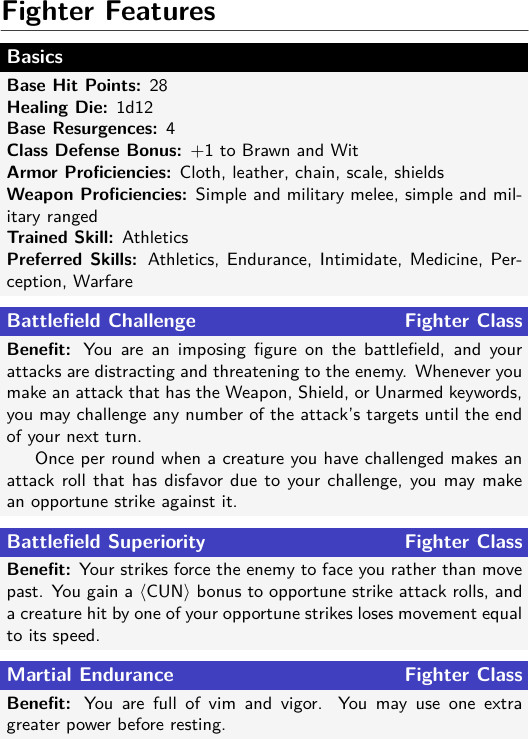
    Although he was raised to be a lawyer, now that he’s been forced to get his hands dirty adventuring Ragnvald comports himself in the manner of a traditional Dwarven warrior: that means wearing proper armor, carrying a proper weapon, and facing his enemies in proper honorable combat. This is best represented by the Fighter class (left).

    Basics

    First off, Fighters are tough. With 28 base hit points, 1d12 healing die, and 4 base resurgences, they can not only take a beating, but recover from one too. This is only amplified by their armor proficiencies, which give them access to scale armor and shields: this can let Ragnvald get a high AC (with good armor resistance!) despite his lack of Dexterity and Grace.

    The Fighter’s class defense bonus is +1 to both Brawn and Wit, making them harder to shove around, and also harder to trick or deceive.

    Fighters are proficient with all weapons, although fighters will get the most mileage out of melee weapons, since they want to be in the thick of things.

    And finally, Fighters are trained in Athletics and can add that and five other skills to their preferred skill list. More on this in the next post…

    Features

    Next up, the actual class features. The big ones are Battlefield Challenge and Battlefield Superiority: together, these two features mean that Ragnvald can:

    • Challenge any enemy he attacks (not hits, attacks!) with weapons, shields, or fists, causing them to suffer disfavor on attack rolls unless they are attacking Ragnvald or have already attacked him this turn.
    • Make an opportune strike against a challenged creature when it attacks someone other than him.
    • Gain a bonus to opportune strike attack rolls, including for attacks like the one described above.
    • Stop creatures hit by his opportune strikes from moving any further.

    All told, this makes Ragnvald (like any Fighter) incredibly “sticky:” creatures he attacks will have trouble attacking any of his allies or getting away from him.

    The other of the Fighter’s class features is Martial Endurance, giving him an additional use of his greater powers (for four total). While not flashy, getting an extra greater power in a fight can make a big difference. All Martial classes have this feature.

    Abilities

    The last thing we’ll pick today will be Ragnvald’s abilities. As we saw in the Heritage section, Ragnvald’s heritage gives him Constitution, Wisdom, and Charisma as favored abilities. This means he can boost two of those by +1 after buying his abilities, or boost any one other ability. Let’s keep that in mind as we make our choices…

    As a fighter, Ragnvald will want high Strength (to make attacks with), followed by high Constitution (to survive the attacks he will hopefully be drawing). Cunning will also be useful (to improve Battlefield Superiority and many Martial powers) but not as high a priority.

    Like any character, Ragnvald has 13 points to spend on abilities, with costs given in the table to the right:

    We really should go for +4 Strength. +3 would be doable if Ragnvald used precise weapons to make up for it…but as a proper dwarf warrior, Ragnvald will be wanting something like a warhammer. Since Strength isn’t a preferred ability, we’ll need to buy the full +4, at 10 points.

    Next, we want Constitution: we can get +2 with our remaining 3 points, and boost it to +3 as a preferred ability.

    AbilityPoint Cost
    -2-2
    -1-1
    00
    11
    23
    36
    410

    We have no points left, but we should try to get some other abilities above 0. Ragnvald doesn’t particularly need Dexterity or Grace, since he’ll be wearing heavy armor; we can drop one to -1 and raise the other to +1. I’ll pick Grace as the high ability, attributing it to comportment lessons his clan subjected him to. The same goes for Cunning and Intelligence, where we’ll raise Cunning and drop Intelligence (Ragnvald is full of clever legal strategies that don’t work, because he doesn’t actually know the law that well), and Wisdom and Charisma, where we’ll raise Charisma and drop Wisdom, then boost Charisma to +2 (Ragnvald lacks the wisdom to see the futility of his family’s litigation, but is fairly convincing when he talks about it).

    The finalized ability array for Ragnvald is:

    +4 STR-1 DEX+1 CUN-1 WIS
    +3 CON+1 GRA-1 INT+2 CHA

    Up Next

    In the next post of this series, we’ll give Ragnvald some things he can use these abilities for. And if you want to see a specific class in the next sample character, remember to vote above!

  • In the interest of giving the poll from my previous post time to gather responses, I’m going to insert a post on a different topic today. This will be the first in a series of posts about the history, geography, and nations of Aetrimonde, the titular default setting of the game.

    A Brief History of Aetrimonde

    Aetrimonde has around 5000 years of recorded history. Its historians divide their past into five eras:

    • The Age of Myth (??? to c. 5000 AAC1) predates written history. The few legends from this time that survived to be written down speak of terrible, recurring cataclysms that plagued ancient mortals until the gods, through their divine messengers, tamed the land and made it safe.
    • The Age of Glories (c. 5000 AAC – c. 1200 AAC) saw the development of writing, agriculture, and Aetrimonde’s first cities. These cities grew and merged (and were conquered), forming the great empires of their time:
      • Caras Seidharen, the sorcerous empire of the elves.
      • Gjalerbron, a dwarven empire of unparalleled craftspeople.
      • Arcis Aurum, a human empire of vast cities and great palaces and temples.
      • Gobol Karn, a sprawling empire populated by goblins and their chattel slaves, and unique in that it collapsed of its own accord before the end of the Age of Glories.
    • The Collapse (c. 1200 AAC – c. 1100 AAC) saw a terrible war break out between Arcis Aurum and Caras Seidharen. After decades of fighting, as both sides approached exhaustion and considered making peace, they were beset by a great orc horde that marched out of the east without warning. Both empires were overrun in a matter of years, and the dwarves, who had remained neutral for the entire war, were only able to defeat the horde in a pyrrhic victory that resulted in the death of their high king, the destruction of their capital, and the shattering of the horde into hundreds of feuding bands.
    • The Interregnum (c. 1100 AAC – 126 AAC), during which survivors of the Collapse built new societies largely intended to avoid the mistakes of the Collapse. Poets and armchair historians lament the Collapse as the end of a golden age, but the truth of the matter is that the empires of the Age of Glories were stagnant, stratified, and oppressive, with Gobol Karn merely the worst of a bad lot. Their successor states, faced with the challenges of rebuilding from the near-total collapse of civilization, were forced to be innovative and (comparatively) egalitarian.
      • The Interregnum is sometimes divided into two parts. The early Interregnum was concerned largely with rebuilding the infrastructure and recovering or rediscovering the knowledge lost in the Collapse. By contrast, the late Interregnum saw the new nations begin to surpass the magic and technology of the old empires, thanks variously to the invention of the gnostic method, the spread of mortalistic philosophy, and increased population density allowing for centers of learning and scholarship.
      • It is generally agreed that the Interregnum truly ended 126 years ago, with the invention of the thaumic turbine allowing for the kinetic energy generated by a water wheel or steam engine to be transformed into magical energies of the sort traditionally wielded by arcanists. While hugely inefficient, the thaumic turbine greatly increased the availability of magic, leading to…
    • The Age of Steam (126 AAC – 17 APC2). The sudden abundance of magical energies on an industrial scale led first to the development of weapons and a series of continent-wide wars beginning in 92 AAC and culminating in a brief exchange of magical super-weapons 17 years ago. This exchange, miraculously,3 shocked the belligerents into accepting a cease-fire, which became a truce, and was formalized in the peace treaties now known as the Concilium Accords.

    The Present Day

    The seven initial signatories of the Accords are now considered to be the great polities of Aetrimonde:

    • Caras Elvaren, the magical realm of the “high elves,” where the poorest citizen lives in relative luxury off of the labor of the state’s golem labor force.
    • The Dwarven Federation, a loose association of dwarven clans dedicated to the recovery and preservation of their ancient knowledge and culture.
    • The Novan Imperium, a technologically advanced successor state to old Arcis Aurum. Nominally ruled by an emperor but in fact administered by a vast (but meritocratic) bureaucracy.
    • The Sanctean Primarchy, a theocracy dedicated to the worship of the god of law and civilization, and the second rival successor state to Arcis Aurum.
    • Tir Coetir, the isolationist realm of the elves who forswore arcane magic and retreated into the deep woods.
    • Victovy, an impoverished nation torn between its tradition of military conquest and its rulers’ desire to modernize and prosper.
    • Waystone, a mercantile kingdom with outsized economic clout, extensive diplomatic ties to Aetrimonde’s smaller polities, and a truly impressive espionage network.

    There have been no wars in Aetrimonde for the last 17 years. Thus far, despite grievances on all sides, the Concilium Accords appear to be holding. This is not to say that the world is entirely peaceful: the smaller polities rattle their sabers at each other, the great powers sabotage and spy on each other, and there are extremists unsatisfied with how the war ended that have committed atrocities in the name of their causes. Nonetheless, the great powers remain uninterested in having another near-world-ending war break out.

    The peace has proven to be profitable for adventurers: during the wars, “minor” problems like organized crime, mad scientists, illicit cults, and monsters up to and including dragons were considered a low priority, and there is now quite a backlog of work for people willing to employ swords and spells in dangerous situations for ample pay–if they’re not already being paid to advance the agendas of some faction plotting in the shadow of the wars.

    This is the world an Aetrimonde character is stepping into: shaken by terrible wars, cautiously hopeful for peace, and full of opportunity for people willing to brave danger in the name of justice, ideology, or just plain greed.


    1. Anno Ante Concilium, or Year Before the Concilium. ↩︎
    2. Anno Post Concilium, or Year After the Concilium. ↩︎
    3. The sheer unlikeliness that this event did not escalate into a full-fledged doomsday scenario cannot be overstated. At this point, the wars had been steadily escalating for years, all of the belligerents had grievances against all of the others, and they were all itching to use their secret weapons. The fact that it didn’t lead to the end of the world is so shocking that major religious groups consider it evidence of divine intervention, and restarted the numbering on their calendars. ↩︎
  • Today kicks off a post series in which I’ll be walking through the creation of an Aetrimonde character to illustrate the components and choices that go into a character. However, this series will alternate with other posts covering topics like the reasoning behind certain mechanical choices, peripheral systems like magical items, alchemy, and ritual magic, and information about Aetrimonde’s default setting.

    But before I get into Etterjarl Ragnvald, he isn’t the last character I’ll be building in this blog, and I’m going to leave the next one up to you readers. Respond to the poll below to pick the ancestry you want to see in the next character build I demonstrate!

    Introducing Etterjarl Ragnvald

    Etterjarl Ragnvald is a character I played myself in one of the few 4e games where I got to be a player rather than a GM, and I’ve since played iterations of him in Pathfinder and 5e. I’ve done a bit of digging in some very old files and managed to dig up how I introduced him to the first group he was a part of:

    Etterjarl Ragnvald is the last scion of an ancient dwarf lineage, now in much-reduced circumstances. He was raised with the expectation that he would become a lawyer and finally settle the question of an inheritance that his family has believed is rightfully theirs for the last five centuries; unfortunately, the interest on the legal fees they incurred in the last round of unsuccessful litigation have [sic] forced him into a change of plans. Ragnvald has turned to adventuring in the hopes that he can forestall his family’s creditors long enough to finish his last decade of dwarfish law school.

    Although he prefers to be addressed formally, in the manner prescribed for a dwarf of his nominal title of Etterjarl (Under-Earl, loosely translated), Ragnvald grudgingly tolerates being called Reggie by those who consider themselves his friends.

    It’s going to be a long post today. We’ll go over the basics for Ragnvald as an Aetrimonde character: his heritage, class, and ability scores.

    Heritage

    D&D has typically conflated ancestry and culture: if you are a dwarf, you speak Dwarfish, you know how to use hammers and picks as weapons, and you know how to use some craftsman’s tools. Per the rules as written, this is the case even for a dwarf who was raised by humans or elves.

    I want to avert this in Aetrimonde: the Victorian Fantasy setting means that there will be more widely available travel than in a typical pseudo-medieval D&D setting, which means there it should accommodate expatriates and immigrants a little more readily.

    So, what D&D has typically split into “race” (boy, is that a term I want to not use…) and “background,” I’m going to split into ancestry, culture, and stratum.

    • Ancestry covers who your parents were, and gives you some biological traits.
    • Culture covers who you grew up around, and determines things like languages you speak.
    • Stratum determines your place in your culture: what you did for a living, what skills you might have, etc.

    Together, these make up your heritage.

    Ancestry: Dwarf

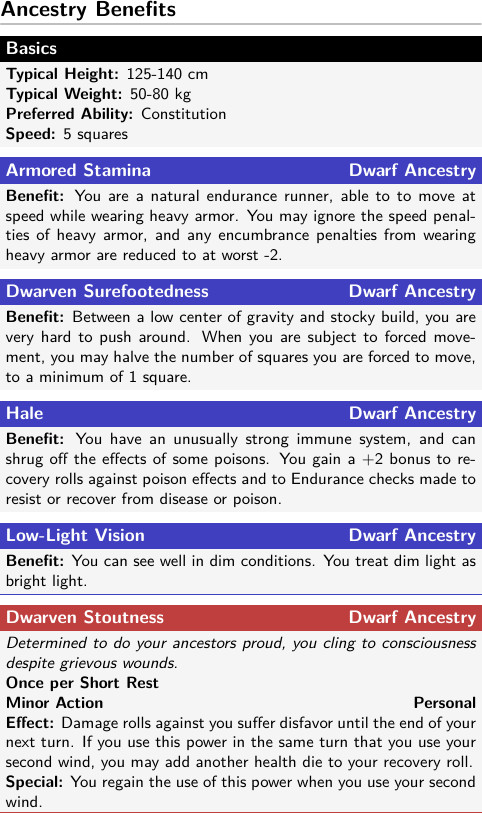
    Ragnvald is, obviously, a dwarf. Aetrimonde dwarves are, for the most part, typical dwarves: short, stout, hairy. Their racial features reflect that:

    Basics

    Typical height and weight are, I think, self-explanatory.

    Preferred abilities allow a character to increase a pair of abilities further than they would normally be able to: all three parts of heritage grant one preferred ability, and a character can choose two of them to increase by +1. As a dwarf, one of Ragnvald’s preferred abilities will be Constitution.

    Speed, of course, determines how far and fast a character can move. In Ragnvald’s case, he can move up to 5 squares during his turn (if he doesn’t dash, sprint, or try to move carefully; I will discuss these details in a later series of posts on combat). 5 squares is slightly below average, on par with a human in heavy armor.

    Armored Stamina

    This makes dwarves better able to handle heavy armor, making up for their low base speed.

    Dwarven Surefootedness

    This makes dwarves much harder to push any great distance, allowing them to hold their ground better.

    Hale

    We haven’t discussed recovery rolls or skills (such as Endurance) yet. Suffice to say, a +2 bonus is significant, and it means that dwarves will shake off poison and disease faster than most other characters, and might not be affected in the first place.

    Low-Light Vision

    This makes dwarves (and other ancestries with low-light vision, because this is not unique to dwarves) able to function better in bad lighting.

    Aetrimonde’s implementation of low-light vision doesn’t make dwarves able to see any farther than humans, but allows them to see more detail in bad lighting. This helps to avoid situations where one character can see something another cannot: in a video game where each player is looking at a separate screen, this is fine, but when all the players are looking at the same map spread out on a table, it can be difficult to pretend that some of their characters can’t see something that the players can.

    Dwarven Stoutness

    This is an active power that dwarves have: since it is the first time I’m showing off a power, I’ll go into what the different parts of it mean:

    • The red header indicates that this is a power Ragnvald can use as an action. Many things in Aetrimonde are color-coded like this: passive features are shades of blue, equipment is yellow, and rules shared by all or most characters are black. “Dwarven Stoutness” is of course the name of the power, and “Dwarf Ancestry” indicates why a character would have this power.
    • The italic text is flavor: it has no mechanical impact, but gives context as to what this power represents.
    • “Once per Short Rest” is the frequency with which the power can be used. Other powers might say here “At-Will,” “Lesser,” or “Greater.”
    • The next line indicates that the power can be used as a minor action (so Ragnvald could use this power and then make an attack or use his second wind), and has a Personal range (affects only him).
    • The Effect is the meat of this power: this is what actually happens when Ragnvald uses it. This power reduces how much damage Ragnvald takes for a round (by imposing disfavor on damage rolls against him) and if coupled with his second wind, lets him get more health back.
    • The Special section explains how this power breaks the normal rules: while it is nominally usable once per short rest, Ragnvald gets it back when using his second wind.

    Culture: Dwarven Federation

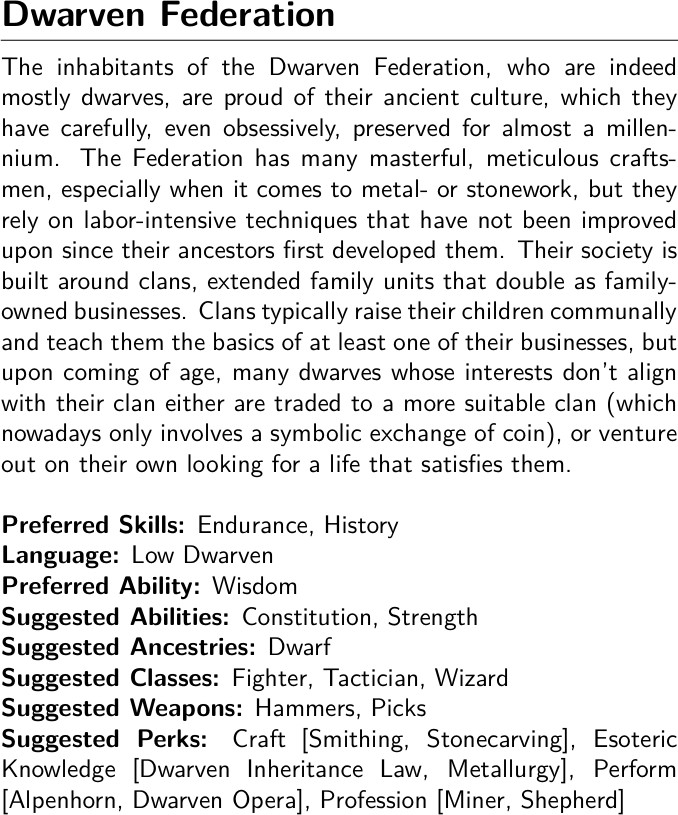
    Ragnvald is a traditional dwarf: stubbornly devoted to honoring his ancestors, insistent in getting what he is due, and distrustful of anything new-fangled. In Aetrimonde, the culture with these attitudes is that of the Dwarven Federation (left).

    Like all cultures, this gives Ragnvald another preferred ability, a preferred skill (which I’ll talk about in detail in the next post), and a language he speaks (likewise). It also makes a bunch of suggestions for abilities, ancestries, classes, weapons, and perks that would suit a character from this culture, in case you can’t figure out where to go next with your character. (And a flexible GM might even let a character swap out their culture’s preferred ability for a suggested one, if they can give a good reason why that’s more appropriate for their character.)

    The information about the culture of the Dwarven Federation presented here raises a question: what is the business of Ragnvald’s clan? I’m going to say that they’re atypical, and don’t create anything tangible: they’re financiers who loan money to other dwarf clans. And unfortunately, their long-running legal battle over Ragnvald’s inheritance (coupled with the economic downturn in the Federation) has drained the family coffers to the point that they’ve been doing more borrowing than lending lately.

    Stratum: Aristocrat

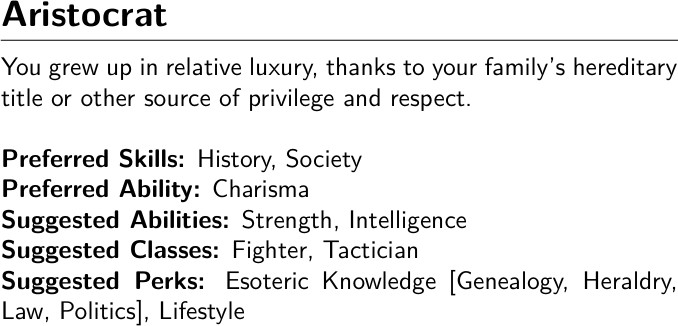
    Ragnvald comes from a clan that considers themselves noble. In reality, they’re a bunch of vexatious litigants with a questionable claim to a long-defunct title, but they stubbornly act like nobles and raise their children to believe and act as such. Ragnvald has the Aristocrat stratum (right).

    Like cultures, strata provide preferred abilities and skills, and make suggestions about abilities, classes, and perks that reflect a character’s stratum.

    Up Next

    In the next post, we’ll go over the Fighter class and pick Ragnvald’s abilities. And if you want to see a specific ancestry in the next sample character, remember to let me know in the poll above!

  • Today’s entry in the Unified Mechanics series will cover ability mechanics, which are used to quantify a character’s raw, well, abilities. I’ll also touch briefly on some of the major character stats that will derive from abilities.

    Various Ability Systems

    D&D has traditionally used an array of six abilities: Strength, Dexterity, Constitution, Intelligence, Wisdom, and Charisma. For a typical character, these start out between 3 and 18 (originally, they were generated by rolling 3d6 for each one). The ability score has traditionally been less important than the modifer derived from them, which is defined as (score – 10) / 2, rounded down.

    The Storyteller system has used an array of nine abilities divided into Mental (Intelligence/Wits/Resolve), Physical (Strength/Dexterity/Stamina) and Social (Presence/Manipulation/Composure). They can alternately be divided into Power (Intelligence/Strength/Presence), Finesse (Wits/Dexterity/Resolve), and Resilience (Resolve/Stamina/Composure). Characters have, generally, one to five “dots” in each ability, which apply directly to dice rolls instead of deriving into another number.

    Warhammer’s various roleplaying games use a varying array of abilities, generally including weapon skill, ballistic skill, strength, toughness, agility, intelligence, willpower, and fellowship. Some versions of these games have also added abilities like dexterity or initiative. These games use percentile dice, and raw  abilities are generally on a 0-100 scale, but a modifier defined as ability / 10, rounded down, is also used in places.

    I found there to be a couple of silly things about D&D’s ability mechanics, even in 4e, and so I’m going to try to improve on them.

    • Dexterity and Intelligence seem like the odd abilities out. The other four abilities can be paired up in “active/passive” pairings: Strength and Constitution fit well as a Physical pairing, and Wisdom/Charisma fit well as an Emotional or Social pairing. But Dexterity and Intelligence don’t go together, and it’s hard to fit them into a group with the others.
      • This is especially apparent in 4e, where Strength and Constitution can quite reasonably both be used to affect the Fortitude defense, and Wisdom and Charisma can both be used to affect Will. But Dexterity and Intelligence are paired together to affect both AC and Reflex defenses, and the explanation for this (that Intelligent characters can predict attacks better and have more time to dodge) has never sat right with me.
    • Dexterity and Intelligence are also doing a lot of heavy lifting, and are stretched thin to cover multiple areas that might be better served by distinct abilities. Dexterity covers both fine-motor skills like picking locks and full-body skills like acrobatics and stealth that might be better captured by an Agility stat. Intelligence is stretched to cover both scholarly knowledge and arcane magic, and (in many editions) sneaky tricks and tactical acumen that could instead be captured by a Cunning or Wits stat.
    • In many editions of D&D, since ability modifiers increased only at even values, there was little point in having odd abilities. In some editions, odd abilities might be useful to meet feat prerequisites, increase carrying capacity, or gain extra spell slots, but these were exceptions to the rule. I largely think that the main reason ability scores continue to be used in later editions is so that it was easy to roll 3d6 for abilities if a group didn’t want to use point-buy generation.
    • Since 3e, characters have gotten to increase their abilities as they gained levels. This results in high-level characters becoming superhuman, with ability scores well beyond what should be possible without magical assistance. This doesn’t fit with the kind of pulp-adventure genre I want to support.

    So here’s what I’m doing with Aetrimonde’s abilities:

    Firstly, Aetrimonde will use four pairs of abilities, adding Grace as a counterpart to Dexterity and Cunning as a counterpart to Intelligence. Each will absorb some of the things their counterpart would otherwise do.

    Secondly, Aetrimonde will do away with the score/modifier distinction. Players will pick their characters’ abilities through a point-buy system, and if they want to roll for abilities instead the GMH can include mechanics or a table that lets them do so.

    Thirdly, in the interest of fitting into the pulp-adventure genre (and of having Solid Level Scaling, I will add), characters will never increase their ability scores: what they have at character creation is what they will keep.

    To give a quick preview of what each of the eight abilities will influence:

    The Eight Abilities
    • Strength
      • Brawn defense (resist physical force, internal injury, disease, poison)
      • Melee weapon, shield, and unarmed attacks
      • Carrying capacity
      • Physical actions like climbing, jumping, etc.
    • Constitution
      • Hit points
      • Healing
      • Endurance and stamina
    • Dexterity
      • Armor Coverage defense (deflect or dodge physical attacks) if wearing light or medium armor
      • Poise defense (deflect or dodge fire, acid, spells, armor-piercing attacks, etc.)
      • Ranged weapon attacks
      • Fine motor skills (open locks, disarm traps, pick pockets, etc.)
    • Grace
      • Armor Coverage defense if wearing light or medium armor
      • Poise defense
      • Move safely when under threat
      • Body control (acrobatics, stealth)
    • Intelligence
      • Wit defense (see through deception, trickery and illusions)
      • Some forms of magic (primarily Arcane)
      • Scholarly knowledge
    • Cunning
      • Wit defense
      • Clever tricks and tactics
      • Initiative
      • Perception
    • Charisma
      • Composure defense (resist manipulation and compulsion)
      • Some forms of magic (primarily Divine)
      • Social interaction (deception, intimidation, persuasion)
    • Wisdom
      • Composure Defense
      • Some forms of magic (primarily Spiritual)
      • Social understanding (sense motives)

    Up Next

    This will be the last of the Unified Mechanics posts–for now. I think that I may revisit the subject later on, but now that I’ve set up these basic mechanics, I want to show off how they work in practice, and it seems o me the best way to do that is to walk through how an Aetrimonde character is built. So, starting in my next post, I’ll be building Ragnvald the Dwarf Fighter, and discussing along the way how the implementation of the various parts that go into a character fulfill my design goals.

  • Today’s topic will be resource mechanics. A resource mechanic gives characters a reserve of something (health, stamina, mana, etc.) that can be spent to do things, or that they need to conserve.

    In this post, I’m only going to discuss the types of resources that all characters will share as part of the goal of unified mechanics. I’m also not going to define numbers, or even a lot of rules, just yet, because that will be part of a later discussion on level scaling.

    Health Resources

    The first kind of resource we’ll talk about is one that pretty much every RPG has some analogue for: health. Characters in this game will be fighting, and dodging traps, and potentially falling from cliffs, and when that happens they will get injured. We need a resource that tracks how healthy they are.

    Health Mechanics in Other Systems

    Various RPGs track character health in various ways:

    • Hit Points: A classic, and one used by D&D since the beginning. A hit point is some discrete unit of “banged-up-edness.” Being injured reduces HP by some amount (typically a dice roll); receiving healing increases them. Tougher characters have more HP.
    • Wounds: A wound is again some discrete unit of “banged-up-edness,” but instead of attacks reducing wounds by a fixed amount, they cause a die roll that determines if you lose one or more wounds. More harmful attacks are more likely to inflict wounds, and might cause more of them when successful. Tougher characters have more wounds, and it may be harder to make them lose wounds.
    • Stress: In a stress system, attacks and injure cause a check to determine if you receive stress, much like a wound system, but with a couple of twists. Firstly, receiving stress has effects other than moving you closer to defeat: it might give you an arm injury making it harder to swing a sword, or daze you so that you can’t think straight. Secondly, stress systems often give you a choice of what kind of stress you get from an injury, and they’re often used in more narrative-based systems for this reason.

    I don’t see a strong reason to depart from 4e’s hit point mechanic. Hit points are simple and familiar to most RPG gamers, and so this will make Aetrimonde accessible. (I’m absolutely going to change how hit points are calculated, though.)

    4e also had a second health-related resource, the “healing surge.” Characters had a limited number of healing surges, which were consumed by many sources of healing and regained when resting overnight. Each use of a healing surge would restore a quarter of the character’s hit points (although many healing effects would add to this amount). So healing surges fulfilled two purposes: they allowed healing effects to scale with how tough a character was to begin with, and they represented a limit on a character’s ability to recover from injury.

    5e has a slightly different take on healing surges, in the form of “hit dice.” A 5e character gets one hit die per level, with tougher classes having larger hit dice. While hit dice are not consumed by many healing effects like spells and potions, a character can spend their hit dice to regain hit points when they rest. Hit dice thus act as a limit on a character’s ability to recover from injury, just like healing surges.

    I think there are good things about both mechanics:

    • I like that 4e’s healing surges being used by most sources of healing limited how much a character could be healed: eventually, a character getting constantly injured would get worn down, no matter how much healing magic you threw at them. This is a nice, gritty mechanic that I think fits well with the pulp-adventure kind of feel I’m going for.
    • I like that 5e’s hit dice involve an actual dice roll. Healing surges restoring a fixed amount of hit points (unless a power said to roll dice on top of that) always seemed like a missed opportunity to me. Rolling dice is fun!

    So, I’m going to invent a mechanic that takes the better parts of both:

    • Characters have a finite stock of resurgences that are consumed by major sources of healing. Not all healing will consume a resurgence, but it will be difficult to regain full hit points without using resurgences. Non-resurgence healing will have limitations like consuming a resource other than resurgences, only working up to half health, or only being temporary.
    • Characters also have a healing die that varies by class. Most healing effects will involve rolling the healed character’s healing die, allowing these effects to scale depending on the character’s toughness.

    HP and resurgences will both be regained on resting.

    Stamina Resources

    The next type of resource is a stamina resource, loosely defined to encompass resources that characters need in order to do things and that are renewable (they can be regained once spent).

    Stamina Resources in Other Systems

    There are many types of stamina resources in various game systems:

    • In D&D, the most common type of stamina resource over several editions has been the spell slot: characters are able to cast a finite number of spells, of varying potencies or levels, before resting.
      • Up to 3.5e, many spellcasters had to prepare spells individually: if they wanted to cast two Fireballs, they had to prepare two Fireballs, and they had to pick the level they would cast each one at. 5e has done away with this, allowing casters to cast any of their prepared spells using any slot of sufficiently high level.
    • 4e is the sole edition to do away with spell slots entirely: every one of a character’s limited-use powers had its own dedicated resource, and they were not transferrable between powers. In general, a per-short-rest or per-long-rest power could be used exactly once per rest, even if you had other powers on the same frequency.
    • Many editions of D&D have had other stamina resources, such as barbarian rage uses, bardic music uses, ki points, Channel Divinity charges, etc.
    • Some Fate-based games allow stress to double as a stamina mechanic, by causing strenuous actions to possibly cause stress to the user.

    In the interest of Design Goals #1 and #2 (Unified Mechanics and Minimize Fiddly Numbers), I’m going to roll stamina resources as much as possible into a single resource.

    Characters will have things they can do as much as they want, and things they can do that are strenuous. We will call these lesser and greater powers. Using a greater power, whether it’s a special sword trick or a powerful spell, will consume a greater power use, and these will be regained on resting.

    Action Resources

    An action resource is a limit on how much time a character has to do things on their turn. Action resources replenish every time a character gets a turn.

    Action Resources in Other Systems

    D&D has traditionally used a system where characters get one each of several types of action, each used for different things.

    • A standard action (shortened to just “action” in 5e) would be used for something major, like attacking or casting a spell.
    • A move action would naturally be used for movement. Most characters could move normally or sprint with a move action; situationally they might climb or swim; and some characters could fly or teleport with their move actions. However, in systems with a move action, characters typically have to use all of their movement in one go, with any excess being lost. 5e does away with the move action, instead allowing characters to split up their movement however they like around and between actions. A standard action could be traded down for a second move action in 3e through 4e, while in 5e the Dash action fills a similar niche.
    • Late 3.5e introduced the swift action, which successive editions renamed the minor and then the bonus action. This could be used for minor tasks like opening doors, pulling levers, and making some kinds of attack.
    • Opportune actions, in 4e, allowed characters to make attacks of opportunity when another creature moved around them, or otherwise react once on each other creature’s turn. 3e had a similar attack of opportunity mechanic, but did not make this an action type.
    • Immediate actions, introduced in late 3.5e, allowed for a more significant action on other creatures’ turns. 4e split this into interrupts, taking place before a trigger event fully resolved, and reactions, taking place afterwards. 5e has preserved this as the reaction, doing away with opportune actions.
    • Free actions represent “instant” actions requiring minimal time but still some thought. Unlike other actions, free actions were unlimited.

    Other game systems use action point mechanics, where characters have some number of points that they can spend on actions during their turn, with more complicated actions requiring more action points. In some of these systems, having unused action points at the end of a turn allows a character to make certain reactions to other characters.

    Action points are a source of fiddly numbers (having to subtract points from your total, and having to track leftover points between turns if the system allows leaving them unused to make reactions), so I’m going to stick to a D&Desque action system.

    I think that 5e’s action economy of one big action and one smaller action per turn is a good place to be: these will be named the main and minor actions. Unlike 5e, I will allow trading down the main action for a second minor action; I don’t mind if a character wants to do two small things in a turn.

    I do like 5e’s take on movement, so I’ll do away with the discrete move action in favor of movement that the player can split up however they like.

    Aetrimonde Design History

    At one point, before I’d played much 5e and gotten to appreciate how its movement system worked, I retained the move action from 4e. The main, move, and minor actions were named for their alliterative appeal.

    I liked that 4e allowed for more off-turn actions using both opportune and interrupt actions, so I’ll keep this distinction where characters can potentially do several small things (balanced around normal weapon attacks, mainly) and one big thing between turns. But, I did find that 4e’s terminology of Immediate Interrupt vs Immediate Reaction led some players to think that they had both an Interrupt and Reaction each round. For clarity, I will name this type of action (once between each of your turns) a Reaction. Some Reactions will be Swift Reactions, indicating that they can interrupt; I think that Reaction vs Swift Reaction will make it clearer that one is a subtype of the other.

    Asset Resources

    An asset resource, like a stamina resource, is something that characters spend to do things, but asset resources are non-renewable: once spent, they’re gone forever. The classic asset resource is wealth: money that can be spent to get goods and services.

    Types of Wealth Resources

    Wealth resources tend to be handled in one of two ways:

    • Account Balance: Characters track the exact amount of money they have, and spend it to get things. This is more common in games with pre-modern settings, where characters are unlikely to have fungible assets, access to credit, etc.
    • Wealth Level: Characters have a Wealth statistic like they might have a Strength or Charisma statistic. A given level of Wealth allows characters to make smaller purchases without impacting their Wealth at all, while larger purchases might permanently reduce the character’s Wealth.

    I don’t see a strong reason to depart from 4e’s currency system of gold, silver, and copper pieces. To make this system a little more flavorful, I’m going to include some information about non-standard currencies (like Waystone half-guineas worth 2gp1sp, and Elvaren electrum obols worth 4sp) in the Game Master’s Handbook’s setting section. And, because I want Aetrimonde to support Victorian Fantasy (which comes with the beginnings of a financial system…) I’m also going to include some rules support for GMs to include assets other than hard cash and gems, like banknotes, savings bonds, and stock certificates.

    Meta Resources

    A meta resource, loosely defined, is a resource that players have but characters don’t. It is an out-of-universe resource that players can use to ensure things go their way when they really need it, or to otherwise influence the story in a more satisfying direction.

    Types of Meta Resources

    Various systems have introduced different kinds of meta resource:

    • D&D 3.5e introduced “action points” as a variant rule that was made an official part of the Eberron campaign setting. Action points could be spent to increase the result of a d20 roll after seeing the roll (but before the result was announced), or for a variety of other effects tied to specific classes and feats. A character would replenish their stock of action points upon gaining a level or when finishing a major milestone in their adventures, and could gain action points from doing something “cool” in the eyes of the GM.
    • 4e retained the name action points, but changed the mechanics: an action point could be spent once per encounter to take an extra standard action during a turn. A character would have one action point after completing a long rest, and would gain one for every two encounters completed without resting.
    • 5e uses an “inspiration” mechanic that allows characters to gain inspiration for doing “cool” things. Inspiration can be spent to gain advantage on a d20 roll.
      • Baldur’s Gate 3, a video game adaptation of 5e, instead uses inspiration to allow characters to re-roll failed skill and ability checks.
    • The Fate system uses Fate points as a core mechanic: Fate points can be gained by playing into aspects of one’s character, accepting complications proposed by the GM, or by allowing enemies to use aspects of your character to their favor, and can be spent to improve or reroll dice rolls, or to make declarations about how the story progresses.

    I’m not going to make meta resources a part of Aetrimonde’s default rules: I think that the use of meta resources is a matter of taste that’s best left up to individual tables. But, I will be including a section discussing a few options for meta resource systems that could work well in Aetrimonde as part of the GMH.

    Up Next

    The next post in this series will cover ability mechanics: how the system accounts for a character’s, well, abilities and how they inform what a character can do.

Is this your new site? Log in to activate admin features and dismiss this message
Log In