Heroic Roleplaying in a World of Swords, Sorcery, and Steam

I’d like to introduce Aetrimonde, a TTRPG I’ve been designing with heavy inspiration from the houserules my group used back in our Dungeons and Dragons 4e days. I’m not ready to publish Aetrimonde yet, but I’m opening up this blog to discuss its design principles, mechanics, and systems.

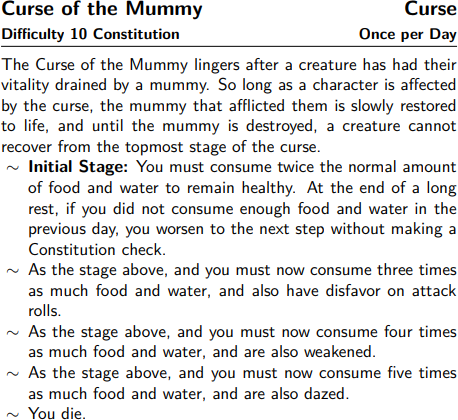
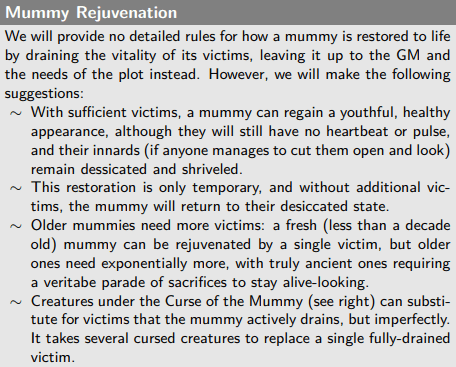
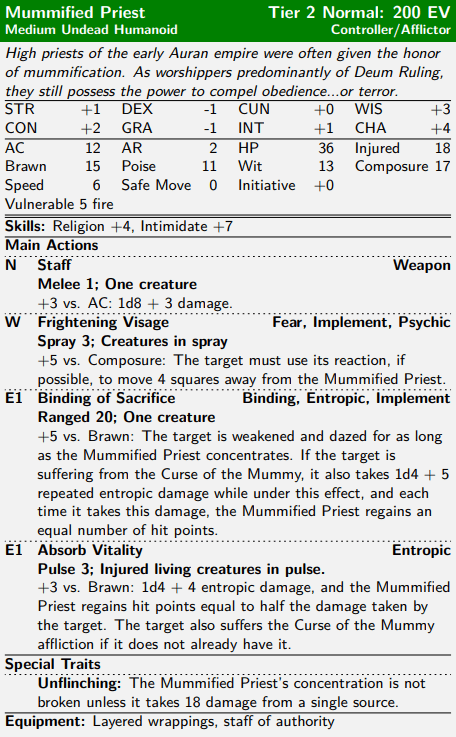
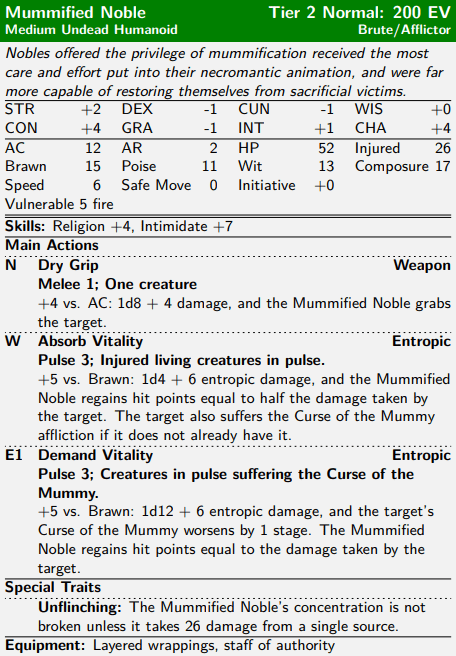
  • Having finished up character creation for Etterjarl Ragnvald, I’m going to take this post to introduce some enemies out of Aetrimonde’s Bestiary that Ragnvald might fight at level 0. To start with, I’ve picked out some enemies that are most similar to a PC: fellow mortal humanoids.

    The enemies I show off today will fill different roles in an encounter, but future Bestiary posts will focus on specific roles. I’ll get to most if not all of them eventually, but for now, let me know what kind of enemy you’d like to see next:

    Enemy Design Philosophy

    In some editions of D&D, enemies are built in much the same way as PCs, especially when they have an ancestry available to PCs or similar. In this paradigm, they have a class, or something like a class, and a level, and this gives them a set of class features that may or may not actually be useful or interesting when using them as an enemy in a campaign. I’m thinking in particular of D&D 3e and 3.5e, where building a custom enemy or monster could take almost as long as building a regular character. It also caused problems with creating spellcaster enemies, because the guidelines for this were to give the creature spellcasting similar to what a PC would have…except that an enemy spellcaster seldom had to worry about saving their spells for later encounters, and could break out the big guns every turn.

    I’m not going to design enemies this way for Aetrimonde. For one thing, I want enemies to be simple for the GM to create and run, and that means giving them only the features and powers that are necessary to make them an interesting challenge. For another, I want them to be easy to create (if the GM is building their own custom enemies). And to cap it all off, there are factors at play that make enemies built like PCs difficult to balance.

    To cut to the chase, here’s the short version of my philosophy of enemy design:

    • Enemies should have at least three interesting things about them, which in general should include one action they can use every turn, one more powerful action they can’t use as often but will probably get to use at least once in an encounter, and a passive trait that is likely to come into play.
      • Conversely, enemies shouldn’t have “dead weight” to them: if they aren’t going to use it in a fight, it shouldn’t take up space in their entry.
    • Enemies can have PC ancestries and resemble or be based on character classes, but that doesn’t mean they should usually be built like a PC. Their “interesting things” can be based on powers, feats, and features that PCs might have, but they don’t need to have the complete set that a PC would.
      • Many enemies will resemble an incomplete PC, like a half-trained Fighter or an apprentice Wizard. Narratively, that might even be what they are!
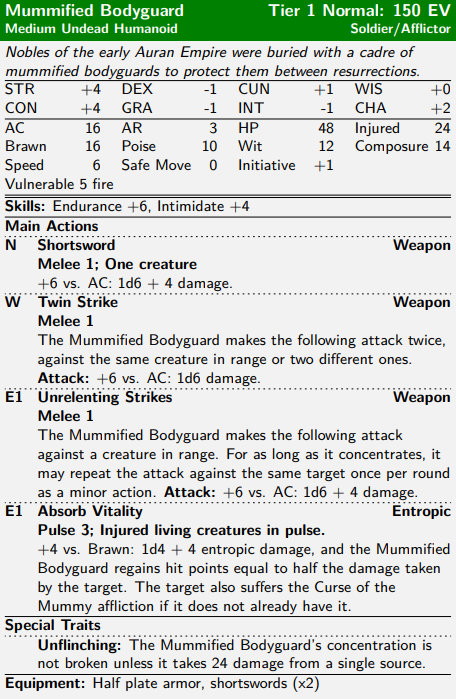
      • Rarely, it might make sense for a notable enemy to actually be built like a PC, but this would be an exception to the rule, and they would make for a challenging fight.
    • Because enemies won’t have as many actions or passive traits as PCs, there’s no sense trying to assign a level to an enemy. Instead, I’ll map them onto Tiers corresponding to the levels where PCs’ expertise bonus increases: Tier 0 for level 0, Tier 1 for level 5, and so on.

    Bestiary Lore

    I don’t intend for Aetrimonde’s Bestiary (which is still under construction) to be just a list of interesting enemies to be fought. In what I’ve written so far, I am mixing in lore and information that a GM can use for worldbuilding and reveal to PCs depending on whether they make knowledge checks and how well they roll.

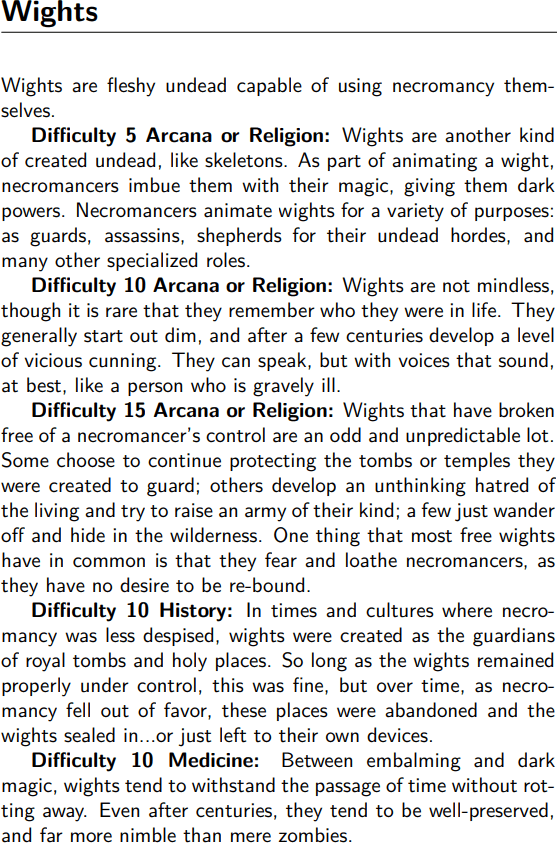
    Since I’ve just spent several weeks building a sample character that’s a dwarf, I think it appropriate that the first enemies I show off from the Bestiary should also be dwarfs. So before I do that, let me also show off some dwarf lore (which expands on what is present in the Core Rulebook).

    The first paragraph here (which doesn’t have an associated Difficulty) is common knowledge that an Aetrimonde character could be counted on to know about dwarves. The rest of this information is locked behind various skill checks, with the most esoteric information needing the best check results.

    Some types of enemy are grouped into subsections with additional lore: the first enemy I’m about to show off is a Dwarf Smuggler, which are usually Exiled Dwarves (most dwarves being law-abiding to a fault). Exiled Dwarves have their own lore specific to them:

    Dwarf Smuggler

    Without further ado, here’s the statblock for a Dwarf Smuggler. Since this is the first enemy I’m showing off, let me briefly touch on some of the parts of a monster entry in the style of Aetrimonde’s Bestiary:

    • Tier 0 Normal: 100 EV” conveys information for the GM about how much of a challenge the Dwarf Smuggler poses. “Tier 0” indicates that this creature is balanced around being a typical challenge for characters at level 0; “Normal” means that this monster is intended to be an equivalent to one PC, as opposed to Elite or Champion monsters that have hit points making them equivalent to two or five PCs, and make attacks to match. (I’ll show off some monsters like this in later posts.) “100 EV” is a numeric value that the GM can use to design an encounter: EV is short for “Encounter Value,” and 100 EV is the value appropriate to one level-0 PC.
    • “Medium Mortal Humanoid (Dwarf)” conveys some basic information about the Dwarf Smuggler: how big it is (Medium, aka 1×1 squares on a grid map), where it comes from (Mortal, so hailing from the material world), its general shape (Humanoid), and in this case a subtype (Dwarf, indicating that yes, this creature has the same ancestry as many PCs).
    • “Assassin” conveys information about the role the monster can fill in a combat encounter: in this case, being an Assassin means that the Dwarf Smuggler is fragile, but has some good attacks that it can use with setup time or favorable terrain. Other roles in the Bestiary include Soldier (has high defenses but not especially dangerous attacks), Protector (makes other monsters harder to kill), and Afflictor (can cause harmful effects to PCs that persist after the end of the encounter). Monsters can have multiple types.

    The next three sections contain the Dwarf Smuggler’s abilities (enemies have the same eight as PCs), defenses and related values like hit points and speed (which again, work much like they do for PCs), and skills (If a skill is listed here, the enemy is considered trained in that skill; otherwise, it is untrained, and its skill modifier is just the relevant ability).

    Following all of this basic information comes the real meat of the Dwarf Smuggler: the Actions it can take and its passive Special Traits. To make it easier for the GM to quickly parse a monster’s entry, actions are divided up by type, although the Dwarf Smuggler only has main actions.

    • Light Hammer is the Dwarf Smuggler’s normal attack (as indicated by the “N” to the left of it). This is essentially equivalent to a PC’s normal attacks, simply adjusted to be a little less accurate and a little less damaging, because this is a Tier 0 enemy.
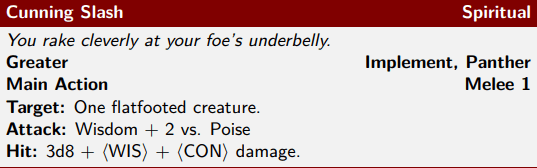
    • Surgical Strike is a more powerful attack that the Dwarf Smuggler can only use in limited circumstances. It can nominally be used at will (denoted by the “W” to the left of it) but requires that the target be flatfooted, which could be the case if the target is flanked or the Smuggler is hidden from it, but it is an attack against Poise and its damage ignores armor. The Poise defense is typically a little bit lower (by about 2 points, on average) than AC, making Surgical Strike more accurate against the average PC, and it can be incredibly accurate against PCs with low DEX and GRA. It also synergizes with the Smuggler’s special traits…
    • Low-Light Vision is a special trait lifted straight out of the Dwarf features in the Core Rulebook. And, as such, I’m not going to take up space writing out the rule here, especially as it will crop up in basically any Dwarf enemy’s statblock. I’m taking this approach with any ancestry or class feature that doesn’t have values specific to the enemy.
    • Under Cover of Darkness is a more unique special trait, allowing the Dwarf Smuggler an improved chance to feint in darkened areas. Any character can feint, as a use of the Deception skill, so I’m not including the rules for that here, but the Smuggler’s Deception bonus is displayed as one of its trained skills.

    The interaction between Surgical Strike, Low-Light Vision and Under Cover of Darkness–enabling the Dwarf Smuggler to fight very effectively in dark areas–is the first example of how I’m fulfilling my design goal of Combat as Puzzle: fighting Dwarf Smugglers is hard in dark areas, and becomes much easier if the PCs can shine a light on the Smugglers or draw them out of the darkness. That’s a simple puzzle, since the Smuggler isn’t intended to be a complicated enemy, but some other enemies have more complicated mechanics that make for more interesting puzzles.

    Dwarf Gunner

    The Dwarf Gunner fills an entirely different role than the Smuggler. For one thing, the Gunner is a ranged attacker, but on top of that, it’s a Protector, centered around protecting other enemies from the PCs. It’s also a higher tier, which comes with better defenses, attacks, hit points, damage, and so on.

    • The Gunner has two normal attacks: one melee (the Bayonet on its Rifle) and the other ranged (the Rifle itself). The Rifle attack is significantly better than the Bayonet attack, so one way to deal with the Gunner is to get a character close to it so that it can’t effectively use the Rifle.
    • The Gunner’s Cover Shot action is one way that it can protect its allies: this functions a little bit like the Battlefield Challenge feature that Ragnvald has, adapted to work at range: if a Cover Shot attack hits, then if the target makes an attack on its next turn, the Gunner gets to shoot it.
    • Cover Shot gets even nastier when coupled with the Gunner’s final action, Suppression Fire. It can only use this action once per encounter (as denoted by the “E1” to the left of it), but it’s a nasty action: it creates a zone, a persistent area on the battlefield, in which the Gunner can effectively make Rifle attacks as opportune strikes. Any creature moving around in the Suppression Fire zone (leaving its space, not just leaving the zone) will take an attack from the Gunner.
    • The Gunner’s special traits are not particularly linked to its role as a Protector, but its Low-Light Vision lets it attack comfortably into dim light, and Dwarven Surefootedness lets it reduce how far it is pushed around.

    The Dwarf Gunner can present more of a puzzle in combat, especially if it is backing up the right kinds of other enemies (like an entire squad of ranged attackers) or has favorable terrain (like a position with cover overlooking a chokepoint). A well-placed Suppression Fire can give an entire party of PCs second thoughts about trying to move up to melee range, but there are several ways to deal with it:

    • The zone only lasts as long as the Gunner concentrates, so if the PCs can hit it with a powerful enough attack (dealing 9 points of damage) or apply any of the conditions that break concentration, that will put an end to the zone.
    • The PCs could seek an alternate route around the zone and get up close to the Gunner. This is a way for a GM to give characters trained in Athletics or Acrobatics a chance to shine by placing difficult routes around a chokepoint. It also rewards teleportation powers, invisibility, and stealth.
    • They could also tempt the Gunner to attack someone not in the zone, or use a power that blocks its line of sight to the zone.
    • Finally, the PCs could just take cover and wait until the Gunner runs through the 5 shots in their rifle and has to reload.

    Dwarf Stonespeaker

    The Dwarf Stonespeaker is a Tier 2 enemy, which is about the most challenging foe Ragnvald should face at level 0. At 200 EV, two Stonespeakers would be nearly a match for a typical adventuring group, which would include Ragnvald and four allies. Two Dwarf Stonespeakers could be manageable, if a slightly difficult fight; three would be pushing it.

    The Stonespeaker isn’t particularly tough, or particularly damaging in itself: its challenge comes from a combination of two factors.

    • Firstly, it’s a Controller, meaning that its role is to impede the PCs and limit what they can do. In this case, the Stonespeaker has the Stonewall power, allowing it to raise a wall of solid stone; this could be used to split the party and allow the Stonekeeper and its allies to focus on one or two PCs at a time, or it could be used to block a path and give the Stonespeaker and allies time to attack the PCs from range. (It would be especially nasty if coupled with an enemy like the Dwarf Gunner…)
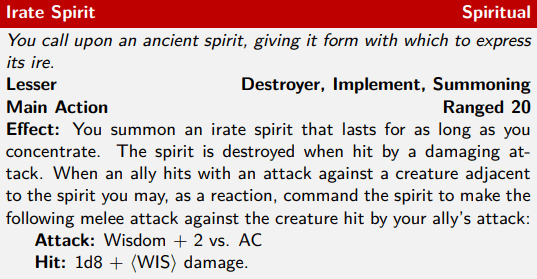
    • Secondly, it’s also a Summoner, and can summon additional enemies to join the fight. In the Stonespeaker’s case, it can summon a single, relatively fragile spirit that lasts only as long as it concentrates…but it can do this repeatedly if the spirits get destroyed. The Stonespeaker effectively gets to attack twice on its subsequent turns.

    The Stonespeaker’s one saving grace is that it can’t concentrate on both Stonewall and its Honored Ancestor Spirit at once, but in an encounter where it has allies, it may have enough time to use both.

    The puzzles presented by the Stonespeaker depend on which of its powers it concentrates on, and how it uses them:

    • If the Stonewall zone is used to split the party, it can be countered by one of the PCs trapped with the Stonespeaker attacking them to break concentration. Of course, if the Stonespeaker has allies, this might be a tricky proposition. The wall can also be broken through by attacks, but with the wall’s invulnerable resistance, that might take some doing: a single attack dealing 15 damage would do it, but it might easily take several characters hacking at it to break through.
    • If the Stonewall zone is instead used to block an approach to the Stonespeaker and allies, the challenge boils down to using the terrain that the GM provides: if there are alternate routes, the PCs can use them, but it might also be possible to find an elevated position and shoot over the wall to break the Stonespeaker’s concentration.
    • Finally, the Honored Ancestor Spirit poses a not-inconsiderable danger: its attacks deal good damage, it can make opportune strikes, and it can help the Stonespeaker or its allies flank a PC. It can be destroyed by an attack, but this means diverting an attack away from other enemies, and the Stonespeaker can always re-summon it.

    A Note on Powers

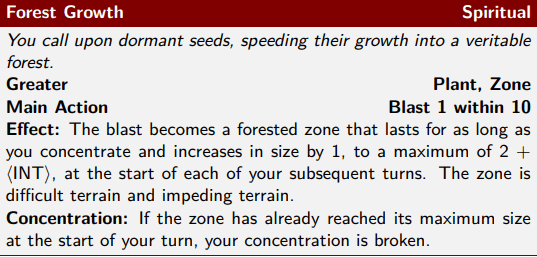
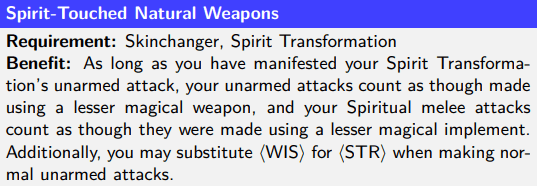
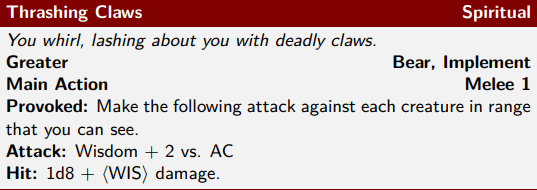
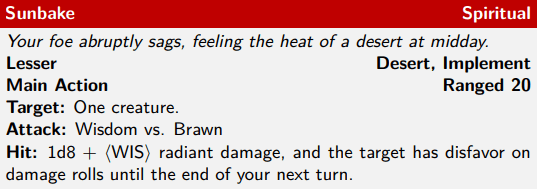
    These dwarf enemies don’t just draw from the dwarf ancestry: many of their powers are available to PCs, too. Surgical Strike, Cover Shot, and Suppression Fire are all available to Martial classes, while Propel Stone and Stonewall are available to Spiritual classes (like the Skinchanger sample character I’m starting work on). The Honored Ancestor Spirit is not exactly a power available to PCs, but it comes close: the main difference between it and certain Spiritual summoning powers is that it has a different damage die implying that it attacks using a warhammer.

    Up Next

    Now that I’ve established some context by introducing these PC-like enemies, my next Bestiary post will cover some stranger enemies. If you want to see more of a particular type of enemy, let me know in the poll above!

  • Before we move on from Ragnvald, I’d like to preview what Ragnvald might look like as he gains a few levels. Although Aetrimonde has no hard level cap, I plan for the material in the CRB and GMH to support adventures from levels 0-20, which I think ought to provide enough space for development in any campaign.

    For every level gained, a character can pick out a new power, new feat, and new perk. At levels divisible by 5, their expertise bonus also increases by 1, and…that’s it! Aetrimonde characters get all of their class features at level 0 and are ready to go out of the box; becoming more powerful is a matter of learning new tricks (mostly from powers) and putting new twists on old ones (mostly from feats).

    In this post, I’ll cover levels 1-5 of Ragnvald’s career: enough to demonstrate where Ragnvald might be heading, but not so much as to get tedious. For his perks, I’m going to be basing his choices on what happened to Ragnvald in the campaign where I played him, but someone else playing Ragnvald could easily make entirely different choices.

    Level 1

    One thing that Ragnvald doesn’t have in his power selection is a way to attack–and therefore challenge–more than one enemy at once. For starters, he can pick up Cleave, which is a lesser power that offers him the chance to make a second attack against a nearby foe. Coupled with his class features, that also lets him challenge a second enemy on his turn (if the first attack hits). Like Advancing Strike, Cleave also offers him a little bit of mobility that he otherwise lacks, by giving him one square of safe movement that allows him to edge past a foe–again, if his first attack hits..

    For his new feat, Ragnvald will take Improved Battlefield Challenge, which now synergizes with his ability to challenge more than one creature per round. He doesn’t have many uses for his reaction (basically just his Walk it Off power, at the moment) so he won’t suffer too badly from holding it in reserve.

    And, for his new perk, Ragnvald will prepare to continue his legal studies by learning High Dwarven (or Hochdverg), the legal and ceremonial language of the Dwarven Federation. This is considered an ancient language, even though it is still used for official purposes; the Language perk allows Ragnvald to learn High Dwarven only because he is trained in History.

    Level 2

    All of Ragnvald’s powers so far deal relatively standard damage (2d4r1 + 4, using his warhammer), so at level 2, he will pick up a greater power giving him a higher-damage attack. Unfortunately, many high-damage Martial powers require either a two-handed weapon or a light weapon: since he wields a warhammer and a shield, it would be difficult for Ragnvald to make these options work. One option that would work with Ragnvald’s weapon setup is Deadly Strike: this power has no particular weapon requirement, deals increased damage, and has the additional perk of gaining critical threat on its attack roll. Critical threat causes an attack roll to be a critical hit if the dice land totalling 17-20 before modifiers (instead of 18-20, as is normal). This increases the chances of a critical hit from 6% to 10%, and even further if the attack roll also has favor.

    At this point in his adventures, Ragnvald has accumulated some treasure, and can easily afford a suit of plate armor, but he lacks proficiency. He can take the Plate Armor Proficiency feat to remedy this, and will then acquire a suit of Full Plate at the first opportunity, giving him an additional +1 AC and AR over his scale armor. This doesn’t scale with level the way that some other defensive feats would, but he has several levels to go before his expertise bonus gets large enough that it would be better than the benefits of Full Plate.

    Ragnvald’s studies continue, but this time he spends his time learning about the fiefdom he expects to inherit, the Jarldom of Helgenholt. This is represented by an Esoteric Knowledge perk, which he can apply to all sorts of knowledge checks related to the geography, history, and people of Helgenholt. Ragnvald is disappointed to learn that the people of Helgenholt are prosperous, quite happy governing themselves, and unlikely to throw him a parade if he shows up and claims to be their long-lost ruler.

    Level 3

    Ragnvald now has a nice, broad selection of powers: it may be time to start consolidating his options by picking some greater powers in the same niches as his lesser powers, and vice versa. Shield Charge is an interesting complement to Advancing Strike, in that it too applies forced movement, but Shield Charge is also useful as an opener: unlike Advancing Strike, it can be used while charging, allowing Ragnvald to close the distance at the start of combat or catch up with a fleeing enemy. (Also, as a Shield power, he could use it while disarmed of his weapon.)

    By level 3, Ragnvald and his adventuring companions are starting to encounter some more powerful foes, and Ragnvald’s attacks (already slightly inaccurate due to his use of a warhammer) are becoming more so. To try and catch up, Ragnvald now takes Weapon Aim [Hammers], giving him a +1 feat bonus to attack rolls using his warhammer and any other hammers he picks up. This bonus will scale, increasing to +2 at level 10 and +3 at level 20.

    Ragnvald has finally had a chance to actually visit Helgenholt, while he and his fellow adventurers were en route to an adventure putting a stop to gryphon rustling in the high valleys above the town. The locals were, as he glumly predicted, unimpressed with his claim to the Jarldom, but he was pleasantly surprised by the warm reception he and his companions got on the way back through town with a manacled band of captive rustlers in tow. They might not have welcomed him with open arms as their rightful liege, but the town archivist did offer to let him look through their genealogies next time he has some time to spare, and the captain of the town watch has offered him a job if he ever decides to give up on adventuring…and, it is implied, his inheritance. Ragnvald now has the Contacts [Helgenholt] perk, allowing him to call in some favors with the locals if he is ever in the area again.

    Level 4

    To continue consolidating Ragnvald’s powers, let’s give him Overpower as a lesser power equivalent to the Unrelenting Strikes greater power he already has. Overpower is a bit more limited than Unrelenting Strikes, in that it only works on creatures that are already flatfooted, but used correctly and with a bit of luck it can keep an enemy flatfooted for a few turns, and without using a greater power.

    For his feat, let’s try improving Battlefield Challenge by giving Ragnvald the Challenger’s Sunder feat: this will let him try to smash an enemy’s equipment instead of making a regular opportune strike. That’s a little bit niche, since it won’t work on animals or other creatures that don’t have equipment they rely on, but against someone with a weapon or shield they rely on it can be a game-changer. Sundering is a combat maneuver, and any character can attempt it, but this feat will give Ragnvald some extra opportunities to try it. In many cases, an enemy might choose to take damage instead of letting Ragnvald deal the damage to a valuable item, but that still works out in Ragnvald’s favor.

    For his perk, Ragnvald will take another Esoteric Knowledge perk, this time about Dwarven Inheritance Law as he picks up his legal studies again. Ragnvald is beginning to understand just how tenuous his clan’s claim to the Jarldom of Helgenholt really is, and just how silly and wasteful it has been for them to keep pressing it for decades.

    Level 5

    Ragnvald will pick up his first ranged power, Flattening Hurl, to be used with his throwing axes. This is something Ragnvald can use when pursuing a fleeing enemy, or if he starts combat just a little too far away to close with the enemy. (It also has a niche use in pushing enemies off of ledges or into traps, like any power that can push.)

    For his feat, Ragnvald will take Toughness, which synergizes nicely with the hefty armor resistance he already gets from his full plate. Combined with the increased hit points he gets as a result of his expertise bonus increasing from +2 to +3, this will bring his total hit points to 50 and his large heals to 1d12 + 5. (Unlike Weapon Aim, another feat that just grants a numeric bonus, the Toughness feat does not scale based on Ragnvald’s expertise bonus, because hit points and large heals already do so.)

    Finally, as a result of his latest adventure, which brought him in contact with his rival claimant to the Jarldom, Ragnvald has taken some time to think about the futility of a generations-long legal battle over a title and a town that’s getting along fine without a Jarl. He has renounced his clan’s claim and submitted a motion to dissolve the Jarldom entirely, earning the ire not just of his own clan but of all the other claimants. Since this doesn’t map well to any of the perks with specific rules, we will just name this perk “Dwarven Reformer,” and have it apply to any checks related to overcoming the inertia of dwarven traditions and stubbornness.

    Up Next

    This is as far as I’m going to take Ragnvald in this blog, but I think it should give some idea of how a character progresses. I’m going to spend a few posts talking about other things, like the enemies Ragnvald might face in his early adventures, before diving into the next sample character.

  • Having discussed the balancing of attack bonuses and defenses in today’s first post, the last major, overarching point of balance to discuss is damage vs. health.

    Choosing the Point of Balance

    The underlying decision here is not how much damage I want characters and monsters to be able to take, but how many turns it should take a party of PCs to bring down a “typical” enemy with “typical” attacks.

    In my experience, a typical TTRPG campaign involves 4-6 players. I’m going to balance Aetrimonde around having a party of 5 players, and I think it would be appropriate for a typical enemy to be defeated if all 5 players hit it with a “typical” source of damage.

    Typical Damage

    What, then, is a typical source of damage?

    This is something that is already pretty much nailed down: a character will typically be making attacks that use their highest ability for attack and damage rolls, and I’ve already benchmarked that at +4. What about the dice?

    I’m going to treat a typical damage roll as using 1d8 dice.

    • This is the damage of a one-handed weapon with +2 precision (which I’m treating as the typical weapon) and no other notable qualities.
    • I can make this the damage of non-weapon-using powers.

    So, a typical damage roll will be 1d8 + 4, averaging 8.5 damage.

    Setting Hit Points

    I want hit points and damage to be symmetrical, meaning that typical characters and typical monsters have similar hit points and deal similar amounts of damage. But, there are going to be varying types of character (from fragile wizards to mighty warriors) just as there are different types of monster (from fragile skeletons to hulking zombies). I’m going to break them down into four categories of toughness, and assume they have different levels of CON and armor resistance:

    Example ClassExample MonsterTypical CONTypical AR
    WizardImp+00
    RogueSkeleton+11
    ArtificerSatyr+21
    FighterZombie+32

    What remains to be set is each category’s base hit points and how CON translates into additional hit points. I’m going to start by defining a single increment: the difference between adjacent categories is the same as the difference +1 CON makes. Let’s call this increment H, and the base hit points of the Wizard/Imp category B. Then typical hit points will be:

    Example ClassExample MonsterTypical Hit PointsTypical AR
    WizardImpB0
    RogueSkeletonB + 1H + 1H1
    ArtificerSatyrB + 2H + 2H1
    FighterZombieB + 3H + 3H2

    Averaging out the four categories (and assuming each category to be equally likely…) we find that the typical character or monster will have B + 3H hit points, and 1 AR.

    With 1 AR, the actual damage taken from a typical attack will be reduced to 7.5 points. We want a character or monster to be taken out by 5 typical hits, meaning that they survive 4 and are taken down only by the 5th. So this typical character should have between 30 and 37.5 HP.

    Now to pick B and H. I don’t want the most fragile characters to die in a single hit, so setting B = 0 is right out. But, I want the differences between categories to feel significant. The difference between each pair of categories is 2H; let’s make that difference roughly equivalent to damage taken from one typical attack and set H = 4.

    That makes the typical character’s hit points B + 12, and we want this to be between 30 and 37.5. B could be set at either 20 or 24, which would both be a nice multiple of H. Let’s take a look at what each option would do to typical hit points:

    Example ClassExample MonsterTypical Hit Points
    (B = 20)
    Typical Hit Points
    (B = 24)
    Typical Damage Taken
    WizardImp20248.5
    RogueSkeleton28327.5
    ArtificerSatyr36407.5
    FighterZombie44486.5

    I like the B = 20 option more. It puts Wizard-tier creatures solidly in the middle of the range where it takes 3 hits to bring them down (17-25.5 damage) and puts Fighters in the range taking 7 hits (39-45.5 damage).

    So I’ll go with that. One last adjustment I’ll make is to include the expertise bonus in hit points: for reasons of scaling that I’ll cover in a later post, the way I’ll do this is by adding double a character’s expertise to their hit points. And to compensate, I’ll reduce base hit points by 4 (double a level 0’s +2 expertise bonus). So to sum up:

    Example ClassExample MonsterBase Hit PointsTypical Hit Points
    WizardImp1620
    RogueSkeleton2028
    ArtificerSatyr2436
    FighterZombie2844

    Relaxing Assumptions

    Now, let’s at least consider that there will be some deviations from the assumptions I’ve made.

    Firstly, I don’t actually expect every Wizard to have 0 CON and every Fighter to have +3. But, based on observations of player behavior, I think that in practice, many Wizards will have around +1 CON, and many Fighters will have only +2. This is just going to tighten the range of hit points, not affect the “typical” character’s hit points.

    Secondly, I don’t expect every fight to feature characters throwing around “typical” amounts of damage. In fact, I’d be disappointed if it did. Some players will be using higher-damage powers, either because they have heftier weapons, or they chose high-damage powers, or their class gives them some additional damage with appropriate powers. Others will be using low-damage powers because they focus more on supporting allies, or applying nasty conditions, or attacking several enemies at once; these types of powers tend to do less damage. Again, I think this will balance out.

    The one thing that I want to double-check here is greater powers. Many greater powers deal increased damage compared to a lesser counterpart; how likely is it that a character breaking out a greater power can take out an enemy just with that one power?

    A typical single-target, damage-focused greater power might deal 3d8 damage instead of 1d8, and a damage-focused character would likely belong to a class giving them additional damage with their powers (let’s call that 1d8, for the sake of argument). How much is 4d8 + 4 damage, in the grand scheme of things? On average, it’s 22 damage: just enough to take out the absolute most fragile tier of character in one shot. It could get up to 36 damage at its absolute maximum, so it could also take out the next two tiers with a lucky damage roll or a critical hit. But, it’s unlikely to take out a Fighter or comparable character in one blow, which I think is a good place for it to be.

  • It’s a double post today! In this post, I’m going to get into the design and balancing assumptions that ensure a “typical” attacker will hit a “typical” defender about 2/3 of the time. And, in the post that follows, I’ll be going over the related process of balancing damage against hit points.

    Attack Mechanics

    As a refresher on how attacks work: when you make an attack, you make a core roll, add an ability and potentially some other bonuses, and if the total is at least equal to the target’s defense against the attack, it hits.

    In order to hit 2/3 of the time, a typical attack needs to hit when rolling 10 or greater on 2d10. So, a typical attack bonus needs to be 10 less than a typical defense.

    Typical Attacks

    I’m going to continue the assumption that a character has between +3 and +5 for their highest ability, which they use to make attacks with. Splitting the difference, this will make a typical attack bonus +4, and we should have a typical defense be 14.

    I’m ignoring AC for the time being: that will be something of a special case to be tackled later. But we will want the other four defenses to be 14, on average.

    Typical Defenses

    I’ve already discussed in a couple of posts that there are four defenses, and each benefits from adding the higher of a pair of abilities. Before I delve into the exact formula, let me back up a moment and explain why this is the approach taken.

    Abilities into Defenses

    First of all, why have four defenses based on pairs of abilities? Why not one defense per ability? There are a couple of reasons:

    • Many attacks thematically could be opposed by multiple abilities. A firebolt could be opposed by dodging it (Grace) or by throwing up an arm or a shield to protect yourself from the worst of it (Dexterity). A spell of compulsion could be opposed by having the self-awareness to recognize and ignore these external impulses (Wisdom) or by having the sheer presence of will that shuts the compulsion out entirely (Charisma). Giving characters the option to use either of these abilities in their defense makes narrative sense.
    • Mechanically, having eight separate defenses spreads resources very thin. It’s not that odd to have a character with +5 as their high defense and -2 as their low defense, and this would create a 7-point gap between defenses just based on abilities, which could easily widen further based on various bonuses. This would create a situation where a character can virtually never be hit against one defense, and virtually never missed against another. Pairing up abilities reduces the spread of defenses and helps keep them in a range where there is almost always a meaningful uncertainty about whether an attack will hit.

    Next: why the greater of the two abilities in each pair? Why not add both, or add the lesser?

    • This is partly a narrative decision. If you could oppose an attack in two ways, you would naturally choose to do it in the way you’re better at.
    • Also, these three options create different incentives for min-maxing:
      • Adding both abilities incentivizes having both abilities in a pair be equal. The diminishing returns from ability point costs means that it is cheaper to get +2 and +2 than +4 and +0, for example. This encourages homogeneity where smart characters are also cunning, wise ones are also charismatic, etc. it also has the same problem that having eight separate defenses does, in that there could be big gaps between highest and lowest defense.
      • Adding the lesser of the two abilities even further incentivizes having the abilities in each pair be the same, because there is no point in raising one ability above the other unless you have a particular use for it. It also means that a character will not necessarily have a high value in the defense that uses their highest ability, which feels wrong somehow.
      • Adding the greater of the two abilities allows characters to be, e.g., very charismatic but an absolute fool, or street-smart but uneducated, without compromising their defenses. This encourages more diversity of characters and roleplaying, which I am in favor of.

    Defense Formula

    With that settled, why does the formula of 10 + half expertise bonus + higher ability arrive at the average defense being 14?

    I’m going to work from the assumption that a typical character has one of the balanced ability arrays laid out in the Why it Works post on ability generation. I’ll further assume that they put one of the four highest abilities into each of the four ability pairings, so that each of their defenses benefits from one of those high abilities.

    The three arrays have high abilities of:

    +3, +2, +2, +1
    +3, +3, +1, +1
    +4, +2, +1, +1

    Note that, in all three arrays, the average of these abilities is +2. We could define defenses to be 12 + the higher ability from the relevant pair, averaging out to 14.

    However, this omits the boosts from heritage, which (applied to two abilities from these four best) would raise the average ability to +2.5 and the average defense to 14.5.

    Reducing the formula to 11 + the higher relevant ability brings the average defense down to 13.5. To get it back up to 14, we need to somehow give every character either +2 to a single defense or +1 to two of them. This can be a function of class, giving a slight increase to defenses that are appropriate for the class.

    The last thing to do here is bring expertise into it. The expertise bonus is +2 at level 0, so setting the formula to 10 + half expertise + greater ability + class achieves the same result at level 0. As to why using half expertise is the way to go…I’ll leave that for a later post dedicated to level scaling.

    Attacks vs. AC

    I left attacks vs. AC for later, because this is going to be more complicated. As I hinted when discussing the purposes of Dexterity and Grace, the AC defense will be based on one of these two abilities, if a character is wearing light to medium armor. That means that the calculation of an Armor defense will include something other than those abilities, that being the protection afforded by the armor they are wearing.

    There are three kinds of armor: light, medium, and heavy. Light armor allows adding the greater of Dexterity and Grace, medium armor the lesser, and heavy armor neither. Why set the armor types up like this, other than thematic reasons? It’s easiest to see if we look at the levels of AC that can be achieved with typical armors in each group:

    ACLeather Greatcoat (+2)Maille Shirt (+3)Scale Armor (+5)
    14+1 DEX or GRA+0 DEX and GRA
    15+2 DEX or GRA+1 DEX and GRA
    16+3 DEX or GRA+2 DEX and GRAAny DEX or GRA
    17+4 DEX or GRA+3 DEX and GRA
    18+5 DEX or GRA+4 DEX and GRA

    As can be seen here, it’s possible to get 18 AC using light or medium armor. However, getting the highest AC in light and medium armor means investing a lot of ability points into DEX and GRA:

    • To get 18 AC in a leather greatcoat, one needs +5 DEX or GRA. This costs 10 ability points and requires boosting the ability using heritage; virtually the only character who can afford to do that is one that would be DEX-based already, like a rogue. 17 AC is slightly more affordable at 6 points, and could be achievable for a non-DEX-based character, but would leave virtually no ability points for other important abilities.
    • To get 18 AC in a maille shirt, one needs +4 DEX and GRA. In the best-case scenario (a character who can boost both DEX and GRA using their heritage), this costs 12 ability points. The only character for whom that could be worthwhile is a DEX-based character like a ranger or tactician focused on ranged weapons. 17 AC is slightly more affordable at 6 ability points, and actually works decently well for martial characters who want to switch back and forth between melee and ranged weapons…but even then, it leaves basically no margin for secondary abilities like CON or CUN.

    I’m going to treat 16 AC as the typical AC, and not just because that’s the AC achievable with most heavy armor:

    • It costs 3 to 6 points to get 16 AC in a leather greatcoat, depending on whether the character can boost the relevant ability. This is cheap enough to be achievable while also having a +4 in another ability.
    • It likewise costs 2 to 6 points to get 16 AC in a maille shirt.

    16 AC being typical means that the typical attack bonus vs. AC should be +6. How do we get the extra +2 (on top of a +4 ability)?

    Most attacks vs. Armor will be made with weapons. We can give weapons a flat +2 bonus to attack rolls. Or, even better, we can give them a varying bonus to attack rolls, with +2 being the default but having some big, heavy weapons that deal more damage but have only +1 to attacks. Any other attacks vs. AC can have a built in +2 (or so) bonus to bring them up to par.

    Deviations from the Assumptions

    All of this depends on the initial assumptions about how a character’s abilities will be distributed. In practice, it won’t work out so cleanly: there will be characters that boost one of their low abilities, or that put two high abilities in the same pairing, and this will mean that they have lower defenses. And then there are Dexterity-based martial characters (most rogues, plus fighters, rangers, and tacticians focused on ranged weapons), who will find it easy to get their AC quite high, because they already have a high DEX. Is this a problem?

    Not a significant one, I think. I’ve generated a bunch of characters to test out the math behind this balance point, and had some testers generate their own. And it seems that in practice, any character that isn’t purposely built as a joke is going to wind up with their defenses averaging no more than half a point below “typical.”

    Aside from that, the guidelines I’ve developed for designing monsters mean that the monsters suffer from the same issues causing their defenses to be just slightly lower than the setpoint I aim for. So, even to the extent that this is an issue, it should affect both “sides” of the game equally.

  • Today’s post is going to be math-heavy, as we take all the decisions from the last several posts and work out the relevant numbers for Ragnvald’s character sheet.

    Health and Healing

    Let’s start with hit points. The fighter class gives Ragnvald 28 base hit points, to which he will add 4 times his CON (+12) and double his expertise bonus (+4) for a total of 44 hit points.

    At half HP or below, Ragnvald will enter the injured state, which changes how certain rules affect him; this will occur at 22 hit points. He will also die if he reaches -22 hit points.

    The fighter class also gives Ragnvald 4 base resurgences, to which he adds his CON (+3), for 7 total. And it gives him a 1d12 healing die, meaning that he will roll 1d12 when he receives small heals. When he receives large heals, he will add his CON and half his expertise bonus, which comes to 1d12 + 4. (This averages 10.5, which keen readers will notice is just under one-quarter of his maximum hit points; this is by design. A typical character will recover just under a quarter of their maximum HP, on average, from a large heal such as using a resurgence.)

    All this makes Ragnvald quite tough: a typical character has around 32 HP, and only 4-5 resurgences. But then, the fighter class is geared around getting enemies to attack Ragnvald rather than his allies, so Ragnvald will need that toughness.

    Defenses

    We will now calculate Ragnvald’s five defenses, which are all 10 + half of his expertise bonus (+1) + some other relevant values:

    • AC: 17 = 11 + 5 (scale armor) + 1 (shield)
    • Brawn: 16 = 11 + 4 (STR) + 1 (class)
    • Poise: 12 = 11 + 1 (GRA)
    • Wit: 13 = 11 + 1 (CUN) + 1 (class)
    • Composure: 13 = 11 + 2 (CHA)

    Ragnvald has good AC and Brawn but mediocre to poor other defenses. (16 is a typical AC; 14 is typical of other defenses. Ragnvald averages 0.2 points less than typical, and it is largely because his highest two abilities, STR and CON, contribute to the same defense.)

    While not exactly a defense, Ragnvald also has 2 armor resistance (AR) from his scale armor. This will reduce any damage he takes, other than bleed, poison, or psychic damage, by 2. A common damage source at level 0 will be averaging around 6-7 points of damage before resistance, so Ragnvald will reduce that by almost a third. It will, however, be less effective against singular big hits like some monsters can dish out.

    Attacks and Damage

    Ragnvald is convenient to calculate attack and damage rolls for, because virtually all of his ways of attacking work the same way.

    To start with, if Ragnvald makes a normal attack with his warhammer, he will just need to add his STR (+4) and the warhammer’s precision (+1) to his core roll, for a total of +5. If this attack hits (vs. AC), it will deal the warhammer’s damage (2d4r1) plus his STR (+4).

    All of Ragnvald’s offensive powers feature the same attack and damage (assuming he is using his warhammer to make the attacks). Convenient!

    But, he also has a pair of throwing axes, so let’s calculate attacks and damage for those: they have the same precision and also use STR for their attacks (even when thrown), so they will have a +5 attack bonus; the only difference from the warhammer is that they have 1d6 damage dice, so their damage will be 1d6 + 4 (again, even when thrown).

    Many characters will have several different sets of attack and damage bonuses, as in the case of a ranger who uses both swords and a bow, or a wizard who carries a staff. Ragnvald is unusually simple in that all of his attacks have the same bonuses.

    Skills

    Ragnvald is trained in six skills, and these are the only ones where his skill bonus will be any different from the related ability. Training allows him to add his expertise bonus into the skill bonus, so his bonus in these skills will be:

    • Athletics (STR): +6
    • Endurance (CON): +5
    • History (INT): +1
    • Perception (CUN): +3
    • Persuasion (CHA): +4
    • Society (INT): +1

    Many characters wearing armor would suffer an Encumbrance penalty to skills based on STR, CON, DEX, or GRA. Ragnvald doesn’t, by virtue of being a dwarf.

    Movement

    As a dwarf, Ragnvald’s base speed is 5 (slightly below average). He is also wearing scale armor, which would normally reduce his speed further, except that by virtue of being a dwarf, he gets to ignore that. His speed remains 5, meaning that he can normally move 5 squares on his turn.

    Ragnvald may not want to move an entire 5 squares on his turn, especially if he is surrounded by enemies: leaving a square threatened by an enemy provokes an opportune strike from it. Ragnvald can, in theory, choose to move safely on his turn: he must do this before using any movement, but it allows him to move a reduced distance without provoking opportune strikes. The reduced distance is equal to his GRA, which is 1; however, his scale armor applies a -1 penalty to his safe movement. So if Ragnvald moves safely, he only gets to move 0 squares; there’s not much point to that.

    This is one of Ragnvald’s big weaknesses: once surrounded by enemies, he has a hard time repositioning safely. However, his Advancing Strike power goes some way towards fixing that: he can, if he hits, push an enemy back and move 1 square safely towards it. This counts against his movement for the turn, but gets around his normal inability to move safely due to his low GRA and armor.

    Carrying Capacity

    A typical Aetrimonde character can carry up to 50 bulk of items, plus another 10 bulk per point of STR. What is bulk, you ask? It’s essentially weight (and is measured in kilograms), but with an added adjustment to account for how awkwardly-shaped things are. A long ladder, such as might snag on every protruding tree root or low cave ceiling, for example, would have bulk exceeding its actual weight because of the care that you would have to take while carrying it.

    With +4 STR, Ragnvald can carry up to 90 bulk without penalty, which is more than enough for the equipment he has picked out.

    Initiative

    The last value to be calculated here is initiative, which determines the order of turns in a fight or other tense situation. Initiative is equal to CUN, which in Ragnvald’s case is +1.

    Up Next

    The last thing I’m going to do in this post series is preview what Ragnvald might look like as he advances a few levels. After that final post, I’ll take a brief break from character creation to touch on some other topics, and then get to work making the character requested in my ancestry and class polls.

    This is the point where I have to confess that I screwed something up in WordPress and accidentally deleted the original polls while making an edit to the posts they were in. I have the results from before I made this mistake, and taken together with the results from after my mistake, I have a pair of ties on my hands:

    • For ancestry, there is a tie between Elf and Ghoul.
    • For class, there is a tie between Artificer and Skinchanger.

    So here’s what I’m going to do: Ghoul Skinchanger is a fun, lore-friendly combination that I actually haven’t tinkered much with, so I’m going to use that for the next sample character. And then I’m going to build an Elf Artificer as the third sample character, because that’s also a lore-friendly combination.

    In the meantime, enjoy Ragnvald’s completed level-0 character sheet! This is based on an editable HTML character sheet I’ve put together, although it’s quite bare-bones at the moment.

  • Today’s post will cover the last (mechanical) choices made when creating a character: powers, feats, and starting equipment.

    Powers

    Powers are special things a character can do (mostly for combat), that most other characters cannot. They include among other things special sword strikes and tactics, spells of fire and lightning, divinely granted healing, and the ability to grow fangs and bite your foes.

    Because Ragnvald is a fighter, one of the four Martial classes, he gets to pick Martial powers (the aforementioned special sword strikes and tactics among them). At level 0, he gets to pick four, of which one must be lesser and one must be greater.

    I envision Ragnvald as a quintessential dwarf fighter, which means heavy armor, melee weapon, and shield. There are plenty of suitable Martial powers (200 in total, of which around 40% are melee powers), so let’s narrow it down: as a frontline fighter, some useful things Ragnvald should be able to do include:

    • Push enemies around.
    • Keep enemies from moving around him.
    • Do something to make enemies fight at a disadvantage.
    • Do something to keep himself alive in a bad situation.

    Let’s try and cover these bases with the four powers available.

    Firstly, moving enemies around: this is something Ragnvald might need to do repeatedly in order to push forward or keep enemies back. Let’s make sure it’s a lesser power, so that it costs no resources. Advancing Strike fits the bill: this lets Ragnvald push an enemy 1 square and then move safely towards it to close the gap. (I’ll talk about safe movement in detail in a later post; for the time being it is enough to understand that this lets Ragnvald move back towards the enemy he just pushed without being attacked himself.)

    This is the first attack power I’ve revealed, so I’ll take a moment to dissect it:

    • The power’s range is “Melee weapon,” meaning it is based off of the weapon Ragnvald uses to make the attack. For most weapons, this is 1 square; for polearms, it is 2 squares.
    • The power targets one creature.
    • The power’s attack being Strength vs. AC means that Ragnvald will make a core roll adding his Strength and (because this power has the Weapon keyword) the precision of his weapon. If the total is at least equal to the target’s AC, the attack will hit.
    • The “1<Weapon> + <STR>” notation indicates that, if the attack hits, it will deal damage based on Ragnvald’s weapon, plus his STR. The rest of this line describes how Ragnvald pushed his foe back and can follow it…again, if he hits. None of these things happen if the attack misses.

    Next, keeping enemies from moving around him. While the Battlefield Superiority class feature goes some ways towards this, let’s lean into it and try to make Ragnvald even “stickier.” Hedging Strike (right) will synergize nicely. This will make Ragnvald’s opportune strikes even more accurate, beyond even the bonus he gets from the Battlefield Superiority class feature. If he hits an enemy with Hedging Strike, that enemy will face a very accurate opportune strike if it then moves.

    Ragnvald is going to have plenty of armor resistance with heavy armor. If he needs to place an enemy at a disadvantage, it’s probably because he’s dealing with one big enemy who can punch through it, not a bunch of small ones. Unrelenting Strikes (left) is a greater power that Ragnvald can use to make an enemy flatfooted against his adventuring allies.

    This flatfootedness applies only if Ragnvald threatens his foe (is in melee range and not staggered/dazed/etc.), and only as long as he keeps making melee attacks against it. However, he can first use Unrelenting Strikes against an enemy, and then (if he hits) use Hedging Strike on subsequent turns: this keeps his enemy flatfooted, and makes it much harder for the enemy to get away, because Ragnvald will have favor on opportune strikes against it.

    This is the first power I’ve shown that uses concentration: a character can concentrate on one effect at once, which might be a series of weapon attacks like this, or a magical spell. Concentration can be broken by taking a significant amount of damage, by conditions such as being stunned, or by power-specific requirements like in this case.

    Finally, keeping himself alive. Ragnvald can get a lot of healing from his second wind, thanks to his Dwarven Stubbornness ancestry feature. What he really needs, in a tight spot, is something that will keep him alive until he gets a chance to use it on his turn. Walk it Off (right) will give him some temporary hit points if he takes damage from an attack and is worried about surviving until his turn.

    This is a reaction power, and as all reactions, is Provoked by a specific event. In this case, Ragnvald can use this power when he is damaged but not downed by an attack, and can then safely move a short distance and gain temporary hit points equal to a small heal (which is generally equal to one healing die, in Ragnvald’s case a d12). This can get Ragnvald out of a sticky position and also give him a few temporary hit points to make up for the damage he took.

    Feat

    Feats are passive traits that alter other aspects of a character: they may increase defenses, grant bonuses to certain damage, cause extra effects to occur when attacking or using powers, or improve class or ancestry features, among many other possible benefits.

    Like virtually all characters, Ragnvald gets one feat at level 0. Here are several options that would improve various aspects of Ragnvald:

    Armor Aptitude will give Ragnvald a +1 bonus to armor resistance (scaling at higher levels!), which would be especially good against low-damage attacks like those made by groups of weak enemies. It would be less useful against single, powerful attacks.

    Dwarven Second Wind will give Ragnvald a second use of his second wind, and by extension a third use of Dwarven Stubbornness. Of course, using his second wind takes a main action that he would normally use to attack, so he will only get full use of it if he needs healing badly.

    Improved Battlefield Challenge will let Ragnvald make multiple Battlefield Challenge attacks per round, where he could normally only make one. But, it will require that he forgo using his reaction, which he could normally use for Walk it Off.

    Plate Armor Proficiency will let Ragnvald wear plate armors without the (sizeable) penalties of doing so without proficiency. If he can afford the cost of plate armor, this could net him an additional +1 AC and +1 armor resistance over the armors he is currently proficient with. However, it would not scale at higher levels like Armor Aptitude.

    Weapon Aim would give Ragnvald a +1 feat bonus to his attacks with one weapon group (axes, heavy blades like longswords, hammers, etc.). Ragnvald would apply this feat to whatever kind of melee weapon he decides to equip himself with. This could compensate for using an imprecise weapon like a warhammer, and would also scale at higher levels.

    Since I need to pick just one, I’m going with Dwarven Second Wind for its added durability (and thematicness!), but the other options here will remain useful options as Ragnvald levels up and picks out more feats.

    Starting Equipment

    Ragnvald now has 100gp to buy equipment, which is standard for a level-0 Aetrimonde character. There are a few must-buy items that Ragnvald should pick out first: armor, a shield, and a one-handed melee weapon.

    Armor and Shield

    Armor adds to a character’s AC and armor resistance. It comes in several varieties and can be grouped into light, medium, and heavy armor. When wearing light armor, a character can add the greater of their DEX or GRA to their AC as well as the bonus from the armor. When wearing medium armor, they can instead add the lesser of those abilities, and when wearing heavy armor they can add neither.

    Strengths and Weaknesses of Armor Groups

    The three armor groups are good for different things: light armor can give a character higher AC (easily 17 before feat and item bonuses, less easily 18) at a relatively low cost in ability points, but offers little to no AR. Medium armor can give similarly high AC and better AR, but it either requires more investment of ability points, or reduces the character’s ability to move. Heavy armor doesn’t allow for quite as high AC unless a character is proficient with plate, the heaviest type of armor, and definitely reduces a character’s ability to move, but offers some of the best AR and requires no ability points at all.

    Ragnvald has poor DEX and GRA. He will want heavy armor, and he is proficient with scale armors, of which there are two medium and one heavy type:

    ArmorACAREncumbranceSave MoveSpeedValueBulk
    Brigandine (Medium)32-220gp10
    Lamellar Armor (Medium)42-2-125gp15
    Scaled Hauberk (Heavy)52-2-1-130gp20

    The heaviest scale armor is a scaled hauberk, which offers +5 AC and 2 AR, but will slow and encumber Ragnvald…or would, if he wasn’t a dwarf. Since Ragnvald can ignore the speed and encumbrance penalties (though not the safe movement penalty) of scale armor, that’s what he will wear.

    Shields are easy: a shield is a shield. Ragnvald will buy one for the added +1 AC. Together, the armor and shield cost 35gp.

    Weapons

    Ragnvald wants a weapon he can wield with his shield, meaning a one-handed weapon. There are two properly dwarfish weapons like this: the warhammer and the light pick. Here they are, presented alongside a longsword for comparison:

    WeaponPrecisionDamageValueBulkProperties
    Light Pick+21d6r210gp2Critical Potential
    Longsword+21d810gp2Solid
    Warhammer+12d4r210gp2Solid

    The warhammer has only +1 precision, but will reliably deliver an average of 6 damage: the 2d4r1 notation means to roll 2d4, rerolling any 1s. Not only does this have central tendency, making low rolls unlikely, it will never roll less than 4. Most hammers have similar traits. It can also be wielded in both hands due to the Solid property, changing its damage to 2d4r2 (rerolling 2s as well as 1s) and increasing its average damage to 7.

    The light pick instead has +2 precision, but deals 1d6r2 damage, averaging only 4.5 damage. However, it has the Critical Potential quality, meaning that on a critical hit it will deal an extra 1d6r2 damage (beyond what critical hits normally do, which is a matter for another post). Again, this is typical of picks.

    By comparison, the longsword has the same precision and average damage as the light pick, but its damage is less consistent, ranging from 1-8 instead of 3-6. Also, instead of Critical Potential, it has Solid like the warhammer, and could be wielded in both hands to make its damage 1d8r2.

    Ragnvald will take the warhammer, and will loudly extol its superiority over the “plebeian” pick. That costs him another 10gp.

    Ragnvald will also want some kind of ranged weapon for emergencies. While he could take a crossbow or an untraditional firearm, he lacks the DEX to really be any good with them. Instead, he will pick up a hurled weapon.

    Unlike thrown weapons, which base their attack and damage rolls on DEX, hurled weapons use STR, which Ragnvald has in spades. His options are the javelin or the throwing axe.

    WeaponPrecisionDamageRangeValueBulkProperties
    Javelin+11d65/102gp1Hurled
    Throwing Axe+11d65/105gp1Hurled

    The axe is not precisely a dwarfish weapon, being more associated with orcs, but it’s better than a wimpy little twig of a spear (an elven weapon if ever Ragnvald saw one) even if it costs more. Ragnvald will take two, for another 10gp.

    Other Useful Equipment

    With 45gp unspent, Ragnvald can afford some extras. For starters, he’ll pick up a Basic Adventurer’s Kit (left) costing 15gp. This contains all the basics for an adventurer: a backpack and belt pouch for carrying things; durable clothing; food and a waterskin; light sources; a bedroll for camping; and the ever-useful coil of rope.

    And, with almost the last of his gold, Ragnvald will buy a tinker’s kit and a stopwatch, playing into his secret fascination with clockwork. Each would normally cost 10gp, but because of his Craft perk, Ragnvald will actually have built the watch from parts at a cost of just 5gp.

    Ragnvald is now well outfitted, and even has 15gp left over for incidentals on his first adventure!

    Up Next

    This was the last of the posts making choices for Ragnvald. The next post will be math-heavy, as we compute things like hit points, defenses, and attack and damage bonuses for Ragnvald’s weapons and powers.

  • As I’ve just gone over how skills work, I thought today would be a good opportunity to cover some of the design decisions that went into skill and ability checks.

    Typical Skill and Ability Checks

    Unlike attacks, where I have benchmarked things so that a typical character will have +4 in the ability they use for most attacks, a character can have a lot of variation in their skill and ability checks:

    • Their abilities can range from -2 to +5.
    • They may or may not be trained in the skill.
    • They also may or may not have a relevant perk in any situation.

    I’m going to define a typical ability or skill check as:

    • Having +3 (the midpoint of the positive ability modifiers, +1 to +5) in the relevant ability,
    • Either being trained or having a relevant perk, but not both. (Granting +2 from expertise at level 0.)
    • Not being impeded by encumbrance.

    This will give a +5 bonus in a skill at level 0.

    Deviations from the Norm

    However, this leaves a lot of room for variation: a character with +5 in a relevant ability, or both training and a perk, or that has specialized in a skill, will be significantly better than is typical. This could give a bonus as high as +10 with favor at the high end, although+7 or +5 with favor is probably more usual.

    It’s also possible to be significantly worse than is typical, such as by just having a bad ability or lacking training or perks, or being encumbered by armor. This could give bonuses as low as -5, although +2 is probably more usual.

    I’m okay with both of these departures from the “typical.” Skills aren’t like attacks, where I want all characters to have broadly similar chances of success when attacking in their preferred method. What I want to accomplish with skills is that all characters have broadly similar chances of success with skills that they are decent at, while retaining variation between characters in the same skill.

    That is to say, I want a wizard to be roughly as good at Arcana and Intelligence checks as a rogue is at Subterfuge and Dexterity checks. But I don’t need the wizard to be just as good as the rogue at Subterfuge, and in fact I think it’s better for the game if the rogue is better at Subterfuge than other characters.

    Why is this, you ask? When making attacks, characters must succeed on their own merits, and so need to have attack bonuses in a tight range. With skills, it is generally the case that the party succeeds based on the merits of whichever of them is best. (Exceptions exist, like with Deception and Stealth, where one character doing poorly can screw things up for everyone.)

    In other words, a typical party should contain a character who is typical (if perhaps not excellent) in most skills. +3 ability, with training or a perk, seems to me to be a pretty good definition of typical here, making it possible for a character to be typical, or close to it, in a wider range of skills.

    Typical Difficulties

    To achieve the targeted 2/3 odds of success, I would like the typical Difficulty to be about 5 points higher than the typical skill or ability check bonus. That means it should be 15, which is a conveniently round number. But, there should also be unusually easy Difficulties, where even below-average characters can have decent odds of success, and unusually hard Difficulties, where even a decently skilled character may struggle.

    I’m going to set Difficulties based on this idea of 15 being typical, with deviations of ±2 being fairly common, and ±5 being more significant. Which is to say, most Difficulties should be between 10 and 20.

    Extreme Difficulties

    I’m not a fan of the style of GMing that requires a skill check to not choke on your food. Nor do I recommend setting skill checks that are so high as to be virtually impossible for characters to make (especially if they gate off the party’s path forward…).

    About the lowest Difficulty that is worth using is 5: this is just high enough that a character bad at the check has a noticeable chance of failing, and I would not bother slowing down play to make a character who is actually good at the check roll.

    There is more room for extremely high Difficulties: for instance, I include locks with Difficulty 25 in the list of purchasable equipment. That is a high enough Difficulty that only a very skilled character would have a decent chance to open it in a single attempt, but a decently- skilled character could get it if they work at it long enough. Again, I would try to avoid slowing down play by making a character roll unless there are consequences to failure (like setting off a trap or somehow breaking their tools): instead, if they have ample time and at least +5 Subterfuge, I would simply let them open it after working on it during a rest.

    Example Difficulties

    To give some examples of difficulties fitting into this paradigm, I shall present some examples from the Athletics, Perception, and Society skills:

    DifficultyAthleticsPerceptionSociety
    10Climb a rough stone wall.Hear shouting through a wall.Find one resident in a small village.
    13Climb a worked stone wall, with the aid of a rope.…And from 6 meters away.Find one resident in a welcoming mid-sized town.
    15Climb a worked stone wall.Eavesdrop on a nearby conversation.Find a good tavern in a large metropolis.
    17Hold position on a worked stone wall using one hand.Spot one person in a crowd at 70 meters.Locate an assassin-for-hire hiding in his tiny, close-knit hometown.
    20Climb in a narrow space between two slabs of glass.Spot one person in an identifally-dressed crowd.Find one resident in a large metropolis.
  • Today’s post will cover the skills, perk, and languages of Etterjarl Ragnvald, the dwarf fighter I’ve been building.

    Skills

    Aetrimonde’s skills are things that adventurers commonly need to do, and can be trained in. Things that require raw talent, like lifting a heavy object, aren’t skills, they just use a character’s abilities. Nor are a lot of uncommon things that not every adventurer would find a use for (these are covered by perks, so read on…).

    When a skill comes into play, the GM will call for a skill check: this means to make a core roll and add your modifier in the relevant skill. This modifier is a relevant ability (each skill specifies one) plus an additional bonus if you are trained in the skill, and at higher levels potentially some other bonuses. I will save calculating this for a later post in which I do all of the math, though.

    Preferred Skills

    As we saw in the previous post in this series, a character’s culture, stratum, and class give them certain preferred skills. There are 18 skills in total; a character is automatically trained in one skill determined by their class, chooses four others from their preferred skill list, and can then choose one final skill that can be any of the 18.

    The 18 Skills
    Acrobatics (GRA)History (INT)Persuasion (CHA)
    Arcana (INT)Insight (WIS)Religion (INT)
    Athletics (STR)Intimidate (CHA)Society (INT)
    Deception (CHA)Medicine (INT)Stealth (GRA)
    Endurance (CON)Nature (INT)Subterfuge (DEX)
    Engineering (INT)Perception (CUN)Warfare (INT)

    Ragnvald’s preferred skills list includes:

    • Endurance and History, from the Dwarven Federation culture.
    • History and Society, from the Aristocrat stratum.
    • Athletics, Endurance, Intimidate, Medicine, Perception, and Warfare, from the Fighter class.

    There are overlaps here! Ragnvald gets History and Endurance from two different sources; this does nothing special, although there is a feat (more on this in the next post) that would benefit this kind of doubling up.

    Ragnvald is automatically trained in Athletics, per the Fighter class. He will also be trained in Endurance, History, Perception, and Society, from his preferred skill list. And for his final trained skill, he will choose Persuasion.

    For the most part, I’m going to leave the math of character creation for a later post, but I will calculate skill bonuses here. A skill bonus is equal to the relevant ability, plus a character’s expertise bonus if they are trained in the skill. For skills based on physical abilities (Strength, Constitution, Dexterity, or Grace), a character may incur an encumbrance penalty from wearing armor or carrying heavy loads. Ragnvald will be wearing heavy armor, but thanks to being a dwarf can ignore encumbrance.

    This is the first time I’ve mentioned the expertise bonus, which is the sole factor in how characters scale with level. A character’s expertise bonus starts at +2 at level 0, and increases by a further +1 for every 5 levels they have. Aside from skills, the expertise bonus is always used to calculate defenses and hit points, and characters can apply it to attack and damage rolls in areas they specialize in.

    So, at level 0, with his +2 expertise bonus, Ragnvald will have the following bonuses in his trained skills:

    • Athletics (Strength): +6
    • Endurance (Constitution): +5
    • History (Intelligence): +1
    • Perception (Cunning): +3
    • Persuasion (Charisma): +3
    • Society (Intelligence): +1

    In all of his other skills, Ragnvald’s skill bonus will just be his ability bonus.

    Perk

    A perk, in Aetrimonde, is a more narrow area of specialization than a skill, and one that often doesn’t have the detailed rules that skills do, with predefined things it can be used for and Difficulties for the various tasks. Although some perks have rules, you can also choose to define your own, like “Frequent Traveler” or “Cosmopolitan Upbringing.”

    Aside from any specific rules, a perk allows you to add your expertise bonus when making any ability check or skill check that you aren’t trained in, or gain favor on any that you are trained in, if you can convince the GM that the perk is related to the task at hand.

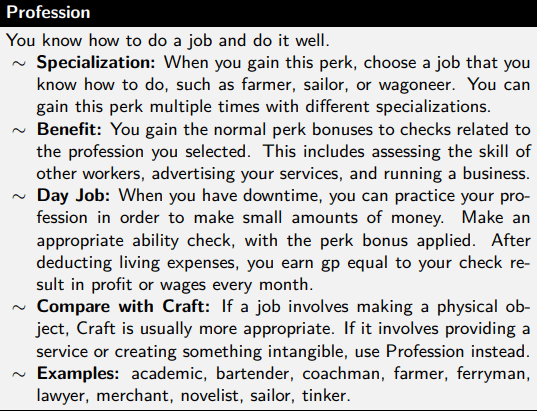
    Many of Ragnvald’s skills are chosen to reflect his background as a lawyer in training and his clan’s deep fixation on their glorious past. Rather than double down on this, let’s give him an unrelated perk that broadens his character. In fact, let’s use the perk to give him a dark secret foreshadowing some eventual character development: despite his outwardly traditional appearance, Ragnvald is fascinated with sophisticated clockwork (decidedly not a traditional dwarfish craft) and has started tinkering with it in private. This will be represented by the Craft [Clockwork] perk. (See general rules for Craft perks, left)

    This will allow Ragnvald to construct clockwork devices like stopwatches cheaper than he could buy them. He can also apply the perk to, for example, Engineering checks made to repair a clockwork device, or History checks about the development of clockwork through the years.

    Languages

    The last things I’ll cover in this post are the languages Ragnvald knows.

    Every PC in an Aetrimonde campaign is assumed to speak one language in common. The Aetrimonde setting recommends that this be Westerling, the language of the Kingdom of Waystone and of diplomacy, commerce, and academia across the continent, but the GM can adjust that for campaigns in a different region.

    Aside from the common language, characters speak another language determined by their culture. In the case of Ragnvald, hailing from the Dwarven Federation, that language is Low Dwarven, which is used in Dwarven culture for matters of everyday importance. (As opposed to High Dwarven, which is spoken for matters of law and ceremony, and which Ragnvald didn’t get to before he had to leave law school.) Because he is trained in History and it is classed as an archaic language, Ragnvald could eventually learn High Dwarven; this is one thing perks can be used for, and he will eventually get more perks.

    Languages of Aetrimonde

    Languages in the Aetrimonde setting include:

    • Mundane languages, which are spoken in everyday life in various parts of the setting. Any character can learn these languages using a perk.
      • Examples: Gobol, Liturgical Auric, Low Dwarven, Modern Auric, Modern Elvish, Urkund, Victish, Westerling.
    • Archaic languages, which are older forms of modern languages, or simply went extinct. A character trained in History can learn these with a perk.
      • Examples: Ancient Elvish, Classical Auric, Gobol Eld, High Dwarven.
    • Magical languages, which are spoken in the other planes connected to Aetrimonde, or otherwise associated with magic or magical creatures.
      • Examples: Draconic, Demonic, Gravespeech, Sidhereal.

    Up Next

    The next post in this series will cover the last set of choices Ragnvald needs to make: powers, a feat, and some starting equipment. There won’t be any more character-building polls until I start building the character you requested, because I will need to show off some mechanics first. Once I do, though, the polls will start up again giving you a chance to weigh in on what this character should specialize in. And the ancestry and class polls remain open! If you haven’t voted yet, now’s your chance.

  • In the post series on Unified Mechanics (first post here), I described in general terms how some core mechanics would work, but I didn’t attach all the necessary numbers to them. In this series, I’ll start hanging numbers on that framework to achieve a benchmark I mentioned in an earlier post: that a character should succeed at tasks they are competent but not superb at, around 2/3 of the time.

    To start with, I will need to work out what a typical character’s abilities should look like, because those abilities will feed into everything else that I need to calibrate.

    Ability Generation In Detail

    I’ve already said that I intend Aetrimonde to run on a point-buy system for generating a characters’ abilities. That is, players will all “buy” their characters’ abilities with the same budget of points.

    However, there is also a second component to ability generation, which is that a character’s heritage allows the player to increase two (of up to 3) preferred abilities by a further +1.

    This post will walk through the calibration of both components.

    Defining Ability Scores

    To start, what range of values do we permit for abilities? And how do they map to real-world qualities, for comparison?

    As an intuitive first step, let’s define 0 to be an “average” ability.

    How many “steps” above average do we want to allow (at least for PCs)? Let’s say, for the sake of argument, that each +1 represents a single standard deviation from the mean in an ability. Assuming a normal distribution of abilities, that lets us work out, statistically, just how extraordinary having a particular score is.

    Unfortunately, it means that by the time you hit +3 in an ability, you are already around one in a thousand; +5 would put you at about one in ten million. That’s quite rarefied: Aetrimonde is aimed at supporting a pseudo-Victorian setting, with a world population of about 1.5 billion, so there would only be around 150 people with +5 in a given ability in such a world. I’d like there to be more than 3 increments between an average person in the street and someone who is probably stronger than anyone else they’ll ever meet.

    Let’s halve how much a +1 means, to only half a standard deviation. Then, ability scores would imply the following:

    • +1: You are in the top third of the population.
    • +2: Top sixth.
    • +3: Top 1/16th.
    • +4: You are one in 40.
    • +5: One in 160.
    • +6: One in 800.

    Point-Buy Costs

    I’m going to impose that a typical PC’s highest ability should be between +3 and +5, with +6 being out of reach for a PC. I’ll also impose the following goals on the array of abilities they can get:

    • After the boosts from heritage, PCs should be able to get abilities of +4, +3, +2, +1, and four +0s.
    • It should be possible to get two +4 abilities, after boosts, but this should mean you have basically no other positive abilities unless you also have some negatives.
    • It should be possible to get a single +5 ability after boosts, but not also any +4s unless you have several negative abilities.

    I think this can be accomplished using a quadratic cost function for positive scores, such that the cost of each successive ability increment gets larger and larger:

    AbilityPoint Cost
    -2-2
    -1-1
    +00
    +11
    +23
    +36
    +410

    These point costs (for the positive abilities) are given by the formula C(a) = a(a + 1) / 2.

    Assuming that a character gets their +4 and +3 by boosting a +3 and a +2, for maximum benefit, they need to buy a +3, +2, +2, and +1. This costs 6, 3, 3, and 1 points for a total of 13: an unlucky number, but also a magical one.

    What else could be bought with 13 points?

    • It’s enough for +3, +3, +1, which boosted becomes +4, +4, +1, and five +0s.
    • It’s also enough for +4, +2, which boosted becomes +5, +3, and six +0s.

    This looks like it will work: it’s possible to get several good abilities, or a pair of excellent ones, without any abilities going negative.

    Limits of Min-maxing

    Min-maxing means to maximize the strengths of a character and minimize its weaknesses: it’s a form of character optimization. In the context of ability generation, min-maxing means raising the abilities your character benefits most from, without creating glaring weaknesses. In practice, that means decreasing abilities that you don’t need so that you can spend more points on the ones you do.

    Most Aetrimonde characters will have two abilities they care most about, followed by a third of less importance. They will want to raise these as high as possible, but they will also want to avoid having too many negative abilities, which would severely impact their defenses. Assuming a character puts their four best abilities into separate defense pairings (so that they have one of their better abilities contributing to each defense), they won’t have any glaringly weak defenses. But as we saw with Ragnvald, who needed high Strength and Constitution, that’s not always going to work out. The negative abilities will create a lot of other weaknesses too:

    • Low Strength will mean a character can’t carry much, will have trouble defending themselves in melee, and will have trouble climbing, jumping gaps, or swimming.
    • Low Constitution will give a character low hit points and resurgences.
    • Low Dexterity is probably the least problematic, as it really only prevents a character from using ranged weapons effectively or engaging in subterfuge like picking pockets.
    • Low Grace will give a character trouble crossing slippery surfaces or remaining hidden, and will make it hard for them to maneuver around enemies.
    • Low Intelligence will make a character bad at a whole range of skills.
    • Low Cunning will ensure a character always acts last and is often surprised.
    • Low Wisdom and Charisma will make it hard for a character to engage in social skills.

    So what does it take to get +5 and +4? The +5 needs to be boosted from a +4, and if the +4 is boosted from a +3, that costs 16 points. So the character would need to have three -1s, or a -1 and -2. If they wanted more than those two positive abilities, they would have to go even more negative, as well. One workable array is +4, +3, +1, +1, -1, -1, -1, -2, which certainly has plenty of drawbacks.

    What about +5 and +5? The only way to get that is from two boosted +4s, which would take 20 points, requiring at least three -2s and a -1. As far as defenses go, the best array is probably +4, +4, +1, +0, -2, -2, -2, -2, which has major drawbacks in half of the abilities.

    In other words, it’s possible to get a pair of very high abilities, but at the cost of some crippling weaknesses. Is this a good basis for a character? Only if the party as a whole can compensate for the weaknesses.

    Suggested Arrays

    Here are some possible arrays of eight abilities (before boosting) that are well-rounded:

    +3, +2, +2, +1, +1, +0, +0, -1
    +3, +3, +1, +1, +0, +0, +0, -1
    +4, +2, +1, +1, +0, +0, -1, -1

    I’m also going to include a note in the core rulebook suggesting that, at least for inexperienced groups, characters should not have any more than a single -1 ability, and no -2s.

  • Today, I’ll reveal the next part of a character: class. Ragnvald has been a Fighter in all his incarnations, so that’s the class I’ll show off today.

    Meanwhile, the polls continue! This week, tell me what class you want to see next: I’m leaving open last week’s poll on the next ancestry I’ll cover, but as of my last look, Elf and Ghoul were in the lead. If you haven’t already voted there, now’s the time: I’m interested to see what kind of ancestry/class combination you give me to work with for the next example character!

    Class

    An Aetrimonde character class is a collection of related features that gives a character the tools to fill a certain role: frontline combatant, deadly assassin, magical savant, pious healer, and so on. This is the core of a character, especially at low levels.

    Class: Fighter

    Although he was raised to be a lawyer, now that he’s been forced to get his hands dirty adventuring Ragnvald comports himself in the manner of a traditional Dwarven warrior: that means wearing proper armor, carrying a proper weapon, and facing his enemies in proper honorable combat. This is best represented by the Fighter class (left).

    Basics

    First off, Fighters are tough. With 28 base hit points, 1d12 healing die, and 4 base resurgences, they can not only take a beating, but recover from one too. This is only amplified by their armor proficiencies, which give them access to scale armor and shields: this can let Ragnvald get a high AC (with good armor resistance!) despite his lack of Dexterity and Grace.

    The Fighter’s class defense bonus is +1 to both Brawn and Wit, making them harder to shove around, and also harder to trick or deceive.

    Fighters are proficient with all weapons, although fighters will get the most mileage out of melee weapons, since they want to be in the thick of things.

    And finally, Fighters are trained in Athletics and can add that and five other skills to their preferred skill list. More on this in the next post…

    Features

    Next up, the actual class features. The big ones are Battlefield Challenge and Battlefield Superiority: together, these two features mean that Ragnvald can:

    • Challenge any enemy he attacks (not hits, attacks!) with weapons, shields, or fists, causing them to suffer disfavor on attack rolls unless they are attacking Ragnvald or have already attacked him this turn.
    • Make an opportune strike against a challenged creature when it attacks someone other than him.
    • Gain a bonus to opportune strike attack rolls, including for attacks like the one described above.
    • Stop creatures hit by his opportune strikes from moving any further.

    All told, this makes Ragnvald (like any Fighter) incredibly “sticky:” creatures he attacks will have trouble attacking any of his allies or getting away from him.

    The other of the Fighter’s class features is Martial Endurance, giving him an additional use of his greater powers (for four total). While not flashy, getting an extra greater power in a fight can make a big difference. All Martial classes have this feature.

    Abilities

    The last thing we’ll pick today will be Ragnvald’s abilities. As we saw in the Heritage section, Ragnvald’s heritage gives him Constitution, Wisdom, and Charisma as favored abilities. This means he can boost two of those by +1 after buying his abilities, or boost any one other ability. Let’s keep that in mind as we make our choices…

    As a fighter, Ragnvald will want high Strength (to make attacks with), followed by high Constitution (to survive the attacks he will hopefully be drawing). Cunning will also be useful (to improve Battlefield Superiority and many Martial powers) but not as high a priority.

    Like any character, Ragnvald has 13 points to spend on abilities, with costs given in the table to the right:

    We really should go for +4 Strength. +3 would be doable if Ragnvald used precise weapons to make up for it…but as a proper dwarf warrior, Ragnvald will be wanting something like a warhammer. Since Strength isn’t a preferred ability, we’ll need to buy the full +4, at 10 points.

    Next, we want Constitution: we can get +2 with our remaining 3 points, and boost it to +3 as a preferred ability.

    AbilityPoint Cost
    -2-2
    -1-1
    00
    11
    23
    36
    410

    We have no points left, but we should try to get some other abilities above 0. Ragnvald doesn’t particularly need Dexterity or Grace, since he’ll be wearing heavy armor; we can drop one to -1 and raise the other to +1. I’ll pick Grace as the high ability, attributing it to comportment lessons his clan subjected him to. The same goes for Cunning and Intelligence, where we’ll raise Cunning and drop Intelligence (Ragnvald is full of clever legal strategies that don’t work, because he doesn’t actually know the law that well), and Wisdom and Charisma, where we’ll raise Charisma and drop Wisdom, then boost Charisma to +2 (Ragnvald lacks the wisdom to see the futility of his family’s litigation, but is fairly convincing when he talks about it).

    The finalized ability array for Ragnvald is:

    +4 STR-1 DEX+1 CUN-1 WIS
    +3 CON+1 GRA-1 INT+2 CHA

    Up Next

    In the next post of this series, we’ll give Ragnvald some things he can use these abilities for. And if you want to see a specific class in the next sample character, remember to vote above!