
I’m slowly working on a post that will go into more detail about the titular spirits that grant powers to Spiritual classes, but the title “Spirits of Aetrimonde” put an idea into my head that has been hard to get out. So today, I’m presenting the first in a series of posts examining Aetrimonde’s cultures through the lens of their alcohol!
Alcohol in the Core Rulebook
The CRB contains a very small section on alcohols, in which it is mentioned that alcoholic beverages are reliably safe to drink when the local water is of unknown quality (a consideration for adventurers). It also provides prices for beer, wine, and spirits of three different qualities:
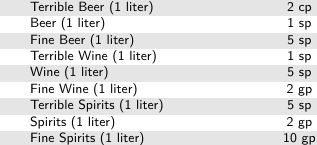
But alcohol is closely entwined with culture, and it is an excellent facet of worldbuilding for GMs to explore: the nature of the local alcohol is an evocative, informative piece of information to give the players. So, to start with, here are a few of the beers that players might encounter in Aetrimonde:
Beers
- Stormrunner Pale Ale: Waystone is a nation of merchants, whose profits depend on the speedy and reliable delivery of goods, largely by sea. In order to extend their water supplies and cut down on port stops, Waystone’s merchant fleet carries strong (and strong-flavored) beers that can be mixed with stagnant water to both sterilize it and cover its foul taste. Stormrunner Pale Ale, named after a class of ship designed to make long voyages across open ocean at speed ahead of a storm, is a strong, light-colored, heavily hopped beer brewed specifically to survive rough treatment in the hold of a ship.
- Hardvergar Dinkelbjor: Dwarven beers have a reputation: high quality, high potency…and sometimes, awful hangovers, although that might have more to do with the traditional mode of consumption (quaffing). Hardvergar Dinkelbjor, literally translated as “High Dwarfish Dinkel Beer,” is brewed in remote, highly traditional dwarven settlements according to recipes unchanged since before the Collapse. The malt used in its brewing is made from the ancient grain dinkel (also called einkorn or spelt), giving it a strong flavor of rustic bread that makes it an acquired taste. (Author’s Note: All of the Germans in my playtesting group simultaneously groaned when I explained that the local dwarves brewed nothing but dinkelbier, which is exactly the reaction I had been aiming for.)
- Auric Brown: A thick, hazy beverage favored in the Sanctean Primarchy and an extremely acquired taste everywhere else. It is fermented from bread soaked in water rather than malt, touted as a recreation of the beverage provided to the laborers building the pre-Collapse Auran Empire’s colossal temples and monuments. In truth, the recipe is more likely a modern invention, made up out of whole cloth as part of the effort to create a synthetic culture that would unify the diverse pilgrims flocking to the fledgling Primarchy. That the drink is also simple to make and highly nutritious (containing ample protein, vitamins, and trace minerals from the presence of spent yeast left in the brew) is certainly a happy coincidence: it is now a staple of Sanctean peasants, with virtually every pantry in the nation containing a bubbling jug of it.
- Monastic Lambic: Lambics are an unusual kind of beer, brewed using wild yeast that gives each batch a subtly different character. This method of brewing has been supplanted by cultivated yeasts, and lambics are now brewed mainly as an artisanal product of certain monasteries that maintain the tradition. The most mainstream lambics, with a sour, fruity, and slightly “funky” notes come from the Cession. For more advanced drinkers, monasteries from the storm-swept Salvage Coast are known for the briny (and sometimes kelpy) notes of their brews, which are often compared to Gose beers. And for the truly adventurous, there are a handful of religious missions to the goblins of the southern Unclaimed Reaches that have combined wild-yeasted brewing techniques with the goblins’ traditional mushroom-based intoxicants, producing a lambic with heavy notes of funk, exotic flavor profile, and only occasional hallucinogenic properties.
- Umpfen Hyperbier: The origins of the Hyperbier are shrouded in mystery, as the original batch was recovered from the cellars of a burned-out Eisenwaldean castle after the resident alchemist went just a hair too far even for Der Eisenwald. The pitchfork-wielding mob tapped the barrels in celebration, and immediately thereafter started combing the charred ruins of the castle laboratory in search of the recipe. Accounts of the Hyperbier uniformly agree that it was “the perfect beer,” although they are entirely contradictory on its style, flavor profile, and even color. Efforts to recreate the recipe from a few charred scraps of notes (some of which likely pertain not at all to the Hyperbier) have inspired generations of brewers and alchemists to try such processes as infusing the yeast with the essence of fire elementals and feeding the wort through the heart of a four-dimensional tesseract. The results have been mixed–and in some cases, explosively lethal–but the pursuit of the Hyperbier has grown into a uniquely Eisenwaldean obsession, culminating in an annual festival in the town of Umpf where those brews deemed safe for consumption are judged on their similarity to the mythical Hyperbier.
I’ll keep updating this mini-column as fun and interesting ideas occur to me. I’ll probably be doing wines next, including wine-like things like mead.


Leave a Reply