
Today I’m going to go over the GMH’s advice on pacing: how to space out scenes (particularly combat encounters) so that they push players to conserve resources without becoming insurmountable. The advice here is a counterpart to D&D 5e’s concept of an “adventuring day,” being
Once you have a rough idea of how your scenes link together, the next step is to make another pass over your scenes and consider pacing. An adventure is not (usually) a series of scenes that the players sprint through: there need to be points in the adventure where they can rest, stock up on supplies, and roleplay off of each other to have some character development. When writing an adventure, this means making sure that there aren’t long stretches of action or tension where the characters can’t reasonably decide to stop and take a rest.
There are some general guidelines about how often an adventure should offer the prospective for a rest (although if you are writing for a specific group, you may be able to fine-tune the time between rests):
- Short Rests: PCs primarily need short rests to regain their greater powers. If they are economical with the use of their greater powers (and don’t have abysmal luck), a typical party of PCs can typically get through a standard-difficulty combat encounter using one greater power apiece; this means that it is only in the third consecutive encounter that they might start to run out of greater powers, and so in general, the PCs should have opportunities for a short rest no less frequently than every 2-3 combat encounters. However, more difficult encounters become even more difficult when the PCs are low on greater powers: consider giving opportunities to rest right before, or at least right after, a difficult encounter.
- Long Rests: PCs mostly need long rests to replenish their resurgences after taking damage and healing up. Generally, you can expect a standard-difficulty encounter to deal each PC roughly one resurgence worth of damage, but since each triumph they achieve restores one resurgence, this in theory means that they can go on indefinitely. However, since a patch of bad luck or a more difficult encounter can cost them more than one resurgence, they will eventually need to take a long rest. As a rule of thumb, expect that PCs will need a long rest after facing 5 standard-difficulty encounters, 2 difficult encounters, or an extremely difficult encounter, whichever comes first.
- Downtime: PCs need downtime mostly to level up, buy supplies, and possibly recover from nasty afflictions. It’s also an occasion for player-led roleplaying, where the players pursue their own goals and riff off of each other’s characters. An adventure should have an opportunity for downtime at least every 10 XP worth of scenes, so that the PCs can take the time to use those XP and level up. Other than that, the need for downtime is driven more by the narrative (and player preference) than by mechanics. Narratively speaking, the PCs should have downtime before embarking on a long journey, or before any other change of pace that might require different equipment that they don’t already have, like cold-weather gear, climbing equipment, or potions of acid resistance.
The second factor to consider is how your adventure’s narrative makes resting harder or presents costless opportunities to rest:
- Immediacy: A scene with immediacy pushes the PCs to tackle it as soon as they are able: if they delay too long, the scene may become harder (because some more guards will have time to join the defense, for example) or the PCs may outright fail the objectives of the scene (because the villains will have disposed of a kidnapped NPC after they have no further use for them, for example). Immediacy means that the PCs may not have time to rest, although there are different degrees of immediacy: long-term immediacy means that the PCs might not have time for a long rest, or downtime to stock up on supplies, but can still take short rests, while short-term immediacy would prevent them from resting at all.
- Security: The PCs also need to be reasonably secure to let their guards down and take a rest (especially in the case of long rests). If the PCs are in the middle of enemy territory, resting gives their enemies a chance to find and ambush them while they are injured and exhausted from a previous battle. As with urgency, there are different degrees of security that could just make it difficult to take long rests or downtime, or in worse situations, could make any rest at all risky.
- Travel: It is safe to assume that any time the PCs have to travel between scenes, they will also rest at some point during the journey if it is safe to do so. The scale of the journey will determine what kind of rest they can take: to give a few examples, going across town to follow up on a lead will give enough time for a short rest, traveling to the next town over will allow for a long rest, and crossing a province can even allow for downtime.
With both of these factors in mind, the goal of the pacing pass is to revisit your rough adventure structure and identify long stretches of the adventure that have immediacy and lack security. If you find any that would deprive the PCs of a rest for longer than the guidelines above, consider what changes you could make to the narrative or adventure structure to allow for a rest to break up these stretches.
Example
Here’s what a diagram of an adventure might look like following the pacing pass:
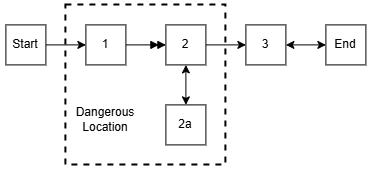
The dashed box denotes a group of scenes taking place in the same location (no travel required between scenes), which is dangerous and difficult to rest in. Depending on the specifics of this adventure, that could mean that the PCs run a risk (or a certainty…) of being ambushed if they rest in this area, or that they recover fewer hit points due to toxic vapors or entropic magic, or some other complication.
The double-arrow linkage between scenes 1 and 2 indicates immediacy: once the PCs complete scene 1, they must proceed to scene 2 quickly or immediately, lest they suffer some consequence for dawdling. Note also the one-way arrows: there is no going back from scenes 1, 2, or 3, although the PCs could make a detour to 2a (an optional encounter) before going to 3, and they can return to scene 3 following the end of this adventure or arc (in an epilogue, perhaps).
Scenes 1, 2, and 2a form a potentially difficult sequence of scenes if they are combat encounters: these are three scenes in a row where resting is difficult, and if that applies to short rests, the PCs may decide they don’t have the resources to tackle 2a and skip it. Which is a shame if it’s just content that they miss out on, but it could be made into a positive by foreshadowing that this sequence of scenes will push them and that if they can tackle 2a there will be a special reward…
 Aetrimonde
Leave a comment